


16,99 €
Mehr erfahren.
- Herausgeber: John Wiley & Sons
- Kategorie: Geisteswissenschaft
- Serie: China Today
- Sprache: Englisch
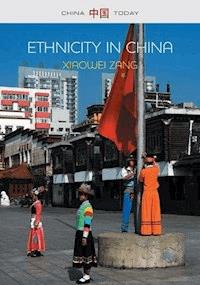
On the global stage, China is often seen to be a homogenous nation when, in fact, it is a diverse multi-ethnic society, with 55 minority nationality groups recognized by the government. Scattered across the vast landmass, ethnic minorities in China occupy a precarious place in the state, where the Confucian concept of cultural community plays down ethnicity and encourages integration of minority nationalities into the majority Han-Chinese society.
This insightful book reveals the ethnic diversity underlying the People’s Republic of China and examines how ethnicity intersects with social and political issues through key themes such as ethnic inequality, the preservation and contribution of the rich traditions and customs of minority cultures, and the autonomy of regions such as Tibet and Xinjiang. The author investigates the important role of the state and Beijing’s assimilation stance to show how its nationality policy, driven by Confucian assimilation ideology, has dictated China’s own minority rights regime and influenced its foreign policy towards international minority rights.
This book by a distinguished scholar of ethnicity in China will be essential reading for students and scholars of race and ethnic relations, nationalism and Chinese culture and society.
Sie lesen das E-Book in den Legimi-Apps auf:
Seitenzahl: 392
Veröffentlichungsjahr: 2015
Ähnliche




















China Today series
Greg Austin,
Cyber Policy in China
David S. G. Goodman,
Class in Contemporary China
Stuart Harris,
China's Foreign Policy
Elaine Jeffreys with Haiqing Yu,
Sex in China
Michael Keane,
Creative Industries in China
Joe C. B. Leung and Yuebin Xu,
China's Social Welfare
Pitman B. Potter,
China's Legal System
Xuefei Ren,
Urban China
Judith Shapiro,
China's Environmental Challenges
Teresa Wright,
Party and State in Post-Mao China
LiAnne Yu,
Consumption in China
Xiaowei Zang,
Ethnicity in China
Copyright © Xiaowei Zang 2015
The right of Xiaowei Zang to be identified as Author of this Work has been asserted in accordance with the UK Copyright, Designs and Patents Act 1988.
First published in 2015 by Polity Press
Polity Press
65 Bridge Street
Cambridge CB2 1UR, UK
Polity Press
350 Main Street
Malden, MA 02148, USA
All rights reserved. Except for the quotation of short passages for the purpose of criticism and review, no part of this publication may be reproduced, stored in a retrieval system, or transmitted, in any form or by any means, electronic, mechanical, photocopying, recording or otherwise, without the prior permission of the publisher.
ISBN-13: 978-0-7456-5360-0
ISBN-13: 978-0-7456-5361-7(pb)
ISBN-13: 978-0-7456-9045-2(epub)
ISBN-13: 978-0-7456-9044-5(mobi)
A catalogue record for this book is available from the British Library.
Library of Congress Cataloging-in-Publication Data
Zang, Xiaowei.
Ethnicity in China : a critical introduction / Xiaowei Zang.
pages cm
Includes bibliographical references and index.
ISBN 978-0-7456-5360-0 (hardcover : alk. paper) – ISBN 0-7456-5360-X (hardcover : alk. paper) – ISBN 978-0-7456-5361-7 (pbk. : alk. paper) – ISBN 0-7456-5361-8 (pbk. : alk. paper) 1. Minorities–China. 2. Ethnic groups–China. 3. Ethnicity–China. 4. Ethnology–China. 5. China–Ethnic relations. I. Title.
DS730.Z364 2015
305.800951–dc23
2014025915
The publisher has used its best endeavours to ensure that the URLs for external websites referred to in this book are correct and active at the time of going to press. However, the publisher has no responsibility for the websites and can make no guarantee that a site will remain live or that the content is or will remain appropriate.
Every effort has been made to trace all copyright holders, but if any have been inadvertently overlooked the publisher will be pleased to include any necessary credits in any subsequent reprint or edition.
For further information on Polity, visit our website:
politybooks.com
Chronology
1894–5
First Sino-Japanese War
1911
Fall of the Qing dynasty
1912
Republic of China established under Sun Yat-sen
1927
Split between Nationalists (KMT) and Communists (CCP); civil war begins
1934–5
Long March
1935
Declaration of the Chinese Soviet Republic to the Mongolian Nationality
proclaimed
1936
Declaration of the Chinese Soviet Republic of the Hui Nationality
proclaimed
1936
Hui autonomous government in Tongxin, Ningxia established
December 1937
Nanjing Massacre
1937–45
Second Sino-Japanese War
1945–9
Civil war between KMT and CCP
1947
Inner Mongolia Autonomous Region established
1948
Yanbian Daily
in Korean language is launched in Jilin province
1949
Xinjiang Daily
in Chinese, Uyghur, Kazak and Mongolian languages is launched
October 1949
KMT retreats to Taiwan; Mao founds People's Republic of China (PRC)
1950–3
Korean War
1951
Qinghai Tibetan Journal
is launched
1951
A seventeen-point agreement between the PRC and representatives of the Dalai Lama is put into effect
1953
First National Traditional Ethnic Minority Sports Meet
1953–4
Ethnic Classification Project
1953–7
First Five-Year Plan; PRC adopts Soviet-style economic planning
1954
First constitution of the PRC and first meeting of the National People's Congress
1955
Xinjiang Uyghur Autonomous Region established
1956–7
Hundred Flowers Movement, a brief period of open political debate
1957
Anti-Rightist Movement
1958
Guangxi Zhuang Autonomous Region established; Ningxia Hui Autonomous Region established
1958–60
Great Leap Forward, an effort to modernize China through rapid industrialization and collectivization
March 1959
Tibetan Uprising in Lhasa; Dalai Lama flees to India
1959–61
Three Hard Years, widespread famine with tens of millions of deaths
1960
Sino-Soviet split
1962
Sino-Indian War
1965
Tibet Autonomous Region established
1966–76
Great Proletarian Cultural Revolution; Mao reasserts power
February 1972
President Richard Nixon visits China; ‘Shanghai Communiqué’ pledges to normalize US–China relations
September 1976
Death of Mao Zedong
October 1976
Ultra-Leftist Gang of Four arrested and sentenced
December 1978
Deng Xiaoping assumes power; launches Four Modernizations and economic reforms
1978
One-child family planning policy introduced
1979
US and China establish formal diplomatic ties; Deng Xiaoping visits Washington
1979
Sino-Vietnamese war
1982
Census reports PRC population at more than one billion
1984
Law on Regional Autonomy for Minority Nationalities of the PRC issued
December 1984
Margaret Thatcher co-signs Sino-British Joint Declaration agreeing to return Hong Kong to China in 1997
1987–9
Tibetan unrest in Sichuan, Tibet Autonomous Region and Qinghai, and the Tibetan prefectures in Yunnan and Gansu
May 1989
Ürümqi unrest in which Uyghur and Hui Muslims protest the publication of
Sexual Customs
《性风俗》
1989
Tiananmen Square protests culminate in June 4 military crackdown
1992
Deng Xiaoping's Southern Inspection Tour re-energizes economic reforms
February 1992
Ürümqi bombings resulting in 3 deaths and 23 injuries
February 1997
The Ghulja Incident in which Uyghurs demand independence for Xinjiang
February 1997
Ürümqi bombings resulting in 9 deaths and 74 injuries
1993–2002
Jiang Zemin is president of PRC, continues economic growth agenda
November 2001
WTO accepts China as member
2003–13
Hu Jintao is president of PRC
March 2008
Tibetan riots in which 19 die and more than 380 civilians are injured
March–August 2008
Uyghur unrests in Hotan and Qaraqash county of Xinjiang
August 2008
The Kashgar attack resulting in the death of 16 Chinese police officers
August 2008
Summer Olympic Games in Beijing
June 2009
The Shaoguan incident, which is widely cited as the trigger event for the July 2009 Ürümqi riots
July 2009
Ürümqi riots in which nearly 200 die and more than 1,700 are injured
2010
Shanghai World Exposition
August 2010
The Aksu bombing resulting in 7 deaths and 14 injuries in Xinjiang
July 2011
The Hotan attack in Xinjiang
July 2011
The Kashgar attacks in Xinjiang
2012
Xi Jinping appointed General Secretary of the CCP (and president of PRC from 2013)
February 2012
The Yecheng attack in Xinjiang with 15 deaths and 18 injuries
June 2012
Six Uyghur men fail to hijack Tianjin Airlines Flight 7554
April 2013
The Bachu unrest in Xinjiang in which 21 people die
June 2013
The Shanshan attack in Xinjiang kills 2 policemen and 22 civilians; 11 of the Uyghur attackers are also killed
October 2013
Three Uyghurs drive a 4×4 vehicle into crowds in Tiananmen Square resulting in 5 deaths and 38 injuries
March 2014
The 2014 Kunming attack in which Uyghur attackers kill 29 civilians and injure more than 140 civilians
April 2014
PRC President Xi Jinping makes a four-day tour of Xinjiang
April 2014
Uyghurs attack passengers and detonate bombs at the exit of Ürümqi South Station, killing one civilian and injuring 79 civilians
May 2014
Five Uyghur assailants plough two vehicles and throw explosives into a crowd in a market in Ürümchi, killing 39 civilians and injuring at least 94
July 2014
Uyghur attacks on Shache County in Xinjiang result in a death toll of 37 civilians and 59 people identified as terrorists
Preface
Nationality is arguably a product of state building in the West. No such concept existed in pre-modern China, and it was not until the late nineteenth century that it was introduced to China from Japan. It is often translated as minzu (民族) in Chinese, which means ‘a people’ or ‘an ethnic group’. In Chinese, ‘minority nationality’ is called ‘shaoshu minzu’ (少数民族). According to the Chinese government, there are altogether 56 ethnic groups in China. This book is about ethnic minorities in China and their relations to the Chinese state in the context of social and political change since 1949, with the emphasis on the post-1978 era, as market reforms have fundamentally changed the institutional arrangements for ethnic relations in the People's Republic of China (PRC). This book insists that the most important aspect of ethnic relations in China is the relations between the PRC state and the ethnic minorities rather than those between Han Chinese, the ethnic majority group, and the ethnic minority groups. The PRC state created the ethnic divide between Han Chinese and non-Han groups, classifying non-Han groups into different nationality groups and maintaining the ethnic identity of each PRC citizen through the state household registration system and personal identity card (Gladney 1996). There would not be 56 nationality groups in China without the PRC nationality policy. Accordingly, this book focuses on the PRC's nationality policy and its impacts on the ethnic minorities to elucidate ethnic relations in China.
Lesen Sie weiter in der vollständigen Ausgabe!
Lesen Sie weiter in der vollständigen Ausgabe!
Lesen Sie weiter in der vollständigen Ausgabe!
Lesen Sie weiter in der vollständigen Ausgabe!
Lesen Sie weiter in der vollständigen Ausgabe!
Lesen Sie weiter in der vollständigen Ausgabe!
Lesen Sie weiter in der vollständigen Ausgabe!
Lesen Sie weiter in der vollständigen Ausgabe!
Lesen Sie weiter in der vollständigen Ausgabe!
Lesen Sie weiter in der vollständigen Ausgabe!
Lesen Sie weiter in der vollständigen Ausgabe!
Lesen Sie weiter in der vollständigen Ausgabe!




