


1,99 €
Mehr erfahren.
- Herausgeber: Quickie Classics
- Kategorie: Geisteswissenschaft
- Sprache: Englisch
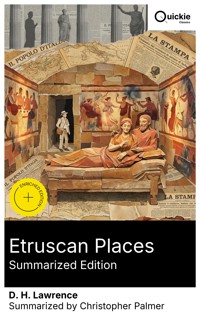
In Etruscan Places, D. H. Lawrence turns a 1927 pilgrimage to Tarquinia, Cerveteri, Chiusi, and Volterra into a sensuous meditation on art, mortality, and looking. In incantatory yet exact prose, he opposes Roman marble—and contemporary Fascist bombast—to the warm, communal vitality of painted tombs and clay sarcophagi. The book straddles travelogue and aesthetic essay, reimagining antiquity beyond the chill abstractions of academic classicism. Written late in life, the book distills Lawrence's obsessions: exile, ill health, and postwar disillusion fed his search for cultures unmaimed by industrial modernity. Years in Italy and earlier travel works, including Twilight in Italy and Sea and Sardinia, honed his tactile seeing and mythic intuition. Visiting Etruria under Mussolini's shadow, he fashioned a countertradition grounded in body, festivity, reciprocity, and a defiant, democratic eros. Readers of antiquity, art history, and modernism—and travelers weary of guidebook pieties—will find Etruscan Places indispensable. It does not supplant archaeology; it humanizes it, asking what the ancient dead require of living eyes. Read it for frescoes restored to breath, for its critique of authoritarian monumentalism, and for a radical, humane alternative to the classical ideal: Lawrence at once companionable and provocatively visionary. Quickie Classics summarizes timeless works with precision, preserving the author's voice and keeping the prose clear, fast, and readable—distilled, never diluted. Enriched Edition extras: Introduction · Synopsis · Historical Context · Author Biography · Brief Analysis · 4 Reflection Q&As · Editorial Footnotes.
Das E-Book können Sie in Legimi-Apps oder einer beliebigen App lesen, die das folgende Format unterstützen:
Veröffentlichungsjahr: 2026
Ähnliche










Etruscan Places (Summarized Edition)
Table of Contents
Introduction
In Etruscan Places, D. H. Lawrence stages a passionate encounter between a modern, disenchanted sensibility and the felt vitality he discerns in an ancient Italian civilization, testing whether the living pulse of art and place can survive the chill of museums, guidebooks, and the restless speed of contemporary life, as he moves through tombs, hill towns, and galleries and his travelogue turns into a meditation on seeing, on how bodies inhabit space, and on what is lost when the past is treated as specimen rather than presence, asking us to weigh astonishment against skepticism and reverence against the urge to classify.
Etruscan Places is a sequence of travel essays that follow Lawrence across central Italy to sites associated with the pre-Roman Etruscans, including towns and necropolises such as Tarquinia, Cerveteri, and Volterra. Written out of journeys he made in the late 1920s, during the interwar period, the book appeared posthumously in 1932. Its pages mix on-site observation with reflections prompted by frescoes, sarcophagi, and landscapes, situating the reader amid Mediterranean light, Tyrrhenian winds, and the hush of subterranean tomb chambers. The result belongs to literary travel writing that is also cultural criticism, archaeology filtered through a poet’s sensibility.
The premise is simple yet rich: an author travels from site to site, looking, comparing, and trying to feel his way into a vanished world through what remains. Lawrence writes in a voice at once ardent and skeptical, quick to rapture and just as quick to rebuke anything that feels lifeless. His prose is sensuous, metaphorically bold, and argumentative, folding description into speculation and sudden judgment. The tone shifts from lyrical hush inside tombs to bristling critique in museums and towns, producing a reading experience that feels like walking beside an exacting companion whose perceptions keep sharpening the scene.
Among the book’s central themes is the insistence that art discloses a way of being, not merely a style. Lawrence treats painted banquets, carved couples, and the curve of a hill as evidence for an ethos grounded in bodily ease and reciprocal relation, and he tests that ethos against later, sterner legacies and against the abstractions of modern life. Again and again he asks what it means to look rightly: to let objects breathe rather than pin them beneath labels. His pages argue for a practice of attention in which sensation, ethics, and history meet without flattening one another.
For contemporary readers, these essays matter because they intervene in questions that still animate cultural life: how to steward the past, how to exhibit it, and how to resist converting artifacts into mere data points or tourist backdrops. Lawrence insists on context, on the feel of stone in air and the way colors live in place, and his sensitivity anticipates today’s emphasis on provenance, site-specific meaning, and slow looking. At the same time, his polemical streak provokes useful debate about authority in interpretation, inviting us to balance scholarly method with experiential knowledge without surrendering rigor or collapsing difference into sentiment.
The prose itself is the book’s instrument of discovery. Lawrence’s cadences amplify touch, color, and motion, creating a tactile criticism that makes stones feel sun-warmed and pigments freshly breathed on. He moves restlessly between close detail and sweeping cultural inference, and the friction between those scales generates both beauty and argument. Readers encounter a writer who trusts sensation as a path to judgment while acknowledging, implicitly, the limits of any modern gaze before antiquity. The effect is immersive rather than encyclopedic, an invitation to dwell, to look twice, and to let uncertainty fertilize understanding rather than force premature conclusions.
Approached today, Etruscan Places reads as a thoughtful companion for travelers, students of art and archaeology, and anyone curious about how the past can quicken the present without being simplified. Rooted in the interwar years and published after Lawrence’s death, it inevitably bears the marks of its moment, but its abiding value lies in the questions it asks and the way it looks. This introduction invites you to meet the book not for definitive answers but for a charged conversation across centuries, in which the desire to know and the desire to feel are kept in productive, illuminating balance.
Synopsis
Etruscan Places is a sequence of travel essays by D. H. Lawrence, drawn from his 1927 visits to Etruscan sites in central Italy and published posthumously in 1932. The book combines on-the-spot description with reflective commentary, using the surviving tombs, sculptures, and painted chambers to probe the character of the ancient Etruscans. Lawrence approaches the material not as an archaeologist but as a writer receptive to place, art, and mood. He sets his observations within the landscapes of Lazio and Tuscany in the early twentieth century, noting excavation practices, museum settings, and the encroachment of contemporary habits upon the quiet precincts of the dead.
Lawrence frames Etruria as a distinct cultural zone predating Roman dominance, encountered through roads that climb to hill towns and descend to fields filled with tomb mounds. He repeatedly underscores the fragmentary nature of the evidence—objects displaced to museums, context lost or altered—and positions his method as intimate looking rather than technical analysis. The book’s sequence follows his route among key sites, establishing a rhythm of approach, descent into rock-cut chambers, and re-emergence into daylight. In this pattern, he develops questions about how funerary spaces can still communicate an ethos of living, sociability, and relationship to the natural world.
At Cerveteri, ancient Caere, he encounters a vast necropolis of tumuli and house-like tombs carved from tufa. The interiors, with benches, pillars, and carved household details, suggest rooms prepared for occupants who continue familiar habits beyond death. Guided entry and scant illumination reveal surfaces and arrangements that feel domestic rather than monumental. Lawrence notes the absence of many original grave goods, removed to collections, and reflects on how the architecture alone conveys a human scale and intimacy. Here he first articulates a contrast between perceived Etruscan warmth and later, sterner traditions, while acknowledging that such impressions arise from funerary spaces.
The exploration deepens at Tarquinia, where painted tombs preserve vivid scenes of banquets, dancers, athletes, birds, and marine life. The freshness of color and pattern, filtered through the limitations of light and restoration, strikes him as a record of movement and conviviality. Lawrence attends to gestures, garlands, musical instruments, and the interplay between figures and surrounding motifs. He considers the tombs not as antiquarian curiosities but as chambers whose images maintain a pulse of daily joy within a mortuary context. The chapter balances admiration with caution about what can be inferred from fragmentary cycles of wall painting.




