


1,99 €
Mehr erfahren.
- Herausgeber: Quickie Classics
- Kategorie: Gesellschafts- und Liebesromane
- Sprache: Englisch
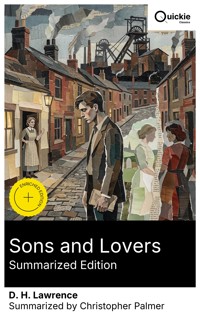
Sons and Lovers (1913) traces Paul Morel's coming-of-age in a Nottinghamshire mining community, mapping the psychic debts he owes to his gifted, thwarted mother, Gertrude, and the fractures in her marriage to the volatile miner Walter. Lawrence fuses naturalist social detail—the pit, domestic privation, class aspiration—with lyrical landscape writing and probing free indirect narration. The novel's tensions with Miriam Leivers and Clara Dawes render desire, vocation, and autonomy, while its Oedipal drama converses with, and often anticipates, early psychoanalytic discourse within an emergent modernist aesthetic. Lawrence, born in 1885 in Eastwood to a coal miner father and an ambitious, educated mother, knew intimately the compromises of industrial life and the ferocities of domestic allegiance. His searing bond with his mother, whose death in 1910 shadowed his early career, impelled repeated revisions of a manuscript first called Paul Morel; under Edward Garnett's counsel he shaped it into this unsparing Bildungsroman. A former schoolteacher and restless traveler, he wrote against provincial constraint to test the claims of art, eros, and rank. Readers of psychological realism and modernist experiment will find here a work of rare candor—intellectually bracing, sensuous in detail, and indispensable for debates about class, intimacy, and self-making. Quickie Classics summarizes timeless works with precision, preserving the author's voice and keeping the prose clear, fast, and readable—distilled, never diluted. Enriched Edition extras: Introduction · Synopsis · Historical Context · Author Biography · Brief Analysis · 4 Reflection Q&As · Editorial Footnotes.
Das E-Book können Sie in Legimi-Apps oder einer beliebigen App lesen, die das folgende Format unterstützen:
Veröffentlichungsjahr: 2026
Ähnliche

















Sons and Lovers (Summarized Edition)
Table of Contents
Introduction
At its core, Sons and Lovers dramatizes the intense friction between attachment and autonomy, tracing how the urgencies of passion, the claims of family, and the weight of class press upon a sensitive young man until every gesture of love becomes a negotiation between nurture and escape, set against the coalfields and kitchen tables of the English Midlands, where desire quickens in the shadow of work and duty, where maternal devotion can both shelter and constrict, where art offers a hard-won path toward self-definition, and where the body and the landscape, equally marked by labor, vibrate with conflicting hungers for belonging, transcendence, and release.
Sons and Lovers is a novel by D. H. Lawrence, first published in 1913. It belongs to the tradition of the coming-of-age novel and psychological realism, observing domestic life with uncommon intensity and detail. Set in a Nottinghamshire coal-mining community in the English Midlands, the book draws closely on the textures of early twentieth-century working-class existence—its rhythms of labor, its cramped homes, its small but fierce pleasures. Lawrence’s focus on interior life, embodied feeling, and social pressure marks a pivotal moment in the development of the modern English novel, preparing the ground for later innovations without abandoning recognizable narrative clarity.
The story centers on the Morel family, shaped by a marriage strained by temperament and circumstance and by the stark demands of the pit. From this household emerges Paul, a boy of keen sensibility whose allegiance to his mother is both sustaining and complicated, and whose encounters beyond the home awaken new claims on his heart and future. The narration combines close psychological observation with sensuous description of place and body, moving with lyrical intensity through kitchens, fields, and streets. The tone is intimate, often conflicted, at times radiant, offering a reading experience at once immersive, sympathetic, and exacting.
Lawrence probes the costs and consolations of family life, showing how affection can mature into demand, how duty can blur into possession, and how classed circumstance narrows the field of imaginable futures. The novel examines the pressures of industrial capitalism on bodies and feelings, counterposing the mine’s coercive regularity to the unruly energies of art, sexuality, and nature. It traces the dawning of adult identity as a process beset by ambivalence, loyalty, and resistance. The maternal bond, central to the book, is rendered with uncommon nuance, inviting readers to consider where care ends and control begins without reducing anyone to caricature.
For contemporary readers, the novel’s attention to emotional dependency, class precarity, and the search for a livable self remains urgent. Its portrait of working households negotiating bills, pride, and exhaustion echoes across today’s economies, while its frank interest in desire and consent, though anchored in its era, still provokes valuable reflection. Lawrence’s commitment to the reality of the body—its vitality, vulnerability, and need for expression—speaks to ongoing conversations about well-being and identity. At the same time, the book’s clear-eyed view of social constraint and personal responsibility challenges tidy moral judgments, insisting that competing goods often collide without easy resolution.
The prose is sensuous yet controlled, attentive to color, weather, and gesture, and punctuated by dialogue that captures the cadences of a community without sacrificing clarity. Lawrence orchestrates motifs of light, shadow, flowers, and seasons to map inner states alongside the industrial environment’s grit and noise, giving the landscape a shaping force in the action. Readers encounter moral ambiguity rendered without cynicism: characters wound and protect one another in the same breath. The novel rewards slow attention to texture and subtext, revealing how small domestic scenes carry the gravity of choice, as tenderness and resentment fold into one another.
Approaching Sons and Lovers, it helps to read for patterns of attachment and break, to notice how speech, silence, and place shape what the characters can imagine for themselves. The book invites questions about boundaries—between care and control, art and labor, class belonging and self-invention—and it rewards readers willing to sit with discomfort as feelings refuse neat categorization. Without presuming to settle these tensions, Lawrence offers an exacting portrait of growth that remains moving and disquieting in equal measure. It stands as a landmark of English fiction, not for doctrine, but for its fearless attention to complicated human need.
Synopsis
D. H. Lawrence’s Sons and Lovers, first published in 1913, traces the life of the Morel family in the coal-mining districts of the English Midlands. Drawing on a late Victorian and early Edwardian setting, the novel observes domestic tensions shaped by class, labor, and aspiration. At its center is Gertrude Morel, a woman of refinement and ambition, and her husband Walter, a miner whose coarse habits and bouts of drinking clash with her values. Against this backdrop, their children grow up amid hardship and affection, and the story develops into a psychological exploration of how family bonds and social constraints mold individual destinies.
The marriage of Gertrude and Walter Morel forms the novel’s foundational conflict. She seeks stability and culture; he favors sociability and physical vigor, often returning from the pits to a home strained by arguments and money troubles. Their household is lively but fraught, filled with small economies, neighborhood gossip, and the rhythms of working-class life. Children arrive, including William and Paul, who become the focus of their mother’s hopes. Domestic scenes reveal both tenderness and resentment, as Lawrence shows how love can be distorted by disappointment, and how a home can serve as both refuge and battleground.
Gertrude invests her thwarted desires in her children’s futures, especially their education and refinement. William, the elder, is bright and ambitious; Paul, delicate and sensitive, turns to drawing and nature, shaping an early artistic sensibility. The narrative lingers over everyday textures—mines, fields, kitchens—while conveying the inner weather of the family members. Walter remains affectionate yet unreliable, and Gertrude’s disillusionment intensifies her closeness to the boys. The mother-son bond particularly with Paul grows into a powerful force, offering consolation but also entanglement, establishing the emotional axis on which the rest of the novel turns.
As the children mature, fortunes shift. William seeks opportunities beyond the mining town, bringing pride and anxiety to the family. His distance magnifies Gertrude’s reliance on Paul, whose fragile health and contemplative nature keep him near home. A family crisis reshapes their bonds, concentrating attention on Paul and clarifying the stakes of maternal devotion. Entering the workforce at a local factory, he navigates new hierarchies and friendships while nurturing his art. Lawrence charts Paul’s early adult years as a negotiation between duty and desire, ambition and loyalty, all set against the pressures of class and the expectations of his upbringing.
Paul’s world expands when he encounters the Leivers family in the countryside, and he forms a deep connection with Miriam. Their relationship is steeped in shared reading, intense conversation, and an almost religious appreciation of nature. Yet this spiritual affinity strains to accommodate physical desire, and Paul feels torn between two forms of love. Gertrude is skeptical, sensing competition for her son’s devotion, and her reservations complicate the couple’s halting progress. The novel presents this triangle without melodrama, focusing on hesitation and longing, and on Paul’s uncertainty about how to reconcile head, heart, and body in a coherent adult identity.
As Paul’s social circle widens, he meets Clara Dawes, an older woman separated from her husband and engaged in the era’s debates about women’s rights and independence. Clara’s urban sensibility and self-possession offer a counterpoint to Miriam’s spiritual intensity. Paul is drawn to the vitality of Clara’s world—its politics, its freedoms, its frankness—while remaining bound to the emotional claims of home. The resulting tension pushes him into new experiences and tests his ability to commit. Lawrence frames these relationships as laboratories for desire and autonomy, where social questions and private impulses intersect and often collide.
Paul’s artistic and professional life develops alongside these romantic entanglements. He gains modest recognition for his paintings and learns to navigate workplace politics, but success brings little clarity. His connections with Miriam and Clara shift in response to pride, jealousy, and conflicting ideals of love. Encounters with Clara’s estranged husband and the judgments of neighbors highlight the constraints of reputation and class. At each turn, the narrative emphasizes interior struggle over event, showing Paul’s oscillations as symptoms of deeper loyalties and fears. The novel’s plot advances through these emotional reckonings rather than through spectacle.
Meanwhile, the pull of home intensifies. Gertrude’s health weakens, and Paul’s sense of responsibility grows heavier. The household, once a place of quarrels and comforts, becomes charged with foreboding and care. Lawrence traces the subtleties of dependency and sacrifice, revealing how affection can become a burden and how the past can anchor or entrap. Paul seeks a path that honors his mother’s love while granting himself freedom, yet every attempt to choose feels like an abandonment of someone he loves. The book deepens its psychological focus, preparing a resolution grounded in character rather than in plot mechanics.
Sons and Lovers endures for its probing study of intimacy under the pressures of class and modernity. It raises questions about how family shapes identity, how love can elevate or consume, and how individuals wrestle with inherited expectations. Without prescribing answers, the novel portrays the costs of emotional entanglement and the difficulty of forging an adult self amid competing claims. Its significance lies in the frank depiction of desire, the careful rendering of working-class life, and the early modernist attention to interiority. The broader message is a compassionate recognition of human complexity and the hard-won possibility of self-understanding.
Historical Context
Set in the English East Midlands during the late Victorian and Edwardian decades, the novel draws on the Nottinghamshire coalfield and a village modeled on Lawrence’s native Eastwood. Company-owned pits, rows of colliery housing, and the rhythms of shift work structured daily life. Local institutions—union lodges, Methodist and Baptist chapels, parish schools, and public houses—shaped identity and leisure. Rail links tied the district to Nottingham and the wider industrial economy. The setting encompasses domestic interiors as much as pit yards, emphasizing how industrial organization penetrated family routines. This social geography anchors the story’s conflicts in a recognizably provincial yet modernizing England.
By the turn of the century, British coal mining combined heavy manual labor with increasing mechanization. Large firms managed leases, output, and wages, while safety remained precarious despite the Mines Regulation Acts (1872, 1887) and the Coal Mines Act 1911, which mandated better ventilation, inspections, and rescue stations. Wage disputes and price fluctuations produced recurring stoppages; the 1893 miners’ lockout and the first National Coal Strike in 1912 marked flashpoints. The Workmen’s Compensation Act 1897 acknowledged industrial injury as a social risk. This environment of danger, insecurity, and solidarity informs the novel’s attention to bodily strain, accident, and household economics.
Industrial districts layered working-class, artisan, and lower‑middle‑class worlds in close proximity. Colliers’ households prized wages, practical skill, and kin networks, while clerks, shopkeepers, and schoolteachers emphasized respectability, thrift, and cultural capital. Friendly societies and trade unions offered mutual aid; cooperative stores and savings clubs structured consumption. Marriage often bridged or hardened class sensibilities, and accent, dress, and reading habits signaled status. Late Victorian debates over self‑help and “improvement” framed aspirations for mobility without severing ties to manual labor. The novel’s tensions between craft pride and genteel refinement reflect these intersecting hierarchies and the psychological burdens they imposed.
Schooling expanded rapidly after the Elementary Education Act 1870 and the 1891 measure that made elementary instruction free in England and Wales. The leaving age rose to 11 (1893) and 12 (1899), and the Education Act 1902 created local education authorities, strengthened secondary provision, and widened access to grammar schools via scholarships. Public libraries and mechanics’ institutes supported autodidacts, while evening classes connected study with office or factory work. For talented children of miners, examination success offered a narrow, competitive pathway upward. The novel tracks this educational ladder to illuminate how meritocratic hopes coexist with dependence on industrial wages.
Religious life in the Midlands mixed the Church of England with strong Nonconformist traditions, especially Wesleyan and Primitive Methodism in mining villages. Chapels organized choirs, teas, and mutual aid, and fostered sober, improvement‑oriented ethics. The temperance movement contested the social pull of the public house, even as pubs remained hubs for news, hiring, and male companionship. Sabbath observance, sermons on duty, and revival meetings offered frameworks for judging conduct. This moral landscape, often gendered and generational, threads through the novel’s portrayal of aspiration, restraint, and revolt, and clarifies conflicts between piety, conviviality, and the demands of hard physical work.
Women’s opportunities were constrained in law and custom, with most working‑class women concentrated in domestic service, textile mills, shops, or teaching before marriage. The suffrage movement intensified after the National Union of Women’s Suffrage Societies (1897) and the Women’s Social and Political Union (1903) organized campaigns; by 1910–1913, demonstrations, arrests, and hunger strikes drew national attention. Within mining communities, household budgeting, childrearing, and respectability fell heavily on wives and mothers, whose authority often contrasted with men’s precarious wages and drinking cultures. The novel examines these pressures and aspirations without losing sight of the era’s contested, evolving definitions of female agency.
Published in 1913 by Gerald Duckworth in London and Mitchell Kennerley in New York, the novel emerged amid the Great Unrest of 1910–1914 and a shift from late‑Victorian realism toward early modernism. French naturalism and English industrial fiction (from Elizabeth Gaskell to Thomas Hardy) supplied models for social observation, while new psychology gained visibility. Ernest Jones publicized Freud’s ideas in Britain, and a London Psycho‑Analytical Society formed in 1913. Without relying on technical theory, contemporary discourse on memory, desire, and family dynamics framed readers’ expectations. Edward Garnett’s editorial guidance—shortening and retitling a manuscript called “Paul Morel”—helped shape its final form.




