


3,99 €
Mehr erfahren.
- Herausgeber: Fausto Lupetti Editore
- Kategorie: Geisteswissenschaft
- Sprache: Englisch
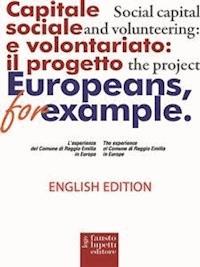
Europe’s most precious capital is its citizens. Thousands of volunteers all over Europe contribute everyday to create social cohesion and rights of citizenship while improving their skills.Europeans, for example (Euforex) is a European project funded under the Lifelong Learning Program, Grundtvig measure and coordinated by the Municipality of Reggio Emilia (Comune di Reggio Emilia).Europeans, for example was created out of the experience of active citizenship promotion that the Municipality has been carrying on since 2008 within the project ‘I Reggiani, per esempio’.Euforex has been developed between October 2011 and October 2013 and had the goal of winning a double challenge: to encourage participation to volunteering and empower the key competences through training and certification. These two objectives are strictly connected and crucial in stimulating people’s active participation to the community. Euforex was also aimed at developing, in different territories, the partnership between public and private sector so that the governance models may achieve common goals. The book is about this European experience of making thoughts, methods, tools and outcomes available to public and private organisations and decision makers.
Das E-Book können Sie in Legimi-Apps oder einer beliebigen App lesen, die das folgende Format unterstützen:
Veröffentlichungsjahr: 2013
Ähnliche



















Nicoletta Levi
I. C. Grazia Filippi F.
Luca Boetti
Roberta Paltrinieri
Giulia Camurri
Capitale sociale e volontariato: il progetto
Social capital and volunteering: the project
Europeans, example
Introduction
Graziano Delrio
Italian Minister for Regional Affairs
and Local Autonomies
Former Mayor of Reggio Emilia
Ugo Ferrari
Deputy Mayor of Reggio Emilia
Authors
Luca Boetti
Giulia Camurri
Irma Carla Grazia Ferro Filippi
Chiara Guglielmini
Nicoletta Levi
Roberta Paltrinieri
Scientific supervision
Roberta Paltrinieri
Associate Professor Alma Mater Studiorum, University of Bologna
Steering committee
Abdullah Acar
Eyyup Akinci
Luca Boetti
Mihaela Brumar
I. C. Grazia Filippi F.
Jorge Hermida Fuertes
Nicoletta Levi
Georg Müllner
Stefan Vasile
Editing
Francesco Rossi Photographer
Cover design
Graphic office of Comune di Reggio Emilia
Translation
Ligabue Paola & C. SAS Reggio Emilia
Intellectual property
Comune di Reggio Emilia
Publishing
Fausto Lupetti Editore
Via del Pratello, 31 - 40122 Bologna
Tel. +39 051 5870786
Viale Abruzzi, 84 - 20131 Milano
Tel. +39 02 3653 6238
www.faustolupettieditore.it
Distribution
Messaggerie Libri
EAN 978-88-97686-70-5
ANVUR - Registered editor
(Agenzia Nazionale di Valutazione
E-book version
Fausto Lupetti Editore
EAN 978-88-97686-71-2
www.europeansforexample.eu
Romanian, Spanish and Turkish ebooks
This project has been funded with support from the European Commission. This publication reflects the views only of the author, and the Commission cannot be held responsible
for any use which may be made of the information contained therein.
Introduction by Ugo Ferrari
Cities, neighbourhoods and communities. These are the common public goods which we are called upon to administer, in the conviction that they are relational as well as physical spaces. They are shared spaces that belong to the community. Within this framework, the concept of city which we have in mind is crucial for social cohesion. Planning spaces in a way that fosters sharing means safeguarding social cohesion and not giving in to indifference, fear and seclusion. It means ensuring vital nourishment to enable the renewal of active citizenship from one generation to the next.
Today, globalisation profoundly changes time-space reference frames for those who are in charge of administration, and for citizens too. Local boundaries are progressively moving towards the wider arena, technological innovation facilitates communications and increases opportunities for social encounter, and intercultural encounters are an integral part of our daily life.
At the same time, the demand for sustainable and people-oriented cities and real, concrete relationships is increasing. Therefore, the real challenge for administrators is to match different needs and find a balanced and harmonious compromise between potentially opposing forces. It is necessary to keep up with the times and, in the meanwhile, to maintain our own common and individual identity.
In this process, the contribution that everyone can make to the surrounding context and to one’s neighbour becomes very valuable. If Reggio Emilia is “the city of people” then we owe it to all those who spontaneously carry out acts of social solidarity and responsibility, as this book will remind us, as well as to fidelity to a specific idea of local governance which places the individual at the core.
Indeed, there are 104 social cooperatives, 263 volunteering organisations and 229 social promotion associations with as many as 280,000 members and 26,000 volunteers who each day give their time and skills to the community. This is a precious asset which reveals an immeasurable social capital in which the Municipal administration has always believed, a belief which is reflected primarily in its effort to relate and make visible these countless stories of solidarity in “I Reggiani, per esempio”.
The idea that our experience may also represent an asset for Europe itself, where we feel we are playing a leading role, is a source of pride and satisfaction based on the fact that Reggio Emilia can clearly represent a social model that has the ability to inspire innovative European projects.
Ugo Ferrari
Deputy Mayor of Reggio Emilia
The city as a covenant between responsible parties by Graziano Delrio
Growth, innovation, and the lives of citizens will increasingly be concentrated in cities. It is cities, increasingly, which will drive countries out of recession and economic crisis. The progressive change that is currently taking place in Asia and South America equally concerns the Old Continent, Europe, and Italy.
The legitimate hope for a better quality of life for the millions of people who are urbanising on a massive scale, puts a significant pressure on the most specific and political dimension of urban life: the practice of citizenship.
“The air of the city will set you free” is an ancient adage of Hanseatic cities: the city is born out of a social contract between free and mutually responsible people.
To this day, the social contract continues to make us free and responsible men and women. This pact is built upon the relationship with the others and the Other, as something or someone yet unknown. Within this plural dimension, created by relationships between different parties, we are, apart than citizens, “people”.
If a city, small or large, fails protect this concept, it loses its own essence and social capital, with the latter interpreted asas the ability of all to create relations and reciprocity, trust and social well-being.
This is the reason why experiences such as those conducted within “Europeans, for Example” and the prior project born in Reggio Emilia “I Reggiani, per esempio” are so fundamental and will be herein discussed.
The impact of globalisation on people’s lives, the crisis of traditional political , parties, and the weakening of social cohesion are all factors that have triggered the local administration of Reggio Emilia to reflect upon the need to revive the sense of belonging to a civil community.
Hence, the public authority has adopted a motivating role of governance, highlighting the city as a public good and as the pivotal locus for the ‘right of citizenship’. Through the vital experience of volunteering, which is fortunately deeply rooted in our society and articulated as a civic call, it has been possible to restore and renew the practice of citizenship awareness.
The practice of civic calls by soliciting a personal confrontation with the public goods, leads to the awareness of “having a right to the city”. Whether in the suburbs of a big metropolis or in the local neighbourhood park, the civic call places everybody in the position of questioning themselves about “the public good” and their responsibility towards this ideal.
The public administration, whether it’s the State or the Municipality, shall play the protective role of social supporter while releasing the energy and the authonomies of both individuals and communities. Therefore the hope is that, even in large cities and extensive metropolitan zones, there will be places inhabitated by a network of relationships that are capable of building bridges and crossing borders, lands of individual opportunity and for the common good.
Graziano Delrio
Minister for Regional Affairs and Local Autonomies
Former Mayor of Reggio Emilia
Lesen Sie weiter in der vollständigen Ausgabe!
Lesen Sie weiter in der vollständigen Ausgabe!
Lesen Sie weiter in der vollständigen Ausgabe!
Lesen Sie weiter in der vollständigen Ausgabe!
Lesen Sie weiter in der vollständigen Ausgabe!
Lesen Sie weiter in der vollständigen Ausgabe!
Lesen Sie weiter in der vollständigen Ausgabe!
Lesen Sie weiter in der vollständigen Ausgabe!
Lesen Sie weiter in der vollständigen Ausgabe!
Lesen Sie weiter in der vollständigen Ausgabe!
Lesen Sie weiter in der vollständigen Ausgabe!
Lesen Sie weiter in der vollständigen Ausgabe!
Lesen Sie weiter in der vollständigen Ausgabe!
Lesen Sie weiter in der vollständigen Ausgabe!
Lesen Sie weiter in der vollständigen Ausgabe!
Lesen Sie weiter in der vollständigen Ausgabe!
Lesen Sie weiter in der vollständigen Ausgabe!
Lesen Sie weiter in der vollständigen Ausgabe!
Lesen Sie weiter in der vollständigen Ausgabe!
Lesen Sie weiter in der vollständigen Ausgabe!
Lesen Sie weiter in der vollständigen Ausgabe!
Lesen Sie weiter in der vollständigen Ausgabe!
Lesen Sie weiter in der vollständigen Ausgabe!
Lesen Sie weiter in der vollständigen Ausgabe!
Lesen Sie weiter in der vollständigen Ausgabe!
Lesen Sie weiter in der vollständigen Ausgabe!
Lesen Sie weiter in der vollständigen Ausgabe!
Lesen Sie weiter in der vollständigen Ausgabe!
Lesen Sie weiter in der vollständigen Ausgabe!
Lesen Sie weiter in der vollständigen Ausgabe!
Lesen Sie weiter in der vollständigen Ausgabe!
Lesen Sie weiter in der vollständigen Ausgabe!
Lesen Sie weiter in der vollständigen Ausgabe!
Lesen Sie weiter in der vollständigen Ausgabe!
Lesen Sie weiter in der vollständigen Ausgabe!
Lesen Sie weiter in der vollständigen Ausgabe!
Lesen Sie weiter in der vollständigen Ausgabe!
Lesen Sie weiter in der vollständigen Ausgabe!
Lesen Sie weiter in der vollständigen Ausgabe!
Lesen Sie weiter in der vollständigen Ausgabe!
Lesen Sie weiter in der vollständigen Ausgabe!
Lesen Sie weiter in der vollständigen Ausgabe!
Lesen Sie weiter in der vollständigen Ausgabe!
Lesen Sie weiter in der vollständigen Ausgabe!
Lesen Sie weiter in der vollständigen Ausgabe!




