


27,99 €
Mehr erfahren.
- Herausgeber: John Wiley & Sons
- Kategorie: Fachliteratur
- Serie: EBMT-EBM Toolkit Series
- Sprache: Englisch
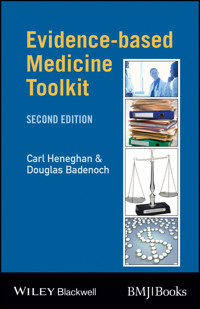
This bestselling pocket guide to the skills of evidence-based medicine succeeds in demystifying the terminology and processes in a handy and easy-to-follow format, all within the space of 100 pages.
With an improved layout, this second edition of Evidence-based Medicine Toolkit offers more up-to-date guidance as well as new sections on important areas of research.
New features of this second edition include:
- A box for each major database showing how to search the evidence, and highlighting the differences between them
- Flow charts for different study types
- New critical appraisal sections on qualitative research and economic evaluation
- Expanded list of EBM resources on the net.
With these added features to make the job easier, the new Toolkit is now an even better companion for all health care professionals using evidence-based methodology in their research and practice.
Sie lesen das E-Book in den Legimi-Apps auf:
Seitenzahl: 105
Veröffentlichungsjahr: 2013
Ähnliche



















Contents
Introduction
Definition of evidence-based medicine
Asking answerable questions
Patient or problem
Intervention
Comparison intervention
Outcome
Type of question
Finding the evidence: how to get the most from your searching
Convert your question to a search strategy
Critical appraisal of guidelines
Scope and purpose of the guideline
Methods
Applicability
Conflict of interest
Appraising systematic reviews
Is the systematic review valid?
Are the results important?
How precise are the results?
Appraising diagnosis articles
Is the study valid?
Are the results important?
Summary
Nomogram for likelihood ratios
Appraising articles on harm/aetiology
Is the study valid?
Are the results important?
Appraising prognosis studies
Is the study valid?
Are the results important?
Appraising therapy articles
Is the study valid?
Are the results important?
Appraising qualitative studies
Appraising economic evaluations
Does this economic evaluation provide a valid comparison of alternatives?
Applying the evidence
Are your patients similar to those of the study?
How much of the study effect can you expect for your patient(s)?
Is the intervention realistic in your setting?
Does the comparison intervention reflect your current practice?
What alternatives are available?
Are the outcomes appropriate to your patient?
Evidence-based medicine: glossary of terms
Selected evidence-based healthcare resources on the web
Levels of evidence
Study designs
Case-control study
Cohort study
Crossover design
Cross-sectional survey
Diagnostic validation study
Randomized controlled trial (RCT)
Index
© 2002 BMJ Books
© 2006 Carl Heneghan and Douglas Badenoch
Published by Blackwell Publishing Ltd
BMJ Books is an imprint of the BMJ Publishing Group Limited, used under licence
Blackwell Publishing, Inc., 350 Main Street, Malden, Massachusetts 02148-5020, USA
Blackwell Publishing Ltd, 9600 Garsington Road, Oxford OX4 2DQ, UK
Blackwell Publishing Asia Pty Ltd, 550 Swanston Street, Carlton, Victoria 3053, Australia
The right of the Authors to be identified as the Authors of this Work has been asserted in accordance with the Copyright, Designs and Patents Act 1988.
All rights reserved. No part of this publication may be reproduced, stored in a retrieval system, or transmitted, in any form or by any means, electronic, mechanical, photocopying, recording or otherwise, except as permitted by the UK Copyright, Designs and Patents Act 1988, without the prior permission of the publisher.
First published 2002
Second edition 2006
1 2006
A catalogue record for this title is available from the British Library and the Library of Congress
ISBN-13: 978-0-7279-1841-3
ISBN-10: 0-7279-1841-9
For further information on Blackwell Publishing, visit our website:
http://www.blackwellpublishing.com
Introduction
This ‘toolkit’ is designed as a summary and reminder of the key elements of practising evidence-based medicine (EBM). It has largely been adapted from resources developed at the Centre for Evidence-based Medicine. For more detailed coverage, you should refer to the other EBM texts and web pages cited throughout.
The first page of each chapter presents a ‘minimalist’ checklist of the key points. Further sections within each chapter address these points in more detail and give additional background information. Ideally, you should just need to refer to the first page to get the basics, and delve into the further sections as required.
Occasionally, you will see the dustbin icon on the right. This means that the question being discussed is a ‘filter’ question for critical appraisal: if the answer is not satisfactory, you should consider ditching the paper and looking elsewhere. If you don’t ditch the paper, you should be aware that the effect it describes may not appear in your patient in the same way.
Definition of evidence-based medicine
Evidence-based medicine is the ‘conscientious, explicit and judicious use of current best evidence in making decisions about individual patients’.
This means ‘integrating individual clinical expertise with the best available external clinical evidence from systematic research’ (Sackett et al. 2000).
We can summarize the EBM approach as a five-step model:
Asking answerable questions
The four elements of a well-formed clinical question are:
The terms you identify from this process will form the basis of your search for evidence and the question as your guide in assessing its relevance.
Bear in mind that how specific you are will affect the outcome of your search: general terms (such as ‘heart failure’) will give you a broad search, while more specific terms (for example, ‘congestive heart failure’) will narrow the search.
Lesen Sie weiter in der vollständigen Ausgabe!
Lesen Sie weiter in der vollständigen Ausgabe!
Lesen Sie weiter in der vollständigen Ausgabe!
Lesen Sie weiter in der vollständigen Ausgabe!
Lesen Sie weiter in der vollständigen Ausgabe!
Lesen Sie weiter in der vollständigen Ausgabe!
Lesen Sie weiter in der vollständigen Ausgabe!
Lesen Sie weiter in der vollständigen Ausgabe!
Lesen Sie weiter in der vollständigen Ausgabe!
Lesen Sie weiter in der vollständigen Ausgabe!
Lesen Sie weiter in der vollständigen Ausgabe!
Lesen Sie weiter in der vollständigen Ausgabe!
Lesen Sie weiter in der vollständigen Ausgabe!
Lesen Sie weiter in der vollständigen Ausgabe!
Lesen Sie weiter in der vollständigen Ausgabe!




