


34,99 €
Mehr erfahren.
- Herausgeber: John Wiley & Sons
- Kategorie: Fachliteratur
- Sprache: Englisch
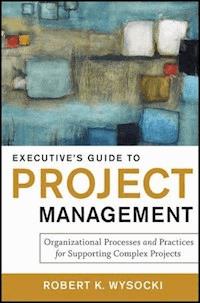
How-to guidance for defining and implementing a complex project performance environment Sharing his forty-five years of project management experience, best-selling author and industry guru Robert Wysocki presents a straightforward, enlightening, and pragmatic guide to help senior managers make the transition to an organization that profits and thrives on complexity. The first book to discuss practical project management mitigation strategies, Executive's Guide to Project Management presents easy-to-implement infrastructures and processes that will ensure the continued success of your organization and maximize your investment of every project. * Collects in one resource all the relevant information for understanding and creating an environment for improved complex project performance * A must-read for every member of your senior management team * Shows you how to regain responsibility, take action, and skillfully handle complexity to mitigate risk and increase return on project investments It's time for your senior management team to take back control of your investments in projects and programs. Executive's Guide to Project Management shows you how to cultivate your part of the organization so that it can respond to a changing project environment with the infrastructure to support the project and program investment decisions.
Sie lesen das E-Book in den Legimi-Apps auf:
Seitenzahl: 363
Veröffentlichungsjahr: 2011
Ähnliche

















Contents
Cover
Title Page
Copyright
Dedication
Foreword
Preface
Introduction
The Nature of Project Complexity and Uncertainty
The Risk Mitigation and Business Value Roles of the Senior Management Team
Organizational Culture and Velocity
How to Carefully Manage the Creative Process
About this Book
Who Should Read this Book
Part I: Challenges to Supporting Complex Projects
The Project Landscape (Chapter 1)
Project Management Life Cycle Models (Chapter 2)
The Complex Project Team (Chapter 3)
Chapter 1: The Project Landscape
The Nature of Project Complexity and Uncertainty
Goal and Solution Clarity
Through the Eyes of Senior Management Team Members
Putting It All Together
Chapter 2: Project Management Life Cycle Models
Traditional Project Management
Agile Project Management
Extreme Project Management
Emertxe Project Management
How to Choose the Best Fit Project Management Life Cycle
Putting It All Together
Chapter 3: The Complex Project Team
What Is a Complex Project Team?
Complex Project Team Position Family
Complex Project Manager Use of the Complex Project Team Profile
Senior Management Team Applications of the Complex Project Manager Position Family Profile
Putting It All Together
Part I: Summary
Organizational Challenges and Mitigation Strategies
Executive Bookshelf
Part II: Improving Project Success With Human Resource Strategies and Processes
Project Manager, Business Analyst, Business Process Professional, and Information Technology Professional Integration (Chapter 4)
Professional Development Model (Chapter 5)
Integrating the Project Manager, Business Analyst, Business Process Professional, and Information Technology Professional into the Project Landscape (Chapter 6)
Chapter 4: Project Manager, Business Analyst, Business Process Professional, and Information Technology Professional Integration
Position Families
An Historical Perspective
Complex Project Team and Complex Projects
Putting It All Together
Chapter 5: A Professional Development Model
The Professional Development Plan
Role of the Senior Management Team in the Personal Development Program
Putting It All Together
Chapter 6: Integrating the Project Manager, Business Analyst, Business Process Professional, and Information Technology Professional into the Project Landscape
Project Complexity Assessment
Generalists Versus Specialists
Project Manager, Business Analyst, Business Process, and Information Technology Skill Profile
Mapping the Project Managers and Business Analysts into the Project Landscape
Putting It All Together
Part II: Summary
Organizational Challenges and Mitigation Strategies
Executive Bookshelf
PART III: Improving Project Return on Investment (ROI) Using Agile Project Portfolio Management
The Project Birth and Death Process (Chapter 7)
Agile Project Portfolio Management Process (Chapter 8)
An Agile Portfolio Strategy (Chapter 9)
Chapter 7: The Project Birth and Death Process
Project Birth Process
Project Maturation Process
Project Death Process
Putting It All Together
Chapter 8: Agile Project Portfolio Management Process
What Is a Project Portfolio?
What Is Agile Project Portfolio Management?
Putting It All Together
Chapter 9: An Agile Portfolio Strategy
Adapting the Project Management Life Cycle Models to the Agile Project Portfolio Management Model
Problem/Opportunity Prioritization
Strategic Alignment Model
Alternatives to the Strategic Alignment Model
Putting It All Together
PART III: Summary
Organizational Challenges and Mitigation Strategies
Executive Bookshelf
PART IV: Establishing and Maturing an Enterprise Project Support Office
Organizing and Defining your Project Support Office (Chapter 10)
Growing and Maturing your Project Support Office (Chapter 11)
The Future of the Project Support Office (Chapter 12)
Chapter 10: Organizing and Defining Your Project Support Office
Definition of a Project Support Office
Spotting Symptoms that You Need a Project Support Office
Organization and Placement of a Project Support Office
Steps to Establishing a Project Support Office
Putting It All Together
Chapter 11: Growing and Maturing Your Project Support Office
Project Support Office Stages of Growth
A Step-by-Step Plan
Challenges to Implementing a Project Support Office
Putting It All Together
Chapter 12: The Future of the Project Support Office
Hub and Spoke BP4SO
Putting It All Together
PART IV: Summary
Organizational Challenges and Mitigation Strategies
Executive Bookshelf
Epilogue: Next Steps
Define Your Role in Supporting Complex Projects
How Will You Make It Happen?
Final Thoughts on the Book
About the Author
Index
Copyright © 2011 by Robert K. Wysocki. All rights reserved.
Published by John Wiley & Sons, Inc., Hoboken, New Jersey.
Published simultaneously in Canada.
No part of this publication may be reproduced, stored in a retrieval system, or transmitted in any form or by any means, electronic, mechanical, photocopying, recording, scanning, or otherwise, except as permitted under Section 107 or 108 of the 1976 United States Copyright Act, without either the prior written permission of the Publisher, or authorization through payment of the appropriate per-copy fee to the Copyright Clearance Center, Inc., 222 Rosewood Drive, Danvers, MA 01923, (978) 750-8400, fax (978) 646-8600, or on the Web at www.copyright.com. Requests to the Publisher for permission should be addressed to the Permissions Department, John Wiley & Sons, Inc., 111 River Street, Hoboken, NJ 07030, (201) 748-6011, fax (201) 748-6008, or online at www.wiley.com/go/permissions.
Limit of Liability/Disclaimer of Warranty: While the publisher and author have used their best efforts in preparing this book, they make no representations or warranties with respect to the accuracy or completeness of the contents of this book and specifically disclaim any implied warranties of merchantability or fitness for a particular purpose. No warranty may be created or extended by sales representatives or written sales materials. The advice and strategies contained herein may not be suitable for your situation. You should consult with a professional where appropriate. Neither the publisher nor author shall be liable for any loss of profit or any other commercial damages, including but not limited to special, incidental, consequential, or other damages.
For general information on our other products and services or for technical support, please contact our Customer Care Department within the United States at (800) 762-2974, outside the United States at (317) 572-3993 or fax (317) 572-4002.
Wiley also publishes its books in a variety of electronic formats. Some content that appears in print may not be available in electronic books. For more information about Wiley products, visit our web site at www.wiley.com.
Library of Congress Cataloging-in-Publication Data
Wysocki, Robert K.
Executive's guide to project management : organizational processes and practices for supporting complex projects / Robert K. Wysocki.
p. cm.
Includes index.
ISBN 978-1-118-00407-4 (hardback); ISBN 978-1-118-08924-8 (ebk); ISBN 978-1-118-08925-5 (ebk); ISBN 978-1-118-08926-2 (ebk)
Printed in the United States of America
1. Project management. 2. Executives. I. Title.
HD69.P75W954 2011
658.4'004—dc22
2011007520
To all of those executives in my client organizations who havereached out for help with understanding and establishing asupportive environment for managing complex projects.
Foreword
Kathleen B. Hass
This outstanding work closes a huge and costly gap in our 21st-century business practices, that of managing and capitalizing on complexity. It represents a real-world, practical guidebook for senior managers and executives to furnish and continually nurture the environment for success in the 21st-century global economy. If you are a member of senior management and you want to prepare yourself to handle complexity in this competitive global ecosystem, this book prepares you to take responsibility and to take action.
Executives of standout companies, businesses that have flourished in spite of the financial crisis of late, have learned to capitalize on complexity. The first thing they did was to admit to the following six points:
1. Projects execute strategy by implementing the changes needed to react to the relentless dynamics of the marketplace.
2. Successful projects are critical to our economic survival.
3. As executives, strategy execution is our job; therefore, diving into the world of projects is our job!
4. Projects are investments and part of a portfolio that has an investment strategy that needs our attention, support, and expertise.
5. Complexity is here to stay; it is only going to get worse; and we must learn to not just manage complexity, but also capitalize on it to remain competitive.
6. It is through creativity and innovation that we will enable a company to capitalize on complexity.
This work is groundbreaking in that it deals with establishing an organizational infrastructure to accommodate the challenges faced by senior management to effectively support complex projects. Implementing the business practices needed to support complex projects is a learning process that demands an understanding of complexity, a focus on creativity, and business practices that are adaptive and flexible. For senior management teams, the objective is clear: risk reduction and increased return on project investments.
Literally every organization is in a discovery mode as it attempts to converge on the most effective structures, processes, and practices for executing complex projects. However, the need is critical, and we must not shy away from the challenge because we don't have the total solution. As Wysocki says, “It's time for the senior management team to take back control of their investments in projects and programs.” The role of the senior manager is changing significantly. Senior managers possess power and influence; and only they can provide the empowering organizational culture and flexible infrastructure needed to deploy complex, creative, innovative solutions.
In these pages, Wysocki presents a straightforward, enlightening, pragmatic guide for senior managers to begin to transition to an organization that thrives on complexity. Each section of the book is organized in a similar manner, with an overview of contents, followed by material that presents practical tools, templates, and processes that provide an infrastructure to support the needs of complex innovation projects. Each section concludes with a summary of the challenges facing senior management in providing the necessary infrastructure and support. The strategies presented here are relatively easy to explore intellectually, but they will require diligence on the part of the senior leadership team to customize them to “fit” in your environment, to implement them, and to continually refine and improve them so that they remain effective.
Of particular interest is a groundbreaking approach to staffing complex projects that consists of a framework referred to as a complex project manager position family, consisting of the convergence of the four professional disciplines critical to the success of complex projects: Project Management, Business Analysis, Business Process Management, and Information Technology. This framework for complex project leadership includes these professionals at all levels, from individual-contributor staff positions, to professional positions in each discipline, and finally, to executive-level process and practice directors. Using this straightforward framework allows senior executives, resource managers, portfolio and program mangers, as well as complex project managers to ensure the complex project team is appropriately skilled and balanced across the four disciplines based on the complexity of the project. Through a real collaborative effort relying on the synergies of the four professionals each with a differing expertise and perspective, the complex project team will have the technical skill base and leadership prowess to succeed.
Also of considerable interest to me as a member of the International Institute of Business Analysis (IIBA) is a proposed new definition of a requirement, one that relates to the need of a requirement to generate business benefits, either in the form of value to the customer or wealth to the organization. Once it is understood that business benefits are the only real measure of project success, it becomes much easier to establish the critical business requirements early in the project—those referred to as “firm basic requirements” by the Standish Group that are not expected to change. Approaching business requirements in terms of business value makes it appreciably easier to make important decisions about the project scope and approach.
This work makes a significant contribution to our quest to manage and capitalize on complexity. It is the only discussion I have found that concentrates exclusively on the role of the senior management team in fostering the supportive and adaptive environment needed for success in this complex, ever-changing world we find ourselves in. This new leadership approach involves changes in the behavior of the senior team relating to three entities:
1.The Project. Once the complexity of a project is well understood, there are a number of specific activities that senior management can engage in, from matching expertise to the complexity profile, to giving the complex project team the physical space that is needed for the team to collaborate and interact, to minimizing distractions and other assignments to the key team leaders, to understanding and accepting that as more is learned the team will adapt their approach.
2.The Project Portfolio. To manage the portfolio of complex projects, the same flexible, adaptive approach is needed. On a regular basis, the portfolio is assessed and appropriate decisions are made, often resulting in significant changes to the portfolio of complex projects. This is the “sweet spot” of the senior management team when they are striving to capitalize on complexity to achieve innovation, for it is through these complex project portfolios that strategy is executed, value is added for the customer, wealth is earned for the organization, and competitiveness is maintained or advanced.
3.The Project Support Office. The executive teams of standout organizations maintain and support an entity that provides a collection of services to complex project teams. The senior team tolerates and encourages different project support models, depending on the complexity of the team structure and the number of different business lines and applications that are impacted by the complex project, program, or portfolio.
My conclusion: This is a must addition to the reference library for members of the senior management team.
Kathleen B. Hass, PMP Principal Consultant, Kathleen Hass & Associates, Inc. Director, International Institute Of Business Analysis award-winning author of “The Business Analysis Essential Library” andManaging Complex Projects:A New Model, the 2009 PMI Book of the Year
Preface
The contemporary project environment is characterized by a high degree of complexity, uncertainty, and risk. There is a never-ending stream of books, articles, webinars, podcasts, and blogs offering a variety of solutions for managing these projects and quick fixes for everything from requirements gathering to change management. Everybody seems to have a silver bullet to offer the project manager. The best I can say about the present plight of the project manager is that he/she is expected to perform in an environment that even the best among them is struggling to succeed in. Let's face it, we are in the midst of an evolution in project management and only the best and most effective organization-wide approaches have any chance of success. Unfortunately the much-needed help has not yet come to the rescue.
Executives, directors, and senior-level managers (a.k.a. senior management team, [SMT]) are expected to tolerate all of this ambiguity and no one is offering them any silver bullets. Well, first of all, there aren't any silver bullets for them or their project managers either. But there are strategies for the SMT that can improve the plight of their project managers and establish an environment to contribute sustainable business value. These strategies are the focus of this book. This will be the first “how to” book written specifically for the SMT. It is written to be your guide and constant companion.
Introduction
The contemporary world of projects and project management is racing ahead without constraint. Project and program managers are faced with a continuously changing array of tools, templates, and processes. Everyone seems to have their own approach with little in the way of standards or best practices. Performance comparisons across projects are difficult at best. Learning opportunities are not shared in any organized way. It would not be unfair to say that the project world of most organizations is spinning out of control.
The business world is the beneficiary of this unbridled change. Time to market has never been more critical than it is now. And an organization's ability to achieve that speed is dependent on their ability to be flexible and creative. Every critical process must align and must be lean and mean. Supporting the design and implementation of those processes from the perspective of the senior management team (SMT) is the topic of this groundbreaking book.
The Nature of Project Complexity and Uncertainty
The state of complexity and uncertainty at the project level exacerbates the management of programs and portfolios and the supporting infrastructure on the part of the SMT. You are a member of your organization's SMT and have clearly been taken out of your comfort zones. This book will share infrastructure and processes you need to take back control of your project environment. Understand at the outset that this will be a daunting task but it is a necessary task. The continued success of your organization depends upon it. Despite the best intentions and efforts of you and the rest of the SMT, it won't happen by next Tuesday. It is in fact a continuous process improvement effort.
Lesen Sie weiter in der vollständigen Ausgabe!
Lesen Sie weiter in der vollständigen Ausgabe!
Lesen Sie weiter in der vollständigen Ausgabe!
Lesen Sie weiter in der vollständigen Ausgabe!
Lesen Sie weiter in der vollständigen Ausgabe!
Lesen Sie weiter in der vollständigen Ausgabe!
Lesen Sie weiter in der vollständigen Ausgabe!
Lesen Sie weiter in der vollständigen Ausgabe!
Lesen Sie weiter in der vollständigen Ausgabe!
Lesen Sie weiter in der vollständigen Ausgabe!
Lesen Sie weiter in der vollständigen Ausgabe!
Lesen Sie weiter in der vollständigen Ausgabe!
Lesen Sie weiter in der vollständigen Ausgabe!
Lesen Sie weiter in der vollständigen Ausgabe!
Lesen Sie weiter in der vollständigen Ausgabe!
Lesen Sie weiter in der vollständigen Ausgabe!
Lesen Sie weiter in der vollständigen Ausgabe!
Lesen Sie weiter in der vollständigen Ausgabe!
Lesen Sie weiter in der vollständigen Ausgabe!
Lesen Sie weiter in der vollständigen Ausgabe!
Lesen Sie weiter in der vollständigen Ausgabe!
Lesen Sie weiter in der vollständigen Ausgabe!
Lesen Sie weiter in der vollständigen Ausgabe!




