


18,99 €
Mehr erfahren.
- Herausgeber: John Wiley & Sons
- Kategorie: Geisteswissenschaft
- Sprache: Englisch
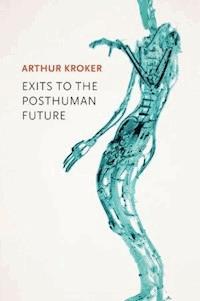
Exits to the Posthuman Future is media theory for a global digital society which thrives, and sometimes perishes, at the intersection of technologies of speed, distant ethics and a pervasive cultural anxiety. Arthur Kroker’s incisive and insightful text presents the emerging pattern of a posthuman future: life at the tip of technologies of acceleration, drift and crash. Kroker links key concepts such as “Guardian Liberalism” and Obama’s vision of the “Just War” with a striking account of “culture drift” as the essence of real world technoculture. He argues that contemporary society displays growing uncertainty about the ultimate ends of technological innovation and the intelligibility of the digital future. The posthuman future is elusive: is it a gathering storm of cynical abandonment, inertia, disappearance and substitution? Or else the development of a new form of critical consciousness - the posthuman imagination - as a means of comprehending the full complexity of life? Depending on which exit to the posthuman future we choose or, perhaps, which exit chooses us, Kroker argues that a very different posthuman future will likely ensue.
Sie lesen das E-Book in den Legimi-Apps auf:
Seitenzahl: 407
Veröffentlichungsjahr: 2014
Ähnliche




















Table of Contents
Cover
Title page
Copyright page
Acknowledgments
1: Introduction: Trajectories of the Posthuman
Trolley to Tijuana and transit of Venus
Living at the tip of the posthuman
Synching your heart to the smartphone
Misprinted organs
The posthuman axiomatic
Accelerate
Drift
Crash
Slow suicide of technological apocalypse
Traversal consciousness
Accelerate
2: The Posthuman Imagination: Neuro-Diversity, Psychic Trauma, and History in the Data Feed
Photography of invisibility
The cage of measurability
Exits to the posthuman future
Drift
3: Code Drift
Software genomics
Spectral destiny of technology
Tethered to mobility
Data trauma
4: History Drift
First hypothesis: the will to history
Second hypothesis: the precession of history
Third hypothesis: hauntological history
The will to history
The precession of history
Hauntological history
Two histories
Hauntologies of the future
5: Archive Drift
Social media and the future of the archive
The digital imaginary
Archives in the wires
Complexity and the digital archive
6: Screen Drift
Video as the skin of the new cinema
Video is the iris of social networking technologies
Remix culture
7: Media Drift
Digital dialectics
Software necropolis
“Flesh rezzing”
Full-mind scans
The lonely digital crowd
The rings of Saturn
Crash: Slow Suicide of Technological Apocalypse
8: After the Drones
When the drones came to town
Bodies that don't matter
When the sun rises on a planet of the dead and dying
Drone flesh
9: Guardian Liberalism: Rhetoric of the “Just War”
Guardian liberalism
The guardian state and born-again ideology
The concept of the “just war”
The Long Grey Line
Reaper drones and remote ethics
The future of the guardian state
Crash: Traversal Consciousness
10: Premonitory Thought: That Fateful Day When Power Abjected Itself
Before Foucault
“Insurrection of subjugated knowledge”: five methodological precautions
Modalities of power
The imperial subaltern
The will to untruth
Politics in the age of cynical ideology
11: Thinking the Future with Marshall McLuhan: Technologies of Abandonment, Inertia, Disappearance, Substitution
McLuhan's ethical dissent
Technologies of the dark tetrad
Prosthetic gods
12: Epilogue: Media Theory in the Data Storm
Figural aesthetics
Index
Copyright © Arthur Kroker 2014
The right of Arthur Kroker to be identified as Author of this Work has been asserted in accordance with the UK Copyright, Designs and Patents Act 1988.
First published in 2014 by Polity Press
Polity Press
65 Bridge Street
Cambridge CB2 1UR, UK
Polity Press
350 Main Street
Malden, MA 02148, USA
All rights reserved. Except for the quotation of short passages for the purpose of criticism and review, no part of this publication may be reproduced, stored in a retrieval system, or transmitted, in any form or by any means, electronic, mechanical, photocopying, recording or otherwise, without the prior permission of the publisher.
ISBN-13: 978-0-7456-7162-8
ISBN-13: 978-0-7456-7163-5(pb)
ISBN-13: 978-0-7456-8225-9(epub)
ISBN-13: 978-0-7456-8224-2(mobi)
A catalogue record for this book is available from the British Library.
The publisher has used its best endeavours to ensure that the URLs for external websites referred to in this book are correct and active at the time of going to press. However, the publisher has no responsibility for the websites and can make no guarantee that a site will remain live or that the content is or will remain appropriate.
Every effort has been made to trace all copyright holders, but if any have been inadvertently overlooked the publisher will be pleased to include any necessary credits in any subsequent reprint or edition.
For further information on Polity, visit our website: www.politybooks.com
Acknowledgments
The intellectual development of Exits to the Posthuman Future benefited immensely not only from close readings of the manuscript by Marilouise Kroker but also, more importantly, from her innovative contributions to theorizing the fate of the body in a contemporary culture typified by code drift and the posthuman imaginary. In every respect, the manuscript has been deeply shaped by our conversations and collaborations over many years, whether co-editing CTheory, pursuing innovative research projects at the Pacific Centre for Technology and Culture, or working collaboratively on books, articles, videos, and performances.
I am deeply appreciative of the superb editorial skills of Joe Devanny, my editor at Polity Press, as well as of the insightful comments offered by anonymous reviewers and the editorial committee at Polity.
The preparation of the manuscript was greatly facilitated by research support from the Social Sciences and Humanities Research Council of Canada (Digital Inflections). Equally, my appointment as a Canada Research Chair in Technology, Culture, and Theory at the University of Victoria provided an innovative multidisciplinary intellectual environment for exploring the digital future. I would also like to acknowledge the contributions of Clare Ansell, Polity's Senior Production Editor, and the careful copy-editing work of Gail Ferguson.
1
Introduction:
Trajectories of the Posthuman
Trolley to Tijuana and transit of Venus
I'm in downtown San Diego, just about to board the trolley to Tijuana, on a day, unlike most days, that is clearly marked by the spectral signs of cosmology because in far-off galactic space, Venus prepares to transit the sun and, in that transit, for the briefest of periods makes itself visible to the shielded human eye. This astronomical event last occurred in 1882 and will only occur again in 2117. And, so, I'm on a trolley to Tijuana, bracketed by astronomy between the past and the unknown, and certainly unknowable, future of the twenty-second century, with the spectral sign of Venus in transit across the fires of the sun and the earthbound signs of that trolley ride to the borderland following its own low visibility, perhaps even minoritarian, transit across the bright sunshine of the California technological way.
Following the Spanish philosopher José Ortega y Gasset's fateful insight that “I am I in the human circumstance and the human circumstance is I,” I ask myself this question enigmatic about my present circumstance on this day of cosmology: What is the connection, if any, between the trolley to Tijuana and the transit of Venus?
Now, the trolley to Tijuana is a down-to-earth story, about migrant workers from Tijuana who begin lining up at 4 am each morning in order to catch the trolley to the houses and stores and construction camps of San Diego. There's a lot of humiliated necessity in those early-morning border crossings. All the immense wealth, restless energy, and sheer disciplined willpower of the California Way pushed to the border, and just stopped with walls of surveillance running into the sea and pitilessness running into the heart. Like everything else on the border, the trolley to Tijuana is a kind of strange fold in the space-time of two cultures, a site of possible cultural intersections that don't really happen, broken mediations, and bodies on the move, some perhaps upward bound, but most disappearing into the routines of daily labor.
And the transit of Venus? That's a different (astronomical) matter altogether. Not just its rarity, although the event dazzles with the fact that it won't happen again for another century. A heavenly messenger linking the twenty-first and twenty-second centuries. Nor even the fact that the transit of Venus cannot be viewed directly, but only with a heavy filter to shield your eyes. But use that filter and the occasion is one of wonderment, that vision of the planet Venus tracking across the face of the sun. In this, the most scientific of times, the event has been stripped of its mystery, reduced to the language of scientific precision or perhaps to celestial celebrity status pumped up by the mass media as another passing interest story for the day – an astronomical punctuation, in this case, supposedly signifying nothing. But still, “I am I in the human circumstance and the human circumstance is I” and there's that irrepressible doubled sense of awe at being witness to the motion of the planets and the stars but also something else, an inexpressible, and certainly prohibited, feeling that what is really being witnessed is something less scientific than cosmological. The transit of Venus is an omen, but an omen of what?
Lesen Sie weiter in der vollständigen Ausgabe!
Lesen Sie weiter in der vollständigen Ausgabe!
Lesen Sie weiter in der vollständigen Ausgabe!
Lesen Sie weiter in der vollständigen Ausgabe!
Lesen Sie weiter in der vollständigen Ausgabe!
Lesen Sie weiter in der vollständigen Ausgabe!
Lesen Sie weiter in der vollständigen Ausgabe!
Lesen Sie weiter in der vollständigen Ausgabe!
Lesen Sie weiter in der vollständigen Ausgabe!
Lesen Sie weiter in der vollständigen Ausgabe!
Lesen Sie weiter in der vollständigen Ausgabe!
Lesen Sie weiter in der vollständigen Ausgabe!
Lesen Sie weiter in der vollständigen Ausgabe!
Lesen Sie weiter in der vollständigen Ausgabe!
Lesen Sie weiter in der vollständigen Ausgabe!
Lesen Sie weiter in der vollständigen Ausgabe!




