


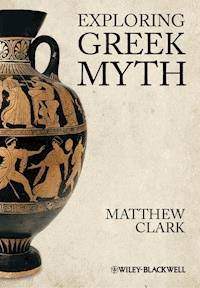
26,99 €
Mehr erfahren.
- Herausgeber: John Wiley & Sons
- Kategorie: Geisteswissenschaft
- Sprache: Englisch
Exploring Greek Myth offers an extensive discussion of variant forms of myths and lesser-known stories, including important local myths and local versions of PanHellenic myths. Clark also discusses approaches to understanding myths, allowing students to gain an appreciation of the variety in one volume.
- Guides students from an introductory understanding of myths to a wide-ranging exploration of current scholarly approaches on mythology as a social practice and as an expression of thought
- Written in an informal conversational style appealing to students by an experienced lecturer in the field
- Offers extensive discussion of variant forms of myths and many lesser known, but deserving, stories
- Investigates a variety of approaches to the study of myth including: the sources of our knowledge of Greek myth, myth and ritual in ancient Greek society, comparative myth, myth and gender, hero cult, psychological interpretation of myth, and myth and philosophy
- Includes suggestions in each chapter for essays and research projects, as well as extensive lists of books and articles for further reading
- The author draws on the work of many leading scholars in the field in his exploration of topics throughout the text
Sie lesen das E-Book in den Legimi-Apps auf:
Seitenzahl: 533
Veröffentlichungsjahr: 2012
Ähnliche


















Contents
Cover
Title Page
Copyright
Dedication
List of Illustrations
Preface
Note on Spelling
Further Reading
Acknowledgments
Chapter One: The Knife Did It
I. What is a Myth?
II. Further Characteristics of Greek Myth
III. Did the Greeks have Greek Myths?
IV. Panhellenic Myth
V. Local Myth
Conclusion
Further Reading
Chapter Two: Six Hundred Gods
I. Ancient Greek Polytheism and Hesiod's Theogony
II. Kronos and Hestia in Myth and Ritual
III. Personified Abstractions as Divinities
IV. Beyond Hesiod
V. Myth as Ritual Aetiology
VI. Myth and Ritual in Greek Society
VII. Myth and Ritual in The Oresteia
Conclusion
Further Reading
Chapter Three: Homer's Beauty Pageant
I. Famous Women of Myth in The Odyssey
II. The Myth of Melampous
III. Mythic Traditions in The Iliad
IV. Mythic Tradition in the Catalogue of Women
V. Myth on the FranÇois Vase
Conclusion
Further Reading
Chapter Four: Pelops' Shoulder
I. Lykaon in Latin Poetry and Greek Myth
II. Pelops' Shoulder
III. Lykaon and Pelops
IV. The Sources of Greek Myth
Conclusion
Further Reading
Chapter Five: Ikaros' Wings, Aktaion's Dogs
I. Ovid and Aktaion's Error
II. Aktaion's Crime
III. Localization and Rationalization
IV. The Fall of Ikaros
V. Ikaros in Rome
VI. Ikaros in the Western Tradition
Conclusion
Further Reading
Chapter Six: The Bones of Orestes
I. The Bones of Orestes
II. Bears for Iphigeneia
III. The Bones of Theseus
IV. Hyrnetho's Olive Grove
Conclusion
Further Reading
Chapter Seven: Born from the Earth
I. The Early Kings of Athens
II. Athenian Autochthony
III. Other Cities and their Founders
IV. Myths of Colonial Foundation
Conclusion
Further Reading
Appendix: genealogies of ion
Chapter Eight: The Judgment of Paris
I. Greek Myth and the Indo-Europeans
II. Greek Myth and The Near East
III. Greek Myth, World Myth, and Psychoanalysis
Conclusion
Further Reading
Chapter Nine: Boys in Dresses, Brides with Beards
I. Boys and Men
II. Girls and Women
III. Women Only
Iv. Men and Women
Conclusion
Further Reading
Chapter Ten: Agamemnon's Mask?
I. Herodotus and Myth
II. Thucydides and Myth
III. Mythic History in Ancient Greek Thought
IV. Myth and the History of the Delphic Oracle
V. Myth and The History of The Trojan War
Conclusion
Further Reading
Chapter Eleven: Orestes on Trial
I. Myth and Thought in Athenian Tragedy
II. Myth and Thought in Aeschylus
III. Myth and Thought in Sophocles and Euripides
IV. Sacrifice and Mythic Thought
Conclusion
Further Reading
Chapter Twelve: Plato and the Poets
I. Skepticism, Allegory, and Rationalization
II. Parmenides, Prodicus, and Protagoras
III. Plato and Myth
IV. Plato and Atlantis
Conclusion
Further Reading
Chapter Thirteen: Conclusion
Notes
Chapter One
Chapter Two
Chapter Three
Chapter Four
Chapter Five
Chapter Six
Chapter Seven
Chapter Eight
Chapter Nine
Chapter Ten
Chapter Eleven
Chapter Twelve
References
Index
This edition first published 2012
© 2012 Matthew Clark
Blackwell Publishing was acquired by John Wiley & Sons in February 2007. Blackwell's publishing program has been merged with Wiley's global Scientific, Technical, and Medical business to form Wiley-Blackwell.
Registered Office
John Wiley & Sons Ltd, The Atrium, Southern Gate, Chichester, West Sussex, PO19 8SQ, UK
Editorial Offices
350 Main Street, Malden, MA 02148-5020, USA
9600 Garsington Road, Oxford, OX4 2DQ, UK
The Atrium, Southern Gate, Chichester, West Sussex, PO19 8SQ, UK
For details of our global editorial offices, for customer services, and for information about how to apply for permission to reuse the copyright material in this book please see our website at www.wiley.com/wiley-blackwell.
The right of Matthew Clark to be identified as the author of this work has been asserted in accordance with the UK Copyright, Designs and Patents Act 1988.
All rights reserved. No part of this publication may be reproduced, stored in a retrieval system, or transmitted, in any form or by any means, electronic, mechanical, photocopying, recording or otherwise, except as permitted by the UK Copyright, Designs and Patents Act 1988, without the prior permission of the publisher.
Wiley also publishes its books in a variety of electronic formats. Some content that appears in print may not be available in electronic books.
Designations used by companies to distinguish their products are often claimed as trademarks. All brand names and product names used in this book are trade names, service marks, trademarks or registered trademarks of their respective owners. The publisher is not associated with any product or vendor mentioned in this book. This publication is designed to provide accurate and authoritative information in regard to the subject matter covered. It is sold on the understanding that the publisher is not engaged in rendering professional services. If professional advice or other expert assistance is required, the services of a competent professional should be sought.
Library of Congress Cataloging-in-Publication Data
Clark, Matthew, 1948-
Exploring Greek myth / Matthew Clark.
p. cm.
Includes bibliographical references (p. ) and index.
ISBN 978-1-4051-9456-3 (hardcover: alk. paper) – ISBN 978-1-4051-9455-6 (pbk.: alk. paper)1. Mythology, Greek. I. Title.
BL783.C53 2012
292.1′3–dc23
2011038291
A catalogue record for this book is available from the British Library.
This book is published in the following electronic formats: ePDFs 9781444362121; ePub 9781444362138; Mobi 9781444362145
This book is dedicated to the memoryof my sister, Miranda Smith
List of Illustrations
Figure 1.1 Persephone rising out of the earth from the Underworld
Figure 1.2 Triptolemos in his winged chariot
Figure 2.1 Rhea deceives Kronos
Figure 3.1 The François Vase
Figure 5.1 Aktaion and Artemis
Figure 7.1 Gaia hands Erichthonios to Athena
Figure 7.2 Kadmos and the serpent
Figure 10.1 The “Mask of Agamemnon”
Figure 11.1 Aigisthos prepares to kill Agamemnon
Figure 12.1 The abductions of Thetis and Oreithyia
Acknowledgments
These explorations would never have happened without the help of many people. I begin by thanking those teachers, colleagues, and friends with whom I have discussed myth over the years, in particular Eric Csapo and Gregory Nagy. Special thanks also to those with whom I have shared the teaching of Humanities 1105, “Myth and Imagination in Ancient Greece and Rome”: James Rives, Laurence Broadhurst, and Clifford Ando; this course is now in the able hands of Rob Tordoff. The wonderful editorial group at Wiley-Blackwell has been helpful and encouraging from beginning to end; Haze Humbert (who got the whole thing going), Galen Young, Allison Medoff, Nik Prowse, and Michael Coultas, as well as the anonymous readers. Thanks also to Ann Lau for the indexing. And thanks to the many students over the years who have allowed me to ramble on about the wonders of Greek myth.
Chapter One
The Knife Did It
Definitions and Characteristics for the Study of Myth
This chapter introduces definitions and concepts necessary for the exploration of Greek myth. Myth is not easy to define, and there is no definition which would receive universal approval, but an approximate definition is presented in Section I. Section II continues with a few characteristics of Greek myth not covered by the definition, including time in Greek myth, and the interconnected web of stories which make up the mythic tradition. Section III asks if the Greek themselves had a concept of Greek Myth. Sections IV and V introduce an important distinction between Panhellenic myths – myths which were widely known throughout the Greek world – and local myths – myths which were of primary interest to those resident in a particular city or region of Greece. Section IV uses the myth of the abduction of Persephone as an example of Panhellenic myth, and Section V presents the story of the Athenian festival of the Bouphonia as an example of local myth.
I. What is a Myth?
It is easy to give examples of Greek myths – the Abduction of Persephone, for instance, or the Labors of Herakles – but surprisingly difficult to say exactly what a Greek myth is. Scholars generally agree that myth is a slippery category. According to G. S. Kirk, “There is no one definition of myth” (1970: 7). Walter Burkert asks, “What is myth?”, and he answers, “A simple definition will not do” (1979: 1). Eric Csapo warns that “Definition is never the innocent first step in a process of empirical discovery . . .; it is rather always the final precipitate of an already elaborate theory”, and he continues, “If I begin with a discussion of the problems of defining myth, it is to urge suspicion” (2005: 1). Despite these warnings, it seems appropriate to attempt a provisional definition, so that the reader will have an idea of what will count as a Greek myth in this book, and then to indicate some of the problems such a definition may raise.
As an approximate definition, then, a myth is a traditional story that speaks to important issues in the culture in which it is told. This definition is not perfect, as further discussion will show, but it marks off at least a central area that everyone would consider myth. This definition should not be used too rigidly, however; the edges of the category are fuzzy, and myths that are atypical by this definition should not be excluded from consideration.
Lesen Sie weiter in der vollständigen Ausgabe!
Lesen Sie weiter in der vollständigen Ausgabe!
Lesen Sie weiter in der vollständigen Ausgabe!
Lesen Sie weiter in der vollständigen Ausgabe!
Lesen Sie weiter in der vollständigen Ausgabe!
Lesen Sie weiter in der vollständigen Ausgabe!
Lesen Sie weiter in der vollständigen Ausgabe!
Lesen Sie weiter in der vollständigen Ausgabe!
Lesen Sie weiter in der vollständigen Ausgabe!
Lesen Sie weiter in der vollständigen Ausgabe!
Lesen Sie weiter in der vollständigen Ausgabe!
Lesen Sie weiter in der vollständigen Ausgabe!
Lesen Sie weiter in der vollständigen Ausgabe!
Lesen Sie weiter in der vollständigen Ausgabe!
Lesen Sie weiter in der vollständigen Ausgabe!




