


40,99 €
Mehr erfahren.
- Herausgeber: John Wiley & Sons
- Kategorie: Fachliteratur
- Serie: Wiley Corporate F&A
- Sprache: Englisch
Foreword by James D. Ratley, CFE, President and CEO, Association of Certified Fraud Examiners
Beyond the basics—tools for applied fraud management
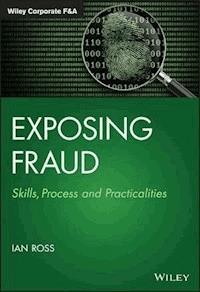
In Exposing Fraud: Skills, Process, and Practicalities, anti-fraud expert Ian Ross provides both ideas and practical guidelines for applying sound techniques for fraud investigation and detection and related project management. The investigative principles in this book are truly universal and can be applied anywhere in the world to deal with any of the range of fraud types prevalent in today's business environments. Topics covered include cyber fraud, the psychology of fraud, data analysis techniques, and the role of corporate and international culture in criminal behavior, among many others. Ensure an optimal outcome to fraud investigations by mastering real-world skills, from interviewing and handling evidence to conducting criminal proceedings.
As technologies and fraud techniques become more complex, fraud investigation must increase in complexity as well. However, this does not mean that time-tested strategies for detecting criminals have become obsolete. Instead, it means that a hands-on approach to fraud detection and management is needed more than ever. The book does just that:
- Takes a unique practical approach to the business of detecting, understanding, and dealing with fraud of all types
- Aids in the development of key skills, including conducting investigations and managing fraud risk
- Covers issues related to ethically and efficiently handling impulsive and systemic fraud, plus investigating criminals who may be running multiple scams
- Addresses fraud from a global perspective, considering cultural and psychological factors that influence fraudsters
Unlike other fraud investigation books on the market, Exposing Fraud develops the ethical and legal foundation required to apply theory and advice in real-world settings. From the simple to the complex, this book demonstrates the most effective application of anti-fraud techniques.
Sie lesen das E-Book in den Legimi-Apps auf:
Seitenzahl: 503
Veröffentlichungsjahr: 2015
Ähnliche



















Exposing Fraud
Skills, Process and Practicalities
IAN ROSS
This edition first published 2016 © 2016 Ian Ross
Registered officeJohn Wiley & Sons Ltd, The Atrium, Southern Gate, Chichester, West Sussex, PO19 8SQ, United Kingdom
For details of our global editorial offices, for customer services and for information about how to apply for permission to reuse the copyright material in this book please visit our website at www.wiley.com.
The right of the author to be identified as the author of this work has been asserted in accordance with the Copyright, Designs and Patents Act 1988.
All rights reserved. No part of this publication may be reproduced, stored in a retrieval system, or transmitted, in any form or by any means, electronic, mechanical, photocopying, recording or otherwise, except as permitted by the UK Copyright, Designs and Patents Act 1988, without the prior permission of the publisher.
Wiley publishes in a variety of print and electronic formats and by print-on-demand. Some material included with standard print versions of this book may not be included in e-books or in print-on-demand. If this book refers to media such as a CD or DVD that is not included in the version you purchased, you may download this material at http://booksupport.wiley.com. For more information about Wiley products, visit www.wiley.com.
Designations used by companies to distinguish their products are often claimed as trademarks. All brand names and product names used in this book are trade names, service marks, trademarks or registered trademarks of their respective owners. The publisher is not associated with any product or vendor mentioned in this book.
Limit of Liability/Disclaimer of Warranty: While the publisher and author have used their best efforts in preparing this book, they make no representations or warranties with respect to the accuracy or completeness of the contents of this book and specifically disclaim any implied warranties of merchantability or fitness for a particular purpose. It is sold on the understanding that the publisher is not engaged in rendering professional services and neither the publisher nor the author shall be liable for damages arising herefrom. If professional advice or other expert assistance is required, the services of a competent professional should be sought.
Library of Congress Cataloging-in-Publication Data is available
A catalogue record for this book is available from the British Library.
ISBN 978-1-118-82369-9 (hbk) ISBN 978-1-118-82368-2 (ebk) ISBN 978-1-118-82367-5 (ebk) ISBN 978-1-119-17749-4 (ebk)
Cover Design: Wiley Cover Image: © Mega Pixel/Shutterstock
To Neil
Contents
Preface
Foreword
About the Author
Acknowledgements
DISCLAIMER (1)
DISCLAIMER (2)
Structure and Method of The Book
OPENING THOUGHTS …
APPROACHING COUNTER-FRAUD WORK
CHAPTER SPECIFICS
FINALLY …
Chapter 1 Cutting Through the Maze
INTRODUCTION
1.1 WHAT IS FRAUD? THE MOST DEBATED QUESTION
1.2 OTHER DISTINCTIONS
1.3 LYING, FRAUD AND THE STATE OF THE MIND
1.4 CUTTING THROUGH THE MAZE
1.5 DISTINGUISHING AND OVERLAPPING: FRAUD AND MONEY LAUNDERING
1.6 NOW ADDING CORRUPTION … LINKING TO FRAUD
1.7 LEGISLATION SUMMARY
1.8 EVIDENCE
CHAPTER SUMMARY
Chapter 2 Concepts and Dynamics of Fraud
INTRODUCTION
2.1 COSTS OF FRAUD – INCLUDING THE HIDDEN ONES WE DON’T LIKE TO MENTION
2.2 IT IS NOT ENOUGH TO KNOW ‘WHAT FRAUD IS’ – KNOW YOUR BUSINESS!
2.3 THE VARYING PSYCHOLOGIES OF FRAUD
2.4 CONTEXTS, AND LEADING TO CROSS-ACTIVITIES OF FRAUD
2.5 CYBERCRIME AND FRAUD
APPENDIX TO CHAPTER TWO BUSINESS TERMINOLOGY
Chapter 3 From Fraud Awareness to ‘Risk’ – A Professional Step
INTRODUCTION
3.1 BEYOND THE DEFINITIONS
Chapter 4 Exposing Fraud: Fraud Investigation at Work
INTRODUCTION
4.1 WHAT IS AN INVESTIGATION?
4.2 FORMALITIES AND INVESTIGATION GOALS
4.3 IDENTIFYING THE ESSENTIAL SKILL SET OF THE FRAUD INVESTIGATOR
4.4 ‘HANDS-ON’
4.5 MANAGEMENT OF INVESTIGATIONS
4.6 ASSESSING YOUR SKILL SET
4.7 INVESTIGATION OUTCOMES
Chapter 5 Training and Education
5.1 TRAINING: WHAT DOES IT MEAN TO YOU?
5.2 PREPARING YOURSELF FOR EXAMS
Final Summary
Bibliography
TABLE OF CASES
Index
EULA
Guide
Cover
Table of Contents
Preface
Pages
xiii
xv
xvii
xix
xx
xxi
xxii
xxiii
xxiv
1
2
3
4
5
6
7
8
9
10
11
12
13
14
15
16
17
18
19
20
21
22
23
24
25
26
27
28
29
30
31
32
33
34
35
36
37
38
39
40
41
42
43
44
45
46
47
48
49
50
51
52
53
55
56
57
58
59
60
61
62
63
64
65
66
67
68
69
70
71
72
73
74
75
76
77
78
79
80
81
82
83
84
85
86
87
88
89
90
91
92
93
94
95
96
97
98
99
100
101
102
103
104
105
106
107
108
109
110
111
112
113
114
115
116
117
118
119
120
121
122
123
124
125
126
127
128
129
130
131
132
133
134
135
136
137
138
139
141
142
143
144
145
146
147
148
149
150
151
153
154
155
156
157
158
159
160
161
162
163
164
165
166
167
168
169
170
171
172
173
174
175
176
177
178
179
180
181
182
183
184
185
186
187
188
189
190
191
192
193
194
195
196
197
198
199
200
201
202
203
204
205
206
207
208
209
210
211
212
213
214
215
216
217
218
219
220
221
222
223
224
225
226
227
228
229
230
231
232
233
234
235
236
237
238
239
241
242
243
244
245
246
247
248
249
250
251
252
253
254
255
256
Preface
A consistent view across many investigators of fraud, including myself, is that fraud is, arguably, the creator of more criminals than any other area of crime. The temptations which reach and ‘turn’ people who last week either had no criminal history – or in any case had no notion to commit a crime of this kind of aggravated dishonesty – are too much to ignore. The numbers of fraud offenders swell at a frenetic rate in all manner of business or other opportunist situations and places. Fraud as both a crime and an entity also ranges from levels that perplex the work of both the investigation and prevention of it. Hence, as a crime, fraud brings a unique set of problems not usually present in other criminal scenarios.
The above statement is not to be confused or misunderstood to mean that corruption (or money laundering) is less serious than fraud. Nor is it the case that corruption is more serious than fraud, albeit that media reporting of corruption carries a higher emotive character of public and business community awareness. In fact, the reporting of fraud tends to be coded or sporadic. A high-profile fraud case will attract a news headline, but it needs to be exceptionally serious, whereas corruption is spread across national newspapers and TV news, and even splashed around social media sites openly by community members and non-professional people commenting on financially driven crime. There is no attempt made in this book to explain why this is so, but merely to highlight an irony, in that pitching and achieving ‘fraud awareness’ even to some professionals is a more arduous task than that of publicising or fostering understanding of corruption initiatives. In this context fraud plays second fiddle to corruption, yet fraud is as rampant as any other economic crime.
Therefore in writing this book, I convey the notion that investigating fraud is the ultimate challenge in investigating crime. That is if we choose to make the effort needed, and surmount the hurdles we must overcome in investigating fraud at any level or scenario.
Ian Ross
Foreword
Fighting fraud is hard work. I have been fighting fraud and crime for over 40 years. As I write this, I have just returned from the Association of Certified Fraud Examiners’ global fraud conference. There were nearly 3,000 people there with a single purpose: to detect and prevent fraudulent conduct.
As I stood on the stage and looked at the sea of faces in the audience, I found myself wondering why someone would want to do this work. It is certainly not glamorous. Fraud examiners are not celebrities. The work is often tedious, and a complex case can take a year or more to investigate and present to prosecutors.
So why then do people want to do this for a living?
I can’t speak for everyone, but I can say that for many people, it is the satisfaction that comes from the work. The types of fraud schemes are limited only by the human imagination – so there is always an opportunity to learn something new.
Likewise, each fraud case is different – different people, industries, amounts, methods. And although a good investigator follows a well-conceived plan, that plan is constantly changing as new facts and information are found.
But as complex as things get, as many late hours as you put in, you feel good at the end of the day because you have prevented someone from stealing the hard-earned assets of your client or organisation. Running a successful business is hard. No one can afford to lose money or assets to thieves and fraudsters. There is no greater reward than helping the good guys and punishing the bad guys.
If you are reading this book, then it means you have that innate drive to do the right thing and stop those who don’t. It won’t always be easy, and many times it will be frustrating. When it gets hard, remember this quote, believed to have originated from the philosopher Edmund Burke: ‘The only thing necessary for the triumph of evil is for good men to do nothing.’ Welcome to the group of us who refuse to do nothing.
James D. Ratley, CFE President and CEO Association of Certified Fraud Examiners Austin, Texas
About the Author
Ian Ross MSc, CFE, CICA, IAiP
Regional Director: GIF Consultora
Associate Consultant: Intersol Global.
Full Associate: International Academy of Investigative Psychology (IAiP)
A former United Kingdom (UK) police officer, since then Ian has undertaken fraud investigations in a range of international locations and contexts. Specific cases have involved high-end value insurance frauds, procurement and corporate fraud and money laundering.
Ian is recognised as a leading incisive, clinical and dynamic investigator.
Strategically, Ian is a fraud control advisory and investigations project lead, with oversight of enhanced business-critical due diligence operations. Implicit within Ian’s experience is advising companies concerning corporate espionage.
A highly sought after global trainer, Ian has delivered fraud detection and prevention training programmes to a range of audiences across five continents, of police forces, the military, and corporate clients. Likewise, Ian has presented at numerous global events, including for the ACFE.
Ian has given numerous television and newspaper media interviews in Africa and the Middle East and has authored numerous articles on fraud and money laundering.
Acknowledgements
I would like to express my thanks to colleagues with whom I have had productive working relationships over thirty years of involvement with investigating fraud (some of whom would not have thought at the time that they would be thanked in the context of countering fraud at some later point).
To certain former colleagues in Greater Manchester Police (UK) who were truly in the battle against fraud, withstanding the internal tide and overriding institutional notions of fraud being a ‘victimless’ crime. Of course, it was then led by the most inspirational Chief Constable in English policing history, James Anderton. It was an honour Sir.
Post police service, I thank the following colleagues:
Anatoly Yakorev, Director at the Moscow Centre for Business Ethics & Compliance.
James Ratley, President of the Association of Certified Fraud Examiners (ACFE) for the foreword to this book.
Professor Eric Shepherd, a name of world renown in our area. Massively inspirational, and whose academic and vocational brilliance benefits so many. ‘SE3R’ and ‘Conversation Management’ are but two such hugely influential contributions ahead of their time, that have shaped so many investigative interviewing best practices in so many places. Professor Shepherd’s kind permission to include these models is highly appreciated.
Suleiman Al Rawahi, Senior Auditor, Ministry of Defence, Sultanate of Oman.
Ehi Esoimeme, associate within Deji Sasegbon (SAN) Nigeria, author of so many excellent scholarly articles and an asset to the anti-money laundering cause overall.
Laurie Pieters-James, Forensic Criminologist at Expert Profiling, Johannesburg. CNN Commentator and renowned author. Supporting victims and the courts, Laurie does so with clinical precision to ensure integrity and justice in the most serious of criminal cases. Thank you for these excellent contributions, filling in gaps of informing behavioural aspects of fraud offending.
Pablo Colombres, GiF Consultora, Buenos Aires. The best and most highly skilled field investigator anyone could work with.
Dr Spyridon (‘Spiro’) Samonas, Virginia Commonwealth University, USA, and the London School of Economics. Senior lecturer. Cybercrime expert. Thanks for your great support.
John Hughes, Director of Interventions, Hertfordshire Probation Trust, (UK). A modest but inspirational man, who radiates trust and integrity. Communication, understanding and tolerance development learned from John has found a rightful place here. Thanks John.
DISCLAIMER (1)
All efforts have been made to ensure that this book is accurate and free from error.
The information provided herein should be regarded as guidance and not as a single source of reference.
The author and contributors to this publication do not purport that the publication ought to be used for the purposes of providing legal advice and shall neither have liability or responsibility to any person or entity concerning any loss, damage or injury caused or alleged to be caused directly or indirectly by any information contained within or deemed to be omitted from this book.
DISCLAIMER (2)
This book is not a guide on ‘how to’ commit fraud. Neither should it be assumed to be such.
Structure and Method of The Book
Welcome to Exposing Fraud: Skills, Process and Practicalities, which I hope you will find to be interesting and appropriate.
OPENING THOUGHTS …
The fact that you are reading this book has, I believe, triggered three essential points in your subconscious or nascent feelings towards fraud as a crime. These are, that fraud is a crime of deceit and dishonesty actively or silently practised. Next, that you are ready for the challenge of understanding the extent and nuances of how fraud is committed in a set of wide scenarios in either a course of study or a situational crime prevention role appropriate to you. Crucially also, why victims, including corporate-identity fraud victims, are reluctant, even dismissive when it comes to reporting being a victim of fraud. Thus a peculiar and slightly warped circle revolves, because already it is clear that as at the first point just made, the atrocious criminal behaviour to cheat someone out of something without any hesitation or remorse ought to be enough to make the whole matter of discussing and dealing with fraud straightforward. But it is not. Our circle becomes slightly misshaped when the conflicting terminologies and confusing dialogue appears. Likewise, we will encounter and clarify some varying meanings to what fraud is as a crime, with definitions in some countries and regions having side-effect meaning to definitions of fraud.
Then, we come to realise the fact that there are deeper victim reactions to fraud, more so than other crimes. To be a victim of fraud is to be made a fool of. Certainly in this regard also, the historical thinking amongst enforcement authorities and even the courts in many jurisdictions have demonstrated little sympathy for fraud victims. Fraud kills, and my offer to you in presenting Exposing Fraud means exactly this. After all, it is fraud that is the enemy – not each other.
Of crucial importance also is that this book will primarily deal with FRAUD. Money laundering is a vast area on its own. Likewise with corruption. Some overlaps are inevitable and comparisons will be made, but any overlaps and links will be kept to a minimum, selectively pulled out if the crime informs a larger fraud scenario (such as a bribe to another to forge something or accept something that is fraud itself and further that activity, or the laundering of proceeds of fraud) and will be used as linkage phrases or reference points.
Therefore, intended to be a working or resource book, Exposing Fraud has a key objective of providing a new focus on fraud investigations, with a refreshing departure from the conventional texts and awareness publications. This book is formed from the ‘ground up’ by first, instilling awareness, via definitions with added explanations to fuse these together, moving through to concepts of fraud and then through to newfound excellence in investigation and outcomes – and finally training.
APPROACHING COUNTER-FRAUD WORK
To benefit from this book, you need not necessarily be planning a career in law enforcement, or as a ‘crime-fighter’ per se. Many professionals in many situations can benefit from this advancement of conceptual thought, and in fact many managers do benefit from such materials as this, to enhance their performances in their roles and industries. Much of what you will read is transferable in this regard. You can apply new thinking, problem-solving, and even reading body language effectively, added to IT, communication, study skills, risk assessment, project management skills.
At the same time, the approach to enforcement and awareness and like courses of action also needs to be stabilised – to stop this running off and following the fashionable hypotheses that fraud is ‘complex’ or so fully technical that it can only be addressed by technical resources, which is a ridiculous attitude. In fact, because fraud is the exploitation of human weakness and fallibility, it is really the case that IT and cyber methods to further fraud attacks are merely a means of leveraging misrepresentation and deceit. This is why the structure of this book is holistic and not merely strictly divided into simplistic or convenient separate parts. The three elements informing this book title form a running theme and thread together all elements and aspects within it.
CHAPTER SPECIFICS
Chapter 1, ‘Cutting through the Maze’ does exactly this. I aim to codify and achieve succinct understanding of fraud as a clear explanation as opposed to wrestling with the bewildering number of self-made definitions of it on so many different fronts. I also present a clear pathway of the most sensible and logical way of viewing counter-fraud work: from awareness, to identification, to detection, to risk management and then to prevention. Definitions are purposely entwined with the law itself. The law is kept to a proportionate amount of content in the book, as I wish to avoid giving an over-chronicled exhaustive account of the law. Instead I give a clear account of the scheme and intention of the law, from overriding legislation into local jurisdictions. We examine the scheme of the law, in what that law was designed for and enacted to achieve. We also make a strong point of the need to understand and apply the concept that evidence is law itself.
Chapter 2, ‘Concepts and Dynamics of Fraud Crime’, gives indications of being set as categories of fraud, but this is purposely marginalised and builds up a running theme of skill and wider case scenarios, as opposed to mundane realisation of fraud ‘types’. Scenarios build knowledge, and these range across finance, accounting, procurement and a range of topics. Costs of fraud are ever-evolving, and are referenced in this chapter.
In this chapter also we address cybercrime as combined with fraud. Many talk about the ‘new age’ of fraud and fraud IT and electronic modus operandi but already some aspects of cyber-fraud are well established and being overtaken by their own dynamics and ‘developments’. Underpinning the visible results of cybercrime and ‘e-washing’, are the feeders of the problems: ‘digital fraud’, social networking, IT security lapses, and human fallibility.
Chapter 3 is a key focal point of risk: ‘Beyond the definitions’. A strong legal backdrop and policy backdrop to your work. Risk assessing as opposed to investigation. Risk thinking is not just about policy setting, it informs better investigative thinking, and hence it is placed at this point in the order of the chapters.
Chapter 4. ‘Exposing Fraud: Fraud Investigation at Work’. We step fearlessly into the realm of investigation. This chapter draws on topics that make up the composite professional profile of a fearless competent investigator. You must be exactly that, not brash, offensive, a pathological rule-bender, intimidating, an evidence fabricator – but fearless. This entails dismantling some so-called ‘common sense’ assumptions that create the myths and knock-on effects to the polarised problems in investigating fraud. Fundamentally, it is crucial that you engage in some self-appraisal of your whole approach to investigating fraud. Investigation is not massively complicated, but it takes clinical approaches, lateral thinking and character to do it well.
One strong inclusion (often missed by investigators) is the ability to perceive ‘naturally occurring’ evidence from one crime to another. One reason sometimes co-offenders are missed. Also, finding ‘trigger points’. This chapter will exemplify this.
To this end also, this chapter has a brief but pertinent engagement with Investigative Interviewing. To conclude Chapter 4, we deal with outcomes reports. This is the culminating of the evidence gathering tasks in a format of showing which the best evidence is and why.
Chapter 5, ‘Training and Education’. This chapter lands upon the issue of training. The question posed means exactly what it says concerning what counter-fraud training actually means to all people in all places. This chapter will also benefit the student at university following an academic programme.
This crucial chapter urges the reader to identify and to pull out the maximum benefit for themselves in finding the right training. I encourage that the investigator insists on this at whatever stage in her/his career.
FINALLY …
In all, I have set out an ambitious, infilled but proportionate approach to exposing fraud. It has grown out of many years of experience between myself and colleagues with an application of strenuous study and investigation in many arenas of fraud activities.
‘The only free cheese you will find, is in a rat’s trap’
Russian Proverb
CHAPTER 1Cutting Through the Maze
Half the work that is done in this world is to make things appear what they are not.
—E. R. Beadle
INTRODUCTION
Cutting through the Maze.’ This chapter attempts to codify and achieve a succinct understanding of fraud as a clear (but not over-simplified) explanation. Avoiding the incessant circular discussion around definitions saves time and gains more convictions. Moreover, a common output of this problem among others, being that professionals across investigations, risk and data analysis, audit, are often at odds with each other with the ever-present dilemma on agreeing what fraud actually is.
Risk management and prevention are alluded to but the main emphasis of this book is investigation, to introduce you to the issues and nuances of fraud awareness from a fresh perspective, with practicalities to combine with your skills, side-by-side.
The run of this first chapter commences with a fundamental engagement of fraud definitions, leading to more involved engagement with the theoretical perspectives and explanations, which are then closed in and combined with practical guidance to reassure you that the definitions are mostly in common with each other, to then lead to a chapter summary of accepted definitions. Therefore, this chapter does not purport or claim to ‘reconcile’ definitions (which cannot be done) but forms the fundamentals to counter-fraud work and places them into a workable practical perspective.
Lesen Sie weiter in der vollständigen Ausgabe!
Lesen Sie weiter in der vollständigen Ausgabe!
Lesen Sie weiter in der vollständigen Ausgabe!
Lesen Sie weiter in der vollständigen Ausgabe!
Lesen Sie weiter in der vollständigen Ausgabe!
Lesen Sie weiter in der vollständigen Ausgabe!
Lesen Sie weiter in der vollständigen Ausgabe!
Lesen Sie weiter in der vollständigen Ausgabe!




