


8,99 €
Mehr erfahren.
- Herausgeber: Amber Books Ltd
- Kategorie: Geisteswissenschaft
- Sprache: Englisch
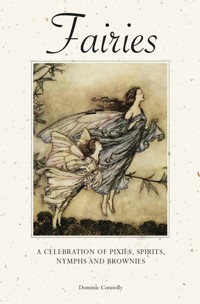
For centuries we have been fascinated with fairies, mythical beings often possessing intriguing magical powers to curse, trick or heal humans. The label of 'fairy' has at times applied only to specific magical creatures with human appearance, magical powers, and a penchant for trickery. At other times it has been used to describe any magical creature, such as goblins and gnomes. In Fairies, discover the charming story behind our best loved magical characters, including the Fairy Godmother, Shakespeare’s Titania and the beloved Tinker Bell. Myths and stories about fairies do not have a single origin, but are rather a collection of folk beliefs from disparate sources. Various folk theories about the origins of fairies include casting them as either demoted angels or demons in a Christian tradition, as deities in Pagan belief systems, as spirits of the dead, as prehistoric precursors to humans, or as spirits of nature. Fairies is a pocketful of delight, packed with beautiful images and full of fascinating tales.
Das E-Book können Sie in Legimi-Apps oder einer beliebigen App lesen, die das folgende Format unterstützen:
Seitenzahl: 76
Veröffentlichungsjahr: 2024
Ähnliche



















Fairies
Fairies
A CELEBRATION OF PIXIES, SPIRITS, NYMPHS AND BROWNIES
Dominic Connolly
This digital edition first published in 2024
Copyright © 2024 Amber Books Ltd
All rights reserved. No part of this publication may be reproduced, stored in a retrieval system, or transmitted in any form or by any means, electronic, mechanical, photocopying, recording, or otherwise, without prior written permission of the copyright holder.
Published by
Amber Books Ltd
United House
London N7 9DP
United Kingdom
www.amberbooks.co.uk
Facebook: amberbooks
YouTube: amberbooksltd
Instagram: amberbooksltd
X(Twitter): @amberbooks
ISBN: 978-1-83886-540-5
Project Editor: Anna Brownbridge
Designer: Keren Harragan
Picture Research: Terry Forshaw
Contents
Introduction
Fairies from Literature
It
The Gentleman with Thistledown Hair
The Iris Fairy
The Lavender Fairy
The Orchid Fairy
The Poppy Fairy
The Primrose Fairy
The Violet Fairy
The Wild Cherry Blossom Fairy
The Fern Fairy
The Ivy Fairy
The Jasmine Fairy
Moon Princess
The Lilac Fairy
Titania
Tinker Bell
Princess Ozma
Ariel
The Cottingley Fairies
The Blue Fairy
Queen Mab
The Bluebell Fairy
Fairies from Folklore
Fairy Godmother
Fairy Queen
Puck
Nuala
Morgan Le Fay
Oberon
Knockers
Nyx
Will-o’-the-Wisp
Joan the Wad
Banshee
Naiad
Vila
Lanvaettir
Dryads
Plant Devas
Billy Blind
Persian Peris
Leprechaun
Finvarra
Cliodhna
Aibell
Aine
Coblynau
Ellyllon
Bwbachod
Gwyllion
Gwragedd Annwn
Hobgoblin
Sluagh
Baobhan sith
Chaneques
Kappa
Lutin
Koro-pokkuru
Yumboes
Weaver Girl
Boggart
Bogle
Lauma
Bereginya
Yaksha
Mogwai
Pillywiggins
Kitsune
Zana
Jogah
Menehune
Tokoloshe
Mimi
Patupaiarehe
Acalia
Picture Credits
Introduction
Ever since humans began telling stories, they have been telling them about fairies. Cultures across the planet have felt the need to explain the unexplainable – and to understand the world around them – and the ‘little people’ have helped them do this.
Although there are physical as well as behavioural differences between fairies from different parts of the world, there exist common themes among them. Many are protectors of nature, as human existence depends on bountiful environments; while others help dreams and aspirations come true. There are also those who help people with their chores and work.
Then there are those associated with fertility, and those linked to death. In fact, the common popular image of fairies these days – winged, female and benevolent – belies how fairies have represented the whole range of human nature. Many fairies are mischievous, others flit between good and bad, while a few are pure evil. And they often come in the male form and have no ability to fly.
Whatever their nature, they are a colourful addition to human culture. And, from folk tales, they have woven their way into all forms of written, visual and aural art forms.
Our world would be so much lesser without fairies.
Fairies from Literature
Shakespeare did much to popularize fairies by writing A Midsummer Night’s Dream, which relies heavily on them. Later, other writers and artists, particularly in and after the Victorian era, latched on to the romance of some fairy stories. These arguably sanitized takes on fairies were compounded in the 20th century with the likes J.M. Barrie’s Tinker Bell from Peter Pan, particularly in her Disney incarnation. However, more recent works, such as the Harry Potter series, have returned to more complex fairies.
Illustration of the Fern Fairy in Keepsake for the Young – A Book of Amusement by Aunt Friendly from 1880
It
In E. Nesbit’s 1902 novel Five Children and It, a group of youngsters discover a sand-fairy in a gravel pit. The sand-fairy – the ‘It’ of the title – is what Nesbit calls a Psammead, which is similar in name to the dryad, naiad and oread nymphs of Greek mythology, but looks grotesque not beautiful. The story was turned into a 2004 film starring Freddie Highmore, Kenneth Branagh and Tara Fitzgerald, with Eddie Izzard as the voice of ‘It’.
Once upon a time…
The Psammead found in the gravel pit has the ability to grant wishes, which all go comically wrong.
Origins:
In the months before the Five Children and It novel was released, segments that would go on to make it up appeared in Strand magazine, under the title The Psammead, or the Gifts.
In popular culture:
There have been a number of stage and television adaptations of Five Children and It, including a Japanese anime version that ran for 78 episodes.
A wooden sculpture of The Psammead, a sand fairy from Five Children and It in southeast London
“Fairy-tales and magic, are, so say the grown-ups, not true at all. Yet they are so easy to believe, especially when you see them happening.”
– E. Nesbit
The Gentleman with Thistledown Hair
In Susanna Clarke’s 2004 novel Jonathan Strange & Mr Norrell, the Gentleman with the Thistledown Hair is the ruler of several fairy kingdoms. He has long, silvery hair, ‘pale, perfect’ skin, bright blue eyes and dark, perfectly formed eyebrows that end in an upward flourish. Jonathan Strange & Mr Norrell – about magic in the time of the Napoleonic Wars – was Clarke’s debut novel and took 10 years to write.
Once upon a time…
Susanna Clarke’s inspiration for Jonathan Strange & Mr Norrell came, she says, “in a kind of waking dream”.
Origins:
The specific characteristics of the Gentleman with the Thistledown Hair were brought to life in the book by illustrator Portia Rosenberg.
In popular culture:
Marc Warren played the Gentleman with the Thistledown Hair in the 2015 BBC TV adaptation of Jonathan Strange & Mr Norrell, starring alongside Bertie Carvel, Eddie Marsan, Samuel West, Charlotte Riley and Paul Kaye.
“Fairies do not make a strong distinction between the animate and the inanimate. They believe that stones, doors, trees, fire, clouds and so forth all have souls and desires, and are either masculine or feminine.”
– Susanna Clarke
An impression of The Gentleman with the Thistle-down Hair from Jonathan Strange & Mr Norrell
The Iris Fairy
The iris takes its name from the Greek word for ‘rainbow’. Iris is also the Greek goddess of the rainbow, so for thousands of years there has been a personification of it in human – or super-human – form. Many artists and writers have paired irises with fairies and, in the early 20th century, British illustrator and poet Cicely Mary Barker chose it as one of the plants for her Flower Fairies books, influencing many other creative people.
Once upon a time…
Cicely Mary Barker suffered from epilepsy and did not go to school, so spent much of her childhood painting and drawing.
Origins:
The Victorian artist and write Kate Greenaway – known for her illustrations in children’s books – heavily influenced Cicely Mary Barker
In popular culture:
In 2014 – Transport for London’s ‘Year of the Bus’ – a sculpture of a London double-decker was adorned with Flower Fairies artwork and stationed at the Whitgift Shopping Centre in Croydon, the area where Cicely Mary Barker was born.
A fairy with iris flowers, painted by Czech art nouveau artist Alfons Marie Mucha
“No need for journeying, Seeking afar: Where there are flowers, There fairies are!”
– Cicely Mary Barker
The Lavender Fairy
The popularity of lavender as a plant, with its many uses, has led it to be adopted by those who want to stylize fairies in stories and artwork. Cicely Mary Barker painted a Lavender Fairy and USA-produced dolls of lavender fairies have been made, standing more than 11 inches tall. Lavender fairies also appear on ceramic plates and there are blogs written about them.
Once upon a time…
The poem next to Cicely Mary Barker’s illustration of the Lavender Fairy quotes the 17th century folk song Lavender’s Blue, but opting for an older ‘diddle, diddle’ refrain rather than the more common ‘dilly, dilly’.
Origins:
Lavender’s Blue, which has come to be used as a nursery rhyme, started out as a bawdy song with verses celebrating sex and drinking.
In popular culture:
Cicely Mary Barker’s Lavender Fairy appears on YouTube, with a picture book, Lavender Finds a Friend, being read out loud and the pages being turned for viewers to see.
“I was Fairy Lavender. I loved it. It was good training for theatre.”
– Actress Sarah Snook, on being a children’s entertainer in her youth
A fairy with lavender flowers surrounded by butterflies and on the back of a bird
The Orchid Fairy
Types of orchids flower in all parts of the world, except in very icy climes, so they have been embraced by many cultures, often becoming the national flower of countries. Cicely Mary Barker chose two types of orchids to be represented in her fairy books – the straightforward ‘orchis’ and the ‘bee orchis’ – helping to popularize the association of orchids and fairies.
Once upon a time…
Cicely Mary Barker modelled the fairies on the children that attended her sister Dorothy’s kindergarten.
Origins:
Cicely Mary Barker’s Flower Fairies are pictured in costumes based on their respective flower. Her illustrations of plants are known for their botanical accuracy.
In popular culture:
An orchid fairy has her own book in Rainbow Magic’s Petal Fairies




