


20,99 €
Mehr erfahren.
- Herausgeber: John Wiley & Sons
- Kategorie: Fachliteratur
- Serie: Agora Series
- Sprache: Englisch
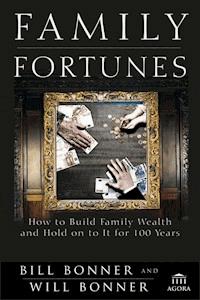
Selected as one of Motley Fool's "5 Great Books You Should Read" Advice on managing your wealth from bestselling author Bill Bonner From trusted New York Times bestselling author Bill Bonner comes a radical new way to look at family money and a practical, actionable guide to getting and maintaining multigenerational wealth. Family Fortunes: How to Build Family Wealth and Hold on to It for 100 Years is packed with useful information, interwoven with Bonner's stories about his own family's wealth philosophy and practices. A comprehensive guide that shows how families can successfully preserve their estates by ignoring most of what people think they know about "the rich" and, instead, training and motivating all family members to work together toward a very uncommon goal. This book is a must-read for all individual investors--even those who do not plan to leave money to their children--because it challenges many of the most ubiquitous principles and rules of investing. You might expect a book on family wealth to be extremely conservative in its outlook. Instead, the Bonners announce what is practically a revolutionary manifesto. They explain: * Why family money should NOT be invested in "safe, conservative" investments * Why charitable giving is usually a waste of money, or worse * Why it is NOT a good idea to let children go their own way * Why you can't trust wealth "professionals" and why you should never entrust your money to money managers * Why giving your children as much education as possible is NOT a good idea * Why Warren Buffett and the rest of the rich people asking for higher tax rates are wrong to take "the pledge" * Why Wall Street is a graveyard for capital, why most celebrity CEOs are a threat to the businesses they run, why modern capitalism is a failure, and more You will come away with a very different idea as to what family wealth is all about. It is not stodgy. Not boring. Not moss-backed and reactionary. On the contrary, it is the most dynamic, forward-looking capital in the world. The essential guide to passing wealth from one generation to the next, Family Fortunes is filled with concrete, practical advice you can put to use right away.
Sie lesen das E-Book in den Legimi-Apps auf:
Seitenzahl: 590
Veröffentlichungsjahr: 2012
Ähnliche




















CONTENTS
Preface
Acknowledgments
Introduction
Chapter 1: Who Ya Gonna Call?
The Family vs. the State
Going Bust
“Nobody Really Starts with Nothing”
A History of Family Wealth
The Tax “Solution”
A Stab in the Back
The Family Office
The Family Balance Sheet
Human Capital
No Room for Retirement
Financial Capital
Enemy of the State?
Chapter 2: The Family
It Takes Teamwork
Life On a Dual-Income Treadmill
Everything Regresses to the Mean
The Role of the Matriarch
The Glue that Holds it All Together
The Three “D”s
Seven Common Pitfalls for Wealthy Families and How to Avoid Them
The Matriarch of the Rothschilds
Growing Human Capital
Developing Your Family Culture
Family Values
The Family Business
How to Bring “Outsiders” into the Family
Fighting Addictions and Troublesome Family Members
Chapter 3: What About the Money?
Most Charity is a Waste of Time and Money
More Harm than Good
Vanity
How Do you Accumulate a “Family Fortune”?
Now Back to Our Story
Are Stocks a Good Idea?
So How Do you Get Real Family Money?
Not So Fast
F-U Money
How Much Money Do you Need?
What Kind of Money is Family Money?
Financial Escape Velocity
Lock it Up!
Chapter 4: Making Your Fortune in Business
The Best Way to Get a Fortune
How to Build a Family Business
One Step at a Time
Learn at Others’ Expense
Don’t Be a Pioneer
Don’t Be an Opportunist
Don’t Try to Do it On Your Own
Morale and Why it Shouldn’t Matter
What Kind of Business Should you Be In?
Work Hard . . . Get Lucky
Compound Effort Over Time
Where Do These Things Come From?
Who Makes Money?
Stay in School?
Chapter 5: Making Your Fortune in Investments
The Key Variable
Born Yesterday
Born the Day Before Yesterday
Desilusionado
Stay Away From “Conservative” Investments
Don’t Chase Alpha
150 Times Your Money in 40 Years
The Beta Personality
Alpha Matters, Too
Capital Gains, Not Income
Let Mr. Market Tell His Story
Don’t Take a Big Loss
The Resource Advantage
America Depends on Cheap Oil
No Longer a Free Society
Spurts Of Growth
A Final Thought . . .
Chapter 6: Our Beta Bets
Bet On the Losers
Why Emerging Markets Will Outperform Developed Ones
“Progress”
The Chinese Century?
What About the Internet?
The Lost Century
Big Trend No. 2
Who Will Have the Last Laugh?
Chapter 7: Hard Structures
A Will and an Estate Plan
Back to the Beginning . . .
An Intentionally Defective Trust
Expatriate Yourself
Using Tax Havens
Taxes Are Largely a Matter of Culture
An Overseas Account
Americans’ Unique Tax Problem
Five-Country Strategy
Putting it All Together
How it Works
Chapter 8: Creating Prosperity for Generations
Soft Structures
Getting Involved
The Heart of the Family Office System: The Family Council
What the Family Council Does
Who Should Sit on the Family Council?
The Family Council’s Role in Trusts
How Multigenerational Families Grow Their Wealth
Set Your Priorities With a Family Mission Statement
The Family Constitution
Setting Up the Family Bank
Creating Permanent Leadership
How to Handle the Transition
Family Council Leadership
Disputes: Why They’re Normal and How to Settle Them
How to Deal With Problem Family Members
Creating a “Family Republic”
Preserving Your Financial Legacy: How to Establish Your Investment Committee
The Wealth Strategist in Each Generation Leads the Committee
A Training Ground for the Next Generation: A Family Philanthropy
Chapter 9: Families with Money
A Brother’s Betrayal and the Liquidation of the Waxman Family Business
Brothers’ Promise Turns into a Family Feud
Pay Two Estate Tax Bills at Once?
“Princess TNT” Saves the Royal Estate
The Public Spectacle
Beware of Parasites
The End of an American Dynasty
A Great Family Business Lost
Introducing the HéNokiens
A Patriarch’s Iron Grip Spells Trouble for a Family Business
Chapter 10: The Family Stronghold
Where to Go?
A Place of Your Own
About the Authors
Index
Copyright © 2012 by Bill Bonner and Will Bonner. All rights reserved.
Published by John Wiley & Sons, Inc., Hoboken, New Jersey.
Published simultaneously in Canada.
No part of this publication may be reproduced, stored in a retrieval system, or transmitted in any form or by any means, electronic, mechanical, photocopying, recording, scanning, or otherwise, except as permitted under Section 107 or 108 of the 1976 United States Copyright Act, without either the prior written permission of the Publisher, or authorization through payment of the appropriate per-copy fee to the Copyright Clearance Center, Inc., 222 Rosewood Drive, Danvers, MA 01923, (978) 750-8400, fax (978) 646-8600, or on the Web at www.copyright.com. Requests to the Publisher for permission should be addressed to the Permissions Department, John Wiley & Sons, Inc., 111 River Street, Hoboken, NJ 07030, (201) 748-6011, fax (201) 748-6008, or online at www.wiley.com/go/permissions.
Limit of Liability/Disclaimer of Warranty: While the publisher and author have used their best efforts in preparing this book, they make no representations or warranties with respect to the accuracy or completeness of the contents of this book and specifically disclaim any implied warranties of merchantability or fitness for a particular purpose. No warranty may be created or extended by sales representatives or written sales materials. The advice and strategies contained herein may not be suitable for your situation. You should consult with a professional where appropriate. Neither the publisher nor author shall be liable for any loss of profit or any other commercial damages, including but not limited to special, incidental, consequential, or other damages.
For general information on our other products and services or for technical support, please contact our Customer Care Department within the United States at (800) 762-2974, outside the United States at (317) 572-3993 or fax (317) 572-4002.
Wiley also publishes its books in a variety of electronic formats. Some content that appears in print may not be available in electronic books. For more information about Wiley products, visit our web site at www.wiley.com.
Library of Congress Cataloging-in-Publication Data:
Bonner, William, 1948–
Family fortunes : how to build family wealth and hold onto it for 100 years / Bill Bonner and Will Bonner.—1st ed.
p. cm.—(Agora series; 77)
Includes index.
ISBN 978-1-118-17141-7 (Cloth); ISBN 978-1-118-23987-2 (ebk); ISBN 978-1-118-26451-5 (ebk); ISBN 978-1-118-22684-1 (ebk)
1. Families. 2. Wealth. 3. Financial security. I. Bonner, Will, 1978–II. Title.
HQ734.B688 2012
306.85—dc23
2012015373
This book is dedicated to our matriarch, Anne Bonner. She rocked the cradles . . . and our world.
PREFACE
What separates the rich from the rest of us?
Hemingway claimed it was the fact that they had more money.
Recently, we drove through a working-class neighborhood of Baltimore, called Dundalk. It is an area of simple one- and two-story wooden houses on small lots. Fifty years ago, it was where Baltimore’s industrial labor force lived. The residents worked in heavy industries for companies such as Bethlehem Steel, General Motors, and the B&O Railroad and at the busy harbor.
Today, those high-wage industries are mostly silent and rusting. Some sites along the water have been converted into loft apartments for Baltimore’s young professionals. And some of the children and grandchildren of the older residents have moved away—to the suburbs or to other cities.
But most of them are still there. Their parents and grandparents earned a good living. But few got rich. And now, few of their descendants are rich, either.
Across town, in the rich “old” northern suburbs of Roland Park and Ruxton, the people are different. The rich left the city many years ago. But in these green suburbs, they remain. Some richer. Some poorer. But by and large, they’re the same people whose parents were there 50 years ago.
What accounts for it? How come some families stay rich generation after generation, while others never have a nickel?
“Culture,” you will say. “Education,” perhaps. You won’t be wrong. But what, specifically, about culture and education is it that makes such a big difference in outcomes?
The secret is simply this: The rich take the long view.
Let me ask you something. If you thought you’d live forever, would you do anything differently? Wouldn’t your attitude toward your money change a little? Wouldn’t you slow down, realizing that you’re not in such a hurry to make money? And wouldn’t you reduce your spending, too, knowing that your money would have to last you a long, long time?
If you look carefully, almost all Old Money secrets can be traced to a single source: a longer-term outlook. The truly wealthy are careful to spend their money on things that hold their values over time.
It’s why they do not trade in and out of investments. Instead, they find a few positions and stick with them—for decades.
It’s also why they prepare their families, over the course of many, many years, so that they will be prepared for the challenges of managing and enlarging the family wealth.
It’s why they invest in education and training. And why they make sure family members add to their collective wealth, rather than subtracting from it.
It’s why they try to guide their children to suitable spouses. They know that a rotten apple will spoil the barrel.
It’s why they spend time and money on lawyers and accountants, too, making sure that the structures are in place to pass along wealth and protect it.
It’s why they prefer deep-value assets over momentum investing. Over time, value rises to the top. Momentum slows.
It’s why they will wait a long time—many, many years—for the right investment at the right price.
It’s why they like investments with long-term payoffs, such as timber, mining, and infrastructure. And it’s how they are able to benefit from compound growth, letting relatively modest gains grow over several generations.
It’s why they are almost fanatical about eliminating costs: taxes, investment charges, and unrewarding living expenses. They know that wear and tear, over time, will wreck their family fortunes.
It’s why they develop long-lasting partnerships with the professionals they need to make sure their interests are protected and their plans are carried out.
It is all a matter of time. They have money. But they expect to have it for a long time. So they work hard, investing in education and professional advice, to make sure they have the personal resources they need.
As you will see in the pages that follow, the long view comes into play in almost everything. But it’s one thing to talk about the “long view” and quite another to take it. What it usually means is something that most people don’t want to do: give up something today for something tomorrow.
Psychologists have done some work on this subject. What they have found is what you’d expect. People who can forgo immediate rewards in favor of longer-term goals are more successful.
In one study, for example, children were offered marshmallows. But they were given a choice. They could have one marshmallow right away. Or if they were willing to wait, they could have two later on. The children were then filmed. They fidgeted. They fussed. They struggled to resist taking the candy, because they knew that two would be more satisfying than just one.
In the study, the average child held out for a bit short of three minutes. But about 30 percent of them held out for 15 minutes and were given two marshmallows.1
The chief researcher in these studies, Walter Mischel, had tested the friends of his own young daughters and was therefore able to keep an eye on his subjects throughout the years. As they grew up, he began to notice a link between his marshmallow tests and the girls’ subsequent performances in school. Curious, he followed up with a serious inquiry into how his marshmallow tests corresponded to other areas of performance. What he found was that, generally, the children who could not wait often found themselves in difficulty later on . . . either with behavioral or academic problems. They had lower SAT scores. They had trouble paying attention. Even their friendships were weak.
On average, the kids who could wait 15 minutes had SAT scores more than 200 points higher than those who could wait only 30 seconds.
In another study, researchers offered teenagers $1 immediately . . . or $2 a week later. They found the results were far better indicators of academic success than IQ tests.
But the researchers didn’t stop there. The kids grew up, with the psychologists looking over their shoulders. The low self-discipline children became—surprise!—fat, unsuccessful adults.
In his testing, Mischel found something interesting and a little disturbing. Children as young as 19 months old could be tested, reliably, to see if they could delay gratification. If they could, they seemed destined for success. If they couldn’t, they were surely going to end up in prison or the poorhouse. This made it appear to be a genetic matter. Either you were “born that way” or you weren’t. But Mischel says it’s more complicated that that. It’s like learning to use a computer. You won’t do it if you don’t have access to a computer.2
Broadly, from our point of view, we interpret that to mean that you won’t develop the capacity for forbearance unless you have a reason to.
If there is one thing that marks families with money over the long term it is this: delayed gratification.
There are psychologists who believe that the performance of different cultures can be largely explained by this single point. Those who look ahead to the future and those that plan for it—surprise, surprise!—have better futures.
There are even some geo-theorists who believe that the relative outperformance of certain ethnic groups of people can be explained in the same way. How come Europe grew rich while Africa remained poor? How come North America is relatively rich, while South America is relatively poor? (However, this was a better question a few years ago, when the differences were more obvious.) How come, generally, colder countries are more successful than warmer ones?
The reason, they believe, is that colder climates force a longer-term view.
Believe it or not, there are still groups of primitive hunter-gatherers living on the African savannah. Anthropologists studying them have found little sense of the future. They do not prepare for it because they don’t need to. One day’s hunt is much like the next. One day’s nuts and berries differ little from those of the day before. No need to think much about the future or to plan for it.
Presumably, people very similar to these primitive tribes spread into Europe and Asia, and there they encountered new challenges. Thirty thousand years ago, there were human tribes following the caribou along the face of Europe’s continental glacier.
Near our house in France there is a cave that provides evidence. For thousands of years, a group of hunters made the cave a stopping point. But it was only a stopping point. They followed the herds of caribou that ranged over Europe at the time. As the weather changed, so did their lifestyle. They had to change their living patterns—and their living places—to keep up with the weather.
In cold climates, you need to stock food, clothing . . . and prepare shelter . . . in anticipation of bad weather. In some places, growing seasons are only a few months long. People had to work night and day in order to put aside enough for the long, cold season ahead. Whether this brought about a change in the habits of mind that cause a person to think about the future—or whether the harsh climate merely eliminated people who could not prepare for it—we don’t know. But somehow the idea took . . . and became more than an idea; it became a cultural rule.
No doubt, the notion that thinking ahead pays off was reinforced by the introduction of agriculture. It was one thing to gather wild grains. It was quite another to plant them. Planting required prepared land, seed and, in the warm, dry climates of Mesopotamia and Egypt, irrigation. All of these things forced people to think ahead. And they required sacrifice in the present for the sake of the future.
How many families went to bed hungry rather than “eat their seed corn”? They had to sacrifice . . . to forbear . . . to discipline themselves to not eat the kernels of corn they had spared for planting, or they would not have any corn to harvest the next year. People must have also learned to save not only some corn, but the best corn, for those were the best seeds. So a family had to deprive itself of its best food . . . in order to have more later on.
A quick look at a map will also reveal another curiosity. Look at places that are rich. Then look at places where people are poor. Take Haiti, for example. It is one of the poorest countries on Earth. It is also one of the easiest places to grow food. Go figure. Want to find other easy places to grow food? Just look at some of the poorest countries in the world: the Democratic Republic of Congo, Burundi, and Liberia.
Now take a look at Switzerland. It is perhaps the richest country on Earth. It is also one of the hardest places to grow food. Go figure again. And look at other relatively rich countries: Sweden, Norway, Denmark, Germany, Britain.
Is it a coincidence that these are difficult places to grow food? Where, for thousands of years, people had to look ahead, plan, and prepare in order to avoid going hungry?
Of course, there’s more to the story. Take West Virginia. On the surface of things, West Virginia and Switzerland are almost twins. Both are mountainous. Both are landlocked in the middle of great economies. Both are inhabited almost exclusively by people of European descent.
But the similarities end there. In terms of resources, Switzerland is poor. West Virginia is very rich. While Switzerland has little timber, little arable farmland, and few mineral resources, West Virginia has almost unlimited supplies. Its oil and gas resources, for example, could power the entire United States for more than 100 years. It doesn’t have wide, flat fields, but compared with Switzerland, it has much more useful, fertile farmland; its mountains are not as high or steep. It also has timber and water resources in abundance.
Oddly, in terms of earnings and net worth, there is an even further divergence, but in the opposite sense: The people of Switzerland are the richest in the world. The people of West Virginia, however, are among America’s poorest. How could that be?
We don’t know. But the cultures are quite different. Switzerland evolved a forward-looking, patient, and self-sacrificing culture. Perhaps it was the long, snowy winters that exaggerated the “prepare, prepare, prepare” culture. The Swiss build houses out of concrete, stone and solid wood, according to the toughest building codes in the world. They even have to have bomb shelters . . . with food and supplies stocked up against disaster. They also have, per capita, the biggest intergenerational wealth transfers in the world.
We know West Virginia fairly well. It is perhaps our favorite state. But it is also a puzzlement. There are rocks and trees everywhere. Compared with the soft, funny-shaped rocks of Poitou, France, where we’ve spent years repairing stone walls, the rocks in West Virginia are a stonemason’s dream. They are hard ... and often rectangular. They practically lay themselves.
As for the timber, imagine the envy in a Swiss woodsman’s eyes when he sees it. The old hardwood forests of Switzerland must have been cut down centuries ago. What is left is controlled growth, mostly conifers, which have nice qualities of their own, but are in no way equal to the majestic oaks, beeches, and hickories of West Virginia’s green hills.
The first settlers used the trees to build log cabins, mounted on stone foundations. Later came two-by-fours, aluminum siding, and drywall. Not to mention tarpaper and mobile homes! Even in the twenty-first century, many of the houses you will see in West Virginia are shacks—architecturally disgraceful, uncomfortable, charmless, and temporary. Compared with the sturdy Swiss chalet, the common West Virginia house is little more than a hovel.
What’s more, when you look at almost any house in Switzerland, what you don’t see is as telling as what you do. Before your eyes, you will find a handsome building, designed to last for centuries. You will not see any of the typical lawn decorations so popular in West Virginia. There are no rusty automobiles with their hoods up and their wheels off. There are no refrigerators lying on their backs, as if killed in battle and left to lie where they fell. Nor will you see lawnmowers, tractors, cement mixers, children’s toys . . . or any of the other paraphernalia that West Virginians use to fill the empty places in their parks and gardens. No one knows why this is the case, but we will put forward a hypothesis: They are victims of abundance.
In Switzerland, the approach of winter meant many months with little access to food. It required the Swiss to think ahead, to plan for the lean months. You might think the same phenomenon would shape the culture of the mountain men of West Virginia, too. But the Mountain State is a much richer place. And it was settled—at least by Europeans—after the invention of the efficient hunting rifle. The first European settlers, tough Scots-Irishmen, found plenty of game, even in winter. They were much better armed than the “Indians” who preceded them. They found it relatively easy to feed themselves.
In fact, according to some reports, the native tribes had bad habits of their own. They didn’t have to work too hard to survive, either. And when the first white men learned from the natives, not only did they pick up their skills, but they took up their insouciant attitudes.
Even today, the mountain men do not seem particularly concerned with planning for the future. When the going gets tough, the tough men of the Appalachians go hunting. Just like the Indians.
As for their miserable lodges, the settlers merely picked up the habits of the migratory hunters who preceded them. There was no need to build lasting structures; they would move to the next valley . . . the next hollow . . . the next county . . . soon, anyway. And why not throw the refrigerator out the door? It was such a big wilderness . . . so rich in everything, especially land. Throw out the trash and move on. The attitude was well adapted to the place. Why go to all the trouble of building proper garages—and proper houses—if you’re going to move on soon, anyway?
But it is not an attitude that encourages long-lasting wealth. We must be more like the Swiss and the Dutch than the West Virginians or the Haitians. We have to make sacrifices now, for the benefit of the future.
Unfortunately, it may be a future in which we personally cannot participate. For it is a distant future we are talking about, 20 . . . 50 years ahead.
It is only by looking ahead, into a future we may not be able to see with our own eyes, that we can build enduring wealth. And by the way, there’s more to “wealth” than just money.
One thing you can see for yourself: Rome wasn’t built in a day. Nor were the Jardins du Luxembourg. The architectural wealth of Europe is the result of centuries of investment and preservation. The hovels and shacks disappear. The Louvre and Versailles are still there. They are part of Europe’s public wealth.
There is immense private wealth, too. You can have an ugly house. Or a pretty one. The values, from a tax—or even a market—standpoint could be the same. The pretty one takes more effort to get right. Even over generations.
We bought the Chateau d’Ouzilly for a pittance in 1994. The owners sold it to us because they could no longer afford to keep it up. We discovered that we could barely afford it, either. The correct translation of the word chateau is “money pit.” Most people would argue that it is a wealth destroyer, not a wealth builder. Most people would say that it is a way to deprive future generations of wealth, not to save it for them.
But life is funny . . . curious . . . and full of ironies. The previous owners had bought the chateau for nothing, paying for it in revolutionary scrip during the French Revolution. The local nobility had fled France for their lives. The chateau was there for the taking.
By the 1970s, however, the lands around the chateau had been divvied up by successive generations, and the remaining fields—about 300 acres—were not enough to support the house and the family. It had to be sold.
The seller told us that the weather was always good in the summer. “It never rains in July or August,” he claimed. As for the roof, “It never leaks.” One day in July, soon after we bought the place, we discovered that he had lied twice.
It would surely be cheaper and easier to repair the roof of a small house in West Virginia than to fix the roof of a chateau in France. The ardoise (local slate) costs a fortune. But when it was done, what did we have? We had a chateau that was dry and a roof that would last for maybe five times as long as we will. It was costly. But perhaps our children and grandchildren would thank us, for we could give them a long-lasting asset.
All over France, there are relics of the “chateau age.” Some are assets. Some are not. Where owners have not fixed the roofs, the chateaux are liabilities. But where the owners have kept them up, they are assets that can last for generations, assuming the French government doesn’t tax them too heavily.
The same general comments could be made—with fewer “if”s, “and”s, or “but”s—regarding gardens. In Europe, too, you will find gardens that were planted to increase the wealth of future generations, not necessarily the people who planted them. At our place, for example, we put in an allee of plain sycamores. Alas, the trees grow slowly while their owners age quickly. They will not reach their full majestic payoff until this author’s grandchildren are as old as he is.
The present generation, those who plant, are arguably as impoverished as those who replace a slate roof. But those who reap the rewards are enriched. Time has worked its magic. The future generation enjoys stately trees that took a lifetime to grow.
Again, you wouldn’t plant trees unless you planned to stay around—or, more correctly, you planned that your descendants would stay around . . . or perhaps that someone would stay around who would appreciate what you had done.
Another group that has been extraordinarily effective at creating and preserving wealth is the Jews. Many Jews throughout history have worked not as farmers, but as tradesmen, merchants, doctors, teachers, and moneylenders. Frequently, if not generally, they were denied ownership of land. They couldn’t plant trees. They couldn’t plant anything. Often, they didn’t have the need to “save the seed corn.” You’d think they would be the biggest spendthrifts and “live for today” crowd on Earth. But they are not. They are careful with wealth. And extremely forward-looking. Why?
Well, one thing that comes readily to mind is that Jews are also extremely oriented toward their own history. And history is a kind of future in reverse. Perhaps it gave them the same focus on the need for preparedness.
Jewish history is a long story of disasters, one after another. Many of those disasters involved avoiding extermination by fleeing. And fleeing costs money. The Jews, perhaps more than anyone, had to think ahead. They had to be prepared. At any minute, the heavy boot of the state or the mob might come down on them. They could not plant trees. But they accumulated wealth, often in the form of gold and diamonds. It is no coincidence that they are the world’s leading moneymen today.
In fact, with the Jews in mind, we might broaden our hypothesis into a general theory:
Adversity leads a people to appreciate preparedness. Wealth is preparation in negotiable form.
The first chapter of this book addresses the objection: Why would you bother? Can’t we safely assume that the supply channels will keep the supermarket shelves stocked, winter and summer? Aren’t the pogroms over? Isn’t the desire to stockpile grain—or wealth—for generations a bit useless and anachronistic, like a prehensile tail? Besides, it would be so much more fun to spend your money now, wouldn’t it?
Assuming you have jumped that hurdle, the following chapters suggest ways to do it.
Not that we, your authors, are experts on the subject. We are just learning. But we happily pass along what we think we have learned and/or figured out on our own. Whether it is correct or not—or whether it is useful or not—you will have to judge for yourself.
But the main point is worth keeping in mind: This book is not about getting something. It is about giving up something. It is for the planter. For the roofer. For the builder. For the saver. It is for the person who wishes to make a sacrifice—even if it is a relatively agreeable sacrifice—so that others may benefit from it, perhaps others whom he will never meet.
Bill Bonner
Notes
1. Yuichi Shoda, Walter Mischel, et al., “Predicting Adolescent Cognitive and Self-Regulatory Competencies From Preschool Delay of Gratification: Identifying Diagnostic Conditions,” Developmental Psychology, 26(6) (1990): 978–986.
2. Jonah Lehrer, “Don’t!: The Secret of Self-Control,” The New Yorker, May 18, 2009.
ACKNOWLEDGMENTS
Special thanks to Robert Marstrand, Chris Hunter, Kat McKerrow, Susanne Clark, and Elizabeth Bonner for their generous help in preparing this book.
INTRODUCTION
FAMILIES THAT WON’T FAIL AND MONEY THAT WON’T DIE
Much of what most people think about “Old Money” families is wrong, including much of what many Old Money families themselves think. You probably have an idea about what kinds of people they are. And you’re probably not too far off. But there are too few of them, and they are too varied, to provide a meaningful stereotype. Some are smart. Some are dumb. Some show off their money; others don’t. Many—perhaps most—are so discreet that we don’t know who they are and what they do.
For those and other reasons that will become obvious, we have chosen prescriptivism over descriptivism. That is, we will prescribe what we might call the “ideal” Old Money. We tell you what we think Old Money ought to do, what it ought to think, and how it ought to manage its wealth.
For example, you probably imagine that serious Old Money families are very conservative with their wealth, favoring “safe” U.S. Treasury bonds over riskier stocks and bonds. And if you have a lot of money, that is exactly what the typical investment advisor will tell you to do with it. You need to play it safe; stick to bonds.
But if you depend on wealth “professionals” to help you manage and protect your money, you are already making a big mistake. Most financial professionals are good at mixing drinks; some are excellent raconteurs. You shouldn’t let them near your money. As for U.S. Treasury debt, it is probably one of the riskiest investments you can make.
In this book, we talk about Old Money not necessarily as it is but as it should be. And it should be very different from what you probably imagine.
It is commonly believed that seriously rich people should withhold money from their children in order to toughen them up, so that they will “find their own ways” or “make it on their own.” Many favor giving their fortunes to charity in order to avoid corrupting their own kin.
This is nonsense, in our view. All wealth either is consumed or must be owned and managed by someone. Serious Old Money accepts the responsibility of taking care of its own money and preparing the next generation to do likewise.
Besides, most charity efforts squander wealth, and many harm the people they were meant to help.
Everyone knows, also, that you should try to give your children as much education as possible. But that, too, is wrong.
And so are Warren Buffett and the other super-rich people who think paying higher taxes will be good for the country. It won’t be, and Buffett must know it.
The closer you look, the more you see that the ideas most people have about wealth—and how to hold on to it—are silly, superficial, and probably a kind of financial suicide.
Not that we claim to have the ultimate truth on the matter. But, at least, we can see that most of the ideas you find on the subject are humbug.
As you will see, family money is very different from other kinds of money—even the money of the rich. It requires different treatment, different management, different security measures—a different investment philosophy—even a different cultural bias.
There are a lot of families. And there are a lot of rich people. But there aren’t many rich families, at least not for long. And there’s a good reason. Keeping money and the family together over longer than a generation is tough. Statistically, it’s unlikely. Practically, it’s hard work. Most people don’t even want to try. Because it’s too hard. Or because they don’t even think it is a good idea.
Real family money—Old Money—is rare; it’s way out on the edge of the bell curve. And it involves sacrifice, not self-indulgence. It involves giving up, not getting. It involves more work, not more leisure.
It is a challenge, not a reward.
But if you are the sort of person to whom this challenge appeals, the rewards can be very substantial.
Let’s say, for example, that you’re able to put $1 million in a family trust. If you organize it correctly and get a rate of growth averaging 6 percent compounded (there are some very important tricks you need to know), your grandchildren could have $18.4 million in 50 years.
But there’s much more to this than money. In fact, money is the least of it, the easiest part of the whole program. Nor is it the biggest benefit. Not by a long shot. This is not about making or preserving money. It’s not about gaining fame and fortune. It’s not about living the good life of luxury and ease.
It’s about building the kind of family that can maintain its wealth and independence over generations. This is no easy feat. It’s against the odds. It’s almost against nature itself. Nature always tries to drag a family back down to the ordinary. And most ordinary people don’t have any wealth to speak of. So if you’re going to have wealth—and hold on to it for longer than a single generation—you’re going to have to do some rather extraordinary things.
Such as?
Well, once you’ve made money, you might think the hard part is over. You might think you don’t have to take chances or work so hard. All you have to do is to put the money into “safe” investments and kick back, right?
Wrong. The “safest” investments always turn out to be the most destructive, from a long-term perspective. And besides, you can’t afford the low returns that these supposedly safe investments bring. You need investment returns higher than average. That means you need an entirely different investment approach.
The key to this approach is that you have to learn to use time to your advantage. Time works against almost everybody. But if you want your family to maintain wealth over several generations, you have to make time work for you or you’re doomed.
Time destroys fortunes in obvious ways, and in some ways that aren’t so obvious. Each year that passes imposes costs: living costs, taxes, maintenance, and so forth. There are also investment costs: fees, commissions, charges. Plus, there are inevitable setbacks: bear markets, errors, oversights, inflation, crashes, fraudsters. All cost you money, sometimes big money.
You have to limit these costs, which isn’t easy, and you need to earn higher rates of return to offset them. You can do it, with a little luck, if you let time work for you.
The typical investor is betting against time. He buys a stock. He hopes the stock will go up . . . and that he will then get out before time takes it back down again.
But if you’re willing to let time help you, you can wait long enough to see what direction the market is taking. The big trends are long-term trends. The last big bull market on Wall Street lasted 25 years. The bear market before that lasted 16 years. The bull market in bonds began in 1983 . . . and it’s still going on. These are the trends that pay off. And if you listen and watch carefully, you can see them coming and going. And you can use them to limit your losses and improve your gains.
But that is not the most important thing. Time also has a devastating effect on families. People grow old. They’re no longer able to do the work required to maintain a dynamic, capable family. New family members are often less able or distracted. Husbands, wives, children—every new family member comes with risks attached. And over time, one or two of those time bombs is bound to blow up.
More important than the money, the family has to be kept strong and healthy. A strong family can make money. A weak family can’t even hold onto money that someone else made. A strong family can build and develop business opportunities. A weak family can only fumble and destroy them. A strong family can meet its financial, business, and other challenges. A weak family collapses under the pressure of them.
So how do you use time to make sure you have a strong family?
Well, that’s the real secret of Old Money families. And it’s a story that is scarcely understood by anyone. The key is that Old Money families are very, very different from regular families. And they are not at all what most people think they are.
They are not “conservative,” in the usual sense. Instead, they are active and forward looking.
They may or may not live in luxury. But they always take care to live well.
They do not spend their time in idleness and leisure. Instead, they are engaged in business, investment and family activities.
They do not even rely on Old Money. They know that each generation needs to renew and rebuild its wealth—and itself.
You may find our view of Old Money surprising. In fact, a lot of people who actually have Old Money may find it surprising. For it is not merely a view of what people with multigenerational money do; after all, some are just lucky. It is not merely a sociological or financial study.
It is a manifesto for a new way of looking at both family and money.
Will Bonner
CHAPTER 1
WHO YA GONNA CALL?
We are learning the secrets of France’s richest family. At least, they appear to be the richest family in France. They have businesses with annual revenues of about $70 billion—and more than a quarter of a million employees. But we’ll bet you’ve never heard of them. And you’ve almost certainly never seen a picture of them. They are the Mulliez family from the north of France. Discreet. Private. Unostentatious.
They own huge discount shopping centers all over France and much of Europe. They were able to figure out how to run large-surface, low-price, rapid-turnover merchandising enterprises. Once they had the system figured out, they were able to apply it to several different retail industries.
The Mulliez family has been in business for half a century. They have managed to create one of the world’s biggest and most profitable family business empires. And they have done it while also creating one of the biggest and most successful families.
From a business perspective, they followed the same three-step success formula John D. Rockefeller famously prescribed: They got to work early. They stayed late. They “struck oil” in the discount retail business.
But the really remarkable thing is the way the Mulliezes have been able to work together as a family, providing all the members—including over 520 in the extended family, not just those who happen to run the businesses—with substantial and enduring wealth.
What’s their secret? We don’t know. But we can guess.
First, it helps to have a big family. The disadvantage of a large family is that you have to split up the wealth among more people. But the advantage is that you have more hands to do the work. And the odds are you will have some clever people in the group.
The founding couple had 11 children. Their children almost all had children, too. Three of them had 7 children each.1
Second, the family decided not to split things up, but to have a system of “everything for everybody,” in which all the children of the founding couple shared equally all the wealth (shares in active companies, mostly).
This was a break with tradition in a couple of respects: Usually, the people who actually build the wealth get a larger share of it. And, typically, in the north of France, although wealth may be partitioned equally, women are usually given real estate and men are given businesses (on the theory that they will take the risks and rewards of active enterprise, while women will be happy to have the solidity of real estate).
This decision, made decades ago, made a big difference. It kept the whole family focused on the family business because they were all in it together. Among the second generation, many did not play an active role in the business, but often, their children, who had as many shares in it as the children of the active siblings, did. The family could draw on three generations of talent. It still does.
Also, as new businesses were created, they were spun out from the center—with “everything for everybody” still the guiding principle.
Third, the family makes a huge effort at affectio societatis, the conscious reinforcement of the family’s original principles and philosophies. The founders’ business—and other—ideas are rehearsed, recalled, and recycled into each generation.
Fourth, they are careful not to get sidetracked by wealth or fame. They keep out of the public eye. There are few, if any, photos of the family members. The general public doesn’t know who they are or what they look like.
Fifth, they do not sell. They’ve had many chances to “monetize” their businesses. They’ve rejected each one systematically. Their businesses double every seven years.
Sixth, the family requires all shareholders, who are also uncles, cousins, and other relatives, to play a role. Even if they are not active in the business, they are supposed to inform themselves about how the business is doing and to help sustain the founding principles of the enterprise.
These interested, knowledgeable, and committed shareholders permit the Mulliez businesses to take a more long-term outlook. They are not particularly concerned with quarterly results or with dividend payouts. What concerns them is the growth and health of the extended business empire of which they are all part.
This is just a guess, but we think families such as the Mulliezes are likely to be much more important in the future than they were in the recent past. Family money, in particular, is likely to be much more appreciated.
THE FAMILY VS. THE STATE
People are social animals. They need organizations, institutions, and collective arrangements that suit them. Family organizations come naturally. The family, extended to uncles, aunts, cousins, and so forth, has been the most important grouping for most of our time as humans. It used to be the family that provided most of our wants and needs—from shelter to food, clothing, entertainment, companionship—you name it. The “means of production” were controlled by the family. Production took place within the family. Only mating was, and still is, usually done outside of the family.
The Old Testament is largely a story of families. And the development of the Roman Empire, too, is a history of a small group of families on the banks of the Tiber that managed to gain control over much of the known world.
In Ireland, where we have our family office headquarters, family-based political and economic power lasted up until the time it was crushed by Oliver Cromwell’s armies in the seventeenth century. Even today, the Irish parliament is known as the Fine Gael, or the “Gaelic families.”
Families receded in importance with the rise of the social welfare nation-state. The promise of modern government was that it would take care of its people. And the illusion was that it didn’t matter what kind of family you came from, that you would be equal to every other citizen. You would have equal access to public transportation, public education, job opportunities, and, ultimately—a good life.
Occasionally, the idea of the state as a replacement for the family was taken to extremes. Soviet-era work farms took charge of children at a very early age and raised them to be good communists. At least, that was the idea. Free from the biases, privileges, and residual bourgeois sentiments of family life, a collectively raised child was supposed to be the “new man” the Soviets thought they needed. What they got was a failed experiment and a nation of alcoholics.
Still, in modern developed countries, people are meant to owe greater allegiance to the government than to their own kin. They pledge allegiance to the flag. They register for the draft. They pay taxes. When they are in need, they visit a government assistance center. When they have a health problem, they expect a government-funded health system to take care of them. When they are unemployed, they look to the government to pay them—and to tide them over until they find another job.
If unemployment is statistically high, they expect the government to take action to fix the problem. And if there is a natural disaster, such as the flooding of New Orleans, they look to the government to look out for them.
Yet government’s performance has been spotty. In fact, every study ever done concludes that the family can be far more helpful to an individual than the state. Schools with more parental involvement—in areas with “good” families—produce higher test results. People from successful families earn more money. People whose parents were happily married are more likely to be happily married themselves. Neighborhoods with stable, decent families have lower crime rates. People from good families even live longer.
People with some family money behind them are more likely to start successful businesses. Successful families help their members overcome problems. Help them get back on their feet when they fall. They help them in countless ways, most of them immeasurable.
Governments spend enormous amounts of money. Presumably, this money is intended to help people lead better lives. But there is no evidence that people are any better off. And there is strong reason to suspect that they would be better off if the money spent by the government had been left in the hands of the families it came from.
The growth in government, as a substitute for or competitor to families, coincided with a huge growth in wealth. Arguably, people accepted larger and larger government like they accept runaway bar tabs—when they can afford them.
But there is no reason to think that the trend toward centralized authority is immutable. In fact, history may be a long tale full of sound and fury, like the ravings of a lunatic. But there are patterns to it. Sometimes, credit, confidence, and centralized political authority expand. Sometimes they contract.
Sometimes centripetal forces dominate, sometimes centrifugal.
GOING BUST
The past 300 years have been marked by further and further centralization: first, the consolidation of kingdoms, duchies, and principalities of western Europe in the eighteenth century. Then, the building of the nation-states in the nineteenth century. And, finally, the creation of the European Union in the twentieth century.
The United States of America was created at the end of the eighteenth century. Its centralization was assured by the War Between the States in the middle of the following century and, later, by the imposition of a federal income tax, the direct election of senators (which ended individual states’ participation in the federal government) and voluminous legislation and numerous Supreme Court decisions further enlarging the power of the central government at the expense of “states’ rights.”
All over the world, gradually, the local dialects, local money, local customs, and local military power disappeared. By 2007, all the major—and quite a few minor—European nations used the same currency, traded in the same goods, paid the same interest rates, and spoke a common commercial and diplomatic language: English. So, too, did the entire world come to practice modern credit-enhanced capitalism as taught in the leading business schools worldwide.
Why these things happened, we don’t know. Was it just because, with the availability of modern communications, it was possible for the first time? Was it because technology had enabled further elaboration of the division of labor, in which each region could do what it did best and depend on the others for what it lacked?
Was it because offensive weapons had achieved supremacy? With the invention of modern artillery, there was no standing behind castle walls to protect a local fiefdom.
Or was it because modern centralized, enlightened government—combined with free trade, free elections, citizen soldiers, and guided capitalism—was simply a better, more productive system? We don’t know.
But now we know something. The political/economic model used by European and American nation-states for the last 150 years is going bust.
They can’t continue to pay for lifestyle enhancements with debt. Every major developed country in the world now has total debt-to-GDP (gross domestic product) of more than 250 percent. Britain and Japan are near 500 percent. You can do a simple calculation to figure out why that level of debt is unsustainable and why, as we write, Europe is on the verge of a crisis. With debt equal to five times GDP, interest payments take up a large part of output. At zero interest rate, the situation is manageable. But when interest rates move up, which they inevitably do, the debtor can’t keep up. Imagine an “ordinary” rate of interest of 5 percent. Five percent of 500 percent is 25 percent.
There is no way a society can afford to use a quarter of its output just to pay for things it has already put into service—and much of which has been fully consumed! As debt payments, the money for past spending, increase, there is less and less money available for the here and now and the future. The economy slumps. As the economy goes down, revenues decline, making less money available for debt repayment. It is an obvious trap—so obvious that the whole system “blows up” soon after you head in that direction.
A centralized, united Europe is not a sure thing. Europe’s leaders are fighting to stay in the footsteps of Louis XIV, Napoleon, Hitler, and Monnet: toward a unified Europe. They believe the debt problem can be hidden under the rug of a larger, more centralized political union. But the forces pulling apart the union may be greater than those bringing it together. The end of a 300-year-old trend may have finally arrived.
In America, too, the poor now threaten the rich. The middle class feels betrayed. Young men have been dubbed “Generation Jobless,” with the highest unemployment rate since the Great Depression. As for the poor, they grow ever more desperate.
The Occupy Wall Streeters attack the government from the left. The Tea Partiers launch their assault from the right. The central authority may not hold.
But things are coming apart for a reason. Centralized control no longer works. Expanding credit no longer produces expanding output. Further government “investment” no longer produces decent returns. The whole edifice wobbles—and then collapses.
And people are better off. Belgium, which has been coming apart for years, still has one of the highest growth rates in Europe.
Since modern nations can’t really afford the lifestyle goals they have set for themselves, they must cut back. That will mean that the people who counted on national health programs, free education, unemployment, welfare, pensions, and the other services provided by the government will be disappointed. They will look for alternatives.
And the alternative they will find is the one that was there all along—the one that has been the most reliable, from long before any histories were ever written up to the present: the family.
Unable to depend on the government when times are tough? Who ya gonna call? A federal bureaucrat? Or a friendly uncle?
To whom will you pledge allegiance? To the nation-state that let you down? Or the family that holds you up?
“NOBODY REALLY STARTS WITH NOTHING”
A study conducted in the early 1990s found that of those who inherited around $150,000, 20 percent left the labor force within three years.3 This phenomenon has been confirmed by more recent research.
In The Millionaire Next Door, Thomas Stanley and William Danko found that children who had received family money were worth four-fifths less than those in the same professions who did not receive money from their parents.4
These numbers should make you worry. Give money to your children and you may ruin their lives. But is it better to ruin the lives of someone else’s children?
One way or another, if you leave any surplus wealth behind, it’s going to end up in someone’s pocket. That person can benefit from it. Or not.
Merryn Somerset Webb, editor-in-chief of our own MoneyWeek magazine in the United Kingdom, says, “The great majority of entrepreneurs we write about have some money somewhere behind them.”5
Many entrepreneurs—including the elder of your authors—are proud of the fact that they “started with nothing.” But it is more a vanity than a fact. Nobody really starts with nothing. We set out from where we are. Perhaps we live at home, feeding at our parents’ table while we prepare our business. Perhaps we depend on the kindness of strangers or a winning smile to help us get started. We all have something at the beginning and something at the end. The trick is to make the most of the middle.
But how?
One of Old Money’s most precious secrets is time.
Here’s another one: modesty.
It pays to be wary of knowledge, facts, and certainty. In business. Law. Investments. Character. Family relations. Everything connected with family money. Nobody really knows anything. It is all guesswork. The best we can hope to do is to guess well so that the space between the beginning and the end is filled well.
Be aware that you may not be able to do all you hope to do, and if you’re not careful, you’ll do considerable harm. Tread boldly, but carefully.
Also, be aware that almost everything you read or hear on the subject is either stupid, wrong, and/or self-serving. Very often, the professionals who offer to help keep family and money are “talking their book,” encouraging you to do things that just, by coincidence, also put money in their pockets.
That is true, generally, in the investment world, too. The people who offer to make you money often have stakes in the investments they present. They sell and take commissions. They manage and take fees. They broker deals and take part of the upside.
While much of this conflict of interest is obvious, much of it isn’t. Nearly all of Wall Street (that is to say, all of the financial industry) has a bias to the upside. Its “book,” which is Wall Street lingo for its own financial interests, or its book of trading positions, wants you to believe that “investing” pays off. This is regarded as a matter of common knowledge. It is a “fact.” Yet it often isn’t true. And if you mean “investing” the way most people invest, it usually isn’t true.
Regarding family money, many of the other things that people take for granted should be taken out and examined more closely. Often, we find they are absurd, incorrect, or counterproductive.
A HISTORY OF FAMILY WEALTH
But let us begin our story in the beginning. . . .
Reaching back into history, what do we find? In what institution did people most often put their faith and their money? The government? Banks? Mutual funds? Lawyers? Clubs? The Church?
People made many different arrangements, depending on what was going on at the time. But the institution that most commonly held and allocated wealth was the family. We say that without any real proof. But it seems self-evident. Most people never had much real wealth. The little they had was what they lived.




