


Erhalten Sie Zugang zu diesem und mehr als 300000 Büchern ab EUR 5,99 monatlich.
- Herausgeber: The History Press
- Kategorie: Geisteswissenschaft
- Sprache: Englisch
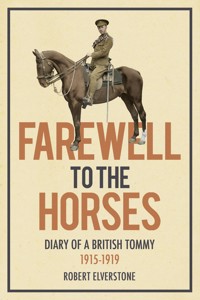
Cady Hoyte, like many other young lads of his generation, proudly joined the army in 1915 to fight for his King and Country. From the Warwickshire town of Nuneaton, he joined the Warwickshire Yeomanry as a gunner in the Machine Gun Corps and quickly found that army life made no concessions for an eager young 19 year old. Never having ridden a horse before, he develops a relationship with the horses, which made it all the harder when he had to say farewell and leave them behind to sail aboard the stricken ship, the Leasowe Castle, to fight in the trenches of France. Written with humour, Cady's diary gives a detailed account of the daily struggles and constant dangers of army life in the First World War without ever losing sight of his respect for human life.
Sie lesen das E-Book in den Legimi-Apps auf:
Seitenzahl: 264
Veröffentlichungsjahr: 2014
Das E-Book (TTS) können Sie hören im Abo „Legimi Premium” in Legimi-Apps auf:
Ähnliche



















‘Dedicated to the memory of my sister Margaret Anne Taylor (née) Hoyte, who was the niece and god-daughter of Cady Cyril Hoyte.’
Barbara Hoyte
CONTENTS
Title Page
Dedication
Acknowledgements
Foreword
Introduction
1 1915 – Tidworth Training Camp
2 Disembarkation – HMS Caledonia
3 Cairo
4 Salhieh
5 Ballah and Bally Bunion
6 Khantara
7 Hassaniya
8 Dispatches
9 El Arish
10 First Attack on Gaza
11 Second Attack on Gaza
12 Port Said
13 The Fall of Gaza
14 Jerusalem
15 Farewell to the Horses
16 Horse Tales
17 Alexandria
18 The Sinking of the Leasowe Castle
19 Across Italy by Train
20 The Western Front
21 Leave
22 Armistice
23 The Final Match
24 Sunday
Plate Section
Copyright
ACKNOWLEDGEMENTS
I would like to thank Cady’s niece, Barbara Hoyte, for allowing me to share this important historical document with a wider audience and for help with detail and research.
Thanks also to the staff of the Chilvers Coton Heritage Centre, Avenue Road, Nuneaton, for help with research and technical details, especially to Rob Everitt for a very interesting and informative tour of the centre.
The photographs, unless specifically indicated otherwise, have all been used by permission of the Hoyte family and have been taken from the family photograph album.
Finally, thanks must go to Cady Hoyte for the foresight to share his experience and for the sacrifices that he, and many more like him, made when he agreed to accept the ‘King’s Shilling’.
‘My sincere thanks to Robert Elverstone, for all his interest, enthusiasm, technical expertise and many hours of work, without which this diary would never have been published.’ – Barbara Hoyte
FOREWORD
July 28th 1914 is remembered as the day war was declared in Europe. Young men, from all walks of life, either joined voluntarily or were conscripted to fight in what they thought was to be a short conflict to defend freedom and democracy. Many believed the fighting would be over in a short time and that they would be home for Christmas. The reality was to prove very different.
On 28 June 1915, Warwickshire-born Cady Cyril Hoyte, aged 19, joined the Machine Gun Corps of the Warwickshire Yeomanry (the Warwicks). Leaving his home town of Nuneaton behind, Private 164684 Hoyte was sent to Tidworth Training Camp before being shipped to Egypt, where he fought as part of the British Expeditionary Force.
After the fall of Gaza, Cady was then sent to fight in the trenches of Northern France. Shipped aboard the Leasowe Castle, Cady was a survivor of the German U-boat torpedo attack which sunk the stricken vessel, before being transported across Italy by train, finally to arrive in France.
Throughout his time with the British Army, Cady kept a diary detailing not only the fears and horrors of the fighting, but also the ordinary daily events of army life. He writes with particular fondness of the horses with which he develops not only a working relationship, but also a true love of these magnificent animals that carried their riders to battle and, so often, to death.
At the end of the war, Cady began to type his diary in the form of a narrative, detailing his entire army career from inception to his final demob in February 1919. He writes with an easy narrative and humour, but never loses sight of his respect for human life and the friends he makes, and loses.
Throughout the diary, the horses are never far from Cady’s thoughts. The reader understands and is able to empathise with Cady when the time comes to say farewell.
It was by chance that I heard about the diary when researching material for another book. Barbara Hoyte, who is Cady’s niece, had inherited the transcript and kept it safely tucked away in a cupboard. What a fortunate moment, when over a welcome cup of tea I was asked, ‘Would you like to read it?’
In transcribing this version of the diary, I have made minor changes to the original script with the intention of making the narrative more easily readable. The detail, dates, description and historical content remain unchanged and can confidently be used as the basis for further historical research.
INTRODUCTION
Perhaps it is necessary to briefly summarise the period immediately preceding the time of the opening of the following diary; which is not intended to be in any way a record of the war, but merely the jottings of a common British Tommy who, prior to August 1914, had no thoughts or ambitions of shouldering a rifle in the service of his King and Country. Having metaphorically received the King’s Shilling and a new suit of khaki, the immediate introduction to the wilds of Salisbury Plain marked the commencement of real military life.
Here the soft corners of civilian life were soon knocked off, and all signs of individuality sunk beneath the title of an official regimental number. One quickly learned the difference between a ‘full-blown’ sergeant major and a temporary, acting, unpaid lance corporal; the former being easily recognisable by two things – the crown on his sleeve and his astounding vocabulary. From the latter, it was very evident that ‘damn’ was not swearing but merely the means of expressing oneself in the briefest but most effective manner.
Little time was required to learn the precise meaning of such expressions as fatigue, clink, CB, canteen (both varieties), and such orders as, ‘Fall in the guard’, ‘Prepare to mount’, ‘Cross your stirrups’, or even to unblushingly meet such shafts of sarcasm as, ‘Slacken your reins or you’ll give your horse the headache!’ and, after an all-too involuntary fall, ‘Who gave you the order to dismount?’
Then, too, by hours of monotonous instruction, one was taught the difference between a gun and a rifle; between a horse’s off fore fetlock and its near hock; and that, when on guard, to move about in a smart and soldier-like manner and to challenge all persons approaching one’s post between sunset and reveille.
All this brought us up to the time when the riding school instructor (an old regular who had won his rough-riding spur) administered his final words of advice: ‘When you get out yonder there are three things to remember; Number One first; Number One second; Number One third and, if there is a fourth, then Number One fourth’ – a very forcible way of explaining that it would be a case of every man for himself.
At any rate, by this time we figured that the result of our training could be aptly summed up as follows: ‘To kill is your duty, but to be killed is damned bad luck!’
Up to this point our daily routine had been somewhat as follows:
Reveille: 6 a.m.
Roll call: 6.10 a.m. followed immediately by ‘stables’ for the purpose of mucking out, in which process no shovels were allowed; hands were made before shovels in the eyes of the military authorities.
Breakfast: 7 a.m. after which we had to wash, shave and clean our buttons and boots before parading at 7.30; those for riding school in breeches and putties, and the remainder in slacks (fatigue dress).
As I was on transport, the whole morning was spent in drawing forage and rations from the supply dump near the station. After dinner, at one o’clock in the afternoon, we had to change into riding breeches and putties, saddle-up our horses and parade for riding school at two o’clock. (Some of our early struggles with saddle and horse can very well be left to imagination.) On returning from riding school (two hours of it), we had to water and rub down our horses, then hurriedly change again into slacks and parade for musketry at half past four. This lasted until teatime at six o’clock, for which we were allowed half an hour; then parade again for an hour’s lecture, sometimes on discipline, other times on map reading, or on the 364 parts which go to form a horse.
After this there would be a good hour’s work on saddle cleaning, which brought the day to a close, but a few short hours before the same thing commenced all over again. It will therefore, I think, be readily understood that our opinion of Tidworth was far from a flattering one.
1
1915 – TIDWORTH TRAINING CAMP
November 9th
On this typical November morning I was sent back to the military hospital at Tidworth to be formally discharged, after having spent the past fortnight, very enjoyably, at a convalescent home in the little Wiltshire town of Pewsey. The cause of my visit there had been a badly poisoned knee, which was really the result of a rather severe boil which, in its turn, was due to the army rations. Having apparently found a warm corner in the heart of the matron at Pewsey, the good lady had given me a written recommendation for five days’ sick leave. So it was with a light heart, and a somewhat stiff knee, that I faced the medical officer at Tidworth who reported me fit for light duty. Now I strode as briskly as possible across the barrack square, my kitbag feeling no heavier (in spite of my stiffness) than the purse in my pocket, whose weight may be judged from the fact that I had not seen a pay day for rather more than three weeks.
With but one brief halt to make sure that my recommendation paper was safe in my pocket, I made a beeline for the orderly room and, having such faith in that scrap of paper, I already pictured myself comfortably ensconced in the afternoon train to London and civilisation.
By this time, I was on the threshold of the orderly room and, unhesitatingly, knocked on the door. It was immediately opened by the sergeant major himself, who greeted me with, ‘Well Hell! So you’ve come back to work again at last.’
Not a very encouraging opening, but I replied, ‘Well Sir, my knee is not quite right yet. In fact, I was told to present this to you.’ And I handed over the precious slip of paper. (You will observe how thoroughly I had learnt the noble art of ‘spinning the yarn’ diplomatically, for one had to be most diplomatic in their dealings with sergeant majors.) While he perused it, I tried to look like a wounded soldier, hoping that might help to soften his heart, if indeed sergeant majors were blessed with such organs. I soon decided they were not, for after one glance at his face I said goodbye to the thoughts of trains, refreshment rooms and everything else appertaining to civilisation, and felt that I was already on the way to the front line.
‘A damn nice thing this,’ he broke out. ‘After five days’ leave, and three weeks in hospital, you have the cheek to come back here and ask for another leave. You’re in the army now, my lad, and you’ve come back to work. Report yourself to the sergeant at Number 2 Stable and he will find you a job.’
At this point I was quite prepared to believe all the horrid things I had heard of sergeant majors in general and, without giving view to my own views, I concluded that to say the least they were not nice people to know.
Fearing that more severe imprecations might follow if I remained, off I went in the direction of Number 2 Stable … but no! I would not report there. Damn the sergeant and his job. Consequently, with a feeling of strong defiance, I turned my steps towards the YMCA hut and squandered the major portion of the contents of my purse in a cup of tea and some biscuits.
Here I remained until a convenient moment presented itself to make my way unseen to the dining hall for dinner. After mapping out and following a zigzag course, I was just beginning to breathe freely again in sight of my objective when, in rounding the last corner, I ran slap bang into the afore-mentioned sergeant major. My knees began to weaken and I walked with a decided limp (a happy idea) as I continued my way, for there was no possible chance of escape.
Fortunately I was just opposite the stable where I was supposed to have been so diligently at work during the past hour and a half. No doubt the sergeant major thought I had just completed my task. However, as I had already decided that he was quite devoid of that organ usually associated with mothers and lovers, I was quite prepared for all that followed: in his best parade voice, the sergeant major shouted, ‘Hi there! Go to Number 1 Stable and relieve the stable guard while he has his dinner.’
Being fairly convinced that discretion was the better part of valour, I obeyed his order with alacrity.
During a period that seemed to last for hours, I pushed a barrow up and down that stable, the cause of my labours forcing me to the conclusion that army horses were being fed altogether too well. As the time dragged on I decided that the food for the troops must have greatly improved in quantity, if not in quality, during my absence in hospital.
At last I was relieved but found no appetite for the grub which met my eyes as I entered the dining hall. The excellent food I had received during the past few weeks put me off the food now before me, and besides, the disappointment at not getting my leave granted was enough in itself to put any chap off his food.
So I again sought refuge in the YMCA where, after making use of their stationery to write several letters, I became quite reckless and spent my few remaining coppers on more tea and biscuits. At any rate, I had no money left to worry about now. Therefore I knew at teatime that I must eat whatever was provided or go without altogether, and it did not take long to come to a decision. After tea, the hours dragged wearily along until, eventually, I put down my blankets and got into bed.
The next morning, the very unwelcome sound of reveille served to renew the bitter disappointment of the previous day and so, in a half-hearted sort of manner, I shuffled down to roll call determined to ‘swing the lead’ to the best of my ability. This I did fairly effectively but, at eleven o’clock – the time the morning post was due – I piloted myself to the post room, but came away disappointed as there was nothing for me.
I managed to pass away the time until the afternoon post arrived, when I again made my way to the post room. This time I was amply rewarded, for there was a registered letter in addition to those letters I had expected. This immediately put new life into me and, at that moment, I felt that I didn’t care a ‘tinker’s cuss’ for all the sergeant majors in the whole British Army, and decided to treat myself to a seat at the garrison theatre that night.
With tea over, I paid quite a lot of attention to my toilet before setting off to the theatre where, after spending some considerable time in the queue, I eventually secured a seat in the gallery.
A number of variety turns, followed by a sort of revue composed chiefly of gaudily but scantily clad chorus girls, helped to pass away a fairly pleasant evening so that I returned to barracks in a rather more cheerful mood.
November 11th
Today passed by quite uneventfully, except that in the evening I paid another visit to the theatre and, from my seat in the gods, I spotted my old pal the sergeant major in one of the seats down below. Had he been aware of all that was passing through the mind of a certain individual up in the gods, he would not have sat there so serenely.
November 12th
After roll call, a party of our men, who had been detailed for a draft for overseas, were granted their five-day draft leave. During the morning, as I watched these men march off to the station, my own disappointment was renewed.
In the afternoon, however, I was ordered to report to the orderly room, and it was with a feeling half of fear and half of defiance that I obeyed the order. Upon arrival, the sergeant major called me to enter and I was surprised at the unusually friendly note in his voice, causing me to wonder whether after all he had succeeded in finding, somewhere in his anatomy, something in the nature of a heart.
To cut a long story short, he wanted to know whether I was sure I was fit enough to ‘stand to’ for an overseas draft. He went on to explain that, after the original draft men had proceeded on leave that morning, he had received an order that they were to leave for Plymouth the following day, and consequently he had had to wire for them all to return to barracks immediately.
As it was doubtful whether they would all get back in time, he had to detail other men to be ready to take their places. Being absolutely fed up with the army generally, and being more anxious still to get out of the grip of the person I was now facing, I assured him that I was as fit as could be and that my knee was perfectly well again. My name was duly entered on the draft roll and excitement quickly overcame my previous ‘fed-upness’.
As I had but recently returned from hospital, I was deficient of quite a lot of necessary equipment, and as a result spent the next few hours rushing backwards and forwards between the quartermaster’s stores and the barrack room, until I was finally re-equipped as far as possible.
As the evening wore on, draft men began to return from leave, each voicing his own grievance at being called back; in some cases, the wire ordering his return had arrived before the individual himself. That night, we were all excited and few slept, as draft men were straggling back into barracks almost all through the night. As I lay awake, I hoped against hope that someone would still be absent in the morning, for my whole mind was now set on going ‘out yonder’.
November 13th
Before dawn, reveille was sounded and, at roll call, it was ascertained that three of the men of the original draft were still absent. It was now certain that I would be going the first part of the journey at least.
We paraded immediately after roll call, and after the colonel and the sergeant major had bid us farewell, the band of the 4th and 7th Dragoon Guards struck up, and in the cold grey dawn, we marched off to the station.
Tidworth being purely a military camp, the first stage of our journey was certainly not in the nature of a triumphal procession through flag bedecked streets. However, a small band of staunch pals accompanied us to the station and, as our train moved off, gave us a final cheer and a shout of good luck.
Little need be said of the journey to Plymouth. As the surrounding country flew past us, there were many half-unconscious sighs heaved at the thought that this was probably our last view of home; not literally, but England was home, and what could have been more fitting than our last glimpse being one of glorious Devon.
On arrival at St Budeaux Camp, Plymouth, we were allotted billets in a large wooden hut; tea was served and we were issued with passes permitting us to be out of camp until, I believe, eleven o’clock. As all my most intimate pals had gone out on an earlier draft – while I was in hospital – I now wandered alone, almost aimlessly, through the streets of Plymouth, finally taking refuge in a cinema. The pictures held little interest for me, however, as I sat and wondered what the folks at home would think when they heard that, instead of going home on leave, I was already on the way out to take my place in the ‘great and glorious adventure’. Of this latter fact I was truly proud and, in spite of my present loneliness, was determined that nothing should now prevent my continuing the journey onwards.
(Sunday) November 14th
Today we were not allowed out of camp. Instead, we were issued with rifles and swords, along with a dozen other things, in order put the final touches to our overseas kit.
The soaking wet day eventually drew itself to a close and the majority, after writing our farewell letters, felt that we were quite ready.
Two of the men who had been absent when we left had now rejoined us, which meant that two of the three who had taken their places were to return to Tidworth. The sergeant major had sent word that I was to have the first chance to go back, but I was determined that should not be, and so it was settled that I would go on with the draft – and so ended my last night in England.
2
DISEMBARKATION – HMS CALEDONIA
November 15th
Early in the morning, the whole camp was bustling as everyone was preparing for the march to the docks. Our little party, about thirty in all, moved off at about half past nine in the morning, and this time it was rather more in the nature of a procession, as flags fluttered from the windows of almost all the houses on the route. As we marched along, women and children leaned out of the windows and cheered us, but in many cases it was noticed that the handkerchief held out to wave goodbye was rapidly withdrawn to dry a tear.
Around midday we marched up the gangway on to HMS Caledonia, which was to carry us to our unknown destination. Having stowed our rifles and been allocated messes, we all went up on deck to take a long, last look at England. Now, for the first time, I almost wished I had taken my chance of returning to Tidworth, but regrets were now of no avail and, realising that, I ran below and scribbled a hasty message home which I asked a sailor on shore to post for me.
As daylight faded and lights sprang up all around, the boat moved from her moorings and a very heavy load settled around my heart as I realised that our last actual link with England was now severed.
For some considerable time I paced the deck in company with another man of our draft, our eyes glued on the lights ashore as, one by one, they gradually disappeared. As the last flickered out, I became aware of a feeling of despair, for it seemed that we were now left to face the unknown absolutely alone.
It soon grew chilly and so we went below to prepare our hammocks for the night. Down here a good many hammocks were already slung. The thumping of the ship’s engines were so loud and regular that they merely added to that feeling of despair.
November 16th
I awoke early but could not say that I had had an altogether pleasant night in this strange bed amidst such strange surroundings. The atmosphere was hot and stuffy and the hammocks slung so close together that there was hardly room for them to swing with the motion of the boat.
The first thing I heard on waking was talk of bread, butter and jam, and I found that these commodities had already been drawn for our mess, and that the two mess-orderlies were already on their way to the cookhouse to draw the porridge and bacon for breakfast. As a good soldier always has a good appetite in spite of his surroundings, I immediately began to prepare for breakfast as the others were doing.
Having all squeezed round the table – eighteen men at a table constructed for fourteen – the arrival of the tea was haled with joy and there was soon a clang of tin mugs as they were passed to the end of the table to be filled. After waiting some time for the arrival of the porridge, during which period our hunger was intensified by the sight of men at the other messes eagerly scoffing theirs, one of our men went to find out what was happening – he soon found the missing orderly leaning over the side of the boat in quite an unfit state.
During the morning, both our orderlies were seized with a very earnest concern for the welfare of the fish and, by evening, the greater part of our little company was paying toll to Neptune. My new-found pal and I, being about the only two men to remain alright, undertook the duties of mess orderlies for the remainder of the voyage.
November 17th
Only a very small number of us were now in a fit state to come below at meal times, and you may guess that we lived nobly up to the standard of a soldier’s appetite.
On the following morning we had to parade before the medical officer (MO), roll up our sleeves and receive the stamp of his inoculating needle. This put paid to several other men who had been hovering dangerously on the borderline of mal-de-mer.
By this time, the large circle of water all around us was becoming tedious, and the never ceasing swish of the water churned up by the ship’s bows, especially at night when no lights were allowed, sounded somewhat dismal and uncanny.
November 19th
Just after dark, a light became visible in the far distance, and as the thump, thump, thump of the engines drove the boat forever onwards, other lights appeared until, just before ten o’clock, we found the giant Rock of Gibraltar towering up beside us.
Numerous signal lamps on all sides flashed out their mysterious messages, and we could but wonder what they all meant. At any rate, here was land and, all around us in the darkness, other human beings playing their part in the great game, a thought which seemed to give us a temporary sense of security. However, we soon passed on our way again and, as the last light disappeared on the backward horizon, my pal and I nestled down in our blankets on deck and were soon fast asleep.
Here I should mention that after the first two nights on board, the stuffy atmosphere and the scarcity of space below deck led us to believe that we should find more comfort on deck, and we did. Each morning, however, soon after dawn, members of the ship’s crew got busy with hosepipes and swabs, giving the decks a thorough washdown. One night we made our bed at the foot of the stairs leading up to the officers’ deck, only to awake early next morning to find water pouring down these stairs and converting our deck into a lake, with our bed creating a miniature island. Without stopping to dress, we snatched up our blankets and ran.
November 22nd
Another parade before the MO took place this morning, and this time a dose of vaccine was injected into our arms. As a result, many of the boys, who by this time were almost recovered from seasickness, became invalids again as the result of the vaccination. My dose had very little effect and I was able to carry on as usual, and could generally be found well to the fore in the canteen queue at each opening time.
November 23rd
During the day, we sailed into the beautiful Valetta Harbour at Malta, and here gained a first glimpse of people and scenes oriental, although unfortunately we were not allowed to go ashore. The casting of the anchors seemed to be the signal for dozens of Maltese traders to pilot their craft laden with cigarettes, oranges, Turkish Delight etc. from the quay across to us. Then followed a perfect hullaballoo; each merchant trying to oust his rivals by loudly proclaiming the quality and variety of his wares, bargaining with a khaki-clad figure high up on our boat. After much gesticulating on both sides, the enterprising merchant would throw up to his prospective clients a heavy piece of wood or a stone to which was attached one end of a long cord, the other end being tied to a small basket. In this way the customer would draw up the basket and, after placing his money therein, lower it to the merchant. The latter would then count the cash at least three times before delivering the goods, and in the majority of cases the purchaser had good cause to admit that the Maltese were indeed shrewd businessmen.
Perhaps a police boat would now hover in sight, whereat all the traders would pull away as quickly as possible – no doubt their conscience smote them – but as soon as the police had disappeared, back they would come in full force.
In spite of their crude and rather ancient customs, their natural object was to make money, and they knew how to do it. So the British Tommy, always regarded by foreigners as a little millionaire, formed a fine trading centre through which these merchants considerably increased the capitals of their various businesses.
Within a few hours of our arrival, large barges laden with coal, on the top of which squatted gangs of partially clad Maltese labourers, were tugged across to the side of our boat and gangways laid across. Baskets were filled with coal from the barges and carried one by one by the native workmen and emptied into the stoke hold of our boat. As the endless procession proceeded, a solemn dirgeful tune was chanted by the black coal heavers and, as one barge was emptied, so another was brought into position. This went on unceasingly for twenty-four hours, till on the 24th we were ready to continue our journey.
Very soon all signs of land disappeared and once again we were left alone on that apparently illimitable circle of water, the horizon forming a perfect circumference. Occasionally a boat could be seen in the distance – a truly welcome sight – but for the most part our eyes rested on nothing but water.
November 25th
The MO was evidently finding life monotonous again and required some form of entertainment to cheer him up. We were detailed to pay him another visit, when each man was presented with a souvenir in the form of another squirt from his inoculating syringe. As we had already been twice vaccinated before leaving England, we began to think that, if the war lasted many years, we should somewhat resemble a sponge or a pepper-box lid on our return to civilian life.
Nevertheless, one of the Army’s strictest disciplinary orders is to obey all orders at once and, if necessary, complain afterwards, so we held out our arms and accepted the perforations like good soldiers, knowing full well that to complain afterwards would be of little avail.
November 27th
At dawn, we found ourselves quite close to land, with the boat steaming round in large circles just outside a large harbour. We learnt this was Moudros, though no one of us was aware (officially) of our ultimate destination, with Gallipoli, Egypt, Salonika and Mesopotamia each being mentioned by someone ‘who knew something’. An hour or so later, however, we entered the harbour, steaming past a truly wonderful array of battleships, hospital ships and submarines of almost all the allies, and finally anchored a mile or so from shore.




