


0,00 €
Mehr erfahren.
- Herausgeber: LaPuerta Books and Media
- Kategorie: Gesellschafts- und Liebesromane
- Serie: Misadventures of Rollo Hemphill
- Sprache: Englisch
When your ex-boss’s sex doll goes missing, and you’re the prime suspect, what could possibly go wrong?
Rollo Hemphill’s life has never been simple, but now it’s downright surreal. Fleeing Paris after a dubious charity scandal, he’s pulled back into chaos when Hugo Farnsworth’s most prized possession — a lifelike doll who’s been mistaken for a real celebrity — vanishes from his boat in the South of France.
Armed with nothing but disguises, bad codewords, and Felicia’s occasional financial lifeline, Rollo must navigate spy games, shady art collectors, and painfully introspective nights in laundromats. Oh, and the doll’s severed ear might just hold the key to international leverage.
From the Riviera to the Bosphorus, Rollo chases answers, avoids jail, and maybe—just maybe—learns to grow up.
In this outrageous comic caper, Gerald Everett Jones serves up farce, philosophy, and flat-out fun. Farnsworth’s Revenge is a sendup of modern love, scandal, and the wild things we do when the truth is stranger than fiction.
Here's how some close observers describe Rollo's improbable misadventures:
“On the lam in Paris, computer geek-turned-shamus Rollo Hemphill is on the prowl for a kidnapped blonde. A rich old man’s plaything, this doll has a famous face, legs up to here, and all the right equipment. A soft-boiled dick if ever there was one, Rollo learns too late that as usual, the yolk is on him.”
- Marvin J. Wolf, author of For Whom The Shofar Blows and other Rabbi Ben Mysteries
“The first requirement to be a fan of Farnsworth's Revenge is an ability to suspend belief. While the scenario of a kidnapped life-size replica inviting international espionage seems far-fetched, the story succeeds in painting a satisfying blend of possibility and madness in a manner designed to attract male readers with an interest in fast-paced espionage stories that hold a healthy dose of angst, witty mishaps and misadventure... Blend all this zaniness with emotional reflections as Rollo strives to reconcile differences between many different factions (not the least of which is his girlfriends) and you have a blend of action, drama, humor, and laugh-out-loud reflections revolving around the male ego and its responses... Don't expect a book that's easily 'pegged': Farnsworth's Revenge provides a read that's out of the ordinary and excels in unexpected twists and turns of plot; all spiced by comedy and hilarious encounters between Rollo and forces that pull him in different emotional and intellectual directions. It's recommended for mature teens (ages 16 and older) as well as adult audiences.” - D. Donovan, Senior Reviewer, Midwest Book Review
Das E-Book können Sie in Legimi-Apps oder einer beliebigen App lesen, die das folgende Format unterstützen:
Seitenzahl: 413
Veröffentlichungsjahr: 2018
Ähnliche


















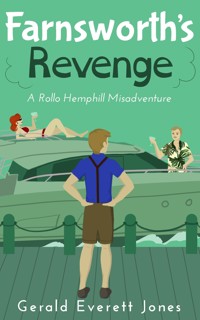
Farnsworth’s Revenge
A ROLLO HEMPHILL MISADVENTURE
GERALD EVERETT JONES
Copyright © 2014 by Gerald Everett Jones
Excerpts: Preface © 2022, Boychik Lit © 2013, Mr. Ballpoint © 2014
All rights reserved.
No part of this book may be reproduced in any form or by any electronic or mechanical means, including information storage and retrieval systems, without written permission from the author, except for the use of brief quotations in a book review.
LaPuerta Books and Media
Email: [email protected]
Fan blog: geraldeverettjones.substack.com
The characters and events of this story are fictitious; any resemblance to actual persons, living or dead, is entirely coincidental.
TRADEMARKS: The author has attempted throughout this book to distinguish proprietary trademarks from descriptive terms by following the capitalization style used by the trademark owner. Any product trademarks, service marks, and registered trademarks appearing herein are the properties of their respective owners and are hereby acknowledged.
EPUB ISBN: 978-0-9856227-3-2
LaPuerta softcover print edition ISBN: 978-0-9856227-2-5
Editors: Thomas Page, Jason Letts
Cover design by Blinky 100covers.com
LaPuerta is an imprint of La Puerta Productions https://lapuerta.tv, Santa Monica, California, USA
To F. D. Reeve
Contents
Preface
1. A Fine Fix
2. Pen Pals
3. Cradled in the Shameless Palms
4. A Woman’s Right to Choose
5. Spin Cycle
6. Reunion at State
7. We’re Off to See the Pasha
8. Attaboy
9. Getting Warmer
10. After the Ball
11. In Which I (Almost) Learn the Meaning of Life
12. Am I Done?
13. Corkscrewed
14. Message in a Bottle
15. Not Quite Home and Dry
16. At the Americana
17. Beaming on Hydrogen
18. Return to Seemly Valley
19. The Happily Ever After
20. In Which I Grow Up?
21. My Nemesis
22. He Never Met a Man He Didn’t Like
23. Swimming to Cambodia—or Somewhere
24. The Sultan’s Villa
25. Rude Awakening, Semi-Nude
26. On My Own—Again
27. A Clarifying Memo
28. Future Tense
29. Hugo’s Shameless Palms
30. Touching Down
31. Arlen Weighs In (Yet Again)
32. Monica Has It All
Explore the Series
Boychik Lit
Another Wacky Novel
About the Author
You may also want to read…
Also by Gerald Everett Jones
Preface
When the notion of reissuing Rollo Hemphill’s misadventures floated past in my stream of consciousness, my next thought was, Hey, those stories are evergreen — why not? But more practical considerations of the publishing marketplace prevailed, necessitating this explanatory note.
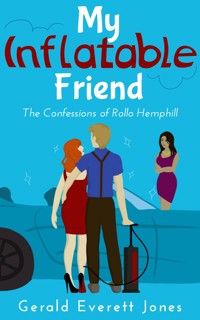
My concern isn’t that the characters won’t be relatable or their follies any less funny in the glare of freshly fired-up high-wattage attention. No, the problem is one of perceived technological obsolescence. The first novel in the series — My Inflatable Friend — was released in 2007. To some of you in the shivering audience for whom first impressions can be cool if not downright cold, that era might not seem so long ago. But to others, the crusty tale might as well have occurred just before the undocumented end of the last Ice Age. (There have been more than one, I’m told. Hence the rush to print again, lest the next big freeze overtake us. Hmm. Some in fire, some in ice. We probably don’t get to pick.)
When the first novel in the series was released, cell phones existed but weren’t yet what you’d call smart. Email was a thing, surely, but social media had not yet turned the world’s great newspapers into ezines for old folks.
Some Luddites still clung to their fax (facsimile) machines, especially those who insisted that electronic signature was an oxymoron.
Some movie crews who were filming were still actually using film. Likewise for shows taping.
Into this latter-day Age of Innocence schlepped poor Rollo, whose challenges getting attention from females, then avoiding journalists and G-men, could no doubt have been helped by the option of sending the occasional exculpatory text message. Emojis wouldn’t have hurt his cause either, and an amusing animation, especially if cloned onto his bodily image as a wisecracking avatar, might have put him right over the top. (Or on the bottom. At the outset, positional advantage was far from his foremost concern.)
Back then, climate change could have been mitigated — or didn’t exist — depending on which talking head you credited. In fact, end-of-the-world-as-we-know-it was mostly a worn-out sci-fi theme, hardly a topic of almost unremitting daily conversation. A pandemic was a post-WWI episode, not feared to be repeated because threats such as Ebola and AIDS had presumably been contained. The James Bond movie franchise was still going strong because male guilt, belatedly dredged up by #MeToo, had not yet made it necessary (spoiler alert!) to kill the legendary rapist off.
And — perhaps most significant for the sake of Rollo’s first episode — lifelike robots designed for intimate uses may have been in development but were certainly not yet ready for the likes of Rollo.
Mind you, Rollo’s stories need not be read in sequence. Rubber Babes exists in its own quirky paranoid reality, and Farnsworth’s Revenge is no less sweet when not saved for last, but the through-line of Rollo’s lurching character development does flow in a bobbing chronology through these books. Wise readers will know better than to regard him as a role model. Rollo’s problem — if you insist on calling it that — is paradoxical: No matter what scheme he tries or how it fails — he persists in falling ever-upward.
I could wonder, though, whether male-centered comic humor can be written anymore. Men seem more pathetic than funny now, as do some who oddly claim to be both white and marginalized. Satire might still be a useful term, but nowadays its connotations tend to be political. Rollo does get enmeshed in complications on an international scale — but he has no agenda other than self-preservation.
My original inspiration for these novels was my admiration for the novelist and poet Peter De Vries. In the mid-twentieth century, his male-centered comic novels ridiculed religion and extramarital sex — often in the same book. However, the whiff of controversy, so delicious in his day, has not aged well, and some would say positively reeks. In Forever Panting (my favorite), an out-of-work actor divorces his wife and marries his mother-in-law, continuing to lust after his ex. In Slouching Towards Kalamazoo, a female high-school teacher carries on an affair with her tender-aged male student.
Such themes are not exactly fodder for popular humor these days.
Lest you think I’m preoccupied with peters, I’ll confess that the works of Peter Lefcourt also influenced me. The Woody is brilliant, and by virtue of its inside-the-Beltway setting, it qualifies as legitimately political satire. (Alas, whether Lefcourt was satirizing Gary Hart or Bill Clinton or both is a question not likely to be explored by any contemporary book club.) And he wrote Eleven Karens when it was still possible to bestow the name on a newborn girl.
As well, when I began to stir the pot of silliness on my own, the publishing business had finally been taken over by women — along with the belated recognition that, for decades if not since Gutenberg, the most avid readers have been women. The genre chick-lit had come full flower. Appreciating the polar opposites such as De Vries and Lefcourt, I coined the term boychik lit as a lodestar for sinking ships helmed by ill-fated peters.
So, by way of further explanation — as if any more of my rants were needed to cheer you on to root for Rollo — I append my essay “Boychik Lit” at the end of this volume.
Thank you for the use of the genre. If Rollo’s exploits bring a smile, you needn’t tell anyone.
Gerald Everett Jones
Santa Monica - June 2022
A Fine Fix
I told myself my life needed more silliness. But the thing is, when you hook up with silliness in real life, it isn’t all that funny. At least, not to me.
You, you’d probably get a kick out of it.
You see, at this particular time, my outward circumstances were far too serious. I was on the run, and the silly part was, I wasn’t entirely sure why.
If you’re going to demand that my story make sense, you might as well stop here and return this book for a full refund. That is, provided you didn’t borrow it or swipe it or download it from Zero-Buck dot com. Mind you, I don’t mind. Going viral isn’t the worst that could happen to me, at this point.
Good thing no one bothers to look for you in a tacky two-star hotel on Rue Mouffetard. The fellow at the desk kept my passport, but then the passport isn’t really mine, is it? (The more information, the sillier it gets.) Sharing a WC with a ragtag collection of local pimps and drug peddlers and the occasional misdirected tourist is a small price to pay for anonymity. You get a crapper and a sink. If you want to shower, you ask the clerk to book a ten-minute drizzle for you in the drafty little bath downstairs.
Maybe silly isn’t the word. Pathetic?
According to the news reports, Interpol had grabbed my mentor and partner in crime, Dr. Dieter Zittpopper, after we’d both fled separately to Europe. I was beginning to suspect that wasn’t his real name. The high-toned charitable foundation I’d headed (in name only) had melted down to reveal its rotten core as a money laundry for anonymous folks in the Secret Government. The plan all along, I eventually guessed, was to set me up to take the fall for their misdeeds. Summoned by mysterious benefactors to Switzerland at the last moment, I was then furnished with an escape route, a fake passport, and a small wad of highly spendable euros.
At the meeting place in the foothills above Geneva, I found out more than I wanted to know about who was behind the scam, including but not limited to Valerie aka Vivi aka VV, a willowy, flesh-and-blood, fire-haired babe from my recent past whom I should have avoided when she so generously gave me an opening.
And there by her side was none other than my long-disappeared father, the mystery man, the investment-scheme mastermind whom both crimestoppers and crooks were looking for but none of them could apprehend, much less prosecute. He was either the force behind the scam that ensnared me or simply a lucky latecomer who skimmed off its profits. Even though, as I often say, paranoia is just a heightened state of awareness, I was not sufficiently paranoid to think that he’d engineered it all from the beginning. But I had no trouble believing that, learning his son had stumbled into the weeds, he’d found a way to make hay.
I never found out, and he was gone again. With Valerie or without, I didn’t know that either.
As far as I knew, there was not yet a warrant for my arrest. Evidently I was not a suspect so much as a “person of interest.” And no telling what Zitts might be telling them at this moment so he could cut a better deal for himself. Let’s just say I wasn’t going to schedule any public appearances.
There’s something about a minimally furnished hotel room in an overpriced city where you can’t afford to go out that gives a person time to reflect.
I started to think about Felicia. I didn’t want to think of her as my ex, because she’s not ex, at least not yet, I don’t think.
In her mind, are we still married? Does she think I’m never coming back?
Ever since we’d gotten together, I’d kept her in the dark about my business dealings. In the beginning, it was because I had no idea what was going on. Then, after I began to suspect there were rats in the back room, I told her as little as possible so she wouldn’t be implicated. Especially since I still don’t know who was pulling the strings.
I would have liked to put our relationship in a locked drawer somewhere, like a cherished piece of family jewelry, something I could come back to and fondle lovingly. Not exactly the way you should treat people. And she was my only link to getting money after the euros ran out.
Yes, that’s right, I use her. Is that love because she permits it? Is any contact better than none?
I’d been keeping in touch with her by clandestine means. Despite our forced separation, she was aiding and abetting my flight from the Keppelhoffer mess.
Does she think I’m an embezzler? Does she still love me even though she now knows I hid my growing suspicions about my employers from her?
Two days ago, her coded email said Farnsworth had contacted her (I’m not sure just how). He said he wanted a meeting, and right away. He was in the south of France. Did he know I was in Paris? Didn’t his request imply he knew I was more or less in the neighborhood?
He should be thanking me, but I feared he had more sinister intentions than a pleasant chat. I was pretty sure he wanted to screw me back, in what I hoped was only a figurative sense.
You would think old Farnsworth would have no need of revenge. After all, I was the one who caused the love of his life to be literally dug up from her premature grave at Forest Lawn and restored to her honored place at his side. Weren’t the two of them even now blissfully tooling around the Mediterranean on his yacht — only because of me?
I’d procured her in the first place. And, yes, I’d caused her to be buried. He did blame me for that. Technically, I was not her original owner. She was purchased on Hector’s credit card. But he would not have gone to the trouble of ordering a seven-thousand-dollar-plus rubber doll if I hadn’t needed a sexy prop to make Felicia jealous. Yes, making her jealous was Hector’s idea originally. And my idea to dress the doll up to look like the most famous pair of tits in Hollywood and drive her around town in a hastily borrowed Bentley actually did have the intended effect. On the plus side, Felicia was indeed jealous. On the negative side of the equation, she wrongly assumed (as Hector rightly warned me she would) that I was Monica LaMonica’s latest boy-toy. But all that did was make me look like a gold-digging gigolo, which if I wasn’t so hot for Felicia I’d probably have settled for. I mean, it would have been a step up from my failed careers as a hacker and then lowly car jockey. And it wouldn’t have been half as illegal as the later messes I got myself into.
All that was silly enough at the time. Trying to make your (intended) girlfriend jealous with a rubber doll seemed innocent, good fun. But look at the consequences. Far from fluff. Well-laid plans gone awry, for sure. And the worst part, I wasn’t getting laid at all, even though I was getting the credit and the blame.
This bed sags in the middle, the mattress long past its prime. The light fixture on the ceiling is full of dead flies. Since I was not finding much humor in my reflections, a nap would be just the thing, if I could stop obsessing.
The Pseudo Monica’s not being flesh and blood but silicone and steel did not deter Farnsworth at all in his affections. In fact, the P.M.’s not being human was probably a big plus as far as he was concerned. Remember, before he was fixated on her, he’d directed all his attentions to his shaggy Persian cat Lascivia, who used to be semipermanently installed on his lap. Hey, he was the boss. At least he wasn’t asking any of us to sit there.
(Perhaps I was the only one of us to refer to the effigy of Monica LaMonica as the P.M. It amused me to think a casual observer from the UK might assume I was talking instead about the late great Maggie Thatcher. But my P.M. never wore a twinset — not, that is, until much later in this story.)
I thought Farnsworth was the least of my worries. Back when I parked cars for him at the hotel, he was my nemesis. Everything was my fault, in one way or another, if you listened to him — including the demise of his cat, which I merely witnessed. Bruno’s jaws did the work. I just scooped her up and drove her to be stuffed, on Farnsworth’s orders, as any loyal company man would do.
Why does the world have to be so complicated?
Unable to nap, I slipped down to the corner café. It was a sunny afternoon in late August, that time of year when bourgeois Parisians, indeed most of middle-class Europe, are off on extended family vacations. (Seaside-dwelling Brits call them the “bucket-and-shovel brigades.”) So the city is yielded up to throngs of tourists in shorts from the States wandering around the Louvre like mice in a maze, ignoring the unfamiliar paintings on the walls as they sniff their way toward the Mona Lisa cheese.
Forsaking a table on the sidewalk, I took a seat at the bar. I resumed my thoughts of Farnsworth and the P.M. and his puerile pelt-toy as I sat sipping a Pernod and watching the TV. It took me one sip to decide it was not going to be my signature drink. They bring you a little pitcher of water along with your shot of golden liqueur. You pour it in, and the mixture looks just like cloudy piss. But it tastes like licorice. Now, the French like licorice-flavored toothpaste, and I’m guessing the drink came first, so that should tell you something.
There’s no way these days to avoid the scrolling news ticker. Stock markets all over the Western world were racing for the bottom of the tank. It was like some contest among the scum-sucking bottom feeders of the global economic ecosystem to see which of them could find a tasty morsel in the filthy accumulation of their own greedy shit.
I should have been relieved, or at least unconcerned. I had no money in the market. But problem was, I had almost no money anywhere. (Felicia was staking me from the profits of her business, a business I’d set up for her, so I didn’t feel I was taking advantage all that much. But either her loyalty or her cash reserves would get tapped out, sooner or later.)
Oddly, in thinking of Farnsworth I found a kind of inspiration. When I’d worked for him at the hotel — with Hector as my immediate supervisor — the old prune was a man of mystery. He was way past retirement age, but he wasn’t about to quit. Every day you’d find him in that sumptuous paneled office, dressed to the nines in aristo attire, his silver hair pomaded just right, his nails neatly manicured, and enough bling flashing on his wrists and fingers to show he knew just how much jewelry a man could get away with — that is, a watch that cost twenty K, a solid gold bracelet, and a diamond ring with a stone that was anything but dinky, on his pinky.
There was the unfortunate episode with the cat, and he weathered that loss with the guts of a Roman soldier. Granted, he fell totally for the rubber babe and was the only one of us who’d ever had her carnally (if that term even applies to tunnels of Venus made of latex). He was crushed emotionally when we had to bury her — which in itself seemed for a good cause. We had to convince the tabloids that Monica was dead so that she could break her contract on The Edge of Endlessness and retire in anonymity to the woods of Tennessee with her high-school sweetheart Merle. (That’s right, with an e, like Oberon or Norman. What — not into trivia? You’re following the wrong guy.)
Merle had no other option. It was me who ruined her political career. I really get that it’s not all about me, except when it is.
When Hector, Audrey, and I came up with the plan to literally bury the P.M., it seemed like a win-win scheme. Everybody got what they wanted — including, not least of all, me. I could finally prove to Felicia that I hadn’t turned pro in the dick department. We hooked up and would have lived happily ever after — that is, if the ever-after hadn’t gotten so damned complicated.
Farnsworth was far more attached to the doll than I ever imagined. He was one of the few players in the game at that point who rightly guessed we’d put the lookalike in place of the star. And he hated me for it. That’s when his fury got the best of him, he had that stroke, and he had to quit his job at the Palms.
I visited him at Happy Manor or whatever that place was called. And from his senseless rant I thought his perverted old brain was just about cooked.
But he’s the one who in his apparent delirium warned me about the Dutch. Better than anyone, he foresaw the snares that would eventually entrap me. His paranoia was working overtime, but I just thought he was a raving loon.
Having the past buried turned out to be my ace in the hole. I ended up tipping the cops to Monica’s wrongful “death” as a neat way of avoiding confessions to much larger crimes they hardly knew about as yet. As I was making my escape to Europe, the LAPD was digging her up. Then an anonymous bidder bought her at auction and — presto — the tabloids were running pictures of the Hollywood star sunning herself on the deck of Hugo’s boat, the Shameless Palms. But anyone who was a party to the original caper knew that Monica was hiding behind a new identity as Louise Jones, reclusive tenant of a triple-wide mobile home in the backwoods of sour-mash Bourbon country.
Anyone who was anyone in this thing — and fortunately there weren’t many of us — knew right away that it was the doll in those paparazzi telephotos of the boat anchored off St. Tropez. (I wonder how much the old coot paid. How much is a fake-but-compliant significant other worth?) But Monica’s fans wanted her to be alive — and, like readers of tabloids and conspiracy theorists everywhere, they believe what they damned well want to believe, and don’t confuse them with the facts. However fervently they may have prayed for her return to daytime TV, they were thrilled and titillated to read about her days toasting her bare tits in the Mediterranean sun as her doting Onassis puttered away in the hold (or whatever yachties do when they aren’t busy steering).
Clarity must have returned to Hugo’s brain. They say the love of a good woman can do that. And maybe a silicone surrogate will work just as well. (Or better? I’ll have to ask him.)
So it was Hugo Farnsworth’s damned resilience as a persistent human horndog which impressed me that day as I watched the Dow Jones chart snake through the sludge of the world’s money pit.
Farnsworth’s grit, that’s what I need. He knew what he wanted, and he went after it.
Shamelessly.
Traveling is risky, but so is staying in one place, even if it’s an unremarkable dump, for very long.
I’ll go see the old fool. If anyone is in touch with his silly side, it’s Hugo. Start by confessing my admiration for his life choices, tell him how fit he looks, how she hasn’t aged a day. Go along with the game, pretend she’s real, even converse with her, if that’s how he wants it. Best meet the challenge head-on. If he suspects where I am, I can’t have him tipping off the authorities. I want him inside my tent, ejaculating out.
But he wanted to screw me. I knew it.
Pen Pals
When I had to ask Felicia for money, we didn’t use email. The sender would copy a plain text file to a node on a tame server account that I’d set up. The recipient would download the message file, then delete it from the node. It was a digital drop, about as low-tech as passing notes in class.
The messages used simple word codes. In our code, money could be any commodity — peas, corn, carrots. And the bank accounts I had in various countries were my rich uncles — Uncle Lars in Denmark, Uncle Hans in Switzerland, Uncle Jan in the Netherlands.
Uncle Hans bought 20 bags of birdseed.
That’s all I would have to say to ask her to wire twenty thousand to my UBS account in Zurich. Search engines don’t understand metaphor. A computer thinks a potato is a potato unless you’re dumb enough to tell it otherwise. If we ever wanted to signal a change in code or a new rubric, the concluding line of the message would contain the hint:
On Tuesday, remind me to tell you the joke about the rabbit who walked into a bar and asked for a cure for Lyme’s disease.
Tuesday, rabbit, bar, and Lyme (which would just as easily be lime next time) are the words that matter. Rabbit would be any subject, bar would be a code word for the place, and lime would be the type of transaction. Any day of the week mentioned anywhere in the message in any context meant that a follow-up message would be sent on that day of the coming week, plus one. So since the message about the rabbit mentioned Tuesday, I’d look for a new message on the next Wednesday.
Although bots never sleep, I assumed that human investigators are too busy pawing through the thousands of everyday email messages that the bots pick out of the noise. Looking for suggestive snippets in the odd read-me text file in some protected folder on an obscure server would be a colossal waste of time, even for a dumb robot.
Or so I thought.
Judging only from the promptness of her responses, Felicia was eager to play the game, maybe because it was our only form of communication. I hoped she missed me, but then again I didn’t want to cause her pain or get her into trouble.
I truly loved her, and you could say that our separation was my punishment for misdeeds both known and unknown.
There were two vegetables with special meanings. “Sack of potatoes” meant I love you, and all is well. “Pickled beets” was a distress call (being a side dish I detested), and thankfully it never got used.
We’d come up with the code one night on a date in the early days, not long after I confessed to her I was a recovering hacker. Even then, we were joking about the then-hypothetical and presumably outlandish idea that one day, sooner or later, I’d be on the lam, dodging the authorities.
Even now, writing or reading “sack of potatoes” made me laugh because I couldn’t help thinking of “Joey Bag o’ Donuts,” the movie wise-guy name for a fat-ass.
It was a great joke. Until it wasn’t.
But Felicia persisted in her good humor, now and then inserting “hash browns,” “latkes and knishes” (which sounded a whole lot like “love and kisses”), and once even “chili cheese fries.”
She was my anchor, and I had no righteous reason to expect that the chains that bound us would hold.
Cradled in the Shameless Palms
The brief train trip to St. Tropez was uneventful, and it gave me a chance to practice my tradecraft. I was itching to get out of that hotel, and now I had an excuse to take chances. If I was going to make a career as a fugitive from justice for however long, I’d best take a page from the spymaster’s book. I had read enough of them to think I could make a short journey by train without being followed.
I took the Metro from the Luxembourg station to the Gare de Lyon, where I boarded the southbound TGV for St. Raphael. Before setting out, at various retail stores near the Sorbonne and without drawing attention I hoped, I boosted the crude makings of my cover characters — a trench coat, a hat, a hoodie, a small backpack, a canvas overnight bag, and a pair of sports shoes.
I wore the hoodie underneath the trench coat, topped off with the hat. I zipped the new shoes into the backpack, then put the backpack in the overnight bag, which I carried onto the train. First Class all the way, I’ll freely admit, since classless democracy does not, never has, and probably never will extend to the passenger rail services of France.
The passenger seats were big as lounge chairs, overstuffed and luxuriously upholstered, with fresh linen doilies on the neck rests. Fucking in one of these would be a joy, accompanied by the gentle rocking and throbbing of the carriage. The compartments are not all that private, though, so the chemin de fer equivalent of the Mile High Club would be an impractical dream, if not downright impossible.
Such are the fantasies of a lonely man. This is my last apology.
Just before I disembarked, I lingered as others got off, and in that brief interval I shucked the coat, the hat, my leather shoes, and the overnight bag, casually leaving articles here and there throughout the now-empty car as if left behind by various travelers in haste. Stepping down onto the platform, I was just another American tourist in hoodie and jeans, with brilliant white sneakers and the ubiquitous camouflage-canvas knapsack slung over my shoulder.
The spies will tell you, if you change anything, change your shoes. No matter how good the disguise, failing to change out of the same tired pair of battered Sketchers is a dead giveaway. Was I worried about those brand-new, too-white shoes being too noticeable? Not at all. If the casual witness recalled anything, she’d remember the shoes, and little else.
I had a prepaid cell phone, which I kept turned off for the duration of the trip. I wasn’t sure when I’d need to turn it back on, actually. No one, including Felicia, had the number. And even if I’d had Farnsworth’s contact info, I wasn’t about to phone ahead so he could have a few polite gendarmes waiting for me.
There aren’t that many boatslips in the small crescent harbor of St. Tropez, perhaps a few hundred. As in all but the largest Mediterranean ports, the big yachts and the cruise ships anchor a ways out, and passengers are ferried to the docks. Close in along the docks, private slips hold an assortment of pleasure sailboats and motorboats, nothing longer than about thirty feet.
So hailing weekend captains in my prep-school French was downright easy. “Ou peut-on se trouve le naveau ‘Shameless Palms’?”
Without fail, it got a smirking laugh. So either the suggestive name needed no translation, or they’d actually met the eccentric British-born American who’d boldly had it painted on the ass end of his modest-sized yacht.
On the fourth try, a dapper fellow looking like Tony Curtis in Some Like it Hot — shameless enough himself in blazer, white ducks, and ascot, minus the cap — gestured erratically with his martini glass toward a sailboat tied up in its slip on the far end of the dock. “Il est fou, ce clochard,” (that bum is crazy) he slurred, as he waved me on. He seemed to be alone, so if his girlfriend was running late, she’d have to toss back several cocktails to catch up. Or if she’d already left after too few, he was well into his own method of drowning his remorse.
Four out of four skippers were men, Frenchmen of a certain age — in their floating retirement homes, I thought. Heading out to sea one last time with your own hand on the tiller would be a respectable way to go.
And with a pretty friend who didn’t give you too much back-chat? My respect for Farnsworth was growing.
As I approached the Shameless Palms, I heard a loud scritch-scritch before I spied a gangly old man in torn denims and sweat-soaked tee-shirt crouched over and laboring with a sanding block on the boat’s wooden deck.
His back was turned and he didn’t see me approach. So I was already standing over him on deck by the time he saw my white shoes and looked up.
“Permission to come aboard, sir,” he said, out of breath. He didn’t seem the least surprised to see me.
“I don’t get it. We’re already on board,” I said.
“No, you say, ‘Permission to come aboard — sir.”
“But as you can see, I’m already…”
“Motherfucking landlubbers,” he mumbled as he straightened up with some difficulty.
He pushed past me and disappeared below, returning moments later with two frosted cans of beer. He tossed me one as he sat down with an exhausted thump, popped the top on his cold one, and took a long swig.
“Nice launch you have here,” I said, toasting him with my can.
He snorted so hard in mid-chug the beer came out of his nose. After a brief coughing fit, he wheezed, “What the fuck did you call my boat?”
“A launch, sir. Isn’t that like, ah, a fancier name for a boat? Like a classy boat that has its own, you know, space at the dock? That it, you know, launches from?”
“For your information, you ignorant little putz, if you were not half as dumb as you do indeed look, that was about as insulting a piece of nautical jargon as you could throw at the skipper of a yar boat such as this.” And he drank.
“I had no idea…”
“Oh, you didn’t, eh? Lost on you, is it, the distinction that a launch is a craft small enough to be launched from a boat? A rowboat, a dingy, is a launch. So is a fucking inflatable raft, for all that matters.” He was fuming, but I sensed that letting off steam was something he needed to do, perhaps for the same reason he’d been furiously sanding a wooden deck that hadn’t yet lost the gloss on its last coat of varnish.
“It’s yar, you said?” Putting him back in the role of mentor seemed a wise move.
“Yar means sleek and fast. Yes, now you’re spot-on. She is yar.”
Looking around with what I hoped appeared to be stark admiration, I said, “I’m sure she is.”
“Sailboats can be yar, but not motor craft, my view. Big, fat, and ugly, those gas-guzzling things. They fart fumes and leave an oil slick in their wake. Drunken captains with their trashy blond whores. Halter tops on a sad pair of saggy boobs that should be hid inside a sweatshirt. Short shorts and cellulite. You get my drift.”
Picking perhaps the precise worst moment to mention it, I asked, “So where’s the P.M.? Freshening up? Taking a nap? No risk of cellulite there!”
Farnsworth’s face went slack, and for the first time I noticed his jowls looked more flaccid than I remembered. He set his beer can down on the deck and sighed.
“Thank you for coming, Rollo,” he said without an ounce of sarcasm. “I heard you’d hit a patch of trouble. I do hope I haven’t put you at any risk.”
“I do have to be careful,” I said.
“What do they want you for? Faking the death of a rubber doll? Murder of the real thing? Monica’s still very much alive, isn’t she? Who the fuck cares about any of it?”
“I helped her disappear into obscurity, and she got me a top job with this high-toned charitable foundation. But then I found out it was a money laundry for spooks and maybe even drug dealers. Maybe the whole reason I was there was to take the rap for some kind of international fraud. I doubt Monica knew anything about that part of it.”
“You don’t say.”
“She didn’t even know what Keppelhoffer’s Syndrome is.”
“Neither do I. Never gave it a thought, actually.”
“Prolonged erection of the penis — downward,” I confided.
“Oh, dear,” he said. “But handy for the old pile-driver, what?”
I shook my head. “Too painful to be any practical use at all.”
“Hmm,” he mused. “And what do they do for it?”
“Nothing, apparently,” I replied. “They took in tons of cash and gave a lot of it to Spaulding Putter University. Supposedly for medical research, but I couldn’t trace a dime of it after that.”
“Spaulding Putter. Not exactly known for turning out doctors, are they?”
“More like pro golfers and hell-raising preachers,” I said. “And it turns out my father — you know, the disappearing financier? — was involved somehow. Although I don’t think he was behind it so much as making it all possible for someone else, for a fee or a cut.”
I took a pull on my beer and went on, “And of course, as you predicted, some of the big players were Dutch.”
“The Dutch!” he cried as his face turned red and his eyes bugged out.
As we both knew all too well, the Dutch conglomerate Fragrant Tulip had bought Wuthering Palms hotel where I had spent my probation parking cars. Farnsworth had been my boss, and to this day it seemed unnatural to address him as Hugo, much less consider him a friend.
“Things seem to have turned out well for you,” I said quietly. “You have what you wanted, and maybe without intending to, at least you could say I helped you get it.”
“That’s just it,” he whimpered quietly, as tears welled up in his leathery eyes. “She’s gone,” he said, and his voice cracked.
Hoo-boy. Here it is, the reason for his invitation. So maybe he doesn’t want to scold me or screw me or scream at me after all.
He’s going to plead with me.
“Some… sneak thief?” I asked, thinking it was the obvious possibility.
“We’d had a quarrel,” he sighed, “as we often did, now and again. Kept things interesting, my view. But it was one of those ‘Do I look fat in this dress?’ kind of tiffs, the kind a man just can’t win. I went ashore to cool off, knock back a few whiskeys at the local establishment, and when I came back on board, she’d disappeared.”
I tried to sound reassuring, as if celebrity lookalike dummies go missing every day. “Like I said, it was a thief. She was a valuable… work of art. A celebrity in her own right.” I reflected a moment. “Tabloids, that’s it. Of course, it’s just the kind of stunt they’d pull. Someone sniffed it out, discovered she… ” and I had to be careful here, “… isn’t… real? You have to admit, it’s a helluva story.”
“I’d do anything to get her back. I just wish I could take back those things I said.”
Does he have a grip? I wondered.
“And I suppose you didn’t inform the police?”
“Are you kidding?” he almost chuckled. “If perchance the paparazzi weren’t involved, that would most assuredly invite them right in.”
He looked at me soulfully. For the first time in the years I’d known him, he didn’t regard me as an underling, as an object of scorn, but as a kindred male, a directionless libido in search of a cause, a jouster at windmills, a rescuer of damsels.
“Please help me, Rollo,” he said simply, and he rested his gnarled hand on my knee.
A Woman’s Right to Choose
We were going at it hot and heavy, drooling over each other in our lust, our discarded clothes still warm on the floor. She was enthusiastic, I was randy, and our interests were about to converge.
That’s when I went soft, in a manner of speaking.
Having been married to Felicia, even though it had lasted less than a couple of years and technically still wasn’t over, had changed my outlook. I’d never been what you’d call a rake, but there was a time when I thought like one. Scoring was the only goal, even though the opportunity didn’t present itself all that often. I was a legend in my own mind. I was a conqueror, a despoiler of sandy nations and dark, sultry females. To be a shameless, heartless, stud road-warrior, that was the ideal.
But with Felicia, I found myself thinking more often about what she wanted. I learned to anticipate, and then to please, and the selfish rewards brought on by this seeming selflessness were truly amazing.
This afternoon, thousands of miles across the sea from my estranged wife, I decided, as if I’d always done business that way, to offer this random lady an unmistakable choice.
I flipped onto my back, my frozen pole pointing to magnetic north. She did the expected thing, throwing a leg over me, crouching with a knee on either side of my heaving chest.
As she looked down at me with what could have been condescending amusement or stifled glee, she panted to catch her breath. I placed my hands on the supple, flushed mounds of her lower back, resting my palms just where her hips flared from her waist. My fingers throbbed, but I didn’t push and I didn’t pull.
That’s when I decided the next move would have to be hers.
She could lower herself onto the throbbing knob of my desire. Or not.
And after half a heartbeat, she decided not.
So as my pole thawed and my balls turned blue, a cold shiver wriggled down my spine. Was I being gallant or moral or faithful or fair, or had I simply lost my nerve?
In not taking her, had I betrayed both of us?
“Perhaps we’d better not,” she said simply.
Was she taking her cue from me, or did she have her own reasons for not going through with it?
Boyfriend? Husband? Girlfriend? Time of the month? Herpes? Brain surgery in the morning?
“Sure” was all I said as I rolled out and crawled around, groping in the half-light for the mate to a gray argyle sock.
In the early twenty-first century in post-industrial Western nations, you’d think it’s the woman’s choice. She decides when and where she will give it up.
Oh, rape happens, but it’s not in my experience base. You read about it in the papers, if you still get a paper and you can still read. You hear about frat parties and Ecstasy and fratire books. I suspect the reality of those stories involves a lot more puking and a lot less sex than advertised, even though not since Brautigan have so many wallowed in so much vomit and pretended it’s cool. But old-fashioned James Bond seduction is pretty much a thing of the past, if it was ever more than a pipe dream of Hugh Hefner and the preppies. If you think you seduced her, you are in denial and your ego is bigger than your dick, no matter what your shoe size. If she thinks she was seduced, she’s indulging in a romantic fantasy. Drunk or sober, she should decide and signal, even if it’s just a provocative look or opening a door. What comes later is more or less negotiated in advance, is all I’m saying.
She picks the time and the place. She has the one egg ready, and I would not be at all surprised if one day science proves she actually picks the lucky spermatozoon.
“Just where do you think you’re going?” she’d ask the wriggling intruder.
“C’mon, do you mind? I’m in kind of a hurry here,” the single-celled, sole-purposed little idiot would reply.
“Not so fast. You don’t look so fresh. Did you sleep over last night? Miss the last douche out? That tail looks deformed to me.”
And that would be enough to turn him around, in shame.
The winner had an IQ of 168 in his past life and managed a call center in Mumbai. He literally did not know how to take no for an answer. Persistence and tenacity were his virtues, overconfidence his downfall. In that past life, he died prematurely when he got so drunk at his brother’s bachelor’s party that he took a dare on a bet, shoved his hand in a straw basket, and startled an irritable cobra.
Now, in his new life starting out as a one-in-a-gazillion sperm, he’s scored because he can think of nothing else but thrusting forward.
His was not my way, not this time. I had hesitated, thinking I was being generous by letting her choose. Of course this babe had chosen already. She chose in the café where we’d hooked up, again as we necked and petted in the Metro, and again as she led me to her cozy studio apartment above an antique store in the Marais.
And her English was almost better than mine, although my French was passable. I made the first move, but she picked me up.
So maybe letting her choose yet again on the point of penetration was beside the point, or literally not on it.
Roused with passion, maybe she didn’t want to choose. Perhaps she wanted to be taken, to deny that it was her own intention to bring me thus far, to be able to tell herself the next day she hadn’t been able to help herself even as she resolved never to see me again.
Kissing on the Metro. Metro sexual. Sounds like some smelly perv on the subway beating his meat.
Her name was Celeste, not that it matters anymore.
I’d met her on the Champs-Élysées, in the high-rent district, where I hardly ever go. They were showing a Vin Diesel crash-and-burn action flick, and most of the big 3D theaters are on that street. So I bucked the tourists and the hawkers of fake Hermès scarves to take in a mindless movie that stirred my aggressive urges.
Afterward, I stopped in an overpriced brasserie thinking it was as good a place as any to collect my thoughts about Farnsworth’s dilemma and figure out what, if anything, I could or would do to help him.
Celeste sat at a table by herself reading Time magazine.
“Could I borrow that when you’re finished?” was all I said, in English, assuming a Parisian would be too ashamed to read a Yank journal in public.
She didn’t bother to finish, just smiled and handed it to me without a word. So I still didn’t know whether to thank her in French or in English or in Schweitzerdeutsch.
“Merci,” I mumbled, sitting down at another table.
I didn’t have to pretend to read because I really wanted to see whether there was anything on the Keppelhoffer story. It took me a few minutes of page-thumbing to realize there wasn’t, at least not this week.
I looked up to see some people on the sidewalk raising their umbrellas as others scurried into doorways and raindrops began to streak the window glass.
She’s drinking Pernod. Maybe she’s French, after all.
“Il va pleurer,” I said and gave her my best smile.
She stifled a giggle, then couldn’t help herself and laughed loudly enough to turn heads.
“You’re either a poor student of French or a very bad poet,” she said in a local accent as she caught her breath.
“Oh, yeah?”
“Pleuvoir,” she coached. “Il va pleuvoir.”
“What’d I say?”
“You said, ‘It’s going to cry.’”
And sometime later, the poet in me realized I’d spoken the truth after all.
Spin Cycle
It was 2 a.m., I couldn’t sleep, and all of my clothes were beginning to smell like ripened brie. I wanted to find a coin-op laundry where I wouldn’t have to use a credit card, but in techno-savvy Paris apparently there is no such thing. Here I was lugging a stuffed pillowcase around town in the middle of the night, stopping in kiosks to thumb the near-forgotten remnants of pre-Web phone directories, looking under “Laverie — Libre Service” in the commercial listings.
I finally found a place near Panthéon that used rechargeable cash cards or else somehow billed you through your cell phone. I wasn’t about to use my phone. The card thing seemed safe, but the machine that vended the cards (accepting coins, bills, or credit cards) refused to march, as the French so colorfully describe their frustrations with all dysfunctional things electromechanical. There was no attendant at this (or perhaps any) hour, an automated laundry being one of the first technological innovations to provide totally robotic service to the sweaty working classes, along with those storied nocturnal places that vend coffee and pieces of stale pastry through little windowed cabinets to insomniacs and cabbies.




