



4,49 €
Mehr erfahren.
- Herausgeber: LaPuerta Books and Media
- Kategorie: Gesellschafts- und Liebesromane
- Serie: Preacher Evan Wycliff Mysteries
- Sprache: Englisch
Science, faith, and murder intersect in this suspenseful debut set in the suspicious heart of a small Missouri farm town.
When Evan Wycliff returns to his rural Missouri hometown to regroup after leaving a promising science career, he expects peace, not tragedy. But his quiet life is upended when he discovers the body of his childhood best friend in a nearby field. The authorities call it suicide. Evan isn’t so sure.
Haunted by doubt and driven by both scientific inquiry and moral conviction, Evan begins to ask questions no one wants answered. His investigation stirs resentment in a town clinging to its secrets and brings him face-to-face with hidden sins, political ambition, and the quiet desperation of forgotten lives.
As the pressure mounts, Evan must navigate strained loyalties and his own crisis of faith to uncover a truth that could either heal or shatter the community. His journey is one of redemption, resilience, and reconciling the man he was with the man he’s trying to become.
A deeply human mystery layered with suspense and spiritual insight, Preacher Finds a Corpse is perfect for fans of character-driven crime fiction.
The Evan Wycliff series has won 10 awards in mystery - including this book and its sequel Preacher Fakes a Miracle winning both Gold and Silver - the top two prizes in Mystery - in the New York City Big Book Awards in the same year!
“This is literature masquerading as a mystery. Carefully yet powerfully, Gerald Jones creates a small, stunning world in a tiny midwestern town, infusing each character with not just life but wit, charm and occasionally menace. This is the kind of writing one expects from John Irving or Jane Smiley.” - Marvin J. Wolf, author of the Rabbi Ben Mysteries, including A Scribe Dies in Brooklyn
Das E-Book können Sie in Legimi-Apps oder einer beliebigen App lesen, die das folgende Format unterstützen:
Seitenzahl: 481
Veröffentlichungsjahr: 2019
Ähnliche



















PRAISE FOR THE EVAN WYCLIFF SERIES
The Series Has Won 9 Book Awards
including both Gold and Silver in the same year in the Mystery category of the 2020 New York City Big Book Awards
This is literature masquerading as a mystery. Carefully yet powerfully, Gerald Jones creates a small, stunning world in a tiny midwestern town, infusing each character with not just life but wit, charm, and occasionally menace. This is the kind of writing one expects from John Irving or Jane Smiley.
MARVIN J. WOLF, AUTHOR OF THE RABBI BEN MYSTERIES, INCLUDING A SCRIBE DIES IN BROOKLYN
This is an excellent read. Such an engaging storyteller! It really sucked me in. That last page did cause a triple-take, quadruple-take, and whatever comes after, up to about eight. Jones is definitely one of my favorite authors.
JOHN RACHEL, AUTHOR OF BLINDERS KEEPERS AND THE MAN WHO LOVED TOO MUCH
A smart, thoroughly entertaining, and suspenseful mystery novel, which is not so much a who-done-it as a how-and-why. The characters are universally well-drawn and quirky, and the relationship between Evan and Naomi is fresh and romantic.
I loved it.
ROBERTA EDGAR, CO-AUTHOR OF THE PERFECT PLAY: THE DAY WE BROKE THE BANK IN ATLANTIC CITY
The constant shifts in trust and tidbits of new information kept me guessing until the end who was friend or foe and the ‘need’ to find out kept the pages turning.
Many of the common stigmas, questions, and feelings suicide deaths leave in their wake were also addressed in a responsible way, which will help the conversation around suicide in general.
RUTH GOLDEN, WRITER-PRODUCER, THE SILENT GOLDENS: A DOCUMENTARY ABOUT SUICIDE AND TALKING ABOUT SUICIDE WITH MARIETTE HARTLEY
Preacher Finds a Corpse is an absolute pleasure to read. Reminiscent of Charlaine Harris’s mysteries and Barbara Kingsolver’s early novels like Animal Dreams and The Bean Trees, it’s full of quirky characters who animate the small town in which they live. Evan Wycliff is a complex and compelling protagonist, conflicted and lost in his own life but nevertheless fiercely dedicated to uncovering the truth about his friend Bob Taggart’s death.
Jones manages to infuse a deceptively simple story with suspense, angst, and whimsy, as well as surprise. His command of setting, history, and behavior is beyond exceptional. I can’t wait for the next book in the series.
PAULA BERINSTEIN, AUTHOR OF THE AMANDA LESTER DETECTIVE SERIES AND HOST OF “THE WRITING SHOW” PODCAST
From the secret contents in a rusty tin fishing box to clues that lead Evan further into danger, Gerald Everett Jones weaves a tense thriller peppered with references to Evan's ongoing relationship to God and prayer.
When the clues boil down to a final surprise, will forgiveness be possible?
Jones does an outstanding job of crafting a murder mystery that romps through a small town's secrets and various lives. His main protagonist is realistic and believable in every step of his investigative actions and setbacks; but so are characters he interacts with; from his boss Zip to a final service which holds some big surprises.
With its roots firmly grounded in an exceptional sense of place and purpose, Jones has created a murder mystery that lingers in the mind long after events have built to an unexpected crescendo.
Murder mystery fans will find it more than a cut above the ordinary.
D. DONOVAN, DONOVAN’S BOOKSHELF
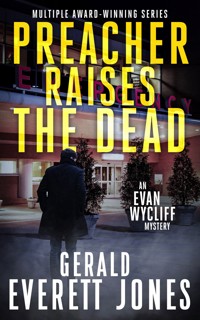
PREACHER FINDS A CORPSE
AN EVAN WYCLIFF MYSTERY
GERALD EVERETT JONES
Copyright © 2019 Gerald Everett Jones
All rights reserved. No part of this publication may be reproduced, distributed, or transmitted in any form or by any means, including photocopying, recording, or other electronic or mechanical methods, without the prior written permission of the publisher, except in the case of brief quotations embodied in critical reviews and certain other noncommercial uses permitted by copyright law. For permission requests, contact the publisher:
LaPuerta Books and Media www.lapuerta.tv Email: [email protected]
The novel in this book is a work of fiction. Names, characters, places, and incidents either are products of the author's imagination or are used fictitiously. Any resemblance to actual events or locales or persons, living or dead, is entirely coincidental.
The author has attempted throughout this book to distinguish proprietary trademarks from descriptive terms by following the capitalization style used by the manufacturer.
ISBN: 978-09965438-8-0
EPUB ISBN: 978-0-9965438-9-7 Kindle ASIN: B07QLHQGZX
Library of Congress Control Number: 2019904247
Design by La Puerta Productions
Author photo: Gabriella Muttone Photography, Hollywood
LaPuerta is an imprint of La Puerta Productions www.lapuerta.tv
“Amazing Grace” hymn lyrics by John Newton (1725-1807) [PD]
Holy Bible verses quoted from the King James Version [PD]
Created with Vellum
CONTENTS
1. Wednesday Dawn
Emmett’s Pasture
2. Wednesday 8 AM
Emmett Farmhouse
3. Wednesday 7 AM
Taggart House
4. Wednesday 11 AM
El Dorado Springs
5. Wednesday 11 AM
With Evan on the Road
6. Wednesday Noon
St. Clair County Sheriff’s Office
7. Wednesday 1:30 PM
With Evan
8. Wednesday 2 PM
Taggart House
9. Wednesday 8 PM
C’mon Inn
10. Wednesday Night
Evan’s Trailer
11. Thursday Breakfast
C’mon Inn
12. Thursday 8:30 AM
Zed Motors
13. Thursday 11 AM
Sheriff’s Office
14. Thursday Afternoon
Evan’s Trailer
15. Friday Morning
On the Road to Peculiar
16. Friday 11 AM
John Knox Village, Lee’s Summit
17. Friday Afternoon
Taggart House
18. Friday Night
With Evan
19. Saturday Breakfast
C’mon Inn
20. Saturday Morning
First Baptist Parsonage
21. Saturday Afternoon
Arthur Redwine Farmhouse
22. Saturday Night
Evan’s Trailer
23. Sunday Morning
First Baptist Church
24. Sunday Afternoon
On the Road to the Army Base
25. Sunday Afternoon
With Lt. Briana Caspar
26. Sunday Dusk
Driving Back from Fort Francis Blair
27. Sunday Night
Sheriff’s Office
28. Sunday 10 PM
Taggart’s Pharmacy
29. Monday 1 AM
In an Ambulance
30. Monday Mid-Morning
Myerson Clinic
31. Tuesday – Wednesday
Myerson Clinic
32. Wednesday Dinner
Myerson Clinic
33. Thursday Morning
Myerson Clinic
34. Thursday Morning
On the Road with Evan
35. Thursday Noon
Ak-Sar-Ben Motor Lodge
36. Thursday Afternoon
In and Out of Peculiar
37. Thursday 4 PM
Redwine Farmhouse
38. Thursday Evening
Rich Hill
39. Friday Morning
Butler
40. Friday Evening
Taggart House
41. Friday Night
First Baptist Parsonage
42. Saturday Morning
Emmett Farm
43. Sunday Morning
First Baptist Church
Now Read the Sequel
Preacher Fakes a Miracle - Sample
Explore the Series
About the Author
Also by Gerald Everett Jones
In Loving Memory of William L. Kamm
WEDNESDAY DAWN
EMMETT’S PASTURE
Preacher Evan Wycliff found his friend Bob Taggart’s body in the early light, about a half-hour after dawn, on the frigid morning of February 29. The light snow from last week had all but disappeared in a brief thaw, leaving a frozen crust on the loamy farmland. The wind was brisk, with a bite. It was a bright day to be glad the roads were safe, salted, and dry. There was no good reason for anyone to get hurt today.
Evan had been on his way to a turkey shoot. But he didn’t have a gun and he had no intention of borrowing one. He was going to sit with his friends in the woods, learn how to blow silly, warbling sounds on a reed-whistle turkey call, take greedy gulps of strong coffee laced with whiskey, and — most important in his role as compassionate counselor — make a mighty effort to make sure his friends didn’t get so drunk they’d shoot each other accidentally. The others liked him because he told good stories and because he’d laugh at theirs even when they knew their jokes were lame.
Now it had all suddenly gone bad. If only the dreadful event having occurred in a leap year would mean he’d have fewer times to acknowledge its anniversary. The mathematical side of his brain worked that way.
Evan had an analytical mind, which, despite his efforts to the contrary, had drawn him away from his studies of theology and into science. Unanswered questions, whether metaphysical or worldly, would get stuck in his head and plague his thoughts.
Cause of death wouldn’t take a forensic expert to explain. Bob had shot himself in the chest. He was wearing his Sunday suit, which was probably his only suit. His starched white shirt had a blood stain about the size of a softball in the center of that once burly but now deflated chest. Here was the entry wound, and Evan didn’t need anyone to tell him the big damage would be at the back. When he came upon Bob’s motionless, curled-up form resting there in the deserted pasture, he took one look, turned, and promptly retched up the biscuits and redeye gravy he’d had with his morning coffee.
Bob’s death probably wasn’t the act of a demented man. Evan was sure his friend had been sane. But they had argued recently, which would cause the young preacher recurring pangs of regret.
To this point in his life, Evan’s loss of loved ones had occurred at a distance. Those events had been wrenching in their suddenness, but this one was in his face. He didn’t have to flip a mental switch to cut off his emotions — he’d already learned the response. He’d never been in combat, never seen a friend fall beside him, but on seeing Bob, the analytical side of the preacher’s brain took over. Evan wasn’t aware of it, but in this moment he became battle-hardened. As if taking a bullet on the run and not falling, he’d feel the pain much later.
Look, then look harder. And remember.
Looking back at the corpse, Evan rested his hands on his knees as he strained to see and remember details. Bob must have pressed the muzzle of the Sig Sauer pistol to his chest as he fired, nudging his rep tie to the side. The tie was undamaged, knotted with a full Windsor at the neck, and otherwise neatly fixed with his gold Masonic tie tack above the ample tummy, except for a small burn mark on one side of the fabric. There were other stains, gravy spills that predated the incident. Like the suit, his patriotic Navy tie with the red-and-white stripes was the only neckwear Bob owned.
Because of the angle of the torso on the ground, listing over on its left side, the corpse had bled out the back. Other than the neat, circular stain in the chest, the body looked whole and restful. Bob’s eyes were gazing upward and his mouth was open slightly.
Was he trying to say something?
Bob wouldn’t have needed both hands to point the pistol at himself, holding the butt in the palm of his hand and squeezing the trigger with his thumb.
But Evan figured most likely Bob would have wanted to use both hands — to steady his resolve. Maybe because holding them together like that in front of him might feel more like praying, a prayer for forgiveness? Or, maybe Bob feared the kick of the powerful weapon would make it fly up, and he’d take it in the face. Yes, Evan decided, Bob’s last gesture had been a prayerful pose. The knees of his pin-striped, polyester pants were wet where, as he knelt, the last of his warmth had thawed the icy soil.
It took him a while to decide.
A neatly folded piece of white paper protruded from the breast pocket of the suit’s jacket. Evan was sorely tempted to pluck it out and study what he assumed would be the suicide note. But he had enough presence of mind to realize, despite his close relationship to the deceased, that he’d better not disturb the scene.
Evan’s priority should be to call the cops, at least officially. But considering the early hour and the apparent fact that he’d been the first to stumble upon his dead friend, he had a personal duty to call Bob’s wife Edie first.
In the few moments for the call to be connected and for her to pick up, he mentally rehearsed what he would say. All he could think of was “Edie, I have some bad news.” But she answered on the first ring, and seeing his caller ID, she simply said, “Evan, I know.”
Evan hadn’t known Edie Taggart all that long, only since he’d returned home from back East a year ago. From her pleasant greetings, he’d assumed she was a sweet, kind-hearted person. After all, mild-mannered Bob, who had all but given up on getting married again, had committed to her three years ago, and he’d never shared any serious complaints with Evan. But Edie’s was not what you’d call a warm personality. Evan had learned she’d been an accountant by training and trade, presumably now retired. She was a local from the nearby town of Montrose, her maiden name being Clark, which was the name affixed to the town’s premier tourist attraction, a renovated Victorian house on the national list of historic places. Evan never knew the family connection, but probably some influential townspeople did — stuffed shirts at the Rotary and the city council. Anyhow, she always expected she’d get the best table at any fine-dining restaurant in the area, of which there were exactly two. Fine dining if you wanted steak or chops in the one place and ribs, dry or wet, in the other.
“I found him” was all Evan managed to say. “There’s a note.”
“I got a note too,” she said. “And it says stay away, don’t come looking for him. It says tell the sheriff he’s in Emmett’s east pasture. So I called it in. You should be seeing them any minute.”
“What can I say?” Evan asked her.
“What is there to say? You know how he’s been. I’ll put some coffee on. Come by when you’ve told them whatever you saw. I’ll need help with the arrangements.”
He risked telling her, “I’m still here… with him.”
“Is it a godawful mess?”
“No, more like he’s taking a nap.”
“As if it makes a difference,” she said and ended the call.
Evan straightened up and surveyed the lonely countryside. It was all Missouri flatland from here to the horizon. Where he stood was brittle, icy-hard, gnawed-down grass in Joshua Emmett’s pasture. Beyond were a couple of acres of matted-down, dried cornstalks. Still farther off was a wooded area where some men took their teenage sons squirrel hunting with small-gauge shotguns. They’d go for rabbit or squirrel.
And why, oh why, did the preacher happen to be in this remote place at this ungodly hour of the morning? Nick Berner and Wiley Krause had invited him to their wild-turkey shoot. Evan was wearing a red Kansas City Chiefs ball cap so no one would mistake him for a deer. He said he wouldn’t be bringing a rifle, didn’t even have one to bring. Nick said not to worry, they wouldn’t be loaning him one. No one manages to shoot anything on one of these outings, anyway, Nick admitted. Dumb as domestic turkeys are said to be (and that’s dumbass dumb), the wild ones are clever as the dickens. It’s just good sport to sit there in the weeds blowing on your turkey call and hoping sooner or later your amateur gobble will attract a hen or challenge a tom to raise its tail feathers in challenge. Then you might just get off a shot if you don’t blink. Great sport, and by the time you’ve drained the whiskey in your flasks, you couldn’t hit the broad side of a barn anyway.
Parking on the shoulder of the two-lane state road and traipsing through Emmett’s field was the only way to get to where Nick and Wiley would be unless you had a helicopter.
It wasn’t coincidental Evan thought about helicopters just then. A squadron of three choppers had flown over as he was locking up his car on the edge of the highway. He didn’t think much of it at the time. There being three flying in close convoy, he assumed they were military. They were flying unusually low. He didn’t know much about aircraft or their markings. Not usually being up at this time of the morning, he also didn’t know whether those flights were routine, but he assumed they were. Locals knew that U.S. Army Fort Francis Blair was located just south of Lake of the Ozarks, east of Lebanon on the interstate, and military traffic, both in the air and on the roads, was a common sight.
Evan didn’t have Wiley’s number but considered phoning Nick. The preacher didn’t know either of them very well. They were Bob’s friends, but unlike Evan and Bob, they hadn’t grown up here. Evan had only met them when he’d come back home, resettling in the countryside near Appleton City. Since the cops were on their way, he didn’t want to go mucking up things by being the first to ask Nick the obvious questions:
Were you expecting Bob for the shoot? Did you hear the gunshot? And where’s Brownie?
Bob’s ever-faithful Lab-mix dog was nowhere in sight.
Perhaps run off at the sound of the shot. More likely, Bob made her stay at home with Edie.
The fact of the body’s lying smack on the path to Emmett’s woods suggested Bob knew about the meetup. He’d wanted his friends to find him. Maybe he’d expected it would be Evan.
I don’t want to be in the middle of this. Best not to overstep. But something tells me I want to know what happened a lot more than some others might. The cops probably won’t care why he did it. Will Edie?
Here came the St. Clair County sheriff’s squad cars, two of them, lights flashing, no sirens. Followed by an ambulance.
First to approach was Sheriff Chester Otis himself. He was a large, broad-shouldered man with ebony skin and arms as thick as some men’s thighs. He had the rolling gait of a wrestler and the sour look of a man who could smell mendacity. His immaculate gray Stetson looked too small for his round head. He seemed not at all happy to be doing any kind of business before he’d had his second helping of grits and sausage. His ample gut spilled over his hand-tooled black gun-belt and attested to his seldom having to skip a hot breakfast or any meal.
Behind the sheriff were three young male deputies, one red-haired, freckled, and white from the lead car and two lean, close-cropped, military-looking blacks from the other. The white guy, the sheriff’s sidekick, carried a camera and a toolbox that must have held a forensics kit. Two paramedics, both female, an overweight white one and the other a trim Asian, were opening the back of the ambulance and setting up a gurney on which was stretched a heavy black-plastic body bag with a head-to-toe zipper.
“Reverend,” the sheriff greeted him with a proffered hand.
Evan returned the manful grip as he confessed, “You understand, I’m not ordained.”
The top cop gave a weak grin and said as he moved past Evan toward the body, “I won’t tell if you don’t.”
As the sheriff stepped carefully around the scene, the red-haired deputy came up behind Evan.
“Friendly warning. Don’t get invested in this,” the fellow snapped.
“He was my friend…,” Evan began, wishing his authority were above the law. He wasn’t sure what to say next.
“I take it you didn’t shoot him.” It was a statement with an implied a question, craving but not expecting denial.
As the deputy slipped on a pair of rubber gloves, he introduced himself tersely as Deputy Malcolm Griggs, and he’d be in charge of the scene investigation.
The sheriff circumnavigated the corpse carefully, then bent down to have a closer look, his elbows resting on his thighs. He gestured to Griggs to come over, then pointed to the paper in the breast pocket of the suit. Griggs reached down and retrieved it with a gloved hand, then unfolded the paper, and they both read it. Otis gave a cursory nod, and Griggs slipped the note into a clear plastic evidence bag and tucked it into his toolkit.
Griggs walked back to Evan as Otis lingered near the body.
“What’s in the note?” Evan asked the deputy.
“That would be confidential, for the time being,” Griggs said, then demanded, “And who would you be?”
“Evan Wycliff, friend of the deceased,” Evan repeated pointlessly and gesturing to the body added, “Bob Taggart. Back in the day, when we were boys, we used to play in these fields.”
Griggs attempted to commiserate, offering, “Has to be tough seeing him like this.” Then he resumed his strident tone as he asked Evan, “How do you come to be here? Were you with him when it happened?”
“No. I was heading into the woods over there to meet up with friends and found him like this.”
Griggs shot him a look. “Odd time of day for a pow-wow.”
“Kind of a sunrise prayer breakfast, you could say,” Evan fibbed, not wanting to say he was on his way to make sure two drunken men didn’t do anything crazy with their shotguns.
“We’ll need their names,” Griggs said.
You’re not going to send somebody after them now? Those two officers over there aren’t doing much. Okay, I won’t ask.
Evan remembered to say, “Bob’s dog Brownie. A big, mixed-breed and, well, brown. She was always with him. Could be on the loose, maybe panicked, somewhere around here.”
“We’ll keep an eye out,” the deputy said dismissively.
The sheriff overheard as he approached. “Dogs run home. Smarter than us. No need to freeze our peckers off here, Reverend. Why don’t you come by the office this afternoon and give us your statement? Griggs’ work is going to take a while, and watching paint dry would be more stimulating.” Otis didn’t wait for an answer but muttered, “Helluva thing,” as he shivered and stomped back toward his car. As he got in, he shouted back at Griggs, “Well, get a move on! Wilma and Darlene need to get him transported. And have Frank and Nolan here help you with whatever.”
Wilma and Darlene had their gurney set up but wouldn’t touch the body until Griggs had taken his photos. The two other officers were standing off at a distance by their car, waiting for instructions from Griggs as they shared a smoke and stamped their feet to keep warm.
The sheriff fired up the monster blown-V8 engine of his Crown Vic Police Interceptor. As the car lurched back onto the road, Griggs turned to Evan and said, “Like I said, don’t get all invested.”
“What do you mean?”
“Have you lost many friends before they got old?”
One who haunts me every day. And now this.
But Evan shook his head. He was in no mood to share with this guy.
Griggs offered with a swagger, “I did two tours, back to back. My friendly advice? The why? The how? I can tell, you’re a smart guy, you’ve got a lot of questions. Don’t go there. This is our job.” Then he stepped closer to begin his survey of Bob’s remains with his camera and added, “And we’ll probably never know. Shit happens. Normal guys snap. Now go get warm someplace, and you be sure to drop by later for a chat with the boss. You’re not a suspect, not unless I find something I don’t expect.”
WEDNESDAY 8 AM
EMMETT FARMHOUSE
Josh Emmett’s hand quaked, his mouth went dry, and he felt stomach acid rising in his throat as he stared with disbelief at the official-looking letter in his hand:
Notice of Demolition
The U.S. Army Corps of Engineers? How could they do this?
The courier had just left, and Josh’s first thought had been whether you’re supposed to tip those guys. That was before he’d opened the envelope.
His wife Linda hadn’t seen it yet. She now read over his shoulder and gasped, “This can’t be happening!”
“It’s saying by this time next week our home will be all smashed up. We’re to be out of here, taking all our possessions, by midnight on Friday.”
“I told you not to ignore that eviction notice!”
“Shhh! The kids will hear you!” In a voice he hoped was calm and reassuring, he explained, “I didn’t ignore it. I went straight to Taggart. He told me he’d work something out.”
“We’re two monthsbehind.”
“They don’t tear your house down just because you can’t pay. And in the middle of winter?”
“What can we do?”
“Edie must be behind this,” he said, grabbing his coat.
WEDNESDAY 7 AM
TAGGART HOUSE
With rustic fieldstone-and-redwood exterior, the house was a handsome three-bedroom rambling ranch, having been custom-built to Bob’s specification on the shore of a small lake less than a decade ago. Evan had visited a few times since he’d been back. Oddly out of keeping with the home’s Western design, its carefully selected furnishings were colonial and expensive, although factory-milled. Drexel Heritage or Ethan Allen. Edie had moved in just three years ago, and Evan guessed she’d given all the first wife’s stuff to charity and redone the place to her conservative tastes. Maybe then she could sit in the parlor and imagine she and her husband were in a grander New England gray-stone mansion in a swanky old-line neighborhood like Swope Park in KC. But Bob wouldn’t have cared whether his chairs were covered in chenille or canvas.
Brownie did not greet Evan at the door, which was her habit. The preacher came in through the side entry to the kitchen, which was unlocked. The kitchen looked newly renovated, complete with high-end, stainless-steel appliances.
As Evan walked in on Edith Taggart, she was dressed in an oriental-print housecoat with fuzzy pink slippers. Her hair was in rollers, and she hadn’t finished putting her face on yet. She didn’t seem the least bit drowsy, and there were no streaks of residual mascara on her cheeks where they might have been wet from crying.
Why the rollers? Where’s she planning on going? Or does she just do it out of habit?
She wasn’t a stunner, more what the locals would call a handsome woman. Perhaps not yet forty, the second Mrs. Taggart had chestnut hair trimmed just long enough to hold a wave, a pale complexion with not a flaw, enigmatic hazel eyes that didn’t blink when she wanted to make a point, and a lean figure. Evan judged she could analyze your loan terms or advise you on the rules of double-entry bookkeeping. So, to handsome, you could add no-nonsense.
“Where’s Brownie?” Evan asked her, not knowing whether it was an insensitive question under the circumstances.
Edie sighed. “That mutt hasn’t been around here for a couple of weeks. She was old and ailing, you know. Some dogs just sneak off to die.”
Like her husband did.
“Bob didn’t say anything about it?”
She glared at him and shot back, “What do you think? Apparently there were a lot of things he didn’t tell me.”
An awkward moment.
“I’m sorry,” Evan said. “I’m so sorry. It’s just… unbelievable.”
Edie seemed to calm a bit as she took a breath and said, “You know, he thinks he botched Aunt Molly’s will.” She motioned for Evan to sit down at the kitchen counter and poured him coffee. He took a sip and was surprised to find it didn’t need much doctoring. He’d need more sugar, but now was not the time to ask for special treatment.
“Is that what it says in the note?” Evan asked, not yet having seen the one the cops lifted from the body.
“Go figure,” she said, handing him a single crumpled sheet of letter paper. “Your guess is as good as anybody’s. It’s not like he could express himself worth a damn.”
Evan took the note. It was a neatly typed, double-spaced letter, a computer printout. The page had been neatly folded into quarters, and he guessed the crumpling was evidence of Edie’s distress after she’d read it. He said to her, “Grief counseling isn’t exactly my thing. But they do tell you, any emotion you’re feeling is okay. Not just sorrow, but resentment. Even relief. You’ll end up running the gamut. And it’ll take at least a year, maybe longer, before you can draw a breath without wondering why you’re here and he isn’t. Don’t blame yourself, no matter what.”
Edie’s kitchen phone has been ringing. She’s letting it go to voicemail. I guess I would too at a time like this.
“Truth be told,” she said, ignoring the phone again, “he’s been dead to me for months now. I just didn’t expect he’d do anything like this. Maybe he’d drink himself to death, overdose on that fruit salad of pills they gave him. But not this way.” She gestured toward the paper. “Go ahead, read it. You tell me what you think he’s trying to say.”
My Dearest Ones,
By the time you read this, I’ve taken my own life. Don’t come looking for me. Call the sheriff and tell them I’m at the northwest end of Emmett’s east pasture. I’m truly sorry I’ve made a mess of things. I am also sorry for any hurt I caused. Now that I’m gone, it can all be settled, and no one can tell me it has to be different. They won’t be able to come after me. I own my mistakes, especially my poor decisions. There is no plot for me, so let’s keep it simple and cheap. Cremation, then bury my ashes at the cemetery between my parents. God willing, I will see my dearest ones again, and He will forgive.
Robert.
There was no handwritten signature. Just Bob’s birth name in twelve-point Calibri font, same as the rest of it. Evan had trouble believing his friend was so fearful.
Evan remarked, “Odd this is printed. I’d expect something this personal to be in his handwriting.”
“His handwriting was awful. I don’t know what it was like years ago when you were cribbing off each other’s exams in school. But as he got older, it got way worse, along with his eyesight.”
The other obvious question was more troubling: “Someone was after him?”
Edie shrugged. “In his mind? What did he have that anybody wanted? But — my dear ones?” she demanded, raising her voice. “Who the hell else did he have but me?”
“Just you, as far as I know,” Evan said. He knew of a prior marriage. The ex-wife was in the distant past, and they’d had no children. Like Evan, Bob was an only child, and they shared the sad fact that both of their parents had passed away by now. Most recently, they’d lost Bob’s Great Aunt Molly, at ninety-four. Although not the officiant, Evan had said a few words at her funeral at First Baptist back in November.
“As far as you know?”
“He had some friends. Close ones,” Evan said. “Joshua, Nick, Wiley. You know, his posse.”
“You don’t call drinking buddies and poker partners dear ones. Not in my language.” When Evan didn’t have an answer, she fumed, “He doesn’t mention me anywhere in there! Do you notice the word love? Nowhere to be found!”
“Anger. That’s totally okay.” Evan tried to infuse his voice with a gentleness he wasn’t feeling.
She stirred two more packets of Sweet ’N Low into a cup of coffee she hadn’t yet touched.
“We’ll burn him to a crisp, all right,” she said as she stirred vigorously. “Twice baked, like a steakhouse potato. He’ll get it in this world and in the next.”
* * *
As Josh drove his Dodge Ram down State Route P at way over the speed limit, he tried Edie again on her cell phone. He’d already called the landline at the house twice. No surprise, she wasn’t picking up. Maybe there was a way to permanently block his number? If she could’ve, she would’ve, he was sure.
Bob had been so easygoing. He seemed to like Josh, wanted him to stay on the property, mend the fenceposts, repair the dilapidated siding on the barn, and — the hard part — be smart about rotating and irrigating his crops, farming the land so it would make a decent living for the Emmetts and a reasonable return for the Taggarts.
Josh realized now, far too late, he should never have trusted Bob, should never have put an ounce of faith in the guy’s lame assurances. Maybe Edie the prissy bean counter was the brains all along. Maybe they had always planned to sell the farm out from under him, and good ole boy Bob was simply shining him on, suckering him, stretching out the default long enough to justify throwing his family into the street. And then something in the guy’s own life went upside-down, the sonofabitch put a bullet in himself, and his wife-hag says to hell with Joshua Emmett!
Josh’s pump-action .20-gauge was loaded, clipped to the window behind his head, and he had six extra shells in his coat pocket. He’d make her give them an extension. He didn’t know what more to ask or to demand. But if he had more time, surely he could get help. There had to be a way, now that he knew the Taggarts had made a fool of him. He needed to beg for help from somebody with more clout than them. Perhaps Mr. Shackleton at the bank would cut him a break.
He’d pick up Nick and Wiley on the way. Best to have his posse with him.
* * *
Evan paused a moment, hoping for a shift in Edie’s mood. He took a couple of sips from his own cup. The coffee was hot, fresh-brewed, and not your average canned, name-brand grind. More like dark-roast Kenyan. Something expensive. Like Evan, Bob had been more of an instant Folger’s guy. It always took three heaping teaspoonfuls in Evan’s mug to make it strong enough for him. He carried packets of instant in his pocket so he could add them to the dishwater house brew at the diner. Thankfully, there was real turbinado in her sugar bowl, and Evan helped himself generously.
Okay, sugar is my vice. And bourbon. And those nasty pills. Time enough to reform, but not now!
“You said on the phone I knew what he’d been going through,” Evan said. “I’m not sure I know what you mean. Had he been depressed recently?”
I’m betting she doesn’t know we argued, or what about.
“You should go have a talk with Doc Wilmer. Although the old cuss might not tell you anything. He’s probably terrified I’ll say he had some hand in this.”
“Bob was seeing Wilmer?”
“For most of the past year. Depression? Sure. Also mania, nightmares, paranoia — you name it. A few months ago — it was right after Molly died — Bob comes home from Wilmer. He’s got fistfuls of pills in trial packets. Like the sawbones says something like, ‘Try these, one at a time. Find out what if anything works for you.’ You know, country doctor. Throw the manure against the wall and see what sticks. So poor Bob chews them like candy, gulps them all down. If one is good, two must be better. And make sure you take a few of the yellow ones to go with the blue ones, along with gulps of Jack Daniels.”
“Samples? He was taking drug samples?”
How did I miss this?
“With bourbon. He liked his Jack. Also Early Times, Evan Williams, Old Crow.”
“We both did,” Evan admitted.
With me, it’s Vicodin for my back pain. I really shouldn’t be mixing the two.
Edie explained, “For him, he drank whatever was on special in the half-gallon size at the Walmart. I poured the bottles down the drain whenever I found where he had them hidden. I suppose he was what they call a functioning alcoholic. Never acted drunk. He’d drink and drink, and then he’d be snoring in his chair. God help me. Booze and pills. You couldn’t tell that man anything. A miracle he didn’t off himself that way, by accident or whatever. That’s what I’ve been expecting, frankly.”
“Did you report any of this behavior to his doctor? Try to get him into treatment?”
“Like I said, Bob was stone deaf when it came to taking anything that sounded like adult advice. And calling that crank Wilmer a doctor would be like calling you the Pope. And I don’t mean any disrespect.”
Edie Taggart knew as well as anybody that Evan Jerome Wycliff was not an ordained minister, not a pastor of any congregation. However, the local ministry — from several different Protestant denominations, including the Baptists and the Methodists — did invite him to deliver guest sermons from time to time. So, Evan had something of a reputation, an honorable one, even if he wasn’t exactly certified. That’s how Edie, with a twinge of vengefulness, was now jerking his chain.
“I knew Bob was stressed, but I didn’t think it was anything he couldn’t work out,” Evan said. “I’d have prayed with him.”
I argued with him. Yes, we should have prayed instead.
“Evan, he respected you too much to tell you how disappointed he was with himself. When he spoke of you, it was with admiration. And he wasn’t in the habit of talking about people. He was so ashamed.”
“I don’t understand. Ashamed — how? He was a good-hearted guy. Sincere. Everybody thought so.”
She got up abruptly, went to the sink, tossed the rest of her coffee into it, and started to wash the mug compulsively.
“For most of our short marriage,” she said with her back to him, “Bob was the guy you could trust. My mother liked him, and she hated everybody.”
“What was it, then?”
She was staring into the sink as she said quietly, “Molly’s estate. The guy had no head for business. I should have stepped in. The Emmetts are tenant farmers. It was Molly’s land, now it’s ours — I should say, mine. They’re deadbeats.”
Evan got up and stood by her side. He started to put a reassuring hand on her shoulder, then thought better of it. She hadn’t come onto him, but something told him it wasn’t out of the question. He’d been the one to say all of the emotions were okay, but he realized then that one of the possibilities was having to deal with the cliché of the horny widow. After all, she wasn’t sobbing and she wasn’t wailing. He had no idea how to read her.
“Blaming yourself,” he said. “Don’t.”
She didn’t look up. “Will you…?” She gasped, perhaps choking back grief or anger, then went on, “Help me with the arrangements? And the other, I don’t know, details?”
“I’ll handle it,” he said. “His instructions were pretty clear. There will be an autopsy, of course. The drug screen might show something. Will you want a memorial service? Lots of people thought well of him. There will be less gossip if you give them all a sit-down and some chicken salad.”
She finally turned around.
Her voice was as dry as her eyes. “We’ll do the memorial service, then bury his ashes right after. But I want it private at the cemetery. I don’t want any of those people at the gravesite. Wedging what’s left of him between two coffins? What do I get? A can next to his? We’ll do it his way, but the world doesn’t have to know.”
“I can find out what’s possible, do what’s necessary now.” Evan offered. “But you don’t have to decide about some things right away.”
She dried her eyes pointlessly with her sleeve and asked him, “Can we do it in a week?”
“The memorial? Next Saturday?”
“Why not? There won’t be anyone coming from out of town. If you make an announcement at the church on Sunday at First Baptist, you’ll take care of most everybody. I’ll ask Reverend Fortnum at United Methodist to inform his folks. And you can place the usual notices, whatever the papers do. Write something. You can text it to me, but I won’t fuss over it. You want to contact Bob’s cousins, or whoever they are, go right ahead. But don’t lose any sleep. They won’t.”
She reached under the counter and pulled out a laptop and a smartphone, saying, “You might as well have a look at these. They were his.”
“He didn’t have his phone with him?”
She knew the plausible answer. “Maybe he was afraid he’d change his mind. And call me, call someone, for help at the last minute.”
“Do you know the passwords?”
She shook her head. “That’s why I’m giving them to you. Bob said you were clever with computers. Maybe you can find a way. My concern is, I don’t want any surprises. If you find any evidence he changed his mind about things, you’re not to tell anybody. You come straight to me.”
“Did he leave a will?”
“His will and Molly’s are in a safe deposit box at the bank. I know what’s in them. Simple, it’s all mine now. If you can’t find anything to the contrary, I’ll feel better. We’ll know we’re carrying out his wishes.”
We will? Or will we know he didn’t do anything to complicate yours?
“Where did he do his work at home?” Evan asked.
“We made the guest room into an office for him.”
“Mind if I have a look around there?”
“Come back later today. I have to go out at two, but you can have the run of the place, for all I care.”
The sound of tires skidding to a stop on the gravel of the driveway startled both of them. Evan parted the kitchen curtain slightly to see the black Dodge Ram, exhaust spewing from its tailpipe in the frigid air. The three occupants were keeping the motor running, perhaps while they decided what to do next.
“Looks to me like Josh Emmett’s truck. And he’s brought friends,” Evan told her.
“This can’t be happening,” she snarled as she grabbed her private phone from the counter.
The truck’s engine continued to run.
Maybe they don’t expect to stay long? Could be good, or not so good.
The doors of the pickup opened. Josh Emmett got out of the driver’s seat. Joining him, sliding out from the passenger side, were Nick Berner and Wiley Krause.
Josh had something in his right hand, which he held out of sight behind his hip.
Maybe a tire iron?
None of them looked happy. And the three of them had that purposeful stroll you see in the old movies when the showdown is coming.
Evan thought about calling Otis, but Edie announced, “I’ve sent the sheriff a text. Josh is in violation of the peace bond.”
“These are friends,” Evan said as if it made a difference.
She shook her head. “Don’t go out there. Don’t.”
At least, yesterday, these guys were my buddies. And some of the few Bob had. If I can’t reason with them, I’d be a pretty poor excuse for a friend. Or a preacher.
Evan said a quick affirmation and stepped outside, without his coat. As Josh approached him, Evan could see that the tire iron he thought Josh was carrying was actually a shotgun. The preacher had never used prayer against a firearm before.
Evan forced a laugh and called out, “This is no way to treat a lady, Josh! And when you should be giving her your condolences.”
“Did you kill Bob?” Josh wanted to know.
Evan figured Nick and Wiley had the news early, possibly because Otis had contacted them already. They’d have had plenty of time to share it with Josh on the way over.
Evan looked each of them in the eye in turn, then said, “That’s the best guess you got? He did it to himself. The question is, did someone — one of us? — drive him to do it? I don’t know enough yet to give you an answer. Maybe it was one of you guys.”
“I need to keep my farm,” Josh said. His voice was unsteady and his lower lip quivered.
“What has Bob said to you?” Evan asked him.
“Not much at all. That’s the problem,” Josh whined. “That man wouldn’t say shit. And now I have till Friday to move my family off the place. Because they’re tearing it down!”
Whoa. This mess just keeps getting thicker!
“There has to be a mistake —,” Evan began.
Josh pointed at the kitchen window. “It’s all her doing!”
“I’ll talk to her, Josh. I will. But you can’t. Not now. You have to understand, Edie’s had the shock of her life.”
“And I haven’t? She gets to do this to me after all the work I’ve put in?”
Evan took a moment. The sun had disappeared behind a bank of cloud cover, and it was getting colder out there. He’d run out of placating words. He stepped closer to Emmett and in a cautionary voice said, “You really shouldn’t be here. The sheriff is on his way. They’ve got a court order. You come near her, they lock you up. It’s going to be kind of hard finding Linda and the kids someplace to live if you’re in jail.”
Josh’s arm had been relaxed, the muzzle of his weapon pointing at the ground. Now he flexed his wrist, and the barrel started to rise.
“I need to see her,” he growled.
Evan surprised even himself as he reached down slowly, calmly, and grasped the barrel of the shotgun.
Then he raised it the rest of the way and pressed the muzzle to his breastbone.
“Why don’t you go ahead?” he said softly. “It worked for Bob.”
The muscles in Josh’s face went slack, and his jaw dropped. “You’re crazy,” he declared. He backed off a half-step, but Evan held tight to the gun. As luck or the stars or God’s will would have it, the gun’s safety was on. Otherwise, Josh’s fierce grip on the stock and the trigger might have caused a good-sized hole to be blown in the preacher.
Josh frowned. “You got some kind of a death wish?”
Evan smiled. “You know, you’re not the first person to tell me that.”
Josh was at a loss. He shouted back, “Preacher, what’s your part in all this? You found Bob like you knew where to look!”
Evan eased the barrel back down and let go, giving Josh a chance to retreat. Indicating the other two men, Evan said, “This morning, I was coming to meet you guys. Maybe Bob was too? Nick, Wiley — did you hear any shots?”
Nick looked like he was going to say something. His eyes were red and his face was flushed. But Josh warned him off with a wave of his arm. Wiley, a frail guy who cowered to bullies but liked to crack wise, looked scared.
Someone should tell Wiley his experiment of a mustache just makes his upper lip look dirty. And sideburns? But his girlfriend Tamara is cuter than most women I’ve dated, so what do I know?
Taking a belligerent step again toward Evan, Josh demanded, “Now suddenly you’re some kind of deputy sheriff? Poking your nose into my family’s business?”
“Maybe you guys haven’t noticed,” Evan said, “but it’s getting kind of cold out here? You want to have a chinwag, fine. I got nothing to give but time. But you can’t go in there. Let’s go to my place. It’s as private as you could want.” He tried another laugh. “I think I got enough coffee left to make us all a cup. With a splash of whiskey.”
Nick and Wiley seemed like they were willing to go along — anything to duck this showdown. But Josh shot them another warning look and snarled at Evan, “I got nothing more to say to you.” He stomped back to his truck, and the others sullenly followed. As they got in, Josh yelled, “Except fuck off!” The doors slammed, and they roared away, accelerating so hard the truck fishtailed in the slushy gravel of the driveway.
The affirmation prevailed against steel and gunpowder! This time.
Evan watched the truck go, then went back inside. Edie was visibly shaken, her head in her hands as she sat with her knees clasped tightly together on an elegant colonial armchair in the living room.
She’s not giving me the whole story. And what’s worse, she’s dragging me down into whatever scheme she has going.
Evan was furious, angry with himself for taking such a huge risk with what he had to assume was a loaded weapon and angry with Edie for not being angry enough at losing Bob. He tried to rein it in. He knew screaming at her or making her wrong would just get him shut out.
“I saw what you did out there,” she said. “Foolish.”
“You should have stayed away from the window,” he replied. “Not smart.”
“I’m beginning to wonder about your judgment.”
“Josh is not a bad person. Neither was Bob. But anything can happen when you push someone too far.”
She glowered at him.
As he might appeal to child who was holding a burning firecracker, he asked, “Maybe now’s a bad time, Edie, but what about Molly’s farm? What was Bob going to do? Josh is under the impression you’ve given orders for his house to be torn down. On Saturday? We’d better reschedule the memorial. Give you both some time to settle down and deal with this.”
She flashed him the stern look she must have given people who refused to accept the consequences of compound interest. “Never mind about those things. It’s out of my hands. Get us through the memorial.”
And she didn’t say “please.”
She must have decided Evan needed some kind of explanation. “The Emmetts haven’t paid their rent for months, and Josh has been pestering us for an extension. The demolition is something else entirely. Bob was way too lenient with Josh, then he made no decisions about the other thing and kept putting them off. Now Josh phones me every time I turn around, and his latest voicemails are threatening. So I took out a peace bond. I’ve been afraid of something like this.”
Evan said. “I hadn’t realized.”
Bob, did you think Josh was gunning for you? Or Edie and whoever else wants that farm?
Evan couldn’t stay. He owed the sheriff his version of events, and he needed to clear his head before throwing more questions at Edie or anybody. In asking Evan to make the arrangements, Edie may not have expected to authorize him to look into whatever had driven Bob to death’s door. But Evan wouldn’t rest until he found out, even if he had to stare down a pack of demons. And keeping the Emmetts on their farm would have to be part of the bargain.
As he left, he grabbed the suicide note from the kitchen counter. Seeing him take it, Edie shrugged as if to say he could do with it whatever he wanted.
Shouldn’t her interests be the same as Bob’s? Deciding — and then getting approval — to destroy a building doesn’t happen overnight. Was this Bob’s decision and his plan? And he couldn’t face the consequences?
* * *
A half-mile down the rural route, Deputy Mal Griggs was sitting alone in the sheriff’s Crown Vic, parked off-road and aiming his radar gun in the direction of Emmett’s expected approach. Calculating what the target would do had seemed simple enough. After the courier’s time-stamped drop-off, when Edie wouldn’t answer the phone (which he’d expected she wouldn’t), there was only one state road between the farm and the Taggart house. Griggs should have been able to time the intercept within a few minutes either way. Problem was, people don’t always do the expected thing. Josh must have pulled off the road before the intercept to pick up his friends. Luckily, as Edie had reported in her second text to Griggs, this Wycliff guy had talked them down before they got inside. Three armed toughs against Edie, with or without the preacher, would not have turned out well.
For the second time today, Griggs figured he’d miscalculated. Emmett hadn’t shown up yet. Of course, he must have stopped on his way back from the Taggart house to unload his buddies. No house party for them today. Just as well, though. Griggs would now have a one-on-one with Emmett. Much safer.
As Josh sped past him, Griggs clocked the speed of the Dodge truck at eighty-six, thirty-one miles per hour over the unmarked rural limit. He switched on his emergency lights and gave chase. For a while there, it looked as though Emmett was accelerating, perhaps in a rage on seeing the squad’s flashing lights come up behind him. Griggs judged the fellow wasn’t too drunk to ignore the warning, because the pickup eased over onto the shoulder and stopped. Drunk might have been better, a chance to rough the guy up and haul him in.
After the customary greeting and the preliminaries, Griggs wrote out a whopping speeding ticket. The fine would be a hundred-and-fifty dollars. As he handed over the ticket with the peace bond tucked beneath it, the officer asked the farmer, “Mr. Emmett, sir? Do you know what a peace bond is?”
Josh wasn’t sure. “It’s like for divorced people? If they fight, somebody goes to jail?”
“Not in this case, sir. Mrs. Robert Taggart has taken out a peace bond on you. If you ever go near her — and technically, that’s defined as within five-hundred feet — you’ll be arrested.” Then Griggs actually grinned as he added, “And you can be sure of it.” He rested his hand on the butt of his Sig Sauer sidearm and pronounced, “Because I’ll be the one to do it. And when an arrest doesn’t go smoothly, things can get out of control.”
The two men parted ways. As events would unfold, Josh would not be heading home, and Griggs had a meetup this afternoon in El Dorado Springs.
WEDNESDAY 11 AM
EL DORADO SPRINGS
Stuart Shackleton was so nervous he willed his hands not to shake — and so angry he could strangle a puppy. He felt a cold sweat trickle down his right arm into his palm, and he worried the moisture would compromise his tight grip on his weapon.
By God, no one is going to threaten me and get away with it. Ever!
It all happened in less than two heartbeats. He heard a noise, a single footfall. He again scanned the dimly lit room, his head turning with a mechanical slowness from right to left. And just as his focus rested momentarily on the bay window to the south, he caught a blur at the edge of his peripheral vision against the north wall, on his right. His eyes flitted over there, ahead of his neck turn. As his right arm raised his Sig Sauer to join the palm of his left, he took a half-step in that direction to ensure his stance was wide and solid.
The blur was a head and then a torso. From a hiding place behind a wine-colored, leather-covered divan, the dark intruder jumped to his feet. His face was hidden in shadow, so it was impossible to tell whether he was black or white or some shade in between.
The creep’s right arm is in motion!
Shackleton held firm, willing his arms ramrod-stiff, his grip vise-tight, his shoulder muscles relaxed but ready to take the recoil. He lowered his head slightly, aimed, and fired a single shot.
Blam!
The intruder keeled over and fell backward, impelled by the impact of the nine-millimeter round as it tore through his chest at the midpoint of his collarbone, directly beneath his larynx.
Shackleton took a deep breath.
One down. How many more?
On his left, outside the bay window, another figure emerged running, coming at the house from some distance away, almost out of range. No doubt in a coordinated attack with the dead man, this malefactor was taking up the fight, sprinting with a weapon in his outstretched hand.
Shackleton chose not to wait, not to let him get close. It was a chancy shot at fifty yards. The first round would shatter the window, and his aim might lag the runner. But the second might hit home. Firing a third round might be a waste, especially if more criminals were lurking somewhere. The defender once again leveled his Sig Sauer and — Blam! Blam! — got off two shots. Coincident with the first shot, the window glass shattered in a crash, followed by a tinkle of falling shards, and the second shot found its mark. The runner hit the ground face-down and didn’t get up.
Then the room went black!
After what would be a prayerful moment for a believing man, Shackleton took a deep, relaxed breath and let his right fist, still holding his pistol, drop to his side. With his left hand, he ripped off his ear protectors.
And the lights on the range came up.
A voice in the shadows behind him chided, “Top marks for marksmanship, reaction time, and technique!”
Griggs had removed his own earplugs. He stepped up to Shackleton, punched his shoulder (not too hard, he hoped), and declared, “But zero points for judgment under fire.”
They stared at each other through their yellow-tinted protective eyewear.




