



0,00 €
Mehr erfahren.
- Herausgeber: LaPuerta Books and Media
- Kategorie: Gesellschafts- und Liebesromane
- Serie: Evan Wycliff Mysteries
- Sprache: Englisch
What if the Second Coming was an illusion — and a conspiracy planned to sell it as salvation?
Disgraced former televangelist Evan Wycliff wants nothing more than solitude and strong bourbon — until an eccentric scientist named Dr. Hans Gropius arrives at his door. He speaks cryptically of time travel, fake prophecies, and conspiracies that blur the line between science fiction and scripture. Within hours, the stranger is dead, struck by a fleeing truck in a crime that might not be random. Gropius's dying warning? The Second Coming is about to be staged — and not by heaven.
Pulled from his self-imposed exile, Wycliff dives into a twisted mystery that spans from backwater diners and aging conspiracy theorists to end-times cults recruiting the vulnerable for a final "cleanse." With former allies like Agent Leon Weiss offering cryptic advice and a grieving town whispering of secrets, Evan must confront not only the possibility of a global deception, but the pieces of his own shattered faith. What begins as a search for answers becomes a reckoning with guilt, grief, and a future darker than prophecy ever predicted.
For fans of genre-bending mysteries, theological thrillers, and stories where redemption meets revelation, Preacher Stalls the Second Coming delivers a provocative ride through faith, science, and the thin line between salvation and manipulation.
Distinguished Favorite winner of the 2024 New York City Big Book Awards in mystery. The Preacher Evan Wycliff series has won 10 major awards.
Das E-Book können Sie in Legimi-Apps oder einer beliebigen App lesen, die das folgende Format unterstützen:
Seitenzahl: 428
Veröffentlichungsjahr: 2024
Ähnliche



















PRAISE FOR THE EVAN WYCLIFF MYSTERIES
NINE BOOK AWARDS, INCLUDING BOTH GOLD AND SILVER IN NYC BIG BOOK MYSTERY IN THE SAME YEAR (2020)
Like its predecessors, Preacher Stalls the Second Coming blends unusually humane and thoughtful procedural sleuthing with a brisk pace, winning local color, and ace scenecraft and surprises, all powered by a strong undercurrent of moral and spiritual inquiry.
BOOKLIFE REVIEWS FOR PUBLISHERS WEEKLY
This is literature masquerading as a mystery. Carefully yet powerfully, Gerald Jones creates a small, stunning world in a tiny midwestern town, infusing each character with not just life but wit, charm, and occasionally menace. This is the kind of writing one expects from John Irving or Jane Smiley.
MARVIN J. WOLF, AUTHOR OF THE RABBI BEN MYSTERIES, INCLUDING A SCRIBE DIES IN BROOKLYN.
As anyone who’s spent time in a small town in the American Midwest knows, there’s a lot more going on behind the scenes than you’d expect. Or suspect. And there are plenty of suspects in the latest Evan Wycliff mystery by Gerald Everett Jones. Preacher Fakes a Miracle haunted my dreams as I read it, in the way that a good story about a bad situation should. I’m looking forward to reading the next installment of the Evan Wycliff mystery series.
PAMELA JAYE SMITH, MYTHWORKS, AWARD-WINNING WRITER-DIRECTOR-PRODUCER
This is not your mother’s preacher. Gerald Jones has created a character who can discover a corpse, kiss a girl, solve a crime, and get back to his trailer in time to say grace over Sunday dinner.
DAVID DRUM, AUTHOR OF HEATHCLIFF: THE LOST YEARS
This time the Preacher digs even deeper, faster, and funnier than his prize-winning debut. It’s just what you’d expect, except everything you expect is wrong because the Preacher, in the very talented hands of Gerald Jones, is always at least a step ahead in this very satisfying second time out of the gate.
MORRIE RUVINSKY, AUTHOR OF MEETING GOD OR SOMETHING LIKE IT AND THE HEART AND OTHER STRANGERS
A fast-moving mystery with twists and surprises that take you in unexpected directions. Jones is adept at creating unique and fascinating characters. His mystery sleuth is a part-timer with lots of heart who splits his time between religion, skip tracing and sometimes the metaphysical. The hero's search for a missing girl and his interactions with various eccentric individuals in the small town make him both sympathetic and compelling. A bit of a shock to learn what's really going on with the abducted young unwed mother... and amazing how it relates to real stories in the news today.
M.J. RICHARDS, COAUTHOR OF DISHONOR THY FATHER
A smart, thoroughly entertaining, and suspenseful mystery novel, which is not so much a who-done-it as a how-and-why. The characters are universally well-drawn and quirky, and the relationship between Evan and Naomi is fresh and romantic.
I loved it.
ROBERTA EDGAR, COAUTHOR OF THE PERFECT PLAY: THE DAY WE BROKE THE BANK IN ATLANTIC CITY
Preacher Finds a Corpse is an absolute pleasure to read. Reminiscent of Charlaine Harris’s mysteries and Barbara Kingsolver’s early novels like Animal Dreams and The Bean Trees, it’s full of quirky characters who animate the small town in which they live. Evan Wycliff is a complex and compelling protagonist, conflicted and lost in his own life but nevertheless fiercely dedicated to uncovering the truth about his friend Bob Taggart’s death.
Jones manages to infuse a deceptively simple story with suspense, angst, and whimsy, as well as surprise. His command of setting, history, and behavior is beyond exceptional. I can’t wait for the next book in the series.
PAULA BERINSTEIN, AUTHOR OF THE AMANDA LESTER DETECTIVE SERIES AND HOST OF “THE WRITING SHOW” PODCAST
From the secret contents in a rusty tin fishing box to clues that lead Evan further into danger, Gerald Everett Jones weaves a tense thriller peppered with references to Evan's ongoing relationship to God and prayer.
When the clues boil down to a final surprise, will forgiveness be possible?
Jones does an outstanding job of crafting a murder mystery that romps through a small town's secrets and various lives. His main protagonist is realistic and believable in every step of his investigative actions and setbacks; but so are characters he interacts with; from his boss Zip to a final service which holds some big surprises.
With its roots firmly grounded in an exceptional sense of place and purpose, Jones has created a murder mystery that lingers in the mind long after events have built to an unexpected crescendo.
Murder mystery fans will find it more than a cut above the ordinary.
D. DONOVAN, DONOVAN’S BOOKSHELF
The constant shifts in trust and tidbits of new information kept me guessing until the end who was friend or foe and the ‘need’ to find out kept the pages turning.
Many of the common stigmas, questions, and feelings suicide deaths leave in their wake were also addressed in a responsible way, which will help the conversation around suicide in general.
RUTH GOLDEN, WRITER-PRODUCER, THE SILENT GOLDENS: A DOCUMENTARY ABOUT SUICIDE AND TALKING ABOUT SUICIDE WITH MARIETTE HARTLEY
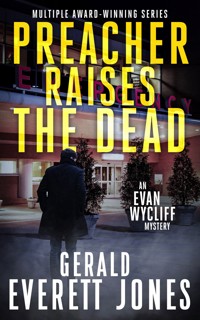
PREACHER STALLS THE SECOND COMING
AN EVAN WYCLIFF MYSTERY
GERALD EVERETT JONES
Copyright © 2024 by Gerald Everett Jones
All rights reserved.
No part of this book may be reproduced in any form or by any electronic or mechanical means, including information storage and retrieval systems, without written permission from the author, except for the use of brief quotations in a book review.
LaPuerta Books and Media lapuerta.tv Email: [email protected]
The novel in this book is a work of fiction. Names, characters, places, and incidents either are products of the author's imagination or are used fictitiously. Any resemblance to actual events or locales or persons, living or dead, is entirely coincidental.
Throughout this book, the author has attempted to distinguish proprietary trademarks from descriptive terms by following the capitalization style used for the brand by the mark owner.
Trade paperback ISBN: 979-8-9860953-8-7
eBook ISBN: 979-8-9860953-9-4 ASIN: B0CRCFGLDP
Library of Congress Control Number: 2024901237
LaPuerta is an imprint of La Puerta Productions lapuerta.tv
Design by La Puerta Productions
Editor: Jason Letts
Author photo: Gabriella Muttone Photography, Hollywood
Epigraph quoted from The Expulsion of the Triumphant Beast, translated by W. Morehead from Jordano Bruno's Spaccia Della Bestia Trionfante. United Kingdom: n.p., 1713. [PD Google Books]
To Phil Enoch
Sophia. So that if there was no Change in Bodies, no Variety in Matter, and no Vicissitude in Beings, there would be nothing agreeable, nothing good, or nothing pleasant.
Saul. If the Case be so, then there is no Pleasure without a mixture of Pain; and a Change from one State to another, partakes of what pleases, and of what disgusts us.
- from The Expulsion of the Triumphant Beast
CONTENTS
Chapter 1
Chapter 2
Chapter 3
Chapter 4
Chapter 5
Chapter 6
Chapter 7
Chapter 8
Chapter 9
Chapter 10
Chapter 11
Chapter 12
Chapter 13
Chapter 14
Chapter 15
Chapter 16
Chapter 17
Chapter 18
Chapter 19
Chapter 20
Chapter 21
Chapter 22
Chapter 23
Chapter 24
Chapter 25
Chapter 26
Chapter 27
Chapter 28
Chapter 29
Chapter 30
Chapter 31
Chapter 32
Chapter 33
Chapter 34
Chapter 35
Chapter 36
Chapter 37
Chapter 38
Chapter 39
Chapter 40
Chapter 41
Chapter 42
Chapter 43
Chapter 44
Chapter 45
Chapter 46
Chapter 47
Chapter 48
Chapter 49
Chapter 50
Chapter 51
Chapter 52
Chapter 53
Chapter 54
Chapter 55
Chapter 56
Chapter 57
Chapter 58
Chapter 59
Explore the Series
For Further Reading: Choke Hold
Acknowledgments
About the Author
Also by Gerald Everett Jones
1
“Reverend Wycliff, much of what you believe in your Christian faith is true, but not for the reasons you believe.”
The grizzled old man at my door was muttering in heavily accented English, but his message was unmistakable. It didn’t help my perception that I was severely hungover, having spent most of the night alternately guzzling cheap bourbon and praying.
It was a spring morning, only slightly chilly, promising a day that might be perfectly fine. I was clad in my habitual sweatsuit, which might well have reeked, but I’d grown so accustomed to my own stink I wouldn’t know. I worried he did, even though his outward appearance was no more respectable than mine. He was dressed in a black business suit, but it wasn’t his size and looked rumpled and dirty, as if he’d been sleeping in doorways.
I’d finally managed to drop off to sleep moments before a polite knock on my door, and I was having trouble keeping my eyes open.
“You’ve made coffee?” he asked with an approving sniff. It wasn’t so much a question as an insistent hint. When I had prepared with undue optimism last night to crawl into bed, I’d set the automatic drip machine for precisely this hour.
It seems I have no choice but to invite him in.
I still hadn’t greeted him or said a word yet. I simply opened the door to my humble cube-sized trailer home and waved toward its shabby interior.
On the narrow counter where I undertake food preparations often no more complex than opening a can, I could only find one crusty mug. As he jostled behind me and sat in the only chair, I rummaged in the wall-mounted crate that housed dinnerware, condiments, and pharmaceuticals. I was delighted to find a second cup, this one emblazoned with the logo of Twin Dragons Casino. I couldn't remember the last time I’d needed to use it, but it looked reasonably clean.
I filled both cups from the steaming carafe, turned to offer him his, and before I could finally manage to speak to ask his preferences, he blurted what sounded like, “Kine krim, kine sook. Trying to quit zucker.”
German, I realized. Or perhaps his accent was of some other Eastern European extraction, and he was telling me he’d be more comfortable if I shared his other common language.
I sat down on my cot and blew out a puff of exhaustion, doubly fatigued after my long, dark night of the soul and the presumably unpleasant surprise of this intrusion on my unenviable privacy.
We both sipped, reverently it seemed.
He smacked his lips before he sighed and said, “I took long time finding you. Fortunately, your neighbors are shameless gossips.”
I took another restorative sip, cleared my throat, and asked gruffly, “To what do I owe the pleasure, Mister …?”
“Doctor Hans Gropius. Forgive the similarity in name to the famous historical person, but no relation. The surname not my choice, of course. People assume I must be from family of architects.” He sipped again, this time long and noisily, then added with a chuckle, “Although I stand in awe of the grand design.”
Somehow I caught the hint. My brain was waking up. There had to be a reason this fellow had taken pains to seek me out. So I asked, “Design? Physical or spiritual?”
He chuckled again. “Insight, you have! I knew I was in the right place. I simply toss out phrases that suggest scheme of Creation, and you jump on it. Clever fellow. We are going to be friends, I am sure of it.”
I cautioned him by displaying the upraised palms of my hands. It occurred to me he might think I was intending to show him stigmata or perhaps pre-Parkinson’s tremor, which might seem crazy, but based on his behavior so far I had no reason to expect he was sane either. “When you talk about what I believe, I don’t know how you’d know. I will say I’m not an agnostic, although certainly I’ve been accused of such. I insist I am a man of faith, but faith in what mostly defies definition, depends on the day and my mood.”
He smiled, explaining, “I was faithful listener to your broadcasts until you went off the air. The news of your resignation from your ministry was also upsetting.”
“I didn’t resign. I was kicked out, but the result is the same. I suppose my tumble downhill began when my wife left me. Turns out being a minister’s wife is an even heavier cross to bear than being a pastor. And as for my show, I tried to speak truth to power one too many times.”
“Do you believe in afterlife?” he asked quietly.
At that moment, I wished the coffee were bourbon and I could stiffen myself with a shot. I began to worry he might be a journalist or some emissary from church leadership sent to chastise me, but I decided I might as well answer as honestly as I could. “I don’t believe in resurrection of the body — as a living, breathing, human body. But reincarnation? Transference of consciousness from one being — or state of being — to another? I won’t say it’s impossible. I worry it’s not, but because I have an obsessively curious intellect, I worry a lot.”
“My dear Evan,” he began then stopped himself to ask, “May I address you so? I feel I know you so well, you see.”
His manner was amusing, endearing. “Go ahead,” I allowed. “Please tell me more about myself than I know, and I’ll gift you another cup of coffee.”
He loved this. Grinning broadly, he teased, “You are, of course, aware of virtual reality?”
“Sure,” I said, “but can’t say I’ve indulged. Not games for kids anymore, I understand. Frankly, it’s scary.”
“And you know work of physicist Nick Bostrum?”
“I do,” I admitted. “Not in depth, but I believe he’s famous for speculating we don’t live in what’s termed base reality.”
“Just so,” the visitor said approvingly. “We say now we live in post-information age. Soon we live in post-reality. Dreaming, waking — who can know the difference?”
“What are you trying to tell me, Hans?”
“My dear Evan, you are a man of faith. You believe what you cannot see. We scientists, we say seeing is believing. I’m here to tell you that seeing means nothing anymore.”
2
Even though it required an effort on my part to get cleaned up, I resolved to take him to breakfast. No question he needed a meal. I asked him to step outside while I doused myself beneath the weak trickle of my improvised shower. I put on a fresh shirt (yes, I had one), a clean pair of jeans, and my navy blazer. I resisted the temptation to brace myself with a shot of whiskey then realized there was nothing left in my only bottle.
I surveyed myself in the mirror made blurry by either my eyesight or its smudged surface and decided to add a tie. The extra touch of respectability might put over the impression that here was the pastor, back on his feet, counseling a poor homeless man.
Who am I to counsel anybody now?
I counted a wad of bills and reasoned there was enough for coffee and pancakes as long as we didn’t spring for seconds. Miraculously, the car keys were close at hand, and I had a dim memory of stopping on the way home to put two gallons in the tank.
More than the clothes, my oddball vehicle signaled the preacher was in town. It was a robin’s-egg-blue Cinquecento — an Easter egg on wheels. It was the cheapest car Zip Zed would let me buy off him, but any rube less desperate would know otherwise he couldn’t give the thing away, maybe even as a service loaner. Not in farm country where the F-150 of any year is standard issue.
Dr. Gropius couldn’t stop grinning, which perhaps I should have cautioned him to since it revealed yellowed teeth with a gap where he’d lost an eye tooth and emphasized his shabbiness. I knew Coralie would serve us, but she’s not the owner of the C’mon Inn, and not even a man of the cloth can always brook the wrath of management.
* * *
“Your eyes is bloodshot,” Coralie muttered disapprovingly as she poured coffee from the Pyrex pot that seemed perpetually welded to her hand.
“I’ll go and sin no more,” I replied, avoiding her gaze as I bent down to empty a pack of instant Folgers into her brew. She wasn’t offended I like it syrupy and inky with generous spoonfuls of sugar, not the worst of my vices.
Gropius was already slurping his down gratefully. “Kine krim, kine sook.”
He beamed up at Cora, his angel, whose family name was Angelides. Shouldn’t make those Greeks angry. They throw plates, or so I’ve heard.
“Nice place you have here,” he told her.
“And where do you hail from, my man?” she challenged.
“Born Romania. Most of my life, Germany. Hence, I have accent.”
She chuckled, “Yes, hence, of course.” She looked over at me. “You’re having the flapjacks. You got enough to cover him?”
“Sure,” I said after taking a noisy, approving sip of my custom-mixed breakfast bracer.
“Ecks!” my guest declared, adding, “You got kosher beef? Anything?”
“Eggs, we got,” Cora assured him. “But the nearest deli is somewhere in Springfield, I’m told.”
“Scramble rye toast butter,” he rattled off. It sounded like scrimple.
Cora looked back at me. “Four eggs for him, scrambled. I’ll charge for two, two on the house.” She turned, took two steps to the next booth, and immediately poured coffee for them.
Now the doctor’s grin was aimed at me. “Friend of yours, this nice lady?”
“Yes,” I admitted. “I married a cocktail waitress instead and made her a minister’s wife. A wiser man would’ve done different, but Coralie is in what they call a committed relationship. He’s a good guy, helped get me off oxy. Many things could have gone the other way.”
“Not easy,” the doctor nodded.
“I started taking it for this pain in my back. Turns out, the other ways to suffer are worse. At least pain lets you know you’re alive.”
“Ah, yes,” he said. “I know about your work, about your struggle. As I say, I am fan, admirer. You built big church, go on TV, had a following. When you speak, people listen. Your word touches hearts. You speak truth to power.”
“Whoa. Hold off on that true-believer stuff. I never preached a sermon I didn’t think was honest, I never asked for money, and at no time did I ever claim to heal the sick.”
“You were and are genuine, no doubt,” he said solemnly. “Fly too close to sun, your wings come off. Old story.”
Coralie came with our meals, a hot plate on each forearm, her Pyrex still affixed to her right hand. She set the plates in front of us with her left then untucked a bottle of syrup from her underarm. She’d been trying to get me to try the sugarless Keto monkfruit goo instead but this time, perhaps sniffing self-pity in the air, had brought the genuine maple.
Gropius’s plate held the promised eggs and toast, accompanied by a generous, ice-cream-sized scoop of butter. She must’ve figured he needed the fat. A farmwife frets about any man who doesn’t have a tummy. I believe it has to do with keeping something in reserve for when you’re laid up and poorly.
I didn’t get as much butter for my pancakes, and I had a sneaking suspicion mine was margarine. I wasn’t ready for the ways that woman wanted to change my life.
Talkative as the little fellow was, he said not a word as he tucked into his food. I did note a slight bowing of his head when he closed his eyes briefly, and his lips moved silently. I was ashamed he was saying grace and I hadn’t bothered. I should have offered to pray for us both, but perhaps he was.
His eggs were gone before they got cold, and he was slathering a slice of rye as he said offhandedly, “You know Second Coming, also a thing?”
Halfway through my short stack (conserving on both calories and expense), I looked up and smiled. “I don’t know where you’re going with this, but I’ve thought about it. The Second Coming will be an awakening of consciousness, a dawning of awareness in humans all over the planet of the Christed essence in ourselves. And as for it being real, we have the evidence of the Internet. Worldwide digital consciousness was invented just when we need to think globally to save the planet. I’d say that glass is at least half full, despite how drunk we got on it for starters.”
“Amusing,” he said as he chomped on his toast. “And poetic, metaphoric. You might have something there. As to the real thing, that is.”
“What else?”
“I’m talking about phony Second Coming. A stage show. Strategic false-flag operation. You never heard of it the first time?”
“In the Bible?”
“Hardly. Nineteen sixties. Crazy plot to bring down Castro. Submarine in Guantanamo Bay sets off fireworks, gigantic bullhorn announces Savior has come. I don’t know, maybe they project some picture on clouds. Observant Cubans who worship in secret pee in their pants when they realize they serve Antichrist — that bugger Fidel. They rise up because bullhorn says communism evil, they must bring him down. And then mob guys move back to Havana with hotels and casinos. Just like God wants.”
“Is this in some novel, or are you making it up?”
“An actual plan. Remember this was time when another way they get him was exploding cigar. It’s all in the Church Commission report — the parts they let us read.”
Until now, his wild speculations had been tinged with reality. He was clearly a student of science as well as religion.
But this? Right out of some Tom Clancy thriller, isn’t it?
“Are you telling me, seriously, they’ll try it again?”
He summoned patience. He really was a dear but aware he might seem pompous. “Remember, we talking about VR. How silly does such plan sound with twenty-first-century technology?”
He isn’t only talking about VR. He’s hinting all of life is an illusion. Or, at least, can’t be proved otherwise. Not exactly new. Wittgenstein.
Something occurred to me. “And if the government is doing this today, I assume the target won’t just be Cuba.”
He shrugged. “All I’m saying is, someone will try it. It’s inevitable. Probably soon — before the real thing could steal the show.” Cora had dropped off a jar of marmalade, and he was smearing it liberally on his last piece of bread. Before he could take a bite, he patted the vest pocket of his coat. “No smokes,” he grumbled.
I didn’t want to encourage him, but I felt I had to tell him how far I’d go. “I’m buying your meal. If you want cigarettes, that’s on you.”
He stood up abruptly, now patting his baggy pants pockets. “I pop across street. Don’t let her take my plate. We get more coffee, I tell you what I know.” He muttered in afterthought, “The Expulsion of the Triumphant Beast. I will lend you this book!”
And he was out the door.
Three seconds later, he was dead.
Or perhaps he simply stepped out of the movie.
If I meet him in some other reality, I’ll ask him how that works.
3
I hadn’t been on my feet fast enough to restrain Gropius from running into the street. I stood with Sheriff Chester Otis at the curb. Despite the circumstances, I was otherwise glad to see him. Deputy Griggs used to be the one to show up on these calls, and back then we were not on remotely friendly terms. But since Griggs had moved on, Chet was breaking in a new officer, one Della Crandall, who stood behind him.
I told them, “He got up from the table, telling me he was headed across the street to Taggart’s to get cigarettes. I heard brakes screech, a thud, tires squeal, and I raced out. There he was, sprawled in the middle of the street, and the truck was speeding away — west. I was calling nine-one-one as I ran to him, but there was no hope.”
“You make the truck?” the sheriff asked.
“White F-150, older model. I didn’t get the plate.”
I’d just described half the vehicles in St. Clair County. The others were either black or red.
Chet turned to Deputy Crandall to order, “Get an all-points on the truck.”
She strode toward the squad car to call it in. He squinted to watch the paramedics loading the covered body onto a gurney and into the ambulance.
He asked me, “Friend of yours?”
“He knocked on my door about an hour and a half ago. Never saw him before.”
“So he’s peddling door-to-door, and you decide to buy him breakfast?”
“He wasn’t selling. He was a storyteller, unless you’d call that selling.”
“Stories about his ex? Enemies? Grudges? Debts?”
How can I tell him and make it sound sane?
“He was a student of religion and science.”
My friend the lawman got a kick out of that. “No wonder you treated him. Who else is gonna shoot that shit with you? He sang for his supper.” Then, serious again, he asked, “So, a drifter? No friends in town?”
“He didn’t mention anyone. And if Cora didn’t recognize him, he was a stranger for sure.”
“Crandall says no ID on him.”
I offered, “Dr. Hans Gropius. Born in Romania and lived in Germany. No relation to the founder of Bauhaus.”
“I’m supposed to know what that is?”
“A famous school of architecture. Came up between the two world wars. Modernism, clean lines, no frills. You see it everywhere here now.”
He huffed. “Maybe you do.” He called over to Crandall, “Have forensics get prints and DNA. You get to do the paperwork on this one.”
He shot me that exasperated look of his. Not enough budget, not enough time. Shit happens. New recruit, diversity hiring. Bet she wouldn’t dare throw a punch. People blame us.
And always making matters worse, being a black man and trying to hang onto a position of authority in this part of the world had never been easy.
He squinted again as he looked at me. This time maybe it was skepticism. “Evan, you back in the game? First time I’ve seen you in a month of Sundays.”
“I’m not going back into the ministry anytime soon, if that’s what you mean.”
“Except for counseling the homeless over a stack of pancakes.”
I hung my head. “I knocked back more than a few last night, and I’d had every intention of sleeping through the day. This guy shows up, and I had to get my act together if I wanted to be presentable in town. If I’d showed up in my sweats with him looking that way, I wouldn’t blame Cora for refusing to serve either of us. And I was as hungry as he was.”
He sighed deeply. “This looks like a hit-and-run. Unless there’s a witness who got the plate or a good look at the driver, I got nothing. He was a mysterious little fella, but unless he poured out his life story to you, again I got nothing. Maybe he wanted to end it all and stepped in front of the truck. Maybe his mom didn’t tell him to look both ways.”
“Or maybe it was vehicular homicide.”
“Did I say that? You got some evidence?”
It was a risk to my credibility (if I still had any) to say anything more. But I did say, “I got that he was something of a conspiracy theorist.”
“Shut up!” Otis exclaimed. “We got none of them around these parts! We got only sensible folks here. Proud Boys? Antifa? We kicked all them clowns out long ago.” I know how it sounded. The sheriff was jerking my chain. He added, in a mocking conspiratorial tone, “Rev — if I may still call you that — unless his ID comes back with a criminal record or a warrant — I’m gonna tell young Crandall to shove her file in the drawer and send her out for donuts.
“But I know you. Inquiring minds want to know. You go sneaking around, who am I to stop you? God knows, ever since those casino boys showed up, it isn’t only jealous husbands committing crimes in here. But if you get a sniff — if you get so much as a speck of something looks wrong — you come to me and no one else. Say you understand.”
I mocked him back. “We’re besties, Chet. Always will be.”
He almost smiled. “You’re trouble, Rev. Always will be.”
4
IN RURAL GEORGIA, YEARS AGO…
Freddie Trucco was devoted to his sister, Ireenie, who was a year younger. She was the only person in his life he cared for. He had no friends, was so scrawny the other boys bullied him, and was always the last picked on any team if he was allowed to play at all. Girls shunned him because of his pinched face and geeky looks, along with his habit of delivering know-it-all answers whenever he was asked about anything.
Freddie’s job was to shield her, as he’d done diligently since they were toddlers. When he was three and she was two, their birth parents broke up. Their father Hugo had some cash, so he took them to live with his girlfriend Tamara in an old farmhouse in rural Georgia, gaining custody not by law but by force, then abandoning all of them on frequent sales trips. Freddie hated him because, when he was home and often angry, he punished them with a belt, woman and children alike. The boy and his sister overheard their parents’ heated arguments, and when Hugo began to whip his woman, Freddie would take Ireenie by the hand and lead her away through any open door. He was not yet tall enough to open them by himself.
Their circumstances were always poor, their meals meager, and their lives loveless. Tamara was more of an inattentive babysitter than a stepmother. By another man who was nowhere in evidence, she’d had two boys of her own, Charles and Nelson, both years older than Freddie and Ireenie. They were abusive to the little kids whenever they had the opportunity and their mother wasn’t home or wouldn’t care.
Tamara wouldn’t discipline the young ones. When Hugo was away, she’d tell her boys to do it. They didn’t spank or slap. Pinpricks, handkerchiefs rolled up as tourniquets, and burning cigarettes were their instruments of choice. Freddie valiantly volunteered to take punishments meant for Ireenie then regretted it. Her transgressions weren’t as blatant as his, more like refusing to eat when they were served some disgusting food, which was sometimes spoiled but more often burnt because Tamara couldn’t be bothered to watch the stove.
The boys became eager to let Freddie take Ireenie’s punishments because, when they’d pushed him to the limits of bearability, they felt justified in giving him more until he fainted. Once when Tamara was out, they had used pliers on his fingers. Freddie’s screams that time were so loud it brought a concerned neighbor, who was told the boy had mashed his own hand in the refrigerator door.
In their grade-school years, neither of them had much of an education. Hugo was hiding out, even though without a custodial order he might not have been charged as a kidnapper. He didn’t want neighbors to know the kids existed, pretending when asked that, following their devout mother’s wishes, these two were being home-schooled. Apparently, the authorities in the backwoods community never inquired. There were no books in the house except a Gideon Bible that Hugo must have taken from some motel room — for reasons God only could know.
The other source of information was the TV. When no one was at home to watch the younger ones, as when Tamara was off with the boys buying them school clothes, she’d lock Freddie and Ireenie in the basement. Their guardian was Buck, an old German-shepherd mix that was big but no longer muscular and wouldn’t have so much as barked on encountering an intruder. The dog alternately slept or relieved itself on the concrete floor, so the cold basement stank of mold and dog waste. Unfortunately for the children, intruders never came. Someone might have taken an interest.
They shared a mattress on the floor and a horsehair blanket. Freddie read the Bible and watched TV. Ireenie pretended to watch the set as well, but when her brother looked over at her, her eyes were glazed or closed as if she were sleeping sitting up. Later in life, she’d tell him she was in meditation and could project her soul anywhere on the planet, to all those places on the TV where he yearned to go.
Perhaps because of her vulnerability, Ireenie was clever in ways Freddie couldn’t grasp. He’d studied bullies, imitation, and intimidation but was careful to stay out of trouble, learning to rely on her to tell him what to do next in any situation. Outwardly, she was quiet and shy. She was pretty and knew it, was as sharp as her brother, but she hid her personality like some fearful hedgehog curling itself into a ball.
When Tamara finally grew tired of the chores of minimal childcare, without consulting Hugo, she enrolled the children in the new county public school, to which they would be bussed so she needn’t be bothered to drive them. They were both admitted into the first grade even though they were years behind. As Ireenie matured, the older boys were always hitting on her. The ones her age teased her just to get a response, which would trigger the next joke.
As they grew into their teens, they began to be seriously abused by their peers, but Freddie realized Hugo was a meaner bully and a greater threat than any of them, especially to Ireenie as her body began to fill out.
Freddie would eventually learn, when he was old enough to understand, that Hugo was not a traveling salesman — he fenced stolen goods, typically by the truckload. All during the kids’ childhood, he’d had wads of money, none making it home.
When Freddie was sixteen, Hugo was apprehended in Birmingham and was rumored to have died in a knife fight in the city jail. Tamara’s boys had left home by then, and she took the opportunity to track down Bettina, the kids’ birth mother, who was living alone in Doraville and was almost as poor as the rest of them but working a steady job as secretary to the minister of a Pentecostal church.
Living with the kind-hearted Bettina, who hadn’t had the resources to try to have them tracked down in all these years, Freddie and Ireenie were both enrolled in a high school equivalency program, and they began to attend Sunday school regularly.
Until that time, Freddie’s notable accomplishment was knowing the Bible, chapter and verse, testaments old and new. He picked up other academic skills quickly, and although he never learned to write well, he got work dictating sermons that his mother would transcribe for Reverend Woodall.
Freddie came to dote on Bettina so much that Ireenie became jealous. He ran errands for her, managed her household expenses, and tended her when she was bedridden with her chronic migraines. But Ireenie never lost faith in him.
“You will do great things, my precious son,” Bettina assured him as he laid a cold compress on her forehead. “God has put you through trials to test your spirit and your will. You know your Bible well enough to understand that’s how the Almighty tempers the metal of righteous swords.”
Like Bettina, Reverend Woodall was kind-hearted and fair-minded. Neither the church nor he personally could afford to sponsor Freddie to attend divinity school. But after encouragement, the boy completed a correspondence course, culminating in a mail-order certification to officiate at weddings and funerals.
One Saturday evening, Hugo showed up at their door. He was stinking drunk and reeling, had survived the fracas in jail, and was furious with Bettina for daring to take charge of his progeny. Shoving Bettina aside after bitter words, he moved to attack Ireenie. Before he managed to rape her, Freddie slit his throat with a kitchen knife.
Bettina’s building superintendent, who was fond of her and needed no explanations, cleaned up the mess and, with Freddie’s help, put the body in a dumpster. Perhaps refuse collection disposed of Hugo’s putrid remains. No one cared.
No way they could stay in Atlanta. Freddie and Ireenie moved to Florida, where he assured her they could make a fresh start. To facilitate their new beginnings, they took the names Frank and Ida Trusdale. Frank became a persuasive preacher, able to salt his sermons with parables. As he gained confidence, his speaking voice deepened, and his delivery became more emotional.
He and his sister were inseparable. People probably assumed they were married. She was his helpmeet, always at his side, guiding his steps with her cleverness, loyal to him because the world without his protection had always terrified her.
The bond between Freddie and Ireenie was unbreakable, but if he had ever truly loved anyone, it was his mother.
5
The night of the accident that killed Gropius — if it was an accident — I sat holed up in my trailer intent on my laptop. I know some people used their phones for everything, but call me old school, I needed a keyboard. Chet was right to accuse me of compulsive data drilling. After my twin collegiate studies of divinity and astrophysics flamed out back east and I returned home to Appleton City, I did casual labor for Zed Motors as a skip tracer. I tracked down borrowers who’d missed more than a few payments on their cars, trucks, or tractors.
I got a rep for finding deadbeats quickly and rarely had to do a repo. I often negotiated win-win settlements that mostly pissed off Mr. Zed because he hadn’t thought of them himself and nevertheless owed me commission on the recovery. My understanding search engines and knowing how to use a spreadsheet saved a lot of legwork.
I’d promised to share anything suspicious with Otis, but likewise I’d requested he let me know if any kinfolk or colleagues of the ill-fated doctor showed up. I’d offer my condolences, but just as important I’d want to speak with anyone who might know why he’d sought me out. From his crack that my neighbors were gossips, I expected he’d asked around.
But you’d think the first place he’d inquired would have been the C’mon Inn, and Cora insisted she’d never met him. Zed’s son ran a gas station over on Route P, so that could be a place to ask. The doctor didn’t seem to have a car (I’d heard none pull up that morning), and it was amazing in these wary times that anyone would dare to pick up a hitchhiker. A trucker might, but those guys were mostly passing through and might have no information about either passengers or locals.
I wasn’t about to share with Chet that the eccentric doctor might have been killed to silence him about a secret government plot to fake the Second Coming of Christ. Weed was still illegal in Missouri, and he’d wonder how I’d come by whatever I was smoking.
Doctor of what? I began with an identity search and found an answer right away. Deputy Crandall would have, as well, if she’d bothered to undertake a simple search.
I found this brief biographical note in the Journal of Concerned Scientists:
Gropius, Hans Lichtenwort (1945 - ), research scientist and engineer. Retired from Los Alamos National Laboratory. Author of white papers on battlefield simulations. Deacon in the Dutch Reformed Church. Also wrote the controversial treatise, “Why There Is No God and I Still Have Faith.” Since his retirement, repudiated for his extremist views advocating false-flag operations. Guest speaker at Q-Anon conferences then reviled by the movement once they’d heard his opinions. No public appearances or publications after 2019. Last reported residence: Lee’s Summit, Missouri.
My searches couldn’t bring up much more on him. I drilled into the wiki article to find its authors and editors, but there was only one, and the link on the avatar-handle was dead. The article had only one footnote — a link to his theological paper, which debated recent scientific speculation that a godless universe could arise spontaneously. You’d think his research would have been published somewhere, but there were no links and no other search results. I tried Google Scholar, the National Science Foundation, and DARPA, among others, but got no hits, which was doubly surprising since the metaverse was one of the hottest topics in physics.
Lee’s Summit was the location of John Knox Village, an assisted-living facility, making it a reasonable guess Gropius might have been living there. It was where several of my now-deceased friends had spent their twilight years. Among them had been attorney Angus Clapper. We’d played his last game of chess. The retirement home was about seventy miles to the north, an hour and a half on the interstate. Not an unlikely place to begin my inquiries.
And then there was the crusty Arthur Redwine. I ministered to him on his deathbed, and he gifted me and my new family with his farmhouse. We both knew and understood abandonment by our dearest loves — his, decades earlier — mine, once before then and another since.
Before I dropped off to sleep, I risked phoning my friend and unofficial collaborator, Special Agent Leon Weiss.
Having not seen me since he’d invited me to help on a prior investigation that quickly went cold, he considerately asked after my health.
“Still happily pickled,” I told him. “Nicely preserved but at risk of turning wrinkled and green.”
“How can I help?”
“Tell me about Dr. Hans Gropius. Paid me a surprise visit then stepped in front of a truck and got himself killed.”
“Oh my.”
I asked him, “Know the name?”
“Not personally. Notorious nut-job. Few took him seriously anymore. But at one time he had clearance, so of course he was never off our radar. He made a lot of noise in the community.”
I began, “He was going to tell me about a false-flag operation…”
“Evan? Know what? My bowels are in a twist, and finally there’s some prospect of relief. Gotta go — literally. I’m off the grid for a few days. Don’t call me, I’ll call you.” Before he abruptly ended the call, he added, “Forget this guy. All due respect.”
6
I often worried I’d become numb to emotions, particularly sorrow and grief. Four years ago, when I found my friend Bob Taggart’s body in that frozen cornfield, I’d already lost both of my parents and my fiancé Naomi, of beloved memory. I’ve never served in the military, but her death in a war zone connected me with soldiers who can hesitate only briefly over the fallen and then must carry on. More recently, during Covid when I foolishly thought I could manage as a full-time pastor, visiting the sick and the dying took its toll on what was left of my compassionate reserves.
Then my dog Murphy succumbed to what the vet said could have been an airborne virus. Gropius had been full of life, delight, and humor. He’d predicted we would become friends, and I bought into the hope. It was time I stopped my closeted moping. He’d gotten me to clean up, hadn’t he? When he was struck down in the street, it was as if my arm had been torn off by the twirling round of an assault rifle.
I’m ashamed I felt nothing at the time.
And then I was overcome with guilt. I felt I’d lost my humanity. How could I now presume to counsel anyone, much less rebuke the wayward in a sermon?
After I phoned Leon, I slept fitfully. A wounded warrior as well, he was encouraging me to do nothing. Perhaps his was wise advice, but it gave me no comfort. He knew me better than to tell me to ask no questions, and I sensed he was speaking about caution for my sake, not morality. Or justice. Whiskey might have helped to knock me out, but I had no cash to buy more, and sinking into a stupor would do nothing for my self-respect.
When I woke from a fit of REM that had me playing cards with Murphy, I prayed for Gropius, recognizing at the same time that I held no belief in the bondage of Purgatory or the lamentations of ghosts. I should’ve prayed for his loved ones, for divine consolation in their distress. On the last day of his life, I might have been his only friend.
And I feel I don’t deserve my own prayers. Silly to fret that I should have walked him across the street. If only — the obsessive thought of the bereaved.
* * *
I’d been present enough to set the timer on the coffeemaker, and when I heard it begin to gurgle awake, I decided I might as well do the same.
When I’d taken Gropius to the diner, it had only been yesterday but seemed like a year ago.
I was sitting on my cot, dressed in the jeans and white shirt from yesterday and downing my second cup of coffee when I heard the hiss of car tires on the gravel outside, followed by an insistent knock on my door.
I had the bewildering thought Gropius had returned, no doubt to chastise me for my lack of tears. A likelier possibility was either Sheriff Otis or Deputy Crandall had come with follow-up questions. I might as well tell them what I’d learned. They’d take it from there. It took an effort to stand, but for once I wasn’t dizzy and my head wasn’t throbbing. I was plain exhausted.
I opened the door on Leon Weiss, looking every bit the federal operative in a neatly pressed gray suit.
“I thought you told me to forget about it,” I said groggily.
He shrugged. “Did I? Since when do you take orders from the likes of me?”
7
“Sorry about your friend,” Cora said. “He was your friend, right?”
I answered, “He promised we’d become friends. That was enough for me.”
Leon had been going on about how much he’d hankered for breakfast. The flapjacks at the C’mon were good, but I didn’t think it was a secret recipe. (A touch of buckwheat? Shortening with lard? I didn’t want to know.) Maybe he had a thing for Cora, as most of the other healthy males in town did. There was something about a caring woman who barked orders at you. No doubt a mommy thing.
As Cora waltzed away, Leon advised in a low voice, “We best take the conversation about your friend outside.”
“You said he was a nut-job. Conspiracy quack.”
Leon grinned as he swallowed a wad of syrupy cakes. “Truth can sound stranger than fiction. Lots of what I see in case files, you couldn’t make that shit up. Now, as we finish off this feast, let’s talk about your personal state of affairs and how to shore up your finances.”
I told him I had an open offer from Zip to go back to chasing deadbeats, a term I only used with those professional colleagues, the car salespeople, who referred to themselves as ironworkers. They lived by the principle: “My money is in your pocket. You just don’t know it yet.”
All of Zed’s sales staff were men. No doubt there were female ag students who knew a lot about tractors, but they must have been huddled in GMO seed-stock research labs because they weren’t looking for work around here. Whenever I ventured into auto dealerships in KC or Springfield, I’d see classy ladies dressed in designer clothes on the sales floor. They sold luxury sedans and sports cars to horny rich guys who wanted to show off super-mechanical pricks.
Hey, if I had the money? I don’t expect to drive it through the Eye of the Needle, but until then how could a spin with a classy lady be amiss?
I shared the salesman joke with Leon, who said he hadn’t heard it. Then I figured, since he’d forbidden discussing the thing that worried me most, I might as well regale him with more car-biz lore.
“Okay, what’s the difference between a salesman’s promise and a lie?”
“None?”
“Nope. When a salesman makes you a promise, he hopes you’ll get it. But he doesn’t feel responsible in any way for its delivery.”
No surprise, Leon has no jokes to share about federal agents.
After breakfast, he finally agreed to a serious conversation, and he wanted to know where we could go for a chat out in the open. I suggested the sports field at Appleton City High, where I sometimes went to watch the teams practice.
He instructed me to leave my phone in his car, and he did the same with his. It was one of those unmarked, full-sized staff vehicles with a blown V8, the kind no one seemed to drive except for undercover cops who sometimes needed to overtake bad guys in high-speed chases.
We strolled around the perimeter of the field, occasionally stopping to marvel at the sight of girls slinging a rubber-coated hardball at each other in a spirited contest of lacrosse. As far as I knew, the indigenous natives who lived in this area as recently as two centuries ago didn’t know the game. But I wondered whether the new Missouri academic curriculum would permit any history lessons based on racial origins.
It's a game with a history. Isn’t that worth knowing?
I told Leon what I’d learned about Gropius, which I assumed he already knew, including my guess about the fellow’s recent residency at John Knox.
Leon nodded as if he knew, but he challenged me with, “You’re intending to go up there, aren’t you?”
“Seems a logical next step, about all I have to go on. I know the place. I visited Angus Clapper there. He passed on that night, natural causes. I began to think I was the angel of death, and here I go again.”
“At the weapons lab, Gropius was assigned there to work on perimeter security. Sensors and displays. Not exactly advanced research. More like a way of keeping him employed. And watched.”
“Sounds like a righteous effort. And a position of trust.”
“He got sidetracked. Somehow he convinced his managers he could do more in another area. He was fascinated with virtual display technology. Started with battlefield simulations then got into designing VR for warfighter combat training.”
“So how would he know about this false-flag operation? Something he read on the Dark Web?”
Leon took a moment to study his shoes. “Evan, I don’t know that there is an operation. People believe all kinds of things, even scientists who should know better. Gropius was pulled off his projects, debriefed, and he retired. Three years ago.”




