


Erhalten Sie Zugang zu diesem und mehr als 300000 Büchern ab EUR 5,99 monatlich.
- Herausgeber: The History Press
- Kategorie: Geisteswissenschaft
- Sprache: Englisch
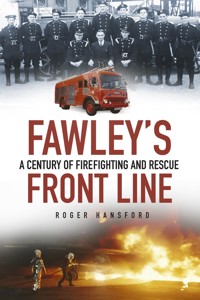
Home to the UK's largest refinery, Fawley is among the most at-risk parts of the country for petrochemical fires. Its fire service is vital to the area's infrastructure and its firefighters must always be prepared. For the first time, the story of this fire station and of the Waterside's private and military fire brigades is told. From establishment in the early twentieth century, through the development of the fire engine and firefighting techniques, to combating modern-day terrorist threats, Fawley's firefighters have witnessed it all. This book looks at how the station and its crew, now reduced from full- to part-time staffing, have evolved in the face of new dangers and challenges.
Sie lesen das E-Book in den Legimi-Apps auf:
Seitenzahl: 214
Veröffentlichungsjahr: 2014
Das E-Book (TTS) können Sie hören im Abo „Legimi Premium” in Legimi-Apps auf:
Ähnliche




















Fawley Refinery’s Dennis F2/pyrene foam tanker LYM 259 (built in June 1952) on a training exercise involving storage tanks. (Dick Lindsay)
Dedicated to my father,Ronald Joseph Hansford1945–2012
CONTENTS
Title
Dedication
List of Abbreviations
Acknowledgements
Introduction
1 Cadland Estate and the Early Fire Brigades
2 Modernisation and War: The Beginnings of Organised Firefighting in Fawley
3 A New Fire Station at Fawley: The Hampshire Fire Brigade Years, 1977–92
4 New Names, New Challenges: Developing a Modern Fire & Rescue Service at Hardley, 1992–2014
5 Petrochemicals and Ammunition: Fawley’s Industrial Fire Brigades and Marchwood Defence Fire Station
Bibliography
Appendices
Plates
Copyright
LIST OF ABBREVIATIONS
AFFF
Aqueous Film-Forming Foam
AFS
Auxiliary Fire Service
AGWI
Atlantic, Gulf and West Indies Oil Company
ALP
Aerial Ladder Platform
APA
Auxiliary Plant Attendant
ARP
Air Raid Precautions
BA
Breathing Apparatus
BFSA
British Fire Services Association
BOC
British Oxygen Company
CAFS
Compressed-Air Foam System
CBRN
Chemical, Biological, Radiological, and Nuclear
CEGB
Central Electricity Generating Board
CFO
Chief Fire Officer
COMAH
Control of Major Accident Hazards
DFRMO
Defence Fire Risk Management Organisation
DF&RS
Defence Fire & Rescue Service
DIM
Detection, Identification, and Monitoring
gpm
gallons per minute
HART
Hazardous Area Response Team
HF&RS
Hampshire Fire & Rescue Service
HGV
Heavy Goods Vehicle
HMS
Her Majesty’s Ship
HVP
High Volume Pumping Unit
ICU
Incident Command Unit
IFPA
Industrial Fire Protection Association
ISR
International Synthetic Rubber Company
LIFE
Local Intervention Fire Education
LPG
Liquefied Petroleum Gas
lpm
litres per minute
MBE
Member of the Most Excellent Order of the British Empire
MOD
Ministry of Defence
MRV
Multi-Role Vehicle
NFRDC
New Forest Rural District Council
NFS
National Fire Service
OBE
Officer of the Most Excellent Order of the British Empire
PC
Police Constable
PDA
Pre-Determined Attendance
PVC
Polyvinyl Chloride
RAF
Royal Air Force
RDC
Rural District Council
RTC
Road Traffic Collision
SEU
Special Equipment Unit
SFB
Southampton Fire Brigade
THA
Tactical Holding Area
VLCC
Very Large Crude Carrier
Note: The traditional term ‘fireman’ was superseded by ‘firefighter’ in 1992, and this is reflected in my text.
ACKNOWLEDGEMENTS
This book was made possible with help from serving and retired firefighters from the Waterside. Chas McGill at Hardley Fire Station allowed me access to his station and to a major emergency exercise, as well as giving me many contacts in the fire brigade. Trevor Fenn at Marchwood MOD Fire Station gave me a tour of his site, including a ride in the fire engine on ‘blues and twos’, and we spent several enjoyable hours sharing photographs and memories. Alan House, retired Deputy Chief Fire Officer for Hampshire, invited me to Fire Headquarters in Eastleigh and took the time to read my work, as well as offering invaluable research advice. I also met with Martin Rumsey, Malcolm Rumsey, Barry Browning, Derek Turner, Colin Partridge and Paul Freeman, and spoke on the telephone with Bill Farr. I would like to thank all the firefighters very much for their time and for the insight they gave me into their unique job.
Other local people have also been supportive. Mike Hocking at Geo Speciality Chemicals responded to my inquiry letter with useful information. At Waterside Heritage Centre in Hythe, Graham Parkes gave me considerable encouragement with my work and help with the early photographs, and Pam White provided interesting news clippings from her files. Jez Gale at the SouthernDaily Echo assisted my archive work, finding me several decades’ worth of clippings on Waterside fires. Janice Taylor at Herald Publishing promoted my project in her excellent local newspaper. Keith Dyer saw the WatersideHerald advertisement and got in touch to share his memories and an early photograph. Ernie Hartnell, formerly a local resident, responded to the advert from Australia! Pam Whittington wrote a 1998 book on the local fire brigade, and she discussed her research with me. I thank all of you, and hope this book gives something back to everybody in the area.
The work of several photographers enhances these pages: thanks to Steve Greenaway, Iain Kitchen, Matthew Leggott, Dick Lindsay, Roger Mardon, and Ken Reid (see Bibliography for individual websites). Clive Shearman and Malcolm Cheshire put me in touch with other photographers and sent me photographs from their collections. Hardley Fire Station and Hampshire Fire & Rescue Service kindly donated photographs, as did many individual firefighters.
Love and support from my mum and my wife Kaman also enabled the book to happen: thank you both!
INTRODUCTION
The rapid turnout of a fire appliance, with bright colours, flashing lights and loud sirens, is exciting to many people, not least when the humanitarian aspects of the vehicle’s work are considered. The fire and rescue service has evolved over many years but the pride associated with the early origins of fire brigades has not diminished. The necessary qualities of discipline, caring and bravery remain unchanged to this day. The firefighter’s role in the Fawley and Waterside area of Hampshire, one which presents firefighting risks of the highest level, is no exception. Firefighting tends to run in families, and many local firefighters were inspired to join by watching previous generations.
The preparations for civil defence during the Second World War marked a turning point in the organisation of fire brigades, but the arrival of a petrochemical industry brought the most significant change to provision on the Waterside. Today, fire and accident risks from industrial, commercial, domestic and rural causes are coexistent. The establishment of a new fire station at Fawley in 1977 provided immediate, round-the-clock cover for the area, but reduced opportunities and resources for existing fire stations. Some of the area’s firefighters were employed full-time, and some were retained firefighters, responding from their homes or places of work, including in local industry. Fawley Fire Station, renamed Hardley in the 1990s, has worked hard to build good relations with local young people and to spread a fire-safety message.
A higher than average number of private fire brigades have operated on the Waterside, and the degree of collaboration between them, both in equipment and personnel, has gone largely unreported. The area is home to the UK’s largest oil refinery, so a special focus on petrochemical firefighting is a particular feature of this book. Most of the industrial sites employ their own fire officers, drawing on additional workers at their plants for an emergency situation. The military presence at the Sea Mounting Centre (Military Port) in Marchwood involves the loading of ships with military explosives, an operation covered by the Defence Fire & Rescue Service (DF&RS) and also featured in these pages.
The 1990 water tender ladder G168 UPO was based at Hardley Fire Station from 1990 to 1997, and then at Lymington Fire Station. It later became part of the firefighting fleet at Fawley Refinery, and here carries the livery of Esso Fire & Response Group in place of HF&RS. (Iain Kitchen)
This book is created to be of interest to firefighters, historians, Fire Service enthusiasts and local people alike. The incidents dealt with attest to the character of the locality and they tell a story of development and change. Fire brigade attendance at the same site over decades will find it in various stages of development, use or dereliction. I describe the way fire brigades dealt with major fires in Fawley Refinery – such as in 1985 and 2004 – and the way this site has prepared for the terrorist threat through large-scale exercises. My focus on vehicles offers a case study of the changing British fire appliance and shows how it has been shaped by commercial constraints. Against this trajectory I show that many fire vehicles on the Waterside differ from convention because of their adaptation to fulfil specialist roles.
My own great-grandfather served at the Auxiliary Fire Station based behind the Falcon Inn in Fawley village, and he probably triggered my interest. As a young child growing up in the area, I saw many fire engines and wondered where they were going and whether there was more I could know about them. At an Esso open day in 1989, I was one of the children encouraged to compare a local authority with a Refinery fire engine. I continued to encounter the fire brigade as part of daily life, going to the Traveller’s Rest public house in the mid-1990s only to find it on fire: we stayed to watch as two Hampshire machines roared up and their crews tackled a blaze in the kitchen! During the preparation of this book in September 2011, I left home early one Sunday morning and found myself following Hardley’s water tender along the A326 as the crew responded to a fire at Marchwood Scientific Services.
I would like to extend particular thanks to Chas McGill and Trevor Fenn for their support of this project. Through them I was able to meet whole-time and retained firefighters, both serving and retired. I am indebted to Alan House who improved my work and whose own publications provided a broad background to the topic. The Southern DailyEcho archive was very useful in showing me how incidents were reported to local residents, and the study of this newspaper itself forms a historical sweep. The highlight of my research was being able to observe Exercise Shannon first-hand, and I extend my appreciation to all the personnel involved at the petrochemical complex on 5 May 2012. In publishing this book, I hope the work of the Waterside fire brigades will be better appreciated and that respect for them will continue to grow as they manage risk in the service of their community.
1
CADLAND ESTATE AND THE EARLY FIRE BRIGADES
At the start of the twentieth century, much of the parish of Fawley was rural in character, and the area consisted of villages, farms, lanes, farmland and woodlands. Significant buildings were the Norman church at Fawley and the Tudor stone castle on Calshot Spit. By this time the Drummond family was well established at the Manor of Cadland, having extended the house originally designed by Henry Holland and set in ‘Capability’ Brown parkland. The records of a fire at the estate farm in the late nineteenth century give a glimpse of the practice of firefighting in the parish at this time. My research on the fire is sourced from two accounts of the event, which I refer to as ‘Report 1’ and ‘Report 2’, both included as cuttings in the Drummond family’s scrapbook dated 1894. It has been difficult to date the incident precisely, but it could have been the fire at ‘Cadlands Farm, Cadlands’ attended by Southampton Fire Brigade on Sunday 1 March 1885, as documented in their records (SC/F 1/1).
Report 1 describes a ‘destructive fire at Cadlands Home Farm’. This was ‘of a very extensive character’ and destroyed five ricks of hay, six of barley, four of wheat, one of barley straw and one of ferns, later spreading to the granary and cart house, which almost completely burnt down. The initial alarm was raised at 8 p.m. on the Saturday by a Mrs Sarah Fry, steward to Edgar Atheling Drummond and servant to the farmer, Mr Hogg. At this, ‘the farm servants and others quickly mustered, and there being a plentiful water supply, the fire was soon extinguished’. Although a watch was kept on the yard, fire broke out again at 1.30 p.m. on the Sunday. This was attributed to brisk winds fanning embers from the previous day’s fire, which had been spread out in the open close to other ricks. Report 2 stated that in total some eighteen ricks were on fire within ten minutes of the alarm being raised in the village by one of the farm boys.
Report 1 details which fire brigades responded, and how they were called. Two engines were sent from nearby estates, one by Count Batthyhany of Eaglehurst Castle and another by Lord Henry Scott of Beaulieu. The naval vessel HMS Zealous was anchored off Netley, and dispatched two engines ‘manned by marines and sailors, and taken in boats up Cadlands Creek, to the scene of the fire’. These engines, when on land, were probably drawn by horses, with pumps operated manually or using steam. Report 1 suggests the engines were mobilised when the fire was sighted: ‘The conflagration was of course very great, lighting up the whole country round.’ More sophisticated methods of despatch were also in use, however, as this report informs us that a telegram was sent to Superintendent Gardner of Southampton Fire Brigade (SFB). Despite a slight difference in spelling, there was a Mr W.H. Gardiner in charge of SFB from 1876 until the mid-1880s, the term ‘Superintendent’ being used instead of Chief Fire Officer at that time. The officer and his personnel took the shortest route to the fire by catching the Hythe Ferry across Southampton Water. Meanwhile, their engine was sent around by road through Redbridge and Totton, but returned to base after meeting Mr Hogg’s messenger in Totton, who stated the fire was too seriously advanced for the engine to be of use. This left the Southampton firemen to assist the crew from Beaulieu, whose engine was the first to arrive. Report 2 said it was ‘thought necessary to telegraph for the Sappers and Miners’, and that the Sappers had arrived at Hythe before receipt of a second telegraph saying they were no longer needed. This may refer to the Southampton engine described in Report 1.
Report 1 gives an idea of the firefighting methods employed at the scene. The fire had spread too rapidly for those present to remove the carts from the cart house before it was engulfed. However, they did remove cattle from the cattle house and sprayed water on the farmhouse and other buildings to prevent them from igniting. Several water sources were available, all of which were utilised. There was a large tank of water 300–400m from the rick yard, and Report 1 states: ‘Two lines [of people] were formed from the yard to the tank, the one side passing empty buckets down from hand to hand, and returning full buckets of water in the same way on the other sides, and thus some of the engines were kept supplied with water.’
In this task, the Southampton and Beaulieu teams ‘did exceedingly good work, the men behaving themselves admirably’, and they were supported by many volunteers. Among the volunteers were important local figures including Mr Hogg, Mr Drummond, Mr Jenkinson, Revd Unwin, Dr Stephenson and Mr Perkins, and the same report states, ‘other gentlemen came, each lending a hand at the pumps or hose’. Meanwhile, Count Batthyhany directed the sailors and others in showering water onto the burning ricks from the farm pond, where one of the Zealous engines was working. Twenty men from HMS Zealous worked through the night with water from a tank in the roof of the corn mill, managing to save the corn and a threshing machine. The first team worked until midnight, when they were relieved by several other detachments from the ship, each led by an officer. This coheres with the Southampton Fire Brigade record, which mentions the attendance of private and manual engines not of SFB, and says the Cadland blaze was extinguished by ‘Firemen and Strangers’.
Despite the efforts of all involved, the impact of the fire was huge, doing damage estimated to cost £15,000, and ruining a good harvest along with the farm buildings. Smoke continued to issue from a hayrick at the scene on Monday, leading local people to believe the fire was still burning then, and there were unfounded rumours in Southampton and Beaulieu that Cadland House itself had been on fire, and even that fires had occurred simultaneously at Broadlands and Netley.
A tragic fire at Cadland Farm on 11 May 1923 was triggered by a boiler explosion and caused £5,000 worth of damage. Southampton Fire Brigade’s motor pump No. 3 attended the call, which had been raised by Leycester Meyer of Fawley. Alfred James Eldridge, aged 29, was killed in the incident along with his horse and three calves. (Waterside Heritage)
Enquiries were made into the origin of the blaze, and the police officers Superintendent Troke and Sergeant Fox concluded that the cause of the initial fire on the Saturday was accidental. Report 2 suggested spontaneous combustion as a possible cause of the fire on Saturday, and questioned whether ‘the crime of incendiarism’ had played a part in the fire’s rapid spread on Sunday. This was thought unlikely given that watchmen had been on guard all morning, and also that Mr Drummond was well-respected in the area. He was not a ‘hard landlord’ but ‘a most affable and kind gentleman, taking delight in and doing his utmost to promote everything that is for the improvement of the estate’. The author was ‘not afraid to assert’ that he was ‘more regarded and respected by all classes’ than any other landlord in the country, and could therefore ‘scout the idea with scorn that anyone of the parish of Fawley could have been guilty of such a dastardly outrage’. A final suggestion was that a ‘fanatic’ of the ‘destestable Trades’ Unions’ may have started the fire, but no such guilty party could be found. Put in context of the scientific approaches to fire investigation used in modern times, it is amusing that the accidental verdict was based largely on the character of the property owner. I suggest the failure to keep burnt embers away from fresh crops on the Saturday, and the rejection of the Southampton engine on the Sunday, leaving its crew unequipped and depriving the incident of an extra pump, were significant errors. Interestingly, the nineteenth-century reports do not question the allegiances or competence of those left to watch the yard before the main outbreak on Sunday morning!
The accounts of the Cadland Farm fire in Reports 1 and 2 are significant because they raise issues that have been important for firefighting in the parish – and in this location – over the last century. The reports evoke pictures of a rural landscape where farming was paramount, and rural firefighting has been commonplace in the surrounding area ever since. After development as an industrial site, the land at Cadland often saw fires and incidents where different fire brigades would respond and work together. The military are mentioned in the Drummond reports and they were involved with firefighting and rescue in the wider vicinity at different times; for example Southampton Fire Brigade recorded assistance from soldiers and sailors at a fire in Bourne Hill Cottage, Fawley, on 10 September 1916. In the 1880s many people from the community were prepared to help at Cadland on a voluntary basis, showing a willingness to serve in the face of danger which has not disappeared in the present day. Some of the firefighting techniques used in the farmyard, such as passing buckets down a line of people, differed little from those used since ancient times and employed, for example, at the Great Fire of London in 1666. Such techniques continued to be used into the early 1900s. The methods used to prevent fire spreading anticipated modern techniques, but the inefficiency of communication between fire teams contrasts strongly with the present. Finally, although four engines were called to a fire within the parish, all of them came from stations outside the boundary and none of them were from Fawley.
2
MODERNISATION AND WAR: THE BEGINNINGS OF ORGANISED FIREFIGHTING IN FAWLEY
The first significant signs of change in Fawley occurred in 1920 when the Atlantic, Gulf and West Indies Oil Company (AGWI ) started building a small refinery for bitumen and bunker fuels on land from the Cadland Estate. On 19 July 1921, SFB recorded attending a fire, with Engine No. 3, which had broken out in 500 out of the 1,200 sleepers piled beside the Totton railway line that were ‘to be used for the new Fawley line’ (SC/F1/1). This call-out heralded the arrival of the railway on the Waterside, meaning the area would no longer be isolated from development.
A fire brigade began in Fawley’s neighbouring parish of Hythe in 1919, moving to a purpose-built fire station in New Road in 1927. Pam Whittington’s HytheFire Brigade: A Local History (1998) tells the story of this brigade, including incidents they responded to within the Fawley area. In contrast, it would be another half-century before the parish of Fawley had its own purpose-built and permanent local authority fire station. Yet the area had a successful volunteer fire brigade before the legal requirement to provide a Fire Service came in the late 1930s. This chapter covers developments underlining Fawley’s need for a local authority fire station and describes the measures taken in the meantime to save life and property from fire. From the 1920s to the 1960s the degree of petrochemical risk was to increase unrecognisably and special arrangements were needed for the threat of armed assault and invasion by Nazi Germany. However, it was not until the 1970s that the new fire station was built.
The Fawley Volunteer Fire Brigade in the 1930s
During the first decades of the twentieth century there was no fire brigade in the area. No legislation required such provision and no piped water supply was available. The population relied on pumps and wells for domestic purposes and the authorities jostled to avoid responsibility. The minutes of the Fawley Parish Council, held at the Hampshire Record Office in Winchester (Shelfmark 25M60/PX1), show how the need to improve firefighting capacity was recognised in the parish as early as 1927, but it was initially difficult to obtain necessary backing from the New Forest Rural District Council (RDC). The entry for a meeting held on 21 March 1927, at 7 p.m. in the Public Hall, reads:
Fire Hydrants
Mr. G. Musselwhite brought forward the question of Fire Hydrants, stating that in view of the recent disastrous fire at Copthorne, and difficulty of obtaining supplies of water in case of fire, he considered that it was advisable that Fire Hydrants should be fixed in the village. Mr. Maclean explained what had been done by the Agwi Co. regarding Hydrants for their works and a letter was read from the clerk to R. D. C. explaining necessary steps to be taken to obtain Hydrants, this matter was left to the Parish Council.
It is interesting that firefighting practice in AGWI was seen as a benchmark for local improvements. In 1931, SFB attended fires at Ashlett Cottage, Fawley, and at Hubert Scott-Paine’s British Powerboat Company in Hythe, involving twelve powerboats. The Fawley minutes for 1931–32 recorded the Parish Council ‘pressing’ the RDC to ‘act’ and to help fund a water supply to Blackfield, Langley and Spratts Down. Clearly firefighting would have been just one of many uses for piped water!
By 27 March 1933 the situation had improved and Fawley Parish Council was ‘pleased to report the following progress on parish affairs during the past year’. Regarding the water supply to Rollestone, Blackfield, Langley and West Common, arrangements were ‘well under way’, and with help from the RDC and Southampton Borough Corporation this had involved minimal expense for the parish. However, later entries show that local people were sometimes reluctant to take advantage of the water supply, particularly at Langley, West Common and Ashlett Creek. The 1933 report stated, ‘application will also be made to include hydrants’. The second point of the report merits full quotation as, with acknowledgement of financial constraints, it shows how seeds were sown for the first organised fire team in Fawley:
Fire Protection
The rapid development of building in the parish makes the provision of adequate fire protection facilities necessary.
Within its limited means and with a desire to restrict expenditure the Council cannot do much towards providing all the appliances desirable but the formation of a volunteer fire brigade has been under consideration and members of the public who are interested in this matter should give their names to Mr. Dobson the chairman of the Fire Appliances Sub Committee.
The Parish Council’s concern for firefighting provision was prescient given the major incident at the AGWI Refinery on 12 March 1935. Headlines from the Southern Daily Echo’s report of the next day called the fire ‘alarming’, with homes ‘rocked’ by a violent explosion, a petrol tank ‘turned into a roaring, fiery cauldron’, one man making a ‘miraculous escape’, and the firemen engaged in ‘twelve hours’ battle’. The tone of the article is amusing to modern eyes:
Fire at Copthorne House, 5 November 1926. Furniture has been removed to safety on the lawn. An oil lamp started the fire, which severely damaged the dwelling owned by AGWI Corporation and accommodating Superintendent Mr Demoulins and Assistant Superintendent Mr Wishart. (Waterside Heritage)
Firemen at the Copthorne House fire using a soda-acid operated first-aid hose attached to the fire appliance, as well as foam fire extinguishers. The extinguishers would have been ineffective for a house fire! In the left foreground is Captain W. Burt, Chief Officer of Hythe Fire Brigade. Firemen from Hythe, Brockenhurst and Exbury attended this fire, and the vehicle shown is probably the Exbury one. (Waterside Heritage)
Petrol tank fire at the AGWI Refinery, 12 March 1935. (Waterside Heritage)




