


114,99 €
Mehr erfahren.
- Herausgeber: John Wiley & Sons
- Kategorie: Fachliteratur
- Sprache: Englisch
Feline Cardiology is the first book dedicated to thediagnosis and treatment of heart disease in cats. Designedfor use in clinical practice, this reference combines cutting-edgeinformation with practical applications, using a consistent formatfor ease of use. Feline Cardiology provides detailed,species-specific information that is absent from other texts, withan emphasis on the most commonly encountered feline cardiovasculardiseases. Drawing on the expertise of four internationally recognizedauthors, the book is packed with state-of-the-art informationwithin the framework of daily practice. Coverage ranges frombasic and advanced treatment approaches for cardiomyopathies,arrhythmias, and many other disorders to the newest information ongenetic testing, circulating markers of heart disease, andmore. Feline Cardiology provides a comprehensivesingle resource to managing cardiovascular disease in cats and is awelcome addition to any small animal practice library.
Sie lesen das E-Book in den Legimi-Apps auf:
Seitenzahl: 1306
Veröffentlichungsjahr: 2011
Ähnliche



















Table of Contents
Cover
Title page
Copyright page
Dedications
Preface
Acknowledgments
Authors
SECTION A: Clinical Entities
1 Heart Murmurs and Gallop Heart Sounds
INTRODUCTION
HEART MURMURS
GALLOP HEART SOUNDS
2 Exercise Intolerance and Syncope
INTRODUCTION
ETIOLOGY AND PATHOPHYSIOLOGY
SIGNALMENT
HISTORY AND CHIEF COMPLAINT
PHYSICAL EXAMINATION
DIFFERENTIAL DIAGNOSIS
DIAGNOSTIC TESTING
TREATMENT
OUTCOME AND PROGNOSIS
EXERCISE INTOLERANCE
3 Pleural Effusion
4 Dyspnea and Cough
5 Cardiopulmonary Arrest and Cardiopulmonary Cerebral Resuscitation
CARDIOPULMONARY ARREST
DIAGNOSIS
DIFFERENTIAL DIAGNOSIS
TREATMENT
OUTCOME
SECTION B: Diagnostic Testing
6 Radiography
7 Echocardiography
INTRODUCTION
ECHOCARDIOGRAPHY BASICS
ECHOCARDIOGRAPHIC EQUIPMENT
PERFORMING THE ECHOCARDIOGRAM
ECHOCARDIOGRAPHIC ASSESSMENT OF DIASTOLIC FUNCTION
CONTRAST ECHOCARDIOGRAPHY
8 Cardiac Biomarkers
INTRODUCTION
HOMOCYST(E)INE AND B VITAMINS
ENDOTHELIN I
CARDIAC TROPONINS
NATRIURETIC PEPTIDES (ATRIAL AND B-TYPE NATRIURETIC PEPTIDE; ANP AND BNP)
9 Electrocardiography
INTRODUCTION
TECHNIQUE
NORMAL EVOLUTION OF THE ECG THROUGH LIFE
HOLTER AND EVENT MONITORING
SECTION C: Congenital Heart Disease
10 Congenital Heart Malformations
INTRODUCTION
HISTORY AND CHIEF COMPLAINT
PHYSICAL EXAMINATION
COMPLICATIONS AND MONITORING
ATRIOVENTRICULAR VALVE MALFORMATIONS: TRICUSPID VALVE MALFORMATION
MITRAL VALVE MALFORMATION/DYSPLASIA
MITRAL VALVE STENOSIS
VENTRICULAR SEPTAL DEFECT
AORTIC STENOSIS
ATRIAL SEPTAL DEFECT
COMMON AV CANAL (ENDOCARDIAL CUSHION DEFECT)
COR TRIATRIATUM SINISTER
DOUBLE CHAMBER RIGHT VENTRICLE
PATENT DUCTUS ARTERIOSUS
PULMONIC STENOSIS, PULMONARY ARTERY STENOSIS
TETRALOGY OF FALLOT
SECTION D: Cardiomyopathies
11 Hypertrophic Cardiomyopathy
INTRODUCTION
ETIOLOGY
GROSS PATHOLOGY
PATHOPHYSIOLOGY
SIGNALMENT
HISTORY AND CHIEF COMPLAINT
PHYSICAL EXAMINATION
DIFFERENTIAL DIAGNOSIS
DIAGNOSTIC TESTING
TREATMENT
COMPLICATIONS AND MONITORING
OUTCOME AND PROGNOSIS
12 Restrictive/Unclassified Cardiomyopathy
RESTRICTIVE CARDIOMYOPATHY
ETIOLOGY, PATHOPHYSIOLOGY, AND GROSS PATHOLOGY
SIGNALMENT
HISTORY AND CHIEF COMPLAINT
PHYSICAL EXAMINATION
DIFFERENTIAL DIAGNOSIS
DIAGNOSTIC TESTING
TREATMENT
COMPLICATIONS AND MONITORING
OUTCOME AND PROGNOSIS
13 Dilated Cardiomyopathy
INTRODUCTION
ETIOLOGY, PATHOPHYSIOLOGY, AND GROSS PATHOLOGY
SIGNALMENT
HISTORY AND CHIEF COMPLAINT
PHYSICAL EXAMINATION
DIFFERENTIAL DIAGNOSIS
DIAGNOSTIC TESTING
TREATMENT
COMPLICATIONS AND MONITORING
OUTCOME AND PROGNOSIS
14 Arrhythmogenic Right Ventricular Cardiomyopathy
INTRODUCTION
ETIOLOGY, PATHOPHYSIOLOGY, AND GROSS PATHOLOGY
SIGNALMENT
HISTORY AND CHIEF COMPLAINT
PHYSICAL EXAMINATION
DIFFERENTIAL DIAGNOSIS
DIAGNOSTIC TESTING
TREATMENT
COMPLICATIONS AND MONITORING
OUTCOME AND PROGNOSIS
SECTION E: Other Forms of Structural Heart Disease
15 Acquired Valvular Disease
DEGENERATIVE VALVE DISEASE
DIAGNOSIS
DIFFERENTIAL DIAGNOSIS
INFECTIVE ENDOCARDITIS
16 Cardiac Neoplasia
INTRODUCTION
PREVALENCE, ETIOLOGY, PATHOPHYSIOLOGY, AND GROSS PATHOLOGY
SIGNALMENT
HISTORY AND CHIEF COMPLAINT
PHYSICAL EXAMINATION
DIFFERENTIAL DIAGNOSIS
DIAGNOSTIC TESTING
TREATMENT
OUTCOME AND PROGNOSIS
17 Miscellaneous Myocardial Disease
MYOCARDITIS
ENDOCARDIAL FIBROELASTOSIS
EXCESSIVE LEFT VENTRICULAR MODERATOR BANDS
SECTION F: Arrhythmias and Other Electrocardiographic Abnormalities
18 Arrhythmias and Other Electrocardiographic Abnormalities
INTRODUCTION
ETIOLOGY, PATHOPHYSIOLOGY, AND GROSS PATHOLOGY
CLINICAL ELECTROCARDIOLOGY
SPECIFIC ARRHYTHMIAS
CARDIAC EFFECTS OF SYSTEMIC POTASSIUM AND CALCIUM ABNORMALITIES
MORPHOLOGIC ECG ABNORMALITIES
SECTION G: Congestive Heart Failure
19 Congestive Heart Failure
DEFINITIONS
INTRODUCTION
PATHOPHYSIOLOGY AND GROSS PATHOLOGY
SIGNALMENT
HISTORY AND CHIEF COMPLAINT
PRECIPITATING FACTORS THAT MAY CONTRIBUTE TO CONGESTIVE HEART FAILURE
PHYSICAL EXAMINATION
DIFFERENTIAL DIAGNOSIS
DIAGNOSTIC TESTING
TREATMENT
COMPLICATIONS AND MONITORING
OUTCOME AND PROGNOSIS
SECTION H: Arterial Thromboembolism
20 Arterial Thromboembolism
INTRODUCTION
PATHOPHYSIOLOGY AND GROSS PATHOLOGY
SIGNALMENT
HISTORY AND CHIEF COMPLAINT
DIFFERENTIAL DIAGNOSIS
DIAGNOSTIC TESTING
TREATMENT
COMPLICATIONS AND MONITORING
LONG-TERM OUTCOME AND PROGNOSIS
SECTION I: Systemic Hypertension
21 Systemic Hypertension
INTRODUCTION
ETIOLOGY, PATHOPHYSIOLOGY, AND GROSS PATHOLOGY
SIGNALMENT
HISTORY AND CHIEF COMPLAINT
PHYSICAL EXAMINATION
DIFFERENTIAL DIAGNOSIS
DIAGNOSTIC TESTING
TREATMENT
MONITORING
OUTCOME AND PROGNOSIS
SECTION J: Pericardial Diseases
22 Pericardial Effusion and Other Disorders of the Pericardium
INTRODUCTION
CONGENITAL PERICARDIAL DISEASES
ACQUIRED PERICARDIAL DISEASES
CONSTRICTIVE PERICARDITIS
SECTION K: Heartworm Disease
23 Heartworm Disease
INTRODUCTION
ETIOLOGY AND LIFE CYCLE
HISTORY, CHIEF COMPLAINT, PHYSICAL EXAMINATION
DIAGNOSIS
TREATMENT
MONITORING
OUTCOME AND PROGNOSIS
SECTION L: Comorbidities
24 Comorbidities: Managing Cats That Have Coexistent Cardiac Disease and Extracardiac Disorders
INTRODUCTION
CONCURRENT HEART DISEASE AND KIDNEY DISEASE
CARDIAC DISEASE AND IDIOPATHIC CYSTITIS/FELINE LOWER URINARY TRACT SIGNS
CARDIAC DISEASE AND FELINE ASTHMA
CONCURRENT CARDIAC DISEASE AND OTHER DISORDERS TREATED WITH GLUCOCORTICOIDS
CARDIAC DISEASE AND UNRELATED PLEURAL EFFUSION
CRITICAL CARE REQUIRING FLUID THERAPY IN THE CAT WITH HEART DISEASE
SECTION M: Pulmonary Arterial Disorders
25 Pulmonary Thromboembolism and Pulmonary Hypertension
PULMONARY THROMBOEMBOLISM
PULMONARY ARTERIAL HYPERTENSION
SECTION N: Endocrine Diseases Affecting the Heart
26 Endocrine Diseases Affecting the Heart
HYPERTHYROIDISM
OTHER ENDOCRINOPATHIES
SECTION O: Anesthesia in the Patient with Cardiac Disease
27 Anesthesia in the Patient with Cardiac Disease
INTRODUCTION
PREANESTHETIC PREPARATION
ANESTHESIA
ANESTHETIZING THE FRACTIOUS CAT
SUPPORT AND MONITORING
TREATMENT
POSTOPERATIVE MONITORING AND RECOVERY
PLANNING ANESTHESIA IN THE CARDIAC PATIENT WITHOUT AN ECHOCARDIOGRAM
SECTION P: Cardiac Screening Programs
28 Cardiac Screening Programs
INTRODUCTION
CONGENITAL DEFECTS
HYPERTROPHIC CARDIOMYOPATHY
GENETIC SCREENING
OTHER FORMS OF CARDIOMYOPATHY
SECTION Q: Which Drug for Which Disease?
29 Which Drug for Which Disease?
INTRODUCTION
HYPERTROPHIC CARDIOMYOPATHY—COMPENSATED (“ASYMPTOMATIC”)
DILATED CARDIOMYOPATHY (DCM)
RESTRICTIVE/UNCLASSIFIED CARDIOMYOPATHY
CONGESTIVE HEART FAILURE
AORTIC THROMBOEMBOLISM
SYSTEMIC HYPERTENSION
CONGENITAL HEART DISEASE
ARRHYTHMIAS
SECTION R: Drug Formulary
30 Drug Formulary
Index
Download CD/DVD content
This edition first published 2011 © 2011 by John Wiley & Sons, Inc.
Wiley-Blackwell is an imprint of John Wiley & Sons, formed by the merger of Wiley’s global Scientific, Technical and Medical business with Blackwell Publishing.
Registered office: John Wiley & Sons Ltd, The Atrium, Southern Gate, Chichester, West Sussex, PO19 8SQ, UK
Editorial offices: 2121 State Avenue, Ames, Iowa 50014-8300, USA
The Atrium, Southern Gate, Chichester, West Sussex, PO19 8SQ, UK
9600 Garsington Road, Oxford, OX4 2DQ, UK
For details of our global editorial offices, for customer services and for information about how to apply for permission to reuse the copyright material in this book please see our website at www.wiley.com/wiley-blackwell.
Authorization to photocopy items for internal or personal use, or the internal or personal use of specific clients, is granted by Blackwell Publishing, provided that the base fee is paid directly to the Copyright Clearance Center, 222 Rosewood Drive, Danvers, MA 01923. For those organizations that have been granted a photocopy license by CCC, a separate system of payments has been arranged. The fee codes for users of the Transactional Reporting Service are ISBN-13: 978-0-8138-1242-7/2011.
Designations used by companies to distinguish their products are often claimed as trademarks. All brand names and product names used in this book are trade names, service marks, trademarks or registered trademarks of their respective owners. The publisher is not associated with any product or vendor mentioned in this book. This publication is designed to provide accurate and authoritative information in regard to the subject matter covered. It is sold on the understanding that the publisher is not engaged in rendering professional services. If professional advice or other expert assistance is required, the services of a competent professional should be sought.
Library of Congress Cataloging-in-Publication Data
Feline cardiology / Etienne Côté ... [et al.].
p. ; cm.
Includes bibliographical references and index.
ISBN 978-0-8138-1242-7 (hardcover : alk. paper)
1. Cats–Diseases. 2. Veterinary cardiology. I. Côté, Etienne.
[DNLM: 1. Cat Diseases. 2. Cardiovascular Diseases–veterinary. SF 985]
SF985.F414 2011
636.8'089–dc22
2011007198
A catalogue record for this book is available from the British Library.
This book is published in the following electronic formats: ePDF 9780470960165; ePub 9780470960172; Mobi 9780470960189
Disclaimer
The publisher and the authors make no representations or warranties with respect to the accuracy or completeness of the contents of this work and specifically disclaim all warranties, including without limitation warranties of fitness for a particular purpose. No warranty may be created or extended by sales or promotional materials. The advice and strategies contained herein may not be suitable for every situation. This work is sold with the understanding that the publisher is not engaged in rendering legal, accounting, or other professional services. If professional assistance is required, the services of a competent professional person should be sought. Neither the publisher nor the authors shall be liable for damages arising herefrom. The fact that an organization or website is referred to in this work as a citation and/or a potential source of further information does not mean that the authors or the publisher endorses the information the organization or Website may provide or recommendations it may make. Further, readers should be aware that Internet websites listed in this work may have changed or disappeared between when this work was written and when it is read.
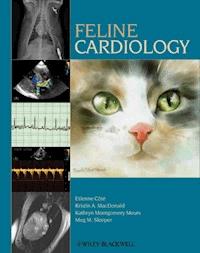
Cover Image Credits—Top left image: Radiograph of a cat with a permanent epicardial pacemaker. Second left image: Echocardiogram of a cat with hypertrophic obstructive cardiomyopathy, showing systolic anterior motion of the mitral valve and associated mitral regurgitation and turbulence in the left ventricular outflow tract. Third left image: Electrocardiogram of a cat showing normal sinus rhythm and superimposed motion artifact caused by purring. Fourth left image: Spectral Doppler tracing obtained in the left ventricular outflow of a cat with dynamic left ventricular outflow tract obstruction. Bottom left image: Cardiac magnetic resonance image of a cat with hypertrophic cardiomyopathy. Right image: “Cat Eyes” by Barbara Hartsook, http://WithBrushandPen.com
For my father, François Côté, and in memory of my mother, Louise Martin, who have been my nature and nurture.
Etienne Côté
For my husband Jim, my mother Nancy, and my daughter Lexi: thank you for bringing so much happiness and support to my life and for encouraging my endeavors. Thank you to my mentor, Dr. Mark Kittleson, for giving me the opportunity and guidance in my research of feline hypertrophic cardiomyopathy.
Kristin A. MacDonald
For the many, many, many mentors (both human and feline) I have had along the way, thank you.
Kathryn M. Meurs
For Drs. David H. Knight and Jim W. Buchanan—I was privileged to be one of your students.
For Mary Jane, who always believed in me. Thank you, Granny.
For Dave, who loves me anyway.
Meg M. Sleeper
Preface
Cats are the most popular house pet in the United States, numbering some 88.3 million (contrasting with 74.8 million dogs) (HSUS 2010). Surveys suggest proportionally similar domestic feline populations in many other countries (Murray et al. 2010; Chambre Syndicale 2006; EPFIF 2010). Even so, a textbook dedicated to heart diseases of the cat has not existed until now. By contrast, the first textbook on cardiology of the dog was published over 40 years ago (Ettinger and Suter 1970). Therefore, much of the information on heart diseases of cats in current reference texts is presented in combination with information on heart diseases of dogs. Such an approach provides a framework but is insufficient, especially in practices where cats make up a substantial proportion of the caseload. Cats develop and manifest cardiac disease uniquely, in ways that often do not lend themselves to comparisons or extrapolations from other species.
Our ability to recognize feline heart disease continues to increase, and as a result, some studies suggest that the prevalence of heart disease in cats rivals or surpasses the prevalence of heart disease in humans (Paige et al. 2009). This awareness presents both opportunity and dilemma. What are the appropriate tests to diagnose heart disease in cats, and how can private practitioners best use them in daily practice? “Does every cat with a murmur need an echocardiogram?” Can some confounding factors influence the diagnosis of heart disease (Campbell and Kittleson 2007)? Should a cat be treated if structural changes of the heart are only discovered as an incidental finding? Is the prognosis guarded even if his/her cardiac disorder is stable for years? How should comorbidities be addressed in cats with underlying cardiac disease? Answers exist for some of these questions but not others; what is undeniable is the emergence of these questions in daily feline practice. Despite insufficient published information, dedicated cat owners expect veterinarians to diagnose and treat cats that have heart disease with a high level of proficiency and care.
As veterinarians, we are faced daily with the spectrum of feline heart disease. The severity of our feline patients’ problems ranges from the very mild to life-threatening and devastating situations. A multiauthor consensus for providing optimal diagnosis and treatment in an attempt to attain the best overall outcome seemed useful but was lacking in existing texts.
All of these observations pointed to a need for more information, which we chose to address by creating this book. Our primary goal has been to collect and present clinically relevant and applicable approaches to the evaluation and treatment of feline heart disease. Above all, the book is meant to be useful in clinical practice. Within this approach, we have also included advanced or state-of-the-art material as appropriate.
We have aimed to describe and explain the intricacies and nuances of feline heart disease, and the uniqueness of feline heart disease, as we see them. Like so many branches of veterinary medicine, feline cardiology suffers from having few formally accepted guidelines to direct the practice and application of the discipline. This book represents our collective effort at identifying and providing the published information that does exist, interwoven with our own experience, opinions, and practice approaches when peer-reviewed data were lacking.
Several features of this book demonstrate the way in which we have sought to reach these goals, including
Emphasis on clinically relevant aspects of naturally occurring heart disease in the cat. The cardiomyopathies, aortic thromboembolism, heart murmurs, congestive heart failure, and other cornerstones of feline cardiovascular disease are explored in detail. The largest part of the book describes individual cardiovascular diseases as they occur in the veterinary setting. The length of chapters deliberately reflects the importance of individual diseases, so that reader-practitioners may find the most information on the diseases they encounter most often.Organization in a predictable and user-friendly format. Chapters begin with key points to summarize the most important elements of each chapter and then proceed through the natural sequence of information, typically: introduction, pathophysiology, signalment, history, physical exam, and so on.Anticipation and recognition of the realities of veterinary practice. For example, Chapter 27 on general anesthesia contains sections on “Anesthetizing the Fractious Cat” and “Planning Anesthesia in the Cardiac Patient without an Echocardiogram”; Chapter 29 summarizes treatment recommendations for the most common feline heart diseases in a streamlined way and is titled simply “Which Drug for Which Disease?”; Chapter 24 describes managing heart disease in cats that have concurrent kidney disease, allergic airway disease, and other comorbidities; and Chapter 30 is a drug index that serves as a quick reference to the commonly—and less commonly—used cardiovascular medications for cats.Presentation of new and innovative information, ranging from cardiac biomarkers and cardiac magnetic resonance imaging to current approaches for genetic screening programs and prebreeding evaluation of cats for heart disease.Full-color illustrations. Photographs present physical abnormalities, diagnostic images, and other visually engaging material as clearly as possible.Inclusion of reference citations in print at the end of each chapter to allow for quick referencing without needing to consult a CD or website.Comprehensive normal feline reference values for cardiovascular parameters and diagnostic tests including electrocardiography, echocardiography, and thoracic radiography are available on the inside covers for immediate access.We were fortunate to benefit from the advantages of communications technology throughout the creation of this book. We wished to have the best of both worlds: taking advantage of our individual strengths and regional exposure, while creating a textbook that is seamless and uniform in style. This was made possible by numerous conference calls and a 6-month comprehensive review period that involved all four of us in a series of 15 desktop-synchronized teleconferences. As a result, each one of us has reviewed and discussed every chapter. We hope readers find that the result is a textbook that is both insightful and cohesive.
This book is resolutely and unapologetically devoted to the cat. Nevertheless, we strived to present cardiology concepts and medical reasoning with the greatest possible clarity, and our hope is that readers not primarily interested in learning about cats will still find that our explanations help them understand cardiology in general.
REFERENCES
Campbell F, Kittleson MD. The effect of hydration status on the echocardiographic measurements of normal cats. J Vet Intern Med 2007;21:1008–1015.
Chambre Syndicale des Fabricants d’Aliments Préparés pour Chiens, Chats, Oiseaux, et Autres Animaux Familiers (FACCO). Survey of pet ownership in France, 2006. http://www.facco.fr/Resultats-de-l-enquete-2006. Accessed July 14, 2010.
Ettinger SJ, Suter PF. Canine Cardiology. Philadelphia, Saunders, 1970.
European Pet Food Industry Federation (EPFIF). Survey of Pet Ownership in Europe. http://www.fediaf.org/gentree.htm. Accessed July 14, 2010.
Humane Society of the United States (HSUS). http://www.hsus.org/pets/issues_affecting_our_pets/pet_overpopulation_and_ownership_statistics/us_pet_ownership_statistics.html. Accessed 7/14/10.
Murray JK, Browne WJ, Roberts MA, Whitmarsh A, Gruffydd-Jones TJ. Number and ownership profiles of cats and dogs in the UK. Vet Rec 2010;166:163–168.
Paige CF, Abbott JA, Elvinger F, Pyle RL. Prevalence of cardiomyopathy in apparently healthy cats. J Am Vet Med Assoc 2009;234: 1398–1403.
Acknowledgments
We thank the group at Wiley-Blackwell, notably Antonia Seymour, Erica Judisch, Erin Magnani, Nancy Turner, Nancy Albright, Justin Jeffryes, and Ray Kersey, for the spark that started this project and their unfailing support throughout its preparation and completion. Their efforts successfully transformed a series of Word documents and digital images into this attractive book.
We owe a great deal of gratitude to many people who helped us make this book possible. Several colleagues, notably Drs. John Bonagura, Phil Fox, Steve Ettinger, Fiona Campbell, and others provided their feedback, their own materials, or both, for us to include in this book. We are truly thankful for their incredible generosity.
Dr. Bruno Pypendop, DrMedVet, DrVetSci, Dipl. ACVA, Associate Professor, Department of Surgical and Radiological Sciences, School of Veterinary Medicine, University of California, Davis, lent his expertise to our group to create an outstanding chapter on general anesthesia in cats with cardiovascular disease (Chapter 27). We thank him sincerely for his dedication of time and his generous contribution of a truly clinically relevant, insightful chapter.
The American Association of Feline Practitioners and the International Association of Cat Doctors kindly responded to our requests by offering dozens of ideas and suggestions for what a good feline cardiology book should contain. We are truly grateful to them for this contribution. This feedback “from the trenches” was extremely valuable, both for confirming the importance of what we planned to include and for proposing new ideas.
Many thanks are due to graphic illustrators John Doval and Maggie Lillo, who transformed our rudimentary ideas and basic sketches into several beautiful, clear, engaging illustrations.
Finally, and above all, we thank our coworkers, friends, and family. Their understanding and support allowed us to make this book a reality.
Authors
Etienne Côté DVM, Diplomate ACVIM (Cardiology, Small Animal Internal Medicine)
Kristin A. MacDonald, DVM, PhD, Diplomate ACVIM (Cardiology)
Kathryn M. Meurs, DVM, PhD, Diplomate ACVIM (Cardiology)
Meg M. Sleeper VMD, Diplomate ACVIM (Cardiology)
2
Exercise Intolerance and Syncope
Key Points
Syncope is an uncommon occurrence in cats.When it occurs, it most commonly is the result of an arrhythmia—typically a pathologic bradycardia—in a cat with underlying structural heart disease, but systemic illness and tachycardias can cause syncope in cats.Detailed diagnostic evaluation is essential in order to confirm syncope and rule out neurologic or other phenomena.Lesen Sie weiter in der vollständigen Ausgabe!
Lesen Sie weiter in der vollständigen Ausgabe!
Lesen Sie weiter in der vollständigen Ausgabe!
Lesen Sie weiter in der vollständigen Ausgabe!
Lesen Sie weiter in der vollständigen Ausgabe!
Lesen Sie weiter in der vollständigen Ausgabe!
Lesen Sie weiter in der vollständigen Ausgabe!
Lesen Sie weiter in der vollständigen Ausgabe!
Lesen Sie weiter in der vollständigen Ausgabe!
Lesen Sie weiter in der vollständigen Ausgabe!
Lesen Sie weiter in der vollständigen Ausgabe!
Lesen Sie weiter in der vollständigen Ausgabe!
Lesen Sie weiter in der vollständigen Ausgabe!
Lesen Sie weiter in der vollständigen Ausgabe!
Lesen Sie weiter in der vollständigen Ausgabe!
Lesen Sie weiter in der vollständigen Ausgabe!
Lesen Sie weiter in der vollständigen Ausgabe!
Lesen Sie weiter in der vollständigen Ausgabe!
Lesen Sie weiter in der vollständigen Ausgabe!
Lesen Sie weiter in der vollständigen Ausgabe!
Lesen Sie weiter in der vollständigen Ausgabe!
Lesen Sie weiter in der vollständigen Ausgabe!
Lesen Sie weiter in der vollständigen Ausgabe!
Lesen Sie weiter in der vollständigen Ausgabe!
Lesen Sie weiter in der vollständigen Ausgabe!
Lesen Sie weiter in der vollständigen Ausgabe!
Lesen Sie weiter in der vollständigen Ausgabe!
Lesen Sie weiter in der vollständigen Ausgabe!
Lesen Sie weiter in der vollständigen Ausgabe!
Lesen Sie weiter in der vollständigen Ausgabe!




