


19,99 €
Mehr erfahren.
- Herausgeber: John Wiley & Sons
- Kategorie: Fachliteratur
- Sprache: Englisch
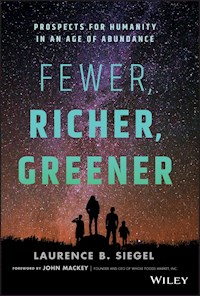
How the world has become much better and why optimism is abundantly justified Why do so many people fear the future? Is their concern justified, or can we look forward to greater wealth and continued improvement in the way we live? Our world seems to be experiencing stagnant economic growth, climatic deterioration, dwindling natural resources, and an unsustainable level of population growth. The world is doomed, they argue, and there are just too many problems to overcome. But is this really the case? In Fewer, Richer, Greener, author Laurence B. Siegel reveals that the world has improved--and will continue to improve--in almost every dimension imaginable. This practical yet lighthearted book makes a convincing case for having gratitude for today's world and optimism about the bountiful world of tomorrow. Life has actually improved tremendously. We live in the safest, most prosperous time in all human history. Whatever the metric--food, health, longevity, education, conflict--it is demonstrably true that right now is the best time to be alive. The recent, dramatic slowing in global population growth continues to spread prosperity from the developed to the developing world. Technology is helping billions of people rise above levels of mere subsistence. This technology of prosperity is cumulative and rapidly improving: we use it to solve problems in ways that would have be unimaginable only a few decades ago. An optimistic antidote for pessimism and fear, this book: * Helps to restore and reinforce our faith in the future * Documents and explains how global changes impact our present and influence our future * Discusses the costs and unforeseen consequences of some of the changes occurring in the modern world * Offers engaging narrative, accurate data and research, and an in-depth look at the best books on the topic by leading thinkers * Traces the history of economic progress and explores its consequences for human life around the world Fewer, Richer, Greener: Prospects for Humanity in an Age of Abundance is a must-read for anyone who wishes to regain hope for the present and wants to build a better future.
Sie lesen das E-Book in den Legimi-Apps auf:
Seitenzahl: 729
Veröffentlichungsjahr: 2019
Ähnliche



















FEWER, RICHER, GREENER
PROSPECTS FOR HUMANITY IN AN AGE OF ABUNDANCE
LAURENCE B. SIEGEL
Cover image: © grynold/Shutterstock, © grakozy/Unsplash
Cover design: Wiley
Copyright © 2020 by Laurence B. Siegel. All rights reserved.
Published by John Wiley & Sons, Inc., Hoboken, New Jersey.
Published simultaneously in Canada.
No part of this publication may be reproduced, stored in a retrieval system, or transmitted in any form or by any means, electronic, mechanical, photocopying, recording, scanning, or otherwise, except as permitted under Section 107 or 108 of the 1976 United States Copyright Act, without either the prior written permission of the Publisher, or authorization through payment of the appropriate per-copy fee to the Copyright Clearance Center, Inc., 222 Rosewood Drive, Danvers, MA 01923, (978) 750-8400, fax (978) 646-8600, or on the Web at www.copyright.com. Requests to the Publisher for permission should be addressed to the Permissions Department, John Wiley & Sons, Inc., 111 River Street, Hoboken, NJ 07030, (201) 748-6011, fax (201) 748-6008, or online at www.wiley.com/go/permissions.
Limit of Liability/Disclaimer of Warranty: While the publisher and author have used their best efforts in preparing this book, they make no representations or warranties with respect to the accuracy or completeness of the contents of this book and specifically disclaim any implied warranties of merchantability or fitness for a particular purpose. No warranty may be created or extended by sales representatives or written sales materials. The advice and strategies contained herein may not be suitable for your situation. You should consult with a professional where appropriate. Neither the publisher nor author shall be liable for any loss of profit or any other commercial damages, including but not limited to special, incidental, consequential, or other damages.
For general information on our other products and services or for technical support, please contact our Customer Care Department within the United States at (800) 762-2974, outside the United States at (317) 572-3993, or fax (317) 572-4002.
Wiley publishes in a variety of print and electronic formats and by print-on-demand. Some material included with standard print versions of this book may not be included in e-books or in print-on-demand. If this book refers to media such as a CD or DVD that is not included in the version you purchased, you may download this material at http://booksupport.wiley.com. For more information about Wiley products, visit www.wiley.com.
NOTE: Any views or opinions represented in this work are personal and belong solely to the author and those quoted or cited. They do not represent those of people, institutions or organizations that they may or may not be associated with in any professional or personal capacity, unless explicitly stated.
Library of Congress Cataloging-in-Publication Data:
Name: Siegel, Laurence B., author.
Title: Fewer, richer, greener : prospects for humanity in an age of
abundance / Laurence B. Siegel.
Description: Hoboken, New Jersey : John Wiley & Sons, Inc., [2020] |
Includes bibliographical references and index.
Identifiers: LCCN 2019035276 (print) | LCCN 2019035277 (ebook) | ISBN
978-1-119-52689-6 (cloth) | ISBN 978-1-119-52693-3 (adobe pdf) | ISBN
978-1-119-52692-6 (epub)
Subjects: LCSH: Economic development—Forecasting. | Economic
history—Forecasting. | Progress—Forecasting.
Classification: LCC HC59.15 .S5564 2020 (print) | LCC HC59.15 (ebook) |
DDC 330.9001/12—dc23
LC record available at https://lccn.loc.gov/2019035276
LC ebook record available at https://lccn.loc.gov/2019035277
CONTENTS
Cover
Foreword
Preface
Acknowledgments
Part I The Great Betterment
1
Right Here, Right Now
The Charming Little House
A Tale of Three Authors
Matt Ridley: How Prosperity Evolves
Hans Rosling: Poor and Sick to Rich and Healthy
Conclusion
Notes
Part II Fewer
2
The Population Explosion, Malthus, and the Ghost of Christmas Present
What Happened to the Population Hockey Stick?
Falling Birth Rates: Boon or Disaster?
“The Paragon of Animals”
Malthus’s Dismal Theory
Malthus’s Mistake
From Malthus to Modernism
The Modern Voice of the Ghost of Christmas Present
Conclusion
Notes
3
The Demographic Transition: Running Out of and Into People
1
The Demographic Transition and Population Momentum
An Aging and Stabilizing World
The High-fertility World: A Shrinking Geography, a Growing Population
Notes
4
Having Fewer Children: “People Respond to Incentives”
The Low-Fertility World: No Longer the Exception, but the Rule
Why People Have Children: The Beginnings of Demography
Gary Becker: The Economics of People
Responding to Incentives in Mid-century America
Responding to Incentives in a Population-stabilizing World
Conclusion
Notes
5
Age Before Beauty: Life in an Aging Society
The Upside of Aging
. . . And the Downsides
Ben Wattenberg’s Vision of an Aging World
Aging Gracefully
The Pension Dilemma
5
Medical Costs
14
Working Longer
Conclusion
Notes
Part III Richer
6
Before the Great Enrichment: The Year 1 to 1750
The Economic Hockey Stick
The First Divergence
Notes
7
The Great Enrichment: 1750 to Today
The Industrial Revolution and the Great Divergence
What the First Industrial Revolution Accomplished
The Second Industrial Revolution
The Great Convergence Begins
Where We Are Today: Toward a Middle-class World
Conclusion: Money Isn’t Everything
Notes
8
Food
The Greatest Person in History?
“There Are Children Starving in Africa”
The Biomechanics of Not Enough Food
Our Paul Bunyanesque Ancestors
The Food Revolution of the Twentieth Century
Toward Food Security for All
Future Advances in Food Production
Conclusion
Notes
9
Health and Longevity
The Second Most Important Event in the History of the World
The End of Agony
Life Expectancy: Just Being Alive
A Remarkable Reduction in Child Mortality
Longevity: Getting to Know Grandma—and Great-Grandma
Healthspan
Notes
10
Energy: A BTU Is a Unit of Work You Don’t Have to Do
Freeing the Energy Slaves
The History of Energy: Making Life Easier
Energy Transitions Are Gradual
Vaclav Smil and the Future of Energy
The Case for Energy Abundance
A Deep Dive into the Light
Notes
11
Cities
Why We Should Care About Cities
Momentum Cities
All Roads Lead to—and from—Rome
A Magnet for the Ambitious, an Escape for the Oppressed
Cities and Loneliness
Squatter Cities: The Creativity of the Desperate
Why Cities Are Green
Deforestation . . . or Reforestation?
Conclusion
Notes
12
Education: The Third Democratization
“Surely You’re Joking, Mr. Feynman!”
First Out of the Gate: MOOCs
Are We Getting Stupider?
What Went Wrong?
Surprising Reservoirs of Knowledge
“Terence, This Is Stupid Stuff . . . ”: A Personal Recollection
Conclusion
Notes
13
Conflict, Safety, and Freedom
Conflict: The Decline of State-sponsored Violence
Safety
Freedom, Political and Economic
Notes
14
The Alleviation of Poverty
Bottom Up and Top Down
Bottom Up: The MacGyver Way
Headmaster, Here’s My Seven Dollars
Banker, Here’s My Five Dollars . . .
Harington, Crapper & Gates: Law Firm or Plumbing Contractor?
The Granny Cloud
The Falling Real Cost of Almost Everything That Comes in a Box
Falling Costs Over a Longer Time Frame
Making Necessities Accessible
For African Farmers, “No More Hungry Season”
The Great Contribution of the Charitable Sector
Top Down
Institutions That Encourage Wealth-building
Why Do Rich Countries Have Poor People?
Conclusion
Notes
Part IV Explorations
15
Robots Don’t Work for Free: A Meditation on Technology and Jobs
Automation, Robotics, Artificial Intelligence
How Low Can You Go?
Brand-new Robot, for Sale Cheap?
The Endless Supply Chain
Understanding the US Labor Market
“But the Labor Participation Rate Changes!”
Chasing the Golden Age
The Adaptability Dilemma
Preparing for the Work Environment of the Future
Conclusion: The Arrogance of the Pessimists
Notes
16
The Mismeasurement of Growth: Why You Aren’t Driving a Model T
Punkahwallah, Please
Supply Side and Demand Side
Chitty Chitty Bang Bang
Adjusting for Wholly New Goods (Caution, Geeky)
Computers, the Internet, and Microprocessors in Everything
Other Products
Services: It’s Hard to Find Good Help These Days
Conclusion
Notes
17
The Discreet Charm of the Bourgeoisie:
Deirdre McCloskey, Capitalism, and Christian Ethics
Deirdre McCloskey, Oracle of Bourgeois Virtues
Épater la bourgeoisie:
Buildings That Make You Cringe
So, Back to the Value of Bourgeois Values
Conclusion
Notes
18
Simon and Ehrlich: Cornucopianism versus the Limits to Growth
The Cornucopian
The Famous Bet
The Doomsayer
Notes
19
Obstacles
Off With Their Heads!
Trade if You Dare
The Travails of Galileo
Bad Government, or Good?
Forgetfulness
Ridiculous Comments by Famous People
A Nation of Slugs?
Misery
Conclusion
Notes
20
“He Shall Laugh”: Why Weren’t Our Ancestors Miserable All the Time?
On Hedonic Adaptation
It’s Hard to Get Happy: The Hedonic Treadmill
Happiness Economics
Conclusion: How Understanding Hedonic Adaptation Helps Us to Better Measure Progress
Notes
Part V Greener
21
Prologue: Why Poor Is Brown and Rich Is Green
Giants in the Earth
The Tipping Point
The Role of Government in Preserving the Environment
Introducing the Environmental Kuznets Curve
The Master of Measurement
An Environmental Kuznets Great Divide
Roadmap Through This Section
Notes
22
A Skeptical Environmentalist: The Greening World of Bjørn Lomborg
The Data Hound
Challenging Received Wisdom
The Critics Howled . . .
Comparing Costs and Benefits
Prioritizing Ways of Helping the World
Economic Growth
über alles
?
Evidence of a Greening World: “Good but Not Good Enough”
Cough, Cough
Incomes and Pollution
Is the Environmental Kuznets Curve a Universal Principle?
Different Curves for Different Problems
Conclusion: Some Ways to Spend a Trillion Dollars
Notes
23
Dematerialization: Where Did My Record Collection Go?
The World’s Largest Vinyl Mine
Degrowth and the Religion of Radical Environmentalism
Environmental Efficiency: The Path Forward
Delving Deeper: The Dematerializing World of Vaclav Smil
It’s Really Happening: Dematerialization in Commodity Usage Data
Dematerializing Water . . . Really?
Experiences, Not Stuff
Rematerialization: It’s Not Easy Being Green
Notes
24
“We Are as Gods”: The Fertile Mind of Stewart Brand
A Merry Prankster
“We Are as Gods”
How Buildings Learn
The Romance of Maintenance
Whole Earth Discipline
Laissez Faire, Property Rights, and a Cleaner Environment
How Do You Privatize a Fish?
Some Uncomfortable Proposals
Notes
25
Ecomodernism: A Way Forward
An Ecomodernist Manifesto
2
Urbanism
Nuclear Power
Bioengineering
Terraforming Earth: Ecosystem Engineering and Geoengineering
Notes
Afterword
Reader’s Guide: Annotated Suggestions for Further Learning
References
Index
End User License Agreement
List of Illustrations
Chapter 1
Figure 1.1 Income per capita, 1820 to 2018 (US) and 1870 to 2018 (world), in today’s dolla...
Figure 1.2 A house that an American family of average means in 1949 might have lived in.
Figure 1.3 Matt Ridley
Figure 1.4 Hans Rosling
Figure 1.5 The world in 1800 and 2018: Poor and sick to rich and healthy.
Figure 1.6 The world in 1800: Incomes (in 2011 dollars) and life expectancy at birth.
Figure 1.7 The world in 1948: Some are rich, most are poor.
Figure 1.8 The world in 2018: Approaching a middle-income world.
Chapter 2
Figure 2.1 World population growth, 1750 to 2015 with projections to 2100.
Figure 2.2 World population from prehistoric times to the present.
Figure 2.3 Charles Dickens.
Chapter 3
Figure 3.1 Diagram of demographic transition.
Figure 3.2 Three patterns of age and sex distribution in a population.
Figure 3.3 Total fertility rates by country as of 2013.
Figure 3.4 Total fertility rate by major world region, 1950–2015.
Figure 3.5 Fertility decline in sub-Saharan Africa versus Asia, 1950–2015.
Chapter 4
Figure 4.1 Total fertility rates in western Europe and the United States and Canada, by co...
Figure 4.2 Total fertility rates in selected less-developed countries, 1960–2017.
Figure 4.3 The children who did not have children.
Figure 4.4 Adolphe Landry (1874–1956), French economist, politician, and pioneer of the de...
Figure 4.5 Gary S. Becker (1930–2014), Winner of the 1992 Nobel Prize in Economics.
Figure 4.6 New Zealand National Party: A family affair.
Chapter 5
Figure 5.1 Dorothy Rothschild (later Dorothy Parker) as a young woman.
Figure 5.2 Young versus old.
Figure 5.3 Kurt Vonnegut Jr. in 1972.
Figure 5.4 Probability distribution of payouts from an equity- oriented retirement savings...
Chapter 6
Figure 6.1 Growth of world economy (GDP
per capita
) from year 1 to today.
Figure 6.2 Anne Hathaway’s cottage (interior). Despite her family’s wealth, Shakespeare’s ...
Figure 6.3 Sainte-Chappelle, Paris (built 1248).
Figure 6.4 European book production, 500–1800.*
Chapter 7
Figure 7.1 The Great Divergence begins: the First Industrial Revolution and its aftermath,...
Figure 7.2 Many nineteenth-century Italians could afford a trip to New York—once. That was...
Figure 7.3 Steam powered factory. A single steam engine turned the overhead horizontal sha...
Figure 7.4 The Great Divergence continues: the Second Industrial Revolution.
Figure 7.5 The Great Convergence begins.
Figure 7.6 The entry point for the global middle class: the Yanvar family of Yogyakarta, I...
Chapter 8
Figure 8.1 Norman Borlaug at work.
Figure 8.2 Annual rate of people dying due to famine globally, per 100,000 people, by deca...
Figure 8.3
The Triumph of Death
by Pieter Brueghel the Elder (c 1562).
Figure 8.4
The Kermess
(Peasant Dance), by Pieter Brueghel the Elder (1569).
Figure 8.5 A vertical farm in Singapore.
Chapter 9
Figure 9.1 Life expectancy at birth from 1543 to the present.
Figure 9.2 Dr. John Snow.
Figure 9.3 Child mortality rate for selected countries, 1800–2015.
Figure 9.4 Expectation of remaining life at age 65, 1900–2001 (historical), 2002–2100, Uni...
Figure 9.5 Jean Calment.
Figure 9.6 World Health Organization estimates of “healthy life span” by region and for th...
Figure 9.7 Teiichi Igarashi.
Chapter 10
Figure 10.1 Muscle power, still in use after all these years.
Figure 10.2 Global consumption of primary energy, 1750–2000.
Figure 10.3 Verbiest’s 1678 “car”—sans steering wheel, brakes, or place to put a driver or ...
Figure 10.4 Sources of energy for the world, 1800–2015.
Figure 10.5 Vaclav Smil.
Figure 10.6 Speed of energy transitions.
Figure 10.7 Energy intensity (energy use per unit of GDP) for the United States and the wor...
Figure 10.8 Gas guzzlers to electron eaters: fuel consumption and CO2 emissions for a 1,000...
Figure 10.9 Real (inflation-adjusted) price of lighting from 1300 to the present in the UK....
Figure 10.10 Trends in the prices of energy for lighting and of lighting services, 1300–2000...
Figure 10.11 Carbon arc lamp (1802), invented by Sir Humphry Davy, the forgotten hero of the...
Figure 10.12 Consumption of lighting from candles, gas, kerosene and electricity in the Unit...
Chapter 11
Figure 11.1 The locus of a network of knowledge connections.
Figure 11.2 Roman road in Seville, Spain, built about 200 BC, 1450 miles from Rome.
Figure 11.3 Map of Roman roads overlaid with modern urban lights at night.
Figure 11.4 São Paulo: Eyesore or magnet?
Figure 11.5 Inside the Rocinha favela in Rio de Janeiro, 2016.
Figure 11.6 Royal Crescent, Bath, UK, aerial view.
Chapter 12
Figure 12.1 Richard Feynman in early 1986.
Figure 12.2 Junction Hackathon in Helsinki, Finland.
Figure 12.3 US high school and college attendance and graduation rates for persons born bet...
Figure 12.4 Telling the Red Cross Health Story from the Chautauqua Platform, late nineteent...
Figure 12.5 James A. Hawken, about 1915, with his school’s two bywords.
Chapter 13
Figure 13.1 The posthuman zoo: artist’s conception of Eloi (left) and Morlock (right).
Figure 13.2
The Second of May 1808
, by Francisco Goya.
Figure 13.3 Frequency of wars between Great Powers, 1500–2000.
Figure 13.4 Two millennia of death rates from conflict: selected conflicts before 1400 and ...
Figure 13.5 Homicide rates in England, 1200–2000.
Figure 13.6 Homicide rates in various parts of the eastern United States from colonial time...
Figure 13.7 Homicide rates in the United States and England, 1900–2000.
Figure 13.8 The personal war with nature: Little Red Riding Hood in peril.
Figure 13.9 A truce with nature: John Muir (1838–1914), circa 1902.
Figure 13.10 Pony Express Route, St. Louis to Sacramento.
Figure 13.11 Unalienable Rights: Life, Liberty, and the Pursuit of Happiness
Figure 13.12 Countries rated according to Economist Intelligence Unit’s Democracy Index, 201...
Figure 13.13 Percentage of world population living in democracy, anocracy, and autocracy or ...
Figure 13.14 Fraser Institute Economic Freedom Rankings by Country, 2018.
Chapter 14
Figure 14.1 Enthusiastic Tanzanian school girl.
Figure 14.2 Cell phone ownership surging in Africa.
Figure 14.3 The nanomembrane toilet, from Cranfield (UK) University.
Figure 14.4 Sugata Mitra.
Figure 14.5 Change in real cost (in hours of labor at average hourly US wage for production...
Figure 14.6 The burden borne by the poor: fetching water in Kenya
Figure 14.7 Douglass North.
Figure 14.8 Purchasing Power Parity (PPP) GDP per capita of European countries in 1938 (exp...
Figure 14.9 The European head start: Genoa in 1481, by Cristoforo de Grassi (View of Genoa,...
Chapter 15
Figure 15.1 Artist’s conception of Ned Ludd, enemy of the robots of his day.
Figure 15.2 US unemployment rate, retrospective estimates, 1800–1890.
Figure 15.3 US unemployment rate, 1890–2015.
Figure 15.4 US female labor force participation rate by race and marital status, 1890–1970....
Figure 15.5 Labor force participation rate for men in the United States, 1948–March 2019.
Figure 15.6 US labor force participation rate trends by sex, 1948–2016.
Figure 15.7 US manufacturing employment versus output, 1947–2011.
Figure 15.8 Real manufacturing output per worker, 1947–2011.
Figure 15.9 Fastest growing and fastest shrinking occupations in the United States: project...
Chapter 16
Figure 16.1 Model T Ford—1912 Speedster.
Figure 16.2 Lincoln Highway between Ames, Iowa, and Nevada, 1918.
5
Figure 16.3 Bugatti Type 57 Atlantique (three were sold).
Figure 16.4 1938 Delahaye 165 Cabriolet.
Figure 16.5 US real manufacturing output (in 2014 dollars) vs. employment, 1947–2014.
Chapter 17
Figure 17.1 View of Paris’s Left Bank. The background, with its churches, stately mansions,...
Figure 17.2 Kunsthaus Graz (Graz Art Museum), Graz, Austria.
Chapter 18
Figure 18.1 Real (inflation-adjusted) composite price of a basket of “all commodities,” 191...
Figure 18.2 Ehrlich (left) pays Simon (right) part of the latter’s winnings.
Chapter 19
Figure 19.1 Roman hypocaust, “forced air” version: a furnace heats air that then flows thro...
Figure 19.2 Roman hypocaust, “radiant heat” version: a furnace heats a bath in the room abo...
Figure 19.3 Countries with the largest number of people who want to move to the United Stat...
Figure 19.4 US geographical mobility rate (percentage of population that moved in past year...
Chapter 20
Figure 20.1 People in richer countries tend to be happier and within all countries richer p...
Chapter 21
Figure 21.1 Liberty Street, Pittsburgh, in 1940 and today.
Figure 21.2 Hypothetical environmental Kuznets curve for a generic pollutant.
Figure 21.3 Border between Haiti (left) and Dominican Republic (right).
Chapter 22
Figure 22.1 Bjørn Lomborg.
Figure 22.2 Sulfur dioxide and smoke concentration in London, 1585–2000.
Figure 22.3 Environmental Kuznets curves: the relation between PPP GDP per capita and parti...
Figure 22.4 Production- and consumption-based environmental Kuznets curves (the heavier lin...
Chapter 23
Figure 23.1 US recorded music formats by sales volume, constant dollars, 1973–2018.
Figure 23.2 Devices fully or partially replaced by smartphone.
Figure 23.3 Use of nine important commodities in the United States, 1900–2010.
Figure 23.4 Use of eight basic materials in the United States, 1900–2010.
Figure 23.5 Average annual personal consumption expenditure growth, 2010–2017.
Chapter 24
Figure 24.1 Stewart Brand.
Figure 24.2 How two buildings in New Orleans learned from their occupants, 1860s–2019.
Figure 24.3 College Hall, New College, Oxford. The late-fourteenth-century oak beams are, u...
Chapter 25
Figure 25.1 How a molten salt reactor works.
Figure 25.2 Modifying a mosquito population so that it does not transmit malaria.
Figure 25.3 Geoengineering proposals.
Figure 25.4 Boston Treepod Party.
Figure 25.5 Putting sunglasses on the Earth could have a downside.
Guide
Cover
Table of Contents
Foreword
Pages
iii
iv
vii
viii
ix
x
xi
xiii
xiv
xv
xvi
xvii
xviii
1
3
4
5
6
7
8
9
10
11
12
13
14
15
17
19
20
21
22
23
24
25
26
27
28
29
31
32
33
34
35
36
37
38
39
40
41
42
43
44
45
46
47
48
49
50
51
52
53
54
55
56
57
58
59
60
61
62
63
64
65
66
67
68
69
70
71
72
73
74
75
77
79
80
81
82
83
84
85
86
87
88
89
90
91
92
93
94
95
96
97
98
99
100
101
102
103
104
105
106
107
108
109
110
111
112
113
114
115
116
117
118
119
121
122
123
124
125
126
127
128
129
130
131
132
133
134
135
136
137
138
139
140
141
142
143
144
145
146
147
148
149
150
151
152
153
154
155
156
157
158
159
160
161
162
163
164
165
166
167
168
169
171
172
173
174
175
176
177
178
179
180
181
182
183
184
185
186
187
188
189
190
191
192
193
194
195
196
197
198
199
200
201
202
203
204
205
206
207
208
209
210
211
212
213
214
215
217
218
219
220
221
222
223
224
225
226
227
228
229
230
231
232
233
234
235
236
237
238
239
240
241
242
243
245
246
247
248
249
250
251
252
253
254
255
256
257
258
259
260
261
262
263
264
265
266
267
268
269
270
271
272
273
274
275
276
277
278
279
280
281
282
283
284
285
286
287
288
289
290
291
292
293
294
295
296
297
299
300
301
302
303
305
306
307
308
309
310
311
312
313
314
315
316
317
319
320
321
322
323
324
325
326
327
328
329
331
332
333
334
335
336
337
338
339
340
341
342
343
344
345
346
347
348
349
350
351
352
353
355
356
357
358
359
360
361
362
363
364
365
366
367
368
369
370
371
372
373
374
375
376
377
378
379
380
381
382
383
384
385
386
387
388
389
390
391
392
393
394
395
396
397
398
399
400
401
403
404
405
406
407
408
409
410
411
412
413
415
416
417
418
419
420
421
422
423
424
425
426
427
428
429
430
431
432
433
434
435
436
437
438
439
440
441
442
443
444
445
446
447
448
449
450
451
452
453
454
455
456
457
458
459
460
461
462
463
Foreword
On Capitalism and Humane True Liberalism
Adam Smith, the eighteenth-century founder of economics, and Milton Friedman, two centuries later, promoted the idea that capitalism improves humanity in a way that cannot be accomplished through any other means. Deirdre McCloskey, the great modern economist, historian, and philosopher, wrote a book that was at first called Humane True Liberalism. (It is now in print under the more prosaic, but still admirable, title of Why Liberalism Works.) It connects capitalism to the ideals of freedom and human autonomy. Rajendra Sisodia and I have written about conscious capitalism in much the same vein.
In this spirit, Larry Siegel, an author trained in finance and economics but now branching out into demography and environmentalism, has written the optimistic book you now hold in your hands. Observing that the end of the population explosion is relatively close at hand, Siegel argues that the whole world (and especially the developing world) has been getting richer and will continue to do so, and that the future will be greener as more resources can be devoted to preserving our precious natural heritage. I think he is right. The future will be better than the present, just as the present is better than the past.
Apocalypse Now . . . or Apocalypse Not?
This is deeply contrarian stuff. People just love to be told that the world is coming to an end. And they often believe it. Apocalyptic thinking has been a feature of every religion since recorded history began, and that habit of mind persists even in these irreligious times. As a result, a book arguing, as this one does, that economic and living conditions have been steadily improving for hundreds of years and will continue to do so if we don’t foul things up, swims against the current. Optimists sound like they are trying to sell you something, while pessimists sound wise and well intentioned.
But Fewer, Richer, Greener is not a statement of blind optimism. It treats challenges like overpopulation, economic stagnation, and climate change as risks to be managed and problems to be solved, rather than existential threats that we can’t do anything about. It proposes solutions that may be uncomfortable—urbanism, nuclear power, and environmental engineering among them—but will work. Panicking and saying “we’re all going to die” will not.
Free Markets and Free Minds
Perhaps the most important fact of which Siegel reminds us is that free markets and free minds are the key to solving the most fundamental problem of human life, which is allocating scarce resources to unlimited wants. This is usually called the economic problem. As the great economist Gary Becker showed, however, this challenge extends far beyond ordinary economic considerations to infiltrate almost every aspect of life. Applying economic thinking to a wide variety of problems opens the mind to insights that cannot be obtained in any other way.
Here are some questions that are amenable to economic thinking although they do not appear to be at first blush: Why do some animals (say, rabbits) have a lot of offspring and devote few resources to each, while others (say, whales) do the opposite? Which kind of animal are we, and is that equilibrium changing? What are the unintended consequences of zoning laws, of gas mileage regulations, of government transfer payments to individuals? Were the Germans who invaded Rome in the fifth century climate refugees? How about the Europeans, from whom I’m descended, who invaded the Americas a little over a millennium later?
These are the kinds of questions Siegel raises in a book that asks the reader to remove the constraints on his or her reasoning that come from a lifetime of mainstream thinking and uninspired education. He asks you to engage, instead, in the opposite: unconventional thinking—bolstered by quotes from adventurous philosophers, scientists, and humanists through the millennia—and passionate self-education.
A Big and Rich Africa?
His chapter on education, for example, proposes that “we could be on the cusp of a worldwide golden age of education,” spurred by access, through the Internet, to books, teachers, and ideas that will reach those previously barred from such knowledge by custom and geography. Siegel quotes Deirdre McCloskey as saying that “a big and rich Africa will yield a crop of geniuses unprecedented in world history. In a century or so the leading scientists and artists in the world will be black.”
Have you thought about that? You might want to contemplate such an outcome, because it’s very likely if what we’ve observed about genetic diversity on that huge continent is correct.
Conscious Capitalism
I’ve written extensively about free markets. While I believe that the single-minded pursuit of profit by businesses is misguided and should be tempered with (or replaced by) concern for all the stakeholders, the first lesson that Rajendra Sisodia and I teach in Conscious Capitalism is that capitalism is “marvelous, misunderstood, [and] maligned.” From a starting point 200 years ago of more than 90 percent of the world living in desperate poverty, how did we get to be as rich as we are?
We wrote,
In a mere 200 years, business and capitalism have transformed the face of the planet and the complexion of daily life for the vast majority of people. The extraordinary innovations that have sprung from this system have freed so many of us from much of the mindless drudgery that has long accompanied ordinary existence and enabled us to lead more vibrant and fulfilling lives. Wondrous technologies have shrunk time and distance, weaving us together into a seamless fabric of humankind extending to the remotest corners of the planet.
Siegel’s narrative fills in the details of this transformation, drawing on modern authors as varied as Matt Ridley, Stewart Brand, Hans Rosling, Johan Norberg, and of course McCloskey—but also a zoo of historical characters, including Charles Dickens (who, it turns out, appears to have been a capitalist free trader, entirely consistent with his Victorian liberalism and compassion for the poor); the Flemish priest Ferdinand Verbiest, who developed a self-propelled “car” in the 1600s as a gift to the emperor of China; the anonymous builders of the great French cathedrals in the Middle Ages; and the wonderfully named Isambard Kingdom Brunel, England’s greatest engineer.
Perils and Promise of the Future
But the last 200 years were not a straightforward march from the benighted past into the sunlit meadows of liberal capitalist prosperity. Nor will the future be free of problems—far from it! In Conscious Capitalism, we cautioned:
So much has been accomplished, yet much remains to be done. The promise of this marvelous system for human cooperation is far from being completely fulfilled. . . . [A]s a result, we are collectively far less prosperous and less fulfilled than we could be.
And, at this time, we are experiencing a reaction against classical liberal principles in pursuit of the security of borders and trade restrictions, and autocratic rule is in a bit of a revival. These tendencies are almost worldwide and concern me. But, in the long term, I do not think they will be more than a blip on the path to greater productivity, exchange, and freedom.
Population and the Environment
We also face environmental challenges (not just climate change) and demographic patterns to which we are unaccustomed. Among the demographic patterns are low birth rates, not only in the rich world but in most of the rest of the world; longer and longer lives, due to medical technology and better public health practices; and the aging of the population due to both causes. Only in Africa are birth rates anywhere near their traditionally high levels, and they, too, are falling, although perhaps not fast enough.
At any rate, the world’s population will peak around 11 billion later in this century, about a 50 percent increase from the current level. That is, in percentage terms, no more than the increase from 1950 to 1970! And then the population will begin to decline.
Thus we are, finally, getting our population under control. This is wonderful news for the human race and for the environment. We just have to take advantage of this circumstance and use the opportunity to preserve the natural environment and avoid further degradation of it.
Rational Optimism
Larry Siegel is, of course, not alone in making his contrarian case—although few of his peers have used art, architecture, poetry, philosophy, and humor as extensively as he has, making this book an exceptionally fun read. The genre that I’d call rational optimism (after Matt Ridley’s 2012 book, The Rational Optimist) has been flourishing. In addition to the books that Larry’s volume refers to, I recommend the works of Robert Bryce, Byron Reese, and Thomas Sowell. To gather the courage and resources needed to solve the problems of the future, we need to wash away the hopelessness and alarmism that has permeated public discourse and the world of education. These books, in addition to Larry’s, will provide the desperately needed restorative.
To sum up, don’t fear the future. Embrace it with all your heart and mind, and work to improve it.
John P. Mackey
Founder and CEO, Whole Foods Market, Inc.
Preface
How I Came to Write This Book1
Thirteen years ago, I read Ben Wattenberg’s book, Fewer, his elegy for the population explosion. Showing that the explosion was effectively finished in the developed world and quickly coming to an end in the rest of the world, Wattenberg wrote in funereal tones, lamenting the end of an age of youth, exuberance, and innovation.
I thought it was the best news I had ever heard.
(And I’m not one of those antipeople people. Some such folks exist. More about that later.)
For decades we had heard that the population explosion would impoverish and perhaps kill us all. Now that it’s almost finished, it’s time to reexamine our outlook: we will have fewer people than we were expecting, we will become richer, and the planet will become greener.
This betterment will take place not just in the advanced industrial societies, where self-perpetuating economic growth has been taking place for more than two centuries, but in China, India, and the rest of the developing world. It is the first decent break that three-quarters of the world’s population has ever gotten. I don’t want it to stop.
Yet many people are afraid. We have been told, consistently and repeatedly by people who seem to be well informed, that the world is running out of resources; that the economy used to be kinder and more humane; that the costs of advanced technology are greater than the benefits.
These concerns, although mostly misplaced, should not be dismissed as the foolish thinking of Luddites who romanticize the past. Change always produces winners and losers, and we need to understand and respect the concerns of people who believe they are likely to suffer rather than benefit from it. Progress is not a military march from debased to elevated ways of living. It is confusing and messy.
Life has improved tremendously in the last 250 years; this book argues that it will continue to improve in almost every dimension: health, wealth, longevity, nutrition, literacy, peace, freedom, and so forth. Without overlooking the many obstacles on the path of progress, my aim is to reinforce and help restore people’s faith in the future—and help them understand why optimism is amply justified.
■ ■ ■
But this is not a book about population, and I am not a demographer. I’ve spent my adult life studying the economy, businesses, and investments, so that is the lens through which I tend to observe human action. As a result, economic progress is my principal focus, although it’s tempting—and I’ve succumbed to the temptation—to write about closely related noneconomic topics such as population and the environment.
This book, then, is mostly about “richer.” More food, better food, less hunger. Longer lives, healthier lives, happier lives. Less work, easier work. Technology that satisfies and makes life more pleasant and interesting. A culture worth enjoying.
The amount of betterment that has taken place over the last 250 years—the Great Enrichment—in what we call the developed world, and which is rapidly spreading to the rest of the world, is almost unbelievable. Humans have lived on Earth for many tens of thousands of years, but only in the last quarter-millennium has any large number of them enjoyed the fruits of economic growth and technology on a sustained basis. There were exceptions—Leonardo’s Florence and Mozart’s Vienna come to mind—but most human lives until the Great Enrichment were lived under conditions of deprivation that are almost unimaginable today.2
How we got out of that morass and how the whole world can and will enjoy the fruits of the Great Enrichment is the real topic of this book.
Of course, like anything else, economic output cannot grow forever—if, by output, we mean piles of stuff. But economic growth can, and will, mean other things too: products that are more useful or economical, services and experiences that did not exist before, methods of delivery and disposal that improve upon existing practices. That kind of progress can proceed as far as human ingenuity takes it.
■ ■ ■
I am also not a naturalist, but I care about nature. I’d better, since we’re an essential part of it.
It is possible to imagine a future in which humans appear to prosper at the expense of other living species and the rest of the physical world; this is unacceptable and, in the long run, self-defeating. I am old enough to remember filthy air and water in the United States. Through new and necessary laws, but more importantly through economic growth and improvements in technology, we’ve largely resolved that problem. The air and water are still filthy in some other places.
There are many environmental dragons to slay, and to do that we need an abundance of fiscal and intellectual resources. Continued economic growth is the key to the solution. It will not be cheap or easy, but we will largely prevail.
Fewer, richer, greener.
■ ■ ■
This book is a guide to the past and the likely (but not guaranteed) future of human betterment, but it is also a reader’s guide. In the reader’s guide, I briefly describe the 20 or so books that have most directly influenced my thinking on these topics, plus data sources.
Luck is the most important factor in life, and I’ve been blessed with it. I dedicate this book to Connie O’Hara, who, on account of my inexplicable good fortune, became my wife almost four decades ago and is sitting right next to me at this moment.
Notes
1
A note on language: English does not have a neutral gender embracing both the female and male of the species. In German it’s
mensch
, human being, and the word is neuter in meaning (although grammatically masculine, don’t ask why). As the best of a bunch of bad choices, when I’m referring to human beings collectively, I often use “mankind,” “the ascent of man,” “the rights of man,” and so forth in this Germanic sense. “Humankind,” the repetitive use of “the human race” (which is not a race but a species), and other half-solutions just don’t sound right to my ear, although I use them occasionally. I apologize to those who object.
2
The phrase “Great Enrichment” is from the works of Deirdre McCloskey, from whom we will hear much in this book. She said, “It was a stunning Great Enrichment, material and cultural, well beyond the classic Industrial Revolution, 1760–1860, which merely doubled income per head. Such doubling revolutions as the Industrial had been rare but not unheard of, as in the surge of northern Italian industrialization in the Quattrocento” (McCloskey 2019). Unlike previous doublings, the doubling of income from 1760 to 1860 led to yet another doubling, then another, continuing today and spreading across the world. That is what makes the modern era unique in human history.
Acknowledgments
This book literally could not have been written without the efforts of David L. Stanwick and Joanne Needham. Dave Stanwick, research assistant extraordinaire, is the kind of colleague who knows the answers to a question before I’ve finished asking it. He is also a skilled web designer, digital marketer, literary editor, and food vendor (Blazing Bella oil and vinegar). Joanne Needham, my permissions editor, solved some of the most difficult permissions riddles I could dream up, investigating sources behind sources and so on ad infinitum. She even commissioned artists and photographers to create a number of illustrations. Thanks!
I want to express deep appreciation to John Mackey, who graciously volunteered to write the foreword to this book, and who founded what I think is the world’s finest chain of grocery stores, Whole Foods Market, Inc.
My delightful literary agent, Lucinda Karter, is someone else without whom this book would not have been written. She persuaded me to turn my old (2012) magazine article on this topic into a full-length book. I also want to thank my publisher, Bill Falloon at Wiley, and his excellent staff, for their help and support.
Lavish thanks are due to those who made helpful comments, including Stephen C. Sexauer and M. Barton Waring—both frequent co-authors of mine whose ideas made it into the book in various ways—as well as David E. Adler, Ted Aronson, the late Peter Bernstein, Erik Brynjolfsson, Thomas Coleman, Elizabeth Hilpman, Michael Falk, Michael Gibbs, William Goetzmann, Walter (Bud) Haslett, Gary Hoover, Bob Huebscher, Lee Kaplan, Robert Kiernan, Marty Leibowitz, Deirdre McCloskey, John O’Brien, Ben Rudd, Thomas Totten, and Wayne Wagner. Roger Ibbotson introduced me to the nascent New Optimism genre a very long time ago, pointing me to the works of Julian Simon and Petr Beckmann. He and I have had a long and fruitful collaboration, and I look forward to further efforts with him.
I am of course deeply indebted to all the people whose research and writing I referred to, and to those who gave permission for their work to be cited or illustrations reproduced. They are noted in the footnotes, illustration credits, and the reader’s guide.
Finally, I wish to thank my family for putting up with me during this time-intensive wild adventure. My wife, Connie, turns up in the preface with a fuller expression of my appreciation of her.




