


13,99 €
Mehr erfahren.
- Herausgeber: The History Press
- Kategorie: Geisteswissenschaft
- Sprache: Englisch
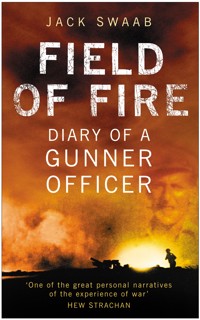
Jack Swaab joined the veteran 51st (Highland) Infantry Division on 3 January 1943. He kept a series of diaries over the following two and a half years, recording the combination of boredom and fear that characterises active service. In mid-March 1943 he saw battle for the first time as Montgomery attacked the Mareth Line. In July that year Swaab took part in the Allied landings on Sicily, writing of the scorching humidity of the Sicilian summer. In May 1944 he records the restless time as his regiment prepared for the invasion of Normandy. In September 1944 Swaab's role changed dramatically, as he moved from commanding a troop to being a forward observation officer. His new position meant that he was working closely with the infantry in the front line. Swaab's first five months as a forward observation officer came to an abrupt end on 13 February, when he was wounded in the leg by shellfire. He was again selected for FOO duty during Operation 'Varsity', the Rhine crossing, in March 1945, and received the Military Cross.
Das E-Book können Sie in Legimi-Apps oder einer beliebigen App lesen, die das folgende Format unterstützen:
Veröffentlichungsjahr: 2007
Ähnliche




















Jack Swaab enlisted in the Royal Artillery on 10 September 1939. He kept a war diary from December 1942 until August 1945, seeing action in Tunisia, Sicily and Italy before becoming a forward observation officer in the North West Europe campaign. He was mentioned in despatches and awarded the Military Cross. Jack Swaab is married and has two sons. He lives in London.
For my family
FIELDOF FIRE
DIARY OF A
GUNNEROFFICER
JACK SWAAB
First published in 2005
Paperback edition first published in 2007
The History PressThe Mill, Brimscombe PortStroud, Gloucestershire, GL5 2QGwww.thehistorypress.co.uk
This ebook edition first published in 2013
All rights reserved©Jack Swaab, 2005, 2007, 2013
The right of Jack Swaab to be identified as the Author of this work has been asserted in accordance with the Copyrights, Designs and Patents Act 1988.
This ebook is copyright material and must not be copied, reproduced, transferred, distributed, leased, licensed or publicly performed or used in any way except as specifically permitted in writing by the publishers, as allowed under the terms and conditions under which it was purchased or as strictly permitted by applicable copyright law. Any unauthorised distribution or use of this text may be a direct infringement of the author’s and publisher’s rights, and those responsible may be liable in law accordingly.
EPUB ISBN 978 0 7524 9591 0
Original typesetting by The History Press
CONTENTS
List of Maps
Foreword
Preface
Acknowledgements
Note on the Text
Author’s Introduction
PART ONE:
20 December 1942–19 May 1943
PART TWO:
5 July–26 November 1943
PART THREE:
26 May 1944–14 February 1945
PART FOUR:
15 February–21 August 1945
Postscript
Glossary
LIST OF MAPS
Operations in North Africa, December 1942 and January 1943
Triumph in North Africa, February to May 1943
Assault on Sicily, July and August 1943
Assault on Normandy, June to August 1944
The Ardennes, January 1945
The Reichswald, February 1945
The Rhine Crossing, 23 March 1945
FOREWORD
For whom are diaries written? Are they personal records, only for the purposes of private recollection? Or do we secretly hanker for the day when our innermost thoughts and reflections will be read by others? And, if the latter, do we adjust what we say accordingly?
Jack Swaab’s diaries raise these questions precisely because he asked them of himself. They are so well written, so full, and – not infrequently – so lyrical as to suggest that he had an audience in mind. When one of his many correspondents during the war suggested that his letters be published, he liked the idea. The end of the Second World War found him penning short stories. And yet, at the beginning of his active service, he was recording his contempt for some comrades in terms that he would later repent, and maintaining liaisons with girl friends that were not just successive but – at least as this story begins – simultaneous. Anybody who was seriously looking to posterity might have been more circumspect. The fact that Jack Swaab was not is what makes Field of Fire such an immediate and powerful record, one of the great personal narratives of the experience of war to come out of the British Army in the years 1939–45.
Edmund Blunden prefaced Undertones of War, his reflections on the western front in a previous war, with the thought that no one would read it or would understand it who had not ‘gone the same journey’. Swaab, consciously or unconsciously, reflected Blunden when he wrote in 1943, ‘can anybody who has not travelled these roads be expected to understand that?’ ‘That’ was not the horrors of war, which those who are caught up in them often do not feel need specific description, but the restorative powers of a cup of tea (on which score these pages provide plenty of testimony). Swaab may not have cited Blunden but he refers to Siegfried Sassoon and quotes Rupert Brooke and Julian Grenfell. It may be that the proximity to the literary legacy of what was still to his generation the Great War was what kept the authors of the Second World War silent for so long. Blunden published Undertones of War ten years after the event. With one or two exceptions the classic personal accounts of the experience of the Second World War, such as this, have appeared in the last ten years, since the fiftieth anniversary of VE day.
Swaab was a field gunner in the 51st Highland Division. For much of the war he was a forward observation officer (F.O.O. in these pages). It was a dangerous job, requiring him to be up with the infantry, directing the guns of his battery on to targets it could not see but he very often could. Their 25-pounder field guns were one of the great artillery pieces of all time, their bombardments the epitome of industrialised war, with batteries firing up to 1,000 rounds a time in the closing battles in north-west Europe. Indeed, Swaab uses the word ‘work’, not fighting, firing or shooting, to describe what he and his fellow gunners were doing.
When he joined the 51st Highland Division, it had just become a household name in Britain. Originally raised from Territorial Army battalions based in the north-east of Scotland, it was re-formed after the first division was overrun at St Valery in France in 1940. On 23 October 1942 it advanced into action at El Alamein, its pipes playing and, crucially for this story, its artillery giving it the sort of support which the infantry had not enjoyed since the final battles of 1918. Swaab was with it as it drove the Afrika Korps back to Tunisia. For the rest of the war, the ‘HD’ of its divisional shoulder flash marked the progress of the British Army as it crossed into Europe. In July 1943 the division landed in Sicily, an operation which Swaab rightly described at the time as the greatest ever combined operation. The lessons from Husky were applied in an even bigger one eleven months later, when the division, which had been brought back to Britain, took part in the D Day landings. The fighting of the bitterly cold winter of 1944/5 would have been recognisable to Sassoon and Blunden, as infantry and artillery slogged it out in attritional battles in the Ardennes and the Reichswald. Swaab was in it all, and was an F.O.O. when the division finally crossed the Rhine. By then there were some who felt that the division’s morale had become the casualty of too much combat, too little rest, and too many deaths. Although there is much in Swaab’s diary to contradict that view, his tone changes as he moves into north-west Europe, the sense of fear and danger increasing as the possibility of surviving the war grows.
Keeping a diary such as this was itself in breach of regulations. But keep it Swaab did. The reader needs constantly to remember that many of these entries were written under fire, particularly after D Day. Frequently they are preoccupied with the minor horrors of war, with flea bites, sore teeth, malaria, headaches and simple exhaustion. Veganin and whisky were as important as tea in sustaining morale. But possibly more vital than both was the flow of letters from home. As well as writing this diary, Swaab was corresponding daily with his loved ones. Mixed in with all his other reactions was the growing sense of professional ambition, the pride in being a front-line soldier, the contempt for ‘base-wallahs’, the frustration with staffs for changing plans, the admiration of Montgomery. His desire for a third ‘pip’ to signify his promotion to captain was rewarded. These diaries do not reveal whether his hope that he might be awarded a Military Cross was answered, but the portrait which accompanies this book shows that distinctive and rightly coveted white and purple ribbon.
Hew StrachanChichele Professor of the History of WarUniversity of Oxford
PREFACE
I suppose that it must have been the summer of 1936. Down to the last two for the annual reading prize, I approach the brass eagle in the school chapel. The large bible is open at Ecclesiastes. Loudly, and (looking back) I now suspect rather theatrically, I began to intone: ‘Remember now thy creator in the days of thy youth . . .’.
Alas, I have long since ceased to believe in my creator, but with that tiresome nostalgia which seems to mark one’s increasing years, I do look back on the days of my youth; and lately on the seven closely written diaries which – against all orders – I kept as a not very senior front-line officer.
The odd thing I find is that although I am the person who wrote them, what I read there doesn’t seem to be me at all. Of course, I recognise certain characteristics, recall certain incidents (but have totally forgotten certain others), but the whole thing has an air of unreality; as though it all happened to someone I used to know very well.
Above all, I note the rather embarrassing ordinariness of much of what I recorded. I wince slightly at the undeniably commonplace nature of many observations. Yet, dammit, I do feel a sneaking admiration for this chap – me? – who seems to have done battle for 110 hours without getting his boots off; and who apparently coped variously with temperatures ranging from 118°F in the shade to 40 degrees of frost, with sandstorms, snow, mud and rain; with lack of food and lack of sleep, not to mention toothache, malaria and love.
The fact is that this was such an ordinary creature who, by and large, had such an ordinary war. Not for him the terrors of Odette or the White Rabbit. Did he know of the hell of the Burma railway, the Arctic convoy or the unimaginable interior of Auschwitz? When I read of such things long after the war had ended, I felt almost ashamed of my minuscule contribution. Could it really be of interest to young people now? Or to the old who shared so much of it? Or, indeed, to anyone except perhaps myself and my family?
I try to recall why I actually wrote those diaries – often half-dead with fatigue and fear, sometimes elated, more often, it seems, depressed. There are hints that I always intended to use it in some printed form if I survived the war, but I’m not sure of this. I know that the diaries remained in an old ammunition box in the loft, untouched and unread for a quarter of a century. Then one day a young friend of mine in publishing asked to borrow them for possible extracts for a book he was editing. Later, he told me that he’d read them at a sitting and found them ‘riveting – better than a novel’, and urged me to publish them if I could.
It was then, that – once again, I suspect – I began to wonder whether my little war might interest the many others who had had the same kind of experience. For of one thing I have no doubt: that the old clichés about comradeship are well founded. Spared as we were the appalling carnage and squalor of the First World War, we did share hardship and privation, pleasure and plunder, and the ‘red, sweet wine of youth’. And no one who lived that life with all its profit and loss will ever be quite the same.
2005
Ten years ago, my family’s birthday present was a computer printout of the 140,000 words of my diaries, which I was able to read for the first time. Now, thanks to my enterprising great-nephew Simon, I am to see them published. Many of the people mentioned are now dead and I myself near the end of the road. I read again my distant words. ‘Old men forget; yet all shall be forgot / But he’ll remember . . .’
ACKNOWLEDGEMENTS
I am very grateful to a number of people who have helped to make this book possible: Emily Lincoln, who deciphered and typed the seven original diaries; Roderick Suddaby of the Imperial War Museum, for his guidance through the museum’s resources; Jane Cochrane, Bill French and Moira Stevenson, for photographs; my nieces Ann Louise Luthi and Monica Parkhurst; my great-nephew Simon de Bruxelles, who – unknown to me – sent the manuscript to Sutton Publishing; my son Richard, an unfailing source of cogent advice and constructive criticism; my son Peter, himself a battle-hardened author, who has been my (unpaid) agent and guided me through unknown territory; Elizabeth Stone; and, perhaps above all, my editor Nick Reynolds, for taking a chance on me.
NOTE ON THE TEXT
The occasional references in Field of Fire to the original Diary numbers could be confusing for the reader in that they don’t necessarily correspond to one of the four parts into which this book is divided. It may, therefore, be helpful to point out that Part 1 of the following text is covered by Diaries 2 and 3 (Diary 1 has not survived); Part 2 by Diaries 4 and 5; Part 3 by Diary 6 and Part 4 by Diary 7.
AUTHOR’SINTRODUCTION
These diaries don’t start until June 1942, by which time I was just over 24, and had already been in the army for two and a half years. By way of brief background, and (I suspect) of justifying some of the more callow comments they contain, I should provide a little additional information.
I was born on the Ides of March 1918, just before the black days of the German offensive which destroyed Gough’s Fifth Army. My parents were born in Holland but had come to England around the turn of the century and were nationalised British. We – my parents, two older sisters and a younger brother – lived in Sydenham, a pleasant but unfashionable London suburb, and my childhood was happy and unmemorable. We were, I suppose, totally middle class, but comfortably well off. I went to a minor but, I’ve always thought, rather good, little public school at Weymouth – alas an early casualty of the war. Being poorly endowed, it closed down.
After school I went to Oxford. A year later I was sent down – but not for anything criminal! After Oxford I worked as a reporter, and later went to London University where I behaved better, and would have been the gold medallist (the Principal told me) except that a year before that could happen, Hitler invaded Poland. On 10 September I enlisted – at Oxford, where a desire to be able to ride a horse had been my reason for joining the University OTC in the horse artillery. And finally, on the 10th of that icy December of 1939, I was called to the colours as (I still remember) 928547 Gunner Swaab, earning two shillings a day. Down at the training barracks at Dover I was put in the ‘potential officers’ squad. We were drilled and disciplined by a bunch of regulars from the British Army in India, and I remember that we had to polish the studs under our boots and the back of our cap badges. All wooden brushes had to be scraped shiny clean with razor blades for Saturday morning inspection. And woe to the man whose folded blankets showed an edge, or whose Brush, tooth, did not align exactly with the other twenty Brushes, tooth, on the barrack-room beds. I spent happy leisure hours eating bacon, egg and chips at the hospitable Salvation Army hostel in Dover. Two of us were rejected as potential officers. I recall that the Colonel (Rendell was his name) felt that we had no qualities of leadership (I met the other reject quite by chance in the Western Desert when we were both Eighth Army officers. He was even in the RHA). At the time we just felt that our faces didn’t fit, though we had very different faces.
It’s odd that many names in my diaries produce absolutely no visual recall. Yet from the distant 5th Training Regt RA, I clearly remember two of my early disciplinarians. Sergeant Dawnay: a big mournful face like a badger. In lugubrious tones he would warn of the perils of walking backwards at gun drill to fall squashed under the wheels of our ancient howitzers. ‘I seen men killed by gun wheels, I seen men killed by G.S. waggons . . .’ Sgt Dawnay had evidently seen so many men killed by accident that I sometimes wondered how they manned the army in India. Or at Bren gun dismantling: ‘This ’ere ’ole we calls the happerture.’
Then there was Sergeant Chadwick, an Irishman of unbelievable ferocity, said to have been broken three times only to rise like a three-striped phoenix from the horrors of the glasshouse. Chadwick at rifle drill: ‘I want to see your hands bleeding from hitting those rifle bolts . . .’
I spent the next year or so as a very unimportant subaltern ‘Training’ with two regiments in Aldershot and Dorset. I can’t remember much about it, but suspect that my irreverent attitude and occasionally insubordinate tongue did not endear me to my superiors. In fact, I also suspect that I was a pain in the ass. Anyway, whatever the reason, I finally found myself drafted to Woolwich en route – at last – for some theatre of war. After twenty-four more or less reprehensible and wasted years I was, I hoped, about to do something useful.
As it happened, I didn’t do anything of very much value at all until I was a couple of days beyond my twenty-fifth birthday. Or perhaps, to be a little charitable – a quality which I find disconcertingly lacking in myself in the early diaries – until January 1943, when I finally joined the Field Regiment with whom I was to fight my real war. Little could I guess then that, as its last Adjutant, I should supervise its virtual dissolution in Germany three and a half years later. When I started to re-read those long-since-written scribbled pages, I was astonished to find that I was at first unhappy in that unit with which I was later to experience a life of much self-fulfilment in the company of people I came to trust and admire. I also find I made cruel, superficial and (not infrequently) inaccurate initial judgements which now rather disgust me. Accordingly I have occasionally identified some people by initials only, though where possible I have avoided this.
My love life – if it can thus be dignified – also appears to be a very good reason for omitting the early part of the diaries. My propensity for falling in love (as well as merely satisfying my more strictly physical needs) appears to have been marked. It wasn’t until later in 1943 that I fell genuinely in love, and this lasted until not too long before I married – someone else – in 1948.
So: back to 1942.
PART ONE
20 DECEMBER 1942–19 MAY 1943
Just as Alamein was, in Churchill’s words, ‘the end of the beginning’, so in its own small way was it the end of my beginning to learn to be a soldier.
Exercises in England gave way to fatigue and fighting over hundreds of arid miles; well-fed army life to dry tack, vitamin pills and a couple of mugs of water a day; and a bed in Britain replaced by a cold bed of sand under starlit desert nights. We marched westward. Lessons were gradually learned: earning the respect of your soldiers; coping with blood and loss; the acid tests of self-control (or at least the pretence of it) and leadership under fire.
The Axis army finally crumbled and surrendered in Tunisia. The Highland Division was, although we didn’t yet know it, destined to cross a storm-swept Mediterranean Sea, and win a hard-fought battle for Sicily. The end of my beginning had taught me pride and confidence in my Division.
And a little in myself.
20 DECEMBER 1942
The course yesterday included a rather Diehard Colonel on ‘Traditions-Regimental’, and an indignant but fluent Czech on The Hun. The latter was very good though nothing he said was new to me. Unfortunately however a good many of our officers don’t read very much and still have the idea that the Germans are good chaps. My fear is that when we’ve won the war we shall allow some militarist to take over and let the Germans give in while they are, so to speak, intact. Then we shall have another war before 1980. 1980 – what years it seems away. Yet I remember getting my Tiger Tim’s Annual for 1926 (I particularly remember the cover for that year – very black and yellow it seems in my memory) and writing down nineteen thirties and forties and thinking how impossibly remote they seemed.
We have to give ten minute lectures. I have chosen as my subject ‘An urgent draft is required. . .’ As it’s just about 6 months since it was, the subject and tone of the lecture should speak for itself. I am about to prepare it.
I have just finished rather a good Diary-narrative called The Road to Bordeaux by two Englishmen who enlisted in the French ambulance service. It’s quite astonishing the way the French people panicked – though in view of the way the post services and news broke down perhaps not so very. I still can’t believe the British would have cluttered up the roads and allowed such complete chaos to reign, all the same. I’m sure the army would have taken over; though one is inclined to forget that our own army had a good many shortcomings in 1940.
Went to tea with the W.A.A.F.s yesterday. They were all there except Annette (on duty) also D., Owen Lowless, and two chaps from the Niew Amsterdam. One we always called Miniver because he looks a bit like ‘Viv’ in the film. Real name Minchin, and not so stand-offish as he looks; the other Ian Shaw, who is one of those subalterns you always think of as being nicknamed Toby and holding a mug of beer. Rather cheerful. They are both in the 1st Surrey Regt. I am not going on the church parade ‘The Brigadier likes all officers to attend’ (nor is Frank Neary; as the little attendance role is apparently not presented at the porch, it shouldn’t matter).
Later: Gave the lecturette. The Brigadier, criticising later, said ‘Humour shouldn’t be attempted unless you can get away with it. Now Lt. Swaab kept us in fits of laughter; I should think he’d always be able to make the men laugh; a very good lecture.’ I only quote at such length because it wasn’t as funny as all that, though it has a few rather shrewd cracks.
Lesen Sie weiter in der vollständigen Ausgabe!
Lesen Sie weiter in der vollständigen Ausgabe!
Lesen Sie weiter in der vollständigen Ausgabe!
Lesen Sie weiter in der vollständigen Ausgabe!
Lesen Sie weiter in der vollständigen Ausgabe!




