


Erhalten Sie Zugang zu diesem und mehr als 300000 Büchern ab EUR 5,99 monatlich.
- Herausgeber: Books on Demand
- Kategorie: Geisteswissenschaft
- Sprache: Englisch
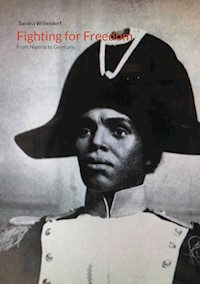
The former slave gets into the eye of the Caribbean hurricane during the French Revolution there in 1794. He fights in Napoleonic Wars and get English Pow. He returns back to Guadeloupe after his release and takes part in the rebellion of the Bataillon des Antilles in May 1802 when slavery was to be reintroduced by the order of Napoleon. The unit is expelled from the island. François is ordered to serve in Mantua, where he escapes and finds refuge in the Danish duchy of Holstein. He settles there and founds a family in October 1806. François is a direct ancestor of the author. His biography is retraced. The conditions of slave trade are analyzed for Nigeria, the trade itself as are society and culture in Guadeloupe. Which are the factors leading to the rebellion of May 1802? How Guadeloupe deals with it and the reintroduction of slavery? The deportation of the soldiers causes an international diplomatic affair. Which policy does Napoleon lead referring to people of color? What happens in the unit of Black Pioneers in Mantua? François is literally fighting for freedom and a humble decent life, free of the construct of slavery. He finds his freedom in the Danish duchy of Holstein. The book contributes a micro-historic view to the macro-history.
Sie lesen das E-Book in den Legimi-Apps auf:
Seitenzahl: 1353
Veröffentlichungsjahr: 2020
Das E-Book (TTS) können Sie hören im Abo „Legimi Premium” in Legimi-Apps auf:
Ähnliche

















Table of contents
1. Prolog
2. What a legend has to do with a DNA test
Different stages in life of François Lacour / Jochim Friedrich Willendorf
3. Circumstances in Nigeria
3.1. The Igbo
3.2. The role of the Aro
3.3. Their voyage to the coast
3.4. The Efik on the coast
3.5. Influencing factors for the slave trade
3.6. The impact of the slave trade on the region of Nigeria
3.7. Some numbers on transatlantic trade
3.8. Crossing without return
3.9. The slave trade with children, men and women
4. In the Caribbean
4.1. Direct connection or transfer to Guadeloupe?
4.2. After landing in Guadeloupe
4.3. Population structure, organization and economy
4.3.1. Description of the island
4.3.2. The slave
4.3.3. The population pyramid
4.3.4. The family
4.3.5. Child mortality
4.3.6. Occupations and career opportunities
4.3.7. Social control
4.3.8. The maroons
4.3.9. Rise in the system through release
4.3.10. The land and its structure
4.3.11. Urban design
4.3.12. Economic production
4.3.13. Conditions of production
4.3.14. Trade balance
4.3.15. Chamber of Commerce
4.3.16. Social control of the church
4.3.17. The role of the city of Basse-Terre
4.3.18. Missionaries and the role of school education
4.3.19. Contraband in Basse-Terre
4.3.20. The role of the city of Pointe-à-Pitre
4.4. Political conditions as a pioneer of the rebellion of
4.4.1. Battles in the Caribbean
4.4.2. First term of Governor Lacrosse
4.4.3. Abolition of slavery
4.4.4. Commercial blockade, corsairs, emigration and guillotine
4.4.5. All slaves who enter the islands are free
4.4.6. Human rights of colored people
4.4.7. Freemasons, Société des Amis des Noirs and Academy
4.4.8. The census
4.4.9. No implementing directives
4.5. Military structures
4.5.1. Organization of militia
4.5.2. Legion of Saint-Georges
4.5.3. Organization of military - Battalion of the Antilles
4.5.4. The battalion as British POW
4.5.5. Marine structures
4.6. Between Victor Hugues and Lacrosse
4.6.1. Flashback: Achievements of Victor Hugues
4.6.2. After the first term of Victor Hugues
4.6.3. The term of office of Desfourneaux
4.6.4. Comparison of the economy from 1790 to 1799
4.6.5. Psychology of the triangular trade
4.6.6. With Napoleon: Other forces are active
4.6.7. Two steps forward and three back
4.6.8. Second term of Lacrosse initiates the rebellion
4.7. The rebellion is approaching
4.7.1. The Proconsulat of Lacrosse
4.7.2. The Provisional Government of Magloire Pélage
4.7.3. Proconsulat of Richepance - rebellion of May 1802
4.7.4. Reception of rebellion
4.7.5. The deportation to France
4.7.6. The rebellion in the civil acts
5. In Europe
5.1. The Black Pioneers
5.2. Escaped from the French structures
5.3. Rethwischdorf
5.4. Development in Ostholstein
5.5. The passage of the soldiers
6. Evaluation of the sources to Lacour
6.1. The planter and merchant family Lacour
6.1.1. Possible connection to the religious orders
6.1.2. Evaluation of the Lacour family tree
6.1.3. Everyday life in Basse-Terre
6.1.4. Anse-Bertrand and Petit-Canal
6.1.5. Censuses of Guadeloupe
6.1.6. Former slaves of Lacour family in the civil register of Basse-Terre
6.1.7. Evaluation of notarial deeds
6.1.8. Gazette of Guadeloupe
6.1.9. Almanac of Guadeloupe
6.1.10. Citizen meetings
6.1.11. The impact of the rebellion
6.2. Documents for the colored (François) (Lacour)
6.2.1. Considerations to naming
6.2.2. Battalion of the Antilles in Brest on 17 November 1794
6.2.3. Portrait of the soldier
6.2.4. English POW
6.2.5. François in the civil status register Pointe-à-Pitre 1798-1802
6.2.6. Deeds of liberation and death
6.2.7. … and if he was a creole?
6.2.8. The castle of Plön
6.2.9. The naturalization or adoption
6.2.10. A possible travel itinerary from Kiel/Plön to Copenhagen
6.2.11. The army of Schleswig-Holstein
6.2.12. The semi brother and the double in the Kiel census of
6.2.13. The censuses in the duchy of Holstein
7. Summary of the derivations for my ancestor
7.1. The life-path
7.2. Possible reasons for a desertion
7.3. Relationship of François Lacour to the family of planters and merchants Lacour
7.4. Might there have existed a „Balkan route“?
7.5. The family tree of the descendants
7.6. Experiences of discrimination / Epilogue
Annex
Repartition of areas among Aro lineage-groups
Principal Aro settlements at the border of central Igbo region
Arondizuogu lineage groups before 1890 and possible pre-existing land owners
Nuclei of Arondizuogu lineage-groups
Arochukwu structure
List of Igbo proverbs matching with the context
Ships 1759-1763 introducing slaves under British occupation
List of known slave ships Biafra - Dominica 1783-1792
Slave ships Biafra-Guadeloupe
Evidence of James Arnold, surgeon on the Bristol ship RUBY 1787
Extracts from a Journal, Ship Black Prince to Antigua
Bataillon des Antilles / Brest 17.11.1794
First abolition of slavery on 16 pluviôse An II - February 4, 1794 -
Reports on May 1802 in the French Press
Reports on May 1802 and Deportation in the American press
Reports May 1802 and deportation in the English press
Reintroduction of slavery after the treaty of Amiens, 30 floréal An X (May 20, 1802)
Decree of July 16, 1802, reinforcing reintroducing slavery
Another reinforcement of the decree of July 16,
Infection with yellow fever of General Ernouf
Ode à la liberté - Ode to the liberty
Revision of the troops - military force of Guadeloupe’s army in
Revision of the troops - Black Pioneers -
Chronic of deportation and organization of troops Black Pioneers
Over the thumb kilometers of François Lacour
Portraits of some family members of Willendorf
Documents François Lacour / Jochim Friedrich Willendorf
Death document
Censuses in Duchy of Holstein
Census 1803 Duchy of Holstein, Rethwischdorf
Census Farm Frauenholz 1835
Census 1835, Duchy of Holstein, Rethwischdorf
Emigrants in passenger lists
Family tree Willendorf
Tables
Illustrations
Bibliography
Films
Archives and databases
1. Prolog
The present work deals with a topic that has already happened millions of times to people in migration, in search of a better life, and that their fellow human beings experience even in the present.
External social, political and economic conditions affect regions, individual groups and people in general. These must learn to handle it. They have different options: to adapt, to revolt, to seek their own way or, at first, to survive.
In the present case, I am trying to trace the conditions that affected my ancestor some 200 years ago - in Nigeria for his parents -, Guadeloupe, France, Italy, and Germany, and which path he undertook to claim for his freedom, or to fight for his condition in freedom as a human being, not a chattel.
If one reduces the experiences in life and the coming ones to the perspective of the brain, then it is always about making predictions for survival from all possible inputs in the environment, solving problems and aligning one’s behavior accordingly. This concerns physical and emotional border experiences as well as everyday situations.
For example, one problem can be found to adapt to different situations in different cultures and societies, such as the Igbo's African tribal culture, the conditions on the slave ship, the plantation society in Guadeloupe, the military of the Battalion of the Antilles in war and peace, the deportation to Brest, the mission in the Pionniers Noirs, the desertion over the Alps, the orientation on his way northbound and to seek for survival as a deserter in the middle of the hustle and bustle in the Austrian and German speaking countries towards the Baltic Sea.
In relation to the surrounding fellow human beings, my ancestor had to interact with different expectations or required behaviors of the people around him and adapt appropriately.
His parents probably have been members of an Igbo clan. With the enslavement and deportation to the coast came the painful loss of their parents and siblings, their clan, their homeland, traditions and culture. From then on, obedience was required under duress, on the way to the coast, during the transatlantic passage and in the colonial society of Guadeloupe, and later for the son in the military.
In addition to the basic survival problem of having enough fluids and food, staying healthy and mentally strong in some way, not giving up or taking good care of illnesses and injuries, not being at the mercy of battles and fights, having a secure roof for living, also he had to overcome language barriers. Besides one of the Igbo dialects-which my ancestor might still be able to speak on the plantation when he was undiscovered, and there were other Igbo slaves on the plantation who understood his dialect - these were Créole, French, a little bit English, maybe a little Italian, and later certainly Plattdütsch, the local patois of northern Germany. To what extent my ancestor could learn standard German, I have not been able to find it out.
These survival and adjustment tactics and experiences were colossal and fundamental, they should have profoundly shaped my ancestor. For these dangerous situations in which my ancestor found himself several thousand times, it can be said that the brain, in order to survive - or the human being - consciously or unconsciously continually asks the question: Am I sure? Is the surrounding person safe with me? Is the environment safe? How do I rate these?
The ability to survive at such moments, to develop and survive solutions, means a tremendous amount of empowerment, both at the individual level and at the group level. Can I grow or break under borderline experiences and in extreme situations?
The parents of my ancestor have then been- against their will - refugees, as they went from the Igbo hinterland in the direction of the Nigerian coast. Later on, in the colonies, the slaves got accustomed to their destiny if they did not decide to rebel. Against his will, my ancestor, being a soldier of the Bataillon of Guadeloupe, was disarmed in Guadeloupe and expelled from the island. On command of Napoleon, the colored soldiers were transferred to Mantua to perform earthwork and fortification work, but not to fight. This humiliation would not have corresponded to his free will, when he had already made the oath of service in the battalion of the Antilles to fight for the fatherland of France. On the more than 1,000 km long march from Mantua to the Baltic Sea region, my ancestor was a deserter and again a refugee - actually only in search of a safe, simple life, free from slavery, free of war and destructive forces. He wanted to be simply human.
In a sense, since the discovery of overseas by sailors, a first globalization has taken place. There were and are societies that rule over others, different cultures with different prestige. In the land as well as at sea and in the overseas colonies, the lives of many millions of people in war and peace have been mixed up in roughly 15-20 generations. Therefore, there has always been migration, which should also be reflected in the DNA of the majority of people, mostly to their surprise.
It is interesting in the present case, how world history influences the individual fate and how with good luck, combinatorics and grassroots methods even the life of a simple man could be proven.
I was incredibly fortunate that the marriage certificate in Ostholstein, a diary entry by a young nobleman von Witzleben in Plön and the reports of a Guadeloupe planter family fit together.
Now it's time to thank for support, encouragement and discussion of individual aspects:
First of all, my family, without whom the present work would not have come to pass;
Church circles in Bad Segeberg, Hamburg, Hamburg-Harburg, Pinneberg, Kiel, Neumünster, Reinbek; the team of the Landesarchiv Schleswig and Julia Liedtke, Kay Nico Horn departmental archives Plön, the team of the City Archives of the Hanseatic City of Lübeck, the team of the town library and University Library Hamburg; the team of the State Archives of Hamburg, the Rahlstedt Cultural Association Carmen Hansch, Werner Jansen, Detlef Kraack (Association of Schleswig-Holstein for local history), Peter Dörling, Manfred Bruhn of the AKVZ, Sylvina Zander city archives Bad Oldesloe, Dirk Jachomowski Landesarchiv Schleswig-Holstein, family farmer president Werner Schwarz, domain Frauenholz in Rethwisch, Mayors Eick and Jens Poppinga in Rethwischdorf, the pastor of Church in Rethwischdorf, the village council of Willendorf, Peter Hennings, the Bavarian State Library Verena Pres, Martin Krieger University Kiel, Gísli Pálsson; Iceland, for other very good sources;
the team of the Archives nationales CARAN in Paris and Pierrefitte-sur-Seine, Bibliothèque nationale François Mitterand, Paris, service historique de la Défense et des Armées de Terre, Vincennes Paris, ANOM Aix-en-Provence, GHC Genealogy and history of the Caribbean Bernadette and Philippe Rossignol (+), Society of history of Guadeloupe Gérard Lafleur, ADG Guadeloupe Gourbeyre Laure Tressens and Claude Garnier, voluntier genealogical help Colette Douroux and Annick François-Haugrin, the team of Rigsarkivet Danish National Archives and Asbjorn Thomsen for the exchange and the suggestions; Sue Giles Senior Curator British Empire and Commonwealth Collection Bristol Museums; Lorna Hyland Assistant Curator International Slavery Museum Liverpool, Tanja Fittkau Deutsches Auswandererhaus Bremerhaven, the team of the emigration museum Ballinstadt;
The historians Sylviane A. Diouf, Bernard Gainot, Frédéric Régent, Sainte-Croix Lacour, David Eltis and Nick Radburn of slavevoyages.org, Erick Noël and Flavio Eichmann, the archivist of Ahrensburg, Angela Behrens, for their exchange and their suggestions.
to friends and family Bénédicte Elting-Delabarre, Heinz-Hermann Elting, Luxembourg, Baaba Yankah-Odeuah and her husband, the group "Mama Afrika", Cologne, Tim Ford, Eric Cobb, Dr. Förster and Dr. Gehrke, Hildegard Krauss, Sven Sauter, Angela Joost and Yasmina, Amara and Ramon Willendorf for their support.
I was deeply moved by the opening of an exhibition of the Palestinian-American artist Nida Sinnokrot. In St. Peter, Cologne, he showed an Objet trouvé in early December 2019, a former shipping container that served as an office in Bethlehem. In accordance with the dimensions of an Arab living room, windows were cut out on two walls of the container and the typical wrought-iron grilles were placed in front. Nida sawed the container into about twelve parts, as he has found it. Sawed on the floor was one of these oversized plastic rugs as an imitation of an oriental rug in shades of brown. The container still had the iron bar and lock to lock it. It stood in the central nave of the church and Jesus watched over it with his arms spread out, what a counterpart to the subject of migration, freedom, flight and displacement! In the speech at the vernissage, it was said that goods from all five continents had always been packed in containers and sent somewhere, and so it was, and also happened to people who are on the run everywhere. Since I was heavily involved in this work at the time, I was immediately drawn back 200 to 250 years and I thought of my ancestors with pain. Then when the intonation began, like a signal from a steamer entering or leaving the port - the composer could not know that he was awakening such connections - I felt like on the beach in Bonny or Calabar, went closer to the container, almost into it (it was not accessible due to the risk of injury - and thought, if the doors close, I will lose my mind on this slave ship! I could feel the emotions and the madness that Equiano describes in his diary during the middle passage in the composition. Nida was very impressed and felt emotional during our conversation, as I was impressed by his exposition. I am very grateful to him for that.
2. What a legend has to do with a DNA test
In our paternal family, the anecdote was handed down from generation to generation: At the beginning of the 19th century, a soldier from Napoleon's French army had a rendezvous with a young German girl in the Bay of Lübeck. The result was a child of southern European temperament and appearance.
As a first-born I have three younger siblings and I got a lot from this southern European temperament and appearance, as well as my father and his sister and their ancestors - and in gradations my siblings as well.
In the early 1970s - in the midst of the Biafra crisis - my parents almost adopted a child from Biafra. I was still in kindergarten and could remember being with them on a movie night or slide show to get informed about the project. The administrative effort has been too much and my parents abandoned their plans. But unconsciously, my father has been digging claims in the region of his ancestors!
From the mid-80s - time of puberty - onwards I was fascinated by everything that was related to African American and African music. My father had piano lessons as a child and teenager. Much to the annoyance of his then music teacher, he was not enthusiastic for classical music. Instead, he wanted to play jazz, swing, samba, bossa nova, Cuban music Cha-cha and mambo. In the sixties to eighties, he made some music stores crazy, because they had to first bibliography for his notes and singers and then he could pick up the notes a few weeks later. The dances and the bongos fascinated him as well. My aunt was equally passionate about music playing the piano and the accordion. Whenever possible, my uncle and his wife went on cruises to the Caribbean, Scandinavia, the Maldives and whatever you can imagine. My aunt had towards the Baltic Sea - like so many people there - a very strong bond to the sea and to ships. Usually on weekends she wore multicolored tropical fashion. She liked to wear creole earrings as well, what she underlined with the way of pronunciation of the word „creole“, accompanied by a grin knowing the deeper meaning and hiding it at the same time. Once, we have been visiting her in the Nineties, she called me in her room. When the door was closes, she put off a wig with great brown curls. For just a second I have had a glimpse on her real hair, the only time in my life. It was short, fine curled, deep dark, of an African structure. I was deeply astonished, rushing out of the room and did not ask any further. It seems today to me that she tried to hide her African aspects which have been very hard to bear for her. Once, my father told me, that they both have been called „nigger“ and „gypsy“, what traumatized them. Having lived during Hitler and after WW II, he did no go any further to discuss this subject. My mates from the French Antilles said to me that I am not really white, referring to our character, charm and funny jokes as well which have always persisted. The older kin of my father’s side whispered that I was a real Willendorf, when we had visited them when I was very young. I did not have a clue of all these logical relations, and this for 50 years.
Whenever someone spoke to us about our appearance and temperament, we repeated the mantra of the Bay of Lübeck. This thing has not left me in peace for thirty years; I've studied literature, music, and Afro-American culture all my life.1 The first clique I moved around with was from Guadeloupe, not very common in Germany. I had met them at a vernissage in Speyer, where a band from Ghana played West African rhythms. One of the band members was in driving school with me, and I helped him translate the theory into English and follow the lessons. So, I came to know about the appointment with the vernissage. I can hardly remember the exhibited art, but the music very well.
I remember a balmy summer evening in the early nineties. I have come home for a weekend from the student village to my parents and had brought a new cassette, as it was customary at that time, from an LP recorded with me. I knew I would exactly meet my dad's taste and played him the recordings of Machito - 1982 and his Salsa Big Band. We both listened deeply to the music, almost cried and wanted more of it. We both had a deep attachment to the moment of the music for each other, the artist, what he expressed by his music and about his region.
My travels, which I undertook before my studies, took me to Naples (where the Pionniers Noirs were later stationed), to Corsica (where I was born) and to Guadeloupe and Martinique. I remember an evening that was hard to beat for kitsch. I stood on the Place de la Victoire in Pointe-à-Pitre, Guadeloupe, it was a warm evening, the moon in the zenith. My knees were shaking - actually my whole body. I felt that I had a very strong inner reaction to this place and this moment, and I did not know why. My inner voice told me that I should never leave this place. At this point, I did not know that about 180 years ago, my ancestor ran across this place or was in the fort and was disarmed at this place on May 6, 1802.
Just arrived in the student village, I met the man of my life, who comes from Morocco. We are happily married and have two growing daughters. It pulled me throughout "southbound".
While studying at the Romanic Seminary, I almost had to convince a professor of linguistics to write a paper on French creole languages. Never before had a student voluntarily approached him with this idea. During the short spare time, nothing avoided me to go deep into lecture of Maryse Condé "Ségou"2, unaware that I was going to deal with my ancestors.
During the sportive vacation in 2010, a long-distance tour from Flensburg to Garmisch-Partenkirchen, I was reacting very emotional from Kiel on, passing the region of Ostholstein, Lübeck and Hamburg. I only knew at that time that I had ancestors from my father’s side in Lübeck and Rahlstedt ad from my mother's side. in Hamburg Vierlande. Via Wilhelmsburg, we arrived at Hoopte, having a look at the small embarkation point Zollenspieker where my parents had married in 1966. It is very probable that my ancestor has crossed the river Elbe here in August 1805.
At the end of 2017, I received an advertisement saying that it was possible to have DNA analysis done. I informed myself in detail and decided to embark on the adventure. Yes, I really wanted to know what's behind the legend! I felt it had to be something other than this mysterious Southern Europe - something more Southern, but it was unthinkable to speak it out.
When at the end of January 2018, the message of the result came by e-mail, I was very excited. The sister-in-law and one of our daughters were also tested and the results came the same day. From now on, everything should have a deeper meaning.
I opened the little movie that was attached to the mail. In line with the respective ethnicity, the percentages of the ethnicity found were given in descending order, graphically and accompanied by a folklore piece. Just over 75% was allocated to Western Europe. Banal and logical. Then came Scandinavia and Finland in descending order, which surprised me first, because of course in the family nothing was known about this. But the result was also plausible, as there were many contacts in northern Germany with regard to trade and migration to northern Europe. A small percentage led to Eastern Europe - that was supposed to be Silesia, the home of my maternal grandmother. I continued to scroll through the map - the area around the Mediterranean remained empty. I could not figure out what that meant. The "Southern European temperament and appearance" were obvious, but where is its source? I summoned up my courage and scrolled one page further, waiting for the following surprise. The globe turned and came to a halt over Nigeria. The percentage was even bigger than Eastern Europe! I was startled once.
Of course, I looked at the result of my sister-in-law. Again, a big surprise for them, a small percentage was from Spain and Nigeria, the rest was from North Africa. This was very interesting, but also trivial, because there were, for example, contacts of the Haussa and Fulani from Nigeria to southern Morocco about the slave trade and merchandise trade, caravans and migration. I had read the same during my studies in Maryse Condé's saga "Ségou", in which the author dealt intensively with the African tribes of the Sahel and Sub-Saharan Africa, their kingdoms, feuds, culture and population structure. She spoke about with the social changes in the time, the wars of religion and the establishment of the first trading offices of the Europeans, the beginning of the slave trade, which destroyed all structures.
In the DNA of our daughters, two Nigeria shares had come together. The DNA has made a sort of small, different trip around the world through migration and slave trade through both parents, but which one for my part? I could not explain myself especially "my trip around the world". I did not see the forest for the trees and wondered what a single Nigerian had to do on the Baltic two hundred years ago. So I wrote mails to the archives of the city Hamburg and Lübeck, also to a Schleswig-Holsteinisches Institut for local history. There I found an open ear. The researcher of this institute had at his disposal a historical source which reports about the existence of Napoleon army deserters from Guadeloupe, Martinique and Marie-Galante around 1805 in the region of Plön. I was hit by the blow. I got the book and tried to record exactly the line by line of the diary entry by Adam Ernst Rochus von Witzleben (cf. Schieckel/Koolman 2006: 41-44). Every detail mentioned there could be useful.
At the same moment I searched through our photo albums in search of "Afro-details" - and found them too. Things that were previously puzzling to us were now explainable. I asked my siblings to send me all sorts of pictures of our paternal ancestors, if they had any. I also had a few. Here, too, showed one or the other characteristics, which of course were repeatedly jumbled and sometimes appeared so.
So I needed documents, evidence! We hardly had any. From the memory, I first created a family tree and then enrolled in an online genealogy portal that manages the family tree, makes more suggestions for links, and offers millions of documents for research. Within maybe ten to fourteen days, our family tree was studded with documents. Through entries of witnesses and godfathers in the documents, I could prove that some other partial family trees - other descendants of our ancestor had already researched online - were related to mine and that we had the same common ancestor from the region. The records stopped always with the hitherto mysterious "Mister X", who bore my maiden name, with a calculated 100% Nigeria DNA. Soon I could not continue online. In February or March 2018, I then went for two weeks in the archives to Hamburg and Ostholstein. I have always been staying in an archive all day, collecting registry numbers, looking through the microfiches and taking notes. Already in my family tree online, it could be seen that the geographical areas, the farther I went back, pulled together even closer. One day, I was in a "source archive" and had thirty to fifty entries of records that would fit into the family tree. So I wrote down records all day long, rummaged through registers and microfiches. I had to make a decision as which documents I wanted to copy. Shortly before closing time, I was drawn to a marriage certificate, which could even have been "the one who" - of the mysterious "Mister X". Unfortunately, the microfiche was completely illegible, because the ink had already faded. The employee was already busy closing the office. Thankfully, she also realized that something very interesting could happen here, gave a jolt and took the original marriage register from the next room. With palpitations we were over the entry, she read it to me aloud and I quickly wrote in a college block. What she read to me then pulled the ground from under my feet.
I remembered the diary entries by von Witzleben and found here some parallels, which were both in the document, as well as in his entries and in our oral tradition. As a result, almost certainly my ancestor was one of the deserters group described by von Witzleben! (Cf. Kuhlmann-Smirnov 2013: 235)3
The birthplace was Dorfgarten near Kiel in 1781. Place and date of birth were not mentioned in the marriage act, but in an alphabetical register referring to this act.4 My reaction was - "Such a nonsense, that was the harbor Kiel Gaarden, from which the deserters wanted to go to Copenhagen and then further home, Guadeloupe, Martinique and Marie-Galante, probably via the Danish Virgin Islands and then change the vessel." The secretary looked at me in disbelief and advised me to look for his birth and baptism certificate in Kiel. Since these were then continuously written in a book, it was impossible to add something later.
Then his name was mentioned - Jochim or Joachim Friedrich Willendorf.5 Afterwards, the naming of his deceased parents followed. The name read like Hinrich Wallandorf or Wallemindorf. We bent even deeper to be sure how the script was to be deciphered. Yes, it was Wallandorf or Wallemindorf. I burst out laughing. That was an attempt to pronounce our surname Willendorf in French! Even his father Hinrich's wife, a born Mrs. Busch, was a pure - genetical - invention, as well as father Hinrich.
Next came the remark that he was in a Schleswig-Holstein infantry regiment that was just in Damsdorp. Of course, you do not mention such a thing in a marriage document and a simple soldier gets free to marry and goes from Damsdorp (Damsdorf there is a village near Neumünster) to Rethwischdorf? I corrected and said that the reference to the "Pionniers Noirs of Napoleon" would be better - up to this day, my ancestor has been a soldier.
Jochim Friedrich's wife, a Margaretha Magdalena Dorothea Meyer - the order of the first names and spelling were often not fixed at that time - I found living in a census 1803 on the land belonging to a farm Treuholz near Rethwischdorf with her parents and younger sister, here the proof was clean.6
The pastor must have been so excited about the special marriage record that he subsequently mentioned the three witnesses, all agricultural workers from old-established families in Rethwischdorf, twice, so that the whole document extended to one and a half pages.
Obviously, my ancestor got a new identity with the marriage certificate. Kuhlmann-Smirnov provides an important clue to this: at the end of the 18th century, it was necessary to know the protection of noblemen in order to gain a legal foothold in society. Jochim Friedrich Willendorf thus had to achieve the binding of the rule of Witzleben, which began for his interests - beyond the usual extent. This was fundamentally important as he could not teach physical parents or certificates on the spot, as the consent of the parents was a prerequisite for the marriage. The procedure for marriage was probably cumbersome and would not have been very successful without the protection of a gentleman (cf. Kuhlmann-Smirnov 2013: 127). Elsewhere, Kuhlmann-Smirnov points out that the colored people in this case needed the marriage license of the provincial prince. The permission is usually granted if the willing to marry had previously moved to a court and its networks for a long time (cf. Kuhlmann-Smirnov 2013: 233). This was the case with the stay of Jochim Friedrich Willendorf as François Lacour at the court of Witzleben in Plön in the year 1806.
Thus, the marriage is a key position in the biography of François Lacour / Jochim Friedrich Willendorf, who had spent several months at the court of Witzleben before his marriage (cf. Kuhlmann-Smirnov 2013: 127-128) where he gave infantry lessons to the young writer of the diary, Adam Ernst Rochus.
In the French Antilles, the commandment was that all slaves be educated Catholic (cf. Régent 2007: 179).7 Due to the ban on the Jesuit order in 1764 and the numerical explosion of the slave society, the church and the planters were no longer able to keep up with the religious instruction of the slaves. At the end of the 18th century, only baptism was regular belief and the other sacraments were almost completely abandoned (cf. Régent 2007: 417). So Jochim Friedrich Willendorf must have switched to Protestantism by marrying. Otherwise, explicitly "catholic" in the document would have been noted, as usual at that time. That was not the case. In other words, the Protestant baptism was a prerequisite for marrying the maid Margaretha Magdalena Dorothea Meyer.
To select a possible new name with the baptism Kuhlmann-Smirnov noted that "the naming […] was usually done according to local diction": "The godparents chose the name of the person to be baptized under their own names. Immigrants often lost their original name or passed it on as a surname. "(Kuhlmann-Smirnov 2013: 224). Baptism was accompanied by instruction in the catechism and in reading and writing. The baptized person should become fully aware of the conversion - here from Catholicism to Protestantism - (cf. Kuhlmann-Smirnov 2013: 224-225). Accordingly, Jochim Friedrich should have received a small instruction in the (high) German language and writing. Unfortunately, there is no document in which he personally signed, surviving to us.
The first name was - as often on the West Indies also, often denominational, if it was not the forerunner of the godfather (cf. Kuhlmann-Smirnov 2013: 177).
In the marriage certificate, the godparents or witnesses are noted with Hinrich Feddern,- day laborer - in Rethwischdorf and Jochen Hinrich Been, working man in Rethwischdorf.
So Jochim (other form: Jochen, Joachim) "is a biblical name of Hebrew origin. Derived from the Hebrew jehojaqim or jehojakhin, Jochim means "God (Jehovah) judges" or "God establishes". The original name forms are Jojakim and Jojakin. "8
"The name Friedrich is composed of the Old High German words frid" peace, protection, security "and rîhhi (adj.)" Mighty, rich "or (noun)" ruler, rule, power, empire "together. The first record of the name can be found in a gothic calendar fragment:
· Kg · þize ana Gutþiudai managaize marwtre jah Friþareikei [kei] s.
In the 18th and 19th centuries it was one of the most popular names in Germany, certainly also in reference to the Prussian kings. "9
For the meaning of the name Willendorf nothing useful could be found. Although there is a village called Willendorf in the vicinity of Rethwischdorf and near Lübeck, today belonging to Rehhorst,10 it is not the inspiration for the new name of Jochim Friedrich. According to a local councilor interviewed in July 2018, the village was not called Willendorf at that time, but was pretty similar. There had been a sound shift, graphics and phonetics were not yet set at Willendorf at the beginning of the 19th century.
The marriage was on 17.10.1806. Why the pastor could have been so excited, we will learn later.
Which person from the diary entries by Witzleben is now in question? Who was François Lacour?
Adam Ernst Rochus von Witzleben mentions in his diary entries a François Lacour, leader of the small deserter group as seen in the castle garden in the autumn of 1805. The young nobleman and the small group were able to speak in a good French. In his diary, von Witzleben tells that the group was spotted in the castle garden of his parents' home in Plön. The family of Oldenburg chamberlain and palace captain Rochus Friedrich Otto von Witzleben resided at that time in Eutin and Plön of the Duchy of Holstein, who were Danish at the time. The young von Witzleben learned from the group of deserters that they were from Martinique, and mainly from Guadeloupe and Marie-Galante, in Mantua, there deserted and now arrived in Plön. In the meantime, in Lübeck, they had run into the Frenchman's arms almost at the city gate. Since they had gone into the city a few times and left, it had risen the attention of the French military and police. From the French they were pursued to the limit of their sovereignty in Schleswig-Holstein - up to the "Danish" border (i.e. Bad Schwartau or Stockelsdorf)- and not reached. Then an extradition order was issued. This incident also happened in the autumn of 1805. The bailiff of the castle August von Hennings, royal Danish chamberlain and senior official of the offices Plön and Ahrensbök, a philanthropist as well as the family of Witzleben, negotiated with the French in Lübeck to prevent extradition. He may have been assisted by the official administrator Franzius, an official (cf. Kraack 2018: 129). Once in Plön, the French deserters were initially trapped in a dungeon. In their argumentation to von Hennings and to von Witzleben asking for support and asylum, certainly thoughts have raised that from the first abolition of slavery under Victor Hugues, they were free soldiers in the military and accepted fate as prisoners in the dungeon until their fate was decided but needed the support of the Danish sovereignty in order not to go back into slavery (cf. Morieux 2019: 281).
Von Hennings was editor of the Journal of Schleswig (cf. Hatje 2012: 41), enlightened (cf. Spalding 2012: 12-13), possibly disappointed with the results of the French Revolution and Napoleon, and thus may have been in line with the deserters (cf. Auge 2013: 150). August von Hennings was visiting a family member of the Schimmelmann family in Copenhagen, when about four hundred slaves from various ships were able to flee the harbor of Copenhagen and made the city insecure. He noted this incident from 1802 in his diary (cf. Pálsson 2016: 1010/4493 23%). Already in 1801 it was Hans Jonathan, born in St. Croix, Danish West Indies, who had come to Copenhagen with his mistress Henrietta Cathrina Schimmelmann and his mother, a colored slave, Emilia Regina. He was a mulatto (cf. Pálsson 2016: 380/4493 9%), his father had the function of a secretary and could have been Hans Gram (cf. Pálsson 2016: 884/4493 20%) or the Lord of the Plantation Ludwig Heinrich Ernst von Schimmelmann (cf. Pálsson 2016: 488/4493 11%). In addition to Hennings, the family Schimmelmann (Hamburg Wandsbek and Ahrensburg cf. Pálsson 2016: 808/4493 19% and 2903/4493 65%) had connections to the Danish crown. In Copenhagen, the question about ownership of Hans Jonathan was dealt in a lawsuit. Henrietta Cathrina Schimmelmann considered Hans Jonathan to be her property under Danish law of the Virgin Islands (cf. Pálsson 2016:1333/4493 30%), but the Crown Prince of Denmark had already declared him free (cf. Pálsson 2016: ibid); he had successfully served in the military. The decision to return him to the West Indies in the legal status of slavery (cf. Pálsson 2016: 1481-1489/4493 34%), was not implemented (cf. Pálsson 2016: 1526/4493 35%). Hans Jonathan fled to Iceland, was an assistant salesman and then a dealer in a store in Djupivogur (cf. Pálsson 2016: 1921/4493 41%), later peasant, died on 18 December 1827 (cf. Pálsson 2016: 2263/4493 51%). He had married an Icelandic and had with her two children (cf. Pálsson 2016: 2278/4493 51%). An international team has made the project known worldwide about the Icelandic descendants. There are about eight hundred proven descendants worldwide today.11 Thus, Copenhagen was prepared when the rest of the deserter group arrived there, because the recollection of the lawsuit was still fresh and long remembered. Therefore, the idea to equip the group of deserters with a letter that they would not harm anyone was good, because colored people were in principle regarded as suspect (cf. Pálsson 2016: 1529/4493 35%). In addition, Denmark had already declared the country’s slave trade illegal in 1803 - if concerning the mainland (cf. Jos 2019: 112).
But back to the diary: The efforts to prevent extradition were almost in vain. The carriage with the group set off for Lübeck. This happened a day later, after they appeared in the castle garden. They would have been threatened as deserts and liquidated. The plan of the group was to anticipate this while on their way to Lübeck by killing themselves with their French arms they still kept with them. But a courier of the castle was faster, caught the coach and brought everyone back to the castle. There they were safe. They got Caribbean food, clothes were collected and money (about 100 to 200 Rigsdaler) for the crossing. In addition, the group received a letter of recommendation that they had good intentions and did not harm anyone. So they could continue to collect money in Kiel and on the way. When enough money had come together, the group set off for Kiel. A short time later, the guide François Lacour appeared alone at the castle in Plön, handed over the loaded military weapons with the statement that the group would not need them any more, since they were safe. He also asked for advice on how to behave in order to get out of Kiel, because they would get stuck there and nobody could help them, as they come from Kiel to the West Indies. The Witzleben family promised safe passage to Copenhagen and did so. The promise of escort to Copenhagen was probably so successful because there were Danish colonies in the Caribbean and also because the Danish royal family was actively involved in the triangular trade (cf. Kuhlmann-Smirnov 2013: 133) - about relations with the Danish West India Company and the West Indian-Guinean Company (cf. Kuhlmann-Smirnov 2013: 152). The group arrived in Copenhagen, profusely thanking them with letters having saved their lives; even after they returned to the Antilles. Again, to everyone's surprise, François Lacour appeared alone at the castle some time later and reported that the money collected was unfortunately not enough to pay his trip. If he could be able to give fencing instruction to the young Adam Ernst Rochus? François was granted permission to stay at the castle for a few months until he had enough money. Adam Ernst Rochus was visibly impressed by his military arts. Then Adam Rochus concludes his diary with the episode and reports that François Lacour also took the ship overseas (cf. Schieckel/Koolman 2006: 41-44 and Kraack 2018: 77-124, 126-132).
Really?
The wedding document with the parallels to Kiel Gaarden (the harbor from which the deserters wanted to go to Copenhagen), the French pronunciation of the new identity of Willendorf and the activity as a light infantryman in a regiment of the Schleswig-Holstein Army, which is currently in Damsdorp, and the fictitious parents for Jochim Friedrich Willendorf dated 17 October 1806.12 The daughter of the newly married couple Catharina Sophia Dorothea Willendorf is born three days later in Rethwischdorf.
It is probably more likely that my ancestor did not use the income from the fencing lessons for a crossing, but as the basis of his family, so as not to be completely empty-handed.
If you calculate ten months back, then you are at the end of January / beginning of February 1806. In the period, probably the entire group or François Lacour has been alone in winter quarters in Rethwischdorf or on the farm Treuholz. This is the estate where his future wife lived as a maid with the younger sister and her parents on a Vorwerk. It can be assumed that the sea route over Kiel was not passable in winter and the group had to wait for spring. It was customary at the time for soldiers and deserters to serve themselves and require "out of the field" (cf. Kienitz 2013: 106).
Using a wealth of secondary literature and logical reasoning, I have tried to outline the life of my ancestor as it might have happened. Here I go with Léo Elisabeth, who says (Elisabeth 2003: 69-70):
„Le sort de ceux qui sont arrivés en Europe commençant à être connu, reste à tenter surtout de mieux cerner les responsabilités et les motivations, les itinéraires, la qualité, l’origine et le nombre des déportés, les conditions du transport et leurs conséquences.“
The fate of those who have arrived in Europe is gradually becoming known (perhaps Elisabeth evokes the Black Pioneers). It needs to be more deeply understood how the responsibilities and motivations lie. What are the routes, the quality, the origin and the number of the deportees, the transport conditions and the resulting consequences?
To a large probability that the original tribe were the Igbo in Nigeria, I came because a large part of Igbo was involved in the enslavement at the end of the 18th century (cf. Dubois 2004: 51-52).13 On the other hand, an African woman certified similarity in my physiognomy with the Igbo. I also found them on the basis of photos: I compared different family photos with photos of Igbo and could make out facial features, the shape of forehead and head or even my way of laughing. I had a photo some time before the start of a run on my phone: With a sports colleague I laugh in the camera. On that day I did not know anything about the African woman, what she would know or recognize, because I did not weave braids until a few days later. When I entered her shop, she said, "You're 100% Igbo, the shape of your nose and everything." I was completely surprised. A few days later I searched my music subscription for "Igbo Music" and found a playlist of some singers I did not even know. I googled some names and a musician hit me like a punch - he had a similar forehead, a similar nose and the same way of laughing as me! Of course, these assumptions, to derive something from this, are vague, but form a common thread in the overall picture.
Let's go back to the secondary literature and try to trace the path of François Lacour / Jochim Friedrich Willendorf based on the diary entries of Witzleben, as he could have been. The selection of the aspects presented is derived from his curriculum vitae outlined in the documents.
1 Martin 2018 deals the question what his origins are and why he is like he is? He found out that he is descendant of Whites and Blacks. The destiny of being oppressor or oppressed in the 18th century could have even consequences of today’s descendant’s life, as he states. This theory seems to me not o be too far-fetched, when I am looking deeper into some facts of members or our family tree. Another logical relation could be made to stress resisted mice what I describe later.
Hantel-Quitmann states: “Taboos prevent the discrepancies between myth and reality from being discussed, acting as familial secrets. The children are aware of two existing truths, but they are not allowed to discuss the contradiction. That is why sometimes unconscious failures give hints to shame and guilt and are able to unveil the truth.” (Hantel-Quittmann 2015: 432-433) I have anything to add to this statement. In my opinion, these failures are one of the threads leading to François Lacour.
2 Condé Maryse: Ségou: Les murailles de terre. Laffont, Paris 1984 and Ségou: La terre en miettes. Laffont, Paris 1985
3 This praxis of a notable family to support a colored man in order to leave the district, by giving him money or other support, is proven in Kuhlmann-Smirnov Anne (2013: 235).
4mariage record 1806/25, 17.10.1806 Bad Oldesloe, Kirchenkreis Bad Segeberg
5 Willendorf is my surname of birth. I am descendant in direct line from Jochim Friedrich Willendorf (François Lacour) in the 5th generation. In some sources, he appears as Jochim Friedrich, in others as Joachim Friedrich Willendorf.
6www.akvz.de The programing of the site does not allow to create precise links. If you tape „Hinrich Meier“ in the search mask, you will find entries for his family as entry number 19 of 91, source VZ 1803, Boden, Klein-; Dorf with a link to BDF27. Page consulted on 25.08.2018.
7 Cf. also Code Noir edition of 1635, Art. 2, phrase 1, in : http://fr.wikisource.org/wiki/Code_noir, page consulted on 31.12.2018
8https://www.beliebte-vornamen.de/13317-jochim.htm, page consulted on 01.11.2018
9https://de.m.wikipedia.org/wiki/Friedrich, page consulted on 01.11.2018
10 Cf. http://m.ln-online.de/Lokales/Stormarn/Will-hin-Dorf-am-Rande-des-Kreises, page consulted on 01.11.2018. In the end of the 70s or beginning of the 80s, my father showed me proudly this village telling me that there would be a coincidence between his family name and the village. That was not true, as was proven by the Family tree. Neither did Jochim Friedrich nor someone else live in this village. By the way, a Willendorf line exists coming from or going to Denmark and living near the frontier to Denmark. But they have nothing to do with our tree. Up to today, I could ancre all Willendorf descendants to Jochim Friedrich Willendorf, if they have had documents and if they have lived in the Lübeck, Hamburg or Ostholstein region.
11 Cf. https://www.spiegel.de/wissenschaft/mensch/genprojekt-in-island-die-wundersame-geschichte-des-hans-jonathan-a-1198637.html, page consulted on 08.05.2019
12 A contemporary statistical comparison of the duchies of Schleswig and Holstein shows that around one in 125 people were married in the region by 1814. It was customary for the inheriting eldest son to wait until both parents died before marrying (cf. Gudme 1819: 23-24). The marriage of Jochim Friedrich Willendorf is the 25th in 1806, which is entered in the church register.
13 Dubois examines the situation Guadeloupe and comes to the conclusion that this French Antillean island has received roughly 46.000 slaves in the 18th century. Almost 20 % of them came from the Bight of Biafra and mainly from the Igbo hinterland. He estimates that 25 % of all slaves on the Island are originated in Africa and of the first generation „freshly“ imported. Approximative 80 % of them are working on the plantations. Less than half of the Island was agricultural cultivated land. From its 51.279 ha 22.686 ha were used for sugar cultivation, the remaining rest for coffee, cotton and subsistence farming.
See also Vanony-Frisch Nicole: She demonstrates out of notarial documents for Guadeloupe between 1770-1789, that 37% of the slaves were Igbo (cf. Vanony-Frisch 1985: 32)
Different stages in life of François Lacour / Jochim Friedrich Willendorf
3. Circumstances in Nigeria
Since the historical events are very complex, I will present them first for the specific regions or stages in the life of my ancestor and only later in the summary filter out the events and findings that are very probable or proven for him. The events in Nigeria probably concerned his parents in the period between 1750 and 1780. Nevertheless, if some descriptions are going beyond this period, the mechanism between Africa, Europe and the Caribbean rests the same. The commerce intensified in the last decades of the 18th century and more sources are subsisting. That is why these descriptions can serve as a model for the period before.
3.1. The Igbo
The Igbo are a tribe in southeastern Nigeria14 between the Niger River in the west and the Cross River in the east with a long tradition. The expansion of their settlement area around 1625 can be found in Thornton 1998: 21. In the Bronze Age, they had a highly developed culture with pottery (cf. Ohadike 1958: 21), forging and woodwork. In the following period, the quality of the products was controlled by guilds (cf. Chuku 2016: 51). Agriculture played a central role in the economy in the functions of farming farms, processing food, keeping livestock to a lesser extent, keeping fish and hunting and herding. The land as a gift of God was highly valued for its survival. There were developed trade relations with neighboring regions (cf. Chuku 2016: 49-52).15
The account of the creation of the world is not unlike that of the Old Testament, including the views of the Igbo on God (cf. Ohadike 1958: 19-20). In addition, they had a variety of natural gods (cf. Chuku 2016: 49). It was taboo to break marriage, incest, steal crops, poison food or kill people and kill themselves. Through these acts, the balance of family and society would be confused. The offender is punished with hell (cf. Achebe 2016: 33). However, as a means of responding to the new to harsh conditions of the New World, with fear and depression, there was a tendency for suicide, hoping for the Igbo reincarnation of their souls in their African homeland (cf. Nwokeji 2010: 389/830).
The basic attitude was grassroots democratic (cf. Chukwu 2016: 17), entrepreneurial (cf. Ohadike 1958: 26 and Chukwu 2016: 18), freedom-loving with a strong sense of justice - this explains the resistance to slavery and thus later the resistance to the Ancien Régime (cf. Lacour 1857: 2) legendary among the Igbo (cf. Chambers 2016: 160-161). 16 Through leadership, oratorical skills, and the accumulation of life experiences, coupled with material goods, an Igbo could rise to the respected Council of Elders in the course of his life (cf. Ohadike 1958: 26). In other words, the reputation of each member of society in society is measured by how it contributes to society so that it functions well. Individual self-realization through self-employment is promoted; hard work and competition to enrich money equally. Personal achievements and social status are very important. At the same time, there is a strong sense of community in the area of social responsibility and well-being (cf. Chuku 2016: 46).
All this seems to have lived Joachim Friedrich Willendorf and passed it on to our family, perhaps traded by his parents. Because the following generations were often self-employed, adapted to structural change and moved to the larger cities such as Hamburg or Lübeck, where there was work. Baptismal, marriage and funeral documents provide strong relationships with relatives.
Back to the Igbo: The sense of family was very pronounced (cf. Ohadike 1958: 22). On the other hand, it was allowed to sell unloved subjects into slavery - below I will elaborate on this aspect of the conditions for enslavement (cf. Afigbo 2016: 79). That was supported by an oracle. No one could ignore the counsel and power of divine power as a secular power (cf. Ohadike 1958: 28). For example, infants who first teetered above were expelled, or one of the twins was killed according to the motto: Two children at once are too much of God's happiness and this is seen supernatural, which only brings disaster (cf. Ohadike 1958: 26).
The Igbo lived in family clans in villages and the villages side by side were loose associations (cf. Ohadike 1958: 22). They were more a group with a common culture and customs (cf. Korieh 2016: 174): A real identity to feel like an igbo did not come until the 20th century. In contrast, the study of Arinze showed that slaves named Igbo were sold and looked for in the Caribbean region from the 1780s onwards (cf. Arinze 2019: 51/325 18%).17Dozens of different dialects have been spoken in more than 200 groups - each group having existed as a mini-society of 20 to 30 villages (cf. Ohadike 1958: 19). Their language was scripted.18 Belonging to the Igbo is determined by the fact that for the participants of this population the yam and the kola nuts have a great importance, both as a staple food and spiritually (cf. Nwokeji 2010: 18/830 and 464/830). Planting and harvesting times are significant during the course of the year (cf. Chuku 2016: 50). The two foods are worshiped at religious festivals. Another feature is to believe in the gods Ani and Chi (cf. Achebe 2016: 33-34 and Eneze 2016: 17 and Nwokeji 2010: 18/830).19
Women, too, could assume functions and have a high rank in village or tribal society (cf. Ohadike 1958: 28). In order to accomplish the work, the head of the household resorted to the labor of his wife(s) and children, to other relatives, friends and social organizations, such as the associations of the same age groups, including dependent slaves. Polygamy was encouraged to get more workers (cf. Chuku 2016: 50), and the women could also be workers themselves in polygamy structures. The example in Thornton, however, concerns another ethnic group (cf. Thornton 1998: 534-535). The gender roles and work distribution were not fixed but could adapt to local or temporal conditions (cf. Chuku 2016: 46-51)20 and has also shifted under the triangular trade (cf. Thornton 1998: 484-485).
In addition, same-sex marriages were not taboo (cf. Achebe 2016: 35). Some associations had something like a regional ruler, king or tribal leader, others not (cf. Chuku 2016: 47). In this way, the region worked for centuries.
As agricultural practices were well developed and crops were high, the population could feed well and the Igbo area was densely populated, blessed with good fertility of the women - "good" conditions for an extensive transatlantic slave trade from about 1650 to 1850 (cf. Chuku 2016: 50 and Morgan 2016: 82).
To be an Igbo means, according to Byrd, to have common beliefs in philosophy, cosmological worldview, and politics, even in language. Acculturation is understood as a process (cf. Byrd 2008: 654/8689 8%).
The group of the Igbo originally had a different language and also differing culture: they understood themselves only by the destructive forces of the slave trade with momentum at the latest at the end of the transatlantic crossing as Igbo unity (cf. Byrd 2008: 658/8689 8% and O' Malley 2016: 43).
The Igbo hinterland was so marked by terror and hopelessness that the Igbo equated with their identity the future or fate of the slave ship (cf. Byrd 2008: 662-667/8689 8%).
3.2. The role of the Aro
The Aro (cf. Chuku 2016: 52),21 a clan22 of Igbo, took advantage of their supremacy by the oracle Ibini Ukpabi (cf. Lovejoy 2016: 148) and the control of the latest 1720 well-developed trade routes in the Igbo hinterland to expand on the slave trade (cf. Morgan 2016: 88). Thus, the founding of the settlement Arochukwu and the development of the Aro diaspora in the hinterland coincided with basic development trends in the transatlantic slave trade (cf. Nwokeji 2010: 101/830). The Aro clan moved orbiting through the Igboland, his actions were protected by the oracle. Therefore, the Aro knew geographically the dangerous bush very well (cf. Afigbo 2016: 76). It could be proven that from about the middle of the 18th century, the Aro settled more at strategic points in the central Igbo hinterland (cf. Nwokeji 2010: 328-330) and founded settlements by violence (cf. Nwokeji 2010: 144, 355).23




