


17,99 €
Mehr erfahren.
- Herausgeber: John Wiley & Sons
- Kategorie: Fachliteratur
- Sprache: Englisch
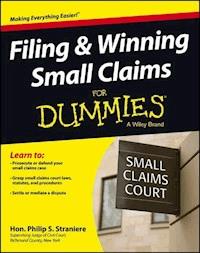
Real advice you can trust and use in small claims court
When every other method to collect has failed, a small claim is the right remedy to seek. If you're looking at either prosecuting or defending in a small claims court, with or without an attorney, the information presented in Filing & Winning Small Claims For Dummies is indispensable.
The nuances of small claims courts vary from state to state, but the basic approach in preparing and presenting a small claims case is extremely uniform no matter where you are. Regardless of state or circumstance, you can find, trust, and use the info in Filing & Winning Small Claims For Dummies to prepare yourself for your court date. You'll find everything you need to know including establishing a case, settling or mediating a dispute, fees, applications, and other paperwork, statues of limitations, securing witnesses and experts, preparing for court, filing for appeal, case studies and more. Filing & Winning Small Claims For Dummies also includes the most current information and resources on specific laws, statues, dollar limits, and procedures.
- Includes the most current information and resources on specific laws, statues, dollar limits, and procedures
- Offers practical information on securing witnesses and experts
- Complemented with real-world examples of small claims court cases
If you're headed to small claims court, either as a plaintiff or a defendant, you'll want Filing & Winning Small Claims For Dummies in your corner!
Das E-Book können Sie in Legimi-Apps oder einer beliebigen App lesen, die das folgende Format unterstützen:
Seitenzahl: 645
Veröffentlichungsjahr: 2013
Ähnliche



















Filing & Winning Small Claims For Dummies®
Published by John Wiley & Sons, Inc. 111 River St.Hoboken, NJ 07030-5774 www.wiley.com
Copyright © 2013 by John Wiley & Sons, Inc., Indianapolis, Indiana
Published by John Wiley & Sons, Inc., Indianapolis, Indiana
Published simultaneously in Canada
No part of this publication may be reproduced, stored in a retrieval system or transmitted in any form or by any means, electronic, mechanical, photocopying, recording, scanning or otherwise, except as permitted under Sections 107 or 108 of the 1976 United States Copyright Act, without either the prior written permission of the Publisher, or authorization through payment of the appropriate per-copy fee to the Copyright Clearance Center, 222 Rosewood Drive, Danvers, MA 01923, (978) 750-8400, fax (978) 646-8600. Requests to the Publisher for permission should be addressed to the Permissions Department, John Wiley & Sons, Inc., 111 River Street, Hoboken, NJ 07030, (201) 748-6011, fax (201) 748-6008, or online at http://www.wiley.com/go/permissions.
Trademarks: Wiley, the Wiley logo, For Dummies, the Dummies Man logo, A Reference for the Rest of Us!, The Dummies Way, Dummies Daily, The Fun and Easy Way, Dummies.com, Making Everything Easier, and related trade dress are trademarks or registered trademarks of John Wiley & Sons, Inc. and/or its affiliates in the United States and other countries, and may not be used without written permission. All other trademarks are the property of their respective owners. John Wiley & Sons, Inc. is not associated with any product or vendor mentioned in this book.
Limit of Liability/Disclaimer of Warranty: The publisher and the author make no representations or warranties with respect to the accuracy or completeness of the contents of this work and specifically disclaim all warranties, including without limitation warranties of fitness for a particular purpose. No warranty may be created or extended by sales or promotional materials. The advice and strategies contained herein may not be suitable for every situation. This work is sold with the understanding that the publisher is not engaged in rendering legal, accounting, or other professional services. If professional assistance is required, the services of a competent professional person should be sought. Neither the publisher nor the author shall be liable for damages arising herefrom. The fact that an organization or Website is referred to in this work as a citation and/or a potential source of further information does not mean that the author or the publisher endorses the information the organization or Website may provide or recommendations it may make. Further, readers should be aware that Internet Websites listed in this work may have changed or disappeared between when this work was written and when it is read.
For general information on our other products and services, please contact our Customer Care Department within the U.S. at 877-762-2974, outside the U.S. at 317-572-3993, or fax 317-572-4002.
For technical support, please visit www.wiley.com/techsupport.
Wiley also publishes its books in a variety of electronic formats and by print-on-demand. Not all content that is available in standard print versions of this book may appear or be packaged in all book formats. If you have purchased a version of this book that did not include media that is referenced by or accompanies a standard print version, you may request this media by visiting http://booksupport.wiley.com. For more information about Wiley products, visit us at www.wiley.com.
Library of Congress Control Number: 2013932109
ISBN 978-1-118-42444-5 (pbk); ISBN 978-1-118-46104-4 (ebk); ISBN 978-1-118-46101-3 (ebk); ISBN 978-1-118-46100-6 (ebk)
Manufactured in the United States of America
10 9 8 7 6 5 4 3 2 1
About the Author
Hon. Philip S. Straniere was elected to the New York City Civil Court in November 1996 from the Second Civil Court District on Staten Island, and was reelected in 2006. In 2004 he was named an Acting Justice of the New York State Supreme Court and Supervising Judge of Civil Court, Richmond County.
Straniere received his JD from New York University School of Law and his BA (Magna Cum Laude) and MA in history from Wagner College on Staten Island. Prior to going on the bench he was in private practice for more than 20 years.
He is currently an adjunct assistant professor at St. John’s University, where he has taught undergraduate law for over 30 years. He also taught at St. John’s University in the College of Business Administration before becoming a judge, and served as an administrative law judge for the New York City Board of Education Impartial Hearing Office, the Taxi and Limousine Commission, the Parking Violations Bureau, and the Environmental Control Board.
Known for using humor as well as references to popular culture in his decisions, Judge Straniere has been the subject of articles in the New York Times and The Wall Street Journal. In addition, his writing style has been the subject of an academic paper presented to the Mid-Atlantic Popular/American Culture Association in 2011.
He is married to Jennifer and has three children — Gregory, Amanda, and Nicholas.
Dedication
This book is dedicated to all the court clerks across the United States who every day answer the same questions over and over in an effort to make litigants’ encounters with the court system as easy as possible; to all attorneys who volunteer their time to serve as arbitrators and in other roles so that small claims courts can handle the volume of cases they deal with on a regular basis; and to all of the judges who are committed to ensuring that every litigant gets his or her day in court and who, after sitting in small claims court, will turn to colleagues, staff, family, and friends and say, “You won’t believe the case I just heard; you can’t make this stuff up.”
Author’s Acknowledgments
First I have to acknowledge my family. My wife, Jennifer, and my children, Gregory, Amanda, and Nicholas, who kept suggesting that I should write a book. Well, here it is. I was hoping it would be 101 Moose Jokes, but I guess a book that helps people understand small claims court will be just as good (and humorous).
Next on the list are Maria Colonna Emanuel and Helene Donlan Sacco, my current and my original court attorneys. Helene graduated from the world of small claims court to become a Family Court Judge and, like Maria, quickly gave up trying to eliminate the references to popular culture, theatre, and sports from my decisions.
To my secretaries, Traci Batiancela and Collette Curry, who come to me after reading a decision and let me know when something doesn’t make sense.
I also have to thank the gang I work with at 927 Castleton Avenue, Staten Island. They’re all dedicated public servants who spend their days trying to help people navigate the legal system so that the process is less intimidating.
I should also mention my law student intern, Tara Pistilli, who, after spending a summer checking out every state’s small claims law, has apparently decided to focus on patent law.
Also deserving mention are the individuals who have led the court system in New York during my time on the bench: Hon. Judith Kaye, Hon. Jonathan Lippman, Hon. Ann Pfau, Hon. Gail Prudenti, and my direct supervisor, Hon. Fern Fisher. Their commitment to making the legal process understandable to the general public, to simplifying forms, and to providing much-needed services to the unrepresented litigants who dominate my court has made New York a leader in ensuring that people, through the access to justice program, get both their day and their say in court.
Special mention has to be made of Joe Gebbia. Max Bialystock may be the “King of Broadway,” but Joe is the “King of Small Claims Court” in New York City. He established a training program for judges and arbitrators, in addition to getting a manual published that serves as a handy reference to arbitrators in New York City small claims court.
I really have to thank the people at Wiley who, even though they work for a company named after a coyote who gets hit in the head with Acme Anvils on a regular basis, helped me navigate the For Dummies process to completion: Sharon Perkins, Erin Mooney, Tracy Brown Hamilton, and Kathleen Dobie. And thanks also to my technical editor, Kari Race.
Finally, I want to thank my agent, Bookends, and my friend Dan Marotta, who mentioned one day that he had a friend who was looking for someone to write a book on small claims court.
Publisher’s Acknowledgments
We're proud of this book; please send us your comments at http://dummies.custhelp.com. For other comments, please contact our Customer Care Department within the U.S. at 877-762-2974, outside the U.S. at 317-572-3993, or fax 317-572-4002.
Some of the people who helped bring this book to market include the following:
Acquisitions, Editorial, and Media Development
Project Editor: Tracy Brown Hamilton
Acquisitions Editor: Erin Mooney
Assistant Editor: David Lutton
Editorial Program Coordinator: Joe Niesen
Technical Editor: Kari Race
Senior Editorial Manager: Jennifer Ehrlich
Editorial Manager: Carmen Krikorian
Editorial Assistant: Alexa Koschier
Art Coordinator: Alicia B. South
Cover Photos: © Ricky Corey / iStockphoto.com
Composition Services
Project Coordinator: Patrick Redmond
Layout and Graphics: Carrie A. Cesavice, Jennifer Creasey, Joyce Haughey
Proofreaders: Glenn L. McMullen, Dwight Ramsey
Indexer: Infodex Indexing Services, Inc.
Special Help: Sharon Perkins
Publishing and Editorial for Consumer Dummies
Kathleen Nebenhaus, Vice President and Executive Publisher
Kristin Ferguson-Wagstaffe, Product Development Director
Ensley Eikenburg, Associate Publisher, Travel
Kelly Regan, Editorial Director, Travel
Publishing for Technology Dummies
Andy Cummings, Vice President and Publisher
Composition Services
Debbie Stailey, Director of Composition Services
Filing and Winning Small Claims For Dummies®
Visit www.dummies.com/cheatsheet/filingandwinningsmallclaims to view this book's cheat sheet.
Table of Contents
Introduction
About This Book
Conventions Used in This Book
(Not So) Foolish Assumptions
How This Book Is Organized
Part I: Making Your Big Problem a Small Claim
Part II: Getting Ready to Go to Court
Part III: Presenting Your Case in Court
Part IV: Dealing with Specific Problems
Part V: Handling Post-Trial Issues
Part VI: The Part of Tens
Icons Used in This Book
Where to Go from Here
Part I: Taking Your Big Problem a Small Claim
Chapter 1: Understanding the Ins and Outs of Small Claims Court
Starting Down the Road to Small Claims Court
Doing It Without a Net — Or a Lawyer
Understanding Why Small Claims Court Rules Seem So Confusing
Getting the go signal for small claims court
Being rejected by the small claims system
Preparing for Your Big Day
Showing Up in Court
Living Through the Aftermath
Chapter 2: Deciding if Your Case Belongs in Small Claims Court
Why Small Claims and Not Regular Court
Evaluating Your Decision to Go to Court
Keep It Civil: Civil Suits versus Criminal Cases
Knowing what a civil suit covers
Knowing what is not a civil suit
Understanding the laws of your state
Limiting your options: Subject matter jurisdiction
The goal of substantial justice
Law versus Equity Compensation
When it’s all about the money: Law cases
When money isn’t everything: Equity cases
When Small Claims Court Is Not For You
When you want too much money
When you want to sue the government
When you want to sue a charity
When you want to bring a suit against bankrupt defendants
When you want to sue the deceased
Chapter 3: Evaluating Whether You Need a Lawyer
Going It Alone: Heading to Court Lawyer-Free
Understanding What a Lawyer Can Do for You
Recognizing When You May Need a Lawyer
When the defendant has a lawyer
When you sue a corporation or business
When you sue a government agency
Choosing the Right Lawyer for Your Situation
Smart ways to find good lawyers
Put it in writing: Protecting yourself with a retainer
Paying Up: Dealing with Lawyer Fees
Taking your case on a contingency agreement
Paying by the hour
Agreeing to a flat fee
Getting free legal services
Chapter 4: Classifying Your Claim: Figuring Out What Kind of Case You Have
Classifying Your Case
Breaking promises: Contract agreements
Causing harm: The law of torts
Determining Who’s Really at Fault
Contributory and comparative negligence
Understanding assumption of risk
Pointing the finger — last clear chance
Realizing Why Personal Injury Claims Aren’t Brought in Small Claims Court
Acting Fast: Time Is of the Essence
Time’s up! Checking out the statutes of limitations
Statutes of limitations in different states
Laches can lock your case out of court
Chapter 5: What’s the Damage: Understanding Different Types of Damages
Classifying Your Damage Claim
Making you whole: Compensatory damages in contract cases
Compensatory damages in negligence cases
Knowing the consequences: Collecting on consequential damages
When you’d rather be right than rich — nominal damages
Behaving badly can be costly — punitive damages
Liquid Gold: Dealing with Liquidated Damages
Agreeing ahead of time on liquidated damages
Differentiating between liquidated and unliquidated debts
Getting What’s Coming to You — And Then Some
Collecting interest and other additional monies
Expenses that aren’t really damages
Mitigation of damages: Reducing what the defendant owes you
Part II: Getting Ready to Go to Court
Chapter 6: Just the Facts, Jack: Gathering Your Information
Determining Who Your Defendant Is
Providing the defendant’s address
Identifying the defendant
Looking for the right business
Tracking an elusive defendant
Knowing your role: Recognizing who you are in court
Making a minor point: Cases involving minors
Bringing a Case to the Right Location
Gathering Your Facts
Making a list and checking it twice
Writing it down for the clerk
Chapter 7: Dealing with the Clerk
Understanding How and Why Clerks Rule the Legal World
Respecting the clerk’s knowledge
Getting off on the right foot with the clerk
Being prepared for meeting the clerk
Information Every Clerk Needs
Determining whether you want a jury trial
Say what? Arranging for an interpreter
Proclaiming yourself a senior citizen
Making the clerk aware if you have a disability
Pay Up: The Filing Fee
Paying the filing fee
Filing more than one case at a time
Chapter 8: Informing the Defendant About the Case
Serving Papers: The Service of Process
You’ve got mail: Delivering through the post
Making it personal: Handing it over via personal delivery
Substituted service: Giving it to someone else
Conspicuous service: Going to the tape
Self-service: Serving the defendant yourself
What to do if none of the other methods works
Preparing for Battle: What to Expect from the Defendant
Counterclaims: When the person you’re suing sues you
Counterclaims that exceed the court limits
When the person you’re suing blames someone else: Third-party actions
Cross-claims: When defendants point fingers at each other
Chapter 9: Looking at Your Options: Considering Alternatives to Trial
Understanding Alternate Dispute Resolution (ADR)
Meeting in the middle through mediation
Going through arbitration
Participating in a preliminary conference
Settling Rather Than Going to Trial
Deciding where to settle
Entering into an oral agreement
Spelling out the terms
Chapter 10: In Your Defense: Advice for the Defendant
Taking Action when Served with a Claim
Ignoring a summons at your peril
Refusing certified mail isn’t a good strategy
Pleading for mercy: Reading the plaintiff’s documents
Considering settlement
Preparing Your Response
Considering getting a lawyer
Preparing your answer
Going to Court
Keeping quiet as a trial strategy
Having your say
Part III: Presenting Your Case in Court
Chapter 11: Mastering Courtroom Etiquette
Mastering First Impressions in Court
Dressing for success: Your appearance at your appearance
Knowing what to expect when you show up
Minding your manners
Dealing with the Judge
Discovering who will hear your case
Requesting a judge
Asking for a judge to be removed
Getting Over the Courtroom Jitters
Going to court before you go to court
Protecting Your Case by Making a Record
Recognizing what constitutes a record
Going off the record
Getting a Postponement
Asking for an adjournment or continuance
Marking the case as final
Chapter 12: Providing the Proof You Need to Make Your Case
The Proof Is in the Pudding: Gathering Evidence
Carrying the burden of proof
Looking at direct versus circumstantial evidence
Knowing your enemy: Discovery of the facts
Subpoenaing information
Submitted for Your Approval: Presenting Evidence
Placing photographs into evidence
Putting documents into evidence
Submitting evidence when you’re the defendant
Chapter 13: Handling Live Witnesses Well
Choosing Not to Be Your Own Witness
Sending someone to court in your stead
Using a power of attorney
Calling the Defendant as Your Witness
Questioning Witnesses
Explaining question categories
Asking leading questions
Presenting Affidavits in Place of Live Witnesses
Impeaching a Witness
Bringing in an Expert Witness
Recognizing the economics of paying an expert
Establishing a witness as an expert
Keeping Your Cool When Your Witness is Lying
What to Do When Your Witness Doesn’t Show Up
Chapter 14: Sounding Like a Lawyer in the Courtroom
Understanding and Making Motions
Understanding what a motion is
Getting a flavor of pre-trial motions
Making motions during trial
Finishing up with a post-trial motion
Raising Objections
Looking at what an objection is
Raising common objections
Ruling on objections
Introducing Evidence
Handling hearsay
Looking at the best evidence rule
Understanding the parol evidence rule
Chapter 15: Understanding the Judge’s Decision
Receiving Your Judgment
Understanding a Loss
Getting the Brush-Off: Being Dismissed
Dealing with Defaults
Winning because the defendant never answered
Winning because the defendant didn’t respond to a motion
Seeing Inquest Judgments
Part IV: Dealing with Specific Problems
Chapter 16: Getting Hit Where You Live: Contract Cases Involving Your Home
Looking at Disputes between Landlords and Tenants
Suing over the security deposit
Getting your security deposit back
Keeping the security deposit as a landlord
Going to Court with the Condominium or Homeowner’s Association
Disagreements over Down Payments
Chapter 17: Getting the Business: Suing over Business Transactions
License to Sue: Cases Involving Unlicensed Businesses
Buyer Beware: The Downside to Hiring Unlicensed Businesses
Bringing a Case over a Car
Making lemonade: Using lemon laws
Seeking redress on repairs
Suing an Airline over Lost Luggage
Making the Moving Company Make Good
Dealing with damages
Escaping extra charges
Suing a Store for a Refund
Getting Your Just Deserts: Collecting Your Wages
Understanding Bailments
Types of bailment
When bailments occur
Chapter 18: Getting Personal: Suing Those Closest to You
Neither a Borrower nor a Lender Be
Breaking Up — and Sometimes Getting Together — Is Expensive to Do
Buying or borrowing together
Dealing with wedding-related lawsuits
Looking at Pet Lemon Laws
Hassling with the Health Club
Paying for Professional Services
Lawyers and accountants
Doctors
Chapter 19: Pardon My French: Understanding Tort Cases
Battling with the Neighbors
Tangling over trees
Fighting over fences
Disputing over driveways
Wrangling with Rover: Pet Disputes
Making a Case for Malpractice
Open wide! Dental malpractice
Taking the vet to court on Fido’s behalf
Turning the tables: Suing your lawyer
Suing over Property Damage
Causes of floods: Water mains and sewer backups
Damages: Proving the value of property
Chapter 20: Looking at Legal Issues in the Internet Age
Making Agreements on the Internet
Determining the contract terms
Entering an e-signature
Understanding arbitration clauses
Determining where the contract was performed
Determining whether you can sue
Finding out what state’s laws apply
Providing E-Evidence
Part V : Handling Post-Trial Issues
Chapter 21: Getting the Verdict and Collecting Your Judgment
Waiting for the Decision
Counting the Ways You Can Collect
Entering into a payment plan
Enforcing your judgment
Locating Assets
Tracking down information
Getting an information subpoena
Chapter 22: Appealing a Decision
Deciding to Appeal
Beating the time clock: Appealing on time
Determining if you have the right to appeal
Weighing the cost of an appeal
Appealing Even if You Win
Having Your Case Heard
Posting a bond or the judgment amount
Monitoring the status of an appeal
Choosing to use a lawyer
Looking at the possible results
Part VI : The Part of Tens
Chapter 23: Ten Ways to Improve Your Odds of Winning in Court
Remembering That Substantial Justice Is the Goal
Creating the Right Message
Preparing to Appeal
Choosing the Right Location
Reviewing Legislation
Treating the Clerk Kindly
Making Lists, Checking Them Twice
Looking Good in Court
Investigating the Facts
Establishing a Dollar Amount
Chapter 24: Ten Blunders to Avoid
Heading for Court Before Thinking about Alternatives
Failing to Prepare Adequately
Assuming the Judge Understands What You’re Talking About
Deciding against Using a Lawyer
Refusing to Listen
Not Making Things Clear
Lacking Vital Information about the Court
Having the Wrong Attitude
Underestimating Your Opponent
Making the Wrong Monetary Decisions
Chapter 24: Glossary
Introduction
If you’re reading this book, it’s a fair bet that you’re interested in suing somebody — or that somebody has decided to sue you. If you’re getting ready for your day in court, reading this book can dramatically increase your chances of winning by helping you prepare and avoid the pitfalls that derail so many small claims cases. Because I’m a judge, I approach your courtroom education from the other side of the bench, so I can tell you what you’re likely to do wrong — after all, I see it every day.
Going to small claims court isn’t like going to traffic court — you’re going to need to be better prepared than you would to fight a $100 speeding ticket. But it’s not rocket science, either. You don’t have to be the cousin of a lawyer or a part-time brain surgeon to find out how to gather information, present it in a logical way, and avoid irritating the court so much that your case gets thrown out because the judge doesn’t like you.
Be forewarned: I’m not giving you legal advice and I’m not guaranteeing that you’ll win your case. In some cases, I may even convince you to resolve your dispute outside of the courts. I’m simply trying to point out common errors parties on both sides of the litigation process make that prevent them from presenting their case in the best possible light. The task is further complicated by the fact that each state has slightly different rules for their small claims court, so it’s important that you check your local court and not just plunge ahead blindly like the proverbial bull in a china shop.
About This Book
This book will discuss everything you need to know about small claims court. Much of the information centers around the plaintiff — the person bringing the suit against someone else — but I also address issues that interest the defendant. Much of the information in this book applies to both parties.
You may be avoiding reading a book on this topic, even though you desperately need the information it contains, because you’re afraid it’s going to be
Too dry and difficult to plow through in an afternoon
Full of confusing jargon and information
Boring beyond belief
I’ve tried to ensure that this book is none of these things, because I wouldn’t want to read it if it were, either. The court system is sometimes dry and dull enough on its own; my job in this book is to make the information both easily accessible and easily understandable — as well as a bit funny where possible. And believe me, court is often quite funny, whether intentionally or unintentionally so.
Conventions Used in This Book
It’s too cumbersome to use the term “he or she” all the time when talking about judges, defendants, and plaintiffs, so I alternate them with each chapter, using male pronouns in odd-numbered chapters and female pronouns in even-numbered chapters. Please note that throughout this book, the word guy is used in its most common meaning and refers to both men and women — sort of like actor in the movie industry.
New terms that may be unfamiliar to you are italicized the first time I use them; you can look them up in the glossary at the back of the book.
(Not So) Foolish Assumptions
I’m going out on a limb here and making some brazen assumptions about you. These are
You’re either suing someone or being sued in small claims court.
You have already been to small claims court and want to know what you did wrong so you can do it right next time.
You have a secret interest in becoming a judge and trying small claims court cases.
If none of these describe you, you’re still more than welcome to read this book.
How This Book Is Organized
Books must be organized, or you’ll never find the information you need. This one is well organized into sensible parts, because I’m a judge and have a logical mind.
Part I: Making Your Big Problem a Small Claim
Going to small claims court always involves an issue you consider a big problem, or you wouldn’t go through all the trouble to do it. In this part, I help you determine whether your case belongs in small claims court in the first place. I also assist with the big decisions — such as how much money you’d like to get and whether you need a lawyer to help you get it — before you take the next step and file.
Part II: Getting Ready to Go to Court
Preparing to go to court can take a lot of prep work. If you don’t have all the paperwork and information you need, or if you don’t properly identify your opponent in court, you have no chance of winning. This part tells you what to do ahead of your court date.
Part III: Presenting Your Case in Court
Even if your notes and paperwork are in pristine order, you can blow your case by not presenting to the right person at the right time in the right way. In this part, I explain how to avoid making any missteps that will compromise your case.
Part IV: Dealing with Specific Problems
You may be hungry for more information about cases similar to yours. In this part, I describe some of the most common types of small claims cases and how to prepare specifically for them.
Part V: Handling Post-Trial Issues
When the verdict comes in, you may not like it. This part tells you what to do if you’re not happy with the judge’s decision. I also talk about what to do if you’re ecstatic with the decision but the defendant has disappeared into the sunset without paying you a dime of what she owes.
Part VI: The Part of Tens
If you’re into short sound bites, the Part of Tens chapters will appeal to you. They’re short, pithy, and they address two of the most important aspects of small claims court: ways to increase your chances of winning and common mistakes to avoid.
Icons Used in This Book
Obviously, I think every word in the book is essential to someone, or I wouldn’t include it. But some bits of information are more important than others, so I mark them with an icon that identifies them as something you should pay extra attention to.
The “Remember” icon sits next to information I hope stays in your head long enough for you to get to the courtroom and use it.
The “Tip” icon gives insider info it would take years to discover on your own. Because you probably don’t have time to become a judge before your case goes to court, I give you the tips I’ve gleaned.
I’m only going to warn you if I think the information I’m giving is essential to not messing up your case.
Because law can be a little complex, I use it occasionally to point out particularly technical details.
Where to Go from Here
For Dummies books are designed to be modular, which means you don’t have to read them cover-to-cover from the first page to the last . The information in each chapter is complete on its own, so if you’re going to court in an hour and just want to know what to wear, turn to Chapter 11 where I explain how your appearance can affect your case. If you’ve get a few weeks to prepare, take the time to read through a chapter, digest what’s in it, and then move on to the next, if you want. Or if you find the book so fascinating that you just can’t put it down, feel free to read through the entire thing in one sitting.
Part I
Making Your Big Problem a Small Claim
Check out www.dummies.com/extras/filing&winningsmallclaims online for free information on important things to do before filing for court.
In this part . . .
Get to know the specific rules of small claims court, how the system works and how to navigate it, and the key ways in which small claims court differs from other courts.
Gain insight from a practicing judge on what types of complaints are best suited to be resolved in small claims court, and what alternatives exist outside of the court system.
Get ready to represent yourself in small claims court by knowing how to select, work with, and pay for a lawyer to consult with you on preparing your case, should you choose to work with one.
Recognize the various classifications of cases, from contract breaches to personal injuries, and know which kind of case you are dealing with and what you hope to gain from your day in court.
Understand how to arrive at and justify monetary amounts when requesting compensation from a defendant, and familiarize yourself with the monetary rules of the court to better your chances of getting what is fair.
Check out www.dummies.com/extras/filing&winningsmallclaims online for free information on important things to do before filing for court.
Chapter 1
Understanding the Ins and Outs of Small Claims Court
In This Chapter
Making a decision to go to court
Going to court without a lawyer
Wrapping your head around the rules
Preparing yourself for court
Showing up to make your case
Getting back to normal life post-court
Most people don’t really want to court. It’s stressful, it can be expensive, and it takes a big chunk of time out of what I assume for most of you is a busy enough schedule. Of course, there are exceptions: Lawyers go there because that’s their job, and people who love drama — and create lots of it in their daily lives — may find going to court to get people to listen to them somewhat addicting.
If you’re an average Joe or Jane, staying out of court probably seems like a better idea to you, until something happens that seems so unfair that you start considering going to court to get it resolved. If that happens, then this book can help you figure out the best way to go forward with the greatest shot of getting what you want out of small claims court.
In this chapter, I give you a quick overview of small claims court, why it exists, and a quick analysis of whether it’s where you should be to resolve your problem. The information here gives you an overview of the kinds of topics covered in greater detail throughout the book.
Starting Down the Road to Small Claims Court
Why are you going, or considering going, to small claims court? Everyone has different reasons, but usually frustration, aggravation, and a sense of outrage at the way a business or personal transaction has turned out is the impetus.
If you could solve things in another way, you probably would. Many litigants say they end up in small claims court because the person they’re having a problem with doesn’t seem to be listening to them or responding to what’s an important issue to them. Some of these situations may be better resolved outside of the court system through mediation or conciliation.
Let’s say you threw a garden party in an effort to spiff up your social standing in your neighborhood — you know, tea, crumpets, watercress sandwiches, and the like. You decked yourself out in your white linen suit. You were strolling your garden, greeting neighbors, when the dog next door, Tiny, greeted you by putting his muddy paws on your suit and licking your face.
Although everyone had a good laugh at your expense and the incident won first prize in a funniest video contest, your neighbor refused your request that he pay for the dry cleaning bill for your suit. Not only did he refuse, but he insists you pay the veterinarian’s bill because his dog is allergic to linen.
Rather than challenge your neighbor to a duel, you decide to take a more civilized approach and call your lawyer, who tells you that the legal fees involved would be more than any money you may recover. You call several other lawyers and get the same response.
Well, don’t despair. Throw your shoulders back, lift your head up high, and put a smile on your face. There is hope. You have a remedy tailor-made (pardon the expression) that suits situations like yours. It’s called small claims court.
Small claims court is part of the court system available in every state. It’s a court where you don’t need a lawyer, where the rules of evidence are not strictly applied, and where the goal is to obtain “substantial justice” for the parties in an expeditious manner. Substantial justice is explained in Chapter 2.
But don’t run out and file just yet. Because there are 51 different small claims courts in the United States — the 50 states and the District of Columbia — it’s important that you check with your local court system before you start your lawsuit, because not every state permits the same kind of case to be brought in small claims court.
Doing It Without a Net — Or a Lawyer
A book such as this one is very handy to the average citizen who has not passed the bar, because small claims court is a court where lawyers are not only not required but in some places actually prohibited. Yes, you read that correctly: Some courts actually prohibit lawyers in small claims court, which makes it a unique place ripe for human error.
Did you ever hear the saying, “A person who represents himself has a fool for an attorney?” Or is it, “A person who represents himself has a fool for a client?” The point is that someone going to court without legal representation is the sort of thing you’ve always heard is a really bad idea. The people who get most upset about self-representation are called lawyers or attorneys or counselors.
Small claims courts operate on the assumption that you don’t need a lawyer in order to have your case presented easily and decided fairly. Because lawyers have chosen the law as a profession, they generally don’t like programs where legal services are available to just anyone — and at no cost or very little. You have a job, right? And you wouldn’t be happy if someone found a method of doing your job without having to pay you for it, so too lawyers are often skeptical of ideas that reduce potential income sources.
Well, if lawyers control state legislatures — which may actually be a myth — how did we end up with small claims courts all over the country? It’s really very simple. It’s called small claims court for a reason. The amount of money you can sue for is limited; In fact, in most places, it’s downright puny. Each state has set a limit as to what is the most money you can sue for in small claims court.
The cost of using a lawyer to represent you on your small claims court case in all likelihood would exceed the amount of money you potentially can recover, making it really hard to hire counsel. This makes the lawyers feel much better about letting you represent yourself.
Don’t think that my intent here is to bash lawyers. Small claims court can’t function without the thousands of attorneys who volunteer their time to serve as arbitrators in small claims courts throughout the United States. The court system couldn’t handle all of the cases brought in small claims court each year in a timely manner if every lawsuit had to be heard by a judge. It would be remiss of me not to recognize the contribution of members of the bar in every jurisdiction who help make the American court system function.
That being the case, if at times throughout this book, it seems as if I’m throwing lawyers under the bus, I ask forgiveness and I promise not to shift into reverse after they’re on the ground. To find out more about how lawyers fit into the small claims court system, check out Chapter 3.
To broadcast or not to broadcast? That is the question
For those of you who are not currently starring on your own reality show, small claims court may be you opportunity to obtain your 15 minutes of fame. The producers of courtroom television shows and their offspring — both legitimate and illegitimate — often send staff members to small claims court to sift through the filings and identify potential cases to be heard before all of America on one of these television programs.
If the staff members think the case you filed with the small claims court clerk sounds interesting, the producers send you and your opponent a letter asking if you want to have your dispute heard on television. If you both agree to do this, you sign a contract with the television show producers and the case is decided under the rules established by the production company and not in your local small claims court. The production company’s rules determine how the case will proceed and whether you have any recourse after the television judge decides the case in the event you’re dissatisfied.
The advantage of having your case heard on television is that everyone is a winner in that they’re compensated by the producers. If you’re bringing the case and you win, the producers pay you the amount of the judgment awarded by the television judge. The person you’re suing doesn’t lay out a cent. That person is also paid a fee for agreeing to have the case heard on television and appearing on the program. If you don’t prove your case, and the television judge rules against you, both you and the person you are suing are compensated by the production company.
You may be thinking, fame and/or fortune, what’s the downside? Well, as I mention, the entire proceeding is subject to the terms of the contract you sign with the producers. This means you may be sacrificing any rights you would have under the laws of the state in which you live and agreeing to be bound by the rules of the television show. Should there be a dispute between you and the producers, you may be subjecting yourself to the law of a different state, such as the state where the television show is filmed. You may be limiting your monetary compensation should the show not be broadcast on television for any reason. You’ll also be subject to the editing discretion of the production company. This means you can end up looking like the complete incompetent your mother-in-law always thought you were.
If you and your opponent both decide that television is me, you can close this book and save yourself the trouble of reading it, because nothing that happens on television is even remotely like going to real court.
Understanding Why Small Claims Court Rules Seem So Confusing
Although you may not need a lawyer to use small claims court, you may need one to ferret out your state’s various rules and regulations.
The information you need about the procedures of small claims court are contained in your state’s statutes. You may not be able to find it conveniently located in just one section of your state’s law — you may have to skip around to various statutes to figure out what court to file in, what procedures to follow, and what rules of evidence are used in small claims court. Sometimes the rules may also be contained in some local regulation as well as in the state law.
Even after you find the information, understanding the statutes may require a lawyer or at least a reference to a legal dictionary, as many states still use terms that have been applied since colonial times from common law rather than plain language to describe the process and your rights.
Check whether your court system or the state bar association has some user-friendly pamphlets or websites that explain how small claims court operates in your area.
Getting the go signal for small claims court
Because every state is different, I can only generalize about your state’s rules about small claims court. But generally, small claims court maybe an option for you if you meet three criteria:
You’re looking for a limited amount of money.
The transaction arose locally rather than across county or state lines.
The potential defendant is a readily identifiable individual or business.
See Chapter 2 for all the details about determining whether you belong in small claims court, or whether just knocking on your neighbor’s door and apologizing for all the scenes you caused in the last month may be more appropriate.
Being rejected by the small claims system
Sometimes it’s evident from the start that you and small claims court aren’t a match made in heaven. For example, you don’t belong in small claims court if:
You want a remedy or result other than money, such as forcing someone to meet the terms of a contract or stopping your neighbor from doing something that really annoys you.
You’re looking to win enough money from the defendant to retire to a tropical paradise and never have to handle money again in your life.
You want to sue so many people that you need a sports arena to seat them all and interpreters from every member nation of the UN.
Preparing for Your Big Day
One thing that becomes apparent as you read this book, which I’m assuming that you find it so informative and entertaining that you read it from cover to cover and give as a holiday gift to all your friends and some of your enemies, is that preparation is the key to success.
Preparation for small claims court means:
Knowing what kind of claim you have. Do you have a contract claim, property damage claim, or something else? (Chapter 4 can help you figure it out.)
Figuring out how much money to seek and properly classifying your damage claim. (Chapter 5 explains money matters.)
Determining who you’re planning to sue: Is it a person or a business? If the defendant is a business, you need to know whether it’s a sole proprietorship, a partnership, or a corporation. Chapter 6 tells you how to ferret out this information.
Discovering the procedures used in your local court. (The clerk has all the answers; find out how to work with the clerk in Chapter 7.)
Planning what you intend to do when you get to court. (Chapter 11 can help you avoid making a fool of yourself in court.)
Deciding how to present your case. (Turn to Chapter 12 for tips on this.)
Finding specifics on your type of case
Because small claims cases tend to fit into certain general categories, I’ve picked out some of the more typical situations I’ve seen in court to give a more detailed treatment as to what to expect and how to better prepare your case.
Chapter 16 talks about contract cases that involve where you live; landlord and condominium disputes both fit into this category.
If you’re doing battle with a business, turn to Chapter 17 for details on what this entails. Chapters 18 and 19 discuss all the things that go wrong in daily living, such as arguments associated with weddings in Chapter 18 and irritating situations with the neighbors in Chapter 19. If you’re struggling with issues rising from Internet transactions, Chapter 20 can help you succeed in court.
Showing Up in Court
Woody Allen once said something to the effect that 80 percent of success is just showing up. That may be good in some situations, but in small claims court, just showing up will be a disaster for you — although not showing up is worse.
Even if you’re prepared for your case, you still have to be prepared for court. This means being dressed for the occasion and treating it as an important event. You also have to be prepared to deal with the clerks of the court, the courtroom staff, your opponent, and the judge.
A confrontational attitude with everyone you meet along the way in your quest for justice is a good way to undo all of the preparation you did for your day in court. Let Chapters 11 and 14 help you win your case by not losing your case through your own incorrect actions.
Living Through the Aftermath
One thing that people who aren’t familiar with the legal process discover quickly is that there is a difference between winning a case and collecting your money. I hope this book sets you on the path to victory. But even if you win your case, you still have to figure out how to collect a money judgment in your favor.
Historical aspects of small claims court
Because I have a master’s degree in American history, I’m forced to place some historical information in this book. Lots of significant events occurred 100 years ago in 1912. The Titanic sank. Fenway Park opened in Boston. Teddy Roosevelt and William Howard Taft split the Republican vote, leading to the election of Woodrow Wilson. And more germane to this book, some sources say that the first small claims court was started in Kansas.
Before long it became apparent that you didn’t have to be in Kansas anymore to find a small claims court, as every state created one for its citizens. Some other sources have concluded that the first small claims court started in Cleveland, Ohio, in 1913. It really doesn’t matter for the purposes of this book, but by going with 1912 and Kansas, I get to refer to some events that just about everyone knows about and to make a reference to The Wizard of Oz that just doesn’t work with 1913 and Cleveland.
Deciding to settle your case for less than you want in order to insure prompt payment is an option to explore. Chapter 21 helps you figure out how to get what you have coming to you. It also explains options for what you can do if you’re not paid and who can help you enforce your judgment using the legal process.
In every small claims trial, someone wins and someone loses. What to do if you’re not satisfied with the court’s determination is something to think about almost before you start your case. Chapter 22 helps you make decisions about what to do if the verdict doesn’t go your way. It helps you prepare for the possibility of losing and tells you how to proceed to either appeal a decision or to respond to an appeal.
Chapter 2
Deciding if Your Case Belongs in Small Claims Court
In This Chapter
Deciding whether you have a small claims case
Making sure you really want to go to court
Understanding the scope of civil cases
Knowing what you hope to gain from going to court
Looking at what won’t fly in small claims court
Not every case is suitable for small claims court. Before you begin your quest for justice, you need to determine whether the facts and circumstances of your particular situation are right for a civil suit.
In this chapter, I look at the factors that help you decide whether you have a small claims case, including the limitations of small claims court. I also help you decide what you hope to achieve by going to small claims court, whether it be monetary compensation or some other form of satisfaction.
Why Small Claims and Not Regular Court
Many cases that end up in court do not, in my opinion, really belong there. But some disputes truly are best resolved in the small claims court system. After you decide you have a case worth suing over (look to the next section for help making that decision), small claims court may seem like a viable option because it’s less intimidating than regular court. Small claims courts are more user-friendly, for the following reasons:
You aren’t required to have a lawyer, which saves money but also allows you to present the facts in the way that you choose. This isn’t always the best option for winning your case, however.
Filing fees are less, so not only do you save on lawyer’s fees, but you also pay less in court fees.
The rules of evidence and procedure tend to be relaxed, so you don’t feel like you have to memorize a year’s worth of current legal television show scripts just to walk through the doors.
Cases move quickly and are often tried at night or, in some states, on weekends. The expanded hours make small claims court appealing if you still have a regular life to live while bringing your lawsuit.
Evaluating Your Decision to Go to Court
One of the first things to do before heading for the courthouse is to decide whether you really belong there: Do you really have a legal problem that requires you to go to court? You may have very valid reasons to go to court to resolve a dispute, but the decision to take a case to court should not be made lightly.
Not everything that happens in your life results in harm that a court of law can fix, so the first consideration really is whether there is a better way to resolve your issue, including just letting it go.
Judging from some of the lawsuits you read about in the news or see on popular court programs like The People’s Court and Judge Judy, it’s obvious many people feel justified in bringing all kinds of problems to the courts to fix. You see claims being brought for things most people would assume are part of the hassles of everyday living rather than an excuse to go to court.
For example, you have, after massive effort and six years in school, graduated from your local college with a degree in accounting. In spite of your efforts, you can’t get a job anywhere.
It can’t be because you have shown up late for every interview, have typos in your resume, or arrive to appointments with conservative companies sporting a purple Mohawk and wearing ripped clothing that shows off your plentiful tattoos. It must be the fault of the college for not educating you properly. You decide to sue the college for “negligent education.”
The clerk of the court, after nearly passing out from laughing at the ridiculousness of your claim, cannot reject the papers just because no one ever brought such a suit before. Only a court can decide whether you have a viable claim. In fact, some courts may even let the case proceed to a full trial, preferring to err on the side of giving you your day in court rather than closing the courthouse door in your face.
Potential backlashes of small claims suits
Suing isn’t always the most prudent action. It may result in outcomes that don’t better your situation, and in fact make it much worse. For example, say you’re looking for a new job and the prospective employer does a background check, which shows that you sued several prior employers for discrimination or filed wages claims against them. A background check may show that you have filed a number of suits against neighbors and merchants in the community. The prospective employer may conclude that, even though you’re qualified on paper, you have difficulty getting along with people and are a lawsuit waiting to happen.
Or, say you’re looking for a new apartment and the prospective landlord discovers that not only have you been evicted from your last three apartments for failing to pay rent, but you then sued the landlord in small claims court for the return of your security deposit. Would you blame the new landlord for not wanting to have you as a tenant?
Just because you can, doesn’t mean you should. In small claims court, you don’t need a lawyer to represent you. And because you, the potential plaintiff of a small claims case, are not bound to the same ethical prohibitions as a lawyer, you can in theory bring any case you want. (In “regular” court, ethical rules require lawyers only to bring lawsuits that they reasonably believe have a legal basis.).
Generally speaking, the clerk of the court can’t look at your papers and proclaim you a blithering idiot and refuse to accept the filing, even though she may want to. Only a judge has the ability to do that. She can, however, refuse to file if you’ve screwed up the paperwork in some way.
So you have to decide whether you have a valid argument that can be satisfactorily settled in court.
Consider these factors before gathering up your legal-size notepad and studying the latest episodes of all the current law shows:
Who are you going to sue? Are you planning to sue a relative, your next-door neighbor, or a merchant you’ve dealt with for years? If you bring a lawsuit against someone you know, you must be willing to forgo any further relationship with them. Maybe you should just tell them what the problem is and hope you can work it out. Or contact a third party such as a mediation service to see if the problem can be resolved in a friendly way.
Do you have proof to support what you’re saying? Having something happen to you is a completely different issue from being able to prove it happened, that the defendant did it, and that you suffered some harm. Sometimes discretion is a better part of valor, and treating the incident as a life lesson rather than a lawsuit is the best course.
What do you really want the outcome to be? Many small claims cases are brought because people don’t communicate. One person feels that the other person did something wrong and either won’t take responsibility for her action or won’t acknowledge causing bad feelings. In these cases, perhaps some counseling service makes more sense than coming to court. Judges aren’t therapists.
Do you really want to air your dirty linen in public? Your case will be brought in front of other people, many of whom may be your neighbors and friends. Sometimes local newspapers run stories about interesting small claims cases. Consider whether your case is something you want people to read about in the paper. On the other hand, if you’re a businessperson, do you want people to know either that you sue or refuse to settle disputes with customers?
Keep in mind that a record will be made by the court for posterity. In some states, the information is readily available online. Do you work someplace or are you applying for a job where a background check is going to bring out the fact that you are a litigious person? Such information may adversely affect your position.
Are you willing to commit the time and money necessary to bring the suit? You may have to take time off from work to file the claim with the court or to try the case if there are no night or weekend sessions in your area. You may have to ask witnesses to do the same, and they may be willing to do so only if you pay them for their time.
Keep It Civil: Civil Suits versus Criminal Cases
The word civil has a specific meaning in the law. It’s not used in the context of civil versus uncivil behavior. In a legal sense, civil refers to a category of law different from criminal litigation, which differ in the following ways:
Civil litigation refers to disputes between individuals and/or businesses where a party is seeking money damages or some other relief from the court. It differs from criminal litigation where society, not the individual harmed, brings the suit and punishes the wrongdoer.
Civil litigation doesn’t seek to put the other person in prison or subject them to a fine. As much as you may like to send someone who’s harmed you to jail, you can’t achieve that goal in civil court. Only courts established to enforce criminal law have that power. With civil litigation, justice comes in the form of getting money from the person who wronged you.
Civil litigation is brought to court by the injured party. A criminal case is brought to court by the district attorney or county prosecutor, not the person harmed.
In the next section, I look at the factors that determine whether you have a case worth pursuing.
Knowing what a civil suit covers
Although you can bring any case you want to the court, there’s no point in wasting time filing a civil suit that the judge will likely throw out. Civil suits, like those handled by small claims courts, cover only specific problems and can only be filed if you’re limiting the amount of money you want to recover. In civil court, you can only sue for amounts set by the state and no more, no matter what your actual damages were.
Civil litigation covers many of the disagreements that arise between people and includes:
Breach of contract claims, which are acts where the other person failed to live up to the terms of a legal agreement.
Intentionally wrongful acts, called intentional torts.Intentional torts are wrongful acts done deliberately to cause harm, such as assault, trespassing, and defamation.
Negligence actions are things done deliberately that were not intended to cause harm but still did. Car accidents, repairs that weren’t done properly, or a tree branch falling on your house from your neighbor’s tree all fit into this category.
Examples of the difference between an intentional tort and negligence can make the difference clearer:
Negligence: You get in your car to go to your local fast food chain for a snack because your goal is consume enough calories to qualify for your local sumo wrestling team. You’re driving along and are in an accident when someone steps out from the curb in front of you. In this case, you intended the act, driving your car, but you didn’t intend to cause any harm because you didn’t purposefully want to run someone over.
Intentional tort: In the same situation, however, you see your archenemy — the person who makes your life miserable — standing on the sidewalk with her back to you. You decide to take advantage of the situation and drive on the sidewalk intending to run your nemesis over. In this case you intended the act — driving— and intended the harm — running her over.
Civil suits and criminal liability aren’t mutually exclusive. In some cases, you may want to file both a civil lawsuit to recover money damages and a separate and distinct criminal complaint with the authorities. If your case has merit, it would be pursued in both civil and criminal court, with you bringing the civil case and the district attorney or county prosecutor pursuing the criminal case on behalf of society.
For example, I go to a baseball game in a New England city known for its beans and having a tea party 200 years ago. I’m decked out in the pinstriped colors of the opposing team, which has in fact won 27 world titles. I make sure I sit in the cheap seats, where the price of the tickets is less than the cost of the beer. I then proceed to yell at the top of my voice my opinion of the parentage of all the players on the home team as well as their general lack of playing skills.




