


51,99 €
Mehr erfahren.
- Herausgeber: John Wiley & Sons
- Kategorie: Fachliteratur
- Serie: Wiley Finance Editions
- Sprache: Englisch
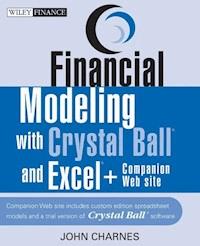
Praise for Financial Modeling with Crystal Ball(r) and Excel(r) "Professor Charnes's book drives clarity into applied Monte Carlo analysis using examples and tools relevant to real-world finance. The book will prove useful for analysts of all levels and as a supplement to academic courses in multiple disciplines." -Mark Odermann, Senior Financial Analyst, Microsoft "Think you really know financial modeling? This is a must-have for power Excel users. Professor Charnes shows how to make more realistic models that result in fewer surprises. Every analyst needs this credibility booster." -James Franklin, CEO, Decisioneering, Inc. "This book packs a first-year MBA's worth of financial and business modeling education into a few dozen easy-to-understand examples. Crystal Ball software does the housekeeping, so readers can concentrate on the business decision. A careful reader who works the examples on a computer will master the best general-purpose technology available for working with uncertainty." -Aaron Brown, Executive Director, Morgan Stanley, author of The Poker Face of Wall Street "Using Crystal Ball and Excel, John Charnes takes you step by step, demonstrating a conceptual framework that turns static Excel data and financial models into true risk models. I am astonished by the clarity of the text and the hands-on, step-by-step examples using Crystal Ball and Excel; Professor Charnes is a masterful teacher, and this is an absolute gem of a book for the new generation of analyst." -Brian Watt, Chief Operating Officer, GECC, Inc. "Financial Modeling with Crystal Ball and Excel is a comprehensive, well-written guide to one of the most useful analysis tools available to professional risk managers and quantitative analysts. This is a must-have book for anyone using Crystal Ball, and anyone wanting an overview of basic risk management concepts." -Paul Dietz, Manager, Quantitative Analysis, Westar Energy "John Charnes presents an insightful exploration of techniques for analysis and understanding of risk and uncertainty in business cases. By application of real options theory and Monte Carlo simulation to planning, doors are opened to analysis of what used to be impossible, such as modeling the value today of future project choices." -Bruce Wallace, Nortel
Sie lesen das E-Book in den Legimi-Apps auf:
Seitenzahl: 342
Veröffentlichungsjahr: 2011
Ähnliche


















Contents
Preface
Acknowledgments
About the Author
Chapter 1: Introduction
Financial Modeling
Risk Analysis
Monte Carlo Simulation
Risk Management
Benefits and Limitations of Using Crystal Ball
Chapter 2: Analyzing Crystal Ball Forecasts
Simulating A 50 – 50 Portfolio
Varying the Allocations
Presenting the Results
Chapter 3: Building a Crystal Ball Model
Simulation Modeling Process
Defining Crystal Ball Assumptions
Running Crystal Ball
Sources of Error
Controlling Model Error
Chapter 4: Selecting Crystal Ball Assumptions
Crystal Ball’s Basic Distributions
Using Historical Data to Choose Distributions
Specifying Correlations
Chapter 5: Using Decision Variables
Defining Decision Variables
Decision Table with One Decision Variable
Decision Table with Two Decision Variables
Using OptQuest
Chapter 6: Selecting Run Preferences
Trials
Sampling
Speed
Options
Statistics
Chapter 7: Net Present Value and Internal Rate of Return
Deterministic NPV and IRR
Simulating NPV and IRR
Capital Budgeting
Customer Net Present Value
Chapter 8: Modeling Financial Statements
Deterministic Model
Tornado Chart and Sensitivity Analysis
Crystal Ball Sensitivity Chart
Conclusion
Chapter 9: Portfolio Models
Single-Period Crystal Ball Model
Single-Period Analytical Solution
Multiperiod Crystal Ball Model
Chapter 10: Value at Risk
VaR
Shortcomings of VaR
CVaR
Chapter 11: Simulating Financial Time Series
White Noise
Random Walk
Autocorrelation
Additive Random Walk with Drift
Multiplicative Random Walk Model
Geometric Brownian Motion Model
Mean-Reverting Model
Chapter 12: Financial Options
Types of Options
Risk-Neutral Pricing and the Black-Scholes Model
Portfolio Insurance
American Option Pricing
Exotic Option Pricing
Bull Spread
Principal-Protected Instrument
Chapter 13: Real Options
Financial Options and Real Options
Applications of ROA
Black-Scholes Real Options Insights
ROV Tool
Summary
Appendix A: Crystal Ball’s Probability Distributions
Appendix B: Generating Assumption Values
Appendix C: Variance Reduction Techniques
Appendix D: About the Download
Glossary
References
Index
Copyright © 2007 by John Charnes. All rights reserved.
Published by John Wiley & Sons, Inc., Hoboken, New Jersey.
Published simultaneously in Canada.
No part of this publication may be reproduced, stored in a retrieval system, or transmitted in any form or by any means, electronic, mechanical, photocopying, recording, scanning, or otherwise, except as permitted under Section 107 or 108 of the 1976 United States Copyright Act, without either the prior written permission of the Publisher, or authorization through payment of the appropriate per-copy fee to the Copyright Clearance Center, Inc., 222 Rosewood Drive, Danvers, MA 01923, (978) 750-8400, fax (978) 750-4470, or on the Web at www.copyright.com. Requests to the Publisher for permission should be addressed to the Permissions Department, John Wiley & Sons, Inc., 111 River Street, Hoboken, NJ 07030, (201) 748-6011, fax (201) 748-6008, or online at http://www.wiley.com/go/permission.
Limit of Liability/Disclaimer of Warranty: While the publisher and author have used their best efforts in preparing this book, they make no representations or warranties with respect to the accuracy or completeness of the contents of this book and specifically disclaim any implied warranties of merchantability or fitness for a particular purpose. No warranty may be created or extended by sales representatives or written sales materials. The advice and strategies contained herein may not be suitable for your situation. You should consult with a professional where appropriate. Neither the publisher nor author shall be liable for any loss of profit or any other commercial damages, including but not limited to special, incidental, consequential, or other damages.
For general information on our other products and services or for technical support, please contact our Customer Care Department within the United States at (800) 762-2974, outside the United States at (317) 572-3993 or fax (317) 572-4002.
Wiley also publishes its books in a variety of electronic formats. Some content that appears in print may not be available in electronic books. For more information about Wiley products, visit our Web site at www.wiley.com.
Library of Congress Cataloging-in-Publication Data:
Charnes, John Martin.
Financial modeling with crystal ball and Excel / John M. Charnes.
p. cm.—(Wiley finance series)
“Published simultaneously in Canada.”
Includes bibliographical references.
ISBN 13: 978-0-471-77972-8 (paper/cd-rom)
ISBN 10: 0-471-77972-5 (paper/cd-rom)
1. Finance–Mathematical models. 2. Investments–Mathematical models. 3. Crystal ball (Computer file) 4. Microsoft Excel (computer file) I. Title.
HG106.C485 2007
332.0285′554—dc22
2006033467
In Memory of Gerald Daniel Charnes, 1925–2005
Founded in 1807, John Wiley & Sons is the oldest independent publishing company in the United States. With offices in North America, Europe, Australia and Asia, Wiley is globally committed to developing and marketing print and electronic products and services for our customers’ professional and personal knowledge and understanding.
The Wiley Finance series contains books written specifically for finance and investment professionals as well as sophisticated individual investors and their financial advisors. Book topics range from portfolio management to e-commerce, risk management, financial engineering, valuation and financial instrument analysis, as well as much more.
For a list of available titles, please visit our Web site at www.WileyFinance.com.
Preface
I wrote this book to help financial analysts and other interested parties learn how to build and interpret the results of Crystal Ball models for decision support. There are several books that exist to inform readers about Monte Carlo simulation in general. Many of these general books are listed in the References section of this book. This book focuses on using Crystal Ball in three main areas of finance: corporate finance, investments, and derivatives.
In 1982, University of Minnesota–Duluth Business School professor Henry Person introduced me to IFPS, computer software designed for financial planning, that we ran on VAX mainframe computers for an MBA class in quantitative methods. IFPS used a tabular layout for financial data similar to Excel’s, although it was more abstract than Excel’s because one had to print the data to see the layout in IFPS instead of working with Excel’s tabular display of the data on the screen. Gray (1996) describes what is evidently the latest, and perhaps final, version of this financial planning software. It is significant to me because IFPS included a Monte Carlo command that gave me my first glimpse of using a computer as a tool for financial risk analysis.
I was hooked. The next term, I took Henry’s class in discrete-event simulation based on Tom Schriber’s (1974) red GPSS textbook. I found the notion of system simulation fascinating. It made experimentation possible in a computer lab on models of real-world situations, just as the physical scale models of dams in the University of Minnesota–Twin Cities hydraulic laboratory made experimentation possible for the civil engineering professors during my days as an undergraduate student there. I saw many places where systems simulation could have been applied to the construction industry when I worked as a field engineer, but was unaware at the time of what simulation could accomplish.
More graduate school beckoned. After a year of teaching finance at the University of Washington in Seattle, I returned to the Twin Cities to eventually earn my doctorate in what became the Carlson School of Management. There I met David Kelton in 1986. His coauthored textbook, now in print as Law and Kelton (2000), got me started on my dissertation research that was done largely at the Minnesota Supercomputer Institute, where I ran FORTRAN programs on Cray supercomputers and graphed the resulting output on Sun workstations. It is amazing to me that anyone can do the same tasks today faster and more easily by using Crystal Ball on a personal computer. I wish that I had had today’s version of the personal computer and Crystal Ball available to me when I worked as an economic analyst at a Fortune 50 banking conglomerate in 1985.
As assistant professor in the management sciences department at the University of Miami in Coral Gables, Florida, I taught simulation to systems analysis and industrial engineering students in their undergraduate and graduate programs. When I moved to the University of Kansas in 1994, I had hopes of offering a similar course of study, but learned quickly that the business students here then were more interested in financial risk analysis than systems simulation. In 1996, I offered my first course in risk analysis at our suburban Kansas City campus to 30 MBA students, who loved the material but not the software we used—which was neither IFPS nor Crystal Ball.
I heard many complaints that term about the “clunky software that crashed all the time,” but one student posed an alternative. She asked if I had heard of Crystal Ball, which was then in use by a couple of her associates at Sprint, the Kansas City–based telecommunications company. I checked it out, and the more I read in the Crystal Ball documentation, the more convinced I became that the authors were influenced by the same Law and Kelton text that I had studied in graduate school.
At the 1997 Winter Simulation Conference, I met Eric Wainwright, chief technical officer at Decisioneering, Inc. (DI), and one of the two creators of Crystal Ball, who confirmed my suspicions about our shared background. Thus began my friendship with DI that led to creation of Risk Analysis Using Crystal Ball, the multimedia training CD-ROM offered on the DI Web site. That effort, in collaboration with Larry Goldman, Lucie Trepanier, and Dave Fredericks, was a wholly enjoyable experience that gave me reason to believe—correctly—that the effort to produce this book would also be enjoyable.
About the same time I met Eric, I had the good fortune to work with David Kellogg at Sprint. His interest in Crystal Ball and invitation to present a series of lectures on its use as a decision support tool led to my development of training classes that were part of the Sprint University of Excellence offerings for several years. I am grateful to David and all the participants in those classes over the years for their helping me to hone the presentation of the ideas contained in this book. I am also grateful to Sprint and Nortel Networks for the financial support that led to development of the real options valuation tool described in Chapter 13. Other consulting clients will go unnamed here, but they also have influenced the presentation.
Microsoft Excel has become the lingua franca of business. Business associates in different industries and even some in different divisions of the same company often find it difficult to communicate with each other. However, virtually everyone who does business planning uses Excel in some capacity, if not exclusively. Though not always able to communicate in the same language, businesspeople around the globe are able to share their Excel spreadsheets. As with everything in our society, Excel has its critics. Yet the overwhelming number of users of this program make it foolish to deliberately shun its use.
My main criticism of Excel is obviated by use of the Crystal Ball application. Excel is extremely versatile in its ability to allow one to build deterministic models in many different business, engineering and scientific domains. Without Crystal Ball, it is cumbersome to use Excel for stochastic modeling, but Crystal Ball’s graphical input and output features make it easy for analysts to build stochastic models in Excel.
In the 1970s, Jerry Wagner and the other founders of IFPS had a dream of creating software that would dominate the market for a computerized, plainlanguage tool for financial planning by executives. In the meantime, Microsoft Excel came to dominate the market for financial planning software. The combination of Excel, Crystal Ball, and OptQuest provides a powerful way for you to enhance your deterministic models by adding stochastic assumptions and finding optimal solutions to complex real-world problems. Building such models will give you greater insight into the problems you face, and may cause you to view your business in a new light.
ORGANIZATION OF THIS BOOK
This book is intended for analysts who wish to construct stochastic financial models, and anyone else interested in learning how to use Crystal Ball. Instructors with a practical bent may also find it useful as a supplement for courses in finance, management science, or industrial engineering.
The first six chapters of this book cover the features of Crystal Ball and OptQuest. Several examples are used to illustrate how these programs can be used to enhance deterministic Excel models for stochastic financial analysis and planning. The remaining seven chapters provide more detailed examples of how Crystal Ball and OptQuest can be used in financial risk analysis of investments in securities, derivatives, and real options. The technical appendices provide details about the methods used by Crystal Ball in its algorithms, and a description of some methods of variance reduction that can be employed to increase the precision of your simulation estimates. All of the models described in the book are available on the accompanying CD-ROM, as is a link to a Web site from which a trial version of Crystal Ball may be downloaded. The contents of each chapter and appendix are listed below:
Chapter 1 provides an overview of financial modeling and risk analysis through Monte Carlo simulation. It also contains a discussion of risk management and the benefits and limitations of Crystal Ball.
Chapter 2 describes how to specify and interpret Crystal Ball forecasts, the graphical and numerical summaries of the output measures generated during simulation. A retirement portfolio is used for an example.
Chapter 3 takes a helicopter view of building a Crystal Ball model. It starts out with a simple, deterministic business planning Excel model, and then shows you how to add stochastic assumptions to it with Crystal Ball. The chapter also contains a discussion of possible sources of error in your models and how they can be controlled.
Chapter 4 contains a deeper look at specifying Crystal Ball assumptions. It describes Crystal Ball’s basic distributions and shows you how to select distributions using historical data and/or your best expert judgment. The chapter also describes how to use, estimate, and specify correlations between assumptions in a Crystal Ball model.
Chapter 5 covers the use of decision variables in detail. A decision variable is an input whose value can be chosen by a decision maker. Decision variables enable you to harness the power of Crystal Ball and OptQuest to find optimal solutions. A first look at real options is included in this chapter.
Chapter 6 lists and explains the runtime options available in Crystal Ball as well as how and when to use them.
Chapter 7 discusses the relative merits of using the concepts of net present value and internal rate of return in deterministic and stochastic models. Examples include capital budgeting in finance and customer lifetime value in marketing.
Chapter 8 describes how to add stochastic assumptions to pro forma financial statements, then perform sensitivity analyses using tornado charts and Crystal Ball sensitivity charts.
Chapter 9 presents examples of using Crystall Ball to construct single- and multiperiod portfolio models. It also compares the Crystal Ball results for a single-period model to the analytic solution in a special case where an analytic solution can be found.
Chapter 10 discusses Value at Risk (VaR) and its more sophisticated cousin, Conditional Value at Risk (CVaR), the relative merits of VaR and CVaR, and how they are used in risk management.
Chapter 11 describes how to simulate financial time series with Crystal Ball. It covers random walks, geometric Brownian motion, and mean-reverting models, as well as a discussion of autocorrelation and how to detect it in empirical data.
Chapter 12 shows how to create Crystal Ball models for financial option pricing, covering European, American, and exotic options. It includes a model to demonstrate how to simulate returns from option strategies, using a bull spread as an example. It also shows how to use Crystal Ball to evaluate a relatively new derivative security, a principal-protected instrument.
Chapter 13 concludes the main body of the text with a discussion of how Crystal Ball and OptQuest are used to value real options. It also contains a brief review of the literature and some applications of real options analysis.
Appendix A contains short descriptions of each available Crystal Ball assumption. Each description includes the assumption’s parameters, probability mass or density function, cumulative distribution function, mean, standard deviation, and notes about the distribution and/or its usage.
Appendix B provides a brief description of how Crystal Ball generates the random numbers and variates during the simulation process.
Appendix C describes some variance reduction techniques, methods by which an analyst changes a model to get more precise estimates from a fixed number of trials during a simulation.
Appendix D provides information on downloading the Crystal Ball software and Excel files that are used in this book.
Appendix E contains citations for the references in the text to academic and practitioner literature relating to financial modeling and risk analysis. A glossary is also included.
Acknowledgments
For their conversations and help (unwitting, by some) in writing this book I would like to thank: Chris Anderson, Bill Beedles, George Bittlingmayer, David Blankinship, Eric Butz, Sarah Charnes, Barry Cobb, Tom Cowherd Jr., Riza Demirer, Amy Dougan, Bill Falloon, Dave Fredericks, Larry Goldman, Douglas Hague, Emilie Herman, Steve Hillmer, Mark Hirschey, Joe B. Jones, David Kellogg, Paul Koch, Mike Krieger, Chad Lander, Michael Lisk, Howard Marmorstein, Samik Raychaudhuri, Catherine Shenoy, Prakash Shenoy, Steve Terbovich, Michael Tognetti, Lucie Trepanier, Eric Wainwright, Bruce Wallace, and Laura Walsh. Special thanks go to Suzanne Swain Charnes for help with editing and time taken to indulge my interest in Crystal Ball over the years.
I enjoyed writing this book, and hope that it helps you learn how to build stochastic models of realistic situations important to you. I will appreciate any feedback that you send to [email protected].
John Charnes
Lawrence, Kansas 2006
About the Author
Dr. John Charnes is professor and Scupin Faculty Fellow in the finance, economics, and decision sciences area at the University of Kansas School of Business, where he has received both teaching and research awards. Professor Charnes has taught courses in risk analysis, computer simulation, statistics, operations, quality management, and finance in the business schools of the University of Miami (Florida), University of Washington (Seattle), University of Minnesota (Minneapolis), and Hamline University (St. Paul).
He has published papers on financial risk analysis, statistics, and other topics in Financial Analysts Journal, The American Statistician, Management Science, Decision Sciences, Computers and Operation Research, Journal of the Operational Research Society, Journal of Business Logistics, and Proceedings of the Winter Simulation Conference. Professor Charnes has performed research, consulting, and executive education for more than 50 corporations and other organizations in Kansas, Missouri, Washington, Minnesota, Florida and Ontario, Canada.
Professor Charnes holds PhD (1989), MBA (1983), and Bachelor of Civil Engineering (1980) degrees from the University of Minnesota. Before earning his doctorate, he worked as a surveyor, draftsman, field engineer, and quality-control engineer on numerous construction projects in Minnesota, Iowa, and Maryland. He has served as president of the Institute for Operations Research and the Management Sciences (INFORMS) College on Simulation, and proceedings coeditor (1996) and program chair (2002) for the Winter Simulation Confererences.
CHAPTER 1
Introduction
Life is stochastic. Although proponents of determinism might state otherwise, anyone who works in business or finance today knows quite well that future events are highly unpredictable. We often proceed by planning for the worst outcome while hoping for the best, but most of us are painfully aware from experience that there are many risks and uncertainties associated with any business endeavor.
Many analysts start creating financial models of risky situations with a base case constructed by making their best guess at the most likely value for each of the important inputs and building a spreadsheet model to calculate the output values that interest them. Then they account for uncertainty by thinking of how each input in turn might deviate from the best guess and letting the spreadsheet calculate the consequences for the outputs. Such a “what-if” analysis provides insight into the sensitivity of the outputs to one-at-a-time changes in the inputs.
Another common procedure is to calculate three scenarios: best case, worst case and most likely. This is done by inserting the best possible, worst possible, and most likely values for each key input, then calculating the best-case outputs when each input is at its best possible value; the worst-case outputs when each input is at its worst possible value; and using the base case as the most likely scenario. Scenario analysis shows the ranges of possibilities for the outputs, but gives no idea of the likelihood of output values falling between the extremes.
Lesen Sie weiter in der vollständigen Ausgabe!
Lesen Sie weiter in der vollständigen Ausgabe!
Lesen Sie weiter in der vollständigen Ausgabe!
Lesen Sie weiter in der vollständigen Ausgabe!
Lesen Sie weiter in der vollständigen Ausgabe!
Lesen Sie weiter in der vollständigen Ausgabe!
Lesen Sie weiter in der vollständigen Ausgabe!
Lesen Sie weiter in der vollständigen Ausgabe!
Lesen Sie weiter in der vollständigen Ausgabe!
Lesen Sie weiter in der vollständigen Ausgabe!
Lesen Sie weiter in der vollständigen Ausgabe!
Lesen Sie weiter in der vollständigen Ausgabe!
Lesen Sie weiter in der vollständigen Ausgabe!
Lesen Sie weiter in der vollständigen Ausgabe!
Lesen Sie weiter in der vollständigen Ausgabe!
Lesen Sie weiter in der vollständigen Ausgabe!
Lesen Sie weiter in der vollständigen Ausgabe!
Lesen Sie weiter in der vollständigen Ausgabe!
Lesen Sie weiter in der vollständigen Ausgabe!
Lesen Sie weiter in der vollständigen Ausgabe!




