


134,99 €
Mehr erfahren.
- Herausgeber: John Wiley & Sons
- Kategorie: Fachliteratur
- Serie: Wiley Finance Editions
- Sprache: Englisch
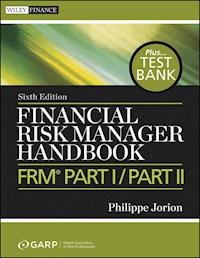
The essential reference for financial risk management Filled with in-depth insights and practical advice, the Financial Risk Manager Handbook is the core text for risk management training programs worldwide. Presented in a clear and consistent fashion, this completely updated Sixth Edition, mirrors recent updates to the new two-level Financial Risk Manager (FRM) exam, and is fully supported by GARP as the trusted way to prepare for the rigorous and renowned FRM certification. This valuable new edition includes an exclusive collection of interactive multiple-choice questions from recent FRM exams. Financial Risk Manager Handbook, Sixth Edition supports candidates studying for the Global Association of Risk Professional's (GARP) annual FRM exam and prepares you to assess and control risk in today's rapidly changing financial world. Authored by renowned risk management expert Philippe Jorion, with the full support of GARP, this definitive guide summarizes the core body of knowledge for financial risk managers. * Offers valuable insights on managing market, credit, operational, and liquidity risk * Examines the importance of structured products, futures, options, and other derivative instruments * Contains new material on extreme value theory, techniques in operational risk management, and corporate risk management Financial Risk Manager Handbook is the most comprehensive guide on this subject, and will help you stay current on best practices in this evolving field. The FRM Handbook is the official reference book for GARP's FRM certification program.
Sie lesen das E-Book in den Legimi-Apps auf:
Seitenzahl: 1266
Veröffentlichungsjahr: 2010
Ähnliche


















Contents
Cover
Series
Title Page
Copyright
Preface
About the Author
About GARP
FINANCIAL RISK MANAGER (FRM®) CERTIFICATION
OTHER GARP CERTIFICATIONS
GARP DIGITAL LIBRARY
GARP EVENTS AND NETWORKING
Introduction
Part One: Foundations of Risk Management
Chapter 1: Risk Management
1.1 RISK MEASUREMENT
1.2 EVALUATION OF THE RISK MEASUREMENT PROCESS
1.3 PORTFOLIO CONSTRUCTION
1.4 ASSET PRICING THEORIES
1.5 VALUE OF RISK MANAGEMENT
1.6 IMPORTANT FORMULAS
1.7 ANSWERS TO CHAPTER EXAMPLES
Part Two: Quantitative Analysis
Chapter 2: Fundamentals of Probability
2.1 CHARACTERIZING RANDOM VARIABLES
2.2 MULTIVARIATE DISTRIBUTION FUNCTIONS
2.3 FUNCTIONS OF RANDOM VARIABLES
2.4 IMPORTANT DISTRIBUTION FUNCTIONS
2.5 DISTRIBUTION OF AVERAGES
2.6 IMPORTANT FORMULAS
2.7 ANSWERS TO CHAPTER EXAMPLES
2.8 APPENDIX A: REVIEW OF MATRIX MULTIPLICATION
2.9 APPENDIX B: NORMAL DISTRIBUTION
Chapter 3: Fundamentals of Statistics
3.1 PARAMETER ESTIMATION
3.2 REGRESSION ANALYSIS
3.3 IMPORTANT FORMULAS
3.4 ANSWERS TO CHAPTER EXAMPLES
Chapter 4: Monte Carlo Methods
4.1 SIMULATIONS WITH ONE RANDOM VARIABLE
4.2 IMPLEMENTING SIMULATIONS
4.3 MULTIPLE SOURCES OF RISK
4.4 IMPORTANT FORMULAS
4.5 ANSWERS TO CHAPTER EXAMPLES
Chapter 5: Modeling Risk Factors
5.1 REAL DATA
5.2 NORMAL AND LOGNORMAL DISTRIBUTIONS
5.3 DISTRIBUTIONS WITH FAT TAILS
5.4 TIME VARIATION IN RISK
5.5 IMPORTANT FORMULAS
5.6 ANSWERS TO CHAPTER EXAMPLES
Part Three: Financial Markets and Products
Chapter 6: Bond Fundamentals
6.1 DISCOUNTING, PRESENT VALUE, AND FUTURE VALUE
6.2 PRICE-YIELD RELATIONSHIP
6.3 BOND PRICE DERIVATIVES
6.4 DURATION AND CONVEXITY
6.5 IMPORTANT FORMULAS
6.6 ANSWERS TO CHAPTER EXAMPLES
6.7 APPENDIX: APPLICATIONS OF INFINITE SERIES
Chapter 7: Introduction to Derivatives
7.1 DERIVATIVES MARKETS
7.2 FORWARD CONTRACTS
7.3 FUTURES CONTRACTS
7.4 SWAP CONTRACTS
7.5 IMPORTANT FORMULAS
7.6 ANSWERS TO CHAPTER EXAMPLES
Chapter 8: Option Markets
8.1 OPTION PAYOFFS
8.2 OPTION PREMIUMS
8.3 VALUING OPTIONS
8.4 OTHER OPTION CONTRACTS
8.5 VALUING OPTIONS BY NUMERICAL METHODS
8.6 IMPORTANT FORMULAS
8.7 ANSWERS TO CHAPTER EXAMPLES
Chapter 9: Fixed-Income Securities
9.1 OVERVIEW OF DEBT MARKETS
9.2 FIXED-INCOME SECURITIES
9.3 PRICING OF FIXED-INCOME SECURITIES
9.4 FIXED-INCOME RISK
9.5 ANSWERS TO CHAPTER EXAMPLES
Chapter 10: Fixed-Income Derivatives
10.1 FORWARD CONTRACTS
10.2 FUTURES
10.3 SWAPS
10.4 Options
10.5 IMPORTANT FORMULAS
10.6 ANSWERS TO CHAPTER EXAMPLES
Chapter 11: Equity, Currency, and Commodity Markets
11.1 EQUITIES
11.2 EQUITY DERIVATIVES
11.3 CURRENCIES
11.4 CURRENCY DERIVATIVES
11.5 COMMODITIES
11.6 COMMODITY DERIVATIVES
11.7 IMPORTANT FORMULAS
11.8 ANSWERS TO CHAPTER EXAMPLES
Part Four: Valuation and Risk Models
Chapter 12: Introduction to Risk Models
12.1 INTRODUCTION TO FINANCIAL MARKET RISKS
12.2 COMPONENTS OF RISK MEASUREMENT SYSTEMS
12.3 DOWNSIDE RISK MEASURES
12.4 VAR PARAMETERS
12.5 STRESS-TESTING
12.6 VAR: LOCAL VERSUS FULL VALUATION
12.7 IMPORTANT FORMULAS
12.8 ANSWERS TO CHAPTER EXAMPLES
Chapter 13: Managing Linear Risk
13.1 UNITARY HEDGING
13.2 Optimal Hedging
13.3 Applications of Optimal Hedging
13.4 IMPORTANT FORMULAS
13.5 ANSWERS TO CHAPTER EXAMPLES
Chapter 14: Nonlinear (Option) Risk Models
14.1 OPTION MODELS
14.2 OPTION GREEKS
14.3 OPTION RISKS
14.4 IMPORTANT FORMULAS
14.5 ANSWERS TO CHAPTER EXAMPLES
Part Five: Market Risk Management
Chapter 15: Advanced Risk Models: Univariate
15.1 BACKTESTING
15.2 EXTREME VALUE THEORY
15.3 COHERENT RISK MEASURES
15.4 IMPORTANT FORMULAS
15.5 ANSWERS TO CHAPTER EXAMPLES
Chapter 16: Advanced Risk Models: Multivariate
16.1 RISK MAPPING
16.2 JOINT DISTRIBUTIONS OF RISK FACTORS
16.3 VAR METHODS
16.4 LIMITATIONS OF RISK SYSTEMS
16.5 EXAMPLE
16.6 IMPORTANT FORMULAS
16.7 ANSWERS TO CHAPTER EXAMPLES
APPENDIX: SIMPLIFICATION OF THE COVARIANCE MATRIX
Chapter 17: Managing Volatility Risk
17.1 IMPLIED VOLATILITY
17.2 IMPLIED CORRELATION
17.3 VARIANCE SWAPS
17.4 DYNAMIC TRADING
17.5 CONVERTIBLE BONDS AND WARRANTS
17.6 IMPORTANT FORMULAS
17.7 ANSWERS TO CHAPTER EXAMPLES
Chapter 18: Mortgage-Backed Securities Risk
18.1 PREPAYMENT RISK
18.2 SECURITIZATION
18.3 TRANCHING
18.4 IMPORTANT FORMULAS
18.5 ANSWERS TO CHAPTER EXAMPLES
Part Six: Credit Risk Management
Chapter 19: Introduction to Credit Risk
19.1 SETTLEMENT RISK
19.2 OVERVIEW OF CREDIT RISK
19.3 MEASURING CREDIT RISK
19.4 CREDIT RISK DIVERSIFICATION
19.5 IMPORTANT FORMULAS
19.6 ANSWERS TO CHAPTER EXAMPLES
Chapter 20: Measuring Actuarial Default Risk
20.1 CREDIT EVENT
20.2 DEFAULT RATES
20.3 RECOVERY RATES
20.4 ASSESSING CORPORATE AND SOVEREIGN RATINGS
20.5 REGULATION OF CREDIT RATING AGENCIES
20.6 IMPORTANT FORMULAS
20.7 ANSWERS TO CHAPTER EXAMPLES
Chapter 21: Measuring Default Risk from Market Prices
21.1 CORPORATE BOND PRICES
21.2 EQUITY PRICES
21.3 IMPORTANT FORMULAS
21.4 ANSWERS TO CHAPTER EXAMPLES
Chapter 22: Credit Exposure
22.1 CREDIT EXPOSURE BY INSTRUMENT
22.2 DISTRIBUTION OF CREDIT EXPOSURE
22.3 EXPOSURE MODIFIERS
22.4 CREDIT RISK MODIFIERS
22.5 IMPORTANT FORMULAS
22.6 ANSWERS TO CHAPTER EXAMPLES
APPENDIX: ISDA MASTER NETTING AGREEMENT
Chapter 23: Credit Derivatives and Structured Products
23.1 INTRODUCTION
23.2 CREDIT DEFAULT SWAPS
23.3 OTHER CONTRACTS
23.4 STRUCTURED PRODUCTS
23.5 CDO Market
23.6 DISCUSSION
23.7 IMPORTANT FORMULAS
23.8 ANSWERS TO CHAPTER EXAMPLES
Chapter 24: Managing Credit Risk
24.1 MEASURING THE DISTRIBUTION OF CREDIT LOSSES
24.2 MEASURING EXPECTED CREDIT LOSS
24.3 MEASURING CREDIT VAR
24.4 PORTFOLIO CREDIT RISK MODELS
24.5 CONCLUSIONS
24.6 IMPORTANT FORMULAS
24.7 ANSWERS TO CHAPTER EXAMPLES
Part Seven: Operational and Integrated Risk Management
Chapter 25: Operational Risk
25.1 IMPORTANCE OF OPERATIONAL RISK
25.2 IDENTIFYING OPERATIONAL RISK
25.3 ASSESSING OPERATIONAL RISK
25.4 MANAGING OPERATIONAL RISK
25.5 THE BASEL OPERATIONAL RISK CHARGE
25.6 IMPORTANT FORMULAS
25.7 ANSWERS TO CHAPTER EXAMPLES
APPENDIX: CAUSAL NETWORKS
Chapter 26: Liquidity Risk
26.1 SOURCES OF LIQUIDITY RISK
26.2 ASSET LIQUIDITY RISK
26.3 FUNDING LIQUIDITY RISK
26.4 MANAGING LIQUIDITY RISK
26.5 IMPORTANT FORMULAS
26.6 ANSWERS TO CHAPTER EXAMPLES
Chapter 27: Firmwide Risk Management
27.1 INTEGRATED RISK MANAGEMENT
27.2 BEST PRACTICES REPORTS
27.3 ORGANIZATIONAL STRUCTURE
27.4 CONTROLLING TRADERS
27.5 RISK-ADJUSTED PERFORMANCE AND RAROC
27.6 IMPORTANT FORMULAS
27.7 ANSWERS TO CHAPTER EXAMPLES
Chapter 28: The Basel Accord
28.1 STEPS IN THE BASEL ACCORD
28.2 DEFINITION OF CAPITAL
28.3 THE BASEL I CREDIT RISK CHARGE
28.4 ILLUSTRATION: CITIBANK
28.5 THE BASEL II ACCORD
28.6 THE MARKET RISK CHARGE
28.7 CONCLUSIONS
28.8 IMPORTANT FORMULAS
28.9 ANSWERS TO CHAPTER EXAMPLES
Part Eight: Investment Risk Management
Chapter 29: Portfolio Risk Management
29.1 INSTITUTIONAL INVESTORS
29.2 PERFORMANCE EVALUATION
29.3 RISK BUDGETING
29.4 IMPORTANT FORMULAS
29.5 ANSWERS TO CHAPTER EXAMPLES
Chapter 30: Hedge Fund Risk Management
30.1 THE HEDGE FUND INDUSTRY
30.2 LEVERAGE, LONG POSITIONS, AND SHORT POSITIONS
30.3 HEDGE FUNDS: MARKET RISKS
30.4 HEDGE FUNDS: SPECIFIC RISKS
30.5 DEALING WITH HEDGE FUND RISKS
30.6 IMPORTANT FORMULAS
30.7 ANSWERS TO CHAPTER EXAMPLES
Index
FRM Test Bank
Founded in 1807, John Wiley & Sons is the oldest independent publishing company in the United States. With offices in North America, Europe, Australia, and Asia, Wiley is globally committed to developing and marketing print and electronic products and services for our customers' professional and personal knowledge and understanding.
The Wiley Finance series contains books written specifically for finance and investment professionals as well as sophisticated individual investors and their financial advisors. Book topics range from portfolio management to e-commerce, risk management, financial engineering, valuation, and financial instrument analysis, as well as much more.
For a list of available titles, visit our Web site at www.WileyFinance.com.
Copyright © 2011 by Philippe Jorion, except for FRM sample questions, which are copyright 1997–2011 by GARP. The FRM designation is a GARP trademark. All rights reserved.
Published by John Wiley & Sons, Inc., Hoboken, New Jersey. Published simultaneously in Canada.
No part of this publication may be reproduced, stored in a retrieval system, or transmitted in any form or by any means, electronic, mechanical, photocopying, recording, scanning, or otherwise, except as permitted under Section 107 or 108 of the 1976 United States Copyright Act, without either the prior written permission of the Publisher, or authorization through payment of the appropriate per-copy fee to the Copyright Clearance Center, Inc., 222 Rosewood Drive, Danvers, MA 01923, (978) 750-8400, fax (978) 646-8600, or on the web at www.copyright.com. Requests to the Publisher for permission should be addressed to the Permissions Department, John Wiley & Sons, Inc., 111 River Street, Hoboken, NJ 07030, (201) 748-6011, fax (201) 748-6008, or online at http://www.wiley.com/go/permissions.
Limit of Liability/Disclaimer of Warranty: While the publisher and author have used their best efforts in preparing this book, they make no representations or warranties with respect to the accuracy or completeness of the contents of this book and specifically disclaim any implied warranties of merchantability or fitness for a particular purpose. No warranty may be created or extended by sales representatives or written sales materials. The advice and strategies contained herein may not be suitable for your situation. You should consult with a professional where appropriate. Neither the publisher nor author shall be liable for any loss of profit or any other commercial damages, including but not limited to special, incidental, consequential, or other damages.
For general information on our other products and services or for technical support, please contact our Customer Care Department within the United States at (800) 762-2974, outside the United States at (317) 572-3993 or fax (317) 572-4002.
Wiley also publishes its books in a variety of electronic formats. Some content that appears in print may not be available in electronic books. For more information about Wiley products, visit our web site at www.wiley.com.
Library of Congress Cataloging-in-Publication Data:
Jorion, Philippe. Financial risk manager handbook plus test bank : FRM Part I/Part II, 6th Edition / Philippe Jorion. – 6th ed. p. cm. Includes index. ISBN 978-0-470-90401-5 (paper/online) 1. Financial risk management. 2. Risk management. 3. Corporations–Finance. I. Title. HD61.J67 2009 658.15′5–dc22 2010047263
Preface
The Financial Risk Manager Handbook Plus Test Bank provides the core body of knowledge for financial risk managers. Risk management has rapidly evolved over the past decade and has become an indispensable function in many institutions.
This Handbook was originally written to provide support for candidates taking the FRM examination administered by GARP. As such, it reviews a wide variety of practical topics in a consistent and systematic fashion. It covers quantitative methods, major financial products, as well as market, credit, operational, and integrated risk management. It also discusses investment risk management issues essential for risk professionals.
This edition has been thoroughly updated to reflect recent developments in financial markets and changes in the structure of the FRM program. The book is now structured to correspond to the two levels of the FRM exams. All of the chapters have been updated to account for recent developments in financial markets and regulations. In particular, current issues are integrated in the second part of the book. New chapters have been added, including chapters that deal with advanced univariate and multivariate models, as well as advanced option models. Finally, this Handbook incorporates the latest questions from the FRM examinations. Modern risk management systems cut across the entire organization. This breadth is reflected in the subjects covered in this Handbook. The Handbook was designed to be self-contained, but only for readers who already have some exposure to financial markets. To reap maximum benefit from this book, readers ideally should have taken the equivalent of an MBA-level class on investments.
Finally, I want to acknowledge the help received in writing this Handbook. In particular, I would like to thank the numerous readers who shared comments on previous editions. Any comment or suggestion for improvement will be welcome. This feedback will help us to maintain the high quality of the FRM designation.
Philippe Jorion October 2010
About the Author
Philippe Jorion is a Professor of Finance at the Paul Merage School of Business at the University of California at Irvine. He has also been a professor at Columbia University, Northwestern University, the University of Chicago, and the University of British Columbia. In addition, he taught the risk management class in the Master of Financial Engineering programs at the University of California at Berkeley and University of California at Los Angeles. He holds an M.B.A. and a Ph.D. from the University of Chicago and a degree in engineering from the University of Brussels. Dr. Jorion is also a managing director at Pacific Alternative Asset Management Company (PAAMCO), a global fund of hedge funds with approximately $10 billion under management. PAAMCO is one of the few funds of funds to require position-level transparency from all invested hedge funds. This information is used to provide various measures of portfolio risk as well as to develop tools that help investors to understand the drivers of the funds' alpha and to detect style drift.
Dr. Jorion is the author of more than 100 publications directed to academics and practitioners on the topics of risk management and international finance. He has also written a number of books, including Big Bets Gone Bad: Derivatives and Bankruptcy in Orange County, the first account of the largest municipal failure in U.S. history, and Value at Risk: The New Benchmark for Managing Financial Risk, which is aimed at finance practitioners and has become an industry standard.
Philippe Jorion is a frequent speaker at academic and professional conferences. He is on the editorial board of a number of finance journals and was editor in chief of the Journal of Risk.
About GARP
Founded in 1996, the Global Association of Risk Professionals (GARP) is the leading not-for-profit association for world-class financial risk certification, education, and training, with close to 100,000 members representing 167 countries. With deep expertise and a strong reputation, GARP sets global standards and creates risk management programs valued worldwide. All GARP programs are developed with input from experts around the world to ensure that concepts and content reflect globally accepted practices.
GARP is dedicated to advancing the risk profession. For more information about GARP, please visit www.garp.com.
FINANCIAL RISK MANAGER (FRM®) CERTIFICATION
The benchmark FRM designation is the globally accepted risk management certification for financial risk professionals. The FRM objectively measures competency in the risk management profession based on globally accepted standards. With a compound annual growth rate of 25% over the past seven years, the FRM program has experienced significant growth in every financial center around the world. Now 16,000+ individuals hold the FRM designation in over 90 countries. In addition, organizations with five or more FRM registrants grew from 105 in 2003 to 424 in 2008, further demonstrating the FRM program's global acceptance.
The FRM Continuing Professional Education (CPE) program, offered exclusively for certified FRM holders, provides the perspective and framework needed to further develop competencies in the ever-evolving field of risk management.
For more information about the FRM program, please visit www.garp.com/frmexam.
OTHER GARP CERTIFICATIONS
International Certificate in Banking Risk and Regulation (ICBRR)
The ICBRR allows individuals to expand their knowledge and understanding of the various risks, regulations, and supervisory requirements banks must face in today's economy, with emphasis on the Basel II Accord. This certificate is ideal for employees who are not professional risk managers but who have a strong need to understand risk concepts. The ICBRR program is designed for employees in nonrisk departments such as internal audit, accounting, information technology (IT), legal, compliance, and sales, acknowledging that everyone in the organization is a risk manager!
Energy Risk Professional Program
The Energy Risk Professional (ERP®) program is designed to measure a candidate's knowledge of the major energy markets and gauge their ability to manage the physical and financial risks inherent in the complex world of energy. This program is valuable for anyone working in or servicing the energy field, requiring an understanding of the physical and financial markets, how they interrelate, and the risks involved.
GARP DIGITAL LIBRARY
As the world's largest digital library dedicated to financial risk management, the GARP Digital Library (GDL) is the hub for risk management education and research material. The library's unique iReadings™, allow users to download individual chapters of books, saving both time and money. There are over 1,000 readings available from 12 different publishers. The GDL collection offers readings to meet the needs of anyone interested in risk management.
For more information, please visit www.garpdigitallibrary.org.
GARP EVENTS AND NETWORKING
GARP hosts major conventions throughout the world, where risk professionals come together to share knowledge, network, and learn from leading experts in the field. Conventions are bookended with interactive workshops that provide practical insights and case studies presented by the industry's leading practitioners.
GARP regional chapters provide an opportunity for financial risk professionals to network and share new trends and discoveries in risk management. Each of our 52 chapters holds several meetings each year, in some locations more often, focusing on issues of importance to the risk management community, either globally or locally.
Introduction
GARP's formal mission is to be the leading professional association for financial risk managers, managed by and for its members and dedicated to the advancement of the risk profession through education, training, and the promotion of best practices globally. As a part of delivering on that mission, GARP has again teamed with Philippe Jorion to produce the sixth edition of the Financial Risk Manager Handbook Plus Test Bank.
The Handbook follows GARP's FRM Committee's published FRM Study Guide, which sets forth primary topics and subtopics covered in the FRM exam. The topics are selected by the FRM Committee as being representative of the theories and concepts utilized by risk management professionals as they address current issues.
Over the years the Study Guide has taken on an importance far exceeding its initial intent of providing guidance for FRM candidates. The Study Guide is now being used by universities, educators, and executives around the world to develop graduate-level business and finance courses, as a reference list for purchasing new readings for personal and professional libraries, as an objective outline to assess an employee's or job applicant's risk management qualifications, and as guidance on the important trends currently affecting the financial risk management profession.
Given the expanded and dramatically growing recognition of the financial risk management profession globally, the Handbook has similarly assumed a natural and advanced role beyond its original purpose. It has now become the primary reference manual for risk professionals, academicians, and executives around the world. Professional risk managers must be well versed in a wide variety of risk-related concepts and theories, and must also keep themselves up-to-date with a rapidly changing marketplace. The Handbook is designed to allow them to do just that. It provides a financial risk management practitioner with the latest thinking and approaches to financial risk-related issues. It also provides coverage of advanced topics with questions and tutorials to enhance the reader's learning experience.
This sixth edition of the Handbook includes revised coverage of the primary topic areas covered by the FRM examination. Importantly, this edition also includes the latest lessons from the recent credit crisis, as well as new and more recent sample FRM questions.
The Handbook continues to keep pace with the dynamic financial risk profession while simultaneously offering serious risk professionals an excellent and cost-effective tool to keep abreast of the latest issues affecting the global risk management community.
Developing credibility and global acceptance for a professional certification program is a lengthy and complicated process. When GARP first administered its FRM exam in 1997, the concept of a professional risk manager and a global certification relating to that person's skill set was more theory than reality. That has now completely changed, as the number of current FRM holders exceeds 16,000.
The FRM is now the benchmark for a financial risk manager anywhere around the world. Professional risk managers having earned the FRM credential are globally recognized as having achieved a level of professional competency and a demonstrated ability to dynamically measure and manage financial risk in a real-world setting in accordance with global standards.
GARP is proud to continue to make this Handbook available to financial risk professionals around the world. Philippe Jorion, a preeminent risk professional, has again compiled an exceptional reference book. Supplemented by an interactive Test Bank, this Handbook is a requirement for any risk professional's library.
The Test Bank is a preparatory review for anyone studying for the FRM exam and for risk professionals interested in self-study to review and improve their knowledge of market, credit, and operational risk management. The Test Bank contains hundreds of multiple-choice questions from the 2007, 2008, and 2009 FRM exams, with answers and solutions provided. The Test Bank can be downloaded following the instructions on the FRM™ Test Bank Download page at the end of this book.
Global Association of Risk Professionals October 2010
Part One
Foundations of Risk Management




