


54,99 €
Mehr erfahren.
- Herausgeber: John Wiley & Sons
- Kategorie: Fachliteratur
- Serie: Wiley Corporate F&A
- Sprache: Englisch
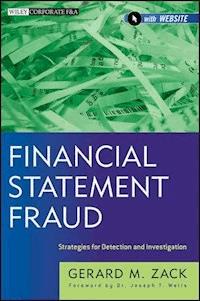
Valuable guidance for staying one step ahead of financial statement fraud Financial statement fraud is one of the most costly types of fraud and can have a direct financial impact on businesses and individuals, as well as harm investor confidence in the markets. While publications exist on financial statement fraud and roles and responsibilities within companies, there is a need for a practical guide on the different schemes that are used and detection guidance for these schemes. Financial Statement Fraud: Strategies for Detection and Investigation fills that need. * Describes every major and emerging type of financial statement fraud, using real-life cases to illustrate the schemes * Explains the underlying accounting principles, citing both U.S. GAAP and IFRS that are violated when fraud is perpetrated * Provides numerous ratios, red flags, and other techniques useful in detecting financial statement fraud schemes * Accompanying website provides full-text copies of documents filed in connection with the cases that are cited as examples in the book, allowing the reader to explore details of each case further Straightforward and insightful, Financial Statement Fraud provides comprehensive coverage on the different ways financial statement fraud is perpetrated, including those that capitalize on the most recent accounting standards developments, such as fair value issues.
Sie lesen das E-Book in den Legimi-Apps auf:
Seitenzahl: 455
Veröffentlichungsjahr: 2012
Ähnliche


















Contents
Cover
Series
Title Page
Copyright
Dedication
Foreword
Preface
Acknowledgments
Part 1: Revenue-Based Schemes
Chapter 1: Introduction to Revenue-Based Financial Reporting Fraud Schemes
REVENUE RECOGNITION PRINCIPLES
CHANGES PROPOSED BY FASB AND IASB
OVERVIEW OF REVENUE-BASED SCHEMES
Chapter 2: Timing Schemes
ALTERATION OF RECORDS
SHIPPING SCHEMES
PERCENTAGE OF COMPLETION SCHEMES
IMPROPER ESTIMATES OF REVENUE RECOGNITION PERIOD
MULTIPLE-ELEMENT REVENUE RECOGNITION SCHEMES
CUSTOMER LOYALTY PROGRAMS
CHANNEL STUFFING
BILL AND HOLD SCHEMES
SALES WITH RIGHT OF RETURN
IMPROPER PUSHING OF CURRENT REVENUE TO FUTURE PERIODS
USE OF RESERVES AS A RAINY DAY FUND
Chapter 3: Fictitious and Inflated Revenue
FICTITIOUS REVENUE SCHEMES
SALES TO RELATED PARTIES
INFLATED REVENUE SCHEMES
CONSIGNMENT OR FINANCING ARRANGEMENTS
Chapter 4: Misclassification Schemes
RECORDING FINANCING ARRANGEMENTS AS REVENUE
ONE-TIME CREDITS REPORTED AS REVENUE
SALES INCENTIVE SCHEMES
Chapter 5: Gross-Up Schemes
AGENT VERSUS PRINCIPAL
BARTER AND ROUND-TRIP TRANSACTIONS
PHONY REVENUE AND EXPENSES
Part 2: Asset-Based Schemes
Chapter 6: Improper Capitalization of Costs
START-UP COSTS
RESEARCH AND DEVELOPMENT COSTS
PROPERTY AND EQUIPMENT
SOFTWARE DEVELOPMENT AND ACQUISITION COSTS
WEBSITE COSTS
INTANGIBLE ASSETS
ADVERTISING COSTS
OTHER DEFERRALS AND PREPAID EXPENSES
INVENTORY CAPITALIZATION SCHEMES
INVENTORY FLOW ASSUMPTIONS
Chapter 7: Asset Valuation Schemes
FICTITIOUS ASSETS
INVENTORY VALUATION SCHEMES
INFLATING THE BASIS OF PROPERTY AND EQUIPMENT
INFLATING THE BASIS OF ASSETS ACQUIRED IN NONCASH TRANSACTIONS
ASSETS ACQUIRED FROM RELATED PARTIES
UNDERSTATING DEPRECIATION AND AMORTIZATION EXPENSE
INVESTMENT PROPERTY
IMPROPER VALUATION OF INVESTMENTS'FINANCIAL ASSETS
LOANS
EQUITY METHOD INVESTMENTS
PROPORTIONATE CONSOLIDATION
IMPROPER CLASSIFICATION OR AMORTIZATION OF INTANGIBLE ASSETS
IMPAIRMENT LOSSES—NONFINANCIAL ASSETS
INVESTMENTS IN INSURANCE CONTRACTS
Chapter 8: Fair Value Accounting
FAIR VALUE CONSIDERATIONS
METHODS OF MEASURING FAIR VALUE
INTERNAL VERSUS EXTERNALLY DEVELOPED VALUATIONS
INPUTS USED IN MEASURING FAIR VALUE
Part 3: Expense and Liability Schemes
Chapter 9: Shifting Expenses to Future Periods
TIMING SCHEMES INVOLVING LIABILITIES
ACCOUNTS PAYABLE
COMPENSATED ABSENCES
CONTINGENT LIABILITIES
ACCRUED COMPENSATION
IMPROPER USE OF LIABILITY “RESERVES”
Chapter 10: Omissions and Underreporting of Liabilities
DEBT
GUARANTEES
PENSION LIABILITIES
CONDITIONAL ASSET RETIREMENT OBLIGATIONS
Part 4: Other Financial Reporting Schemes
Chapter 11: Consolidations and Business Combinations
FRAUDULENT REPORTING INVOLVING CONSOLIDATIONS
BUSINESS COMBINATIONS
Chapter 12: Financial Reporting Fraud as a Concealment Tool
FINANCIAL STATEMENT FRAUD TO CONCEAL ASSET MISAPPROPRIATIONS
FINANCIAL STATEMENT FRAUD TO CONCEAL ILLEGAL ACTS
Chapter 13: Financial Statement Fraud by Not-for-Profit Organizations
INFLATING THE VALUE OF NON-CASH CONTRIBUTIONS
IMPROPERLY REPORTING CONTRIBUTIONS RAISED FOR OTHERS
NETTING THE RESULTS OF FUND-RAISING EVENTS
IMPROPER ALLOCATION OF COSTS ASSOCIATED WITH JOINT ACTIVITIES
MISCLASSIFICATION OF EXPENSES
Chapter 14: Disclosure Fraud
CATEGORIES OF DISCLOSURE FRAUD
COMMON DISCLOSURE RISKS
Part 5: Detection and Investigation
Chapter 15: Detecting Financial Statement Fraud
MOTIVES FOR FINANCIAL STATEMENT FRAUD
FRAUD RISK INDICATORS
INTERNAL CONTROL INDICATORS
Chapter 16: Financial Statement Analysis
USE OF ANALYTICAL TECHNIQUES TO DETECT FRAUD
HORIZONTAL ANALYSIS
VERTICAL ANALYSIS
BUDGET VARIANCE ANALYSIS
Chapter 17: Ratio Analysis
RESEARCH ON RATIO ANALYSIS
USE OF OPERATING RATIO ANALYSIS TO DETECT FINANCIAL STATEMENT FRAUD
ANOTHER USEFUL MEASURE: WORKING CAPITAL TO TOTAL ASSETS
Chapter 18: Other Detection Procedures
ANALYSIS UTILIZING MULTIPLE RATIOS
RATIOS INVOLVING NONFINANCIAL DATA
OTHER INFORMATION AND DISCLOSURES IN FINANCIAL STATEMENTS
UNDERSTANDABILITY OF FINANCIAL STATEMENT DISCLOSURES
TESTING OF JOURNAL ENTRIES
Chapter 19: Fraud or Honest Mistake?
THE “SMOKING GUN”
WITNESSES
ALTERED DOCUMENTS
MULTIPLE RECORDS
DESTRUCTION OF EVIDENCE
ACTIONS THAT CONTRADICT RECOMMENDATIONS
PATTERNS OF BEHAVIOR
PERSONAL GAIN
THERE'S NO OTHER EXPLANATION FOR IT
Chapter 20: Assessing (or Minimizing) Auditor Liability
LITIGATION AGAINST AUDITORS
CONCEALMENT FROM THE AUDITORS
AUDITING STANDARDS
CONSIDERATION OF THE RISKS OF MATERIAL MISSTATEMENT
IMPROPER OR INADEQUATE USE OF ANALYTICAL PROCEDURES
AUDITING ACCOUNTING ESTIMATES AND FAIR VALUES
REVENUE RECOGNITION RISKS
INSUFFICIENT CONSIDERATION OF RELATED PARTY TRANSACTIONS
AUDITING DISCLOSURES IN THE FINANCIAL STATEMENTS
OVERRELIANCE ON THE MANAGEMENT REPRESENTATION LETTER
ABOUT THIS BOOK
GLOSSARY OF ABBREVIATIONS USED THROUGHOUT THIS BOOK
Appendix: Financial Statement Fraud Indicators
Bibliography
About the Author
About the Website
Index
Index to Cases
Founded in 1807, John Wiley & Sons is the oldest independent publishing company in the United States. With offices in North America, Europe, Asia, and Australia, Wiley is globally committed to developing and marketing print and electronic products and services for our customers' professional and personal knowledge and understanding.
The Wiley Corporate F&A series provides information, tools, and insights to corporate professionals responsible for issues affecting the profitability of their company, from accounting and finance to internal controls and performance management.
Cover image: John Wiley & Sons, Inc. Cover design: @ Kajal Patel/iStockphoto
Copyright © 2013 by Gerard M. Zack. All rights reserved.
Published by John Wiley & Sons, Inc., Hoboken, New Jersey
Published simultaneously in Canada
No part of this publication may be reproduced, stored in a retrieval system, or transmitted in any form or by any means, electronic, mechanical, photocopying, recording, scanning, or otherwise, except as permitted under Section 107 or 108 of the 1976 United States Copyright Act, without either the prior written permission of the Publisher, or authorization through payment of the appropriate per-copy fee to the Copyright Clearance Center, Inc., 222 Rosewood Drive, Danvers, MA 01923, (978) 750-8400,fax (978) 750-4470, or on the web at www.copyright.com. Requests to the Publisher for permission should be addressed to the Permissions Department, JohnWiley & Sons, Inc., 111 River Street, Hoboken,NJ 07030, (201) 748-6011, fax (201) 748-6008, or online at http://www.wiley.com/go/permission.
Limit of Liability/Disclaimer of Warranty: While the publisher and author have used their best efforts in preparing this book, they make no representations or warranties with respect to the accuracy or completeness of the contents of this book and specifically disclaim any implied warranties of merchantability or fitness for a particular purpose. No warranty may be created or extended by sales representatives or written sales materials. The advice and strategies contained herein may not be suitable for your situation. You should consult with a professional where appropriate. Neither the publisher nor author shall be liable for any loss of profit or any other commercial damages, including but not limited to special, incidental, consequential, or other damages.
For general information about our other products and services, please contact our Customer Care Department within the United States at (800) 762-2974, outside the United States at (317) 572-3993, or fax (317) 572-4002.
Wiley publishes in a variety of print and electronic formats and by print-on-demand.Some material included with standard print versions of this book may not be included in e-books or in print-on-demand. If this book refers to media such as a CD or DVD that is not included in the version you purchased, you may download this material at http://booksupport.wiley.com. For more information about Wiley products,visit www.wiley.com.
Library of Congress Cataloging-in-Publication Data:
Zack, Gerard M. Financial statement fraud : strategies for detection and investigation / Gerard M. Zack. p. cm. Includes bibliographical references and index. ISBN 978-1-118-30155-5 (cloth); ISBN 978-1-118-41977-9 (ebk); ISBN 978-1-118-43405-5 (ebk); ISBN 978-1-118-42147-5 (ebk) 1. Misleading financial statements. 2. Fraud. I. Title. HF5681.B2Z2343 2013 658.4'73—dc23
2012028599
This book is dedicated to my wife, April. Your encouragement, support, and love made this book possible and make my life so rich. I am very lucky to have you as my partner in life. I love you.
Foreword
FINANCIAL STATEMENT FRAUD certainly is not new, although there are few times in history when it has received more public scorn. Some would claim that its genesis is in the corporate structure. The first entity to issue shares to the public was the Dutch East India Company, which was granted a government monopoly over the Asian trade in 1602. In the same year, the Amsterdam Stock Exchange was founded. It quickly grew to an organization of 50,000 civilian employees with 40 warships, 20,000 sailors, and 10,000 soldiers. And soon, tiny Holland ruled the world of commerce.
But, as Lord Acton so famously said, power corrupts. By 1637, corporations had become so powerful in the Netherlands that stock market speculation led to a frenzy that nearly destroyed the entire credit system. At the time, audits were almost unheard of. They didn't gain prominence until nearly two centuries later, after the infamous American stock market crash of 1929. Until then, the price of shares was largely determined by insiders engaging in "pump and dump" schemes; the value of stock would be pumped through shameless and aggressive promotion, only to be dumped before the bottom fell out. In response to the massive frauds uncovered during the Great Depression, the U.S. passed the Securities Act of 1933. Among other provisions, it required for the first time that publicly traded companies be independently audited. That, in turn, gave real impetus to the CPA profession.
However, audits did not turn out to be a panacea. Crooked business executives have managed to consistently skirt internal controls designed to stop their financial chicanery. The last half of the twentieth century was littered with increasingly bold frauds that have become close to legendary: Crazy Eddie's, Enron, and WorldCom, to name a few. There are several disparate reasons for this mushrooming crime trend.
First, the nature of investing has completely changed over the last 50 years.Historically, stocks were purchased because buyers thought they understood the company. They believed in its products or services and that the value of their investments would increase over time. But then came institutional investors; and in the last decade, computerized trading. The effect of this shift, according to many, has been to create a stock market of speculators where share price is the only king. That, in turn, places enormous pressure on corporate executives to deliver good numbers, whether or not they are true. However, don't believe for a moment that financial statement fraud is limited to publicly traded companies; it occurs regularly in private-sector entities whose victims are typically lenders.
A second reason for an increase in financial statement fraud may have to do with the kind of executives now running companies. They have been described as greedy. But that is an incomplete answer; greed is a natural human trait and its extent cannot be empirically measured. Recent studies do suggest, however, that higher-status people are more unethical and behave in ways that serve their own self-interests. Moreover, affluence may foster a sense of entitlement; the rules are for others, not them. This could have created a bolder, more aggressive white-collar criminal.
The third reason is that auditors and accountants have been ill-equipped to detect financial statement fraud. Indeed, the profession has had a long and tortured history concerning its fraud-related responsibilities. Although the public has always felt fraud detection was a major aspect of the audit, CPAs believed otherwise. As a result, fulfilling this important duty was largely ignored until the mid-1980s. Then a plethora of audit failures leading to multimillion-dollar legal judgments against major accounting firms got the profession's attention. Still, not much changed until the beginning of the twenty-first century. That's when anti-fraud training began to be implemented for accounting students at the college and university level.
Education is by far the most important defensive weapon against frauds of all kinds. It is nearly impossible to defraud elderly victims in telemarketing scams if they have been taught to hear the signs; it becomes more difficult to fool the auditor who has the knowledge to recognize fraud schemes. In the latter instance, one would be hard pressed to find a better resource than Gerard Zack's Financial Statement Fraud: Strategies for Detection and Investigation. Logically organized and wonderfully detailed with real examples, the book begins with revenue-based schemes. They are among the most common financial statement frauds but can be surprisingly difficult to detect—unless you know what to look for. Zack thoroughly covers fictitious and inflated sales; timing schemes such as bill and hold, channel stuffing, and fraudulent use of reserves; and misclassification shemes. The book then addresses asset-based schemes and unreported liabilities, which can be the Achilles' heel of the auditor. Particularly useful is an entire chapter on fraudulent disclosures and omissions.
The author doesn't stop there. He gives solid advice on how to uncover financial statement fraud schemes before they become catastrophic. By illustrating a variety of analytical techniques, Mr. Zack has simplified what could ordinarily be a complex topic. But more than that, he knows how to tell a story. Make no mistake: Fighting fraud is a war, one that honest commerce must win. Financial Statement Fraud: Strategies for Detection and Investigation certainly belongs in the arsenal.
Dr. Joseph T. Wells, CFE, CPA Founder and Chairman, Association of Certified Fraud Examiners
Preface
ABOUT THIS BOOK
According to the Report to the Nations on Occupational Fraud and Abuse: 2012 Global Fraud Study , prepared and published by the Association of Certified Fraud Examiners (ACFE), financial statement fraud is the least common of the three categories of frauds studied. Asset misappropriations are by far the most common, present in 86.7 percent of the cases studied. Corruption schemes (e.g., bribes, kickbacks, undisclosed confl icts of interest, etc.) represent 33.4 percent of the cases. Only 7.6 percent of the cases are financial statement fraud schemes (the total is more than 100 percent since some cases were classified in more than one category).
This level of frequency has not changed too much over the years. In the ACFE's 2010 study, financial statement fraud was involved in just 4.8 percent of the cases, while in 2008, this statistic was 10.3 percent. However, while it might be the least frequently encountered, financial statement fraud is by far the most costly. In the 2012 report, the ACFE states that the median loss in financial statement fraud cases was $1 million. Median losses in asset misappropriation cases were only $120,000, while the figure rises to $250,000 in cases involving corruption.
Yet the measurement of losses from financial statement fraud is also the most difficult.There is the obvious loss in value of a company when its stock price drops. And there are other measurable losses. But, the indirect losses that result when financial statement fraud occurs are signifi cant and almost impossible to measure. Not only are jobs lost, but for the employees who remain, morale, and therefore productivity, often plummets. In some cases, there may even be a loss of support from customers, partners, and even vendors who wish to disassociate themselves from the guilty company.
Writing a book about financial statement fraud is a bit dangerous. There are many angles that can be taken to the subject, many sub-topics within the overall topic. For this book, I have chosen to focus on the following:
This book is not designed to cover the basics of financial reporting and accounting. It assumes the reader already knows what the basic financial statements are and what purpose each serves, as well as basic accounting concepts, such as accrual basis accounting. Instead, I will jump right into the fraud schemes and the accounting principles that each violates. Most of the cases used to illustrate the fraud schemes involve publicly traded companies, since public records for these cases are much more extensive than any with cases involving privately held businesses. But the schemes themselves vary less than one might think from public company to small business. The only difference may be that some public companies are just more complex and diverse in their operations, opening themselves up to a broader range of fraud schemes.
There is a companion website that accompanies this book. What can be found on the companion website are copies of the SEC's Accounting and Audit Enforcement Releases (AAERs), complaints that were filed, and certain other documents associated with most of the cases cited in the book. A handful of cases are used that were based on press reporting, with little issuance of official documents from enforcement agencies. But, the vast majority of the cases used in this book are supported with official releases and other publicly available reports or complaints.
GLOSSARY OF ABBREVIATIONS USED THROUGHOUT THIS BOOK
Several terms are used extensively throughout this book.
Acknowledgments
THANKS TO DR. JOSEPH T. WELLS, founder of the Association of Certified Fraud Examiners, who continues to serve as such an inspiration to me and to countless others who fight the fight against fraud every day.
I'd also like to thank the great team at John Wiley & Sons, who make an author's job so much easier. In particular: Tim Burgard, Acquisitions Editor, Stacey Rivera, Development Editor, and Chris Gage, Production Editor.
Finally, I'd like to thank Dominyka Sakalauskaité, a talented Ph.D. student at Aarhus University, who assisted in researching some of the financial statement fraud cases.
PART ONE
Revenue-Based Schemes
SIXTY-ONE PERCENT of the financial statement frauds studied in connection with the 2010 report, Fraudulent Financial Reporting 1998-2007, An Analysis of U.S. Public Companies , from the Committee of Sponsoring Organizations of the Treadway Commission (COSO) involved misstatements of revenue, making this the single most common category of financial statement fraud. This statistic has been rather consistent over time. In an analysis of SEC AAERs issued from 1982 to 2005, it was reported by Dechow, Ge, Larson, and Sloan that 54 percent of 676 misstatements involved incorrect reporting of revenue.
Since accounting inherently involves two sides to every transaction, when a revenue account is misstated, some other account is likely to be misstated as well. The schemes covered in this part of the book, however, are driven by a desire by the perpetrators to misstate revenue. The other accounts that are affected may be assets, liabilities, expenses, or even other revenue accounts. But, the motive behind the schemes described in this part is to misstate one or more revenue accounts.
CHAPTER ONE
Introduction to Revenue-Based Financial Reporting Fraud Schemes
REVENUE RECOGNITION PRINCIPLES
U.S. GAAP describes revenues as inflows or other enhancements of an entity's assets or settlements of its liabilities (or a combination of both) from delivering or providing goods, rendering services, or other activities that constitute the entity's ongoing major or central operations. Under IFRS, revenue is defined in IAS 18, Revenue, as “The gross inflow of economic benefits during the period arising in the course of the ordinary activities of an entity when those inflows result in increases in equity, other than increases relating to contributions from equity participants.”
Lesen Sie weiter in der vollständigen Ausgabe!
Lesen Sie weiter in der vollständigen Ausgabe!
Lesen Sie weiter in der vollständigen Ausgabe!
Lesen Sie weiter in der vollständigen Ausgabe!
Lesen Sie weiter in der vollständigen Ausgabe!
Lesen Sie weiter in der vollständigen Ausgabe!
Lesen Sie weiter in der vollständigen Ausgabe!
Lesen Sie weiter in der vollständigen Ausgabe!
Lesen Sie weiter in der vollständigen Ausgabe!
Lesen Sie weiter in der vollständigen Ausgabe!
Lesen Sie weiter in der vollständigen Ausgabe!
Lesen Sie weiter in der vollständigen Ausgabe!
Lesen Sie weiter in der vollständigen Ausgabe!
Lesen Sie weiter in der vollständigen Ausgabe!
Lesen Sie weiter in der vollständigen Ausgabe!
Lesen Sie weiter in der vollständigen Ausgabe!
Lesen Sie weiter in der vollständigen Ausgabe!
Lesen Sie weiter in der vollständigen Ausgabe!
Lesen Sie weiter in der vollständigen Ausgabe!
Lesen Sie weiter in der vollständigen Ausgabe!
Lesen Sie weiter in der vollständigen Ausgabe!
Lesen Sie weiter in der vollständigen Ausgabe!
Lesen Sie weiter in der vollständigen Ausgabe!
Lesen Sie weiter in der vollständigen Ausgabe!
Lesen Sie weiter in der vollständigen Ausgabe!
Lesen Sie weiter in der vollständigen Ausgabe!
Lesen Sie weiter in der vollständigen Ausgabe!
Lesen Sie weiter in der vollständigen Ausgabe!
Lesen Sie weiter in der vollständigen Ausgabe!




