


9,99 €
Mehr erfahren.
- Herausgeber: Atlantic Books
- Kategorie: Geisteswissenschaft
- Sprache: Englisch
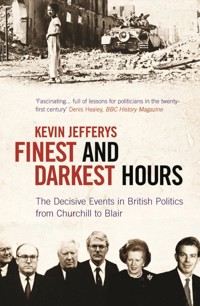
'This survey of British political crises is invaluable for anyone concerned with politics today, and it reinforces George Santayana's dictum that those who forget the past are condemned to repeat it... This book is full of lessons for politicians in the 21st century and also a fascinating read in its own right.' -- Denis Healey, BBC History magazine Kevin Jeffery's authoritative and entertaining book is about the twelve key events in British politics since the Second World War, how they influenced the years that followed them and what Britain might have been like had they not occurred. Combining vivid character portraits with subtle, often highly revisionist, analysis of the unfolding crises, Finest and Darkest Hours ranges from Winston Churchill's accession to the premiership in 1940 through to the emergence of New Labour in 1994, and identifies precisely how significant these episodes really were. 'A well-written romp through the juiciest moments in postwar history' New Statesman 'A good, racy read' Anthony Howard, Books of the Year, Sunday Times 'Addicts of "what if" speculation will love this book' Financial Times 'Politicians don't take good advice: this is what this brilliant book is about' The Herald
Das E-Book können Sie in Legimi-Apps oder einer beliebigen App lesen, die das folgende Format unterstützen:
Veröffentlichungsjahr: 2015
Ähnliche




















FINEST &DARKESTHOURS
ALSO BY KEVIN JEFFERYS
The Churchill Coalition and Wartime Politics 1940–45
The Labour Party since 1945
Retreat from New Jerusalem: British Politics 1951–64
Anthony Crosland: A New Biography
EDITED BY KEVIN JEFFERYS
Labour Forces: From Ernest Bevin to Gordon Brown
Leading Labour: From Keir Hardie to Tony Blair
First published in Great Britain in 2002 by Atlantic Books, an imprint of Grove Atlantic Ltd
Copyright © Kevin Jefferys 2002
The moral right of Kevin Jefferys to be identified as the author of this work has been asserted in accordance with the Copyright, Designs and Patents Act of 1988.
All rights reserved.
No part of this publication may be reproduced, stored in a retrieval system, or transmitted in any form or by any means, electronic, mechanical, photocopying, recording, or otherwise, without the prior permission of both the copyright owner and the above publisher of this book.
9 8 7 6 5 4 3 2 1
A CIP catalogue record for this book is available from the British Library.
ISBN 1 903809 74 6eISBN 9781782398691
Printed in Great Britain by CPD, Ebbw Vale, Wales
Atlantic Books
An imprint of Grove Atlantic Ltd
Ormond House
26–27 Boswell Street
London WC1N 3JZ
For Margaret Stone
Contents
List of Illustrations
Acknowledgements
Introduction
1
‘In the name of God, go’ Chamberlain, Churchill and Britain’s ‘finest hour’, 1940
2
‘The turn of the tide’ El Alamein and Beveridge, 1942–3
3
‘The end is Nye’ The demise of Attlee’s government, 1951
4
‘The best Prime Minister we have’ Eden and the Suez crisis, 1956
5
‘Sexual intercourse began in 1963’ The Profumo affair
6
‘They think it’s all over’ The July crisis, 1966
7
‘Who governs?’ The three-day week, 1974
8
‘Crisis? What crisis?’ The winter of discontent, 1979
9
‘Rejoice, Rejoice’ The Falklands war, 1982
10
‘I fight on, I fight to win’ Margaret Thatcher’s downfall, 1990
11
‘. . . an extremely difficult and turbulent day’ Black Wednesday, 1992
12
‘The people have lost a friend’ The emergence of New Labour, 1994
Notes
Further Reading
Index
List of Illustrations
1
Neville Chamberlain announces the outbreak of war, 3 September 1939 (© Hulton Getty)
2
Winston Churchill on the day he became Prime Minister, 10 May 1940 (© Hulton Getty)
3
British and French troops on the beaches at Dunkirk, May 1940 (© Hulton Getty)
4
Churchill leaving Number Ten Downing Street with Brendan Bracken, 19 June 1940 (© Hulton Getty)
5
Churchill acknowledges the crowds after the ‘turn of the tide’, December 1942 (© Hulton Getty)
6
Sir William Beveridge, addressing the pressure group the Social Security League about his 1942 report (© Hulton Getty)
7
Hugh Gaitskell, preparing to deliver his controversial budget, 10 April 1951 (© Hulton Getty)
8
Aneurin Bevan, leaving his London home, 11 April 1951, shortly before his resignation (© Hulton Getty)
9
Daily Mirror front page on election day in October 1951, supporting Attlee (© Hulton Getty)
10
Anthony Eden gives a TV broadcast on the Suez crisis, August 1956 (© Hulton Getty)
11
British troops patrol Port Said in Egypt, November 1956 (© Hulton Getty)
12
Ships sunk by the Egyptians in the entrance to the Suez canal, November 1956 (© Hulton Getty)
13
John Profumo, the War Minister forced to resign in 1963 (© Hulton Getty)
14
Christine Keeler, pictured during the Profumo scandal (© Hulton Getty)
15
Harold Macmillan, arriving back from holiday as the Profumo crisis intensified, 10 June 1963 (© Hulton Getty)
16
Harold Wilson with his wife Mary, triumphant after the general election of March 1966 (© Hulton Getty)
17
Wilson kicking a ball on a visit to his constituency during the 1966 campaign (© Hulton Getty)
18
Chancellor of the Exchequer Jim Callaghan on budget day, 1966, shortly before the onset of the July crisis (© Hulton Getty)
19
Two office workers in Bond Street, London, during the three-day week, January 1974 (© Hulton Getty)
20
Edward Heath campaigning during the general election of February 1974 (© Hulton Getty)
21
A NUPE rally in Hyde Park at the start of the Winter of Discontent, January 1979 (© Magnum)
22
One of the adiding images of the Winter of Discontent – the garbage mountain in Leicester Square (© Popperfoto)
23
Jim Callaghan leaving Number Ten Downing Street after Labour’s defeat at the general election, May 1979 (© Hulton Getty)
24
British troops arriving on the Falklands, May 1982 (© Hulton Getty)
25
The Royal Navy frigate HMS Antelope is hit in San Carlos bay during the Falklands War, 26 May 1982 (© Hulton Getty)
26
Margaret Thatcher at the Conservative Party annual conference, 1982 (© Hulton Getty)
27
Burning an effigy of Mrs Thatcher in the poll tax demonstrations, May 1990 (© Hulton Getty)
28
Sir Geoffrey Howe delivers his explosive resignation speech, 13 November 1990 (© Rex Features)
29
Margaret Thatcher leaves Downing Street to offer her resignation to the Queen, November 1990 (© PA Photos)
30
John Major with his wife Norma after victory in the general election, April 1992 (© NI Syndication)
31
Chancellor Norman Lamont speaks to the media outside the Treasury on Black Wednesday, 16 September 1992 (© PA Photos)
32
Tony Blair and Gordon Brown at the Labour Party conference, 1994 (© NI Syndication)
Acknowledgements
I am grateful to many friends and colleagues for their help and guidance in preparing this book. In particular I should like to mention Stuart Ball, Mark Garnett, Rick McLain and Jonathan Wood, the latter of whom provided invaluable assistance in tracking down source material. I am also greatly indebted to Toby Mundy at Atlantic Books, in the first place for asking me to write about ‘finest and darkest hours’ and then for providing shrewd and pertinent comments on early drafts of the text. Thanks also to Bonnie Chiang and David Atkinson for their assistance. Any responsibility for remaining errors rests, of course, with me alone.
The bulk of the photographs in the book have been taken from the Hulton Archive Picture Collection, and I would particularly like to acknowledge the following for allowing use of material within the Hulton Getty collection: Kurt Hutton (photograph 6), Keystone Press (16), Fox Photos (18), The Observer (20 and 26) and Steve Eason (27). Finally, I am grateful to Faber and Faber for allowing me to use an extract from Philip Larkin’s poem ‘Annus Mirabilis’.
Kevin JefferysJuly 2002
Introduction
In the life of any government, however safe its majority, there comes a moment when the social movements of which it had once been the expression turn inexorably against it . . . After that moment, every mistake it makes becomes magnified; indeed blunders multiply as if feeding on themselves; and both outwardly and inwardly the Government appears to be at the mercy of every wind.
Christopher Booker, author and journalist, The Neophiliacs (1969)
Men wiser and more learned than I have discerned in history a plot, a rhythm, a predetermined pattern. These harmonies are concealed from me. I can see only one emergency following upon another as wave follows upon wave, only one . . . safe rule for the historian: that he should recognise in the development of human destinies the play of the contingent and the unforeseen.
H. A. L. Fisher, politician and historian, A History of Europe (1936)
When asked about the greatest difficulty of being Prime Minister, Harold Macmillan famously replied: ‘events, dear boy, events.’1 This is a book about ‘events’ in the history of British politics since the Second World War. It sets out to ask: what have been the decisive events in British political life since 1939? Which moments in time have most influenced the direction of politics over the last sixty years? What have been the key turning points? Each chapter addresses an incident or period of importance, ranging from Winston Churchill’s accession to the premiership in 1940 through to the emergence of New Labour in 1994. The main aim is to identify and assess the significance of the critical episodes in British political history, including highs like Britain’s ‘finest hour’ in 1940 as well as lows such as Suez and the Profumo affair. Readers will, no doubt, have their own answers to the questions posed above, their own views about the most formative events in living memory.
In drawing up a list of key dates, much depends on what definitions are used and what criteria for inclusion are employed. British politics has a twofold meaning in what follows: the rise and fall of regimes associated with particular Prime Ministers, and the twists and turns of electoral competition between the major parties at Westminster. Events are those developments that arise suddenly, demanding the full attention of the government of the day and often plunging it into crisis. All the moments included here have a limited timescale. Although every chapter attempts to set the scene, the main action is always concentrated in a short time frame, varying from a single day – Black Wednesday in 1992 – to a few months, as in the case of the three-day week and the Falklands War. Any longer than this and the moment becomes something more protracted, losing the urgency and unpredictability that made it distinctive. The events and moments chosen are also deemed to be turning points, having an impact that resonates for years afterwards.
These criteria help to explain my choice of what to focus on and of what to leave out. There is no place to discuss, for instance, the tangled history of Northern Ireland, whether its many bleak moments since the outbreak of the Troubles or its recent step forward with the Good Friday Agreement. I have also limited the field to a dozen key incidents, on the ground that more would diminish the importance of those chosen. This, too, inevitably means that several notable events etched into public consciousness are not included. The 1976 IMF crisis caused considerable short-term damage to Labour, but did not prevent Callaghan’s government recovering to a position where re-election was a possibility eighteen months later. This book argues that it was Callaghan’s decision not to call an election in the autumn of 1978, followed by the disastrous winter of discontent, that put paid to Labour’s electoral prospects and enabled Mrs Thatcher to come to power. Some traumatic episodes, such as the wartime Blitz and the miners’ strike of 1984–5, were too long-lasting to qualify as moments. And it is difficult to pinpoint particular turning points that explain the profound social changes since the war – in the role of women, for instance, or the creation of a multicultural society.
What is attempted here is a series of snapshots rather than an overview of British politics since the war. These snapshots set out to combine a reliable narrative of the episode under scrutiny with a consideration of its broader implications. Each chapter also looks at what has shaped our understanding of particular events, how ‘myths’ arise and become consolidated, and the part played in this process by politicians, by the media and by historians. Two further themes permeate the book. One is to elaborate on the contention that while some regimes prove more lasting than others, each eventually loses its way – as Christopher Booker notes – after a key moment ‘when the social movements of which it had once been the expression turn inexorably against it’. The second is to show how historical outcomes are not predetermined, and so to highlight what H. A. L. Fisher calls the role of ‘the contingent and the unforeseen’. As John Charmley has written, historians must deal with events as they transpire, but to ask hypothetical questions can add to our understanding and help avoid the temptation to assume ‘that what actually happened was inevitable and, therefore, automatically for the best’.2
The writing of history as a study of events has a long pedigree, though it has not gone unchallenged. The French historian Fernand Braudel, author of the magisterial work The Mediterranean in the Age of Philip II, first published in the late 1940s, dismissed events as ‘ephemera’, nothing more than waves on the sea of the past. The key features of history, in his view, were the tides and currents: long-term developments such as the slowly evolving pattern of rural life in preindustrial societies. Some social historians after the war developed a ‘determinist’ view of history, borrowing insights and methodology from the social sciences to claim that historical events are governed by ‘laws’, for example the driving force of class struggle. More recently the value of narrative history has been reasserted. Simon Schama, presenter of the acclaimed BBC History of Britain, pointed out that to write history under headings such as ‘nobility’ or ‘peasantry’ is to privilege the explanatory force of these themes. In his 1989 book Citizens he argued that the French Revolution was more the product of human agency than it was of structures, ideologies or institutions. On this basis, Schama reasoned, it was essential to let the story unfold as it happened, to provide a chronology that made intelligible the Revolution’s complicated twists and turns, and to present events through the eyes of the main historical actors, mirroring the way in which they saw their world. Finest and Darkest Hours attempts to follow in this tradition. ‘Events’, studied in their appropriate context, are a mainspring of history, not only providing colour and drama, but also having lasting and profound consequences. Nowhere is this more obvious than in the case of Winston Churchill’s emergence as war leader in 1940.
1
‘In the name of God, go’ Chamberlain, Churchill and Britain’s ‘finest hour’, 1940
One thing is certain – [Hitler] missed the bus.
Neville Chamberlain, speech at Central Hall, Westminster, 4 April 1940
[Winston Churchill] mobilized the English language and sent it into battle.
American broadcaster Ed Murrow, on Churchill in 1940
In the summer of 1940 Britain faced its gravest crisis since Napoleon massed his armies across the Channel nearly one hundred and fifty years earlier. The outline of the story is familiar enough and deeply embedded in popular consciousness as the nation’s ‘finest hour’. On the day in May 1940 when Winston Churchill replaced Neville Chamberlain as Prime Minister there was an intensification of the war in Europe: Hitler launched his blitzkrieg attack on Holland and Belgium. After the collapse of the French army in June, Britain was left to stand alone against the might of Nazi Germany and, with the prospect of invasion imminent, Churchill played an inspired role in stirring the British people to resist. During July and August the RAF denied Goering’s Luftwaffe aerial supremacy in the Battle of Britain, and by the autumn Churchill was confident that Britain had survived its sternest test. Although the civilian population faced untold new horrors in the Blitz, the prospect of invasion had receded for good, as it turned out – and the government could begin considering ways of striking back at the enemy. Victory in the war remained a long way off, and was to be dependent in the long run on American and Russian military might, but Britain had come through its moment of supreme danger. Inevitably, the coalition government formed by Churchill in May 1940 – the only occasion in the twentieth century when the Conservatives and Labour worked together in office – devoted its entire energies to the war effort. ‘The situation which faced the members of the new Government,’ as the historian Alan Bullock has noted, ‘left them no time to think about the future: they needed all their resolution to believe there was going to be a future at all.”1
In spite of the extraordinary circumstances of the day, it would be wrong to assume that British politics went entirely into abeyance during the summer of 1940. May 1940 witnessed one of the rare occasions when a British Prime Minister was forced from office, and the impact of Chamberlain’s departure was to reverberate for years to come, not only providing the opportunity for Churchill to establish himself as the nation’s great war hero but also undermining the pre-war domination of the Conservative Party and marking a vital breakthrough for Labour – one that was to culminate in a famous election victory in 1945. None of these consequences, however, was inevitable or easy to predict when Chamberlain left Downing Street. It was only much later – and with twenty-twenty hindsight – that the significance of 1940 could begin to be appreciated.
The difficulties of assessing Britain’s ‘finest hour’ are compounded by the need to come to terms with the Churchill legend. For many years after 1945 any criticism of Britain’s saviour was regarded as almost treasonable. The familiar newsreel images of a defiant Churchill with his trademark hat and cigar, the great man’s own influential history of the period (crucially one of the first to appear after the war), and the flattering tone of Martin Gilbert’s multi-volume official biography all painted the same picture of an indomitable figure who came to power as the ‘man of destiny’ and whose bulldog spirit of resistance saved Britain in the nick of time. Only in the last decade, as memories of the war recede, have revisionists put their heads above the parapet. In his book 1940: Myth and Reality, Clive Ponting snipes at Churchill’s personality – talking of his thirst for money and alcohol, among other things – and argues that the untold story of the ‘finest hour’ was one of disarray among British forces and incompetence ‘in relieving the suffering caused by bombing’. For John Charmley, the price of survival in 1940 was post-war subordination to American interests and the demise of the British Empire. ‘Churchill’s leadership was inspiring,’ he writes, ‘but at the end it was barren, it led nowhere.’2
What follows is an attempt to disentangle the reality from the myths of British politics in the early summer of 1940. As the leader who fell from power, Neville Chamberlain has often been presented unkindly; he was, according to one writer, ‘an anachronism, an exhausted old man whose day had passed’. It will be argued in this chapter that there was nothing preordained about Chamberlain’s fall from power in May and that, with slightly different handling, he might well have survived to fight another day – with all the consequences this might have had for Britain’s war effort. Churchill, it will be suggested, came out on top not because he was ‘walking with destiny’ – the phrase he used in his own later account – but because he proved most adept and ruthless in exploiting a sudden crisis. The second part of the chapter assesses the new Prime Minister’s early weeks in office and again suggests that the reality was more complex than popular mythology allows. It will be shown that in these early days Churchill was by no means a universally acclaimed war leader and that his authority was only built up gradually through good fortune, as well as through immense resolution. None of this is intended to diminish the scale of Churchill’s achievement. Rather it is to bring him into sharper focus, avoiding the simple verities of his admirers and detractors alike – making him, in the words of the historian David Reynolds, ‘a more human and thereby a more impressive figure than the two-dimensional bulldog of national mythology. Churchill’s greatness is that of a man, not an icon.’
Lesen Sie weiter in der vollständigen Ausgabe!
Lesen Sie weiter in der vollständigen Ausgabe!
Lesen Sie weiter in der vollständigen Ausgabe!
Lesen Sie weiter in der vollständigen Ausgabe!
Lesen Sie weiter in der vollständigen Ausgabe!
Lesen Sie weiter in der vollständigen Ausgabe!
Lesen Sie weiter in der vollständigen Ausgabe!
Lesen Sie weiter in der vollständigen Ausgabe!
Lesen Sie weiter in der vollständigen Ausgabe!
Lesen Sie weiter in der vollständigen Ausgabe!
Lesen Sie weiter in der vollständigen Ausgabe!
Lesen Sie weiter in der vollständigen Ausgabe!
Lesen Sie weiter in der vollständigen Ausgabe!
Lesen Sie weiter in der vollständigen Ausgabe!
Lesen Sie weiter in der vollständigen Ausgabe!




