


Erhalten Sie Zugang zu diesem und mehr als 300000 Büchern ab EUR 5,99 monatlich.
- Herausgeber: Luath Press
- Kategorie: Geisteswissenschaft
- Sprache: Englisch
On the eve of the general election, Ed Miliband declared that Labour had won the 'ground war'. He proclaimed that his activists had been in touch with many more voters than his opponents: 'We have had five million conversations. This will go to the wire.' Yet the Conservatives went on to win a majority for the first time in more than two decades - while Labour lost seats in England, and were all but wiped out in Scotland. How could they get it so wrong? Iain Watson followed the Labour campaign around Britain, and now he examines what its senior politicians are now calling the party's 'political and organisational failures.' He exposes the high-level divisions over when to rule out a deal with the SNP, the gulf between perception and reality over Labour's level of support, and looks at the more successful campaigns of the Conservatives and Scottish Nationalists. He sets out the challenges for the next Labour leader, having had his own conversations with voters, activists and senior party figures, and discovers there is no easy solution to the party's problems.
Sie lesen das E-Book in den Legimi-Apps auf:
Seitenzahl: 533
Veröffentlichungsjahr: 2015
Das E-Book (TTS) können Sie hören im Abo „Legimi Premium” in Legimi-Apps auf:
Ähnliche




















IAIN WATSONis aBBCPolitical Correspondent who works acrossTV, radio and online. He reports regularly for Radio 4’sTodayprogramme and previously forBBC2’sNewsnightand the flagshipBBC1 political showOn the Record. He extensively covered both the 2010 and 2015 general elections, spending the entire campaigns ‘on the road’. He also covered the Scottish referendum. Despite being Westminster editor of theSunday Herald, he was delighted to decamp to Edinburgh to cover the first elections to the Scottish parliament in 1999. He lives in London with his wife and son.
Luath Press is an independently owned and managed book publishing company based in Scotland, and is not aligned to any political party or grouping.
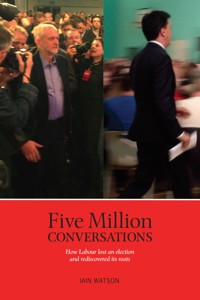
Five Million Conversations
How Labour lost an electionand rediscovered its roots
IAIN WATSON
Luath Press Limited
EDINBURGH
www.luath.co.uk
First published 2015
ISBN: (EBK) 978-1-910324-59-2
(BK) 978-1-910745-26-7
The author’s right to be identified as author of this work under the Copyright, Designs and Patents Act 1988 has been asserted.
© Iain Watson 2015
To Rachel and Alexander Watson
And for Agnes Watson(1932–2014)
Contents
Acknowledgements
Preface
The Accidental Leader
There may be Trouble Ahead – The Election in Microcosm
Deal or No Deal
The Battle for Downing Street
From Builder to Soldier: Britain Succeeds When Working People Succeed
Funny Business
Zero Sum Game
We’re all Labour Here
Happy Warrior
Chips off the Old Block
A Bit of Politics
A Taxing Issue
Education, Education… Fratricide
One Nation, No Vision?
Unions and the Union
Worry Points
A Flock of Starlings
13,000 Conversations
In Good Health?
Hold the Front Page
Missing a Trick?
Invitation Only
Campaign Stop
Not a Big Enough Difference
Put to the Test
Immigration and Exploitation
Marriage of Convenience
A Day at the Races
The Most Unlikely Cult of the 21st Century
Blood on His Hands, Blood on the Carpet
New Town Blues
Generation Rent
Marred by theSNPMyth
A Trip to the Theatre
Building Non-Traditional Support
Labour’s Brand Problem
Dangerous Territory
No Question of Deals
A Question of Credibility
Mayday, Mayday… Scottish Labour’s Existential Threat
Facebook v Foot-Weary: Right People, Wrong Conversations
Luvvies for Labour
Edstone
Message, Not Mileage
Five Million Conversations
The Strange Disappearance of Arnie Graf
A Little Less Conversation: Food, Drink and Fun
Breakfast in Doncaster
The Loser Always Wins?
Moment of Truth
Nuneaton is the New Basildon
Exit
A Question of Leadership
APPENDICES
APPENDIX 1: Clause 4 – Aims and Values
APPENDIX 2: Labour Party Leaders
APPENDIX 3: Selected quotes
APPENDIX 4: Labour Votes at General Elections
APPENDIX 5: Campaign Chronology
APPENDIX 6: Labour Party Leadership results announced 12 September 2015
APPENDIX 7: Miliband and Corbyn buzzwords
Acknowledgements
Thanks to the government ministers, shadow ministers, senior politicians, special advisers, strategists – and voters – who gave me their accounts of a fascinating election, and its unexpected aftermath. Many of you are quoted. But this book wouldn’t have been possible without the assistance of those who are not. You know who you are – and I’m not telling! I, of course, take responsibility for all errors in a publication which was necessarily swiftly produced. So a special mention, too, for the publishers who made it possible.
My gratitude to all my BBC colleagues who remained on a relatively even keel despite spending so much time covering an intense election – especially the ‘core team’ of Dave ‘renaissance man’ Bull and Dan Grant. Thanks are due to Maxine Collins, Peter Hunt, Simon Lister, Sarah Kirby, Simon Lister, Lucy Manning, Callum May, Richard Perry, John Prendergast, and Sam Smith. Let’s not do it again soon though…
And above all thanks to Rachel for reading this – and to Alexander for not disrupting it too much!
Preface
At the start of this campaign I said that we wanted to have four million conversations in four months. And I am so proud that today, on the final day of campaigning, we will top five million conversations. This race is going to be the closest we have ever seen. It is going to go down to the wire.
ED MILIBAND, 6 May 2015
THIS BOOK TRIES to solve a mystery. How could Labour’s activists talk to a record number of voters – and end up with fewer seats than at the previous election? What was the nature of those conversations? Was there any way to report – and react to – the scepticism campaigners were hearing on the doorsteps? Why did all this apparent activity bequeath the next leader greater challenges than the last? From Cardiff to Colne, Glasgow to Gloucester, Leeds to London, I followed Labour’s election campaign around Britain. As this book reveals, those around Ed Miliband never expected him to lead a majority government. But they did assume he would do enough to deprive the Conservatives of outright victory and ‘lock out’ David Cameron from Downing Street, without the need for a formal deal with the SNP. How could Labour get it so wrong? And how will the party’s next leader avoid the same mistakes?
This book covers all the significant moments in Labour’s campaign. The day-by-day approach is designed to offer an insight into how political parties try to control their message, their messengers – and those who try to report on both. It also offers you a front-row seat at the daily dramas of the most closely fought election in two decades.
But this is a lot more than a campaign diary. It examines what one senior politician called ‘failures of policy, personnel and organisation’ – and looks forward to the challenges Jeremy Corbyn will face. With access to some of the party’s most revealing private polling, this book explores how Labour failed to reassure voters on the two policy issues which concerned them most – its record on spending and its stance on immigration. And it charts how big ideas were boiled down to what one frontbencher called ‘small bribes’. Through the prism of the much-mocked Edstone, it shines a light on the party’s personnel – and the behind-the-scenes battles which hampered the quality and speed of decision making. As for organisation, it discovers that what the Conservatives and the SNP got right can be as instructive as what Labour got wrong.
A large, if not decisive, contribution to Labour’s defeat was the loss of 40 of the 41 seats the party had held in Scotland. The book provides new information on the divisions and lack of decisiveness at the very top of the party over how to handle the SNP threat – and how to counter the Conservative charge that a weak Labour government would be at the mercy of Alex Salmond and Nicola Sturgeon.
Above all, it concludes that when parties have millions of conversations with voters, they can learn more from listening than talking.
The Accidental Leader
12 September
• Jeremy Corbyn is elected Labour leader.
• He gets the support of nearly 60 per cent of his party’s members and supporters.
• He is the most left wing leader of his party since Michael Foot in 1983.
• Can he now change the party as well as its leadership?
HIS HEAD SHOOK in disbelief. The full-time official of the Labour Party must have seen the result coming, but he couldn’t help utter the phrase: ‘How the f*** did that happen?’
To be fair, it was probably the sheer scale of Jeremy Corbyn’s victory that shocked him.
251,417 Labour members and supporters had backed Corbyn, and he had beaten all three of his rivals – Andy Burnham, Yvette Cooper and Liz Kendall – by more votes than they had between them. He gained nearly 60 per cent of the ballot – coming 40 points ahead of second placed Burnham, the former frontrunner who had garnered a little less than one in five of the votes cast. While Corbyn smiled as though he had just heard he had won £25 on the premium bonds, his nearest rival sat stiff as a statue, apparently hoping his tear ducts would be just as immobile.
The venue for the announcement was close to the ultimate prize. Jeremy Corbyn, a republican, was declared Labour’s new leader on Saturday 12 September at the Queen Elizabeth Conference Centre – just a mere tilt of the head and glance of the eye away from Downing Street and the Houses of Parliament. Yet for many Labour stalwarts in the audience these centres of power might as well have existed in a parallel universe. Jeremy Corbyn’s politics are to the left of Michael Foot and he is supported by only one in ten of his MPs. But he has the biggest mandate of any of his party’s leaders, ever.
I had ‘tweeted’ that Corbyn had won before it was officially announced because a member of Labour’s ruling National Executive Committee told me the result – but they hadn’t told me the extent of it. And as the NEC chairman Jim Kennedy – who would probably be quite good at drawing raffles – benevolently but rather underwhelmingly delivered the news officially from the conference stage, the atmosphere in the room was like a moving image that had just been paused. There was a stunned silence which lasted just a few seconds, but it felt like everyone had needed a little time to suspend disbelief, take a sharp breath, then move on. Normal service was resumed relatively swiftly when a member of Labour’s staff – and not a Corbyn supporter – began the applause from the back of the hall. Soon, there was an ovation. That was a signal for the ‘snappers’ – who had maintained almost a dignified distance from the row of seats where the candidates had been uncomfortably juxtaposed – to rush like greyhounds from their traps and surround the new leader. Liz Kendall’s vote – just 4.5 per cent of the total – hadn’t even been announced at that point. Her result was quickly dispensed with, and a besieged but becalmed Corbyn took to the stage with the diminutive but determined press officer Anna Wright – who had been a mainstay of Labour’s election campaign – almost single-handedly trying to part the sea of photographers to let the new leader deliver his victory speech.
The old method of electing a Labour leader – with special privileges for MPs and trade unions – had been swept aside by his predecessor Ed Miliband in favour of a system which gave each of the party’s members – and a new franchise of supporters – an equal say in choosing who leads them. Corbyn had not been the first choice of the small Socialist Campaign Group of MPs to stand for leader – but Diane Abbott, who had failed to win in 2010, was concentrating on her ultimately unsuccessful bid to be her party’s candidate for London Mayor. John McDonnell, the Group’s chair, had failed to get enough support from fellow MPs to get on the ballot in 2007 – when Tony Blair had stood down – and in 2010 when Gordon Brown resigned. He had had a heart attack since then and had persuaded his long-standing political ally to lead the charge this time.
And now here was Jeremy Corbyn, ready and willing to throw open the door of his party as leader. In his first remarks on being elected, he also extended his hand of friendship to those who had drifted away from Labour in recent years. He declared:
Our party has changed. We have grown enormously because of the hopes of so many ordinary people for a different Britain, a better Britain, a more equal Britain, a more decent Britain. They are fed up with the inequality, the injustice, the unnecessary poverty, all those issues have brought people in in a spirit of hope and optimism. So I say to the new members of the party, or those that have joined in as registered supporters or affiliated supporters: welcome, welcome to our party, welcome to our movement. And I say to those returning to the party who were in it before and felt disillusioned and went away: welcome back, welcome back to your party, welcome home.
I dashed out to broadcast the result from a nearby radio car. However weird the atmosphere had been in a room full of long-standing Labour Party members and politicians, outside there was jubilation as his newer supporters – some rather grizzled, but many of them young and vibrant – were waiting to catch a glimpse of him. Many were sporting red and white Corbyn T-shirts or displaying other memorabilia. Some had placards as they prepared to join a pro-refugee demonstration, which the new leader had announced he would address that afternoon, in Parliament Square. He may have acquired new powers, but his first act on assuming the mantle of leadership would be to join a protest, and climb aboard a makeshift stage where he was subsequently joined by veteran singer/songwriter Billy Bragg, who led an impromptu rendition of the ‘Red Flag’. Until then some of his admirers whiled away the time by selling far left newspapers to each other. The Labour Briefing vendor was declaring to all and sundry ‘we have our party back’. The publication had been influential when Ken Livingstone had led the Greater London Council in the ’80s and Corbyn had been on its editorial board. It had championed social causes – including an equal age of consent for all – which had once been marginal but had now become mainstream, though the economic policies it advocated had been as unpopular with Tony Blair as they were with the Tories.
To keep any well-wishers congregating outside the conference centre at bay, three burly but polite security staff were blocking the entrance and tried to prevent me going back in to gain reaction to the result. After a stand-off, good sense prevailed and, once back inside, I gathered a wide range of views.
The Tottenham MP David Lammy had nominated Corbyn for leader to encourage a wide ranging debate on Labour’s future after its election failure but hadn’t expected or wanted him to win. Nonetheless he told me he didn’t regret his decision:
Absolutely not. He didn’t get my vote, but you know we now have a movement. Under Bill Clinton, the Democrats were very top-down and I saw Obama change that. We have a renewal now and we have a different party now and we must deal with members as they are, not as we would like them to be. Under Ed Miliband’s leadership people who had left over Iraq were already coming back. So were the Greens, and of course former Lib Dems. So we were in the process of changing. I have always been sceptical that a pure left-wing offer would work in England – it might work in Scotland and maybe even London, but not in England as a whole. But Jeremy’s authenticity really struck home. This is the end of the spin-doctor-policy-wonk-go-to-Oxford-become-a-researcher-then- an-MP kind of politics.
Angela Eagle had chaired Labour’s NEC when the new rules for electing a Labour leader had been adopted. Again not a Corbyn supporter, she told me she would serve in his shadow cabinet. ‘I am a feminist and we need women at the top echelons of the party’. She was to be appointed Shadow Business Secretary and Shadow First Secretary of State.
Fellow NEC member Jonathan Ashworth said he was prepared, for now, to take the new leader at his word: ‘Jeremy Corbyn said he wants to move forward inclusively and have democratic decision making. Let’s see how that develops.’
But John Woodcock – the Blairite MP who had been a leading figure in the Liz Kendall campaign – had no intention of sitting on the Labour front bench alongside someone who he felt would take the party back to an unelectable past. He represented Barrow-in-Furness, where Britain’s nuclear submarines were constructed. He had pledged at the election to resign as an MP if Labour resiled on a commitment to renew the nuclear deterrent, but had just seen a unilateralist become his party’s leader for the first time in three decades…
Days before he had been elected so decisively, I had asked Jeremy Corbyn himself what his priorities would be as leader – and some of those sceptical stalwarts perhaps do have grounds for feeling nervous, not just about Labour’s electoral prospects – that is already concerning them – but about the scale of changes that might be necessary to bring the party more in to line with his own policies. He is out of step not with Labour’s aims – even the Tony Blair-revised Clause IV describes the party as ‘democratic socialist’ – but with many existing Labour positions, from nuclear weapons to renationalisation, and existing Labour MPs’ views. It will take something of a grassroots revolution to move those policies closer to the leader’s own, but this is how he summed up his approach:
I want people to come in and have an influence – and not wait for an all seeing, all knowing leader at some point in five years’ time to send the policies down the food chain for the footsoldiers to knock on doors and deliver – get the people involved in the policies in the first place, and people will have a real strength and real feeling and real passion behind what they do.
His other immediate priorities, he told me, were ‘a strong absolute opposition to the welfare reform bill. And the brutality behind it’ – his leadership rivals had initially abstained on this – and ‘an opposition to the sale of public assets’. But above all he would ‘challenge this agenda of the Conservatives of greater inequality, where the most vulnerable are being asked to pay the price of the banking crisis of 2008’.
Ed Miliband moved his party, in his words, ‘beyond New Labour.’ Jeremy Corbyn is likely to move it so far beyond that it will be over the current political horizon. But he believes he has every right to do so: ‘the mandate for the new leader comes from the biggest democratic process that any political party in Britain has ever undertaken’
Celebrating victory on 12 September was Corbyn supporter Stuart Watkin, who had worked for Katy Clark when she was MP for North Ayrshire and Arran. She had been defeated by the SNP at the general election. He said:
His campaign has really sparked something off. Over the years members have been seen as voting and leafleting fodder by party leaders. Now there will be a debate – and I am sure if 400,000 of our 500,000 members want to keep nuclear weapons Jeremy will listen. But if they think Trident’s a waste of money well, the MPs need to get in line with the party members who put them there. If they ignore them, that’s the up to their local Labour parties but I think when the dust settles people will realise the strength of the mandate Jeremy has won.
* * *
So how has a 66-year-old who has languished on Labour’s backbenches for half his life – since he was first elected for Islington North in 1983 – become leader of what is now Britain’s largest political party?
His views came under far greater scrutiny than ever before during the leadership contest but there is a sense in which he is still something of an unknown quantity – Ed Miliband’s former deputy chief of staff Lucy Powell said she had never spoken to him. So one of her first conversations must have been on 13 September, when he offered – and she accepted – the role of Shadow Education Secretary.
Perhaps his lack of contact with some fellow MPs at Westminster was part of the attraction for a wider group of voters – he didn’t look or sound like a conventional, modern-day politician.
A couple of weeks before his elevation to his party’s leadership I went to meet him to try to find out more about what influenced him, and what motivated him and his recent admirers.
* * *
The capacity crowd were keen to get inside the venue. If they had been queueing to see the latest cinema blockbuster there would have been popcorn vendors at hand to offer sustenance. If this had been a football crowd, there would have been purveyors of hot pies. But the 500 people on the streets of Chelmsford were eager to attend Jeremy Corbyn’s 87th rally of his leadership campaign and all that was on offer to them was food for thought. Paper sellers on – and to – the left of Labour were pushing copies of Socialist Worker and Socialist Appeal, the organ of a Trotskyist group which had splintered from the Militant Tendency.
For Corbyn there were now no no-go areas. He was attracting more people to his meetings in Conservative-held seats than the former leader of his party managed to pull out to most well-organised rallies in marginal constituencies during the most closely fought election in recent years. The Conservative MP for Chelmsford – Hillary Clinton-supporting Simon Burns – has a majority of more than 18,000 and the small Essex city hasn’t returned a Labour MP to Westminster since the dying days of the post-war Attlee government, when the party won a by-election. So what the media dubbed Corbyn-mania was indeed rather manic and a phenomenon people wanted to experience for themselves. Some had clearly come out of their homes on the cusp of September – just as the weather was turning autumnal – in order to bask in the rekindled warm glow of fellow-feeling.
Sasha McLoughlin was very much younger than Jeremy Corbyn but had nonetheless waited a long time for someone who shares her politics to be in such a prominent position: ‘It’s the first time a Labour leader has represented me in years. You vote Labour because that’s what you do but it’s so exciting to have a left-wing leader, not a Tory in disguise.’
A local teacher, Helen Davenport, had been attracted back from the Greens. She was a personification of the problem Labour had in policing their leadership rules – more of that later! Although she had backed another party, she was genuinely being swayed back to her old allegiances because Corbyn was on the ballot: ‘I’d given up hope. But now there’s an alternative. I like his ideas on renationalising rail and he has a more sympathetic policy on immigration. He has the wisdom of Tony Benn.’
‘I am a lifelong socialist and appalled that we have a government that is using austerity in my view for ideological reasons,’ says Brian Littlechild, a former Communist Party member. Despite the surname, he is of Jeremy Corbyn’s generation. ‘The other candidates, even Andy Burnham, are too close to Blair and what he stood for – we looked like pink Tories.’ But hadn’t Tony Blair fought three election winning campaigns for Labour?, I ventured. For Brian, winning elections wasn’t everything: ‘The chances are Jeremy won’t get elected in 2020. But what we need is a good opposition to keep the Tories in check. And look, maybe this is where to start the change.’
For Sue Millman – of a similar age to most of Corbyn’s leadership rivals: ‘I have been a member of the Labour party in the past, I never joined another party. I was disillusioned. I am an active trade union member and he is the most relevant Labour leadership candidate there is.’ But her attitude was ‘I won’t get fooled again.’ He was not quite relevant enough yet for her rejoin Labour and vote for him as leader. She would only return to the fold once she saw him in action and if ‘there are sufficient changes that make me feel enthusiastic again’.
Gerard D’Arcy, on the other hand, was solidly Labour, and a recent Corbyn convert. ‘He is straight-talking, There’s no artifice. No spin. The other candidates are preened, moulded. He looks like a ’70s sociology lecturer but people are now into the issues, not the image – no one cares about what his smile looks like.’ He said Andy Burnham would have been ‘excellent’ but had now been relegated to his second choice.
But it wasn’t just the people of Chelmsford who had turned out to see Jeremy Corbyn. An internationalist from an early age, he was nonplussed to be surrounded as soon as he himself set foot in the venue by Finnish television, a reporter from France’s Le Monde and a German journalist. He calmly restored order from chaos and politely took questions from each. He was asked to dispense advice to Finland’s social democrats – ‘I am impressed with education and the level of public services in Finland – I wish them well in expanding the socialist traditions of Finland.’ He gave his assessment of Socialist François Hollande’s rocky record as French President: ‘He hasn’t been able to sufficiently challenge austerity and has imposed quite a lot of it himself. I do hope the reforms of previous socialist governments such as the [shorter] working week are safe.’
There has been a lot of speculation about – and a small amount of evidence of – ‘entryism’. That is, people mostly to the left of Labour – Trotskyists in particular – joining or becoming supporters in order to change the party and use it the means of conveying a more radical, even revolutionary, message to voters. Corbyn seemed more concerned about ‘exitism’ – people who had left the party because it wasn’t radical enough. Asked to comment on whether he felt close to Syriza and Podemos – the Greek and Spanish movements to the left of Labour’s sister parties in those countries – he said:
Labour’s the mass party broadly of the centre left in Britain. Parties to its left haven’t done particularly well partly because of the electoral system. The election for Labour leader has provided the space and opportunity for people to get involved in a political discussion. I want the Labour Party to be an open door.
* * *
Unlike his Oxbridge educated opponents Jeremy Corbyn hadn’t gone to university. He dropped out of a course on trade union studies at what was then North London Poly in the ’70s after a row about the syllabus. He told me:
I have got very few qualifications but I have a fascination of reading and read a lot. I spent a lot of time in the school library and the local library and I have this view that everyone I meet knows something I don’t know and we can learn from each other.
His father David was an electrical engineer and his mother Naomi, a teacher at girls’ grammar school, weaned him on socialist literature. They had met demonstrating against Franco’s Spain. So not for him the capers of the Famous Five, but the conversations held between painters and decorators in ‘Mugsborough’ – or Hastings – more than a century ago: ‘My mother gave me the Ragged Trousered Philanthropists to read.’
The main character, Frank Owen, rails against his workmates, who seem all too content to donate their ‘surplus value’ to their bosses:
As Owen thought of his child’s future, there sprang up within him a feeling of hatred and fury against his fellow workmen. They were the enemy – those ragged-trousered philanthropists, who not only quietly submitted like so many cattle to their miserable slavery for the benefit of others, but defended it and opposed and ridiculed any suggestion of reform. They were the real oppressors – the men who spoke of themselves as ‘the likes of us’ who, having lived in poverty all their lives, considered that what had been good enough for them was good enough for their children.
The book was written by Robert Tressell, himself a painter and signwriter, and published posthumously after he succumbed to TB in his early 40s. Corbyn was also influenced by George Orwell’s writings and said he joined Labour because of the ‘the injustice I saw in society’.
With the help of BBC producer Tom Edgington, I had interviewed his astrophysicist brother Piers for Radio 4’s pm programme on the day that Jeremy Corbyn made the ballot for Labour leader. The family had moved from Wiltshire to a large house, formerly a B&B, in Shropshire when Jeremy was seven. Piers said their home had been ‘alive with political discussion’ and that Jeremy had been actively involved in debating at school. He had, however, been trounced in a school election in 1964 when he stood as a Labour candidate. That was the prestigious Adams’ Grammar School in Newport, near Telford, where Jeremy had been a prefect. But he had challenged those in authority in other ways at this boys’ school – which dates from the 1600s – by campaigning against older pupils being dragooned into the army cadets. The school’s Combined Cadet Force, though, exists to this day. Sometimes protests don’t lead to change. Corbyn’s opposition to selective schooling has remained constant. Outside of school hours, Piers told me his brother had been the leading light in the Wrekin Young Socialists, Labour’s youth wing. So I asked Jeremy Corbyn about his earliest political activities. Many of the issues he campaigned on then, he still campaigns on now:
We formed the Young Socialists in the early ’60s. I became the secretary of it and was extremely active. We had what we thought were massive meetings of 40 or 50 people every Sunday night in various pubs and produced a local magazine. We got involved in campaigning against the then Conservative government’s immigration bill because we thought it was trying to divide families. We also campaigned against nuclear weapons and on the war.
That was, of course the Vietnam war. ‘Yes I was against, obviously,’ he said with a smile.
On one issue, though, there is no longer any need for him to campaign. He was a staunch anti-apartheid campaigner, opposing – like another leading Labour figure, then a Liberal, Peter Hain – the Springbok rugby tour of England in 1970. He is therefore used to digging in for the long haul. And of course he continues to oppose ‘global injustice’ and argues for debt relief and cancellation for third world economies.
While his three leadership rivals had been advisers to MPs before becoming MPs themselves, he had been a researcher to the National Union of Tailor and Garment Makers in the early ’70s before working as an organiser for NUPE, the public service union. It has now been subsumed into UNISON, one of big backers of his leadership bid.
His political career began on Haringey council in north London in 1974. He chaired the public works, and then planning, committees. Labour peer Toby Harris was a fellow councillor at the time. He confirmed that Corbyn took a close interest in planning and the built environment as well as housing but his focus had always been global as much as local:
I have known him for more than 40 years and his political position on most issues has hardly shifted. He feels passionately about what are called ‘national liberation struggles’ – issues around Palestine and Ireland. When I first met him he was trade union organiser – very passionate in opposing public sector cuts. It’d be very much the same sort of thing that he is saying now.
While his views have been nothing if not consistent, his relationships have been more fluid. He married his fellow councillor Jane Chapman but they split in 1979. She told the Mail on Sunday she would vote for him but that they had had an austere existence in the ’70s, which mostly involved meetings rather than nights out – and she had sought a better work/life balance.
Corbyn very much likes to keep his private life private, and he used his first speech as Labour leader to denounce an intrusive press:
I say a huge thank you to all of my widest family, all of them, because they have been through the most appalling levels of abuse from some of our media over the past three months. It has been intrusive, it has been abusive, it’s been simply wrong. And I say to journalists: attack public political figures, make criticisms of them, that’s okay, that is what politics is about. But please don’t attack people who didn’t ask to be put in the limelight, and merely want to get on with their lives. Leave them alone, leave them alone in all circumstances.
But his private and political lives became intertwined as his second marriage broke up towards the end of the last century. A member of Amnesty International, Corbyn had been a prominent critic of Augusto Pinochet’s military dictatorship in Chile. The left of centre democratically elected government had been ousted in 1973 by a military junta, which tortured and imprisoned opponents who were in most cases probably slightly less left-wing than Corbyn himself. In 1987 he married Chilean exile Claudia Bracchitta, whose family had brought her to Britain in the ’70s aged 11. They had three sons. In 1998 she wanted to send the eldest, Ben – now a football coach – to a selective grammar school in the outer London borough of Barnet, because the local Islington comprehensive was deemed a ‘failing school’. This was portrayed in the tabloids as Corbyn – despite being a grammar school boy himself – being prepared to sacrifice his marriage for his political principles. Ben was already at the grammar school when the story broke. Although the couple subsequently divorced, it wasn’t entirely due to the issue of their son’s education. Corbyn’s brother Piers told me it seemed apparent the marriage had problems well before this incident, and that Ben’s parents had been drifting ‘amicably apart’. Andy McSmith reported in the Observer in 1999 that while they had been living under the same roof, they had been pursuing separate lives for the preceding two years. Corbyn at the time had called for greater regulation of the press: ‘I wish we had the French system, where public figures have genuinely private lives and there is no Daily Mail.’
In 2015 Jeremy Corbyn married his third wife, Laura Alvarez, who imports Fairtrade coffee. The relationship has attracted little media interest but he is no longer a backbencher so it would be unsurprising if he doesn’t return to the theme of privacy and intrusion.
Peter Gruner, who until recently was a journalist on Corbyn’s local paper, the Islington Tribune, did however give me a little peek in to the new Labour leader’s hinterland: ‘He is a member of the parliamentary cheese committee. And he once told me he likes his stilton hard, mature and a little mouldy. And he’ll only have it on bread he bakes himself.’
While he had an appetite for bread and cheese, he confided to Gruner he had no hunger for power:
A rumour went around a few years ago that he wanted to stand as deputy leader of the party and he told me ‘No, that’s a load of old rubbish! Why would I want to that? I couldn’t criticise the party – I couldn’t look myself in the mirror.’ And now look at him!
Corbyn is a teetotal vegetarian who eschews cars in favour of public transport. He even refused to be interviewed in an electric vehicle by BBC colleague Chris Mason. He can often be seen travelling into Westminster from his north London home on his pushbike – though he has recently admitted to a guilty secret. Just as John Prescott was known as ‘two Jags’, Corbyn, it transpires, has two bikes.
And though political plotting might be unavoidable in a three-decade career at Westminster he is just as fascinated with a plot of land – his allotment. But he isn’t a Tom Good of the Labour Party. The relatively soft image conceals a hard core of beliefs.
* * *
Jeremy Corbyn was elected for Islington North in 1983 and proudly stood on the manifesto ridiculed by another Labour MP – Gerald Kaufman – as the longest suicide note in history. It called for unilateral disarmament and withdrawal from the EU. I asked him what he had learned from that experience. He blames splits, rather than socialism, for Labour’s worst post-war result:
‘It taught me the formation of the SDP was catastrophic to the electoral chances of Labour. The Conservative so-called triumph in 1983 owed more to the division of the opposition vote than a move to the left.’
So, as leader, within days he had extensive meetings with those to his right to try to avoid a similar scenario. Nonetheless, many of Ed Miliband’s shadow cabinet refused to serve under him, or in some cases weren’t offered attractive enough roles. The refuseniks included leadership contenders Yvette Cooper and Liz Kendall, the former Shadow Work and Pensions Secretary Rachel Reeves, the former Shadow Education Secretary Tristram Hunt – and after an extensive meeting – the former Shadow Business Secretary Chuka Umunna. None, though, have signalled they intend to split away.
But the SDP was far from catastrophic for Corbyn’s career. Now, it might be a bit of stretch to blame or praise (depending on your view) those former Labour ministers in the Gang of Four – Shirley Williams, David Owen, Bill Rodgers and Roy Jenkins – for Jeremy Corbyn’s political ascent, but if they hadn’t split from their former party it’s possible his parliamentary career wouldn’t have begun when it did. The incumbent Islington North MP –– Michael O’Halloran – joined the newly-formed Social Democrats, taking many on the right of his local party with him, thereby clearing the way for an already active left-wing to select Corbyn as the Labour candidate in 1982.
Martyn Sloman was a member of Islington North at the time and recounts his experiences in a recently published memoir – Labour’s Failure and My Small Part In It – which paints a vivid but ghastly vision of life in London Labour at the time, as the ‘new left’ battled with the old order:
No one ever looked forward to going to a meeting of the North Islington Labour Party.
There was a running fight between two hostile factions that frequently spilled over into aggression: on one occasion police were summoned to calm a situation that had arisen at the Annual General Meeting of the Women’s Section. The Labour Party always held power in Islington and there was a lot at stake. The North Islington factions represented the worst of the Labour Party at the time. The ‘old Right’, to pick a convenient label, and the ‘new Left’, a wide coalition of traditional left-of-centre Labour Party members, Trotskyist entryists, and others who had lost confidence and patience with O’Halloran. In the1970s and early 1980s the Party meetings were a pitched battle; there were contests for every position, however trivial.
Now it’s not impossible that Corbyn may have unseated O’Halloran in any case as the left had pushed through the policy of mandatory re- selection of MPs. This was subsequently watered-down and there has to be unhappiness with an MP’s performance to ‘trigger’ a ballot of all local members rather than having open contests during each parliament. The Campaign For Labour Party Democracy intended to push again for mandatory re-selection of MPs at the 2015 Labour conference, but the move was ruled out of order.
Martyn Sloman very much saw Jeremy Corbyn as a campaigning MP but one who was – irrespective of his politics – perhaps too thin-skinned to be his party’s leader. He told me:
He was never rude. And never aggressive. But this was his weakness – he didn’t like criticism at all. He bridled at it. I can remember during the miners’ strike challenging him about how he was behaving towards a Labour MP from Notttinghamshire [where many NUM members were refusing to strike without a national ballot] and he was very resentful.
Certainly, when first elected, Corbyn was more in tune with the party’s policies then than he is now. But five years later Neil Kinnock abandoned Labour’s support for unilateral disarmament. The party ditched promises to renationalise privatised industries. And then Tony Blair excised the commitment to ‘common ownership of the means of production, distribution and exchange’ from Clause IV of the party’s constitution in 1995.
For parties that nominally advocated co-operation over competition there were no shortage of left-wing alternatives to Labour so when Corbyn’s politics were swept away, especially by the Blairite wind of change, I wondered why he hadn’t joined an organisation more in touch with his own views?
‘I want to see a more equal, more just society and the Labour Party has always been the vehicle to achieve that, especially with its organic link to the trade unions. I have argued my case on lots of issues and I think things are changing.’
That organic link with the trade unions had stood him in good stead now. While Andy Burnham said he wouldn’t accept union cash for his leadership campaign – the better to defend Labour’s union link – Corbyn had no such concerns. He was supported by the leadership of UNITE – who signed up far more of its members as ‘affiliated supporters’, with a vote in the leadership contest, than any other union. But he also received the backing of unions with left-wing leaderships which had severed their formal connections with the Labour Party, such as the rail workers union the RMT and the FBU, representing firefighters.
And although he had been marginalised by successive Labour leaderships, as an MP he had a national platform for his views. One he was not afraid of using. It has meant that his opponents – in the press, in parliament and yes, in his own party – have an arsenal of ammunition to use against him. But as he was elected as a very different leader, perhaps some of the new members of the Labour Party won’t be as shocked as the media assumes they’ll be.
* * *
He has rebelled against his own party 533 times since Tony Blair was elected in 1997, and even rebelled in one in four votes when Labour was in opposition between 2010 and 2015. Some of his political positions have been seen by successive leaderships as mildly irritating. For example 1988 in he signed an Early Day Motion – a kind of parliamentary petition with no standing in law – calling for then Soviet Union to ‘give complete rehabilitation to Leon Trotsky’ – the Russian revolutionary killed in Mexico, it is assumed, on Stalin’s orders using an object more suited to his homeland: an icepick.
The first of his predecessors as leader that he really upset was Neil Kinnock in 1984. Just weeks after the Brighton bomb Jeremy Corbyn invited two IRA supporters convicted of terrorist offences – Linda Quigley and Gerard MacLochlainn (or McLaughlin) to a meeting in the House of Commons. MacLochlainn – later a Sinn Fein councillor in his home city of (London) Derry – had been arrested in Wales and convicted of conspiracy to cause explosions and possession of explosives four years earlier. He had been imprisoned in England and on his release became Sinn Fein’s representative in London. He says he helped with ‘back-channel’ contacts between Gerry Adams and the British government. He also met members of Labour’s front bench team a decade later in 1994, so Corbyn could argue that he was simply ahead of the curve in fostering the peace process. That wasn’t how it was seen by many of his Labour colleagues at the time,
The Glasgow Herald in 1984 contained an account of Corbyn’s dressing down by Labour’s then chief whip Michael Cocks who described him as ‘highly irresponsible’. But Corbyn had been unapologetic. He had said: ‘I felt it important than any MP who wishes to meet anyone from anywhere should have the right to do so.’
He added that he had wanted to discuss prison conditions, and the meeting had been arranged before the Brighton bombing. But the following year he opposed the Anglo-Irish agreement, making these remarks in the House of Commons debate:
‘We believe that the agreement strengthens rather than weakens the border between the six and the 26 counties, and those of us who wish to see a united Ireland oppose the agreement for that reason.’
In 1987 Jeremy Corbyn took part in a minute’s silence for the eight IRA men and one civilian killed by the British army in an ambush at Loughgall – though his allies say the gesture was a protest against what he regarded as a ‘shoot to kill’ policy of extra-judicial execution.
On his election as Labour leader, he was congratulated by Sinn Fein’s Gerry Adams. When he heard this, a senior staffer to a member of the shadow cabinet was spitting blood that Corbyn was, in his view, ‘supporting the IRA while my Dad was risking his life serving in in Northern Ireland.’
Nonetheless, Corbyn gained admiration rather than approbation for campaigning for the release of the ‘Birmingham Six’ and ‘Guildford Four’, wrongly convicted of terrorist offences. He never worried if a cause was popular – he was prepared to be the ‘Islington One’ if necessary.
More recently Jeremy Corbyn’s ‘promotion of dialogue’ with groups associated with violence or extremism has come under far greater scrutiny. And his own dialogue with a TV presenter wasn’t too diplomatic.
He demonstrated his exasperation when asked on Channel 4 News why he referred to Hamas and Hezbollah as ‘friends’.
Remarks he made at a Palestine Solidarity meeting in 2009 had surfaced. He had said:
Tomorrow evening it will be my pleasure and my honour to host an event in parliament where our friends from Hezbollah will be speaking. And I’ve also invited friends from Hamas to come and speak as well. Unfortunately the Israelis would not allow them to travel here.
He explained his use of the term ‘friend’ on Channel 4:
I’m saying that people I talk to, I use it in a collective way, saying our friends are prepared to talk. Does it mean I agree with Hamas and what it does? No. Does it mean I agree with Hezbollah and what they do? No. What it means is that I think to bring about a peace process, you have to talk to people with whom you may profoundly disagree.
But he didn’t welcome being interrupted by presenter Krishnan Guru-Murthy, and snapped: ‘Can I finish?’ Then, quite literally finger-wagging, he went-on ‘you are not prepared to discuss the wider issue of the Middle East’ and accused the presenter of ‘trivialising’ those issues and of ‘tabloid journalism’.
He had asked afterwards if he could do the interview again, but it had been broadcast live. Since then he mostly kept any irritation in check but on 19 August he was asked by Martha Kearney on Radio 4’s World At One if he had met Dyab Abou Jahjah – who had been denied entry to Britain by the then Labour Home Secretary Jacqui Smith. He replied: ‘Sorry, who? I saw the name this morning and asked somebody, who is he?’ Photographs appeared on social media of Jeremy Corbyn sitting beside Abou Jahjah at an anti-war meeting in the House of Commons before his ban in 2009. Abou Jahjah was controversial because he reportedly told a Flemish magazine in 2004 that he considered every dead American, British and Dutch soldier ‘a victory’ – though, writing on his blog, Jahjah said this was a misrepresentation of his long-held belief that the Iraq war had been illegal and ‘every soldier taking part in an illegal occupation is a legitimate target for resistance.’
Jeremy Corbyn’s campaign issued a clarification that afternoon on his behalf: ‘My staff have researched this and told me that I did meet this man.’
But he added he met ‘thousands of people as an MP’ and ‘I meet a lot people on all sides in the Middle East and it does not mean I agree with their views.’
As Jeremy Corbyn has spent three decades or more backing national liberation movements –some of which are or have been involved in ‘armed struggle’ – it is likely that he will come under continued political fire as Labour leader for past associations.
But while says he promotes peace, he actually doesn’t talk to just anyone. He does draw the line at speaking to ISIS. While he would not support British involvement in a bombing campaign on their positions in Syria, he told me: ‘I don’t see any organisation there that at this stage anyone can talk to. Obviously the killing and violence has to stop.’
It’s clear, though that he means killing and violence by all concerned should cease, and he has doubts about the legality of western drone strikes as well as the activities of those prosecuting Syria’s civil war.
* * *
Although he holds controversial views on international issues, Jeremy Corbyn’s first major challenges are likely to be on domestic policy. His campaign wanted to promote ideas and discussion and he issued 13 policy documents which even included proposals for rural areas and for arts funding. The trouble is, on major policy areas, his position and his party’s are separated more by a canyon than a gap.
He is against any ‘arbitrary timetable’ for moving the current account deficit into surplus, while Labour in its election manifesto was committed to eliminating it by 2020. But it’s his plans to boost the economy which have attracted attention – and drawn criticism from many in his own party. These were set out in his document of 22 July entitled The Economy in 2020. At their core is his proposal for ‘People’s Quantitative Easing’:
One option would be for the Bank of England to be given a new mandate to upgrade our economy to invest in new large scale housing, energy, transport and digital projects: Quantitative easing for people instead of banks… Another option would be to strip out some of the huge tax reliefs and subsidies on offer to the corporate sector. These amount to £93 billion a year – money which would be better used in direct public investment… These funds could be used to establish a ‘National Investment Bank’ to invest in the new infrastructure we need and in the hi-tech and innovative industries of the future.
At his Chelmsford rally he defended these schemes as practical, not radical: ‘If you said to people in Germany I have a radical new idea of a National Investment Bank they would just shrug their shoulders and say we are doing that already. What’s extreme about that?’
But increasing the supply of money in the economy when it is already growing would – say his critics – push up inflation and interest rates, leading to an erosion in living standards. And those sceptics include not only Yvette Cooper but Chris Leslie, the man who took over from her husband Ed Balls as shadow Chancellor over the summer and who refused to serve in a Corbyn shadow cabinet.
He also wants to renationalise the big six energy companies which his leadership opponents have suggested would be a waste of money which could be better used on, for example expanding child care or social care.
There is likely to be more unity on his benches in opposing the welfare bill and possibly fewer arguments than anticipated on bringing rail back in to public ownership, so long as Jeremy Corbyn was willing to do this incrementally as franchises expire.
On nuclear weapons, though, Labour can’t fudge their position until the election. The party could face a decision as early as the spring of next year on whether to back the renewal of Trident. He will argue that his mandate as leader trumps the mandate Labour MPs got from the electorate as recently as May to retain the deterrent. He told me:
The elected leader will have a very large mandate from the members and the Parliamentary Labour Party – important as it is – I hope will recognise there is at the very least a mandate for a full debate within the party. I feel strongly about nuclear weapons. We have to have that debate fairly soon as the government might reach a decision in 2016.
He wants Labour to undertake its own strategic defence review – and he stands by his three-decade old policy of setting up a defence diversification agency, which would use skills people have gained in the nuclear and armaments industry and put them to what he would see as more productive use. He has written on his website:
The cost of Trident replacement has met with huge public disquiet …Apart from the astronomical cost, the moral case and the dangers of encouraging proliferation, the UK’s weapons are not ours, nor are they independent. We are part of the US defence network, and they can only be fired with US approval…Security does not come from threats but from understanding and wellbeing.
So this doesn’t appear to be an issue on which he can compromise. The trouble is, existing Labour policy – on which the party’s MPs were collectively elected by more than nine million voters, not the quarter of a million that made Corbyn leader – is for a like-for-like replacement of Trident. The party was committed to continuous ‘at sea’ deterrence, and during the election, Ed Miliband clarified that this, just as the Conservatives were advocating, would mean support for four new submarines.
* * *
Late at night on Sunday 13 September, locked away in a commons office with Rosie Winterton – who had agreed to continue as Labour’s chief whip – Corbyn tried to construct his shadow cabinet. Three journalists – including my colleague Eleanor Garnier, had perched outside. A voice from inside was overheard saying they had ‘a problem with defence’. The then Shadow Culture Secretary Chris Bryant had refused to take the portfolio due to his fundamental disagreements in this area – and concerns over policy on Russia – with Corbyn. He became Shadow Leader of the House instead.
Corbyn proceeded cautiously, however, and the following day appointed Angela Eagle’s twin sister Maria to the defence brief – despite the fact that she favoured the renewal of the nuclear deterrent.
Len McCluskey – the general secretary of the UNITE union which backed Corbyn’s leadership bid – wasn’t pushing for an early resolution of the problem, pointing out that though he himself was a unilateralist, his union took a different position and he accepted that policy. And for Maria Eagle’s part, she was willing to undertake a review of policy on Corbyn’s behalf.
So an early row over nuclear weapons had been defused – or rather delayed, but with the detonator set to 2016. But some of Jeremy Corbyn’s other policy positions came under scrutiny, not from the media but from his MPs. At his first meeting as leader with his Parliamentary Labour Party on 14 September, Corbyn was asked to provide clarity on his view of NATO. He had previously called for the western alliance to be wound up in 1990, after the collapse of the Warsaw Pact. Again he tried to avoid confrontation and talked of the need to review policies. But this peace campaigner was facing a more hostile inquisition from his parliamentary colleagues than the press – largely because some were seeking clarity, but for many others they were anticipating the questions he was likely to be asked publicly not as a candidate for the party leadership, but as the leader.
Amongst the barrage of 20 questions, he was also interrogated on his attitude to another multi-national institution – the EU. He had re-appointed Hilary Benn – the son of one his late political soulmates Tony – as Shadow Foreign Secretary. On the Today programme that morning Benn had said Labour would campaign in the forthcoming referendum to stay in the EU ‘under all circumstances’. But that’s not what the former Shadow Business Secretary Chuka Umunna had heard direct from his new boss. He said Corbyn’s ambivalence to EU membership meant he couldn’t serve in the shadow cabinet. Corbyn’s allies say that while Umunna left the front bench ‘by mutual agreement’, he hadn’t been offered a specific post in any case. But Umunna gave this reason for returning to the backbenches:
It is my view that we should support the UK remaining a member of the EU... and I cannot envisage any circumstances where I would be campaigning alongside those who would argue for us to leave – Jeremy has made it clear to me that he does not wholeheartedly share this view.
Some of those present at that first parliamentary meeting were dismayed at Corbyn’s negative tone on the EU, once seen by those on the left as a ‘capitalist market.’ He refused to endorse Hilary Benn’s view and said he wouldn’t give Cameron ‘a blank cheque’. In 2005 Corbyn had supported a ‘non’ vote in the French referendum on the EU constitution, writing in the Morning Star of ‘the dangers to workers’ rights and living standards if this Trojan horse for neoliberal economics is imposed on Europe’.
An MP who listened to Corbyn said the logic of the position was to come out of the EU if Cameron watered down workers’ rights – so ‘we could let a majority Tory government dilute them even more – it’s mad’. But Corbyn’s allies – including the Shadow Chancellor John McDonnell – say he was simply proposing that Labour needs now to make the case for the Europe it wants to see, and not be regarded as defenders of the status quo. They also argued that David Cameron must not be given a ‘free pass’. If the Prime Minister came back from negotiations with a package which excluded the UK from employment rights enjoyed by those in other member states while signing up to a new transatlantic trade agreement that could see more public services put out to tender, then the option of the exit door shouldn’t be entirely closed. Corbyn, after all, had been a founder member – with Hilary Benn’s father – of the People’s Assembly Against Austerity which took the view that ‘all the US and EU agreements that force open public services to private gain’ must be repudiated. But the emphasis and default position would be on staying in the EU, and arguing for change – not leaving.
The new Chief Secretary to the Treasury Seema Malthorta later admitted, however, that while she wanted to ‘stay and fight for a better Europe’, that this – with nuclear weapons – was another debate still to be had under Corbyn’s leadership.
He was also asked about Syria and Northern Ireland and while he set out his views, some of those present said they didn’t discern how he was going to reconcile them with existing policy.
The Luton MP Gavin Shuker asked his new leader he would support Labour councils that were making cuts. In the past Corbyn had been willing to defy the law on the poll tax but even earlier, in the ’80s had been on the side of an argument amongst the left that suggested it was better for local authorities not to set a rate than to agree budgets that ‘slashed’ public services. Here he had moderated his tone over the years and said he understood the difficult choices councils had to make. But the fact the question was asked showed how little some MPs knew of his views – and how so few shared them.
But one of the main concerns of the MPs had been – well, themselves. Some were worried that in order to bring policy and leader in to closer alignment, he and his new supporters – who were inundating some constituencies – would be prepared to turf them out of their seats and select someone else. After all, in the 48 hours since Corbyn’s election 28,000 more people had joined the Labour Party – many likely to have been inspired by him rather than their sitting MP.
On this they did receive reassurance. The new leader said there would be ‘no need to change the party selection of candidates.’ He said he wanted ‘unity’ and would fight Conservative moves to change constituency boundaries and reduce seats – a process some Corbyn-sceptics see as leading to their own demise.
The party’s new deputy, Tom Watson – who had seen off Stella Creasy, Caroline Flint, Angela Eagle and Ben Bradshaw to take the post – was physically positioned on Corbyn’s left throughout the meeting but will now be trying to push him, relatively gently initially, at least a little to the right. He has a huge mandate of his own – getting around twice as many votes as his nearest rival (though 90,000 fewer than Corbyn amassed for leader) and has called for co-operation with the top team from his fellow MPs. But in a speech just before his election he spoke out against the mandatory re-selection of MPs, and also restated his own support for NATO and nuclear weapons within 24 hours of assuming his new role. He had destabilised Tony Blair before Gordon Brown took over so although he can be a force for unity, he can also be, well, a force – and if Corbyn crosses any of his red lines he could be pivotal in deciding on the longevity of the leadership. But his emphasis will be on trying to make the will of the members work, as Corbyn didn’t exactly just scrape home on the ballot.
Also at the meeting – but remaining silent – was Peter Mandelson. He had failed before the election to wield the knife on Ed Miliband, who was in attendance to greet his successor, and he is unlikely to be a successful assassin this time as few MP s would risk the early wrath of an enthused and expanded membership.
But in an email to colleagues, the secretary of the ‘Blairite’ Labour First Group, Luke Akehurst, described Corbyn’s victory as ‘the biggest reverse modernisers in this party have ever suffered’ and added: ‘absolutely nothing has changed since May about the way ordinary voters – 98 per cent of whom did not participate in the leadership election – view the world.’
* * *




