


Erhalten Sie Zugang zu diesem und mehr als 300000 Büchern ab EUR 5,99 monatlich.
- Herausgeber: The History Press
- Kategorie: Geisteswissenschaft
- Sprache: Englisch
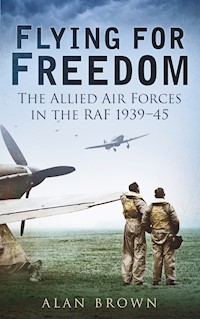
After the Dunkirk debacle in May 1940, Britain's primary weapon of defence was her air force. The exploits of the RAF's bomber crews and fighter pilots featured almost nightly on the radio and in the cinema newsreels; the men themselves were the objects of great admiration and respect. Yet, how many of these brave airmen were not British nationals? During the Second World War, exiled airmen from six occupied countries in Europe flew from British soil, fighting in or alongside the squadrons of the RAF; each had a burning desire to strike back at the cruel regime that had so ruthlessly crushed his homeland. At the political level, the exiled governments were keen for their country's active service arms to remain independent, but the RAF had different ideas. Many influential sections of the Air Ministry avoided making firm commitments to their allies and considered these new reinforcements to have been thrust upon them. This book explores these courageous and often undervalued men, who were caught up in a web of political argument.
Sie lesen das E-Book in den Legimi-Apps auf:
Seitenzahl: 508
Veröffentlichungsjahr: 2011
Das E-Book (TTS) können Sie hören im Abo „Legimi Premium” in Legimi-Apps auf:
Ähnliche




















FLYING FOR
FREEDOM
FLYING FOR
FREEDOM
THE ALLIED AIR FORCESIN THE RAF 1939–45
ALAN BROWN
First published in 2000This edition published in 2011
The History PressThe Mill, Brimscombe PortStroud, Gloucestershire, GL5 2QGwww.thehistorypress.co.uk
This ebook edition first published in 2011
All rights reserved© Alan Brown, 2000, 2011
The right of Alan Brown, to be identified as the Author of this work has been asserted in accordance with the Copyrights, Designs and Patents Act 1988.
This ebook is copyright material and must not be copied, reproduced, transferred, distributed, leased, licensed or publicly performed or used in any way except as specifically permitted in writing by the publishers, as allowed under the terms and conditions under which it was purchased or as strictly permitted by applicable copyright law. Any unauthorised distribution or use of this text may be a direct infringement of the author’s and publisher’s rights, and those responsible may be liable in law accordingly.
EPUB ISBN 978 0 7524 6809 9MOBI ISBN 978 0 7524 6810 5
Original typesetting by The History Press
Contents
Acknowledgements
Abbreviations
1. The Unexpected Allies
2. Poles and Czechs
3. Czechs and Poles
4. The Free French
5. The Norwegians
6. The Belgians and the Dutch
7. Conclusion
Appendix: Allied Air Strengths, 1940–44
Bibliography
Acknowledgements
This study is an extension of my earlier work, The Czechoslovak Air Force in Britain, 1940–1945, which was submitted to the University of Southampton for the degree of Doctor of Philosophy in 1997. Many of the people who assisted me on that project have taken a keen interest in the development of Airmen in Exile, and I offer my profound thanks to the staffs of the Public Record Office, Kew; the Royal Air Force Museum, Hendon; the Air Historical Branch, Whitehall; the Hartley Library and New College Library, both of the University of Southampton; the British Newspaper Library, and Eastleigh, Leeds, Portsmouth, Southampton, Winchester and York public libraries, all of whom have played their part in providing expert guidance and flawless service in the procurement of the books, documents and photographs needed for the project.
I have also received very welcome assistance and correspondence from many organisations connected with the experiences of the exiles in Britain. These include: the Air Force History Unit of the Koninklijke Luchtmacht and the Stichting Dienstverlening Veteranen (Holland); the Fédération Nationale des Anciens de la Royal Air Force et de la South African Air Force 1940–45 (Belgium); and the Krigsveteranforeningen 1939–45 (Norway). Special thanks are also due to Lt Gen Av. e.r. Baron Michel Donnet DFC, President of the Belgian Association, and Lt Gen Wilhelm Mohr of the Norwegian Association, both of whom sent me some useful ideas and some excellent material. General Donnet’s reminiscences, Flight to Freedom, must rank as one of the best aviation memoirs of the war.
There has also been a host of scholars who have shared their knowledge with me and permitted use of their research. These include Christopher Mann (King’s College, London), Matthew Buck (Oxford), Paul Latawski (Royal Military Academy, Sandhurst) and Martin Brown (University College, London). Numerous amateur historians in Europe and America have also contributed information, ideas and encouragement, and I am particularly grateful to Randal Hankla (America), Yves Duwelz and Cynrik de Decker (Belgium), Gert Laursen (Denmark) and Louis Capdeboscq (France). Louis must have a global reputation by now as one of the first dons of the Internet history newsgroups, and it is high time he published some of his work to a wider audience.
Finally, my sincere thanks to my friends and colleagues at Selby College, especially James Broad. Projects of this scale cannot be completed in isolation from ordinary life, and together they gave me a lot of encouragement and plenty of elbow room to see it through to completion. Thanks also to Helen Betteridge, who lent a hand with the research, and to Linda Gray of Chelwood House, Kew, for her excellent hospitality.
Alan BrownNorth Yorkshire
Abbreviations
AACU
Army Air Co-Operation Unit
ACAS
Assistant Chief of the Air Staff + (P) Policy; (I) Intelligence; (O) Operations
ACM
Air Chief Marshal
ADC
Aide-de-Camp
ADGB
Air Defence of Great Britain
AFC
Air Force Cross
AFO
Allied Forces Committee
AFOSC
Allied Forces (Official) Sub-Committee
Air Cdre
Air Commodore
AM
Air Marshal
AMP
Air Member for Personnel
AMPC
Auxiliary Military Pioneer Corps
AMSO
Air Member for Supply and Organisation
AMT
Air Member for Training
AOC
Air Officer Commanding
AVM
Air Vice-Marshal
C-in-C
Commander-in-Chief
CAS
Chief of the Air Staff
CIGS
Commander of the Imperial General Staff
CNC
Czechoslovak National Committee
CO
Commanding Officer
COS
Chiefs of Staff
COS 120
Common name for paper 120 (1944) by the Chiefs of Staff Committee
ERPC
Expansion and Re-equipment Policy Committee
GDB
General Duties Branch
GHQ
General Headquarters
GOC
General Officer Commanding
Gp Capt
Group Captain
GR
General Reconnaissance
GRU
General Reconnaissance Unit
JIC
Joint Intelligence Sub-Committee
MAC
Mediterranean Air Command
MAP
Ministry of Aircraft Production
MC
Military Cross
MNO
Ministry of National Defence (Czechoslovak)
MO
Medical Officer
MP
Member of Parliament (British)
MRAF
Marshal of the Royal Air Force
OC
Officer Commanding
ORB
Operational Record Book
OTU
Operational Training Unit
RAF
Royal Air Force
RAFVR
Royal Air Force Volunteer Reserve
RCAF
Royal Canadian Air Force
RFC
Royal Flying Corps
RNAAS
Royal Norwegian Army Air Service
RNNAS
Royal Norwegian Naval Air Service
RT
Radio Telephonist
TEB
Twin-Engined Bomber
TEF
Twin-Engined Fighter
VC
Victoria Cross
VCAS
Vice Chief of the Air Staff
VE
Victory in Europe
VHA
Military Historical Archive (Prague)
VKPR
Military Office of the President (Czechoslovak)
CHAPTER ONE
The Unexpected Allies
The summer of 1940 dealt a great many shocks to the government, people and armed forces of Britain. The German attack on France and the Low Countries in May was as sudden as any in the history of large-scale military operations, but although France was politically and militarily unprepared for such a trial, the belief that she could stand firm with British assistance was still the prevailing view among those charged with the central direction of the war. That confidence had been wrecked along with the British Expeditionary Force at Dunkirk. As the allies fell back and were eventually swept from the Continent by an apparently irresistible force, talk of a negotiated peace with the Germans was momentarily heard in the most powerful offices in the land. Such talk came to nothing, but amid the confusion on the beaches of southern England and in the government, new voices were heard from men who had never dreamed that such a calamity could befall the Western democracies. Some had sought refuge with the French when their own capitals had been overrun; others had come directly to Britain in the hope of stimulating resistance at home by their determination to stay free. All of them were simply overwhelmed by the magnitude of the defeat.
These were the governments of Norway, Belgium, Holland, Poland and Czechoslovakia. France, of course, joined the list when she too succumbed. In all cases, the experience of politics in exile brought out the worst in some individuals, who used the instability to further their own political agendas, either to fix the blame for the defeat, secure power for the future, or simply to make trouble in settling old scores. But along with the men of words came men of arms, for in the headlong scramble to escape the Nazi scythe, tens of thousands of troops scrambled onto the boats and joined their political leaders in Britain. Men of foreign navies bravely steered their ships to British ports, and many courageous aviators risked capture at the hands of their own countrymen to fly their machines into British air space and deliver themselves for service once again. Throughout the summer and autumn of 1940, these men re-grouped and re-trained to pledge their committed energies to the common war effort, but in so doing they often became part of the wider political scene as their governments fought internecine battles or struggled to assert themselves with their British hosts.
This book is a study of only one part of that great allied force inexile: the airmen of the six European nations who found refuge in Britain and fought their war from British soil under the ensign of the Royal Air Force.1 The presence of so many nationalities gathered together in one service arm was an entirely new experience for the British. The possibility that France might be defeated had never seriously been reckoned with, but it had happened all the same. Apart from coping with the shock of sudden solitude, the government and service departments had to devise ways of assimilating the allied personnel into the fighting corps; at the same time, they had to walk the thorny paths of exile politics. This meant that from the very beginning, the history of all the European exiles was inextricably connected to two British departments: the Air Ministry and the Foreign Office. Quite often the former would not act without the advice and agreement of the latter, and when the political activities of the exiled governments interfered with the military establishments nominally under their command – and we shall see how common an occurrence this was – it would be the Foreign Office which had the deciding voice. The two undertakings frequently collided, sometimes with hardly noticeable effects, at other times with explosive results which rocked the very alliances these endeavours were trying to preserve. All parties found the experience to be a steep learning curve indeed, and there is much to be gained from studying these noble but often tempestuous friendships which, though they ended over fifty years ago, still have enough light left in them to illuminate aspects of Britain’s interaction with Europe today.
In the following chapters, the essential characteristics, trials and triumphs of each of those alliances will be surveyed, the greatest emphasis being placed upon the British perception of each relationship, but the primary purpose of this introduction is to explore the overall political, social and military environments within which each separate relationship functioned. In the first place, the British government had to create a mechanism which permitted the establishment of foreign armies on British soil, and having created that mechanism, had to ensure its smooth operation in times of crisis. Secondly, the presence of so many different nationalities at once raised numerous problems, all of them important, but none more so than the lack of a common language, and the very real dangers of falling morale and political treachery. Thirdly – and this was to be a consideration later in the war – the question arose of what was to be the policy after victory had been secured? Were the allied governments and their forces to be left to their own policies of reconstruction, or would programmes of closer association finally purge the Continent of the German menace? These were issues of major importance; and as we shall see, the Americans felt that they also deserved a voice in the shaping of postwar Europe. The view from Washington was that Britain was too weak and too closely involved with the European powers to make objective decisions regarding the immediate peace, and through the experiences of the Anglo-European alliances we may glimpse the changing nature of ‘the special relationship’ and the onset of the Cold War.
However, in 1940, these were issues far removed from the practicalities of the time. The British government was faced with a situation which demanded immediate action, and the most urgent need was to give some legitimacy to the presence of the foreign armies on British soil. The device chosen was the Allied Forces Act, a hastily concocted piece of legislation based upon an earlier model, the Visiting Forces (British Commonwealth) Act of 1933. Under this latter Act, visiting governments would be legally responsible for the conduct of their forces while they were on British territory. This was just what the British government needed: a tool which gave it all the benefits of extra allies and hardly any of the responsibility. With a few modifications, the Allied Forces Act replaced the earlier instrument, and under the terms of Article One each allied government had full military jurisdiction over its service personnel.
But that was not how some sections of the armed forces interpreted it, for although the War Office and the Admiralty were content to allow the incoming forces the right to enforce their own military laws, the Air Ministry fought against national jurisdiction for the whole of the war. As far as the RAF was concerned, a man in their uniform, irrespective of his nationality, was entitled to serve under British military codes rather than his own national variants, which in the main tended to be less lenient and heavier on punishments.2 This was not because of some noble motive on the part of the RAF, though there were occasions when it stepped in to forbid excessive punishment. Much more likely was the need to avoid giving the exiled governments the opportunities to demand independent status for their air forces, and there were two main reasons why they should pursue such a claim. First, after Dunkirk, the primary weapon in defence of Britain was air power. It was visible, active and highly successful, and the various governments sought to exploit the victories of their own pilots by having their national contingents declared independent of the RAF. The right to operate their own military codes in matters of discipline was perceived as a significant step towards that aim. Independence would give them a highly potent propaganda tool to stimulate resistance at home and recruitment abroad; and as a by-product, enhance their own positions as the guardians of national liberty. Second, having an independent air arm would reinforce their status as allies rather than ‘associated powers’, a much vaguer term used by the British when they felt uncomfortable about nominal alliances not formally recognised by treaty.
In the end, it was all about prestige. For wholly understandable reasons, each of the European governments which reconstituted on British soil suffered to a greater or lesser degree from low self-esteem, and one way of increasing it was to have an active service arm under their sole control. To be sure, most had army units recognised as independent forces by the War Office, but with some notable exceptions (especially the Poles and the Czechoslovaks in the Middle East), the army units based in Britain could do little but prepare for action when the day came, and that was not to be until 1944. In short, there were not enough medals being won on land; but in the skies, the exploits of the bomber crews and fighter pilots featured almost nightly on the radio and in the cinema newsreels. Governments hungry for prestige therefore naturally turned to these heroes as symbols of a freedom temporarily crushed, but by no means finished for good. The RAF high command was well aware of these issues, and from the very beginning resisted every attempt made by all but one of the governments to withdraw their forces from the RAF structure and fight as independent allies. Sometimes the high command lost the struggle, as with the Poles and the French; on one occasion they simply granted independence, as with the Norwegians; and sometimes they held firm and got their own way, as with the Czechs, the Belgians, and to a certain extent the Dutch. In each case an entirely different set of circumstances obtained, and at times the mood turned bitter.
It is easier to observe this intransigence than to explain it, for even now, after much study, the motives are not entirely clear. We can be certain that a deep suspicion was held by many influential and powerful sections of the Air Ministry against virtually all foreigners who came into the country from occupied Europe, and we might argue that to put politically suspect people in charge of a bomber would have been bad policy. But since no conclusive evidence has yet come to light which might confirm that such a fear existed on a widespread basis, we must reject it as mere conjecture. Besides, no allied government even remotely entertained the idea that it might have full operational control over its air force, and each was content to allow its men to serve under the overall direction of the allied high command, which in practice meant the British until the Americans entered the war. It was probably this necessity to fight the air war as one unified arm which motivated the RAF to resist bids for independence until it was forced by political considerations to acknowledge them. Besides, it was quickly apparent to everyone that some of the groups, and in particular the Czechoslovaks, could barely function as national units without substantial help from British ground crew. The Air Ministry took the view that this alone disqualified any pleas for independent status or jurisdiction rights, since it was argued on many occasions that two military codes could not reasonably be applied in mixed squadrons.
To return to the Allied Forces Act, this was one of those occasional pieces of legislation which was denied any realistic chance of debate in Parliament. The National Government had already decided that it should become law long before it reached the floor of the House of Commons, and in the event it passed through all of its stages in a single day, 21 August 1940.3 Rising at 4.28 p.m., the Joint Under Secretary of State for War, Sir Edward Grigg, urged the House to support the bill, which would ‘give legal sanction to the establishment of no less than six foreign armies on British soil, to be trained under their own flags, under their own commanders, and under their own military law.’4 He then assured the honourable members that civil crimes would still be dealt with by British courts, but in all other respects the responsibilities would devolve upon the allied governments.
In theory, this should have been enough to end the debate and lead to a vote which the government could not lose, but a few hardy souls decided to raise issues for the record which might better have been left unaired. Miss Eleanor Rathbone asked if the allies were to be given powers of conscription over their nationals who had made their homes in Britain, and if any provision had been made for racial and religious differences within the forces concerned. If not, would discrimination be permissible? Grigg fumbled this last point by stating that no specific provisions existed in the military codes concerned, but he saw no reason why it should become an issue. On the question of conscription, he answered with an emphatic ‘No.’ Miss Rathbone replied that this would mean that each man was technically a volunteer, and Grigg agreed with her.
In both cases, Grigg was unaware of the facts. He was promptly informed that four days earlier the Dutch government had threatened a man with a charge of evading the colours if he did not report for service immediately. Was this not conscription? Grigg did not reply. Others argued that any man who chose to make his home in Britain deserved the protection of British law, and that no allied government had the right or the power to force him into military service if he chose not to volunteer. Behind this concept lay the very real and highly treasured British principle of asylum for political refugees. The British took the view that if anyone chose to leave their home nation on grounds of political, religious or racial incompatibility or persecution, and had been granted the right of residence in Britain, such individuals were entitled to reject the commands of their former country, especially if it meant taking up arms for a cause which they might not support. Conscription was therefore ‘off the menu’, and although there were numerous cases of allied governments using unpalatable tactics to coerce men into the ranks, the British broadly kept to the policy, particularly if the countries concerned had a history of anti-Semitism or severe political disorder.
This issue of racial discrimination also surfaced in the Commons debate on the Allied Forces Act. Col Josiah Wedgwood declared that the Polish Army in France had been recruited ‘more or less under duress’, noting that Jews had been given the choice of internment or service. He then made the stinging comment that the Polish and German attitudes towards Jews were comparable, and that many had ‘learnt from bitter experience what it is to be under the Polish or Nazi heel’. Supporting Wedgwood, Sydney Silverman added that ‘there is something on the Czech side too which needs a certain amount of care and attention’.5 In an attempt to soothe these concerns, Grigg only fanned the flames by quoting from a specific order issued by the Polish high command forbidding any anti-Jewish behaviour ‘humiliating to human dignity . . . upon pain of severe punishment’.6 An earlier call for an independent Jewish force was rejected by Grigg on the grounds that they had no military system, codes or national government.
There was also the question of jurisdiction. Some members, clearly quite ignorant regarding the military practices of their new allies, very much hoped that flogging would not once more disgrace a British barrack square. Others were concerned about the variations in military codes noted earlier, and the protests were strong enough to force Grigg into assuring the House that he would extract from each government a promise that the death penalty would not be administered if the crime would not attract a similar punishment in the British forces.7 On the related question of conscription, he also pledged that no government would be given the power to compel its nationals to fight, and he wriggled out of the Dutch example by suggesting that they had acted before any official statement had been made on the subject. The final compromise was an assurance that each and every allied serviceman would be given the opportunity to serve in the British forces if he chose not to don his own national colours, irrespective of the pressures brought to bear on him to do so. This was to be a challenge later taken up by Gen de Gaulle of the Free French, and one which the British lost.
The Allied Forces Act received Royal Assent the day after its passage through parliament. The limits of its scope and authority were to be severely tested and frequently reinterpreted, and it would seem from the evidence that it became progressively less important as the conditions of war changed over the years. It was, after all, an emergency measure. But this cannot be said of the policy to meet the educational and welfare needs of the incoming forces from the Continent. It had been recognised very quickly, and especially by the Air Ministry, that if the allied personnel were to be of any use whatsoever, they would need to learn English at least to a point where they could understand and give commands. As a result, the task of linguistic training was thrown into the lap of the British Council, the initial agreement being that it would provide the teaching and the service departments would pay for it. As this was such a vital aspect of the assimilation of the allied forces, the British Council dedicated much of its own money and intellectual resources to creating effective courses of language instruction, but very soon it became apparent that the service departments regarded the programme with a much lower priority.
The British Council was, and is, one of the cornerstones of Britain’s official presence abroad. Formed in 1934, the Council’s initial aims were to promote the life, language and culture of Britain.8 When war came in 1939, the Ministry of Information absorbed much of the Council’s promotional work in the affected countries and left it with a greatly reduced range of activities, essentially the education of refugees and the maintenance of Britain’s cultural profile. Even these, so the Treasury thought, were ‘a luxury in wartime’.9 The sudden influx of displaced persons from occupied Europe enabled the Council to argue its case with more confidence. By insisting that the cultural welfare of these people fell within the remit of the Council, the Executive Committee successfully lobbied for a range of suitable proposals.10 Yet this should not obscure the core function of the Council by creating the impression that it was a benevolent, altruistic body posing as the conductor for all things wholesome, decent and British. By its own admission, its primary aim was ‘political, or at any rate, imperialistic’, and it spent much of its time and its budget encouraging foreign nationals to ‘appreciate British friendship’, which in practice meant acknowledging that London was the hub of the universe.11 Content with its mission, the Council pursued these aims and its agenda with considerable success.
Things changed when the military men arrived after the fall of France. Reacting swiftly to the new situation, the Treasury convened a meeting on 28 August 1940 at which it was generally agreed that the Council would assume all responsibility for the cultural and educational needs of the foreigners now in the country. This meant that the direct teaching of English (as opposed to the indirect exposure to it) would now become part of the Council’s portfolio of activities. To fund the programme, the Treasury allotted a further grant of £17,000. It was also agreed that the Council would teach the language to the foreign servicemen and internees, ‘but only when asked by service departments and the Home Office to do so, when these departments would bear the cost’.12 This implied that the Council could not act without a direct request from the service departments or without clearing its proposed actions with them beforehand. This was to cause problems, for the chain of supply and demand could be broken or kinked by difficulties in communication or resistance by the Air Ministry or the War Office.13
Evidence of this survives in the British Council files. Under the terms of the new financing arrangement, the Council invoiced the Air Ministry for £316 for services provided up to and including 9 September 1940. But decisions on the amount of teaching required by individual units were taken either by the unit commanders or the Education Officer at Fighter Command, Wg Cdr de la Bère. By November 1940, this officer complained to the Council that ‘many units in his Command had received no language teaching, nor had they any grammar books’, in response to which he was informed that no authority had been forthcoming to appoint additional teachers or purchase new books, hence the Council politely referred him back to the Air Ministry.14
By Christmas 1940, the number of teachers employed on behalf of the RAF had increased from 14 to only 16 for a combined contingent of over 10,000 men, and while the Air Ministry paid for the newspapers, fictional and technical works, the basic stuff of teaching – specifically grammars in Polish and Czech – had been translated, produced and supplied at the Council’s own expense. By January 1941, the bill had climbed to £2,110, representing services provided between the beginning of September to the end of December 1940. A cheque for the earlier amount of £316 finally arrived in February 1941.15 In November 1941, an internal note was issued concerning the unpaid invoice for £2,110 ‘which had been lost by the Air Ministry’.16
In April 1941, the Air Ministry sent a summary of the present situation to the British Council. It included a revised list of the technical and general terms which it wanted taught to the allied air crews as part of the general aim ‘to teach every allied officer and man to use the English language operationally and technically’.17 Thus far, the Ministry had employed five methods to further this aim: (1) the widespread use of interpreters, and the dispersal of such men into RAF units ‘where possible’; (2) the translated manuals supplied by the Council, and linguaphone records of operational phrases; (3) the use of British personnel commanding either in the air or on the ground; (4) ‘use of specially selected allied personnel to lead in theair’; (5) the use of allied personnel in operations rooms for radio communications. Each of these techniques had only limited success, concluded the Ministry, and this still left a force ‘that is not fully efficient and has little flexibility’, and suffered from a lack of knowledge of operational language, an inability to absorb or read instructions, and the impossibility of employment in composite crews, especially in bomber work. The British Council reacted with astonishment, for it regarded it as audacious that the RAF should complain when it neither paid its bills on time nor seemed keen to develop the language programme at its own expense.18
It is tempting to blame the Air Ministry itself for these difficulties, but we must also bear in mind the pressures under which it operated during the second half of 1940. Even so, although we cannot level an accusation of outright negligence in regard to the language training of the allied crews, there is certainly a hint of indifference in its behaviour. Nor was this attitude confined to the Royal Air Force. By November 1940, the Council heard reports that men of the Czechoslovak Army ‘had been anxiously awaiting the supply of English teachers since August’.19 An internal memorandum also referred to a plea from the Czechoslovak Military that ‘the lack of mental food for the Czech Army is causing them despair’. There was even talk of writing directly to Churchill.20 Upon enquiry, the Council was told directly by the War Office that ‘any cultural or educational work amongst the allied armies is not required on anything more than a trivial scale’.21 It was not until April 1941 that a suitable working arrangement had been established, and even then there were delays in its implementation.22
It is clear from these scant letters and memoranda that the work of the Council did not feature high in the list of priorities of either the Air Ministry or the War Office, despite the valuable and sometimes valiant efforts of the Council in all other spheres.23 By January 1942, a survey conducted by the Czechoslovak Air Force Inspectorate indicated that the average level of English held by all ranks was a little under 58 per cent. This figure had been calculated from the end-of-year written and oral tests conducted with the officers and other ranks of 310 and 312 Fighter Squadrons, and it roughly corresponds to the modern-day equivalent of intermediate level: good enough to make oneself understood, but far from any real fluency.24 Almost certainly, the tendency for the men to associate with their own countrymen, thereby obviating the need to speak English, would have affected their ability or motivation to learn, but it seems that British policy must bear some of the responsibility for these relatively low levels of achievement after one-and-a-half years of exile.
These problems were very real for the men involved, and anyone who has been to a foreign state with little or no knowledge of the language can relate to the sense of isolation this produces. In material terms, however, they lived identically to their British counterparts. They wore the same uniform (in itself a desirable thing to have, especially after the Battle of Britain), they ate the same food, slept in the same bunks, flew the same planes and shot at the same enemy. In most cases they also received the same pay, though this did not always apply if a squadron was regarded as a fully national unit. Nevertheless, pay levels in all the allied squadrons were roughly equal, for too great a disparity would have seriously affected morale.
The service departments also displayed an indifferent attitude when it came to the social welfare of the men. The British Council received several complaints that little or nothing was being done to entertain the allied servicemen, and approaches to the War Office and the Air Ministry for ideas and assistance met with either silence or carefully worded excuses. Consequently, many private individuals took it upon themselves to lend a hand. Some retired teachers gave English lessons for nothing; others, especially the wealthy, opened their country houses and organised cinema shows, football matches, dances and concerts for allied personnel who happened to be stationed nearby. Somewhat embarrassed by this display of charity, the War Office appointed Sir Thomas Cook MP as a roving welfare officer to tour the air and army camps and report on conditions and general morale. He liaised with the Women’s Volunteer Service and the YMCA, which in turn ran clothing drives, book rallies, bring-and-buy sales and other events to raise money to provide home comforts for all of the allied contingents. Cook did an admirable job, and both the British Council and the Foreign Office received many letters of thanks from commanders of allied units. Only once did he cause brows to furrow with one of his lengthy reports. Having visited 310 (Czechoslovak) Fighter Squadron at RAF Duxford, he wrote: ‘The men’s immediate needs are being well catered for by voluntary women’s bodies in Cambridge’, in reaction to which a senior Czech officer pencilled in the margin ‘Please explain.’
The British Council soon found itself deeply involved with another facet of the welfare provision: the national organisations or ‘hearths’. Beginning with the establishment of the Ognisko Polskie (‘Polish Hearth’), these national centres would act as meeting places for allied personnel where they could enjoy a taste of home. In theory, they were to be the financial responsibilities of the allied governments, but from the start many were heavily supported by the British Council. In the case of the Czechoslovak Institute, the projection for the financial year 1941/2 envisaged a £2,500 subsidy, taking into consideration an expected income of £300 from subscriptions and donations, and a further £100 from overnight room rental. Food and drink would be sold on a limited-profit basis.25 By 1942, that estimate had increased to £4,820 as the probable subsidy required to keep the Institute viable in 1944. The Belgians, Dutch and Norwegians paid half of the running costs of their own national houses, while the Greeks and the Yugoslavs donated £250 and £300 respectively. The Poles and the Czechoslovaks, however, were noted as offering ‘odd amounts only’, with the latter being specifically flagged as ‘unreliable’.26
With such heavy British Council support came a good deal of British Council influence, and very soon the original conception of these national houses as places where civilian and serviceman alike might relax in familiar surroundings soon gave way to the Council’s view of what every good foreigner should be exposed to. The houses tended to organise functions which emphasised ‘civilised culture’ rather than rest and relaxation. Programmes of events which have survived show that the entertainment was very much geared towards the higher thinker. Classical music recitals, literary readings, poetry discussions, historical lectures and similar arrangements formed the staple cultural diet of visitors to the national houses in London.27 But there were few dances, and though on balance the houses dealt with military and civilian clients in equal numbers, activities and amenities tended to be biased towards the latter.28
Furthermore, in 1943 the British Council commissioned work on a short film entitled Safe Custody, which was to be based on the activities of the national houses. Part of the resumé concerning the Czechoslovak Institute stated:
We see a young Czechoslovak student reading a newspaper, then he discards it for a medical book. He has found a haven to pursue his studies in the Czechoslovak Institute, a club with British foundation where Czechoslovakians in Britain can enjoy some of the traditional teachings of their own country. We see the Librarian at work in the Library with its rare copies of immortal Czechoslovakian books. Then we look over the shoulder of a Czechoslovakian officer who is studying a notice-board where we see announcements of concerts, lectures, meetings.29
If this oozing sentimentality truly represented the British Council’s perception of the Czechoslovak Institute – and it seems plausible to assume that it did – then it is no surprise that most service personnel tended to move through it rather than support it in any meaningful sense. In effect, the national houses were little more than tools of the British Council in its mission to promote British culture, and it had a relatively captive audience and chose to maintain its profile by acting as financier, protecting its investment by packing the controlling directorates with its own people.30 On the whole, the Council did its best to educate and accommodate all the émigrés – political, civilian or military – from all of the countries which had succumbed to occupation, and it did so with the consent of the government and with funds provided by the Treasury. Yet it is hard to avoid the impression that the average man in an allied unit was largely left to fend for himself in terms of his entertainment. If he came to London looking for gaiety or careless distractions from the pressures of war, he was unlikely to have his needs satisfied at the national house of his countrymen.
In essence, the allocation of comforts and welfare was bound up with the greater concept of morale. Ever since Roman times, and probably earlier than that, army commanders have been keenly aware that high morale in any fighting force is crucial to its efficiency. No less aware of this was the Air Ministry, but it took it a couple of years to formulate its perceptions of allied morale, and how to maintain it, into a policy document of great depth and considerable length. Unfortunately, space does not permit a full examination of its many fascinating and varied clauses, but what follows should convey the overall sense of the document and, more importantly, the British view of their new allies as it developed over two years of collaboration and close observation.
The preamble to the document acknowledged that time had passed since the ‘urgent atmosphere’ of 1940 and the subsequent tensions generated by the 1941 air raids, and that now, after two-and-a-half years, the various allied air forces were fully engaged in the combined war effort.31 This was followed by a broad declaration that ‘history revealed no precedent to guide the Government or the Service in their planning for the reception, acceptance and operative effect of the allied air forces’. This could be interpreted as an almost apologetic caveat, but the object of its inclusion was to introduce the five basic principles which time and experience had now permitted to emerge as the guiding philosophy of the Air Ministry in its relations with the European exiles. These were:
(i) The Principle of Nationality – the preservation of national, and as far as possible, air force identity; the retention of national traditions and customs, rituals, religion and culture.
(ii) The Principle of Legality – the recognition of the right to be subject to their own national or service laws; the equal obligation to be subject to British and service laws [sic]; the balance of justice under such dual legislation.
(iii) The Principle of Equality – the recognition of absolute equality [to include pay and conditions, ranks, trades, training, vocations and service].
(iv) The Principle of Concentration – as opposed to indiscriminate dispersal of allied air forces through the Royal Air Force; the avoidance of disintegration due to over-dispersal; the advantage of coherent national integral units.
(v) The Principle of Construction – the ultimate creation of independent self-contained national air forces for future national use in Europe; the formation of all-allied units towards that end; the final reconstruction of national air forces on their withdrawal from Britain.32
It must be emphasised here that these were the absolute rules as far as the Air Ministry and Air Council were concerned when it came to the administration, deployment and use of all the allied air forces then on British soil. Broadly speaking, most of them were adhered to, and we can be certain that from 1942 onwards, all major Air Ministry decisions were made in the light of these principles. The document was circulated to all of the allied air force headquarters in early May 1942, and we can only speculate what the various inspectorates made of the rather syrupy rationale: ‘These five tenets shall be the soil upon which allied morale can grow; whether it flourishes or wilts is determined by what it has to weather and the treatment it receives.’
But whatever one makes of the quality of the poetry, the document was certainly considered important by the Air Council because the appended instructions required it to follow the allied squadrons from station to station. Also included was a recapitulation of the existing practices in regard to the command structure within the allied air forces, focusing upon the argument that ‘morale at the top is as important as morale “among the troops”’. This, claimed the document, was to be maintained in the following ways:
(a) A full appreciation of the contribution to the war effort by parliament, press, publicity and propaganda.
(b) The conclusion of agreements pledging mutual co-operation towards common aims and ideals.
(c) A sympathetic and co-operative review of all proposals put forward by Allied Air Force Inspectorates or Headquarters.
(d) A ready concession of all just claims affecting the efficient administration of all allied air forces.
(e) The solutions of ‘problems’ by open conference and discussion in an atmosphere free from bias or prejudice.
We shall see later in this study how (c) and (e) were altered, twisted, or simply ignored in some cases, especially when the question of national independence was at hand; but in the main, these five points said little that was new. Items (a) and (b) were already a reality by early 1942, or committed the Air Ministry to nothing tangible, whereas item (d) was little more than a platitude, in that the next four pages were devoted to describing the administrative procedures as determined by the Ministry, setting them in stone for the rest of the war.
With regard to the welfare and morale of the other ranks, the general policy was ‘keep them busy’. The Ministry identified certain key factors as dangerous to morale. These were: enforced inaction due to a variety of causes (adverse weather, cancelled missions, lack of enemy activity, etc.); geographical dispersal (the separation of squadrons away from concentrated formations or a particular locality); the stress of redeployment to another station or group; bad war news, and problems associated with leave (where to go, what to do, and who to do it with). All of these elements, claimed the Ministry, had a greater impact on allied crews than native squadrons.
Inaction was to be mitigated by providing ‘entertainment, shows, dances, games, competitions, lectures and even serious educational or cultural training for those so disposed’. Geographical dispersal was not strictly a matter for the allies, for it was a command decision made at group or command level. Even so, the Ministry argued that ‘the more we are together, the happier we will be’, and permitted small, localised adjustments to be made in favour of allied squadrons if the principle of concentration was served. Much the same thinking applied to redeployment, the theory here being that a squadron move forced the men to come to terms with a new environment, possibly even a new dialect of English, and certainly a new station commander who might or might not be disposed towards working with allied crews. On the subject of bad war news, again some form of entertainment was recommended to overcome ‘an unusually heavy mood of depression’, but emphasis was to fall on the engagement of ‘prominent allied people’ to give lectures on the war situation or arrange morale-raising tours of arms factories or shipyards. With leave, the document noted that men tended to ‘stay local’ or spend their time in areas where their home nationals were concentrated. No solution was offered for the problems arising here, but the Ministry drew attention to the various hospitality organisations which would advise and assist any man who approached them. The important factor was to draw the men away from the station or camp if possible, for it was accepted that leave – if well spent – was an invaluable boost to morale.33
The document closed with a short paragraph on ‘Tolerance’, for the Ministry understood that the maintenance of good morale was ultimately dependent ‘upon a tolerant and sympathetic understanding’ of the plight of the allies who were so far from home. Nevertheless, the Ministry required no outstanding concessions to be made. In its own words: ‘This is no plea for “wet-nursing”, it is no plaint for weakness, but rather for increased strength. If anyone who is working with allied personnel feels so die-hard English that he can see nothing good or useful in a “foreigner” then he were better not employed with them.’ This was undoubtedly directed at British station commanders or other officers who were likely to come into contact with allied squadrons, and we shall see that this clearly demonstrates that a change of heart had taken place in the two years since the arrival of the men in 1940. Failing that, it was nothing more than a piece of glib propaganda designed to bolster the morale of the allied commanders who read it.
The average British station commander coped in his own way with the new allies on his turf, and he frequently sent back reports on their behaviour, morale and efficiency to command headquarters. In virtually all cases, these tended to be either highly complimentary, or at least benign criticisms, but occasionally we catch glimpses of that raw imperialism which was, or is, so quintessentially British. Many of the early reports focused on the distinctions between the Czechoslovak and Polish pilots. The station commander at Warmwell in October 1940 noted that the Poles were ‘keen and enthusiastic about flying for its own sake and would rather fly and fight than do anything else’. Of the Czechoslovaks, he wrote: ‘They are as hardworking and conscientious as Polish personnel but not usually so good from the flying point of view and the pilots I have met seem to be less enthusiastic than most fighter pilots.’ The station commander at Exeter also had slight reservations about his new comrades: ‘The Czechoslovaks without exception appear keen. They have not the terrific hatred for all things German that the Poles have, but they certainly do not compare unfavourably with British pilots in their offensive spirit. Their morale is good, but not so striking as that of the Poles.’ Of the Poles themselves, he observed: ‘The Polish pilot appears to be almost British. He talks about the same things, enjoys similar jokes, grumbles about the food, and drinks very moderately but makes the most of the party. His manners are better, especially towards women and his superior officers, but he eats less daintily and does not play cricket’.34
From 1942 until the Normandy landings in 1944, the Anglo–allied relationships fell into a routine and a pattern rarely broken by any new developments. After that date, most minds turned towards victory in Europe and the liberation of the occupied territories, but with those pleasant thoughts came a plethora of new political and military problems. Two major initiatives dominated the scene after Normandy. The first was a paper issued by the Chiefs of Staff known generally as COS 120, and the second was an umbrella term used to describe a range of separate yet broadly similar individual agreements: Mutual Aid. Both instruments were directed towards sustaining and improving the postwar inter-allied relationships, though it was to be COS 120 which caused the most problems.
On 30 June 1944, a little over three weeks after the invasion of occupied Europe, Churchill commissioned a policy review concerning all the allied powers then fighting to liberate their homelands from the Nazis. It drew its common title – COS 120 – from the simple fact that it was the 120th paper produced by the Chiefs of Staff Committee that year, but it was correctly known as The Equipping of the Forces of Our European Allies. It had two objectives: (1) to act as a basis for producing estimates in preparation for allied rearmament at the war’s end; (2) to ascertain the extent to which demands on British manpower could be reduced by utilising the forces of the European allies in the occupation of Germany.35
As it reveals much about the predicted conditions in Europe after the defeat of Germany, including the likely political scenario as the Red Army advanced, the document is of great value to the strategic and political historian. For example, the Chiefs of Staff tentatively forecast that the war against Japan would go on for another two years beyond the defeat of Germany, and that it was quite possible that German armament factories would need to be rapidly restored and pressed into service to meet the munitions demand. The likely military position of France was also closely considered, and the COS accepted that the Americans would require an equal voice in re-equipping and training postwar French forces. Indeed, the COS believed that such a presence would be greatly in Britain’s strategic interest, and this is worth recalling when considering the squabbling that began over the French Air Force in 1945. The arguments for the long-term provision of British assistance in the liberated territories are also interesting. It was estimated that the home weapons industry might enjoy contracts sufficient to supply up to 400,000 men for two years, these forces being split between those necessary to ensure each nation’s domestic security, and a share of the occupation liabilities in Germany itself.
Visions of a Soviet hegemony clearly dominated much of the planning behind COS 120, for the Poles, Czechoslovaks and Yugoslavs were to have their fighter squadron capability considerably enlarged as defensive screens against a sudden Soviet thrust. In the west, France was to receive double the amount of fighters she had been operating from European airfields, as was Belgium. Holland would see an increase to four fighter squadrons instead of the one which formed late in the war, but it was part of the overall strategy that these three nations would participate in the occupation of Germany, therefore an immediate increase of fighter capability was an obvious necessity. Only Norway would see a small addition to her fighter defences: the two fighter squadrons which fought so gallantly during the war would be joined by a third. Squadrons of heavy bombers were also scheduled for delivery to some of the European allies, as were transport and reconnaissance aircraft, with full facilities for training and maintenance provided as part of the package.
This, however, was only the plan, and we shall see how wide of the mark some of it was when the halcyon vision was warped by the situation on the ground. In essence, it was the British way of reaping the peace, and although America generally agreed with the principles and estimates laid down in COS 120, she still had plenty to say when these conflicted with her own plans in 1945. Besides, the whole scheme rested squarely upon the ability of the British to supply the aircraft concerned – and, of course, the willingness of the allies to be so equipped when the dust had settled and there were opportunities to think about alternatives. Nevertheless, as we move through the various chapters, references to COS 120 occur from time to time, and it is interesting to watch the cold realities of 1945 unfold in its fading light, first cast while the bridgeheads in Normandy were still being consolidated.
The other programme running alongside COS 120, and to some extent designed to act as the precursor for postwar rearmament, was Mutual Aid. The Mutual Aid protocols signed with the allies in 1944 committed each nation to supplying the British forces with facilities and supplies upon the liberation of her homeland until such time as the Germans were driven out altogether. This was correctly termed ‘reciprocal aid’ in the jargon of the Foreign Office, as it went some way to repaying the British government for the costs incurred equipping and training some of the allied forces during their exile in Britain. Some of the governments had huge resources from which to draw their expenses – Norway and Holland being two good examples – but others, such as the Czechoslovaks and the Poles, needed extensive financial credits to fund their war effort. Indeed, so meticulous were the men at the Treasury in keeping the books, the Czechs were presented with a bill for £177,236 12s 9d for fighter ammunition used in the two years from their arrival in the summer of 1940 to the end of the tax year in 1942.36 By the middle of 1944, the Czechs owed around £5.5 million, but this pales into insignificance when compared to the Polish debt of more than £80 million.37 Mutual Aid was therefore little more than a gesture of support; and besides, political considerations in 1945 made much of it irrelevant anyway. Strong-nerved officials at the Treasury contemplated £100 million write-offs with scarcely a sign of concern in their frequent notes to the service departments, but when it became clear that much of the money would never be refunded, the potential marketing opportunities implicit in COS 120 became all the more attractive.
Such were the major policies and articles of legislation which applied to the foreign airmen in Britain, but, before we move on to examine each nation by turn, a few words must be recorded concerning the primary focus of the present study. More than anything, this entire work is an examination of official Britain’s reaction to an unprecedented situation. France had not been expected to fall, therefore there were no contingency arrangements to administer the air and land units formed on British soil by the governments and servicemen of the occupied nations. They were, indeed, unexpected allies, for if things had gone according to plan they would have fought their war on the Continent alongside a resolute France. That turned out not to be the case, so the British had to cope with things as best they could. Some might agree that they coped fairly well and assimilated the allies into the structure of the Royal Air Force with remarkable efficiency given the difficult circumstances. Others might feel that the entire relationship was based more on tolerance than a genuine spirit of alliance and friendship.
But although many of the views expressed by some of the British make for uncomfortable reading, it is vital to remember that the officers and men of the allied squadrons were seldom selected for individual criticism. Many medals were won, many friends were lost, and the Royal Air Force grew very fond indeed of these stout warriors who refused to give up the fight for their homes. Rather, most of the conflict took place at the higher levels, usually with the allied governments or with the high commands, for this was the area which generated the greatest tensions. The men on the ground or in the air simply got on with the job, and from the dismal days of 1940 right through to the glorious relief of Victory in Europe, they displayed nothing but bravery and dedication to the common cause. They lived and died as airmen of their own countries fighting from the heart of another, and all the foreign veterans’ associations are tenacious in preserving those far-off links with the RAF as defining moments in their respective aviation histories.
Finally, despite all the horrors they had witnessed, the perilous escapes, and the long years in exile during which so many terrible things were heard about conditions at home, we must also note that they displayed a fine sense of humour. Like their British colleagues, they sought laughter wherever they could, for in laughter they might find that extra ounce of comradeship which was so important when the news was bad or the pressures of exile grew hard to bear. Most jokes were usually directed at their political representatives, or at the British for their stuffiness. Language problems gave them no end of fun. One highly popular story, said to have originated with one of the Dutch squadrons, was set in a disciplinary hearing in which a British commander accused an allied pilot of cowardice in the face of the enemy. ‘You were told quite clearly that there were bandits at three o’clock,’ said the CO, ‘and yet you immediately flew back to the station. Why?’ Came the nonchalant reply: ‘Because it was only half past one.’ Another story, this time Polish, poked fun at the British class system. A young lady of high society had volunteered to serve in a tea-wagon, and on the first day she encountered a Polish pilot who had obviously gone to great lengths to master the slang for ‘a cup of tea and a sandwich’. After several attempts to understand the chap’s requests, she turned to her more roughly hewn workmate and said: ‘This fellow keeps asking for “a cuppa cha and a wad”. Do you think he knows any English?’
NOTES
1. During the course of the war, Greek and Yugoslav squadrons were formed as the men and materials became available, but these units were based abroad. The focus of this book is the relationship between the British and their allies stationed on British territory.
2. Examples of the Czechoslovak military codes can be found in British archives. A loose minute in the files of the Allied Administration Committee reveals that the penalty of death was applied to cases of mutiny under martial law, desertion to the enemy, cowardice in the face of the enemy, the surrender of a fortified position to the enemy, and the transfer of military materials to the enemy.
By contrast, the Polish list was more severe. The death sentence could be awarded for murder, crimes against the state, treason, espionage, crimes against the national economy, sabotage, shamming, self-wounding, desertion in the face of the enemy, refusal to obey an order in the face of the enemy, the failure of a commander to hold on to an objective, or capitulating without good cause, and the surrender of military materials (FO 371/24373: Loose minute, June 1940).




