


0,99 €
Mehr erfahren.
- Herausgeber: A.W Publishing
- Kategorie: Geisteswissenschaft
- Serie: History gifts for men who have everything
- Sprache: Englisch
What if the key to rewriting history was hidden in a code no one could crack?
Forbidden History: Secret Codes uncovers the mystical manuscripts, undeciphered languages, and secret messages that could change everything we think we know about the past. From the mysterious Voynich Manuscript to forgotten alphabets and encrypted scrolls, this book takes you on a journey through the codes and riddles that mainstream history can’t explain.
Packed with fascinating trivia, lost facts, and forbidden knowledge, it’s more than just a history book—it’s also the perfect gift for men who have everything, history buffs, and puzzle lovers.
Inside you’ll discover:
Mystical manuscripts shrouded in secrecy for centuries
Undeciphered languages and hidden alphabets that baffle experts
Secret codes and cryptic messages with world-changing potential
A trivia-filled style that makes it an ideal Christmas gift, birthday present, or stocking stuffer
Whether you’re searching for a trivia book, ancient history book, or unique gift for men, this edition belongs in your library.
👉Whether you’re shopping for unique gifts for men, a white elephant gift, or just love captivating history, this book is for you.
Das E-Book können Sie in Legimi-Apps oder einer beliebigen App lesen, die das folgende Format unterstützen:
Seitenzahl: 168
Veröffentlichungsjahr: 2025
Ähnliche















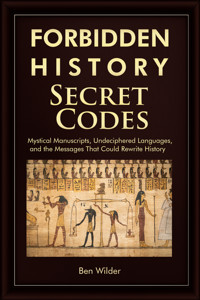
FORBIDDEN
HISTORYSecret Codes
Mystical Manuscripts, Undeciphered Languages, and the Messages That Could Rewrite History
Ben Wilder
Copyright © 2025 Ben Wilder History Publisher
Kindle ISBN: 978-1-959581-78-9
Paperback ISBN: 978-1-959581-79-6
Legal Notice and Disclaimer
All rights reserved.
No part of this publication may be copied, reproduced, stored in a retrieval system, or transmitted in any form or by any means—electronic, mechanical, photocopying, recording, or otherwise—without prior written permission from the publisher or author, except for brief quotations used in reviews or scholarly work permitted under applicable copyright laws.
For More information you can reach us via [email protected]
Printed in the U.S.A
Table of Contents
Introduction: Cracking the Forbidden Cipher
Part I: The Mystical Manuscripts
Chapter 1: The Book No One Can Read
Chapter 2: Lost Words of the Gods
Chapter 3: Sacred Scrolls and Secret Bibles
Part II: Codes Across Civilizations
Chapter 4: Ancient Scripts Still Silent
Chapter 5: Numbers, Stars, and Secret Mathematics
Chapter 6: Hidden Maps and Cryptic Diagrams
Part III: Suppressed Knowledge and Forbidden Codes
Chapter 7: The Language of the Magi
Chapter 8: Secret Societies and Their Ciphered Texts
Chapter 9: Codes They Tried to Silence
Part IV: Messages for the Future
Chapter 10: Patterns Across the Unknown
Chapter 11: Modern Codebreakers and AI Decipherers
Chapter 12: What the Codes Could Mean for Us
Bonus Section: Secret Codes Workbook
Conclusion
Introduction
Cracking the Forbidden Cipher
What if the greatest secrets of human history were written down thousands—perhaps tens of thousands—of years ago... and we can’t read them?
Envisage walking into a library so vast that its shelves stretch beyond sight. On them are scrolls, tablets, maps, and manuscripts. Some are penned in scripts no scholar can decode. Others are illustrated with symbols that look familiar yet defy any known lexicon. A few depict our world in ways that seem impossible—continents mapped before modern explorers, coastlines shown without their ice, celestial patterns recorded with an accuracy that would baffle a 21st-century astronomer.
These artifacts exist. They are not the stuff of fiction. From the enigmatic Voynich Manuscript to the Indus Valley seals, from the Piri Re’is map with its uncanny rendering of an ice-free Antarctica to mysterious Polynesian alignments pointing toward the tropics, we are confronted with a riddle that cuts through time. Each is a fragment of an immense cipher—a message scattered across epochs, cultures, and languages—that could, if decoded, rewrite the history we think we know.
Light on the Unread: Undeciphered Scripts in the Archive
Why Humanity Has Always Sought Hidden Messages
From the dawn of symbolic thought, humans have been code-makers and code-breakers. Our earliest ancestors left ochre markings on cave walls, not for decoration alone, but as intentional symbols. Some may have been tally marks for lunar cycles; others, mythic diagrams of creation and death.
In the mythic traditions of the ancient Near East, Egypt, Polynesia, and the Indus Valley, sacred knowledge was often veiled, presented in allegory, encoded in numerical patterns, or hidden in the alignment of temples to celestial coordinates. The Royal Science of Astronomy was not merely a practical art for predicting seasons; it was a master code, linking heaven and earth through measurable cycles.
According to ancient cosmologies reconstructed by comparative scholars, time itself was a structure—measured, predictable, and yet profoundly symbolic. A shift in the sky, such as the slow precession of the equinoxes, could herald the end of an age and the birth of another. Myths of world mills grinding out peace and then salt, of golden ages and catastrophic floods, may conceal precise astronomical data beneath their poetic skins.
Even in the Age of Exploration, long after the rise of modern empires, traces of this archaic code survived. Hapgood’s research into ancient maps suggests that seafaring cultures before the known record possessed advanced geographic knowledge. They could chart latitudes and longitudes with a precision Europe would not achieve until the invention of the marine chronometer in the 18th century. The maps may have been copies of copies, handed down through civilizations we barely know existed.
How Undeciphered Texts Challenge What We Think We Know
Every undeciphered script is a locked door in the mansion of history. The locks are not all the same; some are linguistic, others cultural, and still others technological.
Linguistic barriers:
Without a bilingual key like the Rosetta Stone, many scripts remain mute. The
Indus Valley script
has no known descendants, no clear phonetic matches, and resists every computational attempt at decryption.
Cultural barriers:
Knowledge is never neutral. It can be intentionally veiled or encoded to protect it from outsiders or the uninitiated within. Medieval alchemists hid formulae in allegories of dragons and kings; shamans encoded their visions in animal-human hybrids painted deep inside caves.
Technological barriers:
Some ciphers were ahead of their time. Without modern computing power or advanced imaging, their layered encryptions remain beyond reach.
Hapgood called this the Knowledge Filter—the idea that some codes were not merely lost to history but deliberately kept out of reach, whether by the collapse of civilizations, the destruction of libraries, or the guarded secrecy of esoteric orders.
And there is another possibility: that the very act of decoding such messages might destabilize our current worldview. If a manuscript revealed irrefutable proof of advanced global navigation in 10,000 BCE, or detailed the mechanics of consciousness-altering plants as gateways to other realms, what would happen to the tidy timeline of history in our textbooks?
Sealed Relic
The Reader as Codebreaker
You are not here to be a passive witness. This book invites you into the vaults, the libraries, the archaeological digs where the air smells of stone dust and the artifacts are cold to the touch.
You will walk alongside the great enigmas: the Voynich Manuscript with its looping, botanical sketches of plants unknown to science; the rongorongo tablets of Easter Island, carved with glyphs no one can read; the cryptic alignments of megalithic sites that whisper of a celestial order now forgotten.
But you will also enter the hidden chambers of the mind itself. For in the work of shamans—from the Bwiti initiates of Central Africa to the painted-cave artists of Paleolithic Europe—there is another cipher, written not on parchment but on the fabric of human perception. Hancock’s investigations into visionary plants like iboga and ayahuasca suggest that some of humanity’s earliest symbolic systems may have been seeded in altered states of consciousness, where geometric patterns give way to encounters with beings, ancestors, and otherworldly landscapes.
As you read, you will be asked to think like a linguist, to observe like an archaeologist, and to imagine like a mythographer. Each chapter will hand you a fragment of the code, but assembling it will be your task.
This book is structured as an expedition through the landscapes of mystery:
Part I:
The world’s most mysterious manuscripts, from the Voynich to the Dead Sea Scrolls—texts that resist translation and may encode revolutionary knowledge.
Part II:
The silent scripts of ancient civilizations, from Linear A to Rongorongo—each a puzzle of symbols without a key.
Part III:
Suppressed knowledge and occult codes, from John Dee’s angelic Enochian to the cryptograms of secret societies.
Part IV:
Modern decoding efforts, from computer-assisted cryptography to AI pattern recognition, and the profound implications of what might be revealed.
Bonus Workbook:
Practical decoding exercises and symbolic puzzles for you to attempt, bringing the thrill of discovery into your own hands.
Each part builds on the last, layering evidence from archaeology, mythology, linguistics, astronomy, and consciousness studies. By the end, you will see the tapestry as a whole.
The Stakes
The potential rewards of cracking these forbidden ciphers are as vast as the risks. At stake is nothing less than our understanding of the human story.
We could discover:
Evidence of lost civilizations capable of global navigation in the Ice Age.
Proof that ancient myths are encoded star maps charting precession cycles and cosmic events.
Insights into consciousness and perception that challenge materialist models of reality.
Instructions—whether practical or spiritual—from cultures long vanished.
But the danger is real: such revelations could dismantle foundational beliefs, disrupt established power structures, and force us to accept that our species is far older, wiser, and stranger than we have been taught.
The Invitation
The codes are waiting. They have waited for centuries, some for millennia. In the silence of long-buried chambers, in the untranslatable lines of a manuscript, in the remembered patterns of a dream, they are still there, watching us as much as we watch them.
In these pages, we will not only examine the artifacts and the evidence, but also the very idea of encoding—how humans across time have hidden, preserved, and transmitted knowledge through the interplay of symbol and secrecy.
The cipher is forbidden not because it cannot be read, but because it dares to suggest that history is not as we have been told. The key is not simply in the hands of scholars or machines—it is in the mind of every curious, questioning reader willing to follow the trail into the unknown.
So take a breath, steady your mind, and step forward. The first lock is just ahead.
Part I: The Mystical Manuscripts
Chapter 1: The Book No One Can Read
You’re holding a riddle that has outlived kings and empires, a codex that looks like it should yield to common sense and yet slips from every grip. Open its vellum leaves and you’re greeted by dream-plants that never grew, cosmological wheels that refuse to say which way they turn, and processionals of crowned, bath-soaked nymphs who appear to be piping secrets through green canals. We call it the Voynich Manuscript—not because we understand it, but because in 1912 a bookseller with that name bought it out of an old Jesuit trunk and launched the modern hunt.
What follows is not just the story of a book—it’s an invitation. I’ll show you what is known, what has been attempted, and what remains deliciously unresolved.
The stage and its props
First, the anchors. The skins used to make the book—calf vellum—were radiocarbon-dated with a 95% probability to the early fifteenth century (most likely 1404–1438). This places the physical substrate squarely in late-medieval Europe.
Open the codex and you encounter six “families” of pages, classified not by legible headings but by their imagery:
• Herbal pages: large, page-filling plants with short blocks of text.
• Astronomical/Astrological pages: circular diagrams, suns and moons, and a full zodiac cycle (with losses), often on foldouts.
• Balneological/Biological pages: networks of pipes and pools threaded with saucy, mostly nude women—some crowned—wading, pouring, connecting.
• Cosmological pages: grand rosette foldouts—nine interlinked “islands” of circles bridged by causeways, sprinkled with fortifications.
• Pharmaceutical pages: jars and plant parts—roots, leaves, pods—arrayed like a shop shelf.
• Recipes: dense pages of short paragraphs marked by star-like bullets in the margin.
Hand and ink studies suggest multiple scribes—five distinct “hands” are often cited—worked on the text, a finding reinforced by recent paleographical and computational work. This means the manuscript is a project, not a lonely eccentric’s weekend.
And yet the writing—nicknamed “Voynichese”—does not match any known alphabet. Its words show language-like regularities (think Zipf-ish frequency profiles and meaningful co-occurrence patterns), but never long enough in the clear to allow a Rosetta-stone moment. An influential information-theoretic study argued that the text behaves like meaningful language, not random babble. Others have countered that a rigorous pseudo-text generation method could mimic those statistics. The jury is still out—but the evidence is richer than most coffee-room myths let on.
The Voynich Manuscript and its bizarre illustrations
Let’s be honest: if the plants were ordinary, we wouldn’t still be talking about this. Many herbal drawings look plausible at a glance but skew when you try to identify them—roots that morph into plumbing, leaves that belong to no family, flowers that borrow traits across species. The overall effect is copy-book confidence married to botanical surrealism.
The astronomical spread is equally slippery. The zodiac series includes Taurus, Pisces, Sagittarius, and others, each ringed by bands of small females clutching star-labels like charms. It looks like astrology—except when it doesn’t, because the labels don’t map cleanly to any known star names in any known language.
Then there are the bathers: page after page of nude women sliding through green channels, tipping ewers, or holding rods that touch their bodies in suggestive ways. You can read books as medicine. You can read pipes as humors. You can also read, as some modern historians now cautiously suggest, a coded gynecological and sexological handbook, self-censored in cipher to keep “women’s secrets” from the uninitiated. Even the nine-rosette foldout has been reinterpreted as a symbolic anatomy of conception and the womb, a late-medieval metaphor maze rather than a map of cities. It’s speculative—but scholarly and richly sourced in the period’s medical culture.
Failed attempts by codebreakers, scientists, and AI
The manuscript has attracted giants. William Friedman—the legendary cryptanalyst who helped crack enemy ciphers in World War II—spent years peering into the Voynich. He died unconvinced by any solution and published no definitive key. Others through the twentieth century—linguists, botanists, historians of science—have taken their turn and left with respectful shrugs.
In the 2010s and 2020s, computers joined the chase. Some teams modeled the text’s entropy and co-occurrence. Others trained algorithms across candidate languages. In 2018–2019, a crop of headlines claimed the book was “solved”—one group leaned toward Hebrew as a base language; another toward a Proto-Romance idiom; others proposed partial readings based on plants or star labels. Within weeks, most specialists expressed skepticism: the methods didn’t scale across pages, or the “translations” relied on post-hoc wiggle room and cherry-picked correspondences. The manuscript seemed to absorb the impact and carry on, uncracked.
Meanwhile, a different trajectory—less glamorous than “I solved it!”—has refined our view. Statistical work argues the text has structure consistent with natural language rather than a blatant hoax; computational linguists have mapped topic clusters and compared “dialects” within the book (the old “Currier A/B” split) to scribe boundaries; paleographers have shown that multiple scribes share a training system, implying a workshop with rules. These aren’t fireworks, but they’re foundations—constraints any future solution must obey.
Theories: hoax, lost science, or alien script?
Let’s tackle the classic theories—not because we must pick one, but because each sharpens your eye.
1) The hoax hypothesis
Could the text be a sophisticated nothingburger—a stream of glyphs arranged by rules that fool our pattern-hungry brains? It’s not impossible. A carefully designed method (e.g., templated syllables, position-dependent word-building, controlled repetition, and variation) can yield Zipf-ish frequency curves and plausible context signatures. Some reconstructions simulate this. But to persist across 240 pages, over multiple hands, with coherent layout conventions, art programs, and section-specific vocabularies—that’s a long con requiring discipline and deep knowledge of bookcraft. Not impossible; not yet proven.
2) The “lost science” hypothesis
Within the margins of late-medieval Europe, specialized knowledge was often esoteric on purpose. Alchemists, court physicians, and practical astronomers guarded recipes and techniques. Some did encipher sensitive topics (sex, fertility, poisons, hallucinogens, contraception), and the visual rhetoric of the Voynich fits the habit of wrapping knowledge in allegory. On this view, the book is a workshop compendium in cipher: part herbarium, part astro-medicine, part women’s health, part pharmacy—compiled for a patron’s circle, not the public. It is not “impossibly advanced”; it’s specialized, secretive, and idiosyncratic.
3) The “other tongue” hypothesis
Here we imagine the text as a constructed language (conlang) or a cipher over a vernacular that lacked prestige scripts. The script could be home-brewed (hence unfamiliar letterforms). The language could be a minority Romance or Germanic dialect, a hybrid trade jargon, or even an engineered auxiliary tongue designed for the book’s internal taxonomy. Statistical signals that look language-like would fit. The hardest part is mapping glyph sequences to sounds without a bilingual anchor. Hence, decades of stalemate.
Reading the pictures without reading the text
Even without the alphabet, we can practice iconographic literacy—the disciplined way of asking a picture what it knows.
Herbal pages. Imagine a workshop that compiled plant portraits from multiple exemplars—merging shapes, exaggerating traits, or schematizing roots to highlight their “virtues” (uses). That would explain why identification is slippery, but the consistency of style is tight. The pharmaceutical section, with its jars and dismembered parts, looks like the index to the main herbal, as if the scribe returned later to extract “lexemes” (leaves, roots, pods) and match them to known vessels.
Astro/astro-medical pages. Think of the zodiac as calendars for treatments—each sign’s wheel could relate to regimens, bleedings, baths, or doses keyed to stars and moons. The tethered stars the women hold might be lot-markers or fixed points in a mnemonic system. If that sounds airy, remember: medieval astro-medicine was more spreadsheet than sky-watching—cycles mattered because procedures were scheduled against them.
Balneological pages. Whether you read these as hydrotherapy diagrams or women’s health allegories, the piping is doing conceptual work: channeling, mixing, timing. Crowns could mark rank (patron, goddess, allegory of “Queen of Baths”), or they could be code: “this is the sovereign method among many.” The visual vocabulary is functional—arrows without arrows.
Cosmological rosettes. Here, the fun begins. You can see a city map, a metaphysical atlas, or a body. The presence of crenellations, causeways, and “gates” encourages cartographic instincts; the symmetry and centralized links encourage anatomical or cosmological ones. New research pushing the sex/gynecology lens reads the rosettes as an allegorical uterus-and-vagina system with chambers, veins, and “sperm” of two colors; even the wordplay on Schloss (castle/lock) fits. You don’t have to accept it wholesale to feel its explanatory traction across motifs.
What the machines say (and what they don’t)
Algorithms do not read meanings; they read patterns. On the Voynich, they’ve been most useful where that’s exactly what we need:
Information theory & co-occurrence
: The text shows clustering and positional dependencies typical of natural languages. Strongly connected words often share visual morphology (prefixes, stems). That looks like productive “roots” and affixes—or a careful simulation thereof.
Topic modeling
: Even ignoring pictures, text in each section tends to
cluster
differently. The model “knows” it’s in the herbal or balneological part just by word shapes. That’s not proof of meaning, but it’s a robust constraint.
Authorship & hands
: Character-sequence models agree broadly with paleographers that
scribal habits
differ by quire. That convergence—two methods, same conclusion—deserves more attention than splashy “we solved it” claims.
On the other hand, machine translations have not delivered a usable lexicon. They’ve produced plausible sentences in this or that language family—until you try to generalize the method across the codex. The results then fray, or require so much latitude that success becomes unfalsifiable. That’s not a failure of AI per se; it’s a reminder that cipher + unknown orthography + no bilingual is a brutal trio.
A disciplined imagination: reading across traditions
We don’t need to claim exotic origins to elevate mystery. Late-medieval Europe was a ferment of encoded knowledge: courtly astrology, guarded pharmacopoeia, constrained sex-advice literature, workshop recipes that moved sideways from master to apprentice. Many scholars in the last century have argued that ancient knowledge often hides in story and picture, that cosmology bleeds into medicine, and that visionary plants shaped symbol systems and rites. Without citing names, let’s borrow three interpretive habits from that broader conversation and apply them to the Voynich:
The astro-myth habit
: Diagrams that look like wheels might not be “maps of the sky” but
mnemonic devices
—timekeeping, ritual calendars, or allegories of turning. Apply that to the zodiac foldouts: the banded women with star-labels could be
regulators
in a memory palace of the year, not star charts for navigation.
The cartographic habit
: A map is any diagram that
preserves relationships
. The rosette foldout could “map” relationships among
procedures
(baths, balms, bleedings) or
anatomical notions
(chambers, flows, locks) instead of towns and roads. Its crenellations and causeways might be the visual grammar of
access
—what is gated, what is bridged, what is locked.
The visionary-pharmacopeia habit
: The hybrid plants and the balneological theatrics could belong to a
ritual regimen
—plants plus baths plus timings—that aimed to alter state and body. If some botanicals were emmenagogues or analgesics or even mildly psychoactive, the imagery’s
heightened, dreamlike
quality reads as intention, not incompetence.
You don’t have to endorse any particular speculative key to benefit from these habits. They make you ask better questions




