


49,99 €
Mehr erfahren.
- Herausgeber: John Wiley & Sons
- Kategorie: Fachliteratur
- Serie: Essential Forensic Science
- Sprache: Englisch
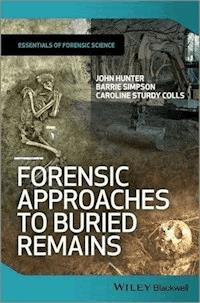
The field of forensic archaeology has developed over recent years from being a branch of conventional archaeology into a well-established discipline in its own right. Forensic Approaches to Buried Remains takes an innovative approach to the subject by placing the role of the forensic archaeologist within the wider forensic environment; it identifies new areas of interdisciplinary research and practice, and evaluates practical difficulties.
The authors see this book as a reflection of the subject’s development, and as a knowledge base for the next generation of forensic archaeologists. Areas covered include:
- Search logistics, integration and specialist search scenarios
- Levels of confidence in site search and elimination
- Urban and rural landscape reconstruction in both short and long term cases
- The integration of cadaver dogs and earth-moving machinery
- The recovery of multiple evidence types
- Sampling strategies, spatial relevance and dating
- Multiple burial scenarios
As part of the Essential Forensic Science book series this book will provide students and practitioners alike with an invaluable resource outlining both the major developments in the discipline, as well as original approaches to the search for, and recovery of buried remains.
Sie lesen das E-Book in den Legimi-Apps auf:
Seitenzahl: 580
Veröffentlichungsjahr: 2013
Ähnliche


















Contents
Cover
Title Page
Copyright
List of Figures
Series Foreword
Essentials of Forensic Science
Preface and Acknowledgements
The Authors
About the Companion Website
Chapter 1: An Introduction to Buried Remains
1.1 Questions of Time
1.2 Questions of Interpretation
1.3 Forensic Archaeology
1.4 Legal Issues and Procedures
1.5 Decay Dynamic
1.6 Search Methods and Adaptations
1.7 Recovery Methods and Adaptation
1.8 Mass Graves
Chapter 2: Search Theory and the Landscape
2.1 The Theory
2.2 Landscape Mapping
2.3 Remote Sensing
Chapter 3: Search Application
3.1 Geophysical Survey
3.2 Cadaver Dogs
3.3 Mechanical Excavation
3.4 Bodies in Aqueous Environments
Chapter 4: Search Design
4.1 Search Design
4.2 Interrogating Landscapes
4.3 Balancing Probabilities
Chapter 5: Longer-Term ‘No Body’ Cases
5.1 Introduction
5.2 History of Cold Case Investigation
5.3 Cultural Changes to Rural Landscapes
5.4 Natural Changes to Rural Landscapes
5.5 Planning Controls and Building Controls
5.6 Current Planning Arrangements
5.7 Planning Records
5.8 Building Records
5.9 Special Circumstances
5.10 Landfill Sites and Waste Disposal
Chapter 6: Recovery, Stratigraphy and Destruction
6.1 Stratigraphy
6.2 The Destructive Process
Appendix: The Forensic Archaeologist's Report (Taken from Section 7 of the Standards and Guidance for Forensic Archaeologists)
Chapter 7: Recovery, Sampling and Dating
7.1 Sieving
7.2 Sampling and Forensic Ecology
7.3 Essential Taphonomics
7.4 Physical Anthropology, Recovery and Surface Scatters
7.5 Dating
Chapter 8: The Investigation of Multiple Burials
8.1 Diversity and Challenges
8.2 Developments
8.3 Interrogating the Evidence
8.4 The Aftermath of Conflict
8.5 Politics and Religion
8.6 Archives for History
Bibliography
Index
This edition first published 2013 © 2013 by John Wiley & Sons, Ltd
Wiley Blackwell is an imprint of John Wiley & Sons, formed by the merger of Wiley's global Scientific, Technical and Medical business with Blackwell Publishing.
Registered office:John Wiley & Sons, Ltd, The Atrium, Southern Gate, Chichester, West Sussex, PO19 8SQ, UK
Editorial offices:9600 Garsington Road, Oxford, OX4 2DQ, UK The Atrium, Southern Gate, Chichester, West Sussex, PO19 8SQ, UK 111 River Street, Hoboken, NJ 07030-5774, USA
For details of our global editorial offices, for customer services and for information about how to apply for permission to reuse the copyright material in this book please see our website at www.wiley.com/wiley-blackwell.
The right of the author to be identified as the author of this work has been asserted in accordance with the UK Copyright, Designs and Patents Act 1988.
All rights reserved. No part of this publication may be reproduced, stored in a retrieval system, or transmitted, in any form or by any means, electronic, mechanical, photocopying, recording or otherwise, except as permitted by the UK Copyright, Designs and Patents Act 1988, without the prior permission of the publisher.
Designations used by companies to distinguish their products are often claimed as trademarks. All brand names and product names used in this book are trade names, service marks, trademarks or registered trademarks of their respective owners. The publisher is not associated with any product or vendor mentioned in this book.
Limit of Liability/Disclaimer of Warranty: While the publisher and author(s) have used their best efforts in preparing this book, they make no representations or warranties with respect to the accuracy or completeness of the contents of this book and specifically disclaim any implied warranties of merchantability or fitness for a particular purpose. It is sold on the understanding that the publisher is not engaged in rendering professional services and neither the publisher nor the author shall be liable for damages arising herefrom. If professional advice or other expert assistance is required, the services of a competent professional should be sought.
Library of Congress Cataloging-in-Publication Data
Hunter, John. Forensic approaches to buried remains / John Hunter, Barrie Simpson and Caroline Sturdy Colls. pages cm Includes bibliographical references and index. ISBN 978-0-470-66630-2 (cloth) -- ISBN 978-0-470-66629-6 (pbk.) 1. Forensic sciences. 2. Forensic anthropology. 3. Criminal investigation. I. Title. HV8073.H8936 2014 363.25--dc23 2013015040
A catalogue record for this book is available from the British Library.
Wiley also publishes its books in a variety of electronic formats. Some content that appears in print may not be available in electronic books.
List of figures
1.1Example of an archaeological matrix of layers during excavation.1.2A grave requiring both archaeological and anthropological attention.1.3Example of adipocere formation.1.4The use of heavy machinery in searching for burials.1.5Typical scale plan of half-sectioned grave.1.6A site plan using local fixed points.1.7Mass grave excavation (top) and detail of commingling (bottom).2.1Excavation of the concrete floor of a barn marked out on a common grid resulting from GPR responses.2.2The so-called ‘Moors Murders’.2.3Overlying maps showing current and ‘historic’ landscape features for breaking down into domains.2.4Large scale maps of (top) a rural area and (bottom) an urban area used in the recovery of missing persons.2.5Examples of different scaled maps illustrating differences in detail.2.6Examples of computer-generated digital terrain models (DTMs) of the Trent Valley.2.7Superimposition of aerial photographs.2.8Plan showing discrepancy between sites identified under different conditions.2.9Example of a LiDAR image which captures subtle topographic change on the ground surface.2.10Four LiDAR images of the same landscape showing the effects of different computer-generated lighting angles.2.11LiDAR images showing an unfiltered (top) and filtered (bottom) landscape.2.12Surveying using GPS.3.1Two geophysical survey systems operating within a grid system.3.2Typical radargrams (vertical slices) across known grave sites showing the effects of different antenna frequencies.3.3Resistivity plots showing areas of higher (lighter) and lower (darker) resistance.3.4Three-dimensional view of mass grave generated using electrical resistance tomography.3.5Recommended phases of search for cadaver dogs.3.6Examples illustrating the potential travel of scent according to landscape and water coursing.3.7Three-dimensional model of moorland landscape from a ground penetrating radar survey showing wettest areas and underground water coursing.3.8Careful machine stripping of surface layers in order to identify disturbances cut into undisturbed substrates.3.9Removal of surface deposits clearly illustrates (top) the badly concealed burial of contaminated waste and (bottom) the remains of an earlier excavation.4.1Venting and drilling through concrete in order to vent a GPR response for cadaver dog attention.4.2Careful trowelling in order to identify a possible disturbance caused by a burial during the construction of a pipe line.4.3The use of a machine (Stage 4) in the search for the garden sub-soil of a demolished building.4.4Careful excavation at the edge of woodland in difficult wet conditions resulting in the recovery of a plastic bag containing neonatal remains.4.5Hypothetical example of use of ‘RAG’ analysis of landscape.4.6Excavation of quarry showing stratigraphic removal of fill using heavy machinery.4.7Investigation of a defined area of land showing (top) systematic venting for dogs (Stage 3) and (bottom) careful excavation and sampling of area of burning (Stage 4).4.8Illustration showing grave marked by bricks (top left), identification of grave cut (top right) and fully excavated grave (bottom).5.1Police and a pathologist recovering the remains of buried victims in Jersey.5.2Comparison of photograph taken in the 1960s (top) and in 2012 (bottom).5.3Changes in the erosion patterns of moorland peat exposure.5.4Human remains discovered as a result of coastal erosion.5.5Human remains discovered as a result of coastal erosion of sand dune.5.6A woodland search showing (top) area of interest and (bottom) location of buried container.5.7Aerial photograph of field containing manure heap.5.8Flow chart for searching locally based planning and building documentation.5.9Flow chart for searching potential landfill disposal sites.6.1Half-section of grave stratigraphy.6.2A CSI being trained to recognise the grave edges.6.3Half-section of grave.6.4Grave in woodland.6.5The use of small implements to recover trace evidence.6.6Excavation using a part-pedestal method, in this case necessitated by the presence of a high water table.6.7Spade marks identified on a root from the digging of the grave.6.8Excavation of grave in cellar.6.9Archaeologists excavating in the fire debris at Windsor Castle.6.10The stratigraphic collapse of a country house containing three victims.6.11The seat of successive bonfires.6.12The archaeological recovery of a coffin from an established graveyard.6.13Example of possible forensic record sheet (front).6.14Example of possible forensic record sheet (back).6.15Example of measured drawing through grave showing location of individual numbered spits.6.16Outline of grid and sketch of position of body for recording and examination of surface remains.6.17A typical stone by stone plan of an archaeological site showing two phases of an Iron Age building.6.18S76 is a typical section through an archaeological site.6.19A photograph of the same archaeological features shown in Figure 6.17 during excavation.6.20Recording of a crime scene using a total station instrument.6.21Stages of an excavation from a fixed camera position.7.1Wet sieving being undertaken using a hose pipe to break down heavy soils in looking for neonatal remains.7.2An example of a sieving record sheet for the recovery of forensic remains.7.3An example of a summary finds (exhibits) record sheet for the recovery of forensic remains.7.4Outline life cycle stages (instar) of the blowfly.7.5The exposure of the upper part of a human skeleton during building operations.7.6Simplified section through a ditch and ditch recutting at Cheddar, Somerset.7.7Diagram illustrating the ‘bomb curve’ and its value in identifying whether remains are of forensic interest or not.7.8Human remains unearthed by a mechanical excavator during building operations.8.1Vegetation change evidenced by tall weeds in the middle ground over a mass grave.8.2Aerial image showing ground scarring caused by mass grave in Bosnia and Herzegovina.8.3A digital terrain model (DTM) showing the location of mass graves in Bosnia.8.4Part of a secondary mass grave containing commingled remains and personal belongings.8.5A memorial service at a mass grave in the Ukraine.8.6A dilapidated Jewish cemetery in Poland.Series foreword
Essentials of forensic science
The world of forensic science is changing at a very fast pace in terms of the provision of forensic science services, the development of technologies and knowledge and the interpretation of analytical and other data as it is applied within forensic practice. Practicing forensic scientists are constantly striving to deliver the very best for the judicial process and as such need a reliable and robust knowledge base within their diverse disciplines. It is hoped that this book series will provide a resource by which such knowledge can be underpinned for both students and practitioners of forensic science alike.
It is the objective of this book series to provide a valuable resource for forensic science practitioners, educators and others in that regard. The books developed and published within this series come from some of the leading researchers and practitioners in their fields and will provide essential and relevant information to the reader.
Professor Niamh Nic Daéid Series Editor
Preface and acknowledgements
Forensic archaeology is no longer new and this book follows from two previous books by this co-author in that it attempts to be more evaluative than prescriptive in its content, resting on some 25 years' experience of working with police forces and other law enforcement agencies in finding and recovering buried bodies. The first two books (Hunter et al. 1996; Hunter and Cox 2005) were very much mission-based in a subject that was still a relatively novel area. This book, we anticipate, moves the subject a step further: it demonstrates that theory and practice are not always compatible; that it is rarely a perfect world, and that there are inevitably political, processual and contextual external forces that an objective textbook can rarely take into account. It seemed appropriate that after 25 years of experience there was much that might be set out for the benefit of future workers in the field, even if some of the comments might not be universally popular. Forensic archaeology has three masters: the academic world in which the rigours of the subject require credibility; the standards of a professional archaeological community as laid down by the Institute for Archaeologists (IfA); and the legal obligations that are tied into the complexities and processes of any crime scene operation and court room appearance. They are not always happy bedfellows. In fact, in the wider context of forensic investigation, the subject is not longer really about archaeology at all, although archaeology remains its theoretical core. Moreover, in 25 years of practice the forensic world has moved on, the role (and definition) of the ‘expert’ has changed significantly, controls are more rigid, and the range and types of evidence have expanded.
In pulling the various strands of this book together I have been aided immeasurably by my co-authors Barrie Simpson and Caroline Sturdy Colls; all three of us have different backgrounds and experiences and we felt that the volume would be more balanced and informative as a result. Time will tell. The first of the eight chapters is very much an introduction: it provides a broad overview of the subject area and will be particularly suited to students or the general reader interested in seeing the nature and breadth of the subject, and perhaps pursuing elements of it. The subsequent three chapters (Chapters 2–4) consider search theory (mapping, GIS and remote sensing), search application (geophysics, cadaver dogs, mechanical excavation and water search) and search design (boundaries, landscape interrogation and probabilities) respectively. Chapter 5 explores the less well-trodden route of longer-term ‘no-body’ investigations and the effects of both natural and cultural forces over time. This is also extended to urban environments (planning and building controls) as well as burials grounds and landfill sites. Chapter 6 (Stratification and Destruction) and Chapter 7 (Recovery, Sampling and Dating) are focused on recovery once the body has been located. The former includes fire scenes, formal exhumations and record systems, and the latter sieving, taphonomy, anthropology and scavenging. Finally, Chapter 8 reviews mass graves, not so much from a technical, practical perspective, but from the point of view of social history, and from the need to learn from previous experiences, notably the Holocaust.
The diversity of themes and interests covered by the book required us to seek external support and advice to ensure accuracy of content. Not least here was generous advice given by Colin Hope (National Search Advisor) who kindly commented on various search chapters, Cecily Cropper (formerly of EULEX) on various aspects including mass graves, Dave Cowley (RCAHMS) on remote prospection, Dr Dave Lucy (University of Lancaster) on statistics and probabilities, Dr Lucina Hackman (University of Dundee) on anthropology, and Dr Richard Wright (mass graves). We are indebted to their advice, and also to Dr John Manlove, Kathy Manlove, Dr Anna Sandiford and Sam Pickles (all from MFL Forensics) who advised on the entomology and pollen sections, Mick Swindells (Search Dogs UK) for his advice on the training and deployment of cadaver dogs, and Jon Sterenberg whose knowledge on the use of heavy plant and machinery on excavations is second to none. Brian Kerr (English Heritage) generously provided information on the archaeological work undertaken in the aftermath of the fire at Windsor Castle, and help on particular case studies was given by Julie Roberts (Cellmark), Corrine Duhig and Dr Karl Harrison (Cranfield University). In places we drew heavily on some excellent postgraduate dissertations/theses many of which are wholly underestimated in their forensic value; these included works by Vicki Gray (hair and fibres), Theresa Farren (geographical profiling), Nadine Ross (sieving) and Sara Turton (scavenging). Their efforts have all entered the mix and we trust we have not misquoted or misrepresented them. We have also taxed several of our colleagues about various issues and are grateful for their views and knowledge, notably Paul Cheetham, Rob Janaway, Geoff Knufper, Steve Litherland, Dr Barry Meatyard, staff of the Missing Persons Bureau (NPIA) and Alastair Ruffell.
Acknowledgements and permissions for specific images are noted in the individual captions, but the authors would like to offer specific thanks to Andrew Graham and Graeme Cavers from AOC Scotland for allowing us to use their LiDAR images, to both Stratascan and Malcolm Weale for their geophysics images, to Zoltan Czajlik for his aerial image, and to Duncan Staff for his research and images on the ‘Moors Murders’. A number of line drawings have benefitted significantly from the work of Henry Buglass (formerly the University of Birmingham) and Rosie Duncan (Forensic and Crime Science Department, Staffordshire University); we are also grateful to Kevin Colls who supplied a number of images and also assisted in the proof-reading.
Any volume of this type that contains case studies requires permissions from various police forces and Senior Investigating Officers. Many case studies have been ‘anonymised’ in order to facilitate this and, although some elements of individual cases have been changed in order to prevent recognition, the thrust of the principle or lesson from each one has been left unaltered. Permissions have been gratefully received from the following Police Forces: Cumbria, Gloucestershire, Humberside, Metropolitan, Northern, Nottinghamshire, South Wales, Tayside, Thames Valley, West Mercia, West Midlands and Wiltshire.
Last, but by no means least, we would like to thank Fiona Seymour at Wiley and Sons for her tolerance, patience and understanding during the preparation of this book. We hope she likes the result.
John Hunter Tysoe, WarwickshireFebruary 2013
The authors
John Hunter OBE BA PhD FSA MIFA FFSSoc was appointed Professor of Ancient History and Archaeology at the University of Birmingham in 1996. Apart from following an extensive scheme of research excavation and survey in Scotland, he began to develop forensic archaeology in 1988, He is involved operationally throughout the UK, has also worked in Bosnia, Iraq and the Falklands and routinely lectures to police and forensic professionals. He helped found the Forensic Search Advisory Group, was a lead assessor for the CRFP and was primary in setting up the current validation system for forensic archaeology. His publications, including ten books, cover a range of archaeological and forensic topics. He is a Royal Commissioner on the Ancient and Historical Monuments of Scotland, an appointee of the Cathedral Fabrics Commission for England at Worcester Cathedral and sits on several public and editorial committees. In 2011 he was awarded an OBE for services to scholarship.
Barrie Simpson BA MSc MSc MIFA MFSSoc is a former Senior Investigating Officer (SIO) and active forensic practitioner. He has a keen interest in landscape archaeology and holds MSc degrees in both forensic archaeology and forensic and biological anthropology. As an SIO he encouraged their use within the police service and became the Police Liaison with the Forensic Search Advisory Group (FSAG). He is a strong advocate of crime scene analysis and the use of interdisciplinary approaches. On retirement from police service he has worked for many years operationally within the UK, and additionally in the Western Balkans, Iraq, on Ascension Island and Thailand. He has been involved in the development of forensic archaeology, initially as secretary of the Forensic Search Advisory Group and, more recently, as the secretary setting up the current validation system for forensic archaeology within UK.
Caroline Sturdy Colls BA MPhil PhD AIFA is a Lecturer in Forensic Investigation at Staffordshire University, specialising in forensic and conflict archaeology. She is also a consultant forensic archaeologist, working throughout the United Kingdom and is a committee member of the IfA Forensic Archaeology Special Interest Group. Having completed her PhD at the Institute of Archaeology and Antiquity at the University of Birmingham in the area of Holocaust Archaeology she continues to research this area and has undertaken the first archaeological surveys of the former extermination camp at Treblinka (Poland), the sites pertaining to the slave labour programme in Alderney (the Channel Islands), and the former Semlin Judenlager and Anhaltelager (Belgrade, Serbia). Her other research interests lie in the application of forensic archaeological methods to the investigation of cold cases and socio-historic conflicts. She has a number of publications in these areas.
The three authors are consultants with MFL Forensics Ltd based in Wantage, Oxfordshire.
The authors seen here on a potential crime scene: John Hunter (left), Barrie Simpson (right) and Caroline Sturdy Colls (centre).
About the companion website
This book is accompanied by a companion website:
www.wiley.com/go/hunter/forensicremains
The website includes powerpoints of all figures from the book for downloading.
1
An introduction to buried remains
1.1 Questions of time
This is a book that deals specifically with buried remains of forensic interest – that is, remains which are germane to a modern criminal investigation; it is about finding these remains and recovering them. It is a book about clandestine burials and concealment, about what can influence search and recovery processes, and about what matters in a forensic sense. It is not a prescriptive manual or a set of standard operating procedures (SOPs) for the specialists involved. The Senior Investigating Officer (SIO) will not find a useful set of ‘tick boxes’ that will guarantee a successful enquiry; nor will the Crime Scene Manager (CSM) find a list of actions that a proper investigation ought to undertake. This book tries to examine how different subject areas interact when it comes to investigating the modern buried past. Successful forensic excavation requires awareness of the component evidential elements and what they signify, together with an understanding of formation processes and how to interpret them. Thus, this is a book about questioning, not about giving answers. This first chapter provides a general introduction to the chapters that follow.
Strictly, the word ‘archaeology’ is a misnomer in a forensic context because the subject of interest, although buried, is not ‘ancient’, which is the usual definition of the discipline. That said, the phrase ‘forensic archaeology’ appears to have become well cemented in forensic literature as well as within archaeological circles, and so this is the phrase used throughout this book. In any event, the approaches to studying ‘ancient’ (archaeological) buried remains and those used to investigate in a modern buried forensic context are largely the same. It matters not whether concealment in the ground occurred yesterday morning or in prehistoric times thousands of years ago. Not only are the processes of finding and recovering evidence from these two chronological extremes much the same, but the methods we use to make sense of that evidence are substantially the same too. It is not really the extent of elapsed time between then and now that is the issue (although it would be incorrect to maintain that it had no effect at all), but the critical difference that lies in the questioning or interrogation of the evidence recovered according to the answers needed.
Lesen Sie weiter in der vollständigen Ausgabe!
Lesen Sie weiter in der vollständigen Ausgabe!
Lesen Sie weiter in der vollständigen Ausgabe!
Lesen Sie weiter in der vollständigen Ausgabe!
Lesen Sie weiter in der vollständigen Ausgabe!
Lesen Sie weiter in der vollständigen Ausgabe!
Lesen Sie weiter in der vollständigen Ausgabe!
Lesen Sie weiter in der vollständigen Ausgabe!
Lesen Sie weiter in der vollständigen Ausgabe!




