


58,99 €
Mehr erfahren.
- Herausgeber: John Wiley & Sons
- Kategorie: Geisteswissenschaft
- Sprache: Englisch
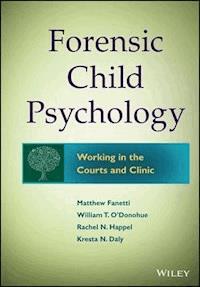
A guide to working effectively with children in the criminal justice system Uniquely designed to train psychology, criminology, and social work students to work with children in the criminal justice system--both in the courtroom and as clinical clients--Forensic Child Psychology presents current research and practice-based knowledge to improve the judicial and child welfare systems. Authors Matthew Fanetti, William T. O'Donohue, Rachel N. Happel, and Kresta N. Daly bring their combined expertise in child psychology, forensic interviewing, and criminal prosecution to bear on the process of obtaining accurate information from children involved in legal proceedings, preparing professionals to work with: * Children who are victims of crime * Children who are perpetrators of crime * Children who are witnesses of crime The book also covers related topics, including mandated reporting, the structure of juvenile justice and advocacy systems, and contains sidebars, summaries, glossaries, and study questions to assist with material mastery. This is an excellent resource for students of child psychopathology in psychology, social work, nursing, and criminal justice at the graduate and late undergraduate stage of their educations.
Sie lesen das E-Book in den Legimi-Apps auf:
Seitenzahl: 704
Veröffentlichungsjahr: 2014
Ähnliche




















Table of Contents
Title Page
Copyright
Preface
Acknowledgments
Part I: Basic Principles
Chapter 1: Introduction to Forensic Psychology
What Is Psychology—Really?
Important Historical Developments in the Field of Forensic Psychology
Study Questions
Glossary
References
Chapter 2: Social and Behavioral Psychology
Social Psychology
Obedience
Conformity
Deindividuation and Social Role-Playing
Group Polarization
Social Loafing and Nonresponders
Attribution
Prejudice and Discrimination
Learning and Behavior
Dual-Process Theory
Schedules of Reinforcement
Study Questions
Glossary
References
Chapter 3: Understanding Psychopathology and Disruptive Behavior
What Is a Psychological Disorder?
Potential Causes of Mental Disorders
Diagnostic Systems and Methods
The
DSM
System
Developmental Pathways
Violent and Disruptive Behavior in Children
Dimensions of Disruptive Behavior
Patterson's Early Starter Model
Risk and Resilience
Ecological Systems Theory
Disorders of Interest to Forensic Professionals Who Work With Children
Study Questions
Glossary
References
Chapter 4: Memory
What Is Memory?
Information Processing Model
Depth of Processing Model of Memory
The Reconstructive Model of Memory
Context and State Effects on Memory
Interference
Memory Accuracy and Developmental Differences
Seminal Studies of Suggestibility in Child Event Memory
Summary Thoughts About Children's Memory of Forensic Events
Review Questions
Glossary
References
Part II: Applied Principles in Child Abuse
Chapter 5: Child Abuse and Neglect
Introduction to Child Abuse and Neglect
Neglect
Child Physical Abuse
Child Sexual Abuse
Intimate Partner Violence
Study Questions
Glossary
References
Chapter 6: Internet Exploitation of Children
Internet Exploitation and Exposure
Sexual Solicitation
Sexting
Evolution of Internet Exploitation and Technology
Victims of Internet Exploitation Crimes
Perpetrators of Internet Exploitation Crimes
Child Pornography Debate
Applications for Smartphones and Tablets
Geotagging
Legal Issues With Internet Exploitation Crimes
Evidence Collection
Where Do We Go From Here?
Study Questions
Glossary
References
Chapter 7: Process of Forensic Interviewing
Multidisciplinary Teams
Forensic Interview Considerations
Suggestibility
Trauma and Memory
Techniques and Other Considerations
Forensic Interviewing Protocols
Truth/Lie Discussion
Media for Interviewing Children
Drawings
Anatomical/Human Figure Drawings
Anatomical Dolls
Study Questions
Glossary
References
Chapter 8: Understanding Pedophilia
The Other Paraphilias
Are the
DSM-5
Diagnostic Criteria for Pedophilia Clear?
Age and Physiological Development
What Makes Pedophilia Abnormal?
An Important Distinction: The Difference Between a “Child Sexual Abuser” and a “Pedophile”
How Will a Pedophile Behave?
What Causes Pedophilia?
How Is Pedophilia Diagnosed?
A Bit More About the Major Assessment Techniques
Reporting Requirement
How Is Pedophilia Treated?
Can Sex Offenders Be Treated Through Medications?
Other Important Issues
Study Questions
Glossary
References
Chapter 9: The Treatment of the Sexually Abused Child
The Category of “Sexually Abused Child”
What Kinds of Reactions Do Children Have to Sexual Abuse?
What Is Not Known
Clinical Assessment and Diagnosis
What an Assessment of a Sexually Abused Child Might Look Like
Conclusions and Informing Session
Evidence-Based Treatment
Treatment Protocols for Cases of Sexual and Physical Abuse
Conclusions
Study Questions
Glossary
References
Part III: Understanding the Law
Chapter 10: Understanding What It Is to Be an Expert Witness
Basic Information and the Legal System in the United States
Advice for the Expert Witness
Other Miscellaneous Issues
An Example of an Expert Report Used as Evidence
Study Questions
Glossary
References
Chapter 11: An Overview of the U.S. Legal System
Fundamentals of the U.S. Legal System
State Law and Federal Law
Civil Versus Criminal Courts
State Versus Federal Jurisdiction
The Professional Parties
Burdens of Proof
Basic Procedure in Civil Cases
Basic Procedure in Criminal Cases
Criminal Sentences
Collateral Consequences of Felony Convictions
Crimes Children Should Know About
Victims' Rights
Conclusion
Study Questions
Glossary
Chapter 12: Mandated Reporters
Basic Legal Principles
Who Is a Mandated Reporter?
What Triggers a Report?
What Mandated Reporters Are Required to Report
What Is Abuse and Neglect?
Privileged or Confidential Information
How Do Mandated Reporters Make a Report?
Common Reasons Mandated Reporters Do Not Report
When Am I Supposed to Make a Report?
What Information Do I Provide to the Hotline Call Taker?
What Happens After a Report Is Made?
Conclusion
Study Questions
Glossary
References
Chapter 13: Juveniles and the Justice System
Overview
Juvenile Delinquency
The Petition
Juvenile Dependency
Conclusion
Study Questions
Glossary
References
Author Index
Subject Index
End User License Agreement
Pages
iv
vii
viii
ix
iii
3
4
5
6
7
8
9
10
11
12
13
14
15
16
17
18
19
20
21
22
23
24
25
26
27
29
30
31
32
33
34
35
36
37
38
39
40
41
42
43
44
45
46
47
48
49
50
51
52
53
54
55
57
58
59
60
61
62
63
64
65
66
67
68
69
70
71
72
73
74
75
76
77
78
79
80
81
83
84
85
86
87
88
89
90
91
92
93
94
95
96
97
98
99
100
101
102
105
106
107
108
109
110
111
112
113
114
115
116
117
118
119
120
121
122
123
124
125
126
127
128
129
130
131
132
133
134
135
136
137
138
139
140
141
142
143
144
145
146
147
148
149
150
151
152
153
154
155
156
157
158
159
160
161
162
163
164
165
167
168
169
170
171
172
173
174
175
176
177
178
179
180
181
182
183
184
185
186
187
189
190
191
192
193
194
195
196
197
198
199
200
201
202
203
204
205
206
207
208
209
210
211
212
213
214
215
216
217
218
221
222
223
224
225
226
227
228
229
230
231
232
233
234
235
236
237
238
239
241
242
243
244
245
246
247
248
249
250
251
252
253
254
255
256
257
258
259
260
261
262
263
265
266
267
268
269
270
271
272
273
274
275
276
277
278
279
280
281
282
283
284
285
286
287
288
289
290
291
292
293
294
295
296
297
298
299
300
301
302
303
304
305
306
307
308
309
310
315
316
317
318
319
320
321
322
323
324
325
326
327
328
329
330
331
332
333
334
335
336
337
338
339
311
312
313
314
Guide
Cover
Table of Contents
Part I: Basic Principles
Begin Reading
List of Illustrations
Figure 3.1
Figure 3.2
Figure 3.3
List of Tables
Table 2.1
Table 9.1
Forensic Child Psychology Working in the Courts and Clinic
Matthew Fanetti
William O'Donohue
Rachel Fondren Happel
Kresta Daly
Cover image: © iStockphoto/jammydesign
Cover design: Wiley
This book is printed on acid-free paper .
Copyright © 2015 by John Wiley & Sons, Inc. All rights reserved.
Published by John Wiley & Sons, Inc., Hoboken, New Jersey.
Published simultaneously in Canada.
No part of this publication may be reproduced, stored in a retrieval system, or transmitted in any form or by any means, electronic, mechanical, photocopying, recording, scanning, or otherwise, except as permitted under Section 107 or 108 of the 1976 United States Copyright Act, without either the prior written permission of the Publisher, or authorization through payment of the appropriate per-copy fee to the Copyright Clearance Center, Inc., 222 Rosewood Drive, Danvers, MA 01923, (978) 750-8400, fax (978) 646-8600, or on the web at www.copyright.com. Requests to the Publisher for permission should be addressed to the Permissions Department, John Wiley & Sons, Inc., 111 River Street, Hoboken, NJ 07030, (201) 748-6011, fax (201) 748-6008.
Limit of Liability/Disclaimer of Warranty: While the publisher and authors have used their best efforts in preparing this book, they make no representations or warranties with respect to the accuracy or completeness of the contents of this book and specifically disclaim any implied warranties of merchantability or fitness for a particular purpose. No warranty may be created or extended by sales representatives or written sales materials. The advice and strategies contained herein may not be suitable for your situation. You should consult with a professional where appropriate. Neither the publisher nor authors shall be liable for any loss of profit or any other commercial damages, including but not limited to special, incidental, consequential, or other damages.
This publication is designed to provide accurate and authoritative information in regard to the subject matter covered. It is sold with the understanding that the publisher is not engaged in rendering professional services. If legal, accounting, medical, psychological or any other expert assistance is required, the services of a competent professional person should be sought. The views and opinions presented in this book are solely those of the authors and do not necessarily represent those of the Federal Bureau of Investigation.
Designations used by companies to distinguish their products are often claimed as trademarks. In all instances where John Wiley & Sons, Inc. is aware of a claim, the product names appear in initial capital or all capital letters. Readers, however, should contact the appropriate companies for more complete information regarding trademarks and registration.
For general information on our other products and services please contact our Customer Care Department within the United States at (800) 762-2974, outside the United States at (317) 572-3993 or fax (317) 572-4002.
Wiley publishes in a variety of print and electronic formats and by print-on-demand. Some material included with standard print versions of this book may not be included in e-books or in print-on-demand. If this book refers to media such as a CD or DVD that is not included in the version you purchased, you may download this material at http://booksupport.wiley.com. For more information about Wiley products, visit www.wiley.com.
ISBN 978-1-118-27320-3 (print)
ISBN 978-1-118-42115-4 (e-Pub)
ISBN 978-1-118-41958-8 (ePDF)
ISBN 978-1-118-65231-2 (e-Mobi)
Preface
The field of forensic psychology has grown slowly over the past century. From the early debates by Hugo Munsterberg and Sigmund Freud that psychology should play a larger role in the legal system, to the use of psychology in advocating the elimination of segregation in schools in the U.S. Supreme Court case Brown v. Board of Education, psychology has struggled to help legal decision makers be better informed. The past five decades have seen an exponential growth in the use of scientific research to answer important questions in forensics, from matters such as bystander inaction to the strengths and frailties of the memories of eyewitnesses. In the 1990s, psychology responded to a rash of well-publicized day-care child sexual abuse scandals, with a push for scientific understanding of children's allegations of sexual abuse. In just 25 years, the applied field of child sexual abuse assessment has come from an ad hoc and unstandardized approach to assessment, characterized by wild disagreements and untrained assessors, to a (mostly) highly controlled approach, which is informed by research with an aim to understand and reduce error. In our estimation, this is a very desirable outcome of mere decades. Psychology can work with the applied community and it can help to work toward better responses to real problems. Ultimately, this was the position of Munsterberg and Freud, though the field at the time was not ready to provide the necessary support.
College instructors today have an interesting problem: finding a text that supports the goals of their classes in forensic psychology. Unlike courses such as the typical general Introduction to Psychology experience (for which available texts are plentiful and varied), undergraduate texts in forensic psychology are rare. Even worse, those with a focus on child issues are even more rare. Compound this with the fact that most available texts are written for students with strong backgrounds in psychology (or graduate students and professors in psychology) and what does an instructor do for a forensic psychology course filled with sophomores in social work, criminology, nursing, premed, and so on? These students need to understand some basic principles, because these principles affect an everyday working environment. However, many students do not have sufficient background in psychology to use an advanced forensic psychology text. Furthermore, they have little need of many of the specific topics discussed in those texts.
The overarching goal of this text is to provide an accessible and basic examination of psychology and law pertaining to children so that students who will enter into the workforce with need of this kind of information will be better prepared. We have focused on writing style and ease of use. Rather than a text that explores every permutation of every relevant concept, we focus on a clear and well-explained iteration of basic ideas. The goal is clarity and understanding, not comprehensive depth.
The first focus of the text is a basic review of some concepts in psychology that may be important to those who actually work in forensic environments, including (1) why psychology is a science and why that is important, (2) relevant social and learning psychology, (3) relevant psychopathology, and (4) basic concepts in memory as applied to forensics.
The second focus of the text is an examination of specific topics and concepts related to child forensics, including (1) an overview of child abuse and exploitation, (2) child abuse in the modern technological world, (3) pedophilia and child molestation, (4) assessment of child sexual abuse, and (5) treatment of children who have been abused.
The third and final focus of this text is to provide a basic understanding of the legal world related to child forensics, including (1) basic concepts in law, (2) mandated reporting, (3) juvenile justice systems, and (4) the role of psychological expert witnesses in child abuse cases.
Ultimately, we hope that the text provides a sound framework for building new courses that are specifically designed for those who will be working directly with children. We are hoping to have built an accessible entry point into the field for some and an understandable set of working principles for others.
We welcome feedback about how to revise this text to help serve the needs of instructors and working professionals. We would also welcome inquiries from instructors hoping to create courses in forensic child psychology. The process may be easier than you think, and finding community resources to assist in the endeavor is often a productive way to engage a department in the public affairs of its own community. Our team has been able to enlist the support of (and directly include) powerful community agencies that can rally around a common goal: to make our professionals more effective and thus strengthen the fight against child abuse.
For correspondence:Matthew Fanetti, PhDProfessorCoordinator of Child Forensic Psychology CertificationDepartment of PsychologyMissouri State UniversitySpringfield, MO [email protected]
Acknowledgments
The authors wish to acknowledge the Greene County (Missouri) Prosecutor's Office and the Child Advocacy Center of Springfield (Missouri), Inc., for the leadership they have provided in the cause of safeguarding our children. Specifically, Darrell Moore, Dan Patterson, Jill Patterson, and Barbara Brown-Johnson have been instrumental in bringing valuable resources together in this effort and heroically dedicated to the never-ending fight against child abuse.
Many thanks also go to the research assistants in the Forensic Child Psychology Laboratory at Missouri State University who participated in the development of this textbook. Specifically, we would like to acknowledge the hard work and the contributions of Tabitha Carwile, Shannon Nicholson, Emily Rader, Rebecca Pearson, Katie Plasmeier, Jamie Thayer, Mariah Turner, and Kathy Robitsch.
Finally, we also wish to acknowledge the Sacramento Children's Receiving Home for the care and compassion they provide in helping victims of abuse and neglect.
Part IBasic Principles
Chapter 1Introduction to Forensic Psychology
Goals of this chapter:
To understand the basic definitions, development, and role of psychology as a
science
.
To explore the important social events that caused the focus on forensics in psychology.
To understand the broad range of activities a forensic psychologist might engage.
Within the past few decades the label forensic psychology has become more common than it might have been prior to the 1980s. Within the past decade, more researchers and practicing professionals may be using the more specific label forensic child psychology. A quick review of articles listed in PsycInfo revealed that articles containing the keywords “forensic psychology” increased from 156 during the 1960s to 8,117 during the 2000s. A similar review using the keywords “Child” (and) “Forensic Psychology” increased from 9 during the 1960s to 1,395 during the 2000s. But what exactly are these fields of study and practice? The most direct definition of forensic psychology is: the study of human behavior in legal settings or relevant legal environments. The most direct definition of forensic child psychology is: the study of the behavior of children in legal settings or relevant legal environments. However, there are many nuances to these studies.
Most people have probably heard these terms from their growing utilization in the entertainment media. From these experiences, many people may come to believe that forensic psychology is dedicated to understanding the causes of criminal behavior—and they would not be wrong. However, the field is much broader than this very narrow sliver of interest.
Even the word forensic has different implications in various fields. For example, in 1997 this author (Fanetti) was visiting with a law enforcement division that specialized in sex crimes against children. Upon meeting and exchanging introductions, one of the detectives presented a quizzical facial expression when he heard the specialty. After learning what we actually researched, he smiled and said he had thought that “forensic child psychology” meant that we tried to study the behavior of dead children. For them, forensics meant post-mortem.
Many of the students who use this text may not actually be psychology students. The goal of the text has always been to reach every frontline professional who interacts with children on a daily basis. This includes teachers, counselors, social workers, nurses, law enforcement officers, juvenile officers, direct therapists, court personnel, to name just a few. It is these people who become the first line of intervention when children become part of the legal (i.e., forensic) system. These children may be the victims of crime, witnesses to it, or even the perpetrators of the crime. In these scenarios, the way that professionals interact with children can make the difference between cases that are resolved well and justly, and those in which justice becomes confused or difficult to obtain. For example, when witnesses testify that they saw a specific person at a crime scene, but later details reveal that they were not sure until the person was pointed out by law enforcement, there is a legitimate question to be raised about the accuracy of that identification. Clear and focused understanding of basic psychological principles related to forensic cases (e.g., in this case, memory research) can help professionals to be effective in preventing crimes against children, helping child victims, and creating environments in which children are less likely to become involved in crime.
Lesen Sie weiter in der vollständigen Ausgabe!
Lesen Sie weiter in der vollständigen Ausgabe!
Lesen Sie weiter in der vollständigen Ausgabe!
Lesen Sie weiter in der vollständigen Ausgabe!
Lesen Sie weiter in der vollständigen Ausgabe!
Lesen Sie weiter in der vollständigen Ausgabe!
Lesen Sie weiter in der vollständigen Ausgabe!
Lesen Sie weiter in der vollständigen Ausgabe!
Lesen Sie weiter in der vollständigen Ausgabe!
Lesen Sie weiter in der vollständigen Ausgabe!
Lesen Sie weiter in der vollständigen Ausgabe!
Lesen Sie weiter in der vollständigen Ausgabe!
Lesen Sie weiter in der vollständigen Ausgabe!
Lesen Sie weiter in der vollständigen Ausgabe!
Lesen Sie weiter in der vollständigen Ausgabe!
Lesen Sie weiter in der vollständigen Ausgabe!
Lesen Sie weiter in der vollständigen Ausgabe!




