


40,99 €
Mehr erfahren.
- Herausgeber: John Wiley & Sons
- Kategorie: Geisteswissenschaft
- Serie: Wiley Series in The Psychology of Crime, Policing and Law
- Sprache: Englisch
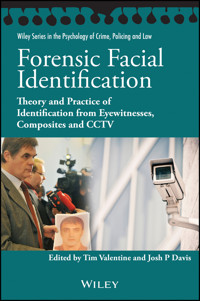
Forensic Facial Identification
“A broad view of contemporary eyewitness research in both traditional and emerging areas. The international cast of contributors particularly highlights the interplay between law and research across countries — with lessons for all.”
Steven D. Penrod, Distinguished Professor, John Jay College of Criminal Justice
“At an age where we are relying more than ever on facial identification to ensure public safety, this volume represents an important milestone in ensuring our decisions are informed by the latest developments in technology and science. International experts provide practitioners with an exhaustive review of the tools needed to identify and investigate cases relying on facial identification, be they terror suspects or victims of disaster. What is unique about this book is that experts are encouraged to learn from mistakes made in the past and to equip themselves with theory and science to enable them to best use identification evidence to avoid miscarriages of justice. An outstanding contribution to the field.”
Amina Memon, Professor of Psychology Royal Holloway, University of London
Forensic Facial Identification provides an up-to-date set of best practices for professionals using eyewitness identification to solve crimes of all kinds. The book brings together a prominent group of contributors to discuss the latest scientific and technical advancements and their implications for practice. The contributors review current procedures for various facial identification methods and discuss their use and reliability. The chapters examine traditional forms of eyewitness identification, such as mugshots and line-ups, but also delve into newer technologies, such as facial identification using CCTV images and computerized automatic face recognition systems. Detailed case studies help put the latest research and technology in the proper legal context. Bridging the fields of psychology, criminology, and law, this essential volume, part of the Wiley Series in Crime, Policing and Law, is for those wishing to stay at the cutting-edge of this expanding and changing field.
Sie lesen das E-Book in den Legimi-Apps auf:
Seitenzahl: 700
Veröffentlichungsjahr: 2015
Ähnliche




















CONTENTS
Cover
Title page
Contributors
Foreword
Series Preface
REFERENCES
Part 1: Introduction
1 Identification and Surveillance of Facial Images: Progress and Problems
REFERENCES
Part 2: Searching for Suspects and the Identification of Victims
2 Interviewing for Face Identification
HOW ARE PERSON DESCRIPTIONS ELICITED FROM WITNESSES, AND HOW RELIABLE ARE THEY?
WHAT IS THE RELATIONSHIP BETWEEN DESCRIPTION QUALITY AND SUBSEQUENT IDENTIFICATION ACCURACY?
IS DESCRIBING A FACE DETRIMENTAL TO SUBSEQUENT IDENTIFICATION PERFORMANCE?
ADVICE FOR PRACTITIONERS
REFERENCES
3 Facial Composites and Techniques to Improve Image Recognizability
FORENSIC USE OF COMPOSITES: POLICE PRACTICE
“TRADITIONAL” MECHANICAL FEATURE-BASED SYSTEMS
SECOND-GENERATION SOFTWARE-BASED FEATURE-BASED SYSTEMS
“GOLD STANDARD” PROTOCOL FOR TESTING COMPOSITE SYSTEMS
SYSTEM EVALUATIONS
HOLISTIC COMPOSITE SYSTEMS
IMPLICATIONS FOR POLICY
SUMMARY AND THE FUTURE
REFERENCES
4 Searching for Suspects: Mugshot Files and Showups (Street Identifications)
MUGSHOTS
SHOWUPS
THE USE OF MUGSHOTS AND SHOWUPS AS THE FIRST OF MULTIPLE PROCEDURES
CURRENT STATE OF THE RESEARCH AND FUTURE DIRECTIONS
REFERENCES
5 Craniofacial Analysis and Identification
INTRODUCTION
HISTORICAL CONTEXT
UNDERLYING ASSUMPTIONS AND PRINCIPLES
ACCURACY OF ANALYSIS
FURTHER RESEARCH
REFERENCES
Part 3: Identification by Eyewitnesses
6 Lineup Composition and Lineup Fairness
MISTAKEN IDENTIFICATION, FALSE CONVICTIONS, AND THE REGULATION OF EYEWITNESS IDENTIFICATION PROCEDURES
EVALUATION OF LINEUP FAIRNESS AND IDENTIFICATION ACCURACY
IMPLICATIONS FOR LAW ENFORCEMENT POLICY AND FUTURE RESEARCH
REFERENCES
7 Estimator Variables and Memory for Faces
PERPETRATOR AND WITNESS CHARACTERISTICS
VIEWING CONTEXT
SUMMARY AND CONCLUSION
REFERENCES
8 Confidence and Accuracy of Eyewitness Identification
PERCEPTIONS OF EYEWITNESS CONFIDENCE IN LEGAL SETTINGS
THEORETICAL PERSPECTIVES ON THE CA RELATIONSHIP
RESEARCH ON THE CONFIDENCE–ACCURACY RELATIONSHIP FOR EYEWITNESS IDENTIFICATION DECISIONS
APPLIED FACTORS THAT LIMIT THE EFFECTIVE USE OF CONFIDENCE
A NOVEL USE FOR EYEWITNESS CONFIDENCE: CONFIDENCE AS AN INDEX OF RECOGNITION
REFERENCES
Part 4: Identification from CCTV Images
9 Human Verification of Identity from Photographic Images
THE USE OF PHOTOGRAPHIC IMAGES IN COURT
THE IDENTIFICATION OF SUSPECTS FROM CCTV
PARALLELS BETWEEN FACE RECOGNITION AND FACE MATCHING RESEARCH
THEORETICAL MODELS OF FACE RECOGNITION AND MATCHING
PRACTICAL ASPECTS OF FACE MATCHING
SELECTION OF NATURALLY GIFTED FACE PROCESSORS
CONCLUSIONS AND POLICY RECOMMENDATIONS
REFERENCES
10 Expert Analysis: Facial Image Comparison
INTRODUCTION
PHOTOGRAPHIC FACIAL COMPARISON ANALYSIS
OTHER TECHNICAL AND METHODOLOGICAL ISSUES
PROBATIVE VALUE, VALIDITY AND RELIABILITY
JURY INTERPRETATION OF FORENSIC EVIDENCE
ANAMORPHIC LAW
REFERENCES
11 Evaluating Automatic Face Recognition Systems with Human Benchmarks
INTRODUCTION TO INTERNATIONAL TESTS OF FACE RECOGNITION ALGORITHMS
COMPARING THE PERFORMANCE OF HUMANS AND FACE RECOGNITION ALGORITHMS
QUALITATIVE COMPARISONS BETWEEN HUMANS AND FACE RECOGNITION ALGORITHMS
NEXT GENERATION ALGORITHMS: CHALLENGES AND PROMISE
REFERENCES
Part 5: Implications for Criminal Justice
12 Eyewitness Identification and Facial Image Comparison Evidence in Common Law Jurisdictions
UNCERTAINTY IN FACT-FINDING AND THE DISTORTING EFFECTS OF THE ADVERSARIAL CRIMINAL PROCESS
THE FORENSIC LIMITATIONS OF THE ADVERSARIAL CRIMINAL TRIAL
IDENTIFICATION FROM IMAGES
CONCLUSION
REFERENCES
13 Forensic Facial Identification: A Practical Guide to Best Practice
CONFIRMATION BIAS
BEST PRACTICE IN FORENSIC FACIAL IDENTIFICATION
CONCLUDING REMARKS
REFERENCES
Index
End User License Agreement
List of Tables
Chapter 06
Table 6.1 Comparison of Lineup Formats with Less Versus More Information, Correct and False Identifications,
d
′ and Proportion Correct
Chapter 10
Table 10.1 An example of a verbal scale often adopted by image analysts in England and Wales. This version is taken from the analyst’s report in
R v. Atkins
(2009)
List of Illustrations
Chapter 03
Figure 3.1 On the left is an EvoFIT composite constructed by a rape victim. On the right is a photograph of the convicted person in this case (Asim Javed).
Figure 3.2 Facial composites of England international footballer, David Beckham (constructed in Frowd
et al
., 2005b). Each image was created by a different constructor, unfamiliar with the face, and three-to-four hours after having seen a facial photograph. From left to right are composites from E-FIT, PRO-fit, Sketch and Photofit. For copyright reasons, the actual photograph used in the study cannot be reproduced here.
Figure 3.3 (a) EvoFIT composites are more accurately constructed when external features are omitted in the face arrays, as shown here. External features are added at the end, once internal features have been constructed in their entirety (i.e., after evolving and holistic-scale use). (b) Stages in the face construction of UK Prime Minister, David Cameron. Images are (i) best face at the end of generation 1, (ii) best face at the end of generation 2 and (iii) after use of holistic-scales and the addition of external features.
Figure 3.4 Example composites constructed following a traditional face-recall cognitive interview (left) and the holistic–cognitive interview (right). Two different people created these composite images using PRO-fit after having watched a video clip of EastEnders’ character Billy Mitchell. (EastEnders is a popular, long-running British TV soap.)
Figure 3.5 Feature-based composites of England footballer, John Terry, created in Frowd
et al
. (2012d, Experiment 2). Composites along the top and bottom rows were constructed by different people from memory. In the centre is the average of these four individual composites, an image known as a morphed composite.
Figure 3.6 Caricaturing feature composite of US actor/director Woody Allen (Frowd
et al
., 2005b). From left to right, images are at −50%, −25%, 0% (unaltered original composite), +25% and +50% caricature. Positive values exaggerate distinctive shape information, while negative values de-emphasize this information to make the face appear more average.
Figure 3.7 Image (a) is a composite of former UK Prime Minister, Tony Blair. To use the perceptual-stretch format, the composite would be shown (to police staff and the public) accompanied by the following written statement: “Viewing the composite sideways may help you to recognise the face”. Image (b) is an example of the perceptual-backdrop image (PBI) format applied to the same composite of Blair. The image has been vertically stretched and displayed against a grey perceptual backdrop. Example wording to accompany the image format is: “Viewing the composite as shown should help you to recognise the face”.
Figure 3.8 Composites produced of EastEnders’s character, Roxy Mitchell, in Frowd
et al
. (2013b). Each image was created by a different person 24 hours after having watched a video depicting this character (an unfamiliar target). The study manipulated the interview (face-recall CI and H-CI) and the method used to construct the composite (external-features blur and internal-features-first). Composites were produced (a) using a CI and external-features blur, (b) CI and internal-features-first, (c) H-CI and external-features blur, and (d) H-CI and internal-features-first. Composites were least identifiable in (a) when they were viewed front-on, but most identifiable in (d) when viewed using perceptual stretch.
Chapter 05
Figure 5.1 Facial depiction of the Jigsaw murder victim (top) with alternative hairstyle images (below).
Figure 5.2 Craniofacial superimposition (C) of the image of Jeffery Howe (A) and the skull model (B).
Figure 5.3 Features of the eye .
Figure 5.4 Features of the nose .
Figure 5.5 Features of the mouth (created by Caroline Erolin, University of Dundee).
Chapter 06
Figure 6.1 Foil similarity for high (H), moderate (M), and low similarity (L) foils, in simultaneous and sequential lineups, from Fitzgerald
et al.
(2013).
Chapter 08
Figure 8.1 Schematic representation of confidence–accuracy (CA) calibration displaying perfect calibration, overconfidence and underconfidence.
Chapter 09
Figure 9.1 Hussain Osman (left) and Jean Charles de Menezes (centre), presented as a chimeric facial image (right). Note that this image has not been manipulated by standardizing skin tone or stretching the images to align facial features, as was suggested by the prosecution to have occurred in the Health and Safety court case reported in this chapter (kind permission Metropolitan Police Service, London).
Figure 9.2 Example of a target-present simultaneous face-matching trial from Bruce
et al
. (1999). The target is number 3 in the array.
Chapter 10
Figure 10.1 Image distortion in high-quality rectilinear photographs. What do the “head” and facial features actually look like? What is the shape of the actual “head” and is the “ear” larger than the “nose”? From the left the photographs were taken from (a) a distance of 295 mm, with a focal length of 15 mm; (b) a distance of 400 mm and a focal length of 20 mm; and (c) a distance of 2500 mm with a focal length of 100 mm.
Figure 10.2 An example of anthropometry from an investigation in New Zealand.
Chapter 11
Figure 11.1 Two example pairs of images from the human–machine comparisons in O’Toole
et al
. (2007b) are shown. The images on the left are taken under uncontrolled illumination and the images on the right are taken in controlled illumination. Humans are asked whether the people in each pair are the same person or different people.
Figure 11.2 The results of the human–machine comparisons for (a) the difficult face pairs and (b) the easy face pairs from O’Toole
et al
. (2007b). The best three algorithms are more accurate than humans on the difficult face pairs, and all but one algorithm is more accurate on the easy pairs.
Figure 11.3 Six images of the same person are shown. Pairs of images are arranged in columns (left to right), according to algorithm performance, (left: good, middle: moderate, right: difficult)
Figure 11.4 A schematic of the distribution of scores for the same- and different-identity pairs is shown (a). Sampling of dissimilar same-identities produces the example pairs on the left (b), and sampling of similar different identity pairs appears on the right (c)
Figure 11.5 Human performance for the original images, face-only images, and body-only images from Rice
et al
. (2013). Performance with this special sample of images indicates that performance on the original images is due to the information in the body (see text).
Guide
Cover
Table of Contents
Begin Reading
Pages
iii
ii
iv
vii
viii
ix
xi
xii
xiii
xiv
xv
xvi
xvii
1
3
5
4
6
7
8
9
10
11
12
13
14
15
17
18
19
20
21
22
23
24
25
26
27
28
29
30
31
32
33
34
35
36
37
38
39
40
41
43
44
45
46
47
48
49
50
51
52
53
54
55
56
57
58
59
60
61
62
63
64
65
66
67
68
69
70
71
72
73
74
75
76
77
78
79
80
81
82
83
84
85
86
87
88
89
90
91
92
93
94
95
96
97
98
99
100
101
102
103
104
105
106
107
108
109
110
111
112
113
114
115
116
117
119
120
122
123
124
126
127
129
130
131
132
133
134
135
136
137
138
139
140
141
142
143
144
145
146
147
148
149
150
151
152
153
154
155
156
157
159
160
161
162
163
164
165
166
167
168
169
170
171
172
173
174
175
176
177
178
179
180
181
182
183
185
186
187
188
189
190
191
192
193
194
195
196
197
198
199
200
201
202
203
204
205
206
207
208
209
211
212
213
214
215
216
217
218
219
220
221
222
223
224
225
226
227
228
229
230
231
232
233
234
235
236
237
238
239
240
241
242
243
244
245
246
247
248
249
250
251
252
253
254
255
256
257
258
260
262
263
264
265
266
267
268
269
270
271
272
273
274
275
276
277
278
279
280
281
282
283
285
287
288
289
290
291
292
293
294
295
296
297
298
299
300
301
302
303
304
305
306
307
308
309
310
311
312
313
314
315
316
317
318
319
320
321
323
324
325
326
327
328
329
330
331
332
333
334
335
336
337
338
339
340
341
342
343
344
345
347
349
350
351
352
353
354
Wiley Series in
The Psychology of Crime, Policing and Law
Series Editors
Graham M. Davies and Ray Bull
University of Leicester, UK
The Wiley Series in the Psychology of Crime, Policing and Law publishes concise and integrative reviews on important emerging areas of contemporary research. The purpose of the series is not merely to present research findings in a clear and readable form, but also to bring out their implications for both practice and policy. In this way, it is hoped the series will not only be useful to psychologists but also to all those concerned with crime detection and prevention, policing, and the judicial process.
For other titles in this series please see www.wiley.com/go/pcpl
Forensic Facial Identification
Theory and Practice of Identification from Eyewitnesses, Composites and CCTV
Edited by
Tim Valentine
Goldsmiths, University of London
Josh P. Davis
University of Greenwich
This edition first published 2015© 2015 John Wiley & Sons, Ltd.
Registered OfficeJohn Wiley & Sons, Ltd, The Atrium, Southern Gate, Chichester, West Sussex, PO19 8SQ, UK
Editorial Offices350 Main Street, Malden, MA 02148-5020, USA9600 Garsington Road, Oxford, OX4 2DQ, UKThe Atrium, Southern Gate, Chichester, West Sussex, PO19 8SQ, UK
For details of our global editorial offices, for customer services, and for information about how to apply for permission to reuse the copyright material in this book please see our website at www.wiley.com/wiley-blackwell.
The right of Tim Valentine and Josh P. Davis to be identified as the authors of the editorial material in this work has been asserted in accordance with the UK Copyright, Designs and Patents Act 1988.
All rights reserved. No part of this publication may be reproduced, stored in a retrieval system, or transmitted, in any form or by any means, electronic, mechanical, photocopying, recording or otherwise, except as permitted by the UK Copyright, Designs and Patents Act 1988, without the prior permission of the publisher.
Wiley also publishes its books in a variety of electronic formats. Some content that appears in print may not be available in electronic books.
Designations used by companies to distinguish their products are often claimed as trademarks. All brand names and product names used in this book are trade names, service marks, trademarks or registered trademarks of their respective owners. The publisher is not associated with any product or vendor mentioned in this book.
Limit of Liability/Disclaimer of Warranty: While the publisher and authors have used their best efforts in preparing this book, they make no representations or warranties with respect to the accuracy or completeness of the contents of this book and specifically disclaim any implied warranties of merchantability or fitness for a particular purpose. It is sold on the understanding that the publisher is not engaged in rendering professional services and neither the publisher nor the author shall be liable for damages arising herefrom. If professional advice or other expert assistance is required, the services of a competent professional should be sought.
Library of Congress Cataloging-in-Publication Data
Forensic facial identification : theory and practice of identification from eyewitnesses, composites and CCTV / edited by Tim Valentine, Josh P. Davis. pages cm Includes bibliographical references and index.
ISBN 978-1-118-46911-8 (cloth) – ISBN 978-1-118-46958-3 (pbk.) 1. Eyewitness identification. 2. Face perception. I. Valentine, Tim, 1959– II. Davis, Josh P. HV8073.F572 2015 363.25′8–dc23 2014047946
A catalogue record for this book is available from the British Library.
Cover image: © Peter Stroh / Alamy © mauro grigollo / iStockphoto
Contributors
Neil Brewer
School of Psychology, Flinders University, Adelaide, Australiae-mail: [email protected]
Charity Brown
Institute of Psychological Sciences, University of Leeds, Leeds, United Kingdome-mail: [email protected]
Steven E. Clark
Professor of Psychology, Director, Presley Center for Crime and Justice Studies, University of California, Riverside, United States e-mail: [email protected]
Josh P. Davis (Editor)
Senior Lecturer, Psychology and Counselling Department, University of Greenwich, London, United Kingdome-mail: [email protected]
Jennifer E. Dysart
Associate Professor, Department of Psychology, John Jay College of Criminal Justice, New York, United Statese-mail: [email protected]
Gary Edmond
School of Law, University of New South Wales, Sydney, Australiae-mail: [email protected]
Heather D. Flowe
School of Psychology, University of Leicester, Leicester, United Kingdome-mail: [email protected]
Charlie Frowd
University of Winchester, Winchester, United Kingdome-mail: [email protected]
Fiona Gabbert
Department of Psychology, Goldsmiths, University of London, London, United Kingdome-mail: [email protected]
Victoria Z. Lawson
Research Associate, CUNY Institute of State and Local Governance, New York, United Statese-mail: [email protected]
Molly B. Moreland
Psychology, University of California, Riverside, United Statese-mail: [email protected]
Alice O’Toole
The University of Texas at Dallas, School of Behavioral and Brain Sciences, Richardson, United Statese-mail: [email protected]
P. Jonathon Phillips
Electrical Engineer, National Institute of Standards and Technology, United Statese-mail: [email protected]
Andrew Roberts
Senior Lecturer, Melbourne Law School, Melbourne, Australiae-mail: [email protected]
Ryan A. Rush
Visiting Assistant Professor of Psychology, Wabash College, United Statese-mail: [email protected]
Hannah Ryder
School of Psychology, University of Leicester, Leicester, United Kingdome-mail: [email protected]
James D. Sauer
School of Medicine (Psychology), University of Tasmania, Hobart, Australiae-mail: [email protected]
Harriet M.J. Smith
Division of Psychology, Nottingham Trent University, Nottingham, United Kingdome-mail: [email protected]
Tim Valentine (Editor)
Professor of Psychology, Department of Psychology, Goldsmiths, University of London, London, United Kingdom e-mail: [email protected]
Caroline Wilkinson
Director of Face Lab, Liverpool School of Art & Design, Liverpool John Moores University, Liverpool, United [email protected]
Foreword
The criminal justice system involves a pantheon of values, and it is not always easy to figure out the best course of action when one of those values appears to clash with another. And so it is the case with our value about avoiding the wrongful prosecution of innocent people and our value about ensuring the correct prosecution of guilty people. Forensic Facial Identification is a superb edited volume whose contributors collectively worry about both of these values, how to balance them, and how scientific evidence on facial identification can help us think about the legal structures that should exist in a world that has a good balance.
Forensic Facial Identification is primarily about the problem of distinguishing accurate eyewitness testimony from mistaken testimony. It is broader than most books on eyewitness testimony in that it concerns not only identification of eyewitnesses who might have actually seen the robbery, or been a victim of the rape, but also the identification of perpetrators from closed-circuit television images, as is becoming increasingly common with the proliferation of cameras throughout our society. And it also concerns the identification of deceased individuals by reconstructions of their faces as they appeared in real life, as happened, for example, when Osama bin Laden was captured and killed. How do you think we know for sure that the man who was shot and killed on May 2, 2011, inside a private residential compound in Pakistan was really the Saudi Arabian bin Laden? The introductory chapter does a splendid job of briefly reviewing these topics – and ones not mentioned – that readers will find in each chapter so there is no need to repeat this review here.
Forensic Facial Identification is broader than most books on eyewitness testimony in other ways. Each chapter begins with a specific case that is used by the chapter authors to guide discussion. The cases, and discussions, cover many regions of the world, mostly the UK and US, but also Australia and New Zealand in particular. The cases are sometimes famous, as is that of the murder of the foreign minister Anna Lindh in Sweden in 2003, and sometimes not famous, as in the case of a fast food worker in Manchester, UK, who was accused of rapes in 2009 and 2010. The cases are historical, as in the case of Adolf Beck who was convicted in 1896 in London for defrauding women. Most are more modern, as in the numerous cases of wrongful conviction uncovered by the New York-based Innocence Project.
One case that is mentioned frequently (in several chapters) is a recent case that was decided by the New Jersey Supreme Court (State v. Henderson). Since the present authors did not go into much detail about this case, and it has been so significant in the US, I thought I would use my “forward platform” to say a bit more about it. In that murder case, the defendant Larry Henderson was accused of being involved in a shooting in an apartment in Camden, New Jersey. About two weeks after the murder, a surviving witness who had been in the apartment identified Henderson from a set of photos. A subsequent identification at trial resulted in Henderson’s conviction. It might seem like an open and shut case, but actually there were serious problems with the initial identification. It turns out that the witness only picked Henderson’s photo after the investigating officers put on some “pressure” and did some “nudging”, as the behaviour of those officers would later be characterized. More specifically, it appears that when the key witness first looked at the photos, he did not see anyone he recognized. He finally narrowed things down to two photos but was indecisive. Pressure and nudging cracked the indecisiveness. On top of this, it turned out that the witness himself had, during the day and just prior to the shooting, consumed large amounts of alcohol and crack cocaine. Henderson appealed his conviction, and when that appeal was heard by the New Jersey Supreme Court in 2011, the criminal justice world paid attention. That decision showed a deep appreciation of the eyewitness problems in the case and a sophisticated appreciation of the science of eyewitness testimony, and the ruling rather dramatically changed the legal standard for how eyewitness evidence is assessed in a criminal case.
What now happens in New Jersey is this. A defendant who can show some evidence of suggestive influences on witness testimony is entitled to a court hearing in which all the psychological factors bearing on the testimony are reviewed and analysed. After this scrutiny, if the judge still decides to admit the testimony at trial, then the judge must also provide to the jury a set of instructions that can guide them on how to think about the eyewitness evidence. Over the next year or so, those instructions were crafted by a committee, which produced a 26-page document that can be found on the internet at: www.judiciary.state.nj.us/criminal/ModelCrimJuryChargeCommHENDERSONREPORT.pdf
Curious as to what happened to Henderson after his successful appeal, psychology professor John Wixted found a prosecutor who gave him an update. According to this source, another hearing was held in which it was determined that proper procedure had been followed during Henderson’s initial trial, which meant that his original guilty verdict was upheld. Of course the procedure might have been “proper” during the trial, but that does not mean that the early identification “activities” shouldn’t make us suspicious about whether the identification of Henderson was truly accurate. For now, we have to live with that uncertainty.
The Henderson decision changed the way eyewitness evidence is handled not only in cases where there are questions about the role of law enforcement in producing an identification, but in cases where law enforcement played little or no role. There was a companion case to Henderson that has not received nearly the same attention, but is important because it extends these safeguarding procedures to a wide array of cases. The companion case (New Jersey v. Chen) involved some titillating facts. One Sunday in 2005, Mr Kim got a phone call from his ex-girlfriend, Cecilia Chen, the first such call since they had ended their relationship in 2000. Kim told Chen he was happily married and expecting a child; Chen told Kim she was not doing well and wondered about what would have happened had they not broken up. Three days later, Kim’s wife Helen was home alone, five months pregnant, and recovering from surgery. A woman came to the Kim home, said her car had broken down and she needed to use the bathroom and phone. The intruder then stabbed Helen with a kitchen knife. Soon thereafter, in discussions with his wife, Kim thought the intruder might be Chen. They accessed Chen’s website and looked at photos of her, and Helen became “ninety percent positive” after viewing one particular photo. So we have a case in which key aspects of the identification process were independent of any law enforcement, but nonetheless rather suggestive. Cases with such facts would also, after Henderson, be entitled to the same legal safeguards, namely the hearing and the judicial warnings.
The policy innovations resulting from the Henderson case will hopefully reduce the likelihood of mistaken identification and wrongful conviction that can result. It remains to be seen whether subsequent research confirms the effectiveness of this bold direction.
Forensic Facial Identification not only presents the basic science in each chapter, but also discusses other policy recommendations. There are recommendations concerning the procedures used to obtain an identification in the first place, such as double-blind testing. There are recommendations concerning the interviewing process, such as taking steps to avoid allowing errors to creep into the early descriptions of witnesses. There are recommendations about the use of composites, mugshot searches, showups, and street identifications, face matching and more. Collectively these authors express their appreciation of procedures that will provide some protection for a suspect who is innocent. But what about catching the guilty? Sadly, some of the reforms may come with a cost, because they reduce correct identifications. So what to do? The editors of Forensic Facial Identification came to a resolution that I very much appreciated: (spoiler alert; skip if you don’t want to know yet)
…the potential disadvantage from adopting these recommendations is no reason to abandon the more important duty to avoid wrongfully prosecuting innocent suspects. Indeed a mistaken identification may result in an investigation being terminated because an innocent person has been charged, leaving the guilty free to commit further offences. The justice obtained from maximizing the rate of suspect identifications from unfair procedures would give a false sense of security.
Forensic Facial Identification should be applauded for its heroic efforts to offer society a true sense of security. Hopefully its messages will be read by many who care about fairness, and how psychological science can help us achieve it.
Elizabeth F. Loftus
University of California, Irvine
Series Preface
The Wiley Series in the Psychology of Crime, Policing and the Law publishes both single and multi-authored monographs and edited reviews of important and emerging areas of contemporary research. The purpose of this series is not merely to present research findings in a clear and readable form, but also to bring out their implications for both practice and policy. Books in this series are useful not only to psychologists, but also to all those involved in crime detection and prevention, child protection, policing and judicial processes.
As the originator of this book series, it has always been my ambition to have a volume devoted to issues surrounding facial identification. It was an early interest of both myself and the co-editor of the series, Professor Ray Bull. Each of us was involved in research into the vagaries of facial identification and we were responsible, with our co-authors, for some of the earliest books and papers published in the UK on this topic (see Clifford & Bull, 1978; Davies, Ellis, & Shepherd, 1981; Shepherd, Ellis, & Davies, 1982). However, we readily acknowledge the primacy of the pioneering work of Elizabeth Loftus (Loftus, 1979), who has provided a forward for this new book.
While research in the UK and the US into facial identification and misidentification stemmed from a common concern over miscarriages of justice based on confident but unreliable witnesses, the drivers and direction which research then took in the two countries was rather different. In the US, a wider range of offences result in jury trials, and the courts have traditionally shown a liberal approach to the admission of testimony by experts which might inform the jury on issues relevant to the evidence (Cutler & Penrod, 1995). Defence attorneys were not slow to grasp the significance of early research by psychologists on eyewitness reliability, but Elizabeth Loftus and another pioneer, the late Robert Buckhout, still faced considerable resistance to the admission of their testimony in cases where issues of identification formed an important element in the prosecution case. Despite reverses, research on the vagaries of identification has gained in credibility as a growing number of American State Courts now admit evidence from suitably qualified psychologists in cases of disputed identification (Loftus, Doyle, & Dysart, 2013 ). For Loftus, this courtroom experience helped to highlight issues of concern which subsequently became the subject of research (Loftus, 1986 )
In the UK, the interest of psychologists in facial identification did not stem from the adversarial cockpit of the courtroom. British courts have traditionally taken a more conservative view on the admissibility of experts in criminal trials, particularly in relation to the credibility of witnesses, where the Turner ruling (Mackay, Colman, & Thornton, 1999 ) effectively prevents psychologists from commenting on the accuracy or reliability of witnesses in the criminal court: this is a matter for counsel to explore and juries alone to decide. However, miscarriages of justice based on mistaken identification have a long history in the British courts (Davies & Griffiths, 2008 ), culminating in a Government enquiry led by the distinguished judge, Lord Devlin. Among the recommendations of his report (Devlin, 1976 ) was that “research should be directed to establishing ways in which the insights of psychology can be brought to bear on the conduct of parades and the practice of the courts” (p.149). Devlin’s recommendation helped to ensure that state funding and support flowed toward psychologists involved in improving police procedures and practices, in order to minimize the risk of misidentification, rather than dealing with its consequences in the courts.
Since those early days, the study of facial memory has matured and spread across the globe, raising new issues, and there has been much cross-fertilisation as Forensic Facial Identification amply demonstrates. However, those early origins can still be discerned. The North American tradition can be seen in research on such issues as the relationship between confidence and accuracy and the composition and fairness of lineups, while the UK approach is reflected in studies of witness interviewing for identification, facial composite techniques and identification from closed-circuit television.
The editors, Tim Valentine and Josh Davis, both have established reputations in the field. Tim has played a crucial role in the development of video identification procedures, a technique which appears to offer a fairer and more accurate test for establishing a positive identification compared with traditional methods, while Josh has contributed important insights into identification from CCTV. Through their standing, they have been able to call upon a range of distinguished international contributors, to offer authoritative perspectives on all aspects of human facial identification. This handbook will be read with profit and interest by practitioners and researchers in law, psychology and policing, who seek safe and effective methods of prosecuting the guilty and safeguarding the innocent.
Graham M. Davies
University of Leicester
REFERENCES
Clifford, B.R., & Bull, R. (1978).
The Psychology of Person Identification
. London: Routledge & Kegan Paul.
Cutler, B.L., & Penrod, S.D. (1995).
Mistaken Identification: The Eyewitness, Psychology and the Law
. New York: Cambridge University Press.
Davies, G.M., Ellis, H.D., & Shepherd, J.W.(1981).
Perceiving and Remembering Faces
. London: Academic Press.
Davies, G.M., & Griffiths, L. (2008). Eyewitness identification and the English courts: A century of trial and error.
Psychiatry, Psychology and Law
,
15
, 435–449.
Devlin, Lord P. (1976).
Report to the Secretary of State for the Home Department on the Departmental Committee on Evidence of Identification in Criminal Cases
. London: HMSO.
Loftus, E.F. (1979).
Eyewitness Testimony
. Cambridge, MA: Harvard University Press.
Loftus, E.F. (1986). Ten years in the life of an expert witness.
Law and Human Behavior
,
10
, 241–263.
Loftus, E.F., Doyle, J.M., & Dysart, J. (2013).
Eyewitness Testimony: Civil and Criminal
(5th ed.). Charlottesville, VA: Lexis Law Publishing.
Mackay, R.D., Colman, A.M., & Thornton, P. (1999). The admissibility of expert psychological and psychiatric testimony. In A. Heaton-Armstrong, E. Shepherd, & D. Wolchover (Eds.),
Analysing Witness Testimony: A Guide for Legal Practitioners and Other Professionals
(pp. 321–334). Oxford: Oxford University Press.
Shepherd, J.W., Ellis, H.D., & Davies, G.M. (1982).
Identification Evidence: A Psychological Evaluation
. Aberdeen:Aberdeen University Press.
Part 1Introduction
1Identification and Surveillance of Facial Images: Progress and Problems
Tim Valentine and Josh P. Davis
Eyewitness testimony is older than the law. Even today, with sophisticated forensic science, eyewitness testimony forms the bedrock of many criminal cases. Whenever a witness gives testimony in court, jurors, judge(s) or magistrate(s) are faced with two basic questions: Is this witness giving an honest account? If so, can their account be relied upon as accurate? There are many reasons why a witness may deliberately give false testimony or identify a defendant they know to be innocent. The witness may be seeking revenge, have been intimidated into giving a false account, or be motivated to deflect blame away from the true culprit. Legal procedure is designed to expose a dishonest witness. In an adversarial system, for example in the UK, US, Canada, Australia and New Zealand, the defence have the right to test the testimony of prosecution witnesses through cross-examination. Equally the prosecution cross-examines witnesses for the defence. Cross-examination has been described as “the greatest legal engine ever invented for the discovery of truth”. It is intended as a method to expose a dishonest witness, but psychological science shows that cross-examination is ineffective in distinguishing reliable eyewitnesses from those who are honest but mistaken (e.g., Valentine & Maras, 2011; Zajac & Hayne, 2003, 2006).
Lesen Sie weiter in der vollständigen Ausgabe!
Lesen Sie weiter in der vollständigen Ausgabe!
Lesen Sie weiter in der vollständigen Ausgabe!
Lesen Sie weiter in der vollständigen Ausgabe!
Lesen Sie weiter in der vollständigen Ausgabe!
Lesen Sie weiter in der vollständigen Ausgabe!
Lesen Sie weiter in der vollständigen Ausgabe!
Lesen Sie weiter in der vollständigen Ausgabe!
Lesen Sie weiter in der vollständigen Ausgabe!
Lesen Sie weiter in der vollständigen Ausgabe!
Lesen Sie weiter in der vollständigen Ausgabe!
Lesen Sie weiter in der vollständigen Ausgabe!
Lesen Sie weiter in der vollständigen Ausgabe!
Lesen Sie weiter in der vollständigen Ausgabe!
Lesen Sie weiter in der vollständigen Ausgabe!
Lesen Sie weiter in der vollständigen Ausgabe!
Lesen Sie weiter in der vollständigen Ausgabe!
Lesen Sie weiter in der vollständigen Ausgabe!




