


50,99 €
Mehr erfahren.
- Herausgeber: John Wiley & Sons
- Kategorie: Geisteswissenschaft
- Sprache: Englisch
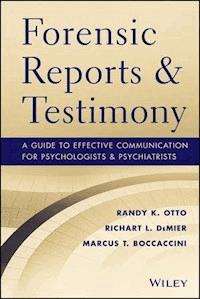
Forensic Reports & Testimony: A Guide to Effective Communication for Psychologists and Psychiatrists provides a roadmap for the mental health professional who wants to provide consistently accurate, defensible, and useful reports and testimony to the legal system. Authors Randy K. Otto, Richart L. DeMier, and Marcus Boccaccini, recognized experts in the field, cover all aspects of the process, including preparing affidavits and reports, preparing for depositions, and testifying. Every written or spoken communication for the courts must be clear and precise, and distinguish between facts, inferences, and opinions. This book uniquely: *Shows the critical differences between forensic psychological reports and the clinical reports psychologists and psychiatrists are accustomed to writing *Includes and explains important maxims of forensic report writing, including separating facts from inferences, focusing on offering expert opinions, explaining why you think what you think, and connecting the dots between facts and conclusions *Provides numerous examples of experts' testimony, affidavits, reports-with commentary and critiques Expert forensic work deserves to be presented in a clear, precise, and understandable way so that it is useful to attorneys, judges, and juries. Forensic Reports & Testimony provides the guidelines and models forensic psychologists and forensic psychiatrists need to make that happen.
Sie lesen das E-Book in den Legimi-Apps auf:
Seitenzahl: 657
Veröffentlichungsjahr: 2014
Ähnliche



















Contents
Foreword
Preface
About the Authors
Chapter 1: Introduction
Overview
Organization of the Volume
The Importance of Knowing Local Laws, Rules, and Customs
Report Writing and Testimony in Context
Points and Avenues of Communication in the Litigation Process
Chapter 2: Functions of Forensic Reports
Distinguishing Forensic and Therapeutic Reports
Forensic Report Functions
Notes
Chapter 3: Content of Forensic Reports
Understanding and Identifying the Referral Question
Addressing Only the Referral Question
Documenting All Sources of Information
Documenting All Requested Data Sources
Identifying the Source(s) of Reported Facts
Problematic Referencing of Data Sources
Appropriate Referencing of Data Sources
Including Relevant Information and Excluding Irrelevant Information
From Report Content to Report Quality
Practical Implications
Chapter 4: Principles of Forensic Reports
Providing the Factual Bases for Opinions
Distinguishing Facts, Inferences, and Opinions
Inference or Opinion Followed by Supporting Facts
Facts Followed by Inference or Opinion
Identifying Presumptions and Assumptions
Limiting Opinions to
Expert
Opinions
Minimizing and Explaining Jargon
Jargon
Jargon with Explanation
Jargon
Jargon with Explanation
Jargon
Jargon with Explanation
Avoiding Inappropriate Use of Absolute Terminology
Avoiding Problematic Language
Using Quotes Effectively
Description of Thought Process
Description of Thought Process Accompanied by a Quotation
Editing or Otherwise Changing Completed Reports
Final Comment: Persuading the Reader in a Meaningful Way
Notes
Chapter 5: Structure of Forensic Reports
Report Structure
Report Elements
Too Ambiguous
More Specific
Too Ambiguous
More Specific
Inadequate Documentation
Inadequate Documentation
Thorough Documentation
Miscellaneous Matters
Notes
Chapter 6: Interrogatories, Affidavits, Declarations, Demonstrative Exhibits, and Demonstrative Aids
Interrogatories
Affidavits
Declarations
Demonstrative Exhibits and Demonstrative Aids
Chapter 7: Conceptual Issues Regarding Testimony
Components of Effective Testimony
General Principles Applicable to Direct Examination and Cross-Examination
Developing Direct Examination and Cross-Examination Skills Outside of the Courtroom
Final Words of Caution
Chapter 8: Testifying at Depositions
Purposes of Depositions
Participating in Depositions
Chapter 9: Testifying in Admissibility Hearings
Legal History
Outcomes of Challenges to Expert Testimony
Responding to
Frye
and
Daubert
Challenges
Chapter 10: Pretrial Preparation
Meeting with Retaining Counsel
Considering and Commenting on the Work and Findings of Other Experts
Providing Information about Other Experts to Retaining Counsel
At the Courthouse
Waiting to Be Called to Testify
The Trial Process
Notes
Chapter 11: Direct Examination
Establishing Expert Status: Qualification
Describing One’s Involvement in the Case
Describing Information Sources and the Bases for Opinions
Communicating One’s Findings and Opinions
Identifying the Limitations of One’s Techniques and Findings
Communicating Confidence and Certainty
Testifying to a Reasonable Medical, Psychiatric, or Psychological Certainty
Commenting on the Work and Opinions of Other Professionals
Notes
Chapter 12: Cross-Examination
Responding to Challenges to Qualifications or Technique
Responding to General Aspersions
Responding to Insinuations of Bias
Responding to Attempts to Impeach
Responding to Specific Types of Questions
Maintaining Composure
When It Is All Over
Notes
Appendix A: Sample Reports
Appendix B: Sample Affidavits and Declaration
References
Author Index
Subject Index
End User License Agreement
List of Illustrations
Figure 9.1 Hierarchical Ordering of Daubert Criteria and Separation by Direct Versus Indirect Evidence
Figure 11.1
List of Tables
Table 2.1 Distinguishing Between Reports Summarizing Therapeutic and Forensic Evaluations
Table 4.1 Problematic Use of Absolute Terminology
Table 4.2 Problematic Word Usage and Better Alternatives
Table 10.1 Appropriateness of Information Disclosure
Table 10.2 The Trial Process
Pages
iii
iv
vii
viii
ix
x
xi
xii
xiii
xiv
xv
xvi
1
2
3
4
5
6
7
8
9
10
11
12
13
14
15
16
17
18
19
20
21
22
23
24
25
26
27
28
29
30
31
32
33
34
35
36
37
38
39
40
41
42
43
44
45
46
47
48
49
50
51
52
53
54
55
56
57
58
59
60
61
62
63
64
65
66
67
68
69
70
71
72
73
74
75
76
77
78
79
80
81
82
83
84
85
86
87
88
89
90
91
92
93
94
95
96
97
98
99
100
101
102
103
104
105
106
107
108
109
110
111
112
113
114
115
116
117
118
119
120
121
122
123
124
125
126
127
128
129
130
131
132
133
134
135
136
137
138
139
140
141
142
143
144
145
146
147
148
149
150
151
152
153
154
155
156
157
158
159
160
161
162
163
164
165
166
167
168
169
170
171
172
173
174
175
176
177
178
179
180
181
182
183
184
185
186
187
188
189
190
191
192
193
194
195
196
197
198
199
200
201
202
203
204
205
206
207
208
209
210
211
212
213
214
215
216
217
218
219
220
221
222
223
224
225
226
227
228
229
230
231
232
233
234
235
236
237
238
239
240
241
242
243
244
245
246
247
248
249
250
251
252
253
254
255
256
257
258
259
260
261
262
263
264
265
266
267
268
269
270
271
272
273
274
275
276
277
278
279
280
281
282
283
284
285
286
287
288
289
290
291
292
293
294
295
296
297
298
299
300
301
302
303
304
305
306
307
308
309
310
311
312
313
314
315
316
317
318
319
320
321
322
323
324
325
326
327
328
329
330
331
332
333
334
335
336
337
338
339
340
341
342
343
344
345
346
347
348
349
350
351
352
353
354
355
356
357
358
359
360
361
362
363
364
365
366
367
368
369
370
371
372
373
374
375
376
377
378
379
380
Guide
Cover
Table of Contents
Begin Reading
Forensic Reports and Testimony
A GUIDE TO EFFECTIVE COMMUNICATION FOR PSYCHOLOGISTS AND PSYCHIATRISTS
RANDY K. OTTO
RICHART L. DeMIER
MARCUS T. BOCCACCINI
Cover design: © iStockphoto/Orchidpoet
Cover image: Wiley
Copyright © 2014 by John Wiley & Sons, Inc. All rights reserved.
Published by John Wiley & Sons, Inc., Hoboken, New Jersey.
Published simultaneously in Canada.
No part of this publication may be reproduced, stored in a retrieval system, or transmitted in any form or by any means, electronic, mechanical, photocopying, recording, scanning, or otherwise, except as permitted under Section 107 or 108 of the 1976 United States Copyright Act, without either the prior written permission of the Publisher, or authorization through payment of the appropriate per-copy fee to the Copyright Clearance Center, Inc., 222 Rosewood Drive, Danvers, MA 01923, (978) 750-8400, fax (978) 646-8600, or on the web at www.copyright.com. Requests to the Publisher for permission should be addressed to the Permissions Department, John Wiley & Sons, Inc., 111 River Street, Hoboken, NJ 07030, (201) 748-6011, fax (201) 748-6008.
Limit of Liability/Disclaimer of Warranty: While the publisher and author have used their best efforts in preparing this book, they make no representations or warranties with respect to the accuracy or completeness of the contents of this book and specifically disclaim any implied warranties of merchantability or fitness for a particular purpose. No warranty may be created or extended by sales representatives or written sales materials. The advice and strategies contained herein may not be suitable for your situation. You should consult with a professional where appropriate. Neither the publisher nor author shall be liable for any loss of profit or any other commercial damages, including but not limited to special, incidental, consequential, or other damages.
This publication is designed to provide accurate and authoritative information in regard to the subject matter covered. It is sold with the understanding that the publisher is not engaged in rendering professional services. If legal, accounting, medical, psychological or any other expert assistance is required, the services of a competent professional person should be sought.
Designations used by companies to distinguish their products are often claimed as trademarks. In all instances where John Wiley & Sons, Inc. is aware of a claim, the product names appear in initial capital or all capital letters. Readers, however, should contact the appropriate companies for more complete information regarding trademarks and registration.
For general information on our other products and services please contact our Customer Care Department within the United States at (800) 762-2974, outside the United States at (317) 572-3993 or fax (317) 572-4002.
Wiley publishes in a variety of print and electronic formats and by print-on-demand. Some material included with standard print versions of this book may not be included in e-books or in print-on-demand. If this book refers to media such as a CD or DVD that is not included in the version you purchased, you may download this material at http://booksupport.wiley.com. For more information about Wiley products, visit www.wiley.com.
Library of Congress Cataloging-in-Publication Data:
Otto, Randy K.
Forensic reports and testimony : a guide to effective communication for psychologists and psychiatrists / Randy K. Otto, Richart L. DeMier, Marcus T. Boccaccini.
1 online resource.
Includes bibliographical references and index.
ISBN 978-1-118-13672-0 (hb); ISBN 978-1-118-41904-5 (ebk); ISBN 978-1-118-42094-2 (ebk) — 1. Forensic psychology. I. DeMier, Richart L., 1962- II. Boccaccini, Marcus T. III. Title.
RA1148
614’.15—dc23
2014014872
Foreword
I love to write, so I like doing forensic reports. I would not care to do forensic evaluations if they did not conclude with a written product, because I could not complete the evaluation. Writing does not merely describe the outcome. It creates it. Yes, some evaluators can muse on the data for awhile and arrive at their opinions about the forensic question. Typically, though, I do not discover my interpretations until I write. Creating visible words is part of finding the logic that flows from data to conclusion, that Sherlock-solving-the-case process that forensic examiners enjoy. Writing drives that process and eventually expresses the result.
Writing also reveals the weak points in a conclusion. Put your first draft aside and read it the next day, pretending you are the opposing attorney searching for every flaw, every logical alternative argument, any data that contradict your conclusions. When you find them, rethink and revise, then revise again to get the communication right. When I have crafted a good report, I feel the artist’s satisfaction after having created a painting or carved a sculpture.
Expert testimony is another matter. The only part of testifying that I enjoy is nodding to the judge, standing down from the witness box, and walking out the door. If writing a forensic report is like working on a painting in your loft, the expert witness is a sidewalk chalk artist in a bad neighborhood, caught in the crossfire between two rival gangs. Technique is difficult to achieve when you’re dodging bullets. And after an overnight rain, you’ve got nothing tangible to show for your effort. Okay, there’s a transcript of court proceedings. But it faithfully memorializes the one or two stupid things you said, which is all you’ll remember and can’t be fixed. Despite all this, I admit that sometimes I’ve found the expert witness role rewarding, but I’d still rather write.
This book is unusual in that it provides guidance for both written and oral communication in our line of work. It captures and dissects all of the basic elements of the art of forensic report writing and the tactics of testimony. I once did a study of the 10 most common errors in forensic report writing, and I can verify that this book tackles all of them.1 Some of the elements are easy to grasp, whereas others are complex. Yet the authors describe them economically and clearly, thus demonstrating one of the most important virtues they want to teach us: The best writers always opt for simplicity. “One day I will find the right words,” said Jack Kerouac, “and they will be simple.”2 Avoid anything unnecessary, observes Stephen King. “The road to hell is paved with adverbs.”3 And they ask for absolute clarity: “All you have to do is write one true sentence. Write the truest sentence that you know,”4 said Ernest Hemingway. The authors of this book teach us to do that, and they do it while they are teaching us.
Hemingway also said this: “There is nothing to writing. All you do is sit down at a typewriter and bleed.”5 If you find report writing easy, you probably need to read this book and compare your reports to its recommendations. Applying its guidance, you may find the next few reports are more difficult, because the effort requires a step up from simply filling the page with words. But with practice, these basics become second nature and pay off in many ways. You will produce higher-quality reports in less time, increase your credibility as a forensic clinician whom lawyers want to consult, and enjoy the satisfaction of having done your best. You may still bleed from time to time, especially when it’s a stubborn case or the fourth report you’ve written this week. If you’ve learned what this book teaches, though, you’ll recover quickly.
The authors faced a difficult challenge when writing this book. How do you offer guidance for the range of circumstances that forensic examiners face? I have reviewed about 1,500 forensic reports in my career. Some were produced by my postdoctoral students who came from various graduate training programs, others by forensic clinicians in states to which I consulted, and a large number by advanced forensic practitioners throughout the United States who were applying for forensic specialization by the American Board of Forensic Psychology. Seeing this diversity, I’m aware of the wide range of circumstances in which we perform our evaluations, write our reports, and testify: the adult NGRI murder and the juvenile delinquency disposition, the high-stakes and high-publicity “case of the year” and the third CST case of the week, competence to be executed, and capacities to have custody of one’s child. Then we face jurisdictional differences in statutory requirements and administrative regulations for forensic reports. Sometimes we even write our reports or testify differently depending on which of the local judges is hearing the case.
Wisely, the authors did not try to demonstrate how to write reports or testify in all of these specific circumstances. Instead, they used their familiarity with the domain of forensic tasks to identify the basic elements—the common nails that can be used to build a thousand different things made of many kinds of wood. Once you learn to drive the nail straight, experience teaches you how to adapt that skill to the varied circumstances you encounter.
After you’ve read this book, you might try focusing on just a few of the techniques at a time. Read a couple of the principles and apply them to some of your upcoming reports or your courtroom testimony. Then, read a few more techniques and work on them. Find a way to read other examiners’ reports or watch their testimony. Serious writers read a lot. They look for things that they admire and might want to emulate sometime, and they find examples of style or content that they want to avoid. Then, if you really want to learn, look for an opportunity to teach someone. Don’t wait until you believe you might be a guru. When you have a handle on the basic principles in this book, you’re qualified to pass them on. Doing so, you come to own them.
Enjoy this book. It has some great laughs, and it captures the essence of the craft and art of communicating your work. Without effective communication, you didn’t do a forensic evaluation.
Thomas Grisso, Ph.D.
Director of the Law-Psychiatry ProgramUniversity of Massachusetts Medical School
Notes
1
Thomas Grisso,
Guidance for improving forensic reports: A review of common errors
, February 2010 (Open Access Journal of Forensic Psychology).
2
Jack Kerouac,
The Dharma bums
, 1958 (Viking Press).
3
Stephen King,
On writing: A memoir of the craft
, 2000 (Scribner).
4
Ernest Hemingway,
A moveable feast
, 1964 (Scribner).
5
William Knott,
The world of fiction
, 1973 (Reston Publishing Co.).
Preface
This book has been a long time coming. It is the product of our varied experiences as psychologists. For the past 25 years, one of us (RKO) has been a faculty member at the University of South Florida and operated an independent practice largely limited to forensic psychological evaluation. Another (RLD) has worked at the U.S. Medical Center for Federal Prisoners, conducting criminal forensic evaluations and supervising predoctoral and postdoctoral trainees; for 11 years he managed the institution’s APA-accredited clinical psychology internship. Another (MTB) has served as a faculty member at Sam Houston State University’s APA-accredited doctoral program in clinical psychology, training graduate students and developing a program of research focused on clinical-forensic psychological assessment.
The careful reader will notice that we are not psychiatrists (although some of our best friends are). Nonetheless, we titled this book Forensic Reports and Testimony: A Guide to Effective Communication for Psychologists and Psychiatrists. We did this for three reasons: (1) Regardless of the unique perspectives that psychologists and psychiatrists might bring to forensic mental health evaluation, most of what psychologists and psychiatrists do is more similar than different; (2) a review of the text and reference list makes clear that we considered and relied on the good work of many of our medical colleagues; and (3) we thought it might have a greater impact if we wrote a volume that was relevant to a larger audience. We hope this explanation suffices for any who take offense.
The reader need not be a careful one to notice that we are also not English or Communications professors. However, this book is about written and oral communication rather than the forensic assessment process. The best psychological or psychiatric evaluations will be of little use to courts, attorneys, or others if the findings are not communicated clearly, precisely, and understandably. We have seen far too many reports that failed to capture and preserve the competent evaluations that formed their foundations. We recognize that the psychological or psychiatric report endures long after the clinician has left the scene; therefore, we chose to focus on the process of writing accurate and defensible reports. Similarly, we have read too many good reports written by our colleagues, only to see their excellent observations and keen insights go unnoticed by the judges or juries they were trying to educate because of their failure to testify in an understandable and engaging way about what they did.
Careful and casual readers alike will quickly realize that we also should not quit our day jobs and seek careers in comedy. And, we all agree with Otto’s Law of Testimony: “None of us are as funny as we think we are.” However, in our attempt to make the book engaging and enjoyable to read, we sometimes were able to reach agreement that something we wrote approached humor, and we included it in the book as a result.
This book focuses on effectively communicating the results of a forensic evaluation. All that we included assumes that a mental health professional conducted a quality forensic evaluation. After all, even the most artfully drafted report or most eloquently crafted testimony cannot overcome a poor evaluation. More frequently than we would like, the blistering cross-examinations of mental health professionals who have conducted forensic evaluations are justified given the shoddy product that they delivered. This book includes no pointers about how to write a report after conducting a substandard examination, or how to respond to cross-examination questions that effectively demonstrate to the judge or jury the inadequacy of the mental health professional’s assessment approach.
Nor does this book necessarily provide cross-examination questions and strategies that effectively demonstrate to the legal decision maker the limitations of the forensic examiner’s work (although we are all for such questions and strategies). Although we did write this book with attorneys in mind (because they are the ones who hire, examine, and cross-examine forensic examiners), they are not our intended audience. Nonetheless, attorneys might find our commentary helpful as they seek to understand what should be in reports and how testimony can be most persuasive. Attorneys looking for effective cross-examination strategies and gambits, however, should look elsewhere (see, e.g., Ziskin & Faust, 2012; Faust, 2012; Faust & Ahern, 2012).
Consistent with Guideline 1.02 of the Specialty Guidelines for Forensic Psychology (American Psychological Association, 2013; hereinafter APA, 2013) and Section IV of the Ethics Guidelines for the Practice of Forensic Psychiatry (American Academy of Psychiatry and the Law, 2005), we believe that mental health professionals who serve as experts to the courts must be objective, independent, and unbiased, and they should seek to help everyone involved—not just the retaining attorney. The practices we recommend are designed to do just that. We went to great efforts to avoid suggesting actions that essentially constitute the shenanigans in which the attorneys who hire us sometimes engage, or the gamesmanship that is recommended by some of our peers in other publications. Consequently, experts reading this may come across attorneys who do not want them to do some of what we recommend (we have come across some of them ourselves). We understand this tension and attribute it to the differing responsibilities of forensic examiners and those who hire them.
It should be no surprise to readers that it is sometimes difficult to get three psychologists (or psychiatrists) to agree to something—even three psychologists whose perspectives are similar enough to co-author a book. When we discovered these disagreements, we attempted to resolve them and find common ground. When we could not, we offered our different perspectives and underlying rationales, and left it for the reader to decide. Similarly, we sometimes came across issues about which none of us held a strong opinion and saw several approaches as acceptable. In these cases we tried to make that clear and identify what we considered to be reasonable approaches, as well as the advantages and disadvantages associated with each strategy.
The large majority of our examples are taken directly from real-world reports, transcripts, and experiences, most of which we collected ourselves, but some of which were shared with us by very generous colleagues. In some cases, however, reports or transcripts were not available, so we did our best to recreate what we observed at some distant time in the past. Whenever we did excerpt case reports or transcripts, or discuss our experiences, in the spirit of Standard 4.07 of the Ethical Principles of Psychologists and the Code of Conduct (American Psychological Association, 2010; hereinafter APA, 2010), we went to great lengths to disguise the identities of the examinee, examiner, and anyone else who might have been involved.
All of us acknowledge that we have never written the perfect report or offered perfect testimony, but we each hope to keep getting better, and that is what this book is about. Finally, all of the perspectives, opinions, recommendations, and errors in this volume (as-of-yet undiscovered, but undoubtedly there) are ours. However, we want to acknowledge that what we provide in this book has been shaped by our experiences, along with the insights and support of many valued professors, colleagues, and trainees. We want to specifically acknowledge Stan Brodsky, Mary Alice Conroy, Dave Corey, Bob Denney, Joel Dvoskin, John Edens, Bill Foote, Rick Frederick, Tom Grisso, David Martindale, Dave Mrad, Daniel Murrie, Christina Pietz, Norm Poythress, and Chris Slobogin.
RKORLDMTB
About the Authors
Randy K. Otto, Ph.D., ABPP
Dr. Otto is a faculty member in the Department of Mental Health Law and Policy at the University of South Florida, and he is an adjunct professor at Stetson University College of Law. Dr. Otto’s research and teaching focuses on forensic psychological assessment; he serves on the editorial boards of several journals; and he edited two recently published books on forensic psychology.
Dr. Otto is a fellow of the American Psychological Association (APA Division 41) and is the 2008 recipient of the American Academy of Forensic Psychology’s Award for Distinguished Contributions to Forensic Psychology. He is board certified in forensic psychology and clinical psychology by the American Board of Professional Psychology, and he has a practice that is limited to forensic psychological evaluation.
Dr. Otto has served as President of the American Board of Forensic Psychology and the American Psychology-Law Society, and he is President of the American Board of Professional Psychology. He chaired the committee that revised the APA’s Specialty Guidelines for Forensic Psychology, and he is a member of the American Bar Association committee that is revising that organization’s Criminal Justice Mental Health Standards, which direct how persons with mental disabilities should be managed in the criminal justice system.
When not at work or with his family, Dr. Otto can probably be found on a motorcycle or at a poker table.
Richart L. DeMier, Ph.D., ABPP
In 1995, Dr. DeMier completed a postdoctoral fellowship in forensic psychology at the U.S. Medical Center for Federal Prisoners, in Springfield, Missouri. Following the fellowship, he joined the staff at that facility, where he conducts forensic evaluations in response to referrals from federal courts. The most common questions involve competency, restoration of competency, sanity, and risk to others. He also evaluates sentenced prisoners to determine whether civil commitment to inpatient mental health treatment is indicated. In 2002, he became the Director of Clinical Training at the U.S. Medical Center, providing leadership for the facility’s APA-accredited predoctoral internship, a position he held for 11 years.
Dr. DeMier is board certified in forensic psychology by the American Board of Professional Psychology. For several years, he has reviewed practice samples of individuals who have applied for board certification and served as an oral examiner at the final stage of the board certification process. He is a regular presenter at workshops of the American Academy of Forensic Psychology; he offers workshops focused on forensic report writing and preparation for board certification. Although he is not an avid researcher, he has written about several forensic topics, including forensic report writing, competency, competency restoration treatment, and ethics.
His interests outside of work include spending time with the family, reading history, and following the St. Louis Cardinals and Green Bay Packers.
Marcus T. Boccaccini, Ph.D.
Dr. Boccaccini is a Professor of Psychology at Sam Houston State University, where he also serves as the Associate Director of Clinical Training for the department’s clinical psychology Ph.D. program. He has published more than 70 articles relating to forensic psychology. His research program focuses broadly on issues relating to forensic assessment, with an emphasis on identifying, understanding, and working to reduce measurement error and disagreement among forensic evaluators. Dr. Boccaccini’s research on evaluator bias and adversarial allegiance in risk measure scoring has recently been funded by the National Science Foundation.
When not at work or with his family—well, he’s pretty much always at work or with his family.
Chapter 1Introduction
Overview
Although it has not always been the case, psychologists, psychiatrists, and other mental health professionals seeking guidance on how to conduct forensic evaluations now have an abundance of published resources available to them (see, e.g., Drogin, Datillio, Sadoff, & Gutheil, 2011; Jackson, 2008; Melton et al., 2007; Otto, 2013; Weiner & Otto, 2014), and continuing education opportunities abound as well (see, e.g., workshops referenced at www.aafp.ws). Quite rightly, the bulk of these resources focus on the legal contours, ethical challenges, and evaluation procedures and practices relevant to conducting forensic mental health assessments. Considerably less attention has been devoted to how forensic mental health professionals can best communicate to legal decision makers what they have done, learned, and concluded.
Lesen Sie weiter in der vollständigen Ausgabe!
Lesen Sie weiter in der vollständigen Ausgabe!
Lesen Sie weiter in der vollständigen Ausgabe!
Lesen Sie weiter in der vollständigen Ausgabe!
Lesen Sie weiter in der vollständigen Ausgabe!
Lesen Sie weiter in der vollständigen Ausgabe!
Lesen Sie weiter in der vollständigen Ausgabe!
Lesen Sie weiter in der vollständigen Ausgabe!
Lesen Sie weiter in der vollständigen Ausgabe!
Lesen Sie weiter in der vollständigen Ausgabe!
Lesen Sie weiter in der vollständigen Ausgabe!
Lesen Sie weiter in der vollständigen Ausgabe!
Lesen Sie weiter in der vollständigen Ausgabe!
Lesen Sie weiter in der vollständigen Ausgabe!
Lesen Sie weiter in der vollständigen Ausgabe!
Lesen Sie weiter in der vollständigen Ausgabe!
Lesen Sie weiter in der vollständigen Ausgabe!
Lesen Sie weiter in der vollständigen Ausgabe!
Lesen Sie weiter in der vollständigen Ausgabe!
Lesen Sie weiter in der vollständigen Ausgabe!
Lesen Sie weiter in der vollständigen Ausgabe!
Lesen Sie weiter in der vollständigen Ausgabe!
Lesen Sie weiter in der vollständigen Ausgabe!
Lesen Sie weiter in der vollständigen Ausgabe!
Lesen Sie weiter in der vollständigen Ausgabe!




