


Erhalten Sie Zugang zu diesem und mehr als 300000 Büchern ab EUR 5,99 monatlich.
- Herausgeber: IVP
- Kategorie: Religion und Spiritualität
- Sprache: Englisch
Jesus said we should focus our minds and hearts on God above all else. No small task! Is there someone we can turn to for help? "Wisdom tells us to sit at the feet of our elders rather than the latest ministry fad," notes author Kyle Strobel. And is there a better elder to guide us than Jonathan Edwards?In Edwards, the eighteenth-century Puritan pastor and theologian, we find deep thought balanced with deep passion. Through his writings and practices, Edwards provides us with the tools—the "means of grace"—that make us receptive to God's work in our lives as we learn to abide in Christ. Here we find a well-rounded account of being formed for the glory of God.
Sie lesen das E-Book in den Legimi-Apps auf:
Seitenzahl: 309
Veröffentlichungsjahr: 2013
Das E-Book (TTS) können Sie hören im Abo „Legimi Premium” in Legimi-Apps auf:
Ähnliche
















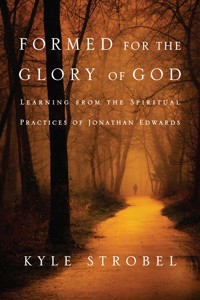
Formed for the Glory of God
Learning from the Spiritual Practices of Jonathan Edwards
Kyle Strobel
InterVarsity Press P.O. Box 1400 Downers Grove, IL 60515-1426 World Wide Web: www.ivpress.com E-mail: [email protected]
© 2013 by Kyle Strobel
All rights reserved. No part of this book may be reproduced in any form without written permission from InterVarsity Press.
InterVarsity Press® is the book-publishing division of InterVarsity Christian Fellowship/USA®, a movement of students and faculty active on campus at hundreds of universities, colleges and schools of nursing in the United States of America, and a member movement of the International Fellowship of Evangelical Students. For information about local and regional activities, write Public Relations Dept. InterVarsity Christian Fellowship/USA, 6400 Schroeder Rd., P.O. Box 7895, Madison, WI 53707-7895, or visit the IVCF website at www.intervarsity.org.
Scripture quotations, unless otherwise noted, are from The Holy Bible, English Standard Version, copyright © 2001 by Crossway Bibles, a division of Good News Publishers. Used by permission. All rights reserved.
While all stories in this book are true, some names and identifying information in this book have been changed to protect the privacy of the individuals involved.
Cover design by Cindy Kiple Images: Forest path: © Christine Amat/Trevillion Images
ISBN 978-0-8308-8439-1 (digital) ISBN 978-0-8308-5653-4 (print)
To Brighton
I pray that you grow to see the beauty of the Lord
and be captivated by his grace.
I love you.
To Kelli
I pray that the Lord continues to unveil his beauty, grace,
love and glory and lead us in his way. Ours is an
uncommon union, and you are my cherished
partner on this journey of grace.
I love you.
Contents
Acknowledgments
Introduction
Part One: A Journey into Beauty
1: A Journey to See Clearly
2: Mapping the Way of Love
3: Walking in Affection
Part Two: Tools for the Journey
4: Spiritual Disciplines as Means of Grace
5: Knowledge of God and Knowledge of Self
6: Meditation and Contemplation
7: Jonathan Edwards’s Spiritual Practices
Conclusion
Appendix 1: Praying with Jonathan Edwards
Appendix 2: Practicing Conference with Jonathan Edwards
Appendix 3: Going on Retreat with Jonathan Edwards
Appendix 4: The Jonathan Edwards Project
Abbreviations
Notes
Metamorpha Ministries
About the Author
Endorsements
Acknowledgments
THIS BOOK HAS BEEN A REAL JOY to write. After four years of academic study on Jonathan Edwards it was truly a blessed time to work on a project that, I trust, honors his memory by focusing on something so close to his heart. There are, of course, many people in my life who have made this project all the more of a blessing. I extend my thanks to my editor, Drew Blankman, for your work and encouragement on this project, and to IVP for buying Biblica just so you could publish my book (I’m kidding, Cindy). Of the many friends who encouraged me and helped me on this project, three in particular stand out. Jamin Goggin, your thoughts, edits and willingness to talk through this process helped me in more ways than you know. Kent Eilers, in your busy schedule you never refuse to read something for me, and your thoughts are always poignant and fruitful. James Merrick, talking through ideas with you has always been incredibly illuminating, and it was no different with this project. I deeply appreciate the friendship that you three provide, and your desire to bridge gaps between the academy and the church. Your friendship is truly a gift from God.
Furthermore, I received incredibly valuable feedback from other friends regarding this project, and their suggestions, insights and critiques helped make this a better and more readable book. For that, I am very grateful. Fred and Linda Wevodau, thank you for taking the time to read the first section and walk me through your thoughts. Your friendship and role in our lives has been such a blessing. Lindsey Cooper, thank you for taking the time to make detailed comments on an early portion of the work. Thanks go to Kelli’s small group as a whole for their friendship and desire to be a part of this process. Josh Weidmann, thank you for reading the first section and for your encouragement. It has been a blessing to get to know you, Molly and the kids, and your friendship has been a real gift in this season.
Last, to my family. My family is full of authors. I appreciate the encouragement from my sister, Alison, a novelist, my brother-in-law, Dan, who writes children books, and my father and mother, who have dabbled in writing a bit. Thank you for your unwavering excitement about what I am doing. Your encouragement never ceases to uplift me. Kelli, thank you so much for the work you put in on my projects, including this one. I make you read some real rubbish. Thank you for reading it, critiquing it and helping me become a better writer. Brighton, thank you for your energy, smile and joy. I hope one day you will read this and be blessed by it. I trust the Lord will continue to guide our family and provide grace in ways we never expect. To him be the glory.
Introduction
ETERNITY SHOULD CAPTURE OUR IMAGINATION. The mundane details of our lives are saturated with divine realities. Our world is dripping with God’s presence and calling us to worship him alone (Ps 97:4-6). But our eyes are dim and our understanding is darkened. Eternity is lost in the immediacy of our world. We hardly have patience to wait for someone to make our latte, let alone to set our minds on Christ, who sits at the right hand of God (Col 3:1-2). What does it look like to grasp God’s presence and his call for our growth in grace? What does it look like to be God’s “fellow workers” (1 Cor 3:9) in the Christian life? What does it mean to proclaim, “Without you I can do nothing” (see Jn 15:5)?
I could have written a book answering these questions myself. But I didn’t. Rather, I wrote a book answering these questions from the perspective of Jonathan Edwards. Why? Edwards is considered one of the great spiritual thinkers in Protestant history, and he is often turned to as an ideal example of the Christian life. Not that he was perfect, by any means, but that he practiced what he preached. By listening to Edwards, we are sitting at the feet of our elders rather than grasping onto whatever happens to be new (Acts 17:21).
What follows, therefore, is a journey into wisdom. If you are looking for easy answers or a few simple disciplines guaranteed to bring about spiritual maturity, you are in the wrong place. The journey into wisdom requires time. Wisdom is the result of living out the Christian life—seeking to live for Christ alone. Wisdom comes through learning patience, humility and love. Wisdom entails sitting at the feet of those who have walked with Christ before us. This book is an opportunity to accept that call.
The Road Less Traveled
I am not musical. That is actually an understatement. I am musically oblivious. I love music, but I lack both talent and an ear for musical excellence. When I was in high school one of my closest friends was a guitar player, and I envied that. I really wanted to learn how to play, but I did not have the kind of motivation to really learn how to play. In fact, I was fine with just being able to play a few songs. I asked my friend Brandon to teach me how to play guitar. There was a song I really liked and I wanted him to teach me how to play it. “It doesn’t really work that way,” he explained. “I can’t just teach you how to play a song, as if the only thing holding you back from playing Mozart on the piano is memorizing which keys to hit.” I just wanted to be able to pick up a guitar and start playing something that actually sounded like music.
This, in many ways, illustrates how people talk about spiritual formation. Many are not concerned to actually understand the depths of spiritual formation, nor are they all that interested in really developing a way of life (as it would have taken for me to learn guitar). Rather, they just want some simple answers to fix their broken lives. When push comes to shove, much that goes by the term spirituality is really just an extension of our own desire to have a “better,” more fulfilling life. Just as we approach health issues, our posture is about getting it fixed as easily and quickly as possible: Isn’t there just a pill I can take?
What we are doing in this book can be described as the “road less traveled.” I’m not interested in giving you a couple of interesting tidbits to fix your life. I’m not interested in showing you a new spiritual practice or two that might provide some short-term satisfaction of devotion. What I am interested in is pointing you to Christ, because that is ultimately what spiritual formation is about. I am interested in turning you to someone like Jonathan Edwards as an example of what the Christian life could look like. Ultimately, the reason this is the road less traveled is that spiritual formation is not simply doing spiritual disciplines. Spiritual formation is about a life oriented to God in Christ by the Spirit. Since spiritual formation is not, ultimately, about us at all, but about God, we must set our minds and hearts on him rather than our problems, our shortcomings or our desire to change. Those who lose their lives for my sake will find them (Mt 16:25), Jesus tells us.
Words, Words, Words
Spiritual formation is the Spirit’s work of transforming us into the image of Christ. Some people get caught up with this and other similar terms, such as spirituality, piety, transformation and so on. Instead of trying to figure out if we should use these terms, or trying to discern how they are currently being used, let’s do something different. Getting into debates about the most appropriate word is a pointless endeavor (2 Tim 2:14). Instead, we will turn to Jonathan Edwards as a source for wisdom about Christian living. In our pursuit, we will seek a distinctively evangelical understanding of spiritual formation. What does our grasp of the gospel tell us about the Christian life and faith? Furthermore, if we are evangelicals, then we must recognize that the terms spirituality, spiritual formation, religion and the Christian life all must mean the same thing for us. We need not grow faint-hearted by how the world and others misconstrue these terms. Rather, we should allow the Spirit to breathe fresh life into them. The key question then is, what do they mean?
Christian spirituality is ultimately about the work of the Spirit to bind us to the Son in love. This is not the “spirituality” of the world. The “Spirit” in spirituality denotes the Holy Spirit of God. Spirituality is not about some innate sense of transcendence or something inherent in people. Spirituality is about the very thing we need and do not have—God’s own Spirit. Christian spirituality is a partaking in God’s work to redeem, reconcile and glorify believers. Rather than being grounded in human potential, Christian spirituality begins with complete dependence, utter neediness and alien righteousness. Rather than us centering ourselves, God pulls us into the orbit of his life, evoking a call to union and communion in Christ by his Spirit. This is why many have chosen to use the term spiritual formation, which focuses on the Holy Spirit’s work to form us. Spiritual formation is the work of the Holy Spirit of God to form God’s people in the image of his Son. Just because the Spirit does the transformation, does not mean we are denied an active role. Quite the opposite is the case, as we will see.
In Edwards’s day, the phrase “true religion” was the popular way to talk about authentic Christian devotion. The Protestant spiritual writer Henry Scougal explains this, claiming, “that true religion is a union of the soul with God, a real participation in the divine nature, the very image of God drawn upon the soul. In the apostle’s words, it is ‘Christ formed in you.’”[1] This is exactly right. Christ formed in us entails the transformation of our whole lives; it means that we take on the contours of God’s life revealed in Christ. If the heart is changed, then a changed life will flow out of the heart. If we abide in the vine, we are told, we will bear good fruit (Lk 6:43-45). For the purpose of this book, our focus is on how Christ forms us by his Spirit that we may live a life for his glory.
Introducing Our Guide
You may be wondering why it is worthwhile to read a book about Jonathan Edwards’s understanding of the Christian life. First, Jonathan Edwards is considered one of the greatest spiritual thinkers in church history. More important, this spiritual depth was backed up by a deeply spiritual life. Second, as a hugely influential thinker in New England, Edwards’s theology and life has helped shape North American evangelicalism. Edwards life and practice has formed our own existence as evangelicals. To understand who we are, it is helpful to learn about the family tree. Third, in Edwards we find a grasp of spiritual formation that tries to balance deep thought with deep passion, human action with God’s action, truth with goodness and beauty, and a life of love with the contemplation of divine things. In Edwards’s grasp of spiritual formation we find a well-rounded account of following Christ, an account that deserves to be meditated upon in our day as much as in his own.
Edwards lived in the early to mid-eighteenth century (1703–1758) and attended Yale College. He was a pastor for the bulk of his life. Eventually he did mission work among the Native Americans and finished his career as the president of Princeton. Edwards was a world-renowned author in his own day, and his influence has increased ever since (particularly over the last fifty years). Works such as Religious Affections, Freedom of the Will, A History of the Work of Redemption, Charity and Its Fruits, and The Life of David Brainerd are considered classics, and those only scratch the surface of Edwards’s writing. Many have called Edwards “America’s greatest theologian” as well as “America’s greatest philosopher.” But at his core, he was primarily a pastor/shepherd who sought to guide people to Christ. With such an impressive academic resume, a focus on the church and a deeply spiritual life, Edwards can be compared with the greatest spiritual writers in history (Augustine comes to mind). Edwards, in other words, is someone worth listening to.
Unfortunately, many mistakenly believe that Edwards was somewhat obsessed with hellfire and brimstone. Because of this, Edwards is often ignored as a spiritual thinker. Rather, if Edwards did have an obsession, it was the beauty and glory of God. Ultimately, Edwards’s grasp of spiritual formation centers on the idea that God is beautiful and glorious, and he calls us to share in that beauty and glory. In Edwards, we find a vision of the Christian life that is deeply spiritual, beautiful and humanizing. It is a vision of losing one’s life to find it in Christ. It is a vision of the human heart captivated by God.
This book aims to paint a picture of Edwards’s vision of the Christian life and is divided into two major sections. In the first section, I give a broad overview of the journey of faith. In other words, I map out our path. Here, we look at how our path is oriented to heaven, how it is an ascent in God’s glory and how it is the way of affection. In the second section, I assess the tools God has given us on this journey, asking what they are for and why we should practice them. Specifically, I highlight spiritual disciplines, what Edwards called means of grace, and then the interconnection of knowledge of God and ourselves. A right knowledge of our tools helps to guide us in how to use them well. Without a firm grasp on the tools given for our journey of faith, our flesh quickly turns this into a journey of worldliness. This second section, which makes up the majority of the book, starts with foundational disciplines (reading/hearing the Word and prayer) and builds upon those to give an account of Christian practice. Not all practices are considered equal; therefore we must understand how these practices are interconnected to guide us on our path to glory. In this sense, Edwards serves as a lived example of Christian faithfulness. Take note at the flow of this book. We refuse to talk about spiritual practices until we have a firm grasp of the big picture of the Christian life. If we started with practices, as so many have, we will ultimately lose sight of their role in leading us to Christ. Inevitably, I fear, a focus on disciplines digresses quickly to self-help. Edwards offers a different way.
Part One
A Journey into Beauty
1 A Journey to See Clearly
Those that are here upon earth are in a strange land; they are pilgrims and strangers, and are all going hence, and Heaven is their center where they all tend.
Jonathan Edwards, “Miscellanies 429: Ascension”
We know that when he appears we shall be like him, because we shall see him as he is.
1 John 3:2
WE TALK A LOT ABOUT “the journey.” Turning to journey imagery was a reaction against the belief that salvation was primarily about conversion—a moment of accepting Christ into one’s life—rather than about the entirety of life under God. Journey imagery is a biblically fruitful attempt to refocus salvation on presenting our entire lives to God (Ps 5:8; 25:4-5; 27:11). Yet it would be a mistake to assume that this imagery is new. Rather, we have tapped into a deep-rooted tradition in church history. Closest to our own context are the masters of journey imagery—the Puritans. Out of the Puritan movement we receive the spiritual classic Pilgrim’s Progress. The idea of a pilgrimage to heaven as the framework for grasping spirituality is one of the great emphases of Puritan theology. Likewise, Jonathan Edwards focuses on the image of being a pilgrim in a land that is not truly our home.
This use of journey language raises questions of where we are going and how our destination informs how we travel. The church has historically understood our destination as either heaven or hell. For Edwards, heaven and hell are not merely places, but realities whose powers are known now. Heaven and hell are fueled by love and hate respectively. Heaven is a world of love—a realm of beauty where faith, hope and love know their fulfillment in a family of people drawn together to the God of love. God, as Edwards never tires of telling his readers, is a fountain of love. The eternal and infinite love of God quenches the thirst of all who draw near. In drinking deeply from this fountain, love of God and neighbor finally reign perfectly. Hell has no such fountain; it is the natural consequence of a society of selfishness. Rather than remaining on the outskirts of our world, heaven and hell assert themselves in our lives. Those who know God, as revealed in Christ Jesus, have a piece of heaven abiding in them. The Holy Spirit, or God’s own love, is given to believers in salvation. The fountain that abides in heaven pours forth through the lives of believers now. Unbelievers, in contrast, will ultimately bear the fruit of the place to which they journey. Those who do not sit and drink at the fountain of love will ultimately have hate abide in their souls. For those who do not know God, selfishness will eventually win out in their hearts; the forces of hell will run rampant in and through them to the world.
Everyone is a pilgrim. Everyone is journeying somewhere. In the fall, humankind set out on a pilgrimage to hell because people lost the Spirit of God communicating the love of God to their hearts. Their hearts, our hearts, have collapsed into themselves, pushing our selves to the center of reality (and pushing God to the outskirts or even to nonexistence). Hell exerts its influence through people in the world, forming cultures, societies and families. In Christ, believers are put on a different path altogether. This path is not simply a different mindset. God implants a piece of heaven in his people so that they are brought from death to life. God’s own Spirit is given as the Spirit of love, so that the redeemed will live out the way of heaven in the world now. The focus on the present reality of heaven and hell does not, in some way, raise the question of their existence. Far from it. The present realities of love and hate are proof that heaven and hell are real—so real, in fact, that their ways of life bleed into ours.
To journey well in this life, it is important to meditate on the direction your heart is pointing. What realm serves as the true north to which your heart finds its bearings? To live a heavenly life now, one must “set your minds on things that are above, not on things that are on earth” (Col 3:2). The “things that are above” do not primarily reference a place, but the Father, Son and Holy Spirit—the triune God. We must turn our attention to the source of the heavenly life so we can live the “way of heaven” here. To do so, I focus our attention on being with God in glory. Heaven is only heavenly because God is there. He is the spring of love that gives life and direction to that place. The life we know now is still given direction by that same source of life and love. God is the only source of the heavenly life, and therefore to grasp the nature of the Christian life we must grasp what it means to know God.
As a child, I loved to go to restaurants so that I could play the games on the back of the children’s placemat. Inevitably, one of those games would be a relatively simple maze. Before too long I realized that it was easier to start at the end, to see where I was going, as a way to figure out how best to avoid pitfalls and dead ends along the way. I am doing the same kind of thing in this chapter— outlining what it means to become oriented to the God of heaven, where a believer’s journey ends, so that we can live a heavenly life here. To better grasp our present life, in other words, we start at the end—at the perfection of this life in glory. By starting at the end, we paint the journey of the Christian life with broad strokes, which are then fleshed out throughout the rest of the book. This chapter maps the ground we will cover on our journey, and the remaining chapters, in one way or another, offer directions, equipment and sustenance for the pilgrimage set before us.
When We Will See
The Christian life is not abstracted away from heaven, but is directly connected to it. In fact, our heavenly and earthly lives are not two different journeys, but are two phases of the same pilgrimage. Heaven is not a static realm where we arrive at eternity only to finish learning, loving and, well, living. Rather, heaven is the place where God is known perfectly, but not fully.
Let me explain. Continuing with the image of God as a fountain, we can see ourselves in heaven as buckets who are full of God. Since we are full, we are perfectly satisfied, but our capacity continues to grow in heaven. We become larger buckets. We continue to learn more about God and love God more and more. As our capacity grows, we remain perfectly full, but since God is infinite he is never fully known. We are always growing and eternally expanding in our desire to know God and love him more—and yet our satisfaction never wanes, but increases exponentially. Heaven is a journey with God where we grow in love and knowledge of him for eternity; where our own love abounds to others in a society of love. Therefore, the term heaven refers to the day when love of God and neighbor reign unhindered.
When we try to talk about heaven, we run into a problem: there simply isn’t all that much information. Interestingly, in the Western tradition there is a broad sense of agreement, among both Catholics and Protestants, that in heaven we will participate in what is called the “beatific vision.” Whether you look to John Calvin, Charles Hodge, John Owen or Jonathan Edwards, the focus of eternity is on coming to see God face to face. The word beatific is not some magical or mystical term, but points to the effect of seeing God. A sight of God, Edwards tells us, is “happifying” (which is what beatific means); it causes happiness to well up inside of the person. It would be foolish to think that seeing God is uninteresting, or maybe interesting only in an academic sense. Seeing God fulfills the design of humanity and therefore sets the mind and heart into motion—it happifies. Seeing God brings a person to complete satisfaction. Note Edwards’s depiction of this sight of God:
The Beatifical Vision of God: that is the tip of happiness! To see a God of infinite glory and majesty face to face, to see him as he is, and to know him as we are known; there to be admitted into the most intimate acquaintance with him, to be embraced as in his arms: this is such a privilege as Moses himself could not be admitted to while on earth. The vision and fruition of God will be so intimate and clear as to transform the soul into the likeness of God: “We shall be like him, for we shall see him as he is,” says the Apostle (1 John 3:2).[1]
The “tip of happiness,” or, we might say, the goal of humanity, is to see God face to face and be embraced as his own. This is the land to which we, as believers, journey—a land where God dwells and where God’s love is open to his people in full. There are two questions we want to answer here: First, where do theologians get this idea? In other words, is this idea biblical? Second, why is this vision “happifying”? What is it about this vision that causes perfect satisfaction and joy to well up from within? Only after considering these questions will we turn back to show how this beatific vision shapes the Christian life.
Before answering these questions, let me pause for a moment and explain why these issues matter. We are not told much about life after death, but we are told something. What we are told does not consist of throw away fun facts for playing Bible trivia, but rather is meant to help ground our lives here and orient our hearts to the glory God has set before us. Meditating on the reality of heaven and hell helps us understand our calling in this life. This will play a particularly helpful role when we turn our attention to talking about spiritual practices. Grasping the destination set before us helps us to understand the kind of journey we are on.
The beatific vision: Biblical considerations. The biblical material for the beatific vision reads like descriptions of something massive, where each passage reveals a tiny piece of the whole. We have to stand back and look at the whole before we know what we are seeing.[2] Many people turn to passages like Psalm 17:15, “As for me, I shall behold your face in righteousness; when I awake, I shall be satisfied with your likeness,” to provide a foundation for more specific New Testament passages. Revelation 22:3-4 is often suggested to paint the picture of the psalmist’s satisfaction, “No longer will there be any curse. The throne of God and of the Lamb will be in the city, and his servants will serve him. They will see his face, and his name will be on their foreheads” (NIV). The idea of seeing God is often related to the idea of satisfaction (happiness) in eternity, where God’s work of redemption is complete. In this sense, the beatific vision is a way to talk about the completion of God’s work of reconciliation—the culmination of what began when Jesus declared, “It is finished” (Jn 19:30).
Life is a pilgrimage of faith that dissolves into sight. That sight is the beatific vision. Since the culmination of faith is sight, faith comes to take on attributes of sight. As pilgrims, we see through a glass darkly, but we see nonetheless (1 Cor 13:12). The life of faith is a life of seeing, even though the “sight” we now have is through a glass darkly. It is by faith, or what we might call spiritual sight (1 Cor 2:14-16). We have, after all, seen God in Christ, even though our “sight” is through faith. The life of faith is not void of sight; it is just void of physical sight. The bulk of biblical passages used to talk about the beatific vision speak to this reality—that by faith we taste the preliminary fruit of Christ’s redemptive work, and as we do so we are transformed into his image. “Beloved, we are God’s children now, and what we will be has not yet appeared; but we know that when he appears we shall be like him, because we shall see him as he is” (1 Jn 3:2). In a real sense, to see God is to become like God. This biblical point will prove incredibly important for Edwards’s understanding of the Christian life. Truly seeing God is grasping him as the highest good, truth and beauty. It is having your eyes opened and taking in the reality of who he is. It is receiving the love of God in full and having God as the object of your own love. As Henry Scougal notes, “The worth and excellency of a soul is to be measured by the object of its love.”[3] What you love is the true north that orients the compass of your heart. In heaven, God the Father is the true north of every soul, oriented by Christ and set into motion by the Spirit of God.
Building on the insights noted above, Edwards focuses the bulk of his attention on three verses from Paul: 1 Corinthians 13:12, 2 Corinthians 3:18 and 2 Corinthians 4:6. First Corintians 13:12 finishes up Paul’s famous exposition on love (which is the subject of Edwards’s sermon series Charity and Its Fruits) and states, “For now we see in a mirror dimly [or “glass darkly”], but then face to face. Now I know in part; then I shall know fully, even as I have been fully known.” The difference between faith and sight is that now, on our pilgrim journey, we see in a mirror dimly, but in glory, we will come face to face with God himself. This, for Paul, is tied directly to knowledge of God. Knowledge of God is not knowledge of an object, but is a personal knowledge, knowledge only available in a relationship of love. This knowledge begets happiness. In other words, knowing God, as Paul describes here, is always relational. “Seeing God” entails deep relational knowledge that exists in a relationship of love—a relationship available to us only through Christ, the image of the invisible God.
The other two passages come from 2 Corinthians. The first, 3:18, is where Paul culminates his discussion of the glory of the “ministry of death,” which caused Moses’ face to shine: “we all, with unveiled face, beholding the glory of the Lord, are being transformed into the same image from one degree of glory to another. For this comes from the Lord who is the Spirit.” Likewise, Paul continues in verse 4:6, “For God, who said, ‘Let light shine out of darkness,’ has shone in our hearts to give the light of the knowledge of the glory of God in the face of Jesus Christ.” Just prior to this, Paul claims that unbelievers are blinded to the gospel: “In their case, the god of this world has blinded the minds of unbelievers, to keep them from seeing the light of the gospel of the glory of Christ, who is the image of God” (2 Cor 4:4).
Several themes come together in these passages that are central to Edwards’s spirituality. First, God is known in Christ, his image, and his image proclaims the glory of God. Second, “face to face” is not simply a way to talk about closeness, but describes a certain kind of knowledge—relational knowledge. Knowing the glory of God necessitates knowing Christ, the light of the world, and having darkness cast away. Knowing God entails faith, the “sight” given in this world, and therefore demands that the whole person—one’s understanding and will—be turned to God. Third, in Christ we have the true mediator who sees and is seen, and who unveils and reveals. Christ beholds God the Father in the love of the Spirit for eternity, and therefore in Christ this vision is given as gift. God the Father eternally beholds the Son, and as they gaze upon their perfection they commune in the perfect love of the Spirit. Jesus comes as the One who has seen the Father and is beheld by him as his Son. Therefore, in Christ, we come to behold God, because only in Christ do creatures come to know, and truly see, their Creator (Jn 14:9).
The Sight That Happifies
Keeping in mind the passages just overviewed, we can now focus on why this sight is “happifying.” In short, we can say that the beatific vision is the radically complete knowledge of God and his glory. It is a sight of who God is, and who God is for you. This sight happifies because it fulfills the purpose of human persons—to know God and love him. It is the culmination of salvation where God pulls his children to himself and communes with them for eternity.
Each of these points needs explanation. It might be helpful to think of knowing other persons in order to understand. Coming to know someone is not simply a matter of understanding what defines a human person. If you were to sit down across a table from someone and ask, “Why don’t you tell me about yourself?” only to interrupt them by saying, “Wait, I know you, you are finite, temporal, and material,” you would have misunderstood what getting to know someone entails. You’ve confused knowing a person with knowing an object. You may know things about someone but still not know them in any meaningful sense. Something similar is true with knowing God. Knowing God necessitates God revealing himself to us, just as others have to reveal themselves. We come to know others through what they say and what they do. Likewise, we come to know God in Christ, his image, and in his work of redemption. Both of these are revealed to us in Scripture. This knowledge, of course, is not attained through sheer force, memorizing every aspect of the biblical text in an attempt to know God through one’s own effort. Rather, the Spirit of God illumines believers such that Christ himself, and likewise the Father, are known through the biblical text (1 Cor 2:9-16).
We will come face to face with Christ in heaven. This sight, however, is distinctly different from the sight the apostle John saw that he describes at the beginning of Revelation, from one who is not glorified:
Then I turned to see the voice that was speaking to me, and on turning I saw seven golden lampstands, and in the midst of the lampstands one like a son of man, clothed with a long robe and with a golden sash around his chest. The hairs of his head were white, like white wool, like snow. His eyes were like a flame of fire, his feet were like burnished bronze, refined in a furnace, and his voice was like the roar of many waters. In his right hand he held seven stars, from his mouth came a sharp two-edged sword, and his face was like the sun shining in full strength. (Rev 1:12-16)




