


106,99 €
Mehr erfahren.
- Herausgeber: John Wiley & Sons
- Kategorie: Fachliteratur
- Serie: Wiley Series in Acoustics Noise and Vibration
- Sprache: Englisch
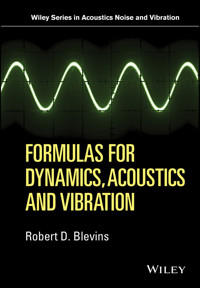
With Over 60 tables, most with graphic illustration, and over 1000 formulas, Formulas for Dynamics, Acoustics, and Vibration will provide an invaluable time-saving source of concise solutions for mechanical, civil, nuclear, petrochemical and aerospace engineers and designers. Marine engineers and service engineers will also find it useful for diagnosing their machines that can slosh, rattle, whistle, vibrate, and crack under dynamic loads.
Sie lesen das E-Book in den Legimi-Apps auf:
Seitenzahl: 449
Veröffentlichungsjahr: 2016
Ähnliche



















Table of Contents
Cover
Title Page
Copyright
Preface
Chapter 1: Definitions, Units, and Geometric Properties
1.1 Definitions
1.2 Symbols
1.3 Units
1.4 Motion on the Surface of the Earth
1.5 Geometric Properties of Plane Areas
1.6 Geometric Properties of Rigid Bodies
1.7 Geometric Properties Defined by Vectors
References
Chapter 2: Dynamics of Particles and Bodies
2.1 Kinematics and Coordinate Transformations
2.2 Newton's Law of Particle Dynamics
2.3 Rigid Body Rotation
References
Chapter 3: Natural Frequency of Spring–Mass Systems, Pendulums, Strings, and Membranes
3.1 Harmonic Motion
3.2 Spring Constants
3.3 Natural Frequencies of Spring–Mass Systems
3.4 Modeling Discrete Systems with Springs and Masses
3.5 Pendulum Natural Frequencies
3.6 Tensioned Strings, Cables, and Chain Natural Frequencies
3.7 Membrane Natural Frequencies
References
Chapter 4: Natural Frequency of Beams
4.1 Beam Bending Theory
4.2 Natural Frequencies and Mode Shapes of Single-Span and Multiple-Span Beams
4.3 Axially Loaded Beam Natural Frequency
4.4 Beams with Masses, Tapered Beams, Beams with Spring Supports, and Shear Beams
4.5 Torsional and Longitudinal Beam Natural Frequencies
4.6 Wave Propagation in Beams
4.7 Curved Beams, Rings, and Frames
References
Chapter 5: Natural Frequency of Plates and Shells
5.1 Plate Flexure Theory
5.2 Plate Natural Frequencies and Mode Shapes
5.3 Cylindrical Shells
5.4 Spherical and Conical Shells
References
Chapter 6: Acoustics and Fluids
6.1 Sound Waves and Decibels
6.2 Sound Propagation in Large Spaces
6.3 Acoustic Waves in Ducts and Rooms
6.4 Acoustic Natural Frequencies and Mode Shapes
6.5 Free Surface Waves and Liquid Sloshing
6.6 Ships and Floating Systems
6.7 Added Mass of Structure in Fluids
References
Further Reading
Chapter 7: Forced Vibration
7.1 Steady-State Forced Vibration
7.2 Transient Vibration
7.3 Vibration Isolation
7.4 Random Vibration Response to Spectral Loads
7.5 Approximate Response Solution
References
Chapter 8: Properties of Solids, Liquids, and Gases
8.1 Solids
8.2 Liquids
8.3 Gases
References
Appendix A: Approximate Methods for Natural Frequency
A.1 Relationship between Fundamental Natural Frequency and Static Deflection
A.2 Rayleigh Technique
A.3 Dunkerley and Southwell Methods
A.4 Rayleigh–Ritz and Schmidt Approximations
A.5 Galerkin Procedure for Continuous Structures
References
Appendix B: Numerical Integration of Newton's Second Law
References
Appendix C: Standard Octaves and Sound Pressure
C.1 Time History and Overall Sound Pressure
C.2 Peaks and Crest
C.3 Spectra and Spectral Density
C.4 Logarithmic Frequency Scales and Musical Tunings
C.5 Human Perception of Sound (Psychological Acoustics)
References
Appendix D: Integrals Containing Mode Shapes of Single-Span Beams
Reference
Appendix E: Finite Element Programs
Professional/Commercial Programs
Open Source /Low-Cost Programs
Index
End User License Agreement
Pages
xi
xii
1
2
3
4
5
6
7
8
9
10
11
12
13
14
15
16
17
18
19
20
21
22
23
24
25
26
27
28
29
30
37
38
39
31
32
33
34
35
36
40
41
42
43
44
45
46
47
48
49
50
51
52
53
54
55
56
57
58
59
60
61
62
63
64
65
66
67
68
69
70
71
72
73
74
75
76
77
78
79
80
81
82
83
84
85
86
87
88
89
90
91
92
93
94
95
96
97
98
99
100
101
102
103
104
105
106
107
108
109
110
111
112
113
114
115
116
117
118
119
120
121
122
123
124
125
126
127
128
129
130
131
132
133
134
135
136
137
138
139
140
141
142
143
144
145
146
147
148
149
150
151
152
153
154
155
156
157
158
159
160
161
162
163
164
165
166
167
168
169
170
171
172
173
174
175
176
177
178
179
180
181
182
183
184
185
186
187
188
189
190
191
192
193
194
195
196
197
198
199
200
201
202
203
204
205
206
207
208
209
210
211
212
213
214
215
216
217
218
219
220
221
222
223
224
225
226
227
228
229
230
231
232
233
234
235
236
237
238
239
240
241
242
243
244
245
246
247
248
249
250
251
252
253
254
255
256
257
258
259
260
261
262
263
264
265
266
267
268
269
270
271
272
273
274
275
276
277
278
279
280
281
282
283
284
285
286
287
288
289
290
291
292
293
294
295
296
297
298
299
300
301
302
303
304
305
306
307
308
309
310
311
312
313
314
315
316
317
318
319
320
321
322
323
324
325
326
327
328
329
330
331
332
333
334
335
336
337
338
339
340
341
342
343
344
345
346
347
348
349
350
351
352
353
354
355
356
357
358
359
360
361
362
363
364
365
366
367
368
369
370
371
372
373
374
375
376
377
378
379
380
381
382
383
384
385
386
387
388
389
390
391
392
393
394
395
396
397
398
399
400
401
402
403
404
405
406
407
408
409
410
411
412
413
414
415
416
417
418
419
420
421
422
423
424
425
426
427
428
429
430
431
432
433
434
435
436
437
439
440
441
442
443
444
445
446
447
448
Guide
Cover
Table of Contents
Preface
Begin Reading
List of Illustrations
Chapter 1: Definitions, Units, and Geometric Properties
Figure 1.1 Newton's second law in consistent units,
Figure 1.2 Motion of the surface of rotating earth and Coriolis deflection of moving particles relative to the earth. Latitude is zero at the equator.
Figure 1.3 A plane section with centroid (
C
) and rotated and translated coordinate systems and a solid body with a translated coordinate system and a rotated vector
r
Figure 1.4 Geometric sections for Examples 1.3 and 1.4
Chapter 2: Dynamics of Particles and Bodies
Figure 2.1 Three cases of rotation
Figure 2.2 Three cases of mass impact against an uncompressed spring
Figure 2.3 Car with velocity strikes a stationary car. They slide together distance
d
before stopping.
Figure 2.4 Irregular object with perimeter
P
and initial velocity strikes and penetrates a stationary plate. is its exit velocity
Figure 2.5 Circular, elliptical, parabolic, and hyperbolic orbits are conic sections
Figure 2.6 Elliptical orbit nomenclature
Figure 2.7 Inertial coordinate system
x–y–z
is instantaneously fixed in the rotating body on the axis of rotation
Figure 2.8 Static balancing a rotor by resting the shaft on knife-edges. Two-plane imbalance generates a transverse moment on the bearings. After Ref. [18]
Figure 2.9 Freely swinging pendulum angular velocity versus angle
Figure 2.10 Spinning top (a) and constrained rotor precession (b)
Figure 2.11 A spinning bicycle wheel is supported by a point at one end of its axle. The wheel precesses about this point. See case 7 of Table 2.7.
Chapter 3: Natural Frequency of Spring–Mass Systems, Pendulums, Strings, and Membranes
Figure 3.1 Sinusoidal motion during free vibration of a spring–mass system. Displacement and velocity are out of phase. The period
Figure 3.2 The three-axis plot of acceleration, velocity, and peak-to-peak displacement amplitudes for harmonic motion is used to specify a vibration environment envelope of a vibrating base
Figure 3.3 Mass with a linear extension spring
Figure 3.4 Cantilever plate spring and a box on a two-dimensional spring suspension
Figure 3.5 Examples of a spring–mass system and a torsional pendulum
Figure 3.6 Three models for a spring in a spring–mass system
Figure 3.7 Bellows modeling
Figure 3.8 Spring–mass discretized longitudinal beam natural frequencies as a function of number of elements
Figure 3.9 Linearization of the gravity-induced torque on the pendulum for small deflections
Figure 3.10 Tensioned cables
Figure 3.11 Flat and cylindrical tensioned membranes
Figure 3.12 Out-of-plane modal deformation patterns of flat membranes
Chapter 4: Natural Frequency of Beams
Figure 4.1 Coordinates for stress and bending deformation of a beam. is the axial beam bending stress and
R
is the radius of curvature
Figure 4.2 Cross section of an asymmetric sandwich beam and beam on an elastic foundation, (a) sandwich beam and (b) beam on elastic foundation
Figure 4.3 Mode shapes of single-span beams (Table 4.2)
Figure 4.4 Fundamental mode shape of a pinned–pinned beam as a function of position of intermediate support (case 1 of Table 4.4)
Figure 4.5 Fundamental natural frequency of an
N
-span beam with ends clamped, variable length outer spans, and intermediate pinned supports spaced at length
L
[14]
Figure 4.6 Example of a clamped–clamped tube
Figure 4.7 Axially loaded beams with pinned ends. force/length, (a) uniform axial load, (b) traction reacted at one end, and (c) traction reacted at both ends
Figure 4.8 End conditions for beams with traction load ([6]; Table 4.7)
Figure 4.9 Effect of axial loads on natural frequency parameter (Eqs. 4.11, 4.21) of clamped–clamped beam (a) and pinned–pinned beam (b) with axial tractions reacted at both ends 21
Figure 4.10 Mode shape of beams with spring-supported ends
Figure 4.11 First-mode deflection of cantilever flexure and shear beams
Figure 4.12 Natural frequencies of transverse modes of a pinned–pinned round steel rod compared to flexural and shear beam theories
Figure 4.13 An aluminum honeycomb beam suspended on strings
Figure 4.14 Torsional deformation of a shaft with rigid end disks (case 8 of Table 4.15)
Figure 4.15 In-plane modes of a complete ring
Figure 4.16 In-plane natural frequency of a circular arc with pinned end with circumferential constraint. Cases 1 and 2 of Table 4.17 in comparison with Henrych [83] and Tufekci [84]
Figure 4.17 Effect of arc rise and axial restraint on transverse in-plane mode of slightly curved beams with pinned and clamped ends (Eq. 4.47)
Figure 4.18 Pin-ended frame and circular arc
Chapter 5: Natural Frequency of Plates and Shells
Figure 5.1 First six modes of simply supported rectangular and circular plates. Natural frequencies increase left to right in each row
Figure 5.2 A rectangular plate with a riveted Z stiffener. Attaching the stiffener to the surrounding structure increases the stiffener's ability to resist plate deformation
Figure 5.3 Coordinates for a circular cylinder, nodal patterns, and deformation of a simply supported cylinder without axial constraint. After Ref. 110 in part
Figure 5.4 Variation in strain energy of a cylindrical shell with increasing number of waves 119
Figure 5.5 Deformed shapes for simply supported shell without axial constraint
Figure 5.6 Natural frequencies of vibration of a cylindrical shell with ends simply supported without axial constraint using the Donnell shell theory and computed using Equation 5.39
Figure 5.7 Section of a cylindrical panel. Simply supported edge conditions without circumferential constraint prevents radial displacement but does not restrict circumferential motion and rotation
Figure 5.8 Shallow spherically curved shell and a flat rectangular plate with the same planform
Chapter 6: Acoustics and Fluids
Figure 6.1 Speed of sound in air, water, steam, and ammonia as a function of temperature. [4]
Figure 6.2 Reduction in speed of sound for propagation through an array of rigid rods [8, 9]
Figure 6.3 A fluid element for derivation of the one-dimensional wave equation
Figure 6.4 Wavelength, traveling, and standing waves
Figure 6.5 Measurement of sound pressure level
Figure 6.6 Sound absorption in atmospheric air at 1 atm and 19
Figure 6.7 Ray and room acoustics
Figure 6.8 Waves in ducts and transfer matrix model for a duct acoustical component
Figure 6.9 Acoustic pressure on the closed end of a duct as a function of piston velocity amplitude and circular frequency (case 2 of Table 6.4)
Figure 6.10 Expansion muffler and Helmholtz resonator transmission loss. -sectional area of chamber; -sectional area of inlet and exit pipes. Curves between and 0.5 repeat between and 1 and its multiples
Figure 6.11 Lined ducts. The circular duct has a 360° liner, whereas the rectangular duct shown has only one side lined
Figure 6.12 Insertion loss of a lined duct in air as a function of the mean airflow velocity. The liner duct has 20% opening and and is tuned to 1600 Hz
Figure 6.13 Systems with compressible fluid in variable volume cavities
Figure 6.14 Polytropic constant as a function of the size of an air bubble in water at [65]
Figure 6.15 Fundamental sloshing mode in a rectangular basin (case 1 of Table 6.7). The
x–y
plane is parallel to the mean fluid level and perpendicular to the paper
Figure 6.16 Response of a rectangular harbor with various size openings to sea waves at frequency
f
for . The response is measured at
x
101
Figure 6.17 Stability of a ship in roll. The moment increases roll of an unstable ship
Chapter 7: Forced Vibration
Figure 7.1 Forced vibration of a spring–mass damped system and phase of response relative to the force
Figure 7.2 Dynamic amplification factor and phase
Figure 7.3 (a) and (b) Spring–mass systems on vibrating base
Figure 7.13 Four cases of isolation. Cases a and d minimize force on the base from motions of a vibrating mass, Cases b and c isolate mass from vibrating base
Figure 7.4 (a–c) Three cases of transverse excitation of a beam
Figure 7.5 Dynamic response of a pinned–pinned tube on a vibrating support as a function of support vibration frequency
f
Figure 7.7 Superposition of loads to create a finite rectangular pulse
Figure 7.6 Response to a suddenly applied and held force (Figure 7.3). period
Figure 7.8 Transient response to a rectangular pulse lasting two natural periods
Figure 7.9 Response spectra (Maximum response) of a damped single-degree-of-freedom system to a duration limited step force
Figure 7.10 Maximum displacement of a damped single-degree-of-freedom oscillator to sawtooth force
Figure 7.11 A portal frame with pine legs is loaded by a ground shock wave
Figure 7.12 Sawtooth shock from Mil-Std M-810C
Figure 7.14 Transmissibility and isolation as a function of frequency and damping
Figure 7.15 Vibration isolation suspensions. Upper row suspensions isolate vibration sensitive component (
M
) from support vibration. Bottom row isolates the floor from machinery vibration
Figure 7.17 Two-stage vibration isolation. The upper mass has substantially higher isolation at high frequencies than the lower mass for forcing frequency above the natural frequencies
Figure 7.16 Two-stage vibration isolation of a rotating machine and its model
Figure 7.18 Tuned mass damper is tuned to the natural frequency of
M
1
. The tuned mass has 8% damping and 5% of the mass of the large mass . It reduces resonant response by a factor of 8
Figure 7.19 Base excitation section in
g
as a function of frequency from MIL-STD-810C
Appendix A: Approximate Methods for Natural Frequency
Figure 1.1 Elastic systems
List of Tables
Chapter 1: Definitions, Units, and Geometric Properties
Table 1.6 Properties of homogeneous solids
Table 1.1 Nomenclature
Table 1.2 Consistent sets of engineering units
Table 1.3 Decimal unit multipliers
Table 1.4 Conversion factors
Table 1.5 Properties of plane sections
Table 1.7 Properties of elements described by points and vectors
Chapter 2: Dynamics of Particles and Bodies
Table 2.1 Kinematic motion
Table 2.2 Coordinate transformations
Table 2.3 Particle dynamics
Table 2.4 Rockets and orbits
Table 2.5 Rigid body rotation theory
Table 2.6 Rotation about single axis
Table 2.7 Multiaxis rotation
Chapter 3: Natural Frequency of Spring–Mass Systems, Pendulums, Strings, and Membranes
Table 3.1 Harmonic motion
Table 3.2 Spring stiffness
Table 3.3 Natural frequency of spring–mass systems
Table 3.5 Natural frequency of pendulum systems
Table 3.6 Natural frequencies of strings, cables, and chains
Table 3.7 Natural frequencies of membranes
Chapter 4: Natural Frequency of Beams
Table 4.1 Beam bending theory
Table 4.2 Natural frequencies of single-span beams
Table 4.8 Natural frequencies of beams with concentrated masses
Table 4.3 Beam mode shapes and their derivatives (Ref. [9])
Table 4.4 Natural frequencies of two-span beams
Table 4.5 Natural frequencies of multi-span beams with pinned intermediate supports
Table 4.6 Buckling load and mode for single span beams
Table 4.7 Values of
λ
i
for beams with axial traction
Table 4.9 Natural frequencies of tapered and stepped beams
Table 4.10 Natural frequencies of beams with spring supports
Table 4.11 Section shear coefficients
Table 4.12 Natural frequencies of shear beams
Table 4.17 Natural frequencies of arcs, bends, and frames
Table 4.13 Natural frequencies of longitudinal vibration, continued
Table 4.14 Torsion constants of beam cross sections
Table 4.15 Natural frequencies of shafts in torsion
Table 4.16 Natural frequencies of circular rings
Chapter 5: Natural Frequency of Plates and Shells
Table 5.1 Plate bending stress and strain theory
Table 5.2 Natural frequencies of round, annular, and elliptical plates
Table 5.5 Natural frequencies of grillages, stiffened, and orthotropic plates
Table 5.3 Natural frequency of rectangular plates
Table 5.4 Natural frequencies of parallelogram, triangular, and other plates
Table 5.6 Cylindrical shell stress and strain theory
Table 5.7 Natural frequencies of cylindrical shells
Table 5.8 Natural frequencies of spherical shells
Table 5.9 Natural frequencies of conical shells
Chapter 6: Acoustics and Fluids
Table 6.1 Speed of sound
Table 6.2 Acoustic wave equation
Table 6.3 Acoustic wave propagation
Table 6.4 Duct and room acoustics
Table 6.5 Acoustic natural frequencies
Table 6.6 Cumulative modal density
Table 6.7 Natural frequencies of surface waves in basins
Table 6.7 Natural frequencies of waves in U-tubes, continued
Table 6.8 Ship motions
Table 6.10 Added mass of bodies
Table 6.9 Added mass of sections
Chapter 7: Forced Vibration
Table 7.1 Harmonically forced vibration of spring-mass systems
Table 7.2 Harmonic forced vibration of continuous systems
Table 7.3 Transient vibration of a spring-mass system
Table 7.4 Transient vibration of continuous structures
Table 7.6 Equivalent static load and approximate response
Table 7.5 Response to random broad band excitation
Chapter 8: Properties of Solids, Liquids, and Gases
Table 8.1 Modulus of elasticity and Poisson's ratio of ferrous and nickel alloys
Table 8.3 Modulus of elasticity and density of various metals
Table 8.4 Modulus and density of wood
a
Table 8.5 Density and modulus of elasticity of plastics, glass, fibers, and laminates
Table 8.6 Properties of freshwater
Table 8.8 Properties of various liquids
a
Table 8.9 Properties of various gases
Table 8.10 Properties of air – metric units, 1 atm pressure
Appendix A: Approximate Methods for Natural Frequency
Table A.1 Approximate methods for computing natural frequencies
Appendix B: Numerical Integration of Newton's Second Law
Table 2.1 Numerical integration of Newton's second law
Appendix C: Standard Octaves and Sound Pressure
Table C.1 Decibel scales of sound
Table C.2 Standard one and one-third octave bands
Formulas for Dynamics, Acoustics and Vibration
Robert D. Blevins
This edition first published 2016
© 2016 John Wiley & Sons, Ltd
Registered office
John Wiley & Sons Ltd, The Atrium, Southern Gate, Chichester, West Sussex, PO19 8SQ, United Kingdom
For details of our global editorial offices, for customer services and for information about how to apply for permission to reuse the copyright material in this book please see our website at www.wiley.com.
The right of the author to be identified as the author of this work has been asserted in accordance with the Copyright, Designs and Patents Act 1988.
All rights reserved. No part of this publication may be reproduced, stored in a retrieval system, or transmitted, in any form or by any means, electronic, mechanical, photocopying, recording or otherwise, except as permitted by the UK Copyright, Designs and Patents Act 1988, without the prior permission of the publisher.
Wiley also publishes its books in a variety of electronic formats. Some content that appears in print may not be available in electronic books.
Designations used by companies to distinguish their products are often claimed as trademarks. All brand names and product names used in this book are trade names, service marks, trademarks or registered trademarks of their respective owners. The publisher is not associated with any product or vendor mentioned in this book.
Limit of Liability/Disclaimer of Warranty: While the publisher and author have used their best efforts in preparing this book, they make no representations or warranties with respect to the accuracy or completeness of the contents of this book and specifically disclaim any implied warranties of merchantability or fitness for a particular purpose. It is sold on the understanding that the publisher is not engaged in rendering professional services and neither the publisher nor the author shall be liable for damages arising herefrom. If professional advice or other expert assistance is required, the services of a competent professional should be sought
Library of Congress Cataloging-in-Publication Data
Blevins, Robert D.
Formulas for dynamics, acoustics and vibration / Robert D. Blevins.
pages cm
Includes bibliographical references and index.
ISBN 978-1-119-03811-5 (cloth)
1. Engineering mathematics–Formulae. 2. Dynamics–Mathematics. 3. Vibration–Mathematical
models. I. Title.
TA332.B59 2015
620.001′51– dc23
2015015479
A catalogue record for this book is available from the British Library.
Preface
This book is an illustrated compilation of formulas for solving dynamics, acoustics, and vibration problems in engineering. Over 1000 formulas for solution of practical problems are presented in 60 tables for quick reference by engineers, designers, and students.
The majority of the formulas are exact solutions for dynamics, acoustics, and vibrations. Their origin lies in the development of calculus and its application to physics by Sir Isaac Newton and Gottfried Wilhelm Leibnitz in the 17th century. Sir Isaac Newton (1642–1727) formulated the inverse square law of gravitation and proved all three of Kepler's laws of planetary motion. Leonhard Euler (1707–1783) derived the equations of rigid body dynamics and wave propagation. In 1732, Daniel Bernoulli described the normal modes of hanging chains in terms of Bessel functions. Gustav Kirchhoff developed the theory of plate vibrations in 1850. The modern age of exact classical dynamic solutions began with publication of Lord Rayleigh's The Theory of Sound (first edition 1877), followed by A. E. H. Love's A Treatise on the Mathematical Theory of Elasticity (first edition 1892–1893), Horace Lamb's The Dynamical Theory of Sound (first edition 1910), and Stephen Timoshenko's Vibration Problems in Engineering (first edition 1928). These books are foundations of vibration analysis and they are still in print.
Formulas in this book span the technical literature from the second edition of The Theory of Sound (1894) to technical journals of the 21st century. Most were generated by modern contributors including Arthur W. Leissa, H. Max Irvine, Phil McIver, Werner Soedel, Daniel J. Gorman, and W. Kitpornchai. Systems too large and complex for exact solution by formulas are analyzed approximately with numerical methods (Appendices A and B) that are formulated, interpreted, and checked with exact classical formulas and reasoning.
As structures become lighter and more flexible, they become more prone to vibration and dynamic failure. Vibration failures include wind-induced vibration of the Tacoma Narrows suspension bridge in 1940 and the steam flow-induced radiation leaks from vibrating tubes that shut down the San Onofre Nuclear Generating Station in 2012. Dynamic and vibration analysis differs from static analysis by including time and inertia. Dynamic analysis starts with identification of a flexible system in a dynamic environment. The next step is calculation of the system mass, stiffness, natural frequency, mode shape, and transmissibility. The third step is calculation of dynamic response to the time-dependent loads. Then design changes can be made to increase reliability and reduce noise and vibration.
Methods to reduce unwanted noise and vibration fatigue failures include the following: (1) increase stiffness, (2) increase damping to reduce amplitude, (3) reduce excitation with load paths to ground, (4) detune natural frequencies from excitation frequencies, (5) reduce stress concentrations and installation preload, (6) use fatigue- and wear-resistant materials, and (7) inspect and repair to limit propagating damage. Increasing stiffness solves many vibration problems, but the size and weight of the stiffened structure may not meet design goals. Design optimization of light, flexible systems requires dynamic analysis and test.
Formulas and data for dynamic analysis are presented in the tables. The text discusses examples, explanation, and some derivations. Chapter 1 provides definitions, symbols, units, and geometric properties. Chapter 2 provides dynamics of point masses and rigid bodies. Chapters 3 through 5 provide natural frequencies and mode shapes for elastic beams, plates, shells, and spring–mass systems. Chapter 6 provides fluid and acoustic solutions to the wave equation and added mass. Chapter 7 presents formulas for the response of elastic structures to sinusoidal, transient, and random loads. Chapter 8 presents properties of structural solids, liquids, and gases that support the formulas provided in Chapters 1 through 7. The property data is given in both SI (metric) and US customary (ft-lb) units. Appendices A and B present approximate and numerical methods for natural frequency and time history analysis.
The formulas are ready to apply with pencils, spreadsheets, and digital devices. There are 35 worked-out examples. Supporting content and software is available at www.aviansoft.com. The table formats were developed by Raymond J. Roark. Many results from my previous formulas book are included and updated with knowledge gleaned over the intervening 30 years. Many contributed to this book. The author would like to thank György Szász, Dr. Hwa-Wan Kwan, Mark Holcomb, Ryan Bolin, Larry Julyk, Alex Rasche, and Keith Riley for reviewing chapters. Beocky Yalof skillfully edited the original manuscript. This book is dedicated to the individuals who developed the solutions herein.
Chapter 1Definitions, Units, and Geometric Properties
1.1 Definitions
Acceleration
The rate of change of velocity. The second derivative of displacement with respect to time.
Added mass
The mass of fluid entrained by a vibrating structure immersed in fluid. The natural frequency of vibration of a structure surrounded by fluid is lower than that of the structure vibrating in a vacuum owing to the added mass of fluid (
Tables 6.9
and
6.10
).
Amplitude
The maximum excursion from the equilibrium position during a vibration cycle.
Antinode
Point of maximum vibration amplitude during free vibration in a single mode. See node.
Attenuation, acoustic
Difference in sound or vibration between two points along the path of energy propagation. Also see damping, insertion loss.
Bandwidth
The range of frequencies through which vibration energy is transferred.
Beam
Slender structure whose cross section and deflection vary along a single axis. Beams support tension, compression, and bending loads. Shear deformations are negligible compared to bending deformations in slender beams.
Boundary condition
Time-independent constraints that represent idealized structural interfaces, such as zero force, displacement, velocity, rotation, or pressure.
Broad band
A process consisting of a large number of component frequencies, none of which is dominant, distributed over a broad frequency band, usually more than one octave. Also see narrow band and tone.
Bulk modulus of elasticity
Lesen Sie weiter in der vollständigen Ausgabe!
Lesen Sie weiter in der vollständigen Ausgabe!
Lesen Sie weiter in der vollständigen Ausgabe!
Lesen Sie weiter in der vollständigen Ausgabe!
Lesen Sie weiter in der vollständigen Ausgabe!
Lesen Sie weiter in der vollständigen Ausgabe!
Lesen Sie weiter in der vollständigen Ausgabe!
Lesen Sie weiter in der vollständigen Ausgabe!
Lesen Sie weiter in der vollständigen Ausgabe!
Lesen Sie weiter in der vollständigen Ausgabe!
Lesen Sie weiter in der vollständigen Ausgabe!
Lesen Sie weiter in der vollständigen Ausgabe!
Lesen Sie weiter in der vollständigen Ausgabe!
Lesen Sie weiter in der vollständigen Ausgabe!




