


19,20 €
Mehr erfahren.
- Herausgeber: John Wiley & Sons
- Kategorie: Geisteswissenschaft
- Sprache: Englisch
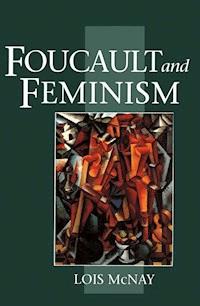
This book offers a systematic attempt to explore the point of convergance between feminist theory and the work of Michel Foucault.
Das E-Book Foucault and Feminism wird angeboten von Polity und wurde mit folgenden Begriffen kategorisiert:
attempt; work; feminist; systematic; book; point; michel; theory; between; convergence; foucaults; careful; mcnay; something; gain; feminism; argues; reading; analysis; light; limitations; concerns; approach; development
Sie lesen das E-Book in den Legimi-Apps auf:
Seitenzahl: 429
Veröffentlichungsjahr: 2013
Ähnliche



















FOUCAULT AND FEMINISM:
Power, Gender and the Self
Lois McNay
Polity Press
Copyright © Lois McNay, 1992
The right of Lois McNay to be identified as author of this work has been asserted in accordance with the Copyright, Designs and Patents Act 1988.
First published in 1992 by Polity Press in association with Blackwell Publishers Ltd.
Reprinted 1994, 1997, 2004, 2007
Polity Press
65 Bridge Street
Cambridge CB2 1UR, UK
Polity Press
350 Main Street
Maiden, MA 02148, USA
All rights reserved. Except for the quotation of short passages for the purposes of criticism and review, no part of this publication may be reproduced, stored in a retrieval system, or transmitted, in any form or by any means, electronic, mechanical, photocopying, recording or otherwise, without the prior permission of the publisher.
Except in the United States of America, this book is sold subject to the condition that it shall not, by way of trade or otherwise, be lent, re-sold, hired out, or otherwise circulated without the publisher’s prior consent in any form of binding or cover other than that in which it is published and without a similar condition including this condition being imposed on the subsequent purchaser.
ISBN: 978-0-7456-0938-6
ISBN: 978-0-7456-0939-3
ISBN: 978-0-7456-6782-9 (Single-user ebook)
ISBN: 978-0-7456-6783-6 (Multi-user ebook)
A CIP catalogue record for this book is available from the British Library.
Typeset in 10½ on 12pt Palatino
by Graphicraft Typesetters Ltd., Hong Kong
Printed and bound in Great Britain by
Marston Book Services Limited, Oxford
This book is printed on acid-free paper.
For further information on Polity, visit our website: www.polity.co.uk
For Marian and Michael McNay
Contents
Acknowledgements
Introduction
1 Power, Body and Experience
2 From the Body to the Self
3 Ethics of the Self
4 The Problem of Justification
5 Self and Others
Conclusion
Notes
Bibliography
Index
Acknowledgements
I would like to thank John Thompson for his excellent advice and encouragement. I would also like to thank Henrietta Moore for her stimulating critical comments.
Introduction
Currently, many left-wing thinkers, ranging from literary critics to political theorists, appear to be grappling with a basically similar dilemma. This dilemma revolves around the implications of poststructuralist thought – and its most recent mutation into theories of the postmodern – for emancipatory politics. The engagement between poststructuralism and other types of radical criticism has been going on for several years now. The poststructuralist attack on traditional forms of thought and, in particular, on orthodox notions of rationality and the unified subject has had deepseated effects on many types of cultural and social critique. Whilst there have always been some critics on the left who have rejected out of hand the insights of poststructuralist thought, the convergence has been, on the whole, positive and stimulating.
However, what distinguishes the most recent dilemma is that many previously sympathetic radical thinkers have begun critically to withdraw in varying degrees from some of the post-structuralist tenets they used to espouse. The questions that are now being asked tend to turn around two central, interrelated themes. Firstly, where does the poststructuralist deconstruction of unified subjectivity into fragmented subject positions lead in terms of an understanding of individuals as active agents capable of intervening in and transforming their social environment? Secondly, what are the implications of the postmodern suspension of all forms of value judgement, of concepts such as truth, freedom and rationality, for emancipatory political projects which necessarily rest on certain ‘metaphysical’ assumptions about what constitutes oppression and freedom?
The tensions that have always existed between poststructuralist theory, whose ‘relativist’ logic tends to lead to a ‘retreat from polities’ (see Fraser 1984), and the normative demands of more politically engaged forms of critique have, in some cases, reached breaking point. Thus, in New Left Review, Kate Soper argues that left-wing thinkers must make explicit their suspicions about the ‘self-indulgent quality’ of postmodern scepticism and return to ‘an open commitment to certain political principles and values’ (Soper 1991: 123).
Feminists have not been exempt from this dilemma either. Indeed, perhaps more than any other group of thinkers, feminists are particularly involved because the crossover between feminist theory and poststructuralism has been especially vibrant and productive. The poststructuralist philosophical critique of the rational subject has resonated strongly with the feminist critique of rationality as an essentially masculine construct. Moreover, feminists have drawn extensively on the poststructuralist argument that rather than having a fixed core or essence, subjectivity is constructed through language and is, therefore, an open-ended, contradictory and culturally specific amalgam of different subject positions. This argument has been used in various ways by feminists – particularly socialist feminists – to criticize the tendency amongst certain radical feminists to construct women as a global sisterhood linked by invariant, universal feminine characteristics, i.e. essentialism.
Despite these important theoretical convergences, however, feminists are beginning to question anew how far they can draw on poststructuralist thought. Once again the fundamental problem is the extent to which a philosophical form of critique that rejects any type of certainty or value judgement conflicts with, or even undermines, feminist politics whose principal aim of overcoming the subordination of women necessarily rests on certain basic value judgements and truth claims.
It is against the general background of these debates that I conduct my investigation into the implications of the work of the French philosopher and historian Michel Foucault for feminist social theory. As a major figure in the poststructuralist canon, any consideration of Foucault’s work will almost inevitably have to take into account the questions being thrown up in the current debate. Even more so, because, perhaps to a greater extent than any other post-structuralist thinker, feminists have drawn on Foucault’s work.
The engagement between feminist theory and the thought of Michel Foucault has tended to centre around the work of his middle years, most notably Discipline and Punish and the first volume of The History of Sexuality. In these works, Foucault presents a theory of power and its relation to the body which feminists have used to explain aspects of women’s oppression. Foucault’s idea that sexuality is not an innate or natural quality of the body, but rather the effect of historically specific power relations has provided feminists with a useful analytical framework to explain how women’s experience is impoverished and controlled within certain culturally determined images of feminine sexuality. Furthermore, the idea that the body is produced through power and is, therefore, a cultural rather than a natural entity has made a significant contribution to the feminist critique of essentialism mentioned earlier.
However, despite the extent to which Foucault’s idea of the body has been used in feminist theory, feminists are also acutely aware of its critical limitations. Again, these limitations centre upon the difficulties of assimilating a primarily philosophical form of critique into feminist theory which is rooted in the demands of an emancipatory politics. For the emphasis that Foucault places on the effects of power upon the body results in a reduction of social agents to passive bodies and does not explain how individuals may act in an autonomous fashion. This lack of a rounded theory of subjectivity or agency conflicts with a fundamental aim of the feminist project: to rediscover and re-evaluate the experiences of women.
With this in mind, a central aim of this book is to show how Foucault’s little-considered final work – The Use of Pleasure, The Care of the Self and various interviews and articles – goes some way to overcoming the limitations of his earlier work on the body through the elaboration of a notion of the self. The development of a concept of the self derives, in part, from Foucault’s own recognition of the analytical limitations of his partial account of the individual as a passive body. Not only does such a limited model deny the potential for agency and self-determination, but it also leads to an understanding of power in purely negative terms as prohibitory and repressive – although, in principle, Foucault contests such conceptions with his idea that power is a productive and positive force. He complements his earlier analysis of technologies of domination, therefore, with an analysis of technologies of subjectification. Foucault defines these technologies of the self as a certain number of practices and techniques through which individuals actively fashion their own identities. Such an idea permits Foucault to explain how individuals may escape the homogenizing tendencies of power in modern society through the assertion of their autonomy. At the same time, however, Foucault avoids defining autonomy in essentialized terms as, for example, the realization of an individual’s prediscursive or innate potential, because, in the final instance, these practices are always determined by the social context.
Foucault’s final work on the self represents a significant shift from the theoretical concerns of his earlier work, and also seems to overcome some of its more problematic political implications. Individuals are no longer conceived as docile bodies in the grip of an inexorable disciplinary power, but as self-determining agents who are capable of challenging and resisting the structures of domination in modern society. Such a shift in emphasis also calls for a renewed exploration of the implications of his idea of the self for feminist theory. However, despite the fact that Foucault’s work on the self has been widely available in English translation for some time now, it has received relatively little attention from both within and outside feminist circles. Even very recent studies of Foucault’s work concentrate in the main upon his theories of power and the body rather than on his notion of the self. This neglect may be explained in part by the somewhat esoteric and dry manner in which Foucault offers up his theory of the self in a study of ancient Greek and Roman behaviour. As a result, a large proportion of the little attention his work has received has been from scholars of antiquity who often dispute the accuracy of Foucault’s interpretation of his classical sources. It is my aim, then, to consider the implications of Foucault’s work on the self in relation to his æuvre as a whole and in relation to feminist theory.
I argue that Foucault’s work on the self is worth serious consideration by feminists because, on certain points, it converges in an interesting fashion with some of the theoretical issues that are currently dominating areas of feminist debate. For example, the idea of a process of active self-fashioning, which lies at the heart of Foucault’s theory of practices of the self, parallels, in certain respects, recent attempts by theorists such as Teresa de Lauretis to model the subjectivity of women in terms other than those of passive victims of patriarchy. Similarly, Foucault’s work on ethics of the self resonates with feminist critiques of some of the essentializing assumptions that underlie radical feminist work on ‘feminine’ or ‘mothering’ ethics.
I hope to show, on the one hand, how Foucault’s work on the self opens up areas of theoretical debate – closed off by his earlier work on the body – for renewed consideration by feminists. On the other hand, I show how at significant points, especially in the linking of practices of the self to issues of gender, Foucault’s work is flawed and how feminist theory on similar issues, such as identity and autonomy, is, in some respects, more insightful. Obviously, to a certain extent, the flaws in Foucault’s work can be connected to his sudden death so soon after initiating such a significant change in his intellectual interests. However, despite the unfinished nature of his final work, I show how some of its flaws are linked to Foucault’s failure to resolve fully some of the more problematic theoretical elements of his earlier work, such as his undifferentiated theory of power. Thus while trying to break into new intellectual ground, the legacy of these unresolved problems hinders his last work.
Another central aim of my examination of Foucault’s work is to re-assess the charge often made against him that he is an ‘anti-Enlightenment’ thinker. I show how Foucault’s theory of practices of the self, rather than representing a rejection of Enlightenment values, represents an attempt to rework some of the Enlightenment’s central categories, such as the interrelated concepts of autonomy and emancipation. This reading of Foucault’s work is not, as some commentators may argue (Poster 1984; Rajchman 1985), an attempt to force his work into inappropriate categories, because Foucault himself saw his final work as running in a tradition of Enlightenment thought rather than running counter to it. By establishing such a continuity between Foucault’s work and the Enlightenment, I also wish to cast doubt on a predominant trend in recent Foucault commentary which argues that his work is a paradigmatic example of ‘postmodern’ thought (e.g. Harstock 1990; Hekman 1990; Hoy 1988). Undoubtedly, there are elements in his work which accord with what are held to be some of the central theoretical tenets of postmodern thought, in particular Foucault’s rejection of systematic forms of knowledge which rest on universal truth claims. However, I show how a close reading of Foucault’s last work confounds any straightforward equation with postmodern thought by revealing the presence of themes and concepts usually associated with the thought of modernity.
My argument that Foucault can not be so easily categorized as a postmodern thinker inevitably touches on the recent debate about the possibility of formulating a postmodern feminism. To schematize, the general points of convergence being debated are, on the one hand, how the postmodern rejection of ‘metanarratives’ and the corresponding stress on the specific and the category of ‘difference’ can correct some of the essentialist and universalizing tendencies that still hamper certain types of contemporary feminism. For example, the emphasis on the constitutive powers of discourse reminds feminists that the problem of feminine identity is better approached as an historically and culturally specific construct rather than as an innate phenomenon. Internal feminist critiques of the essentialist tendencies of some types of feminism have been well established for some time, but there is still a need for such forms of critique in the early 1990s. For if Michèle Barrett (1988) is right, socialist feminism has been in decline and increasingly feminism is identified publicly with the essentialist forms of feminism presented by writers such as Mary Daly, Adrienne Rich, Carol Gilligan and some of the ‘new French’ feminists.
If postmodern thought is seen to contribute to the critique of essentialism within feminism, then the other side of the debate is that a feminist perpective may contribute an awareness of issues connected to gender which, on the whole, is absent from most postmodern thought. The postmodern preoccupation with difference either bypasses the question of sexual difference altogether or, as Rosi Braidotti (1988) points out, renders sexual difference a metaphor of all difference, thus turning it into a general philosophical term which bears little relation to the concrete issues of gender or to the historical presence of real-life women.
Needless to say, within the feminist debate on postmodernism there is no consensus of opinion. A few feminists are optimistic about the possibility of formulating a postmodern feminism (Fraser and Nicholson 1988; Hekman 1990). Other feminists are entirely opposed to the possibility of a fruitful convergence between the two strands of thought, arguing that the postmodern deconstruction of categories such as subjectivity and agency denies women the chance of articulating and analysing their experiences, just as they are beginning to realize the possibility of overcoming their marginalization (Benhabib 1990; Harstock 1990). Many feminists adopt a line between these two positions and accept that there is a need for feminists to develop theoretical tools able to deal with difference in a non-essentializing way, but, at the same time, remain sceptical about the relativist implications of a postmodern stance on feminist politics.
My conclusions about the viability of formulating a postmodern feminism can be related to the more general issue of the compatibility of theories of difference with the feminist interest in sexual difference. Whilst there are undoubtedly fruitful points of convergence, I am sceptical about the necessity of having to formulate such a variation of feminism in order for feminists to be able to come to terms with the issue of difference. The category of difference – or the differences within sexual difference – has, for a while, been an important topic of debate within feminism as a result of criticisms from black and Third World feminists about the ethnocentric and middle-class nature of much feminist theory, which assumes that the struggle against gender oppression is primary regardless of the economic and political conditions under which many women live. Consequently, Western feminists have been trying to break down some of the universalizing categories they have previously employed and are attempting to develop tools capable of relating gender issues to the equally fundamental categories of race and class.
Concern with the question of the primacy of sexual difference has led some feminists to postmodern theories of difference as a potential source of more sophisticated analytical tools. However, in my view these varying theories of difference are not only not coextensive, but they also conflict in several fundamental respects. Furthermore, there is a danger that many feminists, in their desire to construct a correspondence between feminist theory and postmodern theory, overlook these points of conflict. In the final analysis, I believe that feminists cannot afford to relinquish either a general theoretical perspective, or an appeal to metanarratives of justice. I contend that gender issues cannot be fully comprehended without an understanding of general social dynamics, nor can gender oppression be overcome without some appeal to a metanarrative of justice. The adoption of such general theoretical perspectives does not necessarily preclude feminists developing a greater sensitivity to difference.
It is in this area of a potential crossover between feminism and theories of the postmodern that I hope to show how a reconsideration of Foucault’s work on the self by feminist theorists has much to offer. For many of the themes of recent feminist theory, especially those that voice an anxiety concerning postmodernism and its apolitical nature, find parallels in Foucault’s later work. Just as the presence of emancipatory themes in Foucault’s work on the self hinder its categorization as postmodern, so the fundamental emancipatory aims of feminism hinder its assimilation into a postmodern variant. Ultimately – in spite of arguments against subject/object dualisms, the rational subject, etc. – feminism has never abandoned the politics of progression and personal emancipation.
My scepticism about the possibility of a feminist postmodernism arises not only from what I see as certain incompatibilities between the categories of difference and sexual difference, but also from what I perceive as the false polarization that the debate on modernity and postmodernity has established between theory and practice, metanarratives and action, the general and the particular. Such false antagonisms obscure the fact that it is not only possible to articulate a greater sensitivity to difference within a general theoretical perspective, but also that the establishment of certain collective aims and norms is necessary to ensure an atmosphere of tolerance and equality in which differences can be expressed. By abandoning any normative perspective, it is not clear how a postmodern position of laissez-faire could ensure against an environment of hostility and predatory self-interest in which the more powerful repress the less privileged. I believe that if, in the future, feminists are to deal more adequately with the question of difference, it is necessary for them to look beyond the artificial polarities of the modern/postmodern debate and explore ways in which theory can be made compatible with the local.
Despite a shared unease about aspects of postmodern thought, especially concerning the subject and subjectivity, certain theoretical problems with Foucault’s work on the self prevent too close a convergence with the feminist project. My main criticism of Foucault’s final work is that there is an unresolved tension between his commitment to emancipatory social change and his refusal to outline the normative assumptions upon which such change should be based. Like other postmodern theorists, Foucault is reluctant to establish normative guidelines for his ethics of the self because he believes that the laying down of norms inevitably has a normalizing effect on the individual’s freedom to act. However, in the final two chapters, partly through a comparison with the work of Habermas, I show how Foucault wrongly confuses the establishment of basic norms, which serve as a safeguard against the abuse of power and the domination of weaker individuals, with the imposition of inappropriate political demands and aims on individuals. Whilst the latter is to be avoided, the former is necessary if ethics of the self is not to retreat into a form of unregulated introversion. On the one hand, the idea of practices of the self is informed by a strong political commitment and Foucault clearly intends what he sees as the autonomous practices of individuals to feed into some wider process of social transformation. It is this belief in the potential of independent critical thought and action to lead to social transformation that links Foucault’s work to a tradition of Enlightenment thought. Yet, on the other hand, by failing to establish any basic normative guidelines or collective aims for practices of the self, it is unclear how the self can be called out of the self on to a plane of generality where it is reminded of its responsibilities to other individuals in society.
Despite the limitations of Foucault’s theory of the self, it nevertheless represents an important contribution to social theory. For as Anthony Giddens (1979) has pointed out, within social theory there is a marked skewing to the structure side of the agency/structure duality. Of particular significance is the fact that Foucault elaborates his theory of the self without recourse to psychoanalytic theory. At the most fundamental level, most psychoanalytic models posit a basic sense of self which is constituted at an early age and continues into adult life cutting across divisions of race, class and ethnicity. Against this invariant notion of identity, Foucault’s account of the self emphasises the variety of ways in which identities are constituted. Given the enormous influence of Lacan’s rereading of Freud upon the work of feminist and other theorists in France, this resistance to psychoanalysis makes Foucault’s work even more interesting. On the whole, however, I deliberately avoid a comparison of Foucault’s work on the self with psychoanalytic accounts of identity, mainly for reasons of space but also because there is extensive discussion of such issues elsewhere (for example, Braidotti 1991; Forrester 1980).
This book is divided into five chapters. Each chapter deals with a theme which has figured significantly in recent feminist theory. The first chapter focuses on feminist discussions of the ‘body’ and relates these to Foucault’s earlier theory of the relation between the body and power. On the one hand, I argue that Foucault’s account of the body as a radically contingent entity helps to overcome tendencies to essentialism and biologism which have hampered feminist definitions of the body. On the other hand, however, I argue that Foucault does not devote enough attention to the overdetermining effects of gender upon the body. Another more serious problem with Foucault’s account is that he tends to understand individuals solely as bodies and he, therefore, excludes a consideration of other aspects to the experiences of individuals in modern society. Such a one-sided emphasis conflicts with the feminist project of rediscovering and revaluing the experiences of women. In the second chapter, I consider the extent to which the idea of practices of the self overcomes some of the problems with Foucault’s earlier notion of individuals as ‘docile bodies’. I focus on the notions of power and autonomy and link this to parallel developments within feminist theory to avoid positing women as innocent victims of systems of oppression.
Having introduced the notion of practices of the self, the following three chapters centre on a detailed examination of some of the theoretical implications of this theory. In the third chapter, I compare Foucault’s idea that practices of the self can translate into a modern ethics with recent feminist theories of ‘feminine’ or ‘mothering’ ethics. Whereas some theories of feminine ethics tend to reify the categories of masculinity and femininity, I argue that Foucault’s theory of ethics presents feminists with the challenge of thinking through the differences within sexual difference. In the fourth chapter, I examine some of the ambiguous normative implications of Foucault’s theory of the self and I link these ambiguities to his ambivalent relationship with Enlightenment thought. I continue this line of enquiry in the final chapter in relation to Foucault’s one-sided emphasis on the self which leads to a conception of the individual as an isolated entity, rather than explaining how the self is constructed in the context of social interaction.
By exploring a specific set of theoretical issues in Foucault’s work from a feminist perspective, I aim to make the general point that the feminist concern for sexual difference should not be elided as closely as it has been with the poststructural emphasis on difference. However, although the critical approach I adopt is one that tends to focus on points of tension and conflict, this is not meant to be a purely negative assessment. Indeed, I believe that the uncovering of tension and conflict is healthy in that it prevents closure, sustains reflexivity and continually pushes the debate between feminist and poststructuralist theory on to new and challenging ground.
1
Power, Body and Experience
INTRODUCTION
In this chapter, I intend to explore the significance of Foucault’s theory of the body for feminist critique. There are two strands to my argument. On the one hand, I show how Foucault’s theory of power and the body indicates to feminists a way of placing a notion of the body at the centre of explanations of women’s oppression that does not fall back into essentialism or biologism. In this respect, Foucault’s work has been the main impetus behind many interesting and original studies into the regulatory mechanisms which circumscribe the sexualized body. Yet, on the other hand, I hope to show that if feminists are to make use of Foucault’s account of the body there are several theoretical problems which need to be overcome.
One such problem is that, in his elaboration of the body, Foucault neglects to examine the gendered character of many disciplinary techniques. This is a problem that has been widely noted by feminists; for example, Rosi Braidotti claims that ‘Foucault never locates woman’s body as the site of one of the most operational internal divisions in our society, and consequently also one of the most persistent forms of exclusion. Sexual difference simply does not play a role in the Foucauldian universe, where the technology of subjectivity refers to a desexualized and general “human” subject’ (Braidotti 1991: 87). For many feminists, Foucault’s indifference to sexual difference, albeit unintended, reproduces a sexism endemic in supposedly gender-neutral social theory. Silence – no matter how diplomatic or tactical – on the specificity of sexual difference does not distinguish Foucault’s thought significantly from the gender blindness and biased conceptual habits of more traditional theoretical discourses. As Schor puts it: ‘What is to say that the discourse of sexual indifference/pure difference is not the last or, (less triumphantly) the latest ruse of phallocentrism?’ (Schor 1987: 109).
Having considered the status of the gendered body in Foucault’s work, I go on to argue that a more serious problem with Foucault’s notion of the body is that it is conceived essentially as a passive entity, upon which power stamps its own images. Such a conception of the body results in a problematic one-dimensional account of identity. In respect to the issue of gendered identity, this unidirectional and monolithic model of power’s operations on the body leads to an oversimplified notion of gender as an imposed effect rather than as a dynamic process. In terms of identity in general, the reduction of individuals to passive bodies permits no explanation of how individuals may act in an autonomous and creative fashion despite overarching social constraints. For feminists – and, indeed, social theorists in general – this is a particular problem given that a significant aim of the feminist project is the rediscovery and revaluation of the experiences of women.
GENEALOGY, THE BODY AND THE CRITIQUE OF THE SUBJECT
The idea of the body is a concept central not only to the work of Michel Foucault, but to much of what is categorized as post-structuralist thought. The reason for the predominance of the idea of the body is that it is one of the central tools through which poststructuralists launch their attack on classical thought and its linchpin the rational subject or cogito. To schematize, the post-structuralist argument holds that the notion of a rational, self-reflective subject, which has dominated Western thought since the Enlightenment, is based on the displacement and/or derogation of its ‘other’. Thus the notion of rationality is privileged over the emotions, spirituality over the material, the objective over the subjective. One dualism of central importance to classical thought is the Cartesian opposition between mind and body. This dualism privileges an abstract, pre-discursive subject at the centre of thought and, accordingly, derogates the body as the site of all that is understood to be opposed to the spirit and rational thought, such as the emotions, passions, needs. By prioritizing the first term in the series of dualisms, classical thought thus controls the parameters of what constitutes knowledge and monitors the extent and kind of discourses that are allowed to circulate.
It is the opposition between mind and body which, of all the dualisms, has become the focus of the deconstructive manoeuvres of the poststructuralists and the pivotal point of their attack on classical systems of thought and the philosophy of the subject. In regard to this opposition, a main concern has been to unpack the concept of the stable and unified subject by demonstrating how the ideas of rationality and self-reflection, which underlie it, are based on the exclusion and repression of the bodily realm and all that which, by analogy, it is held to represent – desire, materiality, emotion, need and so on. The category of the body, then, has a tactical value in so far as it is used to counter the ‘ideophilia’ of humanist culture. As Nancy Fraser puts it: ‘The rhetoric of bodies and pleasures . . . can be said to be useful for exposing and opposing, in highly dramatic fashion, the undue privilege modern western culture has accorded subjectivity, sublimation, ideality and the like’ (Fraser 1989: 62).
Foucault first employs a notion of the body in the essay ‘Nietzsche, Genealogy, History’, where he attacks traditional forms of history which he regards as being dominated by certain metaphysical concepts and totalizing assumptions derived from a philosophy of the subject. Firstly, he argues that traditional or ‘total’ history is a ‘transcendental teleology’; events are inserted in universal explanatory schemas and linear structures and, thereby, given a false unity. The interpretation of events according to a unifying totality deprives them of the impact of their own singularity and immediacy: ‘The world we know is not this ultimately simple configuration where events are reduced to accentuate their essential traits, their final meaning, or their initial and final value. On the contrary, it is a profusion of entangled events’ (Foucault 1984e: 89). Secondly, Foucault sees traditional history as falsely celebrating great moments and situating the self-reflective subject at the centre of the movement of history. Privileging of the individual actor places an emphasis on what are considered to be immutable elements of human nature and history is implicitly conceived in terms of a macroconsciousness. Historical development is interpreted as the unfolding and affirmation of essential human characteristics (Foucault 1984e: 85). Following on from this, history comes to operate around a logic of identity which is to say that the past is interpreted in a way that confirms rather than disrupts the beliefs and convictions of the present. The disparate events of the past are filtered through the categories of the present to produce ‘a history that always encourages subjective recognitions and attributes a form of reconciliation to all the displacements of the past’ (Foucault 1984e: 86).
Finally, traditional forms of historical analysis seek to document a point of origin as the source of emanation of a specific historical process or sequence. Foucault attacks the search for origins as an epistemologically problematic quest for ahistorical and asocial essences. The search for the origin of a particular historical phenomenon implicitly posits some form of original identity prior to the flux and movement of history. In turn, this original identity is interpreted as an indication of a primordial truth which precedes and remains unchanged by history or ‘the external world of accident and succession’ (Foucault 1984e: 78–9). For Foucault, however, ‘what is found at the historical beginning of things is not the inviolable identity of their origin; it is the dissension of other things. It is disparity’ (Foucault 1984e: 79). Thus, if the origin of the concept of liberty is analysed, we find that it is an ‘invention of the ruling classes’ and not a quality ‘fundamental to man’s nature or at the root of his attachment to being and truth’ (Foucault 1984e: 78–9).
Against what are seen as traditional types of history, Foucault poses the notion, derived from Nietzsche, of ‘effective’ history or genealogy. Adopting Nietzsche’s conception of the primacy of force over meaning, Foucault opposes ‘the hazardous play of dominations’ and ‘the exteriority of accidents’ to the conception of an immanent direction to history. History is not the continuous development and working through of an ideal schema, rather it is based on a constant struggle between different power blocks which attempt to impose their own system of domination. These different systems of domination are always in the process of being displaced, overthrown, superseded. The task of the historian is to uncover the contingent and violent emergence of these regimes in order to shatter their aura of legitimacy. The structuring of social relations is perceived in terms of warfare (Foucault 1980: 90–1, 114). ‘Humanity does not gradually progress from combat to combat until it arrives at universal reciprocity, where the rule of law finally replaces warfare; humanity installs each of its violences in a system of rules and thus proceeds from domination to domination’ (Foucault 1984e: 85).
The representation of history as a series of discontinuous structures is directed against the philosophy of history and, in particular, the Marxist aim of comprehending the totality of past and present from the standpoint of a future yet to be realized. An understanding of history as a series of struggles between different forces is also directed against the dialectical idea of the self-reflective subject as the pivot of historical development. Rather than seeing history as a process of reconciliation of the contradictions between subject and object via the human actor’s interaction with and reflection upon the world, Foucault views the forces in history acting upon and through the human body in a manner which resists incorporation into a totalizing historical perspective. The replacement of the self-thematizing subject as the pivot of history with a notion of the body results in a change in the historian’s methodology. Historical development is no longer hermeneutically interpreted in terms of the meanings it reveals but is understood as a conflict between different power blocks, i.e. permanent warfare. As the centre of the struggle for domination, the body is both shaped and reshaped by the different warring forces acting upon it. The body, then, is conceived of in radically anti-essentialist terms; ‘Nothing in man – not even his body – is sufficiently stable to serve as a basis for self recognition or for understanding other men’ (Foucault 1984e: 87–8). The body bears the marks, ‘stigmata of past experience’ upon its surface;
The body is the inscribed surface of events (traced by language and dissolved by ideas), the locus of a dissociated self (adopting the illusion of a substantial unity), and a volume in perpetual disintegration. Genealogy as an analysis of descent, is thus situated within the articulation of the body and history. Its task is to expose a body totally imprinted by history and the processes of history’s destruction of the body (Foucault 1984e: 83).
Effective history takes the examination of the body as its starting point and thus analyses the effects of power in their most specific and concrete form. Correlative to this attention paid to the power relations inscribed on the body, the genealogist focuses on events in their singularity. The genealogist tries to rediscover the multiplicity of factors and processes which constitute an event in order to disrupt the self-evident quality ascribed to events through the employment of historical constants and the ascription of anthropological traits. The aim of effective history is not to systematize but to disperse and fragment the past; ‘History becomes effective to the degree that it introduces discontinuity into our very being – as it divides our emotions, dramatizes our instincts, multiplies our body and sets it against itself (Foucault 1984e: 88).
It is this idea, that the body and the way it is worked upon by power is the proper focus of history, that is the underlying principle of Foucault’s two later studies, Discipline and Punish and The History of Sexuality. Foucault replaces a method based on the hermeneutic elucidation of contexts of meaning, and a correlative anthropological stress on the subject as the mainspring of history, with an examination of the way in which the body is arbitrarily and violently constructed in order to legitimize different regimes of domination.
FEMINISM AND THE BODY
It is Foucault’s notion of the body as the point where power relations are manifest in their most concrete form which, in the last few years, has made a significant contribution to feminist thinking on the body. Of all poststructuralist work on this theme, Foucault’s has received probably the most attention because of his insistence on the body as an historical and culturally specific entity (Bartkowski 1988). This insistence on the body as an historically specific entity distinguishes Foucault’s theory from those of other theorists, such as Derrida, where the body is a metaphorization of the more general philosophical problem of difference. For feminists, this stress on specificity is important because, as Rosi Braidotti has argued, the representation of the more general philosophical issue of difference in the metaphor of the feminine body allows poststructuralist thinkers to bypass altogether the question of sexual difference as it relates to the experiences of women:
The notion of ‘sexual difference’ has been subjected to such inflationary value that it has led to a paradoxical new uniformity of thought. ‘Postmodern’ . . . ‘deconstructive’ . . . and other kinds of philosophers have first of all sexualised as ‘feminine’ the question of difference and secondly have turned it into a generalised philosophical item. As such it is clearly connected to the critique of classical dualism . . . Yet it is not directly related to either the discursivity or the historical presence of real-life women (Braidotti 1989: 89).
A similar criticism of the poststructuralist tendency to metaphorize the feminine has been made by Alice Jardine in Gynesis (1985). The displacement of classical modes of thought based on dualism and the consequent dislocation of the subject has led post-structuralists to posit a space of unrepresentability or difference – or hetereogeneity, the body, madness, the unconscious, etc. – that new modes of thinking, writing and speaking should try to trace. This space of ‘otherness’ and instability where identity is unfixed is, according to Jardine, generally feminized. However, this putting into discourse of ‘woman’ – ‘woman in effect’ as Jardine calls it – is problematic for feminists. Firstly, it is not clear to what extent the supposedly radical equation of woman with that which cannot be contained within discourse is very different from traditional stereotypes of woman as unknowable and unrepresentable. Secondly, it is difficult for feminists to make the links between this metaphorized idea of woman and the experiences of women as active subjects; indeed, the idea of woman-in-effect may negate the experiences of ‘real’ women altogether.
One of the most important contributions that Foucault’s theory of the body has made to feminist thought is a way of conceiving of the body as a concrete phenomenon without eliding its materiality with a fixed biological or prediscursive essence. The problem of conceptualizing the sexualized body without positing an original sexual difference is one that has preoccupied feminist theorists. On a fundamental level, a notion of the body is central to the feminist analysis of the oppression of women because it is upon the biological difference between the male and female bodies that the edifice of gender inequality is built and legitimized. The idea that women are inferior to men is naturalized and, thus, legitimized by reference to biology. This is achieved through a twofold movement in which, firstly, women’s bodies are marked as inferior by being compared with men’s bodies, according to male standards (homme manqué) and, secondly, biological functions are conflated with social characteristics. In many respects, masculine characteristics can be seen to be related to dominant perceptions of the male body, i.e. firmness, aggression, strength. However, man, unlike woman, is understood as being able to transcend being defined in terms of his biological capacities via the use of his rational faculties. In contrast, women, as de Beauvoir notes, are entirely defined in terms of their physical capacities:
When woman is given over to man as his property, he demands that she represents the flesh purely for its own sake. Her body is not perceived as the radiation of a subjective personality, but as a thing sunk in its own immanence; it is not for such a body to have reference to the rest of the world (de Beauvoir 1972: 189).
This derogation of the female body through comparison with the male body, and the consequent definition of femininity through reference to biological capacities, leads to a series of different strategies of corporeal oppression: the restriction of sexuality within the framework imposed by the opposition of masculinity and femininity, the subjection of women in confinement to medical power, the contemptuousness of menstruation, the construction of female sexuality as ‘lack’ or frigidity, etc.
THE PROBLEM OF ESSENTIALISM
Although a notion of the body is central to a feminist understanding of the oppression of women, it needs to be thought through carefully if what is regarded as patriarchal logic – the definition of the social category of woman in terms of biological functions – is to be subverted and not compounded. This conflation of the social existence of women with their biological functions is a problematic tendency of some types of feminism, most notably radical feminism and some of the ‘new French’ feminisms. The theoretical difficulties inherent in these approaches have been widely commented on and need only be considered briefly here (see Butler 1990a; Plaza 1978; Soper 1989 and 1990). The work of the French feminist Annie Leclerc exemplifies the problems inherent in such an approach to the body. Leclerc argues that women must re-appropriate their bodies from patriarchal forms of control and, thereby, learn to revalue them outside of the framework of male norms and standards. By recovering a positive image of their biological selves, women will find fulfilment in what Leclerc regards as their ‘innate’ caring and nurturing functions:
Washing dishes, peeling vegetables, cleaning clothes, ironing . . . Menial, gloomy, thankless, futile, degrading work? . . . A varied, multiple occupation, work that can be done while singing or day dreaming, work which, like all happy tasks, is obviously meaningful, work where one produces with one’s own hands all that life requires . . . How can work that produces immediate results, results which are carried forward in the very task itself, be thankless? The house takes on a festive air, the meal smells good, the child burbles contentedly while showing off its silky little bottom, and an hour’s dreamy efforts grant the trousers another year’s wear (Leclerc 1987: 75–6).
Whilst most feminists would agree that there is a need to revalue women’s physical way of being in the world, in particular the task of reproduction, the shortcomings of Leclerc’s approach are clear. Her notion of femininity is based on a sentimentalized image of motherhood which comes close to reinforcing patriarchal conceptions of gender difference. Moreover, the elevation of the maternal function as the essence of femininity excludes many women, who are not mothers, from the category of ‘true womanhood’. As Soper trenchantly observes about this extreme difference feminism: ‘it is particularly offensive and arrogant – to the point in fact of operating a kind of theft of subjectivity or betrayal of all those who fail to recognize themselves in the mirror it offers’ (Soper 1990: 15).
An appeal to difference, which is based in an essentialism of the female physique, reinforces traditional notions of a male/female divide and ‘leaves woman once again reduced to her body . . . rather than figuring as a culturally shaped, culturally complex, evolving, rational, engaged and noisy opposition’ (Soper 1990: 13). Because the category of the ‘natural sexed body’ only makes sense in terms of a binary discourse on sex, in which men and women exhaust the possibilities of sex and relate to each other as complementary opposites, the category of sex is always subsumed under a discourse of heterosexuality. Christine Delphy makes a similar point in her attack on Leclerc in Parole de Femme. Delphy argues that Leclerc confuses biological males and females with the social categories of men and women. This derivation of absolute psychological differences from the fact of physical distinction leads to a hypostatization of the categories of masculine and feminine. It also results in a reductionist account of the human subject whose functioning is explained by reference ‘to a few cells’ (Delphy 1987: 89).
To compound this, Leclerc overlooks the complex nature of the oppression of women by reducing it to a simple case of misrecognition. If the caring and nurturing qualities of women were valued more highly by both men and women then, she argues, the oppression of women would disappear. As Delphy notes, Leclerc’s explanation is idealist in that it bypasses an examination of the concrete mechanisms of oppression altogether and inverts cause and effect through the argument that devaluation leads to exploitation rather than the other way round. The caring and nurturing aspects of women’s work are undervalued not simply because of ideological misrecognition but, according to Delphy, because the domestic realm is a major site of the exploitation of women’s labour. By neglecting to analyse the specificities of women’s subordination, Leclerc produces a biologically reductionist and romanticized vision of liberation that is centred around the freeing of women’s bodily functions, which are held to define entirely women’s capacities as social actors. As Delphy observes, Leclerc finishes by reinscribing dominant and oppressive ideologies of femininity in a new ‘feminist’ context.
It must be noted briefly here that Leclerc’s brand of essentialist feminism is not necessarily representative of the work of the other ‘new French’ feminists. In particular, there has recently been some debate about the essentialist nature of the category of the ‘body’ in the work of Luce Irigaray. Some feminists argue that Irigaray’s ‘rewriting’ of the female body is both a parody and displacement of patriarchal strategies which have defined and controlled the female body. Irigaray’s redefinition of the feminine does not represent, therefore, a simplistic retreat to a natural female body, but rather it indicates a way in which women may block the patriarchal logic that invariably constructs the feminine body in negative terms and thereby women may come to control the discourse of biology for their own strategic ends. In short, for some feminists Irigaray’s articulation of a female sexuality through a notion of the biological body is purely strategic rather than essentialist (see Fuss 1989: 55–72; Gatens 1991: 100–21).
This reassessment of the work of Irigaray often goes along with a more general questioning, amongst feminists and other theorists, of the term essentialism. Essentialism, it is argued, is not necessarily as reactionary a position as is often assumed. Thus, Rosi Braidotti argues that nowadays a feminist who is interested in sexual difference ‘cannot afford not to be essentialist’ (Braidotti 1989: 93). Similarly, in a reading of Irigaray, Paul Smith holds up her essentialism as an exemplary ‘moment of contestation’ and goes on to conclude that ‘the charge of essentialism . . . does not necessarily or always amount to the damning criticism it is supposed to be. Within the logic of feminism’s still evolving constitution essentialist claims are perhaps becoming more and more important’ (Smith 1988: 144). Following on from Smith, Fuss argues that the process of laying claim to an essence is not necessarily a reactionary political manoeuvre. Since, in traditional Western metaphysics, woman has no essence, the act of describing a feminine bodily essence undoes ‘Western phallomorphism’ and offers ‘women entry into subject-hood’ (Fuss 1989: 71).
Nevertheless, despite these renewed debates over the interpretation of the bodily essentialism in French feminism in particular and the status of the concept of essentialism in general, feminists – in my view – are still justified in their suspicion of essentialist approaches to the feminine body. An interesting approach to the question of essentialism has been suggested by Diana Fuss who argues that rather than labelling a text as essentialist and therefore bad, feminists should ask instead if a text is essentialist, what motivates its deployment, how and why is it invoked and, most importantly, what are its political effects (Fuss 1989: xi). It is this question of the political effects of essentialist feminisms that brings us to the heart of the resistance from socialist feminists and others to them. For despite the greater sophistication of Irigaray’s rewriting of the body over Leclerc’s, both lead ultimately to a feminist politics that remains within the realm of the aesthetic and psychosexual. As Butler points out, many women simply do not identify with a notion of femininity based on an aestheticized and non-phallic version of the body and hence, rather problematically, risk being written off as ‘male-identified’ or ‘unenlightened’ (Butler 1990a: 30). Furthermore, many feminists believe that such a narrowly aesthetic feminist politics that constantly takes women back to their bodies does not adequately address the social oppression of women and associated issues of power, history and politics. As Ann Jones puts it, ‘Feminists may still doubt the efficacy of privileging changes in subjectivity over changes in economic and political systems; is this not dangling a semiotic carrot in front of a mare still harnessed into phallocentric social practices?’ (Jones 1985: 107).
OVERCOMING ESSENTIALISM
Although the oppression of women is based on the appropriation of their bodies by patriarchy, it does not follow, therefore, that oppression derives from the body or sex, or that the notion of a natural sexual difference can be used to explain gender inequalities. Rather, the ‘natural’ body must be understood as a device central to the legitimation of certain strategies of oppression. As Monique Plaza puts it, ‘If the category of sex has such an important position in patriarchal logic, this is not because sex gives its shape to the social; it is because the social is able to make sexual forms seem obvious and thereby hide oppressive systems’ (Plaza 1978: 9). If one is to avoid positing an original sexual difference, which is represented a posteriori in social practices and, thereby, reduces the social to an effect of biological impulses, then it is necessary to recognize that diverse sexual differences are overdetermined in order to produce a systematic effect of sexual division. It is not necessary to posit a single bodily cause of feminine subordination. Once the female sex has come to connote specific feminine characteristics, this ‘imaginary signification’ produces concrete effects throughout diverse social practices. These concrete effects are not the expression of an immutable feminine essence. However, they react, in turn, by contributing to the maintenance and reproduction of this symbolism and, thus, perpetuate the myth of immutable feminine qualities (see Laclau and Mouffe 1985: 118).




