


77,99 €
Mehr erfahren.
- Herausgeber: John Wiley & Sons
- Kategorie: Fachliteratur
- Serie: Aerospace Series (PEP)
- Sprache: Englisch
An introduction to orbital mechanics and spacecraft attitude dynamics
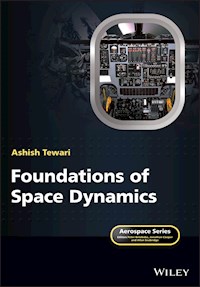
Foundations of Space Dynamics offers an authoritative text that combines a comprehensive review of both orbital mechanics and dynamics. The author a noted expert in the field covers up-to-date topics including: orbital perturbations, Lambert's transfer, formation flying, and gravity-gradient stabilization. The text provides an introduction to space dynamics in its entirety, including important analytical derivations and practical space flight examples.
Written in an accessible and concise style, Foundations of Space Dynamics highlights analytical development and rigor, rather than numerical solutions via ready-made computer codes. To enhance learning, the book is filled with helpful tables, figures, exercises, and solved examples.
This important book:
- Covers space dynamics with a systematic and comprehensive approach
- Is designed to be a practical text filled with real-world examples
- Contains information on the most current applications
- Includes up-to-date topics from orbital perturbations to gravity- gradient stabilization
- Offers a deep understanding of space dynamics often lacking in other textbooks
Written for undergraduate and graduate students and professionals in aerospace engineering, Foundations of Space Dynamics offers an introduction to the most current information on orbital mechanics and dynamics.
Sie lesen das E-Book in den Legimi-Apps auf:
Seitenzahl: 478
Veröffentlichungsjahr: 2020
Ähnliche
















Table of Contents
Cover
Foundations of Space Dynamics
Aerospace Series – Recently Published Titles
Copyright
dedication-page
Preface
1 Introduction
1.1 Space Flight
1.2 Reference Frames and Time Scales
1.3 Classification of Space Missions
Exercises
References
Note
2 Dynamics
2.1 Notation and Basics
2.2 Plane Kinematics
2.3 Newton's Laws
2.4 Particle Dynamics
2.5 The n‐Body Problem
2.6 Dynamics of a Body
2.7 Gravity Field of a Body
Exercises
References
Notes
Chapter 3: Keplerian Motion
3.1 The Two‐Body Problem
3.2 Orbital Angular Momentum
3.3 Orbital Energy Integral
3.4 Orbital Eccentricity
3.5 Orbit Equation
3.6 Orbital Velocity and Flight Path Angle
3.7 Perifocal Frame and Lagrange's Coefficients
Exercises
Notes
Chapter 4: Time in Orbit
4.1 Position and Velocity in an Elliptic Orbit
4.2 Solution to Kepler's Equation
4.3 Position and Velocity in a Hyperbolic Orbit
4.4 Position and Velocity in a Parabolic Orbit
4.5 Universal Variable for Keplerian Motion
Exercises
References
5 Orbital Plane
5.1 Rotation Matrix
5.2 Euler Axis and Principal Angle
5.3 Elementary Rotations and Euler Angles
5.4 Euler‐Angle Representation of the Orbital Plane
5.5 Planet‐Fixed Coordinate System
6 Orbital Manoeuvres
6.1 Single‐Impulse Orbital Manoeuvres
6.2 Multi‐impulse Orbital Transfer
6.3 Continuous Thrust Manoeuvres
Exercises
References
7 Relative Motion in Orbit
7.1 Hill‐Clohessy‐Wiltshire Equations
7.2 Linear State‐Space Model
7.3 Impulsive Manoeuvres About a Circular Orbit
7.4 Keplerian Relative Motion
Exercises
8 Lambert's Problem
8.1 Two‐Point Orbital Transfer
8.2 Elliptic Transfer
8.3 Lambert's Theorem
8.4 Solution to Lambert's Problem
Exercises
References
9 Orbital Perturbations
9.1 Perturbing Acceleration
9.2 Osculating Orbit
9.3 Variation of Parameters
9.4 Lagrange Planetary Equations
9.5 Gauss Variational Model
9.6 Variation of Vectors
9.7 Mean Orbital Perturbation
9.8 Orbital Perturbation Due to Oblateness
9.9 Effects of Atmospheric Drag
9.10 Third‐Body Perturbation
9.11 Numerical Methods for Perturbed Keplerian Motion
Exercises
References
10 Three‐Body Problem
10.1 Equations of Motion
10.2 Particular Solutions by Lagrange
10.3 Circular Restricted Three‐Body Problem
10.4 Non‐dimensional Equations in the Synodic Frame
10.5 Lagrangian Points and Stability
10.6 Orbital Energy and Jacobi's Integral
10.7 Canonical Formulation
10.8 Special Three‐Body Trajectories
Exercises
Reference
11 Attitude Dynamics
11.1 Euler's Equations of Attitude Kinetics
11.2 Attitude Kinematics
11.3 Rotational Kinetic Energy
11.4 Principal Axes
11.5 Torque‐Free Rotation of Spacecraft
11.6 Precession and Nutation
11.7 Semi‐Rigid Spacecraft
11.8 Solution to Torque‐Free Euler's Equations
11.9 Gravity‐Gradient Stabilization
Exercises
12 Attitude Manoeuvres
12.1 Impulsive Manoeuvres with Attitude Thrusters
12.2 Attitude Manoeuvres with Rotors
Exercises
References
ANumerical Solution of Ordinary Differential Equations
A.1 Fixed‐Step Runge‐Kutta Algorithms
A.2 Variable‐Step Runge‐Kutta Algorithms
A.3 Runge‐Kutta‐Nyström Algorithms
References
BJacobian Elliptic Functions
Reference
Index
End User License Agreement
List of Tables
Chapter 1
Table 1.1 Variation of density with altitude in Earth's atmosphere
Chapter 3
Table 3.1 Two‐body orbits.
Chapter 4
Table 4.1 Iteration steps for the solution of Kepler's equation by Newton's m...
Table 4.2 Bessel functions of the first kind and order
.
Table 4.3 Iteration steps for the solution of the hyperbolic Kepler's equatio...
Table 4.4 Iteration steps for the solution of the universal Kepler's equation...
Chapter 6
Table 6.1 The specific impulse,
, of some chemical rocket propellants
Chapter 7
Table 7.1 Comparison of relative position and velocity in a geosynchronous or...
Chapter 8
Table 8.1 Time of flight,
, for a transfer between
and
with a chord lengt...
Chapter 9
Table 9.1 Non‐zero Lagrange brackets for a perturbed elliptic orbit.
Table 9.2 The oblateness parameter,
, of some major bodies.
Table 9.3 The inclination angle for Sun‐synchronous spacecraft in circular or...
Table 9.4 Mass ratio to the solar mass, average distance from the sun, and th...
1
Table A.1 Coefficients of the Runge‐Kutta 4(5) algorithm
List of Illustrations
Chapter 1
Figure 1.1 Decay in the orbit due to atmospheric drag for a spacecraft initi...
Figure 1.2 Decay in the orbit due to atmospheric drag for a spacecraft initi...
Figure 1.3 The equinoctial sidereal frame
, the ecliptic synodic frame
, a...
Chapter 2
Figure 2.1 The position vector,
, of a particle resolved in an inertial ref...
Figure 2.2 A system of
particles in an inertial reference frame
OXYZ
.
Figure 2.3 A body as a collection of large number of particles of elemental ...
Figure 2.4 An elemental mass,
, of a body with centre of mass
O
, and a test...
Figure 2.5 Spherical coordinates for the gravitational potential of a body....
Figure 2.6 Geometry for Exercise 1.
Figure 2.7 Geometry for Exercise 2.
Chapter 3
Figure 3.1 Two spherical bodies in mutual gravitational attraction.
Figure 3.2 Orbital angular momentum and the constant orbital plane.
Figure 3.3 The conic section shapes of a non‐rectilinear Keplerian orbit.
Figure 3.4 The elliptic orbit
.
Figure 3.5 The parabolic orbit
.
Figure 3.6 The hyperbolic orbit
.
Figure 3.7 The orbital velocity vector in the local‐horizon frame.
Chapter 4
Figure 4.1 The auxilliary circle and the eccentric anomaly.
Chapter 5
Figure 5.1 The Euler axis,
, and the principal angle,
, defining the orien...
Figure 5.2 Elementary rotation about the first axis,
, of the coordinate fr...
Figure 5.3 Elementary rotation about the second axis,
, of the coordinate f...
Figure 5.4 Elementary rotation about the third axis,
, of the coordinate fr...
Figure 5.5 The Euler‐angle representation,
.
Figure 5.6 The Euler‐angle representation,
, of an orbital plane.
Figure 5.7 Spherical celestial coordinates,
, and the local‐horizon frame,
Figure 5.8 The local‐horizon frame,
.
Figure 5.9 The classical Euler angles,
.
Figure 5.10 Planet‐fixed, rotating coordinates and the local horizon.
Chapter 6
Figure 6.1 A single‐impulse manoeuvre for intersecting initial and final orb...
Figure 6.2 A general plane‐change manoeuvre.
Figure 6.3 Geometry of Hohmann transfer between two circular orbits.
Figure 6.4 Rendezvous by Hohmann transfer.
Figure 6.5 Rendezvous by Hohmann transfer between spacecraft
A
and a space s...
Figure 6.6 Positions of the manoeuvring spacecraft,
A
, at different times du...
Figure 6.7 Geometry of the outer bi‐elliptic transfer between two circular o...
Figure 6.8 Plots of simulated (exact) and approximate escape trajectory for ...
Figure 6.9 The tangential (
) and normal (
) directions for resolving the mo...
Chapter 7
Figure 7.1 Geometry of relative motion in orbit.
Chapter 8
Figure 8.1 Geometry of a two‐point orbital transfer.
Figure 8.2 The vacant focus,
, of Ellipse #1 of the semi‐major axis,
, as ...
Figure 8.3 The locus of the vacant focii,
and
, of transfer ellipses of t...
Figure 8.4 Geometry of the minimum‐energy orbital transfer.
Figure 8.5 Geometrical interpretation of Lambert's theorem for calculating t...
Figure 8.6 Geometrical interpretation of Lambert's theorem for calculating t...
Chapter 9
Figure 9.1 The osculating orbit as a reference for the trajectory in the pre...
Figure 9.2 Orbital position around an oblate central body.
Figure 9.3 Rotation of apsides,
, and regression of nodes,
, due to an obl...
Figure 9.4 The variation of altitude with time of a satellite initially plac...
Figure 9.5 The orbit of
relative to
, perturbed by
.
Figure 9.6 The perturbation caused by the apparent orbit of the moon or the ...
Figure 9.7 The heliocentric position and velocity components of a spacecraft...
Figure 9.8 The heliocentric radius and inertial speed of a spacecraft pertur...
Figure 9.9 The heliocentric position and velocity components of a spacecraft...
Figure 9.10 The heliocentric radius and inertial speed of a spacecraft pertu...
Figure 9.11 The geocentric position and velocity components of the spacecraf...
Figure 9.12 The geocentric radius and speed of the spacecraft computed by En...
Chapter 10
Figure 10.1 The synodic frame,
, and the sidereal frame,
, with common ori...
Figure 10.2 Geometry of the circular restricted three‐body problem.
Figure 10.3 Lagrangian points of the circular restricted three‐body problem....
Figure 10.4 zero‐relative‐speed contours for the Earth‐Moon system for
, an...
Figure 10.5 zero‐relative‐speed contours for the Earth‐Moon system for
, an...
Figure 10.6 Complete qualitative set of zero‐relative‐speed contours for the...
Figure 10.7 Spacecraft's elliptical orbit around Earth perturbed by the Moon...
Figure 10.8 Spacecraft's elliptical orbit around the moon perturbed by Earth...
Figure 10.9 Free‐return trajectory passing close to Earth and the moon in
...
Figure 10.10 Lunar swing‐by free‐return trajectory passing close to Earth an...
Figure 10.11 Lunar swing‐by escape trajectory simulated for
(47.76 days)....
Figure 10.12 Free trajectory orbiting all five Lagrangian points of the Eart...
Chapter 11
Figure 11.1 Torque‐free rotation of a rigid spacecraft in the angular‐moment...
Figure 11.2 Attitude kinematics of a rigid spacecraft in a torque‐free state...
Figure 11.3 A dual‐spin spacecraft.
Figure 11.4 Precession of an axisymmetric spacecraft.
Figure 11.5 Solution of the torque‐free Euler's equations of a rigid spacecr...
Figure 11.6 The angular‐velocity components,
, in a perturbed spin about th
...
Figure 11.7 The perturbation in the spin rate,
, about the major axis,
, c...
Figure 11.8 The nutation angle,
, and the precession rate,
, in a perturbe
...
Figure 11.9 The angular‐velocity components,
, in a perturbed spin about th
...
Chapter 12
Figure 12.1 Two equal and opposite torque impulses separated by time interva...
Figure 12.2 Angular displacement,
, and angular velocity,
, produced by th...
Figure 12.3 Two‐impulse, time‐optimal attitude manoeuvre of a rigid, axisymm...
Figure 12.4 A control‐moment gyro with spin angular momentum,
, and gimbal ...
Figure 12.5 A single‐axis, gyro‐stabilized platform.
Guide
Cover Page
Title Page
Copyright
Dedication
Preface
Table of Contents
Begin Reading
A Numerical Solution of Ordinary Differential Equations
B Jacobian Elliptic Functions
Index
WILEY END USER LICENSE AGREEMENT
Pages
ii
6
iv
v
xiii
1
2
3
4
5
6
7
8
9
10
11
13
14
15
16
17
18
19
20
21
22
23
24
25
26
27
28
29
30
31
32
33
34
35
36
37
38
39
40
41
42
43
44
45
46
47
48
49
50
51
52
53
54
55
56
57
58
59
60
61
62
63
64
65
66
67
69
70
71
72
73
74
75
76
77
78
79
80
81
82
83
84
85
86
87
88
89
91
92
93
94
95
96
97
98
99
100
101
102
103
104
105
106
107
108
109
110
111
112
113
114
115
116
117
118
119
120
121
122
123
124
125
126
127
128
129
130
131
132
133
134
135
136
137
138
139
140
141
142
143
145
146
147
148
149
150
151
152
153
154
155
156
157
158
159
161
162
163
164
165
166
167
168
169
170
171
172
173
174
175
176
177
178
179
180
181
182
183
184
185
186
187
188
189
190
191
192
193
194
195
196
197
198
199
200
201
202
203
204
205
206
207
208
209
210
211
212
213
214
215
216
217
218
219
220
221
222
223
224
225
226
227
228
229
230
231
232
233
234
235
236
237
238
239
240
241
242
243
244
245
246
247
248
249
250
251
252
253
254
255
256
257
258
259
260
261
262
263
264
265
266
267
268
269
270
271
272
273
274
275
276
277
278
279
280
281
282
283
285
286
287
288
289
290
291
292
293
294
295
296
297
298
299
300
301
302
303
304
305
306
307
308
309
310
311
312
313
314
315
316
317
318
319
320
321
322
323
324
325
326
327
328
329
330
331
332
333
334
335
336
337
339
340
341
342
343
344
345
346
347
348
349
350
351
352
353
Foundations of Space Dynamics
First Edition
Ashish Tewari
Indian Institute of Technology Kanpur
Aerospace Series – Recently Published Titles
Sustainable Aviation Technology and Operations: Research and Innovation Perspectives
Sabatini
Dec 2020
Essentials of Supersonic Commercial Aircraft Conceptual Design
Torenbeek
July 2020
Design and Development of Aircraft Systems, 3rd Edition
Seabridge
April 2020
Design of Unmanned Aerial Systems
Sadraey
April 2020
Flight Dynamics and Control of Aero and Space Vehicles
Yedavalli
February 2020
Future Propulsion Systems and Energy Sources in Sustainable Aviation
Farokhi
January 2020
Conceptual Aircraft Design: An Industrial Approach
Kundu
April 2019
Helicopter Flight Dynamics: Including a Treatment of Tiltrotor Aircraft, 3rd Edition
Padfield
November 2018
Space Flight Dynamics, 2nd Edition
Kluever
May 2018
Performance of the Jet Transport Airplane: Analysis Methods, Flight Operations, and Regulations
Young
October 2017
Differential Game Theory with Applications to Missiles and Autonomous Systems Guidance
Faruqi
May 2017
Advanced UAV Aerodynamics, Flight Stability and Control: Novel Concepts, Theory and Applications
Marques and Da Ronch
April 2017
Introduction to Nonlinear Aeroelasticity
Dimitriadis
April 2017
Introduction to Aerospace Engineering with a Flight Test Perspective
Corda
March 2017
Aircraft Control Allocation
Durham, Bordignon and Beck
January 2017
Remotely Piloted Aircraft Systems: A Human Systems Integration Perspective
Cooke, Rowe, Bennett. Jr. and Joralmon
October 2016
Adaptive Aeroservoelastic Control
Tewari
March 2016
Theory and Practice of Aircraft Performance
Kundu, Price and Riordan
November 2015
The Global Airline Industry, Second Edition
Belobaba, Odoni and Barnhart
July 2015
Modeling the Effect of Damage in Composite Structures: Simplified Approaches
Kassapoglou
March 2015
Introduction to Aircraft Aeroelasticity and Loads, 2nd Edition
Wright and Cooper
December 2014
Aircraft Aerodynamic Design: Geometry and Optimization
Sóbester and Forrester
October 2014
Theoretical and Computational Aerodynamics
Sengupta
September 2014
Aerospace Propulsion
Lee
October 2013
Aircraft Flight Dynamics and Control
Durham
August 2013
Civil Avionics Systems, 2nd Edition
Moir, Seabridge and Jukes
August 2013
Modelling and Managing Airport Performance
Zografos, Andreatta and Odoni
July 2013
Advanced Aircraft Design: Conceptual Design, Analysis and Optimization of Subsonic Civil Airplanes
Torenbeek
June 2013
Design and Analysis of Composite Structures: With Applications to Aerospace Structures, 2nd Edition
Kassapoglou
April 2013
Aircraft Systems Integration of Air‐Launched Weapons
Rigby
April 2013
See more Aerospace Series titles at www.wiley.com
To the loving memory of my daughter, Manya (24.1.2000 ‐ 9.7.2019)
This edition first published 2021
© 2021 John Wiley & Sons Ltd.
All rights reserved. No part of this publication may be reproduced, stored in a retrieval system, or transmitted, in any form or by any means, electronic, mechanical, photocopying, recording or otherwise, except as permitted by law. Advice on how to obtain permission to reuse material from this title is available at http://www.wiley.com/go/permissions.
The right of Ashish Tewari to be identified as the authors of this work has been asserted in accordance with law.
Registered Offices
John Wiley & Sons, Inc., 111 River Street, Hoboken, NJ 07030, USA
John Wiley & Sons Ltd, The Atrium, Southern Gate, Chichester,West Sussex, PO19 8SQ, UK
Editorial Office
The Atrium, Southern Gate, Chichester,West Sussex, PO19 8SQ, UK
For details of our global editorial offices, customer services, and more information about Wiley products visit us at www.wiley.com.
Wiley also publishes its books in a variety of electronic formats and by print‐on‐demand. Some content that appears in standard print versions of this book may not be available in other formats.
Limit of Liability/Disclaimer of Warranty
While the publisher and authors have used their best efforts in preparing this work, they make no representations or warranties with respect to the accuracy or completeness of the contents of this work and specifically disclaim all warranties, including without limitation any implied warranties of merchantability or fitness for a particular purpose. No warranty may be created or extended by sales representatives, written sales materials or promotional statements for this work. The fact that an organization, website, or product is referred to in this work as a citation and/or potential source of further information does not mean that the publisher and authors endorse the information or services the organization, website, or product may provide or recommendations it may make. This work is sold with the understanding that the publisher is not engaged in rendering professional services. The advice and strategies contained herein may not be suitable for your situation. You should consult with a specialist where appropriate. Further, readers should be aware that websites listed in this work may have changed or disappeared between when this work was written and when it is read. Neither the publisher nor authors shall be liable for any loss of profit or any other commercial damages, including but not limited to special, incidental, consequential, or other damages.
Library of Congress Cataloging‐in‐Publication Data
Names: Tewari, Ashish, author.
Title: Foundations of space dynamics / Ashish Tewari.
Description: First edition. | Hoboken, NJ : Wiley, [2020] | Series:
Aerospace series | Includes bibliographical references and index.
Identifiers: LCCN 2020033397 (print) | LCCN 2020033398 (ebook) | ISBN
9781119455349 (paperback) | ISBN 9781119455332 (adobe pdf) | ISBN
9781119455325 (epub) | ISBN 9781119455301 (obook)
Subjects: LCSH: Aerospace engineering. | Astrodynamics. | Orbital
mechanics.
Classification: LCC TL545 .T385 2020 (print) | LCC TL545 (ebook) | DDC
629.4/11–dc23
LC record available at https://lccn.loc.gov/2020033397
LC ebook record available at https://lccn.loc.gov/2020033398
Cover Design: Wiley
Cover Image: © Philip Wallick/Getty Images
To the loving memory of my daughter, Manya (24.1.2000 ‐ 9.7.2019)
Preface
Foundations of Space Dynamics is written as a textbook for students, as well as a ready reference covering the essential concepts for practicing engineers and researchers. It introduces a reader to the basic aspects of both orbital mechanics and attitude dynamics. While many good textbooks are available on orbital mechanics and attitude dynamics, there is a need for a direct, concise, yet rigorous treatment of both the topics in a single textbook. Important derivations from basic principles are highlighted, while offering insights into the physical principles which can often be hidden by mathematical details. While the emphasis is on analytical derivations, the essential computational tools are presented wherever required, such as the iterative root‐finding methods and the numerical integration of ordinary differential equations.
The objective of this book is to provide a physically insightful presentation of space dynamics. The usage of simple ideas and numerical tools to illustrate advanced concepts is inspired by the work of the original masters (Newton, Liebnitz, Laplace, Gauss, etc.), and is combined with the application and terminology of modern space dynamics.
A student of space dynamics in the past generally possessed a strong background in analytical mechanics, often reinforced by such classical treatises as those by Whittaker, Lanczos, Truesdell, and Mach. Today, the exposure to analytical dynamics is often based upon a single undergraduate course. This book therefore includes a basic introduction to analytical mechanics by both Newtonian and Lagrangian approaches.
The contents of the textbook are arranged such that they may be covered in two successive courses: Space Dynamics I could focus on Chaps. 1–7 and 11, while the following course, Space Dynamics II, could cover Chaps. 8–10 and 12, supplemented by a semester project exploring a specific research topic. However, the arrangement of the chapters in the book offers sufficient flexibility for them to be covered in a single comprehensive course, if so required. There are a multitude of exercises at the end of the chapters which can serve as homework assignments and quiz problems. Solutions to selected exercises is also provided.
I would like to thank the editorial and production staff of Wiley, Chichester, for their constructive suggestions and valuable insights during the preparation of the manuscript.
Ashish Tewari
May 2020
1Introduction
This chapter gives an introduction to the basic features of space flight, which is predominated by the quiet space environment and gravity. The essential differences with atmospheric flight are discussed, and the important time scales and frames of reference for space flight are described. Topics in space dynamics are classified as the translational motion (orbital mechanics) and rotational motion (attitude dynamics) of a rigid spacecraft. Classification of the various practical spacecraft is given according to their missions.
1.1 Space Flight
Space flight refers to motion outside the confines of a planetary atmosphere. It is different from atmospheric flight in that no assistance can be derived from the atmospheric forces to support a vehicle, and no benefit of planetary oxygen can be utilized for propulsion. Apart from these major disadvantages, space flight has the advantage of experiencing no (or little) drag due to the resistance of the atmosphere; hence a spacecraft can achieve a much higher flight velocity than an aircraft. Since atmospheric lift is absent to sustain space flight, a spacecraft requires such high velocities to balance the force of gravity by a centrifugal force in order to remain in flight. The trajectories of spacecraft (called orbits) – being governed solely by gravity – are thus much better defined than those of aircraft. Since gravity is a conservative force, space flight involves a conservation of the sum of kinetic and potential energies, as well as that of the angular momentum about a fixed point. Therefore, space flight is much easier to analyze mathematically when compared to atmospheric flight.
1.1.1 Atmosphere as Perturbing Environment
When can the effects of the atmosphere be considered negligible so that space flight can come into existence? The atmosphere of a planetary body – being bound by gravity – becomes less dense as the distance from the planetary surface (called altitude) increases, owing to the inverse‐square diminishing of the acceleration due to gravity from the planetary centre. For an atmosphere completely at rest, this relationship between the atmospheric density, , and the altitude, , can be derived from the following differential equation of aerostatic equilibrium (Tewari, 2006):
where refers to the atmospheric pressure, and the acceleration due to gravity prevailing at a given altitude. For a spherical body of radius , the gravity obeys the inverse‐square law discovered by Newton, given by
where is the acceleration due to gravity at the surface of the body (i.e., at ). When Eq. (1.2) is substituted into Eq. (1.1), and the thermodynamic properties of the atmospheric gases are taken into account, the differential equation, Eq. (1.1), can be integrated to yield an algebraic relationship between the atmospheric density, , and the altitude, , called an atmospheric model. For Earth's atmosphere, one such model is the U.S. Standard Atmosphere 1976 (Tewari, 2006), whose predicted density variation with the altitude in the range km is listed in Table 1.1. It is evident from Table 1.1 that the atmospheric density, , can be considered to be negligible for a flight for km around Earth. A similar (albeit smaller) value of is obtained on Mars at km. Hence, for both Earth and Mars, km can be taken to be the boundary above which the space begins.
The flight of a spacecraft around a large spherical body of radius is assumed to take place outside the atmosphere, (such as km for Earth and Mars), and is governed by the gravity of the body, with acceleration given by Eq. (1.2). Space‐flight trajectories are well defined orbits due to the simple nature of Eq. (1.2). However, since the atmospheric density in a very low orbit (e.g., km on Earth), albeit quite small, is not exactly zero, the flight of a spacecraft can be gradually affected, to cause significant deviations over a long period of time from the orbits predicted by Eq. (1.2). This is due to the fact that the atmospheric forces and moments are directly proportional to the flight dynamic pressure, , where is the flight speed. The high orbital speed, , required for space flight makes the dynamic pressure appreciable, even though the density, , is by itself negligible. The atmospheric drag (the force resisting the motion) causes a slow but steady decline in the flight speed, until the latter falls below the magnitude where an orbital motion can be sustained. Thus atmospheric drag can cause a low‐orbiting satellite to slightly decay in altitude after every orbit, and to ultimately enter the lower (dense) portions of the atmosphere, where the mechanical stress created by the ever increasing dynamic pressure, as well as the heat generated by atmospheric friction, lead to its destruction. Therefore, for predicting the life of a satellite in a low orbit, the atmospheric effects must be properly taken into account. Figure 1.1 shows an example of the decay in the orbit of a spacecraft initially placed into a circular orbit of km around Earth. In this simulation obtained by a Runge‐Kutta method (Appendix A), the spacecraft is assumed to be a sphere of 1 m diameter, with a constant free‐molecular drag coefficient of 2.0 (Tewari, 2006). As seen in the figure, the altitude decays quite rapidly as the number of orbits, , increases. The initial average rate of altitude loss seen in Fig. 1.1 – 1 km per 4 orbits – is likely to increase as the spacecraft descends lower, thereby encountering a higher density. When the spacecraft is placed in a circular orbit of km, its altitude decays very rapidly, and it re‐enters the atmosphere after only 3.5 orbits (Fig. 1.2). Hence, the life of the spacecraft is only about 3.5 revolutions in a circular orbit of altitude 180 km above Earth. As Figs. 1.1 and 1.2 indicate, a stable orbit around Earth for this spacecraft should have km at all times.
Table 1.1 Variation of density with altitude in Earth's atmosphere
Altitude,
(km)
Density,
0
1.2252
1
1.1119
5
0.7366
10
0.4136
20
0.0891
30
0.0185
40
0.0041
50
0.0011
60
70
80
90
100
110
120
150
200
250
Apart from the atmospheric effects, there are other environmental perturbations to a spacecraft's flight around a central body, which is assumed to be spherical as required by Eq. (1.2). These are the gravity of the actual (non‐spherical) shape of the central body, as well as the gravity of other remote large bodies, and the solar radiation pressure. However, such effects are typically small enough to be considered small perturbations when compared to the spherical gravity field of the central body given by Eq. (1.2). Such effects can be regarded as small perturbations applied to the orbit governed by Eq. (1.2), and should be carefully modelled in order to predict the actual motion of the spacecraft.
Figure 1.1 Decay in the orbit due to atmospheric drag for a spacecraft initially placed in a circular orbit of km around Earth.
Figure 1.2 Decay in the orbit due to atmospheric drag for a spacecraft initially placed in a circular orbit of km around Earth.
1.1.2 Gravity as the Governing Force
Space flight is primarily governed by gravity. “Governing” implies dictating the path a given body describes in a three‐dimensional space. Aircraft and rocket flights are not primarily governed by gravity, because there are other forces acting on the body, such as the lift and the thrust, which are of comparable magnitudes to that of gravity and therefore determine the flight path. Discovered and properly analyzed for the first time by Newton in the late century, gravity can be expressed simply, but has profound consequences. For example, by applying Newton's law of gravitation, it could have been inferred that the universe cannot be static, because gravity would cause all the objects to collapse towards a single point. However, this simple fact escaped the notice of all physicists ranging from Newton himself to Einstein, until it was observed by Hubble in 1924 that the universe is expanding at a rate which increases with the distance between any two objects. A reader may be cautioned against the complacency which often arises by treating the motion governed by gravity as simple (even trivial) to understand. There are many surprising and interesting consequences of gravity being the governing force in flight, such as Kepler's third law of planetary motion, which implies that the time period of an orbiting body depends only upon the mean radius, and is independent of the shape of the orbit. A larger part of a course on space dynamics involves understanding gravity and its effects on the motion of a body in space.
1.1.3 Topics in Space Dynamics
Space dynamics consists of two parts: (a) orbital mechanics, which describes the translation in space of the centre of mass of a rigid body primarily under the influence of gravity, and (b) attitude dynamics, which is the description of the rotation of the rigid body about its own centre of mass. While these two topics are largely studied separately, in some cases orbital mechanics and attitude dynamics are intrinsically coupled, such as when the rigid body experiences an appreciable gravity‐gradient torque during its orbit. Furthermore, when designing an attitude control system for a spacecraft, it is necessary to account for its orbital motion. Therefore, while elements of orbital mechanics and attitude dynamics can be grasped separately, their practical application involves a combined approach.
1.2 Reference Frames and Time Scales
Space flight requires a definite background of objects to measure distances, as well as to orient the spacecraft in specific directions. Since fixed objects are hard to come by in practice, navigation and attitude determination are non‐trivial problems in space flight. Such a problem does not exist for the motion taking place on, or very close to, a solid surface, where ground‐fixed objects can serve as useful references for both navigation and orientation of the vehicles.
Figure 1.3 The equinoctial sidereal frame , the ecliptic synodic frame , and Earth centred celestial meridian.
1.2.1 Sidereal Frame
Three mutually perpendicular straight lines joining distant objects constitute a reference frame. Generally, distant objects in the universe are moving with respect to one another; hence the straight lines joining them would rotate, as well as either stretch out or contract with time. Suppose one can find two objects which are fixed relative to each other. Then a straight line joining them would be fixed in length, and a vector pointing from one object to the other would always have a constant direction. A reference frame consisting of axes which have fixed directions is said to be a sidereal frame. There are certain directions which can be used to orient a sidereal frame. For example, the orbital plane of Earth around the sun, called the ecliptic, intersects Earth's equatorial plane along a straight line called the line of nodes. The nodes are the two specific points where this line intersects Earth's orbit, as shown in Fig. 1.3. One of the two nodes is an ascending node, where the apparent motion of the sun as seen from Earth (called the apparent Sun) occurs from the south to the north of the equator. This happens at the vernal equinox, occurring every year around March 21. The descending node of the apparent sun is at the autumnal equinox, which takes place around September 22. Since the vernal equinox points in a specific direction from the centre of Earth, it can be used to orient one of the axes of the sidereal frame, as the axis in Fig. 1.3. Another axis of the sidereal frame can be taken to be normal to either the ecliptic or the equatorial plane (axis in Fig. 1.3), and the third axis can be chosen to be perpendicular to the first two (axis in Fig. 1.3).
The rate of rotation of Earth on its own axis (normal to the equatorial plane) is from the west to the east, and can be measured in a sidereal reference frame oriented with the vernal equinox direction. This rate is called the sidereal rotation rate, and would be the true rotation rate of Earth if the vernal equinox were a constant direction. A sidereal day is the period of rotation of Earth measured from the vernal equinox. If the sun is used for timing the rotational rate of Earth, the period from noon to noon is a mean solar day (m.s.d.) of 24‐hour duration. However, the mean solar day is not the true rotational rate of Earth because of Earth's orbit around the sun, which also takes place from the west to the east. To calculate the sidereal day from the mean solar day, a correction must be applied by adding the average rate at which Earth orbits the sun. The tropical year is the period of Earth's orbit around the sun measured from one vernal equinox to the next, and equals 365.242 mean solar days. This implies that the mean apparent sun is slightly less than one degree per day (). Such a correction gives the sidereal day as the following:
or 23 hr., 56 min., 4.0904 s.
Unfortunately, the vernal equinox is not a constant direction because of the slow precession of Earth's axis (thus the equatorial plane) caused by the gravitational influence of the sun and the moon (called the luni‐solar attraction). When a spinning rigid body, such as Earth, is acted upon by an external torque, such as due to the gravity of the sun and the moon, its spin axis undergoes a complex rotation called “precession” and “nutation”, which will be explained in detail in Chapter 11. This rotation of the equatorial plane causes the two equinoxes to shift towards the west, and is thus called the precession of the equinoxes. The period of the precession is about 25772 yr., which implies that the sidereal day differs only slightly from the true rotational period of Earth. It also means that an equinoctial sidereal reference frame, such as the frame in Fig. 1.3, rotates very slowly against a background of distant stars. Hence the vernal equinox (and the equinoctial sidereal reference frame) can be approximated to be the fixed references for most space flight applications. However, for a long flight time of several years' duration, the calculations must be brought to a common reference at a specific time (called an epoch1) by applying the necessary corrections, which take into account the slow movement of the vernal equinox towards the west. The equinox is given for various epochs by the International Earth Rotation and Reference Systems Service (IERS) in terms of the longitude of the equinox measured from a celestial meridian (see Fig. 1.3). The inclination of Earth's spin axis from the normal to the ecliptic is called the obliquity of the ecliptic (Fig. 1.3), and also varies with time due to the nutation caused by the luni‐solar attraction. (The precession and nutation, discussed in detail in Chapter 11, cause Earth's spin axis to rotate with time due to the luni‐solar attraction.) The value of the obliquity of the ecliptic in the current epoch is measured by IERS to be about 26'21”. The period of nutation of Earth's spin axis is about 41000 yr., which is considerably longer than the period of its precession. The precession and nutation are explained in Chapter 11 when considering the rotation of a rigid body (such as Earth).
Apart from the precession and the nutation of Earth's spin axis, there is also a precession of the ecliptic caused by the gravitational attraction of the other planets. This is a much smaller variation in the equinoxes (about 100 times smaller than that caused by luni‐solar attraction).
Since the vernal equinox moves slightly westward every year, the tropical year is not the true period of revolution of Earth in its orbit around the sun. The true period of revolution is the sidereal year, which is measured by timing the passage of Earth against the background of distant stars, and equals 365.25636 mean solar days. Thus a tropical year is shorter than the actual year by 20 hr., 40 min., and 42.24 s.
1.2.2 Celestial Frame
For a motion taking place inside the solar system, any two stars (except the sun) appear to be fixed for the duration of the motion. Hence, a reference frame constructed out of three mutually perpendicular axes, each of which are pointing towards different distant stars, would appear to be fixed in space, and can serve as a sidereal reference frame. A reference frame fixed relative to distant stars is termed a celestial reference frame. For example, the rate of rotation of Earth about its own axis can be measured by an observer standing astride the North Pole by timing the rate at which a straight line joining Earth to a distant star, called a celestial meridian (see Fig. 1.3), appears to rotate. This rate gives the true rotational time period of Earth, called the stellar day, which is measured by IERS to be 23 hr., 56 min., 4.0989 s. Hence, the sidereal day is shorter than the stellar day by about s.
1.2.3 Synodic Frame
When two objects orbit one another at nearly constant rates on a fixed plane, a reference frame can be defined by two of its axes on the plane of rotation and rotating at the constant rate, and the third axis normal to the plane. Such a rotating reference frame is called a synodic frame. An example of a synodic frame is the ecliptic frame, which is a reference frame constructed out of the ecliptic plane, such as the frame in Fig. 1.3. The motion of an object measured relative to a synodic frame must be corrected by a vector subtraction of the motion of the frame itself, as exemplified by the calculation of the sidereal day from the observed rotation in the ecliptic frame. The ecliptic frame has been used as a reference since the earliest days of astronomical observations. The division of the circle into arose out of the apparent motion of the sun per day, which subtends an arc of one diameter every 12 hours when seen from Earth. Since the moon's apparent diameter from Earth is roughly the same as that of the sun, the eclipses of the sun and the moon are observed in the ecliptic (thus the name). However, since the moon's orbital plane around Earth is tilted relative to the ecliptic, the eclipses happen only along the intersection (i.e., the line of nodes) of the two planes.
The Earth‐moon line provides another synodic reference frame for space flight. The Earth and the moon describe coplanar circles about the common centre of mass (called the barycentre) every 27.32 mean solar days relative to the vernal equinox (called a sidereal month). This rotational period appears in the synodic frame to be 29.53 mean solar days (a synodic month) from one new moon to the next, which is obtained from the sidereal month by subtracting the rate of revolution of Earth‐moon system around the sun.
1.2.4 Julian Date
Instead of the calendar year of 365 mean solar days, the tropical year of 365.242 mean solar days, and the sidereal year of 365.25636 mean solar days, it is much more convenient to use a Julian year of 365.25 mean solar days, which avoids the addition of leap years in carrying out astronomical calculations. A Julian day number () is defined to be the continuous count of the number of mean solar days elapsed since 12:00 noon universal time (UT) on January 1, 4713 BC. Universal time refers to the time taken as 12:00 noon when the sun is directly over the Greenwich meridian (which is defined to be zero longitude). The Julian day number 0 is assigned to the day starting at that time on the Julian proleptic calendar. The Julian date of a general time instant is expressed as the JDN plus the fraction of the 24‐hour day elapsed since the preceding noon UT. Julian dates are thus expressed as a Julian day number plus a decimal fraction. For example, the Julian date for 10:00 a.m. UT on April 21, 2020, is given by J2458960.91667, and the JDN is 2458960. Epochs are listed in ephemeris charts and nautical almanacs according to their Julian dates. Hence a Julian date serves as a common time measure for astronautical calculations involving two events separated in time.
Computation of the Julian date (JD) from a Gregorian calendar date is complicated due to the three calendar cycles used to produce the Julian calendar, namely the solar, the lunar, and the indiction cycles of 28, 19, and 15 year periods, respectively (Seidelmann, 1992). A product of these gives the Julian period of 7980 years. The Julian period begins from 4713 BC, which is chosen to be the first year of solar, lunar, and indiction cycles beginning together. The next epoch when the three cycles begin together will happen at noon UT on January 1, 3268. The following conversion formula for the JDN, truncated to the last integer, uses the numbering of the months from January to December as ; the Gregorian calendar years are numbered such that the year 1 BC is the year zero, , (i.e., 2 BC is , 4713 BC is , etc.); and the day number, , is the last completed day of the month up to noon UT:
This formula calculates the JDN for 09:25 a.m. UT on June 25, 1975, by taking , , , and yields the last truncated integer value as . Then the time elapsed from noon UT on June 24 to 09:25 a.m. UT on June 25 is added as a fraction to give the following Julian date:
An epoch in the Julian date is designated with the prefix , and the suffix being the closest Gregorian calendar date. For example, refers to 12:00 noon UT on January 1, 2000, and has the Julian date of 2451545. Similarly, the epoch , which occurs exactly 100 Julian years before 12:00 noon UT on January 1, 2000, must refer to 12 noon UT on January 0, 1900; hence its date in the Gregorian calendar is December 31, 1899, and its Julian date is 2415020. The difference in the epochs and is therefore mean solar days (which is exactly 100 Julian years).
Since Julian day numbers with the epoch can become very large, it is often convenient to use a later epoch for computing . Epochs can be chosen with simpler figures, such as 12:00 hr. UT on November 16, 1858, which has . Then Julian dates can be converted to this epoch by replacing with . For example, the Julian date for 09:25 a.m. UT, June 25, 1975, converted to the epoch of Nov. 16, 1858, is . For the consistency of data, all modern astronomical calculations are reduced to the epoch, , by international agreement. This means that all the Julian dates must be converted to this epoch by replacing with .
1.3 Classification of Space Missions
Spacecraft are classified according to their missions. A large majority of spacecraft orbit Earth as artificial satellites for observation, mapping, thermal and radio imaging, navigation, scientific experimentation, and telecommunications purposes. These satellites are classified according to the shapes and sizes of their orbits. A spacecraft orbiting a central body at altitudes smaller than the mean radius, , of the body, , is termed a low‐orbiting spacecraft. Examples of such spacecraft for Earth ( km) are the low‐Earth orbit (LEO) satellites, which orbit the planet in nearly circular orbits of km. Orbital periods of LEO satellites range from 90 to 127 min., and are mainly used for Earth observation, photo reconnaissance, resource mapping, and special sensing and scientific missions. The International Space Station is a manned LEO spacecraft with a nearly circular orbit of mean altitude, km. There are hundreds of active LEO satellites in orbit at any given time, launched by various nations for civil and military applications.
A medium‐Earth orbit (MEO) satellite has a period of about 12 hours. Examples of such spacecraft are the Global Positioning System (GPS) navigational satellites in circular orbits of altitudes about 20,000 km, and Molniya telecommunications satellites of Russia in highly eccentric elliptical orbits inclined at relative to Earth's equatorial plane.
The highest altitude of Earth satellites is for those in the geosynchronous equatorial orbit (GEO), which is a circular orbit in the equatorial plane of a period exactly matching a sidereal day, i.e., 23 hr., 56 min., 4.0904 s. This translates into an altitude of km. Since the orbital frequency of a GEO satellite equals the rate of rotation of Earth on its axis, such a satellite returns to the same point above the equator after each sidereal day, thereby appearing to be stationary to an observer on the ground. Hence, a GEO satellite is used as a telecommunications relay platform for signals between any two ground stations directly in the line of sight of the satellite. Due to the high altitude of the GEO satellite, a broad coverage of signals is provided to the receiving stations on the ground, and is the basis of modern television broadcasts and mobile telephone communications.
2Dynamics
Dynamics is the study of an object in motion, and pertains to a change in the position and orientation of the object as a function of time. This chapter introduces the basic principles of dynamics, which are later applied to the motion of a vehicle in the space.
2.1 Notation and Basics
The vectors and matrices are denoted throughout this book in boldface, whereas scalar quantities are indicated in normal font. The elements of each vector are arranged in a column. The Euclidean norm (or magnitude) of a three‐dimensional vector, , is denoted as follows:
All the variables representing the motion of a spacecraft are changing with time, . The overdots represent the time derivatives, e.g., , , . The time derivative of a vector , which is changing both in its magnitude and its direction, requires an explanation.
The time derivative of a vector, , which is changing both in magnitude and direction can be resolved in two mutually perpendicular directions – one along the original direction of , and the other normal to it on the plane of the rotation of . The instantaneous angular velocity, , of denotes the vector rate of change in the direction, whereas is the rate of change in its magnitude. By definition, is normal to the direction of the unit vector, , and lies in the instantaneous plane of rotation normal to . The rotation of is indicated by the right‐hand rule, where the thumb points along , and the curled fingers show the instantaneous direction of rotation,1. The time derivative of is therefore expressed as follows:
where the term represents a unit vector in the original direction of , and is the change normal to caused by its rotation. Equation (2.2) will be referred to as the chain rule of vector differentiation in this book.
Similarly, the second time derivative of is given by the application of the chain rule to differentiate as follows:
Applying Eq. (2.1) to the time derivative of the angular velocity, , we have the following expression for the angular acceleration of :
where is the instantaneous angular velocity at which the vector is changing its direction. Hence, the second time derivative of is expressed as follows:
The bracketed term on the right‐hand side of Eq. (2.5) is parallel to , while the second term on the right‐hand side is perpendicular to both and . The last term on the right‐hand side of Eq. (2.5) denotes the effect of a time‐varying axis of rotation of .
2.2 Plane Kinematics
As a special case, consider the motion of a point, P, in a fixed plane described by the radius vector, , which is changing in time. The vector is drawn from a fixed point, o




