


Erhalten Sie Zugang zu diesem und mehr als 300000 Büchern ab EUR 5,99 monatlich.
- Herausgeber: The History Press
- Kategorie: Geisteswissenschaft
- Sprache: Englisch
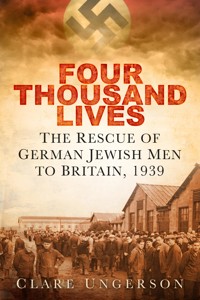
In November 1938 about 30,000 German Jewish men were taken to concentration camps where they were subjected to torture, starvation and arbitrary death. In Four Thousand Lives, Clare Ungerson tells the remarkable story of how the grandees of Anglo-Jewry persuaded the British Government to allow them to establish a transit camp in Sandwich, East Kent, to which up to 4,000 men could be brought while they waited for permanent settlement overseas. The whole rescue was funded by the British Jewish community, with help from American Jewry. Most of the men had to leave their families behind. Would they get them out in time? And how would the people of Sandwich – a town the same size as the camp – react to so many German speaking Jewish foreigners? There was a well-organised branch of the British Union of Fascists in Sandwich. Lady Pearson, the BUF candidate for Canterbury, was President of the Sandwich Chamber of Commerce and Captain Gordon Canning, a prominent Fascist and close friend of Oswald Mosley, lived there and he and his grand friends used to meet there to play golf. This background adds to the drama of the race against time to save lives. Four Thousand Lives is not just a story of salvation, but also a revealing account of how a small English community reacted to the arrival of so many German Jews in their midst.
Sie lesen das E-Book in den Legimi-Apps auf:
Seitenzahl: 430
Veröffentlichungsjahr: 2014
Das E-Book (TTS) können Sie hören im Abo „Legimi Premium” in Legimi-Apps auf:
Ähnliche




















In loving memory of my grandmother, Lilli Jordan Gumbel, and my mother, Annelis Lore Grete Ungerson. Both got away and made a life in England.
CONTENTS
Title
Dedication
Acknowledgements
1 Terror in Germany
2 The British Response
3 Choices and Resources
4 An Arrival and a Party
5 More Arrivals and a Fracas
6 Jews Selecting Jews
7 Moving Towards a New Life
8 Minds and Bodies
9 Sandwich
10 Fascists Offensive
11 Race Against Time
12 War
13 Same Difference: Military Service, Internment and Closure
14 Identity and Death
15 Forgetting and Remembrance
Appendix: A Letter to The Times
Select Bibliography
Plate Section
Copyright
ACKNOWLEDGEMENTS
Many people have helped me with this project and I am grateful to all of them. Gaby Glassman introduced me to the Association of Jewish Refugees, and through the AJR I gave a number of talks at an early stage in the project and thereby met a number of widows and descendants of Kitchener men. The staff of the AJR have also been very helpful, especially Esther Rinkoff, Hazel Beiny, Tony Grenville and Howard Spier. Three archivists, Ray Harlow at Sandwich Guildhall, Howard Falksohn at the Wiener Library, London, and Hadassah Assouline at the Central Archives for the History of the Jewish People at the Hebrew University of Jerusalem all sought out material for me and, in the case of the Jerusalem archives, catalogued the Bentwich papers. Staff at the Wiener Library have always been exceptionally welcoming and helpful, especially Bridget McGing, Marek Jaros and Toby Simpson.
Helen Fry generously introduced me to Harry Rossney and the group of old comrades who still meet at the Imperial Café in the Golders Green Road in London. Harry’s enthusiasm and support were invaluable. Helen Fry also put me in touch with Walter Marmorek when he was still, at age 98, practising as an architect in London, but who sadly died before I could complete this project, which was very dear to his heart. Adrienne Harris, Phineas May’s daughter, gave me very useful information on Phineas and Jonas May’s background and family history and took a positive interest in what I was doing, Joan Cromwell and Philip Stirups gave essential help with the translation of German documents, and Sam Warshaw ably transcribed Phineas May’s rather difficult to read Kitchener camp diary.
Others who, through conversation, letter, or more formal interview, have helped me with this book include Nikki van der Zyl, Hilda Keen, Patrick Miles, Rosa Plotnek, Katherine Shock, Howard Kendal, Monica Reynolds, Hans Jackson, Allen Sternstein, Harry Brooks, Stella Curzon, Eva Mendelson, Andrew Kodin, Ivy Kum, Pat Pay, Robert Fraser, Michael Streat, James Bird. Many others have sent me emails, often with attachments of photos or memoirs, all of which convinced me that there was a story here, well worth remembering and telling. Anne Deighton and Jane Deighton, both with memories of Sandwich summers in the 1950s, filled me in with details about an earlier Sandwich, and made insightful comments as the project progressed.
A number of people read early and late drafts. Mary Evans, Judith Friedlaender, Bernard Harris, Tony Kushner, Esther Saraga, the late A.W.B. (Brian) Simpson, Grace Tonner, Jenny Uglow, all made significant comments at crucial stages. Jean Gaffin deserves a special mention for encouraging me when I was flagging and reading all the early chapters. Towards the end of the project, a group of retired colleagues centred around the University of Kent started meeting on a monthly basis and presenting their work in progress to each other. The constructive, friendly and often forensic critique of Sarah Carter, Judith Hattaway, Lyn Innes, Jan Pahl, and Janet Sayers introduced a rigour and a rhythm to the writing process that were essential for the book’s completion.
Finally, at home, William Fortescue always believed in the project, and was endlessly supportive and patient. He was the mainstay and I could not have done this without him.
Clare Ungerson
Sandwich, Kent
1
TERROR IN GERMANY
On the morning of 10 November 1938, Fritz Mansbacher was woken by his alarm clock at 4.45 a.m. At age 16 he had recently left school and started a job at a local factory, and it was very important that he got to work on time. Many of his Jewish friends had recently lost their jobs, and he hoped that punctuality and reliability would help him keep his. Now that he was earning his own money he was almost an adult and he had moved into a separate flat at the top of his parents’ house in Lübeck, Germany.
That morning he was still half asleep as he dressed himself and started to go downstairs to the floors below. Suddenly he stopped:
I thought I had heard voices! Normally nobody would be up and awake at this hour. I listened. A second later I saw two Nazi stormtroopers come out of my parents’ apartment door. Quickly I crouched into the shadow and clung as closely to the stairwell wall as possible so as not to be seen. There I stayed quietly, not daring to breathe. Now they tramped down the stairs in their heavy boots. Now they closed the front door. Now they walked down the driveway to the sidewalk. Shortly after I could hear a car motor start up, a car door slam and a car driving away.1
Once it was safe to move he ran down the stairs and into his parents’ flat. His mother was standing behind their front door, still in her nightdress, shaking and angry. His father was in bed: Mr Mansbacher had been ill for years, struggling with an illness that Fritz only learnt years later was multiple sclerosis:
In a stern voice, mingled with grim humour and sarcasm, my father related what had just taken place in our apartment. He said that the Nazis had come at that unearthly hour of the morning to take him away to a concentration camp. They were very rough at first. They told him that he was under arrest and to get out of bed, get dressed and follow them. My father, strong in character and afraid of nothing, jestingly told them that he would love to go with them but that he could not do so at this time. They demanded to know why not. ‘I am sick’ he told them. ‘Got a cold, I suppose,’ said the Nazi. ‘No,’ answered my father, ‘it’s worse than that; I cannot walk.’ Now the two got impatient with my father. ‘Get out of that bed, you swine, and show us how well you can walk!’
Fritz’s father was a rational man and he thought that reason and evidence might appeal to these two gentlemen. The only thing to do was to phone his doctor and get him to talk to them, but as Mr Mansbacher picked up the receiver to make the call the stormtroopers had snatched it from him and slammed it down. Perhaps they did not want others to know what was going on, perhaps they thought it was just too much bother to drag a sick man from his bed, get him dressed and push him into their car. Something had stopped them, and in compensation for their weakness in the face of Mr Mansbacher’s disability they had set about wrecking the flat, searching – they said – for guns. Eventually they had left, just as Fritz had reached the top of the stairs.
The Mansbachers were horrified. The situation was bad for the Jews as they knew only too well, but this invasion of their house and the threat of arrest was something new. At least they were still intact as a family and they all thought it best to behave as if nothing had happened. Fritz should go to work as usual. As he rode his bicycle into town he was surprised by something else – ‘an unusual number of police cars, filled with people, driving toward the railway station’. And then at the factory there was a very odd atmosphere: nobody spoke to him and everyone avoided his gaze. He began to wonder if somehow or other his workmates knew about that morning’s incursion and that they felt guilty:
Finally, a fellow worker whom I knew to be a decent fellow, in spite of the fact that he was a member of the Nazi party, took me aside and asked me why I was at work. Did I not know that all the Jewish stores in Lübeck had been smashed, broken into and ransacked and that many of the owners had been badly beaten before being shipped out? And had I not heard that the Synagogue, the Jewish house of worship, had been destroyed? Of course I had not heard about all these events! And at six o’clock in the morning?2
Suddenly Fritz’s boss appeared and sacked him on the spot. Fritz remonstrated that he had a contract till January 1939 and it was only November 1938. ‘The Nazi Party does not honour any agreements or promises. Goodbye!’
Thus Fritz learnt about Kristallnacht. The Mansbachers lived in a quiet Lübeck suburb so they had not heard the rioting, the smashing of shop windows, and the razing of their synagogue, which had taken place in the city centre the previous night. But by the time Fritz came home later that morning his parents had rung round their friends and relatives and discovered even worse news. Almost all the adult men of their acquaintance had been arrested, taken to the railway station and thence they knew not where. And even more serious for them personally was that their friends had added if the Gestapo couldn’t find the man of the house they often took the oldest adult son. It was only the odd arrangement of the Mansbacher’s house, and its separation into two distinct flats, that had saved Fritz. It would not take long for the Gestapo to realise there was a younger male Mansbacher and they would return. Driven by desperation, Fritz’s parents began the process of getting him on a Kindertransport (a train for unaccompanied Jewish children up to the maximum age of 16) to England. They loved their son and that was why they needed to send him away.
Thirty thousand Jewish men from all over Greater Germany were arrested during those few days in November 1938. Most of them were taken to one of three concentration camps – Dachau near Munich, Buchenwald near Weimar, and Sachsenhausen near Berlin. All three camps had been in existence for some years. In fact Dachau was the very first such camp, built as soon as Hitler came to power and in operation from 1933 onwards. It was the first really large material indication of the nature of the Nazi regime.The term ‘concentration’ camp meant a ‘concentration’ of prisoners in very large numbers, guarded, as efficiently as possible, by a minimum of guards who were encouraged to undertake their work with extreme brutality, meting out severe punishments, including death, for minor infractions of camp regulations.3 Dachau was the template for its successors: it was there that the term ‘Arbeit macht frei’ (literally, ‘Work brings freedom’) was first used on concentration camp gates (a phrase now notoriously linked with the gates to the Auschwitz death camp) and it was at Dachau that the ‘Kapo’ system of control, whereby brutalised prisoners controlled other prisoners, was first put in place.
In one important respect these camps differed from what was to come a few years later. There were no gas chambers; these early camps were not designed for mass murder on an industrial scale. They were not death camps but there were many deaths. And in the years preceding Kristallnacht their inmates were not necessarily or predominantly Jewish, but rather were people who, in one way or another, had crossed the Nazi regime since its inception in 1933: many were Communists and wore a red badge on their prison uniform, others were homosexual, with a pink badge, and other ‘anti socials’ including gypsies, ‘criminals’, Catholics and Quakers wore green badges. The Jewish prisoners wore yellow badges.
Everyone in Germany knew about these camps and the horror of what happened in them. Indeed there was a jingle that had been around since 1935, which went: ‘Dear God, make me dumb, that I may not to Dachau come’ (‘Lieber Gott, mach mich dumm, damit ich nicht nach Dachau kumm’). So the day after Kristallnacht all Jewish families in Greater Germany knew that if their men had escaped immediate arrest it was imperative they get them out of the country as quickly as possible. The Mansbachers had been lucky in a way – their son Fritz was, at age 16, still eligible for the Kindertransport – just.
Fred Pelikan was not so fortunate.4 He lived with his mother the other side of Germany in Breslau near the German/Polish border and, at age 20, was well beyond the upper age limit for the children’s trains. On the morning after Kristallnacht Fred had crept out of the house to see for himself what was going on, and when the Gestapo had called for him his mother was able to say genuinely that she did not know where he was. When Fred did eventually come home he knew the worst. He had seen the blazing synagogue and the laughing crowds, heard the uniformed gangs singing Nazi songs as they ransacked Jewish shops. On his way home he had called at his aunt and uncle’s and discovered that his Uncle Martin had already been taken away.
As soon as he got home he threw some things in a bag, kissed his terrified mother goodbye, and made his way to the railway station. The only place he could think of going was Berlin, where an old schoolfriend, David, was now living; by all accounts David’s parents were well off and might be able to put him up. The journey to Berlin was uneventful – fortunately nobody recognized him or denounced him as a Jew – but when he got to David’s house, David’s parents were ‘in a state of frenzy’, terrified that they were about to lose their only son. They were apparently much more stoical about David’s father, who was equally at risk. They were kind and welcoming to Fred, gave him a bed in their large and comfortable flat and then they hunkered down, waiting for the worst. There they stayed for some days, living very quietly and hoping no one would notice them.
A few days later David’s father somehow or other made contact with a people-smuggler, a certain ‘Herr X’, who promised that, for a large fee, he could get both Fred and David over the border to Belgium. It was not to be. Maybe Herr X was a charlatan and a double crosser, maybe the plans simply went wrong, but when the young men reached the village close to the Belgian border, where they were supposed to board a train from which they could – literally – jump into Belgium, they were arrested by the SS. After a rough and aggressive interrogation they were taken to the regular prison in Aachen, close to the German/Belgian border. To Fred and David’s surprise, this prison was actually quite bearable – there was adequate food and they had decent sleeping facilities. But it did not last: after twelve days they were suddenly told that all the Jewish prisoners were leaving that evening. In the darkness about 200 of them were loaded onto lorries and driven to Aachen railway station. A special train was waiting for them – not cattle trucks but a train with seats. Once on board, they were told to be absolutely quiet and keep the blinds drawn: no one waiting at a station as they passed through was to know what human cargo this train contained.
All night and well into the next day the train rolled slowly across Germany. There was no food, they were not allowed to go to the toilet and they had absolutely no idea where they were going or how long this journey was going to take. At long last, sometime in the early afternoon, the train ground to a halt:
We must have been waiting a good half an hour when the train was invaded by numerous SS personnel with strange-sounding dialects which some of us recognized as either Bavarian or Austrian. We were literally pushed out onto the platform and ordered to line up for a roll-call … We were surrounded by a maze of railway lines, an indication of being somewhere near a big city. The SS guards were given the order, ‘Fix bayonets’ and we marched off over several railway lines, climbing over another platform leading on to the main station. My eyes instantly noticed the name München (Munich) and at the very same time I realized what Munich conveyed: Munich meant Dachau.5
It was a chilling moment. And then a woman came out of the jeering crowd, shrieked ‘Dirty Jew’ and spat straight into his face. ‘I can only describe my own feelings: devastated, agonized, humiliated, what on earth did I do to deserve such treatment?’
At age 74, when Fred Pelican (he changed the ‘k’ to the anglicised ‘c’ when he enlisted in the British Army in 1940) came to write his autobiography, he remembered his time in Dachau as though it were yesterday. An inmate of Room 4, Block 10, he found himself one young man among about 150 prisoners in his ‘room’. He seemed to be younger than most of the others and that meant that he could struggle more effectively for space to move about in and, in particular, for a bunk bed.
He also came to know his ‘Kapo’ very well. This Kapo was a man in his late twenties who had already been in Dachau for four years, having been arrested for being a Communist. It was the Kapo’s responsibility to see that all the 150 men under his ‘care’ obeyed. However useless the occupation and however cruel the treatment, the Kapo knew that if his men did not do as they were ordered, and at the double, then the Kapo would be punished. And the punishment at Dachau, as at all these concentration camps, was a form of torture – with hands bound tightly behind their backs, men were suspended by their bonds from a ‘gallows’ for up to three hours. At the same time the Kapo enjoyed certain privileges: ‘he slept in a segregated area from the prisoners and was always well supplied with clothes, shoes and underwear taken from prisoners who had passed away’.6
Fred’s experience at Dachau turned out to be rather unusual. For the first few days after his arrival there was nothing to do – evidently the camp authorities were at a loss as to what tasks to devise for this sudden influx, post-Kristallnacht, of large numbers of new inmates. Fred became bored and rather irritated by his fellow inmates, who ‘sat around either brooding, lamenting or even crying’. So he went to the washroom (Dachau, being the first concentration camp, had reasonable washing facilities), found a bucket and a mop and set about cleaning the entire place. He did this all day for four days. The windows sparkled, the floors shone. He knew the Kapo had noticed but neither man acknowledged the other. On the fourth day the camp authorities took action – they invented a task for the new inmates that involved shovelling the heavy snow (which had fallen the previous few days) from one part of the camp to another. It was to be dreadful work, from which many, particularly the older men, would fall ill with frostbite and exertion and eventually die. But Fred, along with two others, was selected out by the Kapo – these three were to be ‘Room Orderlies’. Fred’s devotion to washroom cleanliness had been rewarded and in a very satisfactory manner. He would be relatively warm, autonomous, and, so long as he did the work properly, would not be beaten. Thus Fred became an observer of horror rather than a participant:
To see the prisoners return from work was a dreadful sight. Most of the men had never done manual work, they may have been academics, teachers, some even doctors. As time went on, some of those going out to work looked more dead than alive, especially the sixty to seventy age group. I felt very sorry for them, I carried inside me a feeling of guilt, that, as a young strong person, I stayed indoors in relative comfort while old men began to die […] the reality of Dachau became more evident by the day. We had men in our room lying down for a night’s sleep and not getting up in the morning. They were dead, their bodies collected by a special commando every morning. Gradually their numbers increased.7
Sometimes the men tried to help each other. A Dr Klein from Vienna took to administering his tiny supply of Vaseline in a useless effort to ease his companions’ frostbite. This had a disastrous consequence. Betrayed to the Kapo, presumably by someone trying to curry favour, Dr Klein was taken away for the ‘gallows’ treatment. ‘When he returned to the room, he seemed to have aged by ten years. Both his arms were swollen and he was completely mute. For days one could not get a single word out of him, as if he had lost his voice completely.’
In his memoir, Fred describes himself as becoming progressively inured to brutality – ‘we seemed to have lost our feelings, we were going through a process of dehumanization’. But this did not prevent him taking pity on one particular elderly man and agreeing to swap places with him ‘for one day only’. Fred himself says that perhaps he was driven by curiosity as much as by sympathy – ‘I was curious about what really went on outside the huts on the working parties. Was it really as bad as others described?’ – and he thought that as a fit young man he would be capable of dealing with whatever hardship and brutality was in store. But he had underestimated the irrationality of the camp regime – a young man working instead of an old, sick man was not a legitimate exchange. No permission had been asked for or given – it was against orders. He was spotted, and the result was two dreadful beatings, one from the SS overseer who first identified him and then a far worse one from the Kapo, who told him that the next time he would kill him. The Kapo was sentenced to the relatively lenient sentence of one hour on the ‘gallows’.
Despite his misdemeanour and the Kapo’s suffering for it, Fred retained his privileged status. He never went on a working party again, and very surprisingly he and the Kapo became friends. December 1938 and January 1939 came and went and the nightmare for the other prisoners continued. In February 1939 someone killed himself by running at the electrified fence and later that same month another man escaped. In punishment the entire camp was made to stand, in nothing but their striped uniforms, all night in the freezing cold while a ‘roll call’ was taken. The death rate, which was already high (Fred thought it to be between 15 and 20 per cent), really spiked that night.
They knew they were not forgotten; they could stay in touch with their families but only with the briefest of messages. But they had no reason to think that they would ever get away from the concentration camp. There probably were rumours in the camps that men could leave on condition that they would quit Germany within a very short time, but for most of these men the prospect of leaving Germany was a chimera. This was despite the fact that many had already got away. When the Third Reich had begun in 1933 there had been about half a million Jews living in Germany and in the first year of the Reich there had been a very rapid upturn in the number of Jews emigrating (about 37,000 left Germany that year) but thereafter emigration had declined to about 25,000 a year, leaving about 200,000 Jews still living in Germany, and a further 100,000 still living in Austria, after Kristallnacht.8 Those Jews who had already managed to leave were the well resourced and well networked who could, for example, persuade the British authorities that they could support themselves in the United Kingdom or find a British citizen willing to support them. Some had managed to be accepted for emigration to Palestine but this opportunity had recently declined: after the 1936 Arab Revolt the British had introduced a strict annual quota of 25,000 migrants to mandate Palestine. If they preferred to emigrate to the United States, which many did, then they had to find a US citizen to provide them with an ‘affidavit’ of support for entry to the United States, and then manage to obtain a visa within the very strict national quotas that the USA operated. There were other countries that would take refugees, but at a price. Steep ‘landing fees’ were demanded by the countries of Latin America, and by the international port of Shanghai. Such opportunities for emigration, which were expensive and often depended on the support of individuals already living in the receiving countries, took place in a context where the Jewish populations of Germany and Austria were being systematically stripped of their assets, sacked from their jobs, and paying the extortionate taxes that the Germans had imposed on the Jews, particularly after Kristallnacht, including a tax that forced the Jews to pay for the reparations for that night of terror. These were forbidding prospects for ordinary German Jews and many, however desperate, knew they could never afford the costs of escape from Nazi persecution.
However, Kristallnacht itself shifted the politics of refugee policy a little – particularly in Britain. The pogrom had drawn the attention of the world to the domestic policies of Nazi Germany. Until late 1938 it had been German foreign policy that had largely transfixed international opinion. (An international conference held at Evian in Switzerland earlier in 1938 to discuss the refugee issue with the intention of persuading various nations, including the USA, to take more refugees, had been an almost complete failure.) In some countries, particularly in Britain, opinion and sympathy for the Jews of Germany and Austria changed after Kristallnacht. The British newspapers, including those that supported appeasement, ran the story of the attacks on German Jewry as front page news the following day. The story was powerful enough to move very large numbers of ordinary people into action and very quickly the idea that a fund should be established that would pay for the rescue of destitute Jewry, particularly children, took hold. Less than a month after Kristallnacht, the ex-Prime Minister, Stanley Baldwin, now Lord Baldwin, gave his name to a National Appeal. The Lord Baldwin Fund for Refugees, supported by many of the prominent dignitaries of the day including the Archbishop of Canterbury, was launched by a special broadcast on BBC radio on Thursday 8 December. Money started to pour in. Special events in aid of the appeal were held on a national basis. For example, all cinema and theatre tickets sold on 14 January 1939 included a 10 per cent levy for the Baldwin Fund, and a filmed appeal for the Fund by the Archbishop of Canterbury was included in the Pathé News for that day. Within three months, by March 1939, the Baldwin Fund had attracted donations from rich and poor such that it had raised the astonishing sum of £461,658 (equivalent to £13.2 million in present day values).9 This was a very convincing and material indication that British public opinion had softened and shifted in relation to the plight of German Jewry.
Fred Pelican, trapped in Dachau, knew nothing of how his plight had caught the imagination of many British people. He was not a child, but he was a Jew in desperate circumstances and public sympathy across the English Channel had been triggered. There was a chink of light at the end of the dark tunnel he was in and it was about to grow larger.
Notes
1. Peter Mansbacher, ‘Refugee from Nazi Oppression’, An Autobiography, unpublished manuscript held at the Wiener Library, copyright 1991, p. 68. Fritz Mansbacher changed his first name to Peter at some point during the Second World War.
2. Ibid., p. 69.
3. See for example, Michael Burleigh, The Third Reich, a New History, London, Pan Macmillan, 2001, pp. 198–205.
4. Fred Pelican, From Dachau to Dunkirk, London, Vallentine Mitchell, 1993.
5. Fred Pelican, ibid., p. 10.
6. Ibid., p. 14.
7. Ibid., p. 16.
8. Pamela Shatzkes, Holocaust and Rescue: Impotent or Indifferent? Anglo–Jewry 1938–1945, London, Vallentine Mitchell, 2004.
9. Richard A. Hawkins, ‘The Lord Baldwin Fund for Refugees, 1938–39: A Case Study of Third Sector Marketing in Pre-World War II Britain’, in Neilson, L.C. (Ed.), (2013), ‘Varieties, Alternatives, and Deviations in Marketing History: Proceedings of the 16th Conference on Historical Analysis and Research in Marketing (CHARM)’, CHARM Association, Copenhagen, Denmark, pp. 82–105.
2
THE BRITISH RESPONSE
On 4 January 1939 Norman Bentwich was at his desk in the offices of the Central British Fund for German Jewry in central London well before his colleagues. This was not unusual – he was still, at age 55, a man of prodigious energy who loved nothing better than getting on top of his work before anyone else could come into his office and disturb him. Woburn House, where his office was located, was occupied by many Jewish organisations, including the United Synagogue, and he enjoyed being surrounded by people who shared his deep faith and, like him, were committed to the welfare of European and Anglo–Jewry. For years Bentwich had worked tirelessly, and often for no salary, on behalf of Jewish refugees desperate to leave Germany, and now, since the German annexation of Austria in March 1938, on behalf of Austrian Jewry as well.
That morning in early January 1939 he was waiting for a very important letter. He knew more or less what would be in it and hoped it would be the agreement, in writing, that he and his colleagues had reached with the Home Office the previous day. It had been a friendly meeting between himself, Sir Robert Waley Cohen and Otto Hirsch from the Jewish agency in Berlin on the one hand and with familiar civil servants whom he trusted and whom he knew trusted him, on the other. It looked as though they were about to make real progress with an idea the Fund had long nurtured – that of setting up a refugee camp, somewhere in Britain, which would temporarily house Jewish refugees while they waited, in safety, for emigration elsewhere.
There were at that time in early 1939 probably about 30,000 German–Jewish refugees resident in Britain but all these refugees had been able to enter because they could show, on an individual basis, that they would make no call on the British State – either they, or someone willing to sponsor them, had the resources to support them over the long term. Now there seemed to be some prospect that the British government would accept the sponsorship of the Fund on a collective basis and this would allow Jews with far fewer resources in terms of money and networks to enter Britain, if only on a temporary basis.
Bentwich had been Honorary Director of Emigration and Training of the Fund since 1935, and in that capacity he had spent a great deal of time in Greater Germany liaising with the German–Jewish agencies in Berlin and Vienna and other major German cities, so he had seen at first hand what the Nazi regime was capable of. He was probably not surprised by the extremism of Kristallnacht. But for others it had been a considerable shock: until that moment it had been possible to ignore the persecution of the Jews in Greater Germany since much of it had taken place behind closed doors in schools and universities, shops and offices and theatres and orchestras, and in the prisons of the Gestapo. Now that persecution was on the street, highly visible and very dramatic.
The British Prime Minister, Neville Chamberlain, who in September 1938 had signed the notorious Munich agreement apparently bringing ‘Peace in Our Time’, had been as shocked by these events as most ordinary British people; when a delegation from the Fund had asked to see him he had readily consented. Accordingly, on 15 November 1938, the elite of Anglo–Jewry had crowded into the Prime Minister’s rooms at the House of Commons and pleaded with Chamberlain for practical help. Viscount Samuel, Chair of the Central British Fund for German Jewry, took the lead, supported by another Jewish peer Viscount Bearsted, the Chief Rabbi, Neville Laski who was President of the Board of Deputies of British Jews, Lionel de Rothschild of the famous banking family, and Dr Chaim Weizmann, the leader of British Zionism and later the founding President of the State of Israel. The delegation was careful not to suggest that the Government throw open its doors to the estimated 300,000 Jews still in Greater Germany. Indeed it is very unlikely that they would have welcomed such an influx of refugees themselves. Instead they asked for targeted permissions, particularly for children under 17 years of age. They were also desperate for help with the funding of the rescue effort they proposed. Chamberlain was sympathetic; on the day of the pogrom he had written to his sister, ‘I am horrified by the German behaviour to the Jews’ even though he was himself a casual, unfocussed anti-semite – ‘no doubt Jews aren’t lovable people, I don’t care about them myself’.1 He talked of the possibility of the permanent resettlement of German Jewry in British Guiana, but with some pessimism and only in the very long term; privately he decided to persuade his cabinet to consider ways in which Britain could alleviate the plight of the Jews by allowing them to come to Britain as ‘transmigrants’.
A few days later the Fund grandees went to see Lord Winterton, the member of Government directly concerned with refugee matters. Despite eloquent pleading particularly by Viscount Samuel for funding for a refugee camp where ‘the intention was, first to put [the refugees] in safety, and then, while there, to train them for ultimate settlement in suitable places abroad’ they had made little headway. The one chink of light was the statement by Lord Winterton that ‘the Home Secretary Sir Samuel Hoare had authorised him to say on his behalf that he had no objection in principle to camps for transmigrants in this country, and he would be glad if the leaders of British Jewry would take the matter up with him’.2
It was at this point that their luck began to turn. This may have been because the Home Secretary was a scion of a distinguished Quaker family and the Quakers had worked very effectively with their own staff in Berlin and Vienna rescuing Jews and supporting destitute Jews.3 Moreover, Sir Samuel Hoare’s senior civil servants, particularly Sir Alexander Maxwell and Ernest Cooper, the Director of the Aliens Section at the Home Office, were known to be sympathetic to the plight of Jews in Germany. It was this team at the Home Office that had given the Fund its first real hope that something collective might be undertaken to save the masses of adult Jews still in Greater Germany and the idea of a rescue camp had first begun to gain some purchase.
The men of the Fund had had to wait for a final decision over Christmas and the New Year but as soon as the festive season was over the Home Office had set up the all-important meeting of 3 January. The letter that Bentwich had been waiting for duly arrived on 4 January 1939. Addressed to ‘Professor Bentwich, MC, OBE, MA’ and signed by Sir Alexander Maxwell, Permanent Under-Secretary at the Home Office, its contents were more or less as expected, although Bentwich knew that it would not contain everything they had hoped for. The main point of the letter was that it laid out the terms and conditions for the establishment of a refugee transit camp somewhere in the UK. The tone was sympathetic:
I am directed by the Secretary of State to say that if the Council for German Jewry establish a camp in England for refugees who have a prospect of ‘migration within a reasonable period’ he will be glad to facilitate arrangements to enable selected persons to come to this country with a view to their residing in this camp until arrangements can be made for their settlement.
But of course there were provisos, not least that the CBF was on its own as far as the management and funding of the camp were concerned. There was definitely to be no money:
He understands the Council will make themselves responsible for seeing that the camp is properly organised and that proper sanitary arrangements are made, and that provision will be available for the maintenance of the persons residing in this camp.
Moreover there was to be no possibility that the camp inmates would acquire rights of citizenship or permanent residence in Britain. Nor would they be able to work, except in exceptional circumstances:
He understands further that the Council will give a collective guarantee that persons admitted to this country for the purpose of going to the camp would not take any employment in this country unless a special permit was obtained, and would not be a public charge and would, so far as possible, migrate within a year.
Two further points were made. At the meeting the previous day the delegation from the Fund, fully aware that the camp numbers would hardly scratch the surface as far as the numbers of Jews desperate to get out of Germany were concerned, had been anxious that the camp population should be continuously replenished as the refugees moved on to other countries. This the Home Office had conceded:
The Secretary of State agrees with the suggestion made at the discussion that it would be desirable to select, as far as possible, persons who have a prospect of migration at a comparatively early date so that vacancies may be made in the camp as soon as possible and facilities thereby afforded for the admission of other selected refugees to fill such vacancies.
And the most satisfying point of all was that the vetting of applicants for the camp would be the responsibility not of the British consulates in Berlin and Vienna but rather of the Jewish agencies in Greater Germany. Moreover, there would be no need to sort out individual visas and individual payments for those visas:
The Secretary of State would look to the responsible Jewry organisation in Germany acting as agents for the Council to make themselves responsible for selecting suitable people for admission to the camp. Provided that the Council satisfy the Department that due care is being taken in the selection of persons, there will be no difficulty in granting permits for their admission to the United Kingdom. Details as to the arrangements to be made for this purpose will be a matter for discussion between the Council and officials of this Department.4
In fact, what was being proposed was an identical operation to that of the Kindertransport. The transports of unaccompanied children from Berlin and Vienna to the United Kingdom had already started – the first one, with about 200 children, had arrived in England on 2 December 1938. The system of selection of the children for the transports by the Jewish agencies in Berlin and Vienna, and their fast tracked admission by the British Home Office, had already been tried and tested. Exactly the same system was being proposed for the adults who were to come to a transit camp somewhere in Britain. Set up within the same context of enhanced public sympathy, following the same procedures, conceived, as the Kindertransporte were originally, as only allowing temporary immigration into Britain, this rescue was to be, in every sense, a parallel rescue to the Kindertransporte.
The Home Office letter, filled with ifs and buts as it was, must have seemed a real turning point to the grandees of Anglo–Jewry who led the Central British Fund. These kinds of transit and training camps, on a small scale, had long been established on continental Europe and they were subsidised by the Fund. In Germany itself, since the 1920s, local Jewish communities had set up training camps for their young people where they could learn the skills – predominantly agricultural skills – that would find them employment in the colonial world, particularly in Palestine.5 And since the inception of the Third Reich and all that entailed for the Jews of Germany, a number of small camps had been established elsewhere in Europe which fulfilled the dual purpose of training and temporary rescue. Bentwich had particular reason to be delighted: since 1935 when he had taken on the unpaid post of Director of Emigration and Training he had spent many weeks away from home inspecting the training centres and agricultural enterprises, most of them in Germany, that the Fund subsidised. Now at least he could stay in England and oversee the strategy of combined rescue and training on his home ground.
There was a huge amount to be done and it had to be done at speed. The first thing the Fund had to do was find a large and usable camp. It must have seemed little short of a miracle when a member of the Fund Executive, the distinguished architect Ernest Joseph, remembered that there was a disused First World War camp along the coast from Dover, the port at which they expected the refugees to enter Britain, located on the edge of the little medieval town of Sandwich. Joseph – or ‘EMJ’ as he was known to his friends – had designed the NAAFI dining hall there when the camp had been built more than twenty years earlier. It was known as ‘The Kitchener Camp at Richborough’ and had been named after Field Marshal Lord Kitchener, who had been Secretary of State for War from 1914 to his death in 1916.
Coincidentally EMJ had a great interest in the Jewish Lads Brigade – an oddly militaristic but very popular organisation designed by the Anglo-Jewish gentry to inculcate order, discipline and a culture of British fair play into the lives of working-class Jewish ‘lads’ from the poorer parts of Britain’s cities.6 For many years between the wars EMJ went down to the Brigade summer camp overlooking the White Cliffs at the nearby coastal town of Deal. When he took some of the lads along the coast to the long pebble beach of Sandwich Bay he would have seen that the Kitchener Camp, where he had designed the soldiers’ mess, was empty and beginning to moulder away.
There was another minor miracle: the owners of this camp were now only too pleased to be approached by the Fund about the availability of the camp for rent, and although the Fund had at first assumed that these derelict huts would not command much more than £100 a year in rental, the owners finally made the entire camp available for the still affordable amount of £380 a year. The Jewish Lads Brigade turned out to be useful again when they declared themselves willing to second their Secretary, Jonas May, to be Director of the refugee camp for the duration of its existence (no doubt pressured by EMJ to do so). Jonas’s brother, Phineas May, also became available, because his employers, the United Synagogue, decided to follow suit and second him as well. These two relatively young men had experience of running summer camps for boys so it was a sensible idea, at least on the surface, to appoint them to run a camp which the Fund expected to contain many thousands of refugees.
It was no accident that the Fund was able to exert such influence and get staff seconded to take on vital jobs at very short notice. As a group of men – and they were all men – they represented an extraordinary resource. Lord Samuel normally chaired their Executive meetings. Very recently ennobled, he had been High Commissioner in Palestine in the 1920s and Home Secretary in the National Government of the early 1930s. Viscount Bearsted had inherited the title from his father, but was an important figure in his own right, having been Chair of Shell (a company which his father and uncle founded) and a close colleague of Sir Robert Waley Cohen who had been Shell’s managing director and was also, at that time, Vice President of the United Synagogue. Simon Marks was the son of the original founder of Marks and Spencer and currently Chair of the company, Harry Sacher was a director of Marks and Spencer. Frank Samuel had also been a colleague of Sir Robert Waley Cohen’s both at the United Synagogue and in a commercial enterprise, and he was now managing director of Unilever. Chaim Weizmann was the leader of British Zionism and later Founding President of the State of Israel, Anthony de Rothschild and his brother Leo were major figures in one of England’s leading banking families, Neville Laski was the President of the Board of Deputies of British Jews. Amongst these huge fish, Norman Bentwich – who was always listed as ‘also present’ at the Executive meetings – must have seemed a mere sprat, but he himself had been Attorney General in mandate Palestine, a Deputy Commissioner at the League of Nations with responsibility for refugees, and a founding Professor of the Hebrew University of Jerusalem.
One extraordinary feature of these gentlemen was that they were all related to each other, both by blood and by marriage. They were brothers-in-law, cousins, first, second and third, they went to each others’ weddings and funerals. They were referred to as ‘the cousinhood’ and they perceived themselves as such.7 For example, Norman Bentwich’s wife Helen was a niece of Viscount Samuel, the Chair of the Fund Executive, and whenever Norman wrote to Lord Samuel he addressed him, rather endearingly, as ‘Dear Uncle Herbert’. These gentlemen were in one another’s pockets all the time: if it wasn’t family matters that brought them together, then it was their business and charitable lives, or their membership of the same synagogue in Bayswater or Hampstead. They could make joint organisational and institutional arrangements at any moment of their busy lives, including their ‘family time’. The one issue that had the potential to drive them apart was Zionism – although all of them would have signed up to some kind of settlement by European Jews in Palestine. Numbers of them, including Norman Bentwich, were reluctant to argue for a Jewish state, and some of them were eager to maintain and promote good relations with the Arabs of Palestine.8 Because of early arguments amomgst them when the Fund was first established they always took care to balance Zionists with ‘non Zionists’ (this latter phrase was the one preferred by Sir Robert Waley Cohen who said he was not an ‘anti Zionist’ but a ‘non-Zionist’).
It was probably not in any of these gentlemen’s mind-sets to countenance failure. But nevertheless, in taking on the funding and organising of a refugee camp for an – as yet – unstated number of refugees (but which could run to many thousands), they were taking considerable risks. Over the years the Fund had been in operation they had raised vast sums to support their various rescue and training activities and most recently they had been called upon to fund the Kindertransporte. Those transports had only just begun and already the organisational and financial effort it was taking to put them in place was proving almost overwhelming.9 It was just possible that the Anglo–Jewish community was ‘philanthropied out’ and that the money they needed for the parallel rescue of the refugee camp would not be forthcoming.
There was another reason to be worried: they were anxious about an upsurge in anti-Semitism provoked by a sudden influx of German Jews in one particular locality. Helen Bentwich, Norman’s wife, was Secretary of the Movement for the Care of Children from Germany, the administrative body overseeing the Kindertransporte, and she herself had ‘advocated the spreading of “our children as far over the British Isles as possible. We do not want too great numbers of them in any one place.”’10 Adults could be even more problematic, particularly adults of working age during an era of economic depression. Indeed, only ten days before Kristallnacht one of their number, Otto Schiff, was minuted as saying to the head of the Aliens Section at the Home Office that the flow of refugees from Germany should be halted altogether:
[he] feels that the time has come when his Committee must refuse to entertain any more applications. This is partly due to the physical impossibility of coping with the work, but more especially because the Committee have no longer available the necessary financial resources; but more important than these, in Mr Schiff’s opinion, which was also endorsed by Mr Davidson is the view that we have already received in this country a sufficient number of refugees from Germany and Austria, and Mr Schiff thinks it is time we closed down at any rate temporarily until those who have been already admitted have been assimilated or emigrated. Mr Schiff’s Committee are at present spending £1,000 per week for emigration work. Mr Schiff also expressed his view that to admit many more refugees might evoke strong public feeling against refugees generally.11
Clearly once Kristallnacht had happened the Fund had taken the view that they could not continue to suggest to the Home Office that a moratorium be placed on the entry of refugees – but their worries about anti-Semitism were not likely to disappear.
At least one amongst their number was not the type to baulk at these anxieties. Sir Robert Waley Cohen had a supremely ebullient manner and he was no doubt of the opinion that obstacles could be overcome if the will was robust enough. Sir Robert saw himself as a natural leader: when asked what he wanted to be during the First World War he had said ‘one of the higher sorts of General’ and when asked ‘to command what?’ had simply replied ‘other Generals’.12 He was also very rich, very large (he was wont to write ‘HUGE’ when asked on a form to state his measurements) and very bad tempered.13




