


13,99 €
Mehr erfahren.
- Herausgeber: The History Press
- Kategorie: Geisteswissenschaft
- Sprache: Englisch
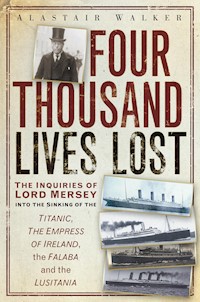
Over four years, four ships were lost under different circumstances and 4,000 lives with them — but one thing linked them all: it was John Charles Bigham, Lord Mersey, who was appointed to head the inquiries into each disaster. Mersey is often referred to as a 'company man', or a government stooge. But is this the whole truth? Everyone has heard of Titanic and Lusitania but more passengers died when the Empress of Ireland sank in May 1914. That inquiry turned into a head-to-head between an American lawyer and a British one. Did Mersey let the right man win? Was he fair to Captain Lord of the Californian when he blamed him for the loss of so many lives on Titanic? The U-Boat that sank the Falaba with the loss of 104 lives behaved very differently to the one that torpedoed the Lusitania just six weeks later. Did Mersey reflect that in his findings or was he more interested in propaganda than truth?
Das E-Book können Sie in Legimi-Apps oder einer beliebigen App lesen, die das folgende Format unterstützen:
Veröffentlichungsjahr: 2012
Ähnliche




















CONTENTS
Title Page
Acknowledgements
Introduction
1 A Maritime World in Transition
2 The Peacetime Risks
3 The Wartime Risks
4 The Nature of Inquiries
5 The Commissioner of Wrecks
6 The Eight Captains
7 Improbable Things Do Happen
8 Men of Steel
9 Issues
10 E.J. Smith
11 Stanley Lord
12 Henry Kendall and Thomas Andersen
13 Frederick Davies and Will Turner
14 Gunther von Forstner and Walther Schwieger
15 Eight Captains and a Judge: The Links
Postscript
Bibliography
Plate Section
About the Author
Copyright
ACKNOWLEDGEMENTS
My interest in maritime matters began at the age of seven with the entry for Horatio Nelson in my parents’ 1923 edition of the Harmsworth Encyclopedia, was nurtured by Arthur Ransome’s wonderful Swallows and Amazons stories and came of age in yacht races in Belfast Lough. The fascination for the nautical never waned. An interest in Titanic was natural as my mother had seen the ship as a child of nine and a near neighbour of the family in the Woodvale area of Belfast had been lost. An uncle was a survivor of the torpedoing of the Athenia on the first day of the Second World War, so the topics covered here have a personal resonance.
I would particularly like to thank the Canadian National Archives for making me aware that the proceedings of the inquiry into the loss of the Empress of Ireland were available on the internet. I also express my appreciation for the work of the Titanic Inquiry Project in making the proceedings of both the Titanic and Luisitania inquires likewise accessible, and the Law Library of Yale University for the digitisation of the proceedings of the Falaba inquiry.
I am deeply indebted to two friends who agreed to read the draft of this book. Una Reilly and Stephen Cameron both provided very helpful and constructive comments. Thanks to Shaun Barrington and the staff at The History Press with whom it has been a pleasure to work.
Finally, go thanks go to my wife Barbara for the patience, understanding and forbearance without which a writing project such as this would never be started, let alone finished.
INTRODUCTION
The Titanic slowly disappeared into the chasm of the deep Atlantic, the Empress of Ireland rolled over in the shallows of the St Lawrence, the Falaba was dispatched into the waters off the south west of England and the Lusitania crashed bow first into the seabed off the south coast of Ireland. The man who links these four terrible tragedies, that cost close to 4000 lives, is Lord Mersey, who, as Commissioner of Wrecks, presided over a series of inquiries into the sinkings between 1912 and 1915. In the process of the inquiries he came to many significant conclusions, some of which, in retrospect, have turned out to be common sense, some have become controversial and some have been shown to be quite simply wrong. Many of those conclusions were judgements about the behaviour of eight men who were in charge of ships involved directly (or indirectly in one case) in the incidents. The purpose of this book is to look at those judgements, at the man who made them, the methods used to arrive at them and the captains whose lives or reputations were affected by them. Our concern will not principally be with the aspects of the tragedies linked to the actions of those in boardrooms, ministries and shipbuilders but rather with those who were held accountable for their actions at sea as the events took place.
Only four of the eight captains appeared before Mersey and, of these, two captained ships that had been lost. Two of the eight died with their ships and two were German submariners. The intention is to give a brief picture of their lives as well as an indication of their personalities and then to look at the way in which they were dealt with during the inquiries and to consider whether the outcomes affected their careers, in the cases of those who survived, or their reputations, in the cases of the two who did not. They are disparate in background and character. Three were quite well known to the public before the disasters took place. Of two we still know comparatively little. Most were reluctant actors in public events (the submariners of course not taking part in the inquiries) but there were also a couple of self-publicists.
It is important to place the incidents themselves and the people concerned firmly into historical context. It is all too easy to level criticisms based upon knowledge and understanding that has accrued over the century since then. We should therefore consider the maritime context of the early twentieth century, including commercial and technical factors, political and military developments and the activities of the press. To help in doing so we will consider some of the other accidents and tragedies that took place at sea during the same period so that we can better pick up patterns.
A great deal of research has already been undertaken into the sinkings of Titanic and Lusitania and there are many publications. Regarding the former, some might use the term ‘overkill’. I have therefore approached that tragedy with some trepidation, but it would make little sense to look at the quartet of Mersey’s inquiries without spending some time on the first and the longest. Less has been written about the Empress of Ireland, but the main events have been documented.
The story of the Falaba, however, has been entirely overshadowed by that of the Lusitania, which followed so closely after it and which resulted in the deaths of many more people. Nonetheless, the sinking of the Falaba raised significant issues and it contrasts with that of the Lusitania in interesting ways. Given the number of sources already in the public domain, a selection of which is listed in the Bibliography, this book is not intended to provide a full narrative of the incidents into which Mersey inquired and only sufficient background has been included to elucidate the issues being discussed.
In some of the material produced about these sinkings, particularly amongst the proliferation of books and films on Titanic, a mythology has developed that bears little relation to the actual events. Indeed, Mersey may have contributed, wittingly or otherwise, to the generation of some of the myths. What follows may help to puncture one or two of these; but the intention is to take an overview, to look for links and patterns and, perhaps by so doing, to gain some insight into the nature of disaster-related inquiries and their impact on the decision makers involved.
There are two themes that recur throughout. One, as just indicated, concerns the nature of the inquiry process and how it was influenced by the backgrounds and personalities of those who took part in it. The second is the extent to which events and reactions to them were influenced by the rapid technological change that was taking place at the time. There may be echoes of those themes that resonate down to the present day. Some of the major government-sponsored inquiries of recent times have demonstrated more than a few of the characteristics of those discussed here. We too live in a period of technological change, one even more rapid than that of the early twentieth century. To what extent do some of today’s disasters arise from a mis-match between the pace of technological change and the speed with which people adapt their thinking and their practices to new circumstances?
In reviewing the judgements that were made about the eight captains, it will prove helpful to set them against two ‘courts of opinion’. Firstly, how were those judgements received by other seafarers? Peer judgements by those who had to face the possibility themselves of being involved in this type of event are particularly valuable. There is also the court of public opinion. It may not be as well informed as the seafaring group and it may be considerably more variable, but it is important, particularly so far as reputation is concerned. The difficulty now, of course, is ascertaining, at this remove, what were the opinions of contemporary seafarers or of the general public on the conclusions reached by Lord Mersey. There are, however, some indications from the actions taken by shipping companies and others after the inquiries as to what those opinions were. The views which Mersey expressed, particularly in relation to Titanic, continue to influence writers today. Even in recent publications it is possible to see those opinions repeated uncritically, including some that have since been shown to be entirely in error. Perhaps one of the lessons we shall learn is the ease with which anything produced under judicial imprimatur acquires for some people the supposed infallibility of pronouncements ‘ex cathedra’.
Altogether the loss of the four ships cost almost 4000 lives. Few people have chaired more than one inquiry into a maritime disaster. Mersey was unique in chairing four encompassing such a tragic number of deaths in a period of just three years and three months. Yet, to some he remains little more than a laughing stock, to others a symbol of judicial mediocrity, while a third group see him as a pawn of shipping bosses and government. Over the years he has received little appreciation for undertaking what must have been a series of daunting tasks and, while he is unlikely ever to be showered with accolades, we may just be able to qualify his infamy with a little more understanding.
1
A MARITIME WORLD IN TRANSITION
Shortly before he left England for the last time, in the late summer of 1805, Nelson attended a meeting at the Admiralty to discuss some new technological developments being promoted by Robert Fulton, an American inventor. Fulton had lived in England for some time, before moving to France and trying to persuade the French government that his ideas for a submersible boat were practicable. Having failed to do so, he was now back in Britain and trying to interest the British government in the same idea as well as his suggestions for an early form of ‘torpedo’, the term then being used to describe a transportable mine. Being a man of broad interests he was also raising the possibility of the navy making use of steam propulsion. There is no record as to how Nelson responded to such technological advances, although being conservative by nature he was probably not impressed. However, while Fulton made little progress with his submersible boat, in October 1805, the same month as Trafalgar, he demonstrated the potential of his torpedo when the resulting explosion sank a 200-ton brig. Just two years later, back in America, Fulton provided the first real evidence, with the Clermont, that steam propulsion was commercially viable.
Over the period of the next century one thinks of developments in maritime technology proceeding in a steady manner, decade by decade, culminating in the great liners, Dreadnoughts and submarines of the early years of the twentieth century. In fact, 50 years after his death Nelson would not have found the ships of the navy or of commerce so very different from those that he had known. Given the continued dominance of wood and sail, there would have been little to amaze him. Most of the really rapid changes took place in the period right at the end of that century and the beginning of the next.
Isambard Kingdom Brunel decided in 1852 to build a ship that was several times larger than any that had gone before. It was an idea ahead of its time, because, although it was then technically possible to create a hull of the requisite size, other elements of the technology necessary effectively to power and to control such a large ship were not in place. Some consider The Great Eastern to have been the biggest white elephant of all time, although it did achieve considerable success, not as the passenger ship it had been designed to be, but as a very effective cable layer. The iron monster, mixing paddle wheels, propeller and sails, laid much of the infrastructure required for the embryonic communications revolution. It was not until 1899 that the White Star Oceanic exceeded it in length and two years later the Celtic, also White Star and also built by Titanic’s builder, Harland and Wolff in Belfast, exceeded it in tonnage. Within a decade, however, there were ships that were twice as large.
The speed that steamships were built to travel at depended on the purpose for which they were intended. The liners hoping to carry mails were normally the fastest of their day. Speeds did not increase dramatically with improvements to steam engines in the 1870s to 1890s. Rather, the quantity of coal needed to produce those speeds dropped significantly. Fuel costs were reduced and a greater proportion of ships’ internal space was given over to revenue-generating passengers or cargoes. That changed suddenly on a single day, 26 June 1897. At the great Naval Review held at Spithead to celebrate the 60th anniversary of Queen Victoria coming to the throne, a small steamboat called Turbinia streaked through the lines of ships, clearly visible to the Prince of Wales watching from the Royal Yacht (his mother was indisposed) and from every ship in the fleet. In modern times it would have caused a tremendous security alert, possibly with dire consequences. In 1897 it certainly created a stir, but for a very different reason. Turbinia was travelling at over 30 knots, a speed that not one of the other ships present could have approached. She was the product of a Dr Charles Parsons, who was aboard her at the time, and she had been built to show off his newly developed steam turbine engine. Instead of cylinders with pistons, cranks and shafts, all in a blur of reciprocating movement, Turbinia was driven by steam jets hitting blades in a casing on the shaft that led directly to the propeller. It was much smoother, involved much less wasteful thrashing of machinery, was more compact and it was much, much faster.
It is an immense tribute to the ability of late Victorian and Edwardian society to take hold of a new idea and apply it rapidly that, just ten years after the Jubilee Naval Review, a battleship, the Dreadnought, the biggest ever built to that time, was powered by the new engines. In the same year, the first of a new class of turbine-driven liner, Lusitania, emerged to take the Blue Riband speed record for crossing the Atlantic. The twentieth century has sometimes been called the century of the internal combustion engine because it is considered to be the most influential technical development of the period and also, perhaps, the most visible. The century could, with equal validity, be called ‘the turbine century’. Not only did the turbine revolutionise propulsion at sea, it became the basis for all electricity generation, whether from coal, from nuclear power, from gas or from wind and water. Add to that the turbo-jet, turbo-prop and turbo-fan and we have the turbine to thank for modern flight as well.
For many ships not requiring high speeds the new propulsion system was not particularly advantageous and normal reciprocating engines continued to be built for several decades. A very few ships, of which Titanic was one, had a hybrid system of large, advanced reciprocating engines and a turbine as well. One effect was that the difference in speed between the fastest liners and the slowest cargo ships increased greatly. Plodding tramps continued to move at around 8 to 10 knots while some passenger ships raced past at 25 knots.
The first application of electricity in ships came in 1882. Cunard’s Servia used it for lighting in passenger spaces. Over the next few years, however, applications relating to the operation of the ship gradually took effect. At around the same time, hydraulic control systems became available and the combination of electrical and hydraulic power made it feasible to manage the complexity of larger, faster ships in ways that had not been possible previously.
By the end of the century, all ships of any size were built of riveted steel plates. In a process of gradual development, rather than through any spectacular leap forward, the design of hulls gradually evolved to include watertight divisions both across the ship from side to side and also along the length of the ship. These divisions, or bulkheads, required doors through which crew members or passengers could pass. When, for any reason, it was necessary for the bulkheads to be watertight the doors needed to be quickly closed. At first this was done manually, then electro-mechanical methods were developed that allowed the doors to be closed by operating a single control on the bridge.
So, within a decade the means of propulsion, the size, speed and complexity of ships had all taken an enormous leap forward. However, there were two further inventions that were also to have a fundamental influence on the whole maritime world of the early twentieth century and were of major importance in the incidents with which we are concerned. These were the fruition of Robert Fulton’s belief in the feasibility of submersible boats and the invention of wireless telegraphy.
The submarine was not the product of a single inventor. Going back to Fulton and beyond, many ideas for submersible boats had been produced and a few had made it off the drawing board. The American Civil War saw the first successful use of the submarine as a weapon of war, if an operation can be called successful that results in the loss of the submarine and its crew. Those early attempts at submarines were, like the contemporaneous Great Eastern, ahead of their time – navigating submerged was an aspiration that required further technical development before it could become established practice. Submarines could only become effective with a propulsion system, other than manpower, that could be made to work under water. They also needed much more sophisticated control systems to maintain the delicate balance of neutral buoyancy and trim which they required to operate submerged.
It was the electric motor and battery storage that provided the underwater motive power and it was electro-mechanical and hydraulic systems that facilitated sustainable trim with neutral buoyancy. Strictly speaking, the internal combustion engine was not necessary for submarine development. Britain built the K-Class steam turbine-powered submarines during the First World War, although they proved to be a failure that was costly in both material and human terms. Large-scale use of steam turbine propulsion in submarines had to wait for the emergence of nuclear reactors. The internal combustion engine, with its ability to stop and start readily and its absence of bulky boilers, made design of the early submarines so much easier; the coming of the marine diesel engine around 1910 made them safer, albeit never safe.
Marconi was not the only person who contributed to the early beginnings of wireless, but he was by far the dominant one and it is his name above all others that has come to be associated with it. His experiments, particularly the trans-Atlantic transmission in 1904, demonstrated the possibilities of radio as a communication tool and not just as a scientific curiosity. There had been earlier experiments at sea. In 1891, Captain Henry Jackson RN (later First Sea Lord) sent wireless Morse signals over a distance of a few hundred yards. In 1899 wireless technology was first used in naval manoeuvres. As with the turbine, the rapidity with which the new invention was applied was startling. The first occasion when radio enabled major loss of life to be averted in a maritime disaster was as early as 1909 during the sinking of the White Star Republic. Despite that success, the initial employment of radio at sea in the merchant service was primarily as a convenience for rich passengers and only marginally as a contribution to the operation of the ship. The terms of employment of the radio operators by The Marconi Company (not the ship owners) and their job descriptions left no doubt as to their commercial priorities. As with the submarine, it was how the invention was used that became controversial rather than the invention itself.
In the next two chapters we will be examining in some detail the nature of the risks that seafarers faced in the early 1900s, in peacetime and in wartime and both wireless and the submarine will feature strongly. Obviously the submarine only appears in the wartime scenarios, but wireless had major roles in both contexts. In one case it should have mitigated risk, but in the other it may well have exacerbated it.
One aspect of ship technology did not change over the two decades before the outbreak of the First World War, although it did so shortly thereafter. Coal continued to provide the energy source for steamships. That meant large bunkers had to be included in the ship’s structure in such a way as to allow the coal to be loaded easily. The stability of the ship had to be managed during a voyage while bunkers were gradually depleted. There had to be arrangements for the movement of the coal to the stokeholds even under severe weather conditions and, finally, there needed to be large numbers of stokers to maintain the fires. For large, fast steamships of the period, the logistics of these processes were daunting and there were considerable dangers from bunker coal catching fire, or from explosion of the air and coal dust mixture remaining once the bunker was nearly empty.
The ‘black gang’ on an Atlantic liner moved hundreds of tons of coal every single day into the boilers. Smaller amounts, but still in the hundreds of tons, of ashes also had to be removed and dumped overboard. Although steam power was used in a large number of different contexts – on trains, in factories and mines and many others – there was something unique about the coal-fired stokeholds in ships, largely because they were subject to the vagaries of the sea and to changing temperature and weather patterns as ships moved through different climate zones. While the heat of the boiler fires might be quite welcome in the North Atlantic in winter, it was utterly intolerable in the Red Sea in summer. Keeping fires lit and steam pressure up in a severe gale required prodigious efforts by stokers and engineers. As can be imagined, the accident rate was appalling. It is a world which, apart from a few preserved ships, has now disappeared. Little remains by way of a record of the life of the men involved because few were communicators or even thought that their story might be of interest in the future.
Perhaps the most striking feature about the maritime scene of the early twentieth century was its variety. As well as the spread of steamers from large, fast passenger ships to small, slow cargo ones, there were still large numbers of sailing ships, both sea-going square riggers and coastal schooners and ketches. Add to them vast fleets of fishing vessels, both sail and steam and one is left with a vision of crowded seas in many parts of the world. The number of sailing ships, particularly ocean-going square riggers, was in steep decline although they continued to be built in small numbers right up to the outbreak of the First World War. The Passat, now preserved in Travemunde in Germany, was one of two sister ships launched in 1911. By the end of the First World War numbers of active ocean going sailing ships had dropped dramatically. Indeed, it has recently been calculated that with the building of replicas and of new sail training ships, there are more square riggers on the ocean now than at any time since 1919.
There were particular niches of the maritime world in which sail continued to flourish long after it had disappeared from the major trading routes. For example, the Grand Banks schooners from Canada and from Portugal continued to fish for cod on the Grand Banks almost as long as the cod held out. Sealers continued to hunt on the ice from small purpose-designed schooners well beyond the Second World War. Indeed, the last example of working sail in UK waters, the Falmouth Oyster fishery, continues to this day because the use of engines over the oyster beds is forbidden in order to reduce the risk of pollution.
We have seen that the early decades of the twentieth century were a period of intense change. It is interesting to reflect on the equally rapid changes in the latter part of that same century. When we look back to the events of 1912-1915 we do so from the perspective of a very different maritime world. Since 1980, there has been an enormous increase in the size of the largest ships, in propulsion systems and in the complexity of the electronics used for navigation and safety. Passenger liners have now largely disappeared except for ferries on short sea routes, but they have been replaced by large numbers of cruise ships. The biggest of those cruise ships are now the equivalent, in gross tonnage terms, of more than four Titanics. Taking into account the increase in the global population, there are probably now more passengers at sea around the world at any given time than was ever previously the case.
Perhaps the biggest change in recent decades has been in cargo handling methods. We still require bulk cargoes to be carried and the specialist ships that do this job are now much larger and more versatile but, in operating principle, they are much the same as they have been since oil stopped being transported in barrels. The real change has been in containerisation and the rapidly increasing numbers of containers being carried on a single ship. Where, early in the twentieth century, most non-bulk cargoes were carried loose in the holds of cargo ships, packed as well as possible to prevent them from being damaged, they are now almost all carried in standard containers on ships designed for that purpose alone. Very large container ships travel on ocean routes between massive container ports. Much smaller short-sea container ships then move goods between the container ports and ports around the coasts.
How does the maritime world of today contrast with that of a century ago? There is no longer such an enormous variety of ships. Standardisation of container ships, of the design of engines-aft bulk carriers and of smaller, but similarly standardised coasters means that there is a rather boring similarity to most modern ships. Cruise ships look like (and are like) floating hotels. They may be designed with some thought to an attractive appearance; but everyone seems to be using the same computer program to do so. The fleets of small fishing craft have disappeared in favour of large, super-efficient trawlers, each of which is capable of hoovering up complete shoals of fish.
On a flight across the Irish Sea it is now quite possible to go from one side to the other on a clear day and see hardly any ships at all. Had it been possible to fly across a hundred years ago, there would have been dozens. There are, of course, seas that remain as busy as ever because they contain main routes. The English Channel is the best known area where congestion, with its greatly increased risk of collision, is a continual concern. Out in the oceans, however, the great container ships, tankers and other bulk carriers travel along narrow sea corridors like juggernauts along motorways. Although the total amount of cargo carried has multiplied greatly over the last hundred years, the jump in the quantity carried by each ship and the speed with which they can be turned around, means that the total number of ships at sea has greatly decreased. The oceans are much emptier places.
Cruise ships, unlike the former passenger liners, frequent areas well away from those narrow corridors. They travel amongst the Caribbean islands, along the coast of Alaska, into Norwegian fjords and around the continent of Antarctica. For extremely large, deep ships they spend a lot of time in narrow, shallow waters, some of which are not as reliably charted as the main shipping routes. Many cruise in remote areas where there are few other ships. Some recent accidents, happily without large numbers of casualties, have demonstrated the element of risk that this type of cruising can sometimes involve.
The purpose of examining the changing maritime world from 1880 to 1910 is to help us to judge the events of the subsequent five years properly within their historical context. It helps us to understand better the minds of the principal actors, either those at sea or those in the inquiry rooms. The men who, in 1910, were at the apex of their profession, captaining large passenger or cargo liners, had spent their formative years in quite a different world. The ships in which they learned their craft were smaller, slower, usually wind- rather than steam-powered and relied only on lights and flags for communication. If they thought about wars at all (and they had little reason to do so) it was of fleets of battleships or of gun-firing surface raiders. It was probably even more difficult for those involved in the inquiries who were not seamen. The world of the big liners provided many stories for the newspapers and a lot of publicity centred on their size and speed. Some of the lawyers and others may have had first-hand experience of crossing the Atlantic on one of the modern leviathans, but even that would have provided them with little understanding of what was involved in guiding one at speed across a crowded ocean. None would have been aboard a submarine; indeed most would never have seen one. Even amongst the seamen, understanding of the dynamics of submarine operation and of their capabilities in terms of offensive action would have been quite limited.
Wireless did not become part of the daily experience of the population until broadcasting began in the 1920s. Until then it was rather a mysterious, almost slightly miraculous, technology confined to a relatively small range of applications. The size, power requirements and fragility of wireless equipment limited its use even in most military contexts. It was never a major factor in the great battles of the Western Front and did not appear in aircraft at all until much later. Most long-range communication continued to use telegraph technology based on the cables of the type that the Great Eastern pioneered, as is still the case to a certain extent today. Neither the seamen nor the lawyers at the inquiries would have had much understanding about how the new invention worked or what its capabilities and limitations were. As we shall see, however, one of the captains had become famous prior to the disaster in which he was involved by exploiting wireless in a new way.
A few years ago the author asked a group of educational technologists how they considered education had changed as a result of the immense increase in the availability of computers. Their answer was a unanimous one; the pace of change of technology was much faster than changes in the practice of the teachers using it. This is an issue that will interest us as we consider the events of 1912-15. To what extent were the disasters themselves the consequence of men not sufficiently adapting their habits at sea to the dramatic technological changes? To what extent also were the outcomes of the inquiries influenced by a failure to understand the new conditions under which seamen were operating? Finally, how much of our thinking about all of those events is a product of our own quite different perspective?
2
PEACETIME RISKS
Fear of flying is a well-known phenomenon and there are consultant psychiatrists who specialise in dealing with it. This is despite the fact that, statistically, travel by modern jet passenger aircraft is amongst the safest means of moving about the planet. In the 1950s, when jets were first being used for long distance flight, that was not the case. It seemed that rarely a month went by without a news announcer solemnly intoning the fate of yet another flight that had come down as a result of bad weather or mechanical problems. A lot of people died before the issue of metal fatigue on the early Comets was diagnosed. However, even the hazards of flying in early jet aircraft were small compared to ocean travel in the first days of steamships.
Our interest is in passenger ships in the North Atlantic in particular and, in order to arrive at an informed view about the actions of the captains and the pronouncements on them by the judge, we need to have some sense of the types of risk they faced at sea. In this chapter we will consider risks faced in peacetime before August 1914 and in the next the additional ones that war amongst the major powers rather obviously brought. Risk management is now a powerful tool that assists in the running of businesses and other organisations. Audit Committees review and update registers which detail the risks that an organisation faces, estimate the severity of those risks and set out measures which, it is hoped, will mitigate them. In a sense what we are now about to do is create retrospectively a sort of risk register for a liner at sea in the second decade of the twentieth century, such as the captain might have produced on the basis of his own knowledge and experience had he been asked.
Identifying risks is not the difficult part of the exercise, nor is listing the mitigating measures that either were or were not then in force. The contentious element in the process is measuring the relative severity of the risks. In modern management practice there is now a fairly standard approach to this. Severity is quantified as the product of two estimations, the first of which is the likelihood of the risk materialising. The second is the level of damage created if it does. The risks that are easy to categorise in this way and to plan for are those at either extreme. An event that is highly likely to happen and is potentially very damaging requires urgent and extensive mitigating measures. It is probable that such risks are well understood and good preventative precautions are already in place. One which is unlikely and of little potential impact can largely be ignored. Even risks which are quite likely to materialise but which are of minimal potential impact do not cause too much concern so long as there are reliable procedures in place to deal with them.
The risks that most often give rise to sleepless nights are the ones that, although highly unlikely to happen, could have disastrous consequences. Their very improbability adds to the difficulty of establishing appropriate means of preventing them. If they are improbable, relatively few people in the past are likely to have experienced them. The underlying causes that give rise to such events may, for the same reason, be less well understood, so the effectiveness of any mitigating measures may be difficult to judge. The failure of some of the world’s most prestigious financial institutions to prevent their own collapse in 2008 as a consequence of the effects of new types of highly complex but poorly secured loans is a classic example.
Audit Committees regularly update risk registers because the severity of risks changes over time and new ones are always emerging. That brings us back to the issue that we identified in the last chapter. How good were our captains at updating their personal estimates of the risks they were facing in the light of changing circumstances principally resulting from rapid developments in technology? For that matter, how well did the judge understand the relevant patterns of risk, even with the help of the nautical assessors who were provided to sit with him and assist him to do so? In the court of public opinion, guided by newspaper reports, it could only be expected that appreciation of what was involved in directing a voyage of a large, fast passenger liner was extremely limited.
In the era of wooden sailing ships casualty rates were extremely high. Indeed, it is surprising how many people were prepared to jeopardise their lives on long and perilous ocean voyages. Even well crewed and well found ships frequently came to grief. In 1707 Sir Cloudesley Shovell and his entire crew on HMS Association, as well as the crews of Eagle, Romney and Firebrand were lost when the squadron of which he was admiral ran foul of the Scillies in bad weather. Almost 2000 men died as the result of an inability to calculate longitude correctly. In 1811 an escorted convoy of merchantmen left the Baltic very late in the season and was caught in atrocious weather in the North Sea. Many ships were overwhelmed and, again, at least 2000 men and women perished.
The early liners were really wooden sailing vessels to which engines had been added. The engines were of limited power and did little to increase the ships’ capacity to withstand hazards. Replacing the wooden hulls with iron allowed for larger ships to be built but had little impact on safety. The catalogue of disasters in the 1850s illustrates just how vulnerable these ships were; 1854 was an awful year. In March the Inman Line City of Glasgow left Liverpool for Philadephia with 480 on board but did not arrive. The sailing ship Baldaur reported sighting a ship of similar appearance to the City of Glasgow which seemed to be in some difficulty but was unable to get to her to help. In the days before wireless, hope lasted longer. For weeks people clung to the possibility that the ship had become disabled but had remained afloat. Eventually hope faded and nothing more was ever discovered as to her fate. She is likely to have foundered in heavy weather, but at that time of year there could have been icebergs in the area through which she was travelling and collision with one of them cannot be ruled out.
In September of that year the same line’s City of Philadelphia grounded on Cape Race. All 600 on board were ferried ashore safely in the ship’s boats, but the ship was lost. That same month the Collins Line Arctic, a large, fairly new and prestigious wooden paddle steamer, collided in fog in the area of the Grand Banks with the smaller iron-hulled French steam schooner Vesta. The badly mangled schooner managed to stay afloat but the damage to the Arctic proved fatal. So did the lack of discipline amongst some members of the crew who commandeered the boats and left the passengers, including many women and children, to fend for themselves. Only 21 of the 281 passengers survived, all of them male, while around 40 per cent of the crew were saved. Altogether around 350 perished and this remains the worst disaster to happen to an American flagged liner. The appalling stories brought back by the survivors created a wave of dramatic headlines in the press. Unlike the City of Glasgow, which simply faded out of public consciousness with little notice, the Arctic became notorious.
One aspect of that disaster which resonates with a later one was the fact that the number of lifeboats carried by the Arctic was nowhere near sufficient for the number of passengers that she carried, despite having the number that was required by law. Just as in the case of Titanic nearly 70 years later, the law had failed to keep up with an increase in the size of ships and the number of passengers carried. Also significant in terms of the level of media attention was the social standing of the passengers. Like the Titanic, the Arctic carried a number of wealthy citizens from both sides of the Atlantic while the City of Glasgow was transporting mostly poor immigrants.
The Collins Line suffered a further tragedy less than two years later. In January 1856 the Arctic’s sister ship, Pacific, departed from Liverpool with 186 on board and was never seen or heard from again, at least not for almost a century and a half. When she failed to arrive the process of waiting and speculation began. There had previously been incidents when ships had gone missing for long periods but had eventually emerged having been damaged or in some way incapacitated. Although her normal passage time was ten or eleven days, it was three months before all hope was officially given up. Reports from other ships in the Atlantic at that time talked about a severe winter, with ice coming farther south than usual and there was speculation that this might have been the cause of her loss. It is difficult to know the extent to which that media speculation was shared by the community of seafarers who were better able to judge the risk. Only in 1991 was the question answered as to where the Pacific sank when her wreck was positively identified in the Irish Sea about 60 miles from Liverpool. It seems that some catastrophe occurred shortly after she left port that must have caused her to sink very quickly. Not only did no one on board survive, nothing identifiable from the ship reached the shore a mere twelve miles away. The riddle remains; we are none the wiser as to the cause of her loss except, of course, that we can remove ice from the list of possibilities. It is a tribute to the power of myth that still, in 2011, on the Ice Data website (http://www.icedata.ca/Pages/ShipCollisions/ShipCol_OnlineSearch.php), the ship is listed as having sunk following collision with an iceberg, the evidence quoted being a message in a bottle supposedly washed up in the Hebrides. The same website states that the City of Boston, which disappeared in January 1870 between Halifax and Liverpool, ‘is assumed to have hit a berg.’ There is, in fact, no evidence to that effect and many at the time considered it more likely that she was overwhelmed in an exceptionally severe storm reported by a number of other ships.
By the 1870s liners were steel-built with more efficient compound engines driving propellers rather than paddle wheels. They were therefore less dependent on their auxiliary sails, although they still carried them. Better control and reduced dependence on the wind helped to improve safety somewhat. A lee shore, with the wind forcing a sailing ship ever closer, does not present the same danger to a well powered steamship. Nonetheless, the changes in the structure and propulsion of ships also created some additional risk. As ships became bigger they carried more people so that a single accident put more lives in jeopardy. Greater speeds, without compensating improvements in navigation aids, meant some types of accidents were more likely to happen and not less. Two awful losses in just over a year illustrate the point.
In April 1873 the White Star Liner Atlantic crashed into rocks close to Halifax in atrocious weather. At least 550 died including all of the women. Only one child was saved. The ship had been turned towards Halifax because of fears aboard that she had insufficient coal left after days of fighting into heavy gales to reach New York. Her captain had left the bridge for a rest but was not awakened at the time he instructed. Either the speed of the ship was greater than estimated as a result of an easing in the weather, or the course plotted was incorrect, or both. Like Arctic before her and Titanic after, the agonies of the passengers were protracted and the stories of survivors heart-rending. An inquiry in Canada found that the captain had been negligent in not ensuring that greater care was taken in approaching a dangerous coast in bad weather. His certificate was suspended for two years, effectively ending his career. The owners, however, were also censured and were found negligent in sending the ship to sea with insufficient fuel. They raised such a clamour that a further inquiry was held in London and only after a very protracted process did they get the result that they wanted. Certainly on paper it seemed as if there ought to have been sufficient coal, so perhaps their exoneration was justified, but the fact that they were able to pursue the matter at such great length and to such good effect illustrated the extent to which, at that time, the Board of Trade, which was responsible for such matters, was open to lobbying by business interests. It is much more unlikely that the ship’s captain, had he disputed the outcome of the first inquiry in Canada, could have achieved any such resolution.
As we have noted, the largest ship afloat in the 1870s was the Great Eastern. For a short time the second largest – although only one fifth of her tonnage – was the French Line Ville du Havre. Initially designed as a paddle wheeler she had been re-engined with screw propulsion as well as being lengthened and was fast, luxurious and well received on her return to service in 1873. Her nemesis was the sailing ship Loch Earn with which she collided in mid-Atlantic in the absence of fog in the early hours of 21 November 1874. Neither ship seems to have been aware of the other until the very last minute. There were heavy seas and it was overcast so, although visibility was good, the darkness meant that only the lights each ship was burning could have acted as warning. Either those lights or the look-outs on both ships were ineffective. Ville du Havre received a massive hole in her side allowing the sea access to the wide open spaces of her engine room; she sank in minutes. The loss of life amounted to 226 passengers and crew. It was over a week before news reached shore that the Ville du Havre had sunk and, despite all of the anguished analysis of survivors’ reports, little emerged by way of explanation as to the reason for the collision. The disaster did illustrate the vulnerability of steel ships to collisions of this nature. As the number of bulkheads and watertight compartments gradually increased in the years following, the level of risk declined. Even so, ten years later, the Cunarder Oregon, then the fastest ship on the Atlantic, was rammed off New York by a sailing ship and likewise sank as a consequence. In her case there was ample time to get the passengers off and assistance on hand to get them to shore, so no lives were lost. However, as the Empress of Ireland was to show in 1914, the potential consequences of such a collision remained extremely severe.




