


16,99 €
Mehr erfahren.
- Herausgeber: John Wiley & Sons
- Kategorie: Geisteswissenschaft
- Serie: War and Conflict in the Modern World
- Sprache: Englisch
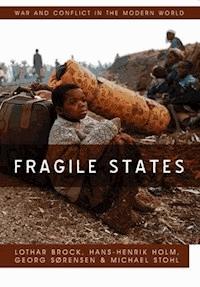
Today a billion people, including about 340 million of the world's extreme poor, are estimated to live in 'fragile states'. This group of low-income countries are often trapped in cycles of conflict and poverty, which make them acutely vulnerable to a range of shocks and crises.
This engaging book defines and clarifies what we mean by fragile states, examining their characteristics in relation to "weak" and "failed" states in the global system, and explaining their development from pre-colonial times to the present day. It explores the connections between fragile statehood and violent conflict, and analyses the limitations of outside intervention from international society. The complexities surrounding 'successes' such as Costa Rica and Botswana - countries which ought to be fragile, but which are not - are analysed alongside the more precarious cases of the Democratic Republic of the Congo, Afghanistan and Haiti.
Absorbing and authoritative, Fragile States will be an invaluable resource for students and scholars of international relations, security studies and development.
Sie lesen das E-Book in den Legimi-Apps auf:
Seitenzahl: 298
Veröffentlichungsjahr: 2013
Ähnliche




















Fragile States
Fragile States
Violence and the Failure of Intervention
LOTHAR BROCK, HANS-HENRIK HOLM, GEORG SØRENSEN AND MICHAEL STOHL
polity
Copyright © Lothar Brock, Hans-Henrik Holm, Georg Sørensen and Michael Stohl 2012
The right of Lothar Brock, Hans-Henrik Holm, Georg Sørensen and Michael Stohl to be identified as Authors of this Work has been asserted in accordance with the UK Copyright, Designs and Patents Act 1988.
First published in 2012 by Polity Press
Polity Press
65 Bridge Street
Cambridge CB21UR, UK
Polity Press
350 Main Street
Malden, MA 02148, USA
All rights reserved. Except for the quotation of short passages for the purpose of criticism and review, no part of this publication may be reproduced, stored in a retrieval system, or transmitted, in any form or by any means, electronic, mechanical, photocopying, recording or otherwise, without the prior permission of the publisher.
ISBN-13: 978-0-7456-5951-0
A catalogue record for this book is available from the British Library.
Typeset in 10.25 on 13 pt FF Scala
by Servis Filmsetting Ltd, Stockport, Cheshire
Printed and bound in Great Britain by MPG Books Group Limited, Bodmin,
Cornwall
The publisher has used its best endeavours to ensure that the URLs for external websites referred to in this book are correct and active at the time of going to press. However, the publisher has no responsibility for the websites and can make no guarantee that a site will remain live or that the content is or will remain appropriate.
Every effort has been made to trace all copyright holders, but if any have been inadvertently overlooked the publisher will be pleased to include any necessary credits in any subsequent reprint or edition.
For further information on Polity, visit our website: www.politybooks.com
For our grandchildren:Kaja, Jovan,Katarina, Luna, Jonatan, Mira, Karla, Bastian, Benjamin,Jonas, Tobias,Sophia, Jasper, Samuel and Nina
Contents
Acknowledgements
Introduction: War and Conflict in Today’s World
1
Major Characteristics of Fragile States
2
The Formation of Fragile States
3
Fragile Statehood and Violent Conflict
4
Coping with State Fragility
5
Surprising Deviations: Fragility Escaped
Conclusion: The Fragile State Dilemma
References
Index
Acknowledgements
This book is a follow-up to a series of five workshops conducted at Purdue University in West Lafayette, Florence, Italy and the University of California Santa Barbara over a period of five years in which the participants submitted papers and then met for five days and discussed the problem of fragile states, political violence and the response of the international community.
As was their purpose, the workshops brought together a rather disparate group of scholars representing very different intellectual traditions and approaches. Most of the workshop participants participated in three or more of the five meetings. They included Chadwick F. Alger, Mohammed Ayoob, William Bain, Christopher Clapham, Robert Dorff, Peter Grabosky, Ted Robert Gurr, Robert Jackson, Jennifer Jackson-Preece, Leslie Janzen, George Lopez, Ann Mason, Steven Metz, Michael Nicholson, Alpa Patel, Scott Reid, Dan Smith, Hans-Joachim Spanger, Rachel Stohl and Peter Wallensteen.
Sponsorship for three of the meetings came from the Strategic Outreach Program of the US Army War College. We thank the Army War College for its financial assistance and all the participants in our workshops for their substantial contributions to our understanding of the issue.
We greatly appreciate the invitation from our editor Louise Knight and Polity Press to contribute to the series of which this book is a part and also thank the anonymous readers who took time to read the manuscript and to provide us with several constructive suggestions for improvement.
Introduction
War and Conflict in Today’s World
Something has happened when it comes to war and conflict in today’s world. It is not that violent conflict has disappeared; there is plenty of it, and some conflicts are even more destructive and devastating in terms of human cost than previously. But we commonly think about large-scale violent conflict – that is, war – as something that takes place between two or more countries. The very definition of war in Webster’s Dictionary reflects this view; war is simply defined as ‘a state of usually open and declared armed hostile conflict between states or nations’.
It is this kind of thinking about war which is increasingly obsolete. In the first half of the twentieth century, conflict escalated into two world wars. Since then, the number of interstate wars has been in decline. This trend has continued after the end of the Cold War. Since 1989, there have been a total of 128 armed conflicts – most of them minor, 48 of them wars (defined as armed conflict in which at least 1,000 people are killed, or killed yearly). Only eight of these conflicts were interstate; the rest of them were intrastate (Harbom and Wallensteen, 2009).
We have therefore experienced a fundamental shift in the nature of armed conflict, including war. Such conflict is now much more intrastate than it is interstate. However, in some cases these intrastate conflicts were internationalized in the sense that an external state or group of states intervened in the conflict, as in the Democratic Republic of the Congo, where several neighbouring states supported one side or the other. In the case of the Georgia war of 2008, a Russian force supported the Ossetians against Georgia. In 1999, NATO intervened in the Serbian war in Kosovo, and in 2011, it intervened in the uprising in Libya. Still, these conflicts are primarily intrastate, related to the peculiar characteristics of the countries affected by violence. These countries are widely defined as fragile states. State fragility is not automatically accompanied by a breakdown of order and collective violence. New research rather shows that the absence of a consolidated state may be compensated by various other ways of governance (Hagmann and Péclard, 2010: 542). Nevertheless, where there is large-scale, intrastate violence there tends to be state fragility. For that reason, it is necessary to engage in the analysis of fragile states in order to understand what it is that generates and shapes war and conflict today, the theme of the book series of which this volume is a part.
Lesen Sie weiter in der vollständigen Ausgabe!
Lesen Sie weiter in der vollständigen Ausgabe!
Lesen Sie weiter in der vollständigen Ausgabe!
Lesen Sie weiter in der vollständigen Ausgabe!
Lesen Sie weiter in der vollständigen Ausgabe!
Lesen Sie weiter in der vollständigen Ausgabe!
Lesen Sie weiter in der vollständigen Ausgabe!
Lesen Sie weiter in der vollständigen Ausgabe!




