


1,99 €
Mehr erfahren.
- Herausgeber: Publisher s13381
- Kategorie: Geisteswissenschaft
- Sprache: Englisch
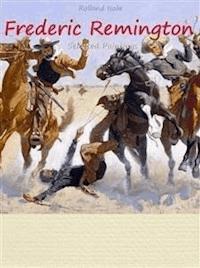
Frederic Sackrider Remington (1861 – 1909) was an American painter, illustrator, sculptor, and writer who specialized in depictions of the American Old West, specifically concentrating on scenes from the last quarter of the 19th century in the Western United States and featuring images of cowboys, American Indians, and the U.S. Cavalry, among other figures from Western culture.Remington was the most successful Western illustrator in the "Golden Age" of illustration at the end of the 19th century and the beginning of the 20th century, so much so that the other Western artists such as Charles Russell and Charles Schreyvogel were known during Remington's life as members of the "School of Remington". His style was naturalistic, sometimes impressionistic, and usually veered away from the ethnographic realism of earlier Western artists such as George Catlin. His focus was firmly on the people and animals of the West, with landscape usually of secondary importance, unlike the members and descendants of the Hudson River School, such as Frederic Edwin Church, Albert Bierstadt, and Thomas Moran, who glorified the vastness of the West and the dominance of nature over man. He took artistic liberties in his depictions of human action, and for the sake of his readers' and publishers' interest. Though always confident in his subject matter, Remington was less sure about his colors, and critics often harped on his palette, but his lack of confidence drove him to experiment and produce a great variety of effects, some very true to nature and some imagined.
Das E-Book können Sie in Legimi-Apps oder einer beliebigen App lesen, die das folgende Format unterstützen:
Veröffentlichungsjahr: 2017
Ähnliche




















Frederic Remington
Selected Paintings
By Rolland Isola
––––––––
First Edition
*****
Copyright © 2017 by Rolland Isola
Table of Contents
Title Page
Copyright Page
Foreword
Paintings
Foreword
FREDERIC SACKRIDER Remington (1861 – 1909) was an American painter, illustrator, sculptor, and writer who specialized in depictions of the American Old West, specifically concentrating on scenes from the last quarter of the 19th century in the Western United States and featuring images of cowboys, American Indians, and the U.S. Cavalry, among other figures from Western culture.
Remington was the most successful Western illustrator in the "Golden Age" of illustration at the end of the 19th century and the beginning of the 20th century, so much so that the other Western artists such as Charles Russell and Charles Schreyvogel were known during Remington's life as members of the "School of Remington". His style was naturalistic, sometimes impressionistic, and usually veered away from the ethnographic realism of earlier Western artists such as George Catlin. His focus was firmly on the people and animals of the West, with landscape usually of secondary importance, unlike the members and descendants of the Hudson River School, such as Frederic Edwin Church, Albert Bierstadt, and Thomas Moran, who glorified the vastness of the West and the dominance of nature over man. He took artistic liberties in his depictions of human action, and for the sake of his readers' and publishers' interest. Though always confident in his subject matter, Remington was less sure about his colors, and critics often harped on his palette, but his lack of confidence drove him to experiment and produce a great variety of effects, some very true to nature and some imagined.
His collaboration with Owen Wister on The Evolution of the Cowpuncher, published by Harper's Monthly in September 1893, was the first statement of the mythical cowboy in American literature, spawning the entire genre of Western fiction, films, and theater that followed. Remington provided the concept of the project, its factual content, and its illustrations and Wister supplied the stories, sometimes altering Remington's ideas.
Remington's prototype cowboys were Mexican rancheros but Wister made the American cowboys descendants of Saxons—in truth, they were both partially right, as the first American cowboys were both the ranchers who tended the cattle and horses of the American Revolutionary army on Long Island and the Mexicans who ranched in the Arizona and California territories.
Remington was one of the first American artists to illustrate the true gait of the horse in motion (along with Thomas Eakins), as validated by the famous sequential photographs of Eadweard Muybridge. Previously, horses in full gallop were usually depicted with all four legs pointing out, like "hobby horses". The galloping horse became Remington's signature subject, copied and interpreted by many Western artists who followed him, adopting the correct anatomical motion. Though criticized by some for his use of photography, Remington often created depictions that slightly exaggerated natural motion to satisfy the eye. Also, noteworthy was Remington's invention of "cowboy" sculpture.
Paintings
Battle of Beecher's Island, 1871/1909, Watercolor on paper, 53.3 x 30.5 cm
The Lookout, 1887, Oil on canvas, 55.7 x 65.9 cm
A Dash for the Timber, 1889, Oil on canvas
Prospecting for Cattle Range, 1889, oil on canvas, 74.3 × 127.6 cm
Cossack, 1890/1896, Watercolor on paper, 68.7 x 55.2 cm




