


Erhalten Sie Zugang zu diesem und mehr als 300000 Büchern ab EUR 5,99 monatlich.
- Herausgeber: Pocket Essentials
- Kategorie: Religion und Spiritualität
- Sprache: Englisch
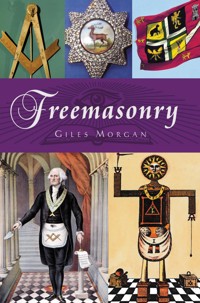
The world of Freemasonry exerts a powerful influence on the modern imagination. In an age when perceived notions of history are being increasingly questioned and re-examined it is perhaps inevitable that secretive societies such as the Freemasons find themselves at the centre of considerable speculation and conjecture. To some they represent a powerful and shadowy elite who have manipulated world history throughout the ages, whilst to others they are an altogether more mundane and benign fraternal organisation. Giles Morgan begins by exploring the obscure and uncertain origins of Freemasonry. It has been variously argued that it derives from the practices of medieval stonemasons, that it dates to events surrounding the construction of the Temple of Solomon and that it is connected to ancient Mystery Cults. One of the major and often disputed claims made for Freemasonry is that it is directly attributable to the Knights Templar, generating a wealth of best-selling publications such as 'The Holy Blood and the Holy Grail' and more recently Dan Brown's 'The Da Vinci Code', linking Freemasonry to a supposed secret order known as the Priory of Sion who are the guardians of the true nature of the Holy Grail. Freemasonry today is a worldwide phenomenon that accepts membership from a diverse ethnic and religious range of backgrounds. Entry to Freemasonry requires a belief in a Supreme Being although it insists it does not constitute a religion in itself. The rituals and practices of Freemasonry have been viewed as variously obscure, pointless, baffling, sinister and frightening. An intensely stratified and hierarchical structure underpins most Masonic orders whose activities are focussed within meeting points usually termed as Lodges. Giles Morgan examines its historical significance (George Washington and Benjamin Franklin were both Masons) and its position and role in contemporary society.
Sie lesen das E-Book in den Legimi-Apps auf:
Seitenzahl: 156
Veröffentlichungsjahr: 2011
Das E-Book (TTS) können Sie hören im Abo „Legimi Premium” in Legimi-Apps auf:
Ähnliche






Freemasonry
GILES MORGAN
POCKET ESSENTIALS
Contents
Introduction
1: What is Freemasonry?
2: The Fellowcraft and the Master Mason
3: The Temple of Solomon
4: Mystery Cults and Secret Societies
5: The Knights Templar
6: The Development of Freemasonry in Europe
7: Freemasonry in America
8: Freemasonry in the Modern Era
Bibliography
Web pages
Copyright
Introduction
Freemasonry is a topic that polarises opinion. Much of the controversy which surrounds the subject has centred on the perception that Freemasons represent a secret society with sinister aims and objectives that has wielded a powerful but unseen influence through history. Its many critics have labelled it as an organisation that is variously corrupt, manipulative, self-serving and even satanic. Those who have attempted to defend the reputation of Freemasonry have often pointed out that it can be more realistically regarded as not so much a secret society as a fraternal society that has its own secrets. Advocates of Freemasonry argue that the secrecy surrounding its rituals and meetings is mainly limited to codes of recognition within what its members call the ‘Craft’.
Freemasonry is a global phenomenon and examples of Masonic-type groups can be found throughout the world. Many view Freemasonry as holding high moral aims and ideals. Membership is potentially open to anyone over the age of 21 with a belief in a supreme being. However, in order to become a Freemason, candidates must be nominated and vetted by existing Freemasons. For the critics of Freemasonry this process is indicative of the elitism and protectionism that is the true nature of the order.
Perhaps one of the most puzzling and perplexing aspects of Freemasonry is the way in which it defines itself. During initiation ceremonies candidates are commonly asked the ritual question, ‘What is Freemasonry?’ The answer generally given is, ‘A peculiar system of morality, veiled in allegory and illustrated by symbols’. Freemasonry also states that its three grand founding principles are ‘brotherly love, relief and truth’. Entrants to Masonic societies are very often required to progress through a series of ceremonies in which the mysteries of the Craft are revealed to them before they reach the rank of Master Mason. The circumstances and content of these rituals have led many, both within and outside Freemasonry, to question how they began and what meanings they contain.
It is often claimed that Freemasonry is the oldest surviving secret society in the world and the numerous beliefs about its beginnings seem to point towards ancient and esoteric origins. The origins of Freemasonry are obscure and uncertain but a body of different theories has emerged in an attempt to answer the seemingly fundamental and basic question of how the Craft began. It has been variously argued that it derives from the practices of medieval stonemasons, that it dates to events surrounding the construction of the Temple of Solomon and that it is connected to ancient Mystery Cults. One of the major and often disputed claims made for Freemasonry is that it is directly linked to the Knights Templar. Best-selling books The Holy Blood and the Holy Grail and more recently Dan Brown’s The Da Vinci Code have linked Freemasonry to a supposed secret order known as the Priory of Sion which is the guardian of the true nature of the Holy Grail. Freemasonry also features heavily in Brown’s novels Angels and Demons and The Solomon Key.
The earliest written documentary evidence of Freemasonry dates mainly from the sixteenth century although some have claimed references to it can be found in older texts. The creation of the Grand Lodge of England in 1717 is often seen as a major turning point or event in the history of Freemasonry as the order became more visible to a wider public for the first time. It has been argued that Freemasonry has played an important role in the shaping of American society and it is known that a number of key figures in American history such as George Washington and Benjamin Franklin were themselves Freemasons.
Some have claimed that Freemasonry also influenced the French Revolution and draw parallels between the slogan ‘Liberty, Equality, Fraternity’ and its own three grand founding principles. On a more sinister level it has been claimed in recent years that the Victorian serial killer Jack the Ripper was a Freemason and the brotherhood has been linked to organised crime. However, it is perhaps less well known that many thousands of Freemasons were amongst those persecuted and killed by the Nazis during the Second World War. Adolf Hitler attacked the Freemasons in Mein Kampf and considered them to be enemies of the Nazi party. Its members were barred from holding public office and arrested and interned in concentration camps as political prisoners.
In more recent times Masonic-type groups such as P2 in Italy have been involved in corruption scandals that have perpetuated the image of Freemasonry as a secretive and self-serving network involved in nefarious activities. Conversely, many Freemasons have pointed to their charitable work, collecting money for a number of causes, and their tradition of scholarly research and education as important and positive aspects of their organisations. Freemasonry can boast many famous and distinguished members throughout its history, ranging from Mozart and Sir Isaac Newton to Sir Winston Churchill and Buzz Aldrin in the twentieth century. Freemasonry has played an important and often little-known role in the shaping of Western culture and, in this sense at least, its development can credibly be claimed to represent something of a secret history.
What is Freemasonry?
Attempting to answer the basic question of what Freemasonry actually is and the associated one of how it originated has proved a surprisingly complex and difficult task for both Masons and non-Masons alike. In 1984, following a flurry of interest in the Brotherhood, a leaflet was produced by Freemasons and issued by a group with the slightly Pythonesque title of the ‘Board of General Purposes’. The leaflet, entitled What Is Freemasonry?, describes Freemasonry as:
one of the world’s oldest secular fraternal societies… a society of men concerned with spiritual values. Its members are taught its precepts by a series of ritual dramas, which follow ancient forms and use stonemason’s customs and tools as allegorical guides.
(The Craft, John Hamill, p.12).
The simplest definition of Freemasonry then is that it is a fraternal organisation found in one form or another in a wide and varied range of countries around the world. However, Freemasonry can also be regarded as a secret society in that many of the inner workings of the organisation are not revealed to the general public. Freemasons aim to improve themselves by learning moral and spiritual lessons taught within the fraternity, not only to develop and benefit their own characters, but also in order to contribute in positive ways to the fraternity and to wider society.
Its members traditionally share a moral code and value system with a belief in a single Supreme Being or deity. It is essential that prospective Masons have a belief in a Supreme Being or deity in order to pursue a course of spiritual growth. Providing that this criterion is met, the candidate is free to adhere to more or less any religion that they choose. One of the tenets of Freemasonry is that its members are at liberty to follow their own separate beliefs but it safeguards this freedom by forbidding religious discussion within its meetings. Similarly, discussion of political issues is prohibited within Masonic meetings in order to promote unity and harmony amongst its members. As we shall see, this has not always been the case but, none the less, it is an ideal that is central to Freemasonry.
The vast majority of Freemasons belong to what is called ‘Craft’ or ‘Blue Lodge’ Freemasonry. Its members usually meet together under the guidance and leadership of a Worshipful Master and other Masonic officials at a local level. The officers of the lodge, led by the Worshipful Master, will initiate new members and deal with issues relevant to the lodge or local area. An impor-tant aspect of Freemasonry is that its members should contribute actively towards charitable and worthwhile causes. There are three levels or ranks within Craft Masonry: the Entered Apprentice referred to as the first degree; the Fellowcraft which is the second degree; and the third degree of Master Mason.
It is also important to recognise that Freemasonry cannot be regarded as one coherent and single body. Rather Freemasonry today is the culmination of differing historical traditions and trends that will be discussed in greater detail in later chapters. Individual Masonic Lodges are governed by a Grand Lodge that varies from territory to territory. For example in Britain there are different Grand Lodges for each country within the United Kingdom. English Masonry is presided over by the United Grand Lodge of England whilst the Grand Lodge of Ireland and the Grand Lodge of Scotland preside over their member’s activities. The central image or symbol around which Freemasonry is organised and teaches its spiritual and moral lessons to Masons is the building of the Temple of Solomon. Just as the Temple was intended to be perfect in its form and function in providing an earthly home for God, so Masons are taught that they must strive to perfect themselves and thus contribute to wider society.
Masonic Principles
The basic principles on which Freemasonry is said to be based and which are intended to inform the thoughts and actions of Masons are Brotherly Love, Relief and Truth. The principle of Brotherly Love emphasises tolerance and mutual respect and working towards a harmonious and productive society. Relief is widely interpreted as offering assistance and aid to those who require it within society through charitable donations and aid. The principle of Truth requires that a Mason should strive to attain high moral standards and aim to fulfil his responsibilities as a Mason and as a citizen.
Freemasonry instructs its members through a series of symbolic and allegorical moral lessons that are described as degrees. It has been argued that these Masonic principles played a major part in determining the idealised qualities and beliefs upon which the Constitution of the United States of America is claimed to have been founded. As we shall see, the Masonic principles of Brotherly Love, Relief and Truth also had a considerable influence upon the ideals of the French Revolution, one which can be recognised in the famous Republican rallying call of ‘Liberty, Equality, Fraternity’.
Masonic Lodges
A Masonic lodge is the term given to a group of Masons and does not denote the meeting place in which they attend. The lodge rooms where Masons meet may vary in size or relative grandeur but they do share a core set of characteristics. Within Freemasonry it is important that the room in which the lodge meets should have an alignment running from east to west. Essentially, and as we shall discover significantly, the Worshipful Master is always seated in the East corner of the lodge room. Lodge members are seated on benches along the south and north walls that are themselves split into east and west groupings. One of the most distinctive and recognisable characteristics of the lodge room is usually the floor upon which a black and white chequered pattern of squares features prominently either as a carpet, tiles or mosaic. Conversely the ceiling often has a depiction of the sun or the heavens. On a practical level the lodge will generally have its warrant from its Grand Lodge visible, that demonstrates its right to assemble and function as a Masonic lodge.
The personnel at the core of a lodge hold seven positions; the Tyler, the Inner Guard, the Junior Deacon, the Senior Deacon, the Junior Warden, the Senior Warden and the Worshipful Master. The Tyler has the role of standing outside the doors that lead into the lodge and is required to prevent any unlawful entry into the inner chamber and to make sure that the business of the lodge is not being overheard by outsiders. The Tyler also greets all those entering the lodge and must ensure that Masons are properly dressed (usually in black suits with black ties and white shirts) before allowing them entry to the lodge room. Traditionally the Tyler stood guard with a ceremonial sword to stop eavesdropping or forced entry to the lodge. The Tyler’s Sword often has a wavy blade because, in the Book of Genesis, a flaming sword was placed in the east of the Garden of Eden to guard the Tree of Life.
The Inner Guard performs the same role as the Tyler but within the lodge room. Ceremonially, the Inner Guard will check that the Tyler is performing his duties by knocking on the door of the lodge to which the Tyler must reply by knocking the outside of the door.
Initiates are met within the lodge by the Inner Guard who then escorts them to meet the Junior Deacon. The Junior Deacon helps candidates to prepare for ceremonies of initiation and monitors those who enter and leave the room during a lodge session. He must ensure that any that do leave or enter do so only with the permission of the Senior Deacon or Worshipful Master. He carries messages on behalf of the Senior Deacon.
The Senior Deacon performs the same function for the Worshipful Master and has responsibility for the introduction of Masons from other lodges to members of his own. Within the lodge the Senior Deacon plays a significant part in initiation ceremonies, leading candidates and participating in ritual speeches. The Senior Deacon will generally progress within the hierarchy of the lodge and so must undergo training to prepare him for his next role in a ‘lodge of instruction’. The role of the Junior Warden is to arrange the business of the lodge in terms of liaising with visitors from other lodges and (importantly) of covering the duties of the Senior Warden and Worshipful Master if they are absent. The Senior Warden is second in command and must be able both to help the Worshipful Master and to take his place in his absence and prepare for his own ascension to that role.
The Worshipful Master is the highest-ranking position within a lodge and he must govern its business and ceremonies and play a central part in its rituals. The Worshipful Master is the most important point of contact between the lodge and its respective Governing Grand Lodge. The Worshipful Master is responsible for the opening and closing of lodge sessions and for maintaining order and appropriate behaviour within it.
There are a number of other non-ceremonial officers who operate within the framework of the lodge. Typically there would be around eight such officers although, in some lodges, there are more. The least senior of these is the Junior Steward and his primary purpose is not to participate in the rituals and ceremonies of the lodge but to assist with lodge activities before sessions are opened and when they are closed. The Junior Steward would provide assistance to the Senior Steward and help the Junior Warden with the provision of food and drink. Those serving as Junior Steward are seen as gaining experience and knowledge in order to progress within the framework of the lodge. The Senior Steward also plays an important role during meals, checking that everything is running smoothly whilst also providing support and assistance to the lodge officers. All lodge meetings begin and end with prayer and it is the responsibility of the Chaplain to lead the lodge in this activity. He is also responsible for the safekeeping of the Volume of the Sacred Law. The Chaplain must also attend the funerals of Masons where he would be expected to say prayers for the deceased.




