


Erhalten Sie Zugang zu diesem und mehr als 300000 Büchern ab EUR 5,99 monatlich.
- Herausgeber: Pocket Essentials
- Kategorie: Sachliteratur, Reportagen, Biografien
- Sprache: Englisch
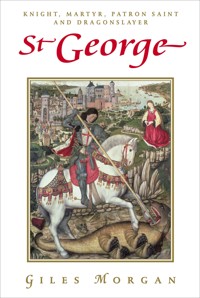
St. George is a figure that bridges many worlds. At the heart of the myths and legends surrounding this English icon lies the story of an Early Christian Martyr persecuted by the Roman Empire around the third century AD. But England is only one country to have adopted this legendary soldier saint as their patron. Other countries including Germany, Armenia, Hungary, Portugal and Malta have all claimed him as their own. The cult of St. George is astonishingly widespread with churches being dedicated to him in Ethiopia, Egypt, Greece and France. His heroic struggle and victory against the dragon can be interpreted as representing the bravery of an individual Christian or as the eternal battle been good and evil. But closer examination of the cult of St. George yields unexpected results. There are clear parallels between his legendary battle and that of earlier pre-Christian heroes such as Perseus and Beowulf. St. George is also identified with the Islamic hero Al Khidr who is said to have discovered the fountain of youth. He has been associated with the coming of spring and has functioned as fertility symbol and been closely linked to the Green Man of Pre-Christian Myth. St. George has also acted as a symbol of chastity and served as a healing saint. His flag has been appropriated by the far right but in recent times come to identify a multi-cultural England. David Beckham arguably embodies many of the contradictory aspects of St. George as sex symbol, multi-racial icon and national hero.
Sie lesen das E-Book in den Legimi-Apps auf:
Seitenzahl: 166
Veröffentlichungsjahr: 2017
Das E-Book (TTS) können Sie hören im Abo „Legimi Premium” in Legimi-Apps auf:
Ähnliche















ST GEORGE
St George is a figure that bridges many worlds. At the heart of the myths and legends surrounding this English icon lies the story of an early Christian martyr persecuted by the Roman Empire around the third century AD. But England is only one country to have adopted this legendary soldier saint as their patron. Other countries including Germany, Armenia, Hungary, Portugal and Malta have all claimed him as their own. The cult of St George is astonishingly widespread with churches being dedicated to him in Ethiopia, Egypt, Greece and France.
His heroic struggle and victory against the dragon can be interpreted as representing the bravery of an individual Christian or as the eternal battle between good and evil. But closer examination of the cult of St George yields unexpected results. There are clear parallels between his legendary battle and that of earlier pre-Christian heroes such as Perseus and Beowulf. St George is also identified with the Islamic hero Al Khidr, who is said to have discovered the Fountain of Youth, and has been closely linked to the Green Man of pre-Christian myth. He has been associated with the coming of spring, served as a healing saint, and acted as a symbol of both chastity and fertility. This comprehensive Pocket Essentials guide tells you everything you need to know about England’s patron saint.
About the author
Giles Morgan has written for magazines including Fortean Times and Focus. He reviews books for Crime Time and has had poetry published in various magazines. He is the author of The Holy Grail, Byzantium, Freemasonry and Saints, all published by Pocket Essentials. He is also the author of Dracula: The Origins and Influence of the Legendary Vampire Count.
Other books in this series by the same author
The Holy Grail
Byzantium
Freemasonry
Saints
Dedicated to the memory of my grandfather Eric J Davies
And with thanks to my wife and parents for their help and support
Contents
Introduction
St George as Martyr
Early Christian Saints
St George and the Dragon
Mythological Heroes
St George and Medieval Warfare
The Patron Saint of England
Hero of the Empire
St George as Icon
Bibliography
Web Pages
Copyright
Introduction
It is claimed that a vision of St George was seen during the English victory at Agincourt in 1415. Many such appearances have been ascribed to St George, from the crusades through to spectral manifestations on the battlefields of the First World War. A warrior saint, very often identified with patriotic and sometimes jingoistic concerns, he has come to be seen by many as an unequivocally English icon. His legend is evident in every aspect of society from the dedication of churches in his honour to secular representations in advertising and, particularly, in the use of his flag, the red cross of St George. And yet for all his notoriety and identification with such familiar institutions as the English village pub, he remains both an elusive and enigmatic figure.
The popularity of the story of his mythical battle with the dragon has come to obscure his origins as a real Christian martyr, who is thought to have lived around the third century AD. Persecuted by a cruel ruler for his beliefs, St George’s legendary courage stems from accounts of his refusal to worship pagan gods even when faced with torture and eventual execution. Some early accounts of his life suggest that he may have been from the province of Cappadocia in Central Turkey, others that he was Palestinian or possibly even of Nubian ancestry. The story of how an early Christian martyr from the Eastern Mediterranean came to be the patron saint of England is a fascinating if contradictory and confused one.
Some people may be surprised to find that St George is also patron saint of many other countries and is recognised on a global scale. He has been claimed by countries as diverse as Germany, Armenia, Lithuania, Portugal, Malta and Hungary. St George is the patron of Barcelona, Antioch, Genoa and many French towns. The European state of Georgia was named after him.
Closer examination of the cult of St George reveals not only his significance to a wide range of countries and societies but also some of the varying and differing roles he has fulfilled in those cultures. He has been a symbol of fertility and champion of the spring, defeating the dragon of winter, and yet he has also served as a role model of chastity. As the ultimate Christian knight, George has been depicted slaying female dragons as he fights the lustful temptations of the flesh. But his exploits have not been limited solely to Christian contexts. He has been identified with the Islamic hero Al Khidr who was said to have discovered the mythical Fountain of Youth.
As Christian martyr, St George was said to have been tortured to death (several times!), only to be resurrected by God, and his story is often linked with concepts of renewal, re-birth and revival. His legends often contain allusions to magic springs and the release of water, which has been ‘held back’ by the dragon and flows again when the beast is killed. The celebration of his feast day on 23 April may be connected with the coming of spring and the death of winter. Many parallels can also be drawn with pre-Christian heroes who fight terrible monsters such as Beowulf, Siegfried and Theseus, who defeats the terrible Minotaur. Close analysis of these legends shows the differing cultural values that inform them but demonstrates the seemingly universal need for a heroic figure who is lauded and revered.
St George enjoyed his greatest popularity throughout Europe in the middle ages when he was adopted by a succession of English kings and was believed to have aided Christian forces at various battles during the crusades. But St George’s appeal extended to many other spheres of medieval life and he became patron of many of the important guilds of the day in cities and towns across England. His influence can be seen throughout our culture and history, from his appearance as an agricultural folk figure and staple of the mummers plays to his role as an imperialist icon in the industrial age.
St George is far from redundant today. In our multi-cultural society St George, with his own complex identity and multi-faceted history, can be seen as a strangely fitting emblem of diversity. The red cross banner of St George may, in the past, have been appropriated by right wing groups and xenophobes but, increasingly, it appears to have been embraced by a broader cross-section of society as England undergoes new political and social changes in the 21st century. The flag of St George is today most commonly seen at sporting events and in many ways has come to supersede the Union Jack as being representative of an English national identity. Football particularly has become strongly associated with the St George’s flag, which is displayed on T-shirts, pennants and the painted faces of fans. Curious parallels can be drawn between George and David Beckham, a modern day icon who has both multi-cultural and national appeal. An exploration of the cult of St George reveals that it is in fact a pan-cultural phenomenon with an apparently universal popularity.
St George as Martyr
The life and identity of St George are shrouded in mystery. Very little can be said with any certainty about the real man around whom a legend has formed. And yet it is now generally accepted by most historians and writers that a real St George did exist. If these two statements seem at odds, then this is another of the many contradictory aspects of the cult of St George.
In the earliest written material about the life of St George, there is considerable variation in circumstance and detail but a basic, recognisable story can be discerned behind all the seemingly endless re-tellings. George is described as a man of high birth and rank who lived around the third or fourth century AD. He was a Christian, ordered by a pagan ruler to sacrifice to a pagan god (usually Apollo or Bacchus) who refused and was tortured and eventually beheaded for his defiance.
Almost every detail of this account changes in the surviving early Christian texts or ‘hagiographies’ that describe the lives of the Christian martyrs. The changes of detail are at times so bewildering that some have argued that the figure of St George never actually existed at all. However, there are also powerfully persuasive reasons for believing that St George was a real person who met his death as a Christian martyr.
Before examining the early texts in detail, it is worth outlining some of the general statements made about his cult. It is widely stated that St George was martyred at the town of Lydda in Palestine. Today this town is known as Lod and, during the Roman occupation, was referred to as Diospolis. A cult of St George centred on Lydda has existed since the early Christian period and this alone lends weight to the belief that St George existed. It was a centre of pilgrimage and worship and a Greek orthodox church dedicated in his honour can still be visited, standing in close proximity to a modern airport. Lydda lies 24 miles from Jerusalem and is located on the plain of Sharon. St George is also often linked with the town of Joppa, whose modern name is Jaffa and which stands about 12 miles from Lydda.
Another location that is consistently linked with St George is the region of Cappadocia which forms part of central Turkey. (The name Cappadocia was first used when the area was part of the Roman Empire.) However, in the centuries since the death of the saint, which is generally said to have taken place on 23 April 303 AD, the tradition of referring to St George of Cappadocia has given rise to much confusion and controversy. The confusion about St George’s links with Cappadocia arises from the fact that it is known that another George of Cappadocia definitely existed. Most famously, Edward Gibbon linked the two figures in his epic The History of the Decline and Fall of the Roman Empire (1776–1788). The identification of the two men is something that the humanist Gibbon seems to have taken spiteful delight in, because the historically recorded George of Cappadocia was a heretical Archbishop of Alexandria of dubious character. He is recorded as having sold ‘questionable’ pork to the Roman Army and was known to have been a believer in the Arian heresy. The Arians formed a religious sect that doubted that Jesus Christ had been anything other than a mortal man. This George of Cappadocia was murdered at the hands of a raging mob in 362 AD.
Gibbon enjoyed undermining some of the more fanciful aspects of Christian belief but he is now thought to be mistaken in connecting the two figures. The long tradition of St George’s martyrdom at Lydda tends to contradict Gibbon’s assertions. The George who was Archbishop of Alexandria has never been linked to this area. Perhaps most conclusively from a modern perspective, the discovery in the nineteenth century of two early churches dedicated to St George in Syria tends to discredit the theory that he came from Cappadocia. A church at Shakka in Syria had a Greek inscription over its doorway that stated that it was ‘the house of the holy and triumphant martyrs, George and the saints who suffered martyrdom with him.’(Budge, George of Lydda, here).
The second inscription, also written in Greek, at Ezra (Azra or Adhra) describes how this previously pagan temple had been re-dedicated to St George. The translation makes for fascinating reading and states that:
1. The habitation of demons hath become a house of God.
2. A saving light hath shone in the place where darkness was enshrouded.
3. Where there were sacrifices of idols there are now a choir of angels.
4. Where God was roused to wrath He is now propitiated.
5. A certain man, a lover of Christ, the noble John, the son of Diomedes.
6. As a gift from his own money he hath offered to God a building meet to be seen.
7. Having placed therein the honourable relic(s) of the splendidly triumphant holy martyr George, who appeared to John himself.
8. Not as in a sleep (or a dream) but visibly.
(Quoted in Budge, George of Lydda, here).
The appearance of St George to his believers and supporters will rapidly become a recognisable aspect of his cult. Perhaps unsurprisingly, accurate dating of the churches has proved difficult. Some scholars have dated them to around 346 AD but others have suggested they were dedicated as late as 515 AD. As I said earlier, little can be said with certainty of the ‘real’ St George. However, the possibility that a known heretical Archbishop would have been made a saint and adopted with such fervent belief seems unlikely. It may be that details of his life were mistakenly grafted on to the life of St George.
The earliest written source that may relate to St George is supplied by the chronicler Eusebius of Caesarea writing in 322 AD. He tells of ‘a man of the greatest distinction’ who was ordered to be executed by the Emperor Diocletian at Nicomedia on 23 April 303. However, he does not record the name of the man, where he was born or even where his body was buried.
The earliest known written account of the life of St George was found in an incomplete manuscript under a pillar in the Cathedral of Qasr Ibrim in 1964. Excavations had been taking place there prior to the building of the Aswan Dam. This narrative, written in Greek, has been dated to the years between 350 and 500 AD. The manuscript describes George as being the son of a Cappadocian who lived in Nobatia, Northern Nubia, an area that forms part of the Nile valley between Khartoum and Aswan. It states that he was born during the reign of Aurelian (270–275 AD) and that he was baptised as a Christian by his mother Polychronia. This was done secretly without the knowledge of his father Gerontius who was opposed to it. George enters the Imperial Service and rises rapidly through the ranks. Later he travels to the city of Diospolis or Lydda to gain promotion. On reaching the court of Diospolis he finds that a pagan ruler has issued a decree sentencing Christians to death. George denounces the worship of Apollo at court and is arrested and gruesomely tortured. He is forced into iron-spiked shoes, his skull is crushed and he is scourged. However, the Archangel Michael heals his wounds and frees him from his imprisonment. As a result of this miracle and St George’s preaching following his ordeals, a great number of people convert to Christianity. Even the wife of the pagan ruler becomes a Christian. St George attacks the temples dedicated to Apollo and Heracles and is then beheaded by order of the furious ruler. Many who have converted are similarly punished. This version of the life of St George describes him as having lived in the same region of Nubia as other warrior saints, such as Mercurius, Theodore and Demetrius, who were all martyred as Christians by the Emperors Diocletian and Decian.
During the reign of the Emperor Diocletian, who ruled between 284 and 305 AD, Christianity had been widely accepted. It was the religion of many, even those of high status. Indeed Diocletian’s wife and daughter were both Christians. But this tolerant attitude changed when a number of Christian soldiers were accused of disobeying commands and a number were killed as punishment for this around 300 AD. Events worsened when a plot emerged that appeared to involve Christians. Diocletian issued an edict that Christians were to be banned from meeting and worshipping and ordered the destruction of churches and religious texts. Every soldier was instructed to make proper sacrifice to the gods of Rome.
Diocletian ordered the Praetorian Guard to destroy the great Cathedral of Nicomedia and this was carried out on 23 February 303 AD. The emperor’s edict was brutally enforced across the Roman Empire. These events may form the background to the martyrdom of St George, although some, including Sir Ernest Wallis Budge, have argued for a different date. Budge, who was the author of George of Lydda, the Patron Saint of England (1930), was also keeper of Near Eastern Manuscripts at the British Museum. He was an important figure in the history of research relating to St George and believed that the generally accepted date of his martyrdom (23 April 303) was incorrect. He argued that the martyrdom had taken place 50 years before that date.
Another important early Christian text relating to the life of St George is known as the Vienna Palimpsest. (A palimpsest is a manuscript which has had its text erased and new material written onto it.) This manuscript is written in Greek and dates from the fifth century. Like other similar works from this and later centuries, it describes events in terms that veer away from realistic detail and move further towards fantasy. Yet, this version is thought to have proved very influential on later accounts of the martyrdom of St George. It purports to have as its basis another document which was written by, or perhaps more properly, authenticated by a servant of George called Pasicrates. (This was a tactic used quite frequently by writers of the lives of the saints, the hagiographers, to lend their accounts gravity and credulity.) In this version, George is again identified as being of Cappadocian extraction but is said to have lived in Palestine.
He has excelled within the Imperial Army and seeks promotion from the ruler Dadianos. Once again, the pagan ruler has attacked and banned Christianity and has ordered his subjects to give sacrifice to the gods. George is defiant, gives away his money and belongings and refuses to sacrifice. In this account, George becomes engaged in a heated argument with the emperor about his actions and is cruelly tortured. A magician called Athanasius gives him poison but he is unaffected by it.
As a result Athanasius is converted to Christianity and put to death by Dadianos. St George is killed on a wheel fitted with knives but he is restored to life by the Archangel Michael and the Lord. When St George appears before the king, his general Anatolius and his entire army convert to Christianity. They too are executed. Dadianos has molten lead poured down the throat of St George who, once again, survives through the help of God. The significance of this account is that it establishes the tradition that George suffers four deaths, is resurrected three times by the Lord and gains his martyr’s crown on the fourth occasion. The saint is also described as having the power to resurrect the dead himself and also causes a number of wooden thrones to grow roots, flower and bring forth fruit. The miracles that George performs persuade the Empress Alexandra and many thousands to convert to Christianity.
The evil ruler Dadianos is often described as being a terrible tyrant or dragon and this could be one origin of the much later medieval account of St George’s fight with the dragon. The ‘Princess’ or ‘Empress’ Alexandra is converted from the worship of Apollo to Christianity by St George and so is ‘saved’ by him. Interestingly, there is a tradition within the imagery of Greek Orthodox icons that portrays St George on horseback trampling down a man with a sword and shield rather than the mythical dragon.
Sir Ernest Wallis Budge argued that the Babylonian Epic of Gilgamesh influenced the story of the martyrdom of St George. The hero Gilgamesh was two-thirds god and one-third mortal man. Budge suggested that early followers of the cult of the saint may have identified him with the Babylonian hero, ‘If St George were three parts God and one part man, the four killings would be understandable’. (Budge, George of Lydda, here).




