


Erhalten Sie Zugang zu diesem und mehr als 300000 Büchern ab EUR 5,99 monatlich.
- Herausgeber: Pocket Essentials
- Kategorie: Geisteswissenschaft
- Sprache: Englisch
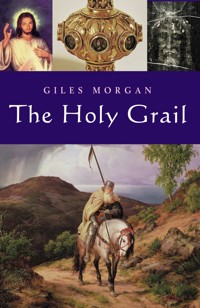
The Holy Grail is a subject that fascinates and intrigues. Through its various guises as magic cauldron, cornucopia, horn of plenty and chalice cup it has remained at the centre of popular culture from antiquity right up to the present day. An object of marvel and mystery it inhabits a place in mythology that has its roots in historical facts. The Grail has been a major inspiration and catalyst for literature and the arts in Western Culture. From Celtic mythology to the flowering of the medieval romances it has in many ways fulfilled its mythical role as a nurturing and regenerative vessel by providing such a rich and seemingly perpetual source of interest to writers and artists. Charting the emergence of the story of the Grail offers a revealing insight into the cultural shift from Celtic paganism to the emergence and domination of Christianity in Western Europe. The influence of Eastern mysticism emerges in the Grail romances as a result of the medieval crusades with its clash of cultures and subsequent cross-pollination of ideas. The Grail has come to symbolise the ultimate achievement in the modern mind and it became an object of fascination for the psychologist Carl Jung and the poet TS Eliot. Wagner, William Blake and the Pre-Raphaelites are just some of the artists to have fallen under its enduring spell.
Sie lesen das E-Book in den Legimi-Apps auf:
Seitenzahl: 171
Veröffentlichungsjahr: 2015
Das E-Book (TTS) können Sie hören im Abo „Legimi Premium” in Legimi-Apps auf:
Ähnliche















The Holy Grail
The Holy Grail is a subject that fascinates and intrigues. Through its various guises as magic cauldron, cornucopia, horn of plenty and chalice cup it has remained at the centre of popular culture from antiquity right up to the present day. An object of marvel and mystery it inhabits a place in mythology that has its roots in historical facts. The Grail has been a major inspiration and catalyst for literature and the arts in Western Culture. From Celtic mythology to the flowering of the medieval romances it has in many ways fulfilled its mythical role as a nurturing and regenerative vessel by providing such a rich and seemingly perpetual source of interest to writers and artists.
Charting the emergence of the story of the Grail offers a revealing insight into the cultural shift from Celtic paganism to the emergence and domination of Christianity in Western Europe. The influence of Eastern mysticism emerges in the Grail romances as a result of the medieval crusades with its clash of cultures and subsequent cross-pollination of ideas. The Grail has come to symbolise the ultimate achievement in the modern mind and it became an object of fascination for the psychologist Carl Jung and the poet TS Eliot. Wagner, William Blake and the Pre-Raphaelites are just some of the artists to have fallen under its enduring spell.
Giles Morgan is the author of the Pocket Essentials on The Holy Grail, Byzantium, Freemasonry, Saints and Saint George. He currently lives in Harrow.
THE HOLY GRAIL
Giles Morgan
POCKET ESSENTIALS
Contents
Introduction
For all its iconic properties there remains something fundamentally elusive about the subject of the Holy Grail. An enigma wrapped within a mystery, it seems at times to move out of reach when approached by the quester, the visionary or simply the curious. As immediately recognisable as the figures of King Arthur, Merlin and the Knights of the Round Table with whom it has come to be identified it nonetheless confounds expectation and presumption on closer analysis. The roots of a Grail tradition can be found deep in ancient Western history but can also be found to contain elements of Eastern mysticism. It has in turn been an object of reverence, devotion, yearning and a powerful tool for political and religious propaganda.
It can be seen to possess a mirror-like quality as it reflects the people and belief systems that have incorporated it into their worldview. The complexity of its origins is matched by its enduring appeal as a metaphor for quest, struggle, ultimate achievement and sometimes painfully, ultimate failure. Unpicking the strands of its development is a telling account of the dreams and ambitions of humanity, its triumphs, obsessions and darkest cruelties. But the grail does not merely belong to the past as a redundant artefact of antiquity; its tradition is alive and evolving in the modern world.
The French poet Chrétien de Troyes from Champagne was instrumental in crystallising the story of the Grail as we know it today. Working between around 1170 to 1190 he produced a series of romances which drew heavily on the British Arthurian tales. The immense popularity of King Arthur in the medieval period is borne out by the fact that no less a figure than Richard the Lionheart himself christened his own sword Excalibur. Whether this might be construed as what we would call today an attempt at 'spin' or reflected an ardent belief in the values which Arthur seemed to enshrine, it is difficult to gauge. Nonetheless it indicates clearly that they were powerful stories and myths that would have been known at all levels of society.
De Troyes introduced the symbol of the Grail in his final tale Conte del Graal or ‘story of the grail’. It introduces the idea of a physical and spiritual quest to the court of King Arthur. A Welsh youth called Perceval undertakes a series of adventures in his quest to become a Knight of Arthur’s court in one of which he meets a mysterious Fisher King and encounters the Grail at his castle. The Fisher King has been wounded or crippled and makes a gift of a sword to Perceval. At this point the Grail Procession enters the castle. The procession is made up of a young man bearing a ‘bleeding’ lance, a young woman carrying a shining Grail made of precious materials and a maiden with a carving dish. Through the asking of a ritual question the Grail has the power to heal the king and his kingdom, the ‘wasteland’, which has been directly affected by his injury. Perceval fails to ask the question and, after he later realises his failure, he devotes the rest of his life to finding the Grail. This also precipitates later quests by other Knights.
At this point the Grail is not a specifically Christian artefact and the story remained unfinished at the time of Chrétien's death. It is possible to find many parallels between this story and Celtic Arthurian stories. Both the Christian and the pre-Christian versions contain a dream-like quality in which they seem to function on the level of pure symbolism. In this sense they represent an encoded, unfolding mystery tradition.
The Holy Grail becomes an explicitly Christian symbol in Robert de Boron’s Joseph of Arimathea, which appeared in about 1190. Here it is specifically described as the cup of the Last Supper and the chalice in which Christ’s blood is caught by Joseph of Arimathea. But de Boron was at this point adding to an already existing storytelling tradition, which dated back to pre-Christian Celtic cultures and beyond. The body of literature, which has come to be known as the Matter of Britain, combines Celtic mythology and the Arthurian tales with the Grail, matching the development of Christianity in Britain and Europe. Joseph of Arimathea is said to have brought the grail to Glastonbury and established the first Christian church in Britain. The Grail becomes a symbol of Celtic Christianity fusing pagan beliefs with the new religion brought from the Middle East.
In Celtic mythology the Grail has parallels with other magical vessels like the magic cauldron which makes many appearances in tales such as 'The Spoils of Annwn', collected in the Mabinogion. Significantly, it can bring the dead back to life and provide limitless food echoing many of the properties later said to be possessed by the Grail. The sacred vessel, such as the Greek cup of Dionysos, provider of inspiration, and the cauldron of the Dagda, an ancient Irish god who owned a cauldron of plenty, can be found in many world religions and cultures. The cauldron can be seen as a central motif of Shamanic cultures and their associated ritual ceremonies. Illustrative mouldings on the Gunderstrup cauldron dating from 1st or 2nd century BC Denmark appear to show an antlered God surrounded by animals and it has been suggested that this could represent a shamanic figure communicating with the spirits of the natural world. By creating hallucinogenic mixtures many shamanic cultures attempt to gain supernatural skills and abilities and the role of the cauldron in this process is both practical and symbolic. The Gunderstrup cauldron also shows a depiction of dead warriors who may be waiting to be brought back to life by the horned god Cernunnos. By dipping them head first in his cauldron they can be re-born. The recurring theme of re-birth in pagan and Christian cultures is a powerful one.
During the medieval period the Grail became closely associated with both the Cathars and the Templars. Both groups were Christian in origin but developed dissenting belief systems which drew on heretical sources such as the teachings of the Gnostics and contained elements of Eastern mysticism. Many stories link the Cathars and the grail and the Templars have been seen as its guardians. Both suffered terrible persecution by the orthodox church and many theories have developed around their relationship to the Grail. It has been variously argued that the Grail is, in fact, the container holding the Turin Shroud of which the Templars were at one point the guardians and that the Holy Grail may actually represent a Holy Bloodline descended directly from Christ. Interest has centred on Rosslyn chapel in Scotland where some believe an actual Grail found its resting place as the Templars fled persecution in Europe.
In 1207 Wolfram von Eschenbach produced Parzival a text in which the Grail takes the form of a stone and not the established symbol of the cup. His version of the Grail story contains many Eastern influences and incorporates many ideas found in alchemy. This reflects the meeting of cultures which came about during the time of the crusades and indicates a cross-pollination of ideas emerging from a background of religious war.
During the 18th and 19th centuries there was a major revival in interest in the medieval period and the Grail Quests of the Arthurian romances became a major source of inspiration for new generations of artists writers and composers. It featured in the work of the Pre-Raphaelites, William Blake, Tennyson, Aubrey Beardsley and became the basis of Richard Wagner’s Parsifal.
The fascination with the Grail intensified in the 20th century as it found expression and interpretation in a wide range of cultural forms and ideas. The poet T. S. Eliot bases much of his groundbreaking poem The Waste Land on the Grail stories and epic story tellers like T. H. White and Tolkien continue the tradition of adopting elements of earlier texts to produce their own mythologies. Mythograhers like Joseph Campbell wrote extensively on the subject and it became an important universal symbol for the psychologist Carl Jung and his wife.
On a more disturbing level the Grail story of Wagner’s Parsifal became an inspiration for Adolf Hitler and the themes of Grail quest were twisted and appropriated by the Nazi party. It is known that Hitler’s interest in the occult and mythology included a fascination with ancient artefacts. In this sense the Grail can be seen to be symbolic on a darker level of obsession and mania as well in its more positive aspects of quest, struggle, healing and renewal.
It has proved influential in film making from the sublime, such as John Boorman’s Excalibur, to the ridiculous in the satire of Monty Python's Holy Grail. In the films of Steven Spielberg and George Lucas the Grail tradition has provided both an implicit and explicit template for story telling and at the beginning of a new century the cycle comes full circle with the current Lord of the Rings trilogy.
The Holy Grail is a potent and compelling image in the modern psyche and its continued evolution is proof of its incredible symbolic flexibility. We have come to understand the quest for the Holy Grail as being representative of personal struggle, collective journeying and as ultimate achievement in all areas of human endeavour. That the most popular Western films of today contain elements reaching back as far as pre-history may represent an unexpected surprise but also an affirmation of the cyclical nature of human existence and culture.
Chapter One
Pre-Christian Sources
The Holy Grail has come to be seen today as a specifically Christian symbol. Through the medieval romances of the twelfth century and onwards it is described as the cup used by Christ himself at the Last Supper and the same vessel in which Joseph of Arimathea caught the blood of Christ. In many accounts of the Christian Grail it is viewed as having regenerative, healing and nourishing qualities both spiritually and physically. Details surrounding the Christian Grail can be seen to change in different accounts of the story, which are discussed in more detail in later chapters, but these are the basic ideas associated with it.
However, the concept of the Sacred Vessel carrying high cultural status and associations with renewal and regeneration can be found in a plethora of sources in the Pre-Christian period. Indeed parallels can be drawn in a wide range of worldwide cultures where recurrent motifs and ideas are echoed in later versions of the Grail story. As we shall see it is the universal elements of the Grail tradition which have contributed to its enduring appeal and success throughout history. Drawing on popular existing stories and traditions, which often enshrined ancient beliefs and ideas, poets and writers of the medieval period Christianised the Grail.
In order to gain insight into the rich myths of the Grail it is necessary to look back into our remote past where so many of the aspects of its later form have their beginnings. During the period known as the Neolithic, or new Stone Age, European human culture was undergoing great changes. The established system of survival of the hunter-gatherers whose nomadic habits go back to the earliest of human origins was giving way to a more settled agrarian lifestyle. Small family or community groups were farming the land and slowly gaining greater control over their food supplies and collective destinies. This socio-economic revolution had important repercussions for the values and belief systems of the people of this period. The new approach to life seems to have brought its own anxieties and responsibilities, which found their expression in the great Megalithic structures that include West Kennet long barrow and Avebury stone circle of Wiltshire in England.
There seems to have been a growing obsession with the fertility of both the land and the people themselves. The great stones of Avebury have been interpreted as having sexualised forms. Tall phallic stones are interspersed with ‘broad-hipped’ stones that have a fuller shape reminiscent of the female form. At the same time there is an emergence or an increased focus on the importance of ancestral veneration expressed in the interment of bones at sites such as West Kennet long barrow, which become important centres for ritual. The underlying concern is with the success of crops and the fertility of their animals and themselves. The symbolism of the cornucopia or horn of plenty overflowing with fruit or corn has its roots in this. Ancestors are seen as providing an important link between the living and the forces of nature, which may have been symbolised as individual deities.
There seems to have been a general trend for the collective interment of bones during the Neolithic which suggests that power resided in groups of people, perhaps important families.
At this point in history the Great Mother Goddess of the earth seems to have been a dominating influence, as is shown by the often womb-like forms that burial chambers of this period take and the proximity of sites such as Callanish in Scotland to hill forms which are often viewed as recumbent goddess figures.
The trend towards important burials of individuals with high status grave goods emerges during the Bronze Age (2200-700 BC) which suggests that power was shifting from collective groups or families towards a single, high-status figure. Grave goods, such as a beaker at the West Kennet Long Barrow, have been found in early burial sites, suggesting a belief in an afterlife or an Otherworld in which the vessel will be used by the dead. During the Bronze Age cups were commonly placed in graves. These were made principally from pottery, sometimes amber and, much more rarely, gold. A recent example is the cup found at Ringlemere in Kent in a Bronze Age Barrow. Dating from 1700-1500 BC it is thought to have been a ritual offering to an important local leader. It has been beaten from a single lump of gold and shows evidence of a high degree of metalworking skill. Cups placed with the dead may have been intended for drinking alcohol in the form of mead or beer and this could reflect the importance of group feasting in building loyalties and close ties. Certainly cups were seen as just as important objects as weapons like swords, axes and daggers.
World Mythologies
The image of a container or vessel with sacred or otherworldly connotations can be found throughout different world mythologies. Though details and contexts may vary basic elements of storytelling and symbolism emerge time after time. Greek myth provides numerous stories that feature just such magical objects. Medea the witch who assists Jason in his search for the golden fleece has a cauldron of re-birth which she demonstrates by cutting up an old sheep and drawing out a living lamb. The significant and parallel elements of the tale to the grail tradition are the matching themes of the quest and the magical vessel. Like the later Grail Knights Jason must face many trials and obstacles to achieve his goal.
Plato used the image of the Greek Krater, a vessel for mixing concentrated wine with water, as a metaphor for the creation of the universe. Through the mixing of different elements in this transformative cup life is created by the deity. The god Dionysos provides humanity with inspiration from his cup.
In another myth Hades the underworld god offers the goddess Persephone a cup containing pomegranate seeds. Upon eating six seeds she is forced to live in the underworld with Hades. However, her mother Demeter makes an agreement with Hades to allow her daughter to return to earth for half the year. (This echoes later stories about making pacts with the Christian devil.)
Upon Persephone's annual return the land, which has been laid waste through sorrow for her absence, is rejuvenated and comes to life again. This story represents ancient concerns with the cycle of the seasons, the yearly process of vegetative death and renewal and the inter-relationship of these seasons as personified in the form of gods and goddesses. It also looks forward to the later Grail stories where achievement of the chalice cup allows the barren wasteland to flower again. The motif of the magic cup recurs again in one of the tales featuring the Greek hero Hercules. In this instance in order to steal cattle from Geryoneus who lives on the island of Erytheia, Hercules borrows the giant gold cup of Helios the sun god to reach his destination. Helios used the cup for his own evening journey across the ocean to return to the east. In this combined image Hercules can be seen as representing both a quester and, in conjunction with the life-giving properties of the sun, a figure of strength and fertility. The use of the cup in obtaining cattle finds echoes in the abundance and plenty offered by later Grail myths.
An important and widespread myth of the Celtic people of the British Isles about the sun has similar features to the journey of Helios. Every day, upon its setting in the west, the sun would be carried in a boat through the underworld, ready to re-appear the next day in the east. Numerous themes of cup/boat symbolism emerge in this story, which will find later resonance in the mythology of the Grail. The magical vessel of re-birth and renewal is married with the theme of a voyage to an Otherworld. In the Arthurian legends the King, after his death, is carried by boat to the mysterious isle of Avalon in the West. In some versions of the story, Arthur is laid to rest in a cave, ready for the time when he is needed again by Britain




