


9,99 €
Mehr erfahren.
- Herausgeber: 50Minutes.com
- Kategorie: Fachliteratur
- Serie: Management & Marketing
- Sprache: Englisch
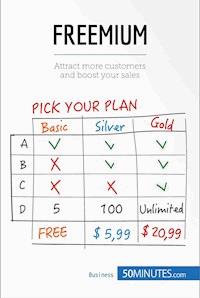
Attract more customers and boost your sales!
This book is a practical and accessible guide to understanding and implementing the freemium model, providing you with the essential information and saving time.
In 50 minutes you will be able to:
• Understand the different types of free offers given to customers and how they can be beneficial to a business
• Implement the freemium business model into your business to grow your customer base
• Offer a premium product with concrete improvements and additional services to increase your premium conversion rate
ABOUT 50MINUTES.COM | Management & Marketing
50MINUTES.COM provides the tools to quickly understand the main theories and concepts that shape the economic world of today. Our publications are easy to use and they will save you time. They provide elements of theory and case studies, making them excellent guides to understand key concepts in just a few minutes. In fact, they are the starting point to take action and push your business to the next level.
Das E-Book können Sie in Legimi-Apps oder einer beliebigen App lesen, die das folgende Format unterstützen:
Seitenzahl: 23
Veröffentlichungsjahr: 2015
Ähnliche













Freemium
Key information
Names: Freemium, crippleware.Uses: Business model, adapted for digital products and digital data.Why is it successful? Original cost management, massive attraction of customers, adapted to digital products.Key words: Freemium, free, premium, digital, conversion rate.Introduction
There’s No Such Thing as a Free Lunch. This title of a book by the American economist Milton Friedman (1912-2006) speaks volumes about the attitude of the majority of economists towards free items: they simply do not exist.
Good to know: There’s No Such Thing as a Free Lunch
This phrase, from an unknown author, was popularised by economists such as Friedman. It refers to the illusion of free offers: everything has a price, whether direct or indirect, visible or hidden.
However, a quick browse of the applications offered on the internet provides several counter-examples, including Spotify, Dropbox and antivirus software. Nonetheless, these products are not completely free:
Spotify limits free listening time;Dropbox only offers some storage space for free;the antivirus software only offers reduced protection.These applications have the same mode of distribution: the offer includes a free version and a more sophisticated or fully developed paid version (premium).
History
The distribution of free samples has already existed for a long time. Offering a small amount of a product (food, shampoo, drinks, etc.) is a tried and tested practice, because it can attract customers and subtly encourage them to purchase the product. This practice has inspired the freemium model, which works in a similar way in a virtual environment. This type of free offer is a business model (a model summarising the activities of a business: objectives, processes and resources used) first developed in the 1980s, especially for software. In 2006, Jarid Lukin from the company Alacra gave it the name ‘freemium’, a combination of ‘free’ and ‘premium’.
Definition of the model
The freemium model is a business model that combines two pricing strategies. For the same product, the model offers two versions: one is free and allows unrestricted access, the other is paid-for and offers from improved or additional services.
The strategy behind this model is based on the possibility that the free version will attract a large number of users and, above all, make them loyal customers. The aim is to convert as many users of the free version as possible into users of the paid version.
This model cannot be used for any product. Although several cases illustrate its suitability for software or video games, it is challenging for cultural products in particular. This is therefore a strategy with the potential for significant added value, but it requires careful analysis of the context of the product, the services attached to it, as well as any operating costs, distribution costs, etc. beforehand.




