


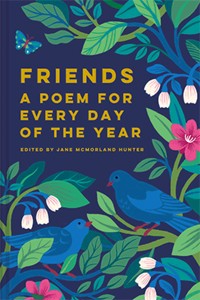
Friends: A Poem for Every Day of the Year E-Book
17,99 €
Mehr erfahren.
- Herausgeber: Batsford
- Kategorie: Poesie und Drama
- Serie: Batsford Poetry Anthologies
- Sprache: Englisch
365 poems celebrating friendship, love and constancy. This wonderful collection of poems celebrates friendship every day of the year. There are poems on the joys of companionship, encouragement, consolation, humour and love, making this a perfect gift for friends, family and partners. Poems featured include Emily Bronte's 'Love and Friendship' and Stevie Smith's 'Pleasures of friendship', as well as writings from Keats, Norman MacCaig, Waldo Emerson and Amy Lowell. Some of the most beautiful poems ever written are collected here to give us insight into the important things in life.
Das E-Book können Sie in Legimi-Apps oder einer beliebigen App lesen, die das folgende Format unterstützen:
Seitenzahl: 282
Veröffentlichungsjahr: 2019
Ähnliche




















FRIENDS: A POEM FOREVERY DAY OF THE YEAR
FRIENDS:A POEM FOREVERY DAYOF THE YEAR
EDITED BYJane McMorland Hunter
CONTENTS
JANUARY
It is a Sweet Thing, Friendship
FEBRUARY
Let Us Hold Hands
MARCH
The Breath of Kindness
APRIL
The Spring is for Joy
MAY
Please Come Flying
JUNE
An Accord in All Things
JULY
Memories that Endure
AUGUST
With Cheerful Greeting
SEPTEMBER
Such Sweet Company
OCTOBER
In Sunshine and in Shade
NOVEMBER
A Little Laughter
DECEMBER
Winter is Deck’d with a Smile
INDEX OF FIRST LINES
INDEX OF POETS
ACKNOWLEDGEMENTS
To Louy and Matilda, with all my love.
ABOUT THE EDITOR
Jane McMorland Hunter has compiled six anthologies: Favourite Poems of London, Favourite Poems of England, Classic Readings and Poems and A Nature Poem for Every Day of the Year for Batsford and Poems of the First World War and Favourite Poems for The National Trust. She also writes gardening books and works as a gardener and as the Shop Scribe at Hatchards Bookshop in Piccadilly, compiling their annual catalogues.
Introduction
There are many different types of friends: old and new, those you see every day, others you might never see but whose contact is still important, and, ideally, lovers and married couples. This collection of poems is aimed at all of these people and more: children, students, families and people nearing the end of their lives who may have more ghostly friends than living ones. There are poems about friendship, poems you would give to a friend and one or two pieces of particularly poetic prose.
Throughout our lives we make, keep and, regrettably, lose friends. Old friends, as praised by Austin Dobson, may be the best, but there was a moment when they were new friends; first meetings, first friends and first loves are all important. At any stage of life, what is clear is that friends make most things better: William Wordsworth’s description of skating, G. K. Chesterton’s drunken outing and Robert Louis Stevenson’s piratical adventures are all better because they are enjoyed in company. Even food tastes better with friends, as Ben Jonson’s planning and Robert Herrick’s lonely meal attest.
Our first friends are often our siblings, followed by school playmates and fellow scholars. It is at this point that love and friendship start to intertwine. Emily Brontë is clear on the difference between the two, describing one as an ephemeral wild briar rose and the other as an everlasting holly tree. Laura, in Thomas Moore’s ‘Temple to Friendship’, confuses friendship and love when choosing a statue for her garden; how much more confusing are matters which involve real people. Sonnets by Elizabeth Barrett Browning, William Shakespeare and others describe feelings of love, but many of these could equally apply to our friends – do most of us not love our closest friends?
Marriage is, again ideally, a union of two friends. From Thomas Campion and Anne Bradstreet to William Barnes and Charles Jefferys, poets have extolled the virtues of friendship in marriage. Laurence Alma-Tadema points out that even if you fail to marry, a squirrel, a rabbit, a pony and a lamb will provide the companionship you need.
Animals are often our best friends, although some are more reliable than others; Elizabeth Barrett Browning’s Flush is well known for his faithfulness but Tiger, Binkie and an unnamed watchdog also prove their worth at the hands of Jonathan Swift, Rudyard Kipling and Lord Byron. Cats have a more varied reputation, with Christopher Smart and others recognising that a cat’s friendship is never quite as unquestioning as that of a dog. For other poets a falcon, a lamb, a tree and a hare are less likely soulmates (Thomas Wyatt, Sarah Josepha Hale, Christina Rossetti and William Cowper respectively).
Friendship between animals also exists, with the surprising pairing of a duck and a kangaroo courtesy of Edward Lear, and the charming faithfulness of a goldfinch who, in the mind of William Cowper, chooses to forsake freedom rather than desert his friend in their cage.
Memories of friends can be as important as friendship itself. Fleeting glimpses of happiness appear in Louis MacNeice’s ‘Sunlight on the Garden’, and in Leigh Hunt’s ‘Rondeau’ the memory of a single kiss outweighs all the trials and tribulations of old age. In some cases the memories can make the dead seem more alive than the living. Many poets write of lost friends and loves, either through death or misfortune. Whatever the cause, as Lord Tennyson writes, ‘’Tis better to have loved and lost, than never to have loved at all’.
As well as descriptions of friendships, this anthology also contains poems which one could give to a friend: Edward Thomas’ ‘Thaw’, which sees the passing of winter, and John Drinkwater’s ‘Miracle’, which welcomes spring. The pleasure of a walk in the countryside and the time to ‘stand and stare’ are things any friends would wish to share. W. B. Yeats gives us the perfect Christmas gesture of friendship, to spread one’s dreams at another’s feet.
Although this is an anthology of poetry, in each month there is a little prose. Essays by Francis Bacon, William Emerson and others were too moving to ignore. There are diaries, plays, passages from the Bible, and an extract from Charles Dickens’ The Pickwick Papers which describe friendship in a poetical way even if they are not strictly poetry.
In many anthologies the order of the poems is governed by external factors: nature by the passing seasons, life by the passage of time itself. Here, apart from Valentine’s, the famously exuberant spring and a few dates with personal connections, there was no such guide. It was impossible to place the poems so that they could be all things to all readers; my hope is that all will find some poems that pertain particularly to them whilst still being able to enjoy the others.
One of the most perceptive poems in this collection is by Edward Verrall Lucas, who rightly points out that often we cannot explain our choice of friends:
‘We two are friends’ tells everything.
Yet if you must know, this is why:
Because he is he and I am I.
Edward Verrall Lucas
JANUARY
It is a Sweet Thing, Friendship
1 JANUARY
Passages of the Poem,or Connected Therewith
LINES 62–77
It is a sweet thing, friendship, a dear balm,
A happy and auspicious bird of calm,
Which rides o’er life’s ever tumultuous Ocean;
A God that broods o’er chaos in commotion;
A flower which fresh as Lapland roses are,
Lifts its bold head into the world’s frore air,
And blooms most radiantly when others die,
Health, hope, and youth, and brief prosperity;
And with the light and odour of its bloom,
Shining within the dungeon and the tomb;
Whose coming is as light and music are
‘Mid dissonance and gloom – a star
Which moves not ’mid the moving heavens alone –
A smile among dark frowns – a gentle tone
Among rude voices, a belovèd light,
A solitude, a refuge, a delight.
Percy Bysshe Shelley (1792–1822)
2 JANUARY
Since We Parted
Since we parted yester eve,
I do love thee, love, believe,
Twelve times dearer, twelve hours longer, –
One dream deeper, one night stronger,
One sun surer, – thus much more
Than I loved thee, love before.
Edward Bulwer-Lytton / Owen Meredith (1831–1891)
3 JANUARY
Brother and Sister
I cannot choose but think upon the time
When our two lives grew like two buds that kiss
At lightest thrill from the bee’s swinging chime,
Because the one so near the other is.
He was the elder and a little man
Of forty inches, bound to show no dread,
And I the girl that puppy-like now ran,
Now lagged behind my brother’s larger tread.
I held him wise, and when he talked to me
Of snakes and birds, and which God loved the best,
I thought his knowledge marked the boundary
Where men grew blind, though angels knew the rest.
If he said ‘Hush!’ I tried to hold my breath;
Wherever he said ‘Come!’ I stepped in faith.
George Eliot (1819–1880)
4 JANUARY
My Thanks
ACCOMPANYING MANUSCRIPTS PRESENTED TO A FRIEND, LINES 61–68
O friend beloved, whose curious skill
Keeps bright the last year’s leaves and flowers,
With warm, glad, summer thoughts to fill
The cold, dark, winter hours!
Pressed on thy heart, the leaves I bring
May well defy the wintry cold,
Until, in Heaven’s eternal spring,
Life’s fairer ones unfold.
John Greenleaf Whittier (1807–1892)
5 JANUARY
The Oblation
Ask nothing more of me, sweet;
All I can give you I give.
Heart of my heart, were it more,
More would be laid at your feet:
Love that should help you to live,
Song that should spur you to soar.
All things were nothing to give,
Once to have sense of you more,
Touch you and taste of you, sweet,
Think you and breathe you and live,
Swept of your wings as they soar,
Trodden by chance of your feet.
I that have love and no more
Give you but love of you, sweet:
He that hath more, let him give;
He that hath wings, let him soar;
Mine is the heart at your feet
Here, that must love you to live.
Algernon Charles Swinburne (1837–1909)
6 JANUARY
XIV
FROM SONNETS FROM THE PORTUGUESE
If thou must love me, let it be for nought
Except for love’s sake only. Do not say
‘I love her for her smile – her look – her way
Of speaking gently – ; for a trick of thought
That falls in well with mine, and certes brought
A sense of pleasant ease on such a day’ –
For these things in themselves, Beloved, may
Be changed, or change for thee, – and love so wrought,
May be unwrought so. Neither love me for
Thine own dear pity’s wiping my cheeks dry, –
A creature might forget to weep, who bore
Thy comfort long, and lose thy love thereby!
But love me for love’s sake, that evermore
Thou may’st love on, through love’s eternity.
Elizabeth Barrett Browning (1806–1861)
7 JANUARY
The Reconcilement
Come, let us now resolve at last
To live and love in quiet;
We’ll tie the knot so very fast
That Time shall ne’er untie it.
The truest joys they seldom prove
Who free from quarrels live:
’Tis the most tender part of love
Each other to forgive.
When least I seem’d concern’d, I took
No pleasure nor no rest;
And when I feign’d an angry look,
Alas! I loved you best.
Own but the same to me – you’ll find
How blest will be our fate.
O to be happy – to be kind –
Sure never is too late!
John Sheffield, Duke of Buckingham (1648–1721)
8 JANUARY
If No One Ever Marries Me
If no one ever marries me –
And I don’t see why they should,
For nurse says I’m not pretty
And I’m seldom very good –
If no one ever marries me
I shan’t mind very much;
I shall buy a squirrel in a cage,
And a little rabbit hutch.
I shall have a cottage near a wood,
And a pony all my own,
And a little lamb, quite clean and tame,
That I can take to town.
And when I’m getting really old,
At twenty eight or nine,
I shall buy a little orphan girl
And bring her up as mine.
Laurence Alma-Tadema (c.1865–1940)
9 JANUARY
If I Could Tell You
Time will say nothing but I told you so,
Time only knows the price we have to pay;
If I could tell you I would let you know.
If we should weep when clowns put on their show,
If we should stumble when musicians play,
Time will say nothing but I told you so.
There are no fortunes to be told, although,
Because I love you more than I can say,
If I could tell you I would let you know.
The winds must come from somewhere when they blow,
There must be reasons why the leaves decay;
Time will say nothing but I told you so.
Perhaps the roses really want to grow,
The vision seriously intends to stay;
If I could tell you I would let you know.
Suppose the lions all get up and go,
And all the brooks and soldiers run away;
Will Time say nothing but I told you so?
If I could tell you I would let you know.
W. H. Auden (1907–1973)
10 JANUARY
Invitation to Love
Come when the nights are bright with stars
Or come when the moon is mellow;
Come when the sun his golden bars
Drops on the hay-field yellow.
Come in the twilight soft and gray,
Come in the night or come in the day,
Come, O love, whene’er you may,
And you are welcome, welcome.
You are sweet, O Love, dear Love,
You are soft as the nesting dove.
Come to my heart and bring it to rest
As the bird flies home to its welcome nest.
Come when my heart is full of grief
Or when my heart is merry;
Come with the falling of the leaf
Or with the redd’ning cherry.
Come when the year’s first blossom blows,
Come when the summer gleams and glows,
Come with the winter’s drifting snows,
And you are welcome, welcome.
Paul Laurence Dunbar (1872–1906)
11 JANUARY
To Mr I. L.
Of that short Roll of friends writ in my heart
Which with thy name begins, since their depart,
Whether in the English Provinces they be,
Or drinke of Po, Sequan, or Danubie,
There’s none that sometime greets us not, and yet
Your Trent is Lethe; that past, us you forget.
You doe not duties of Societies,
If from th’ embrace of a lov’d wife you rise,
View your fat Beasts, stretch’d Barns, and labour’d fields,
Eat, play, ryde, take all joyes which all day yeelds,
And then againe to your embracements goe:
Some houres on us your friends, and some bestow
Upon your Muse, else both wee shall repent,
I that my love, she that her guifts on you are spent.
John Donne (1572–1631)
12 JANUARY
A Parting Song
‘O MES AMIS! RAPELLEZ-VOUS QUELQUEFOIS MES VERS! MON AME Y EST EMPREINTÉ.’ (MADAME DE STAËL)
When will ye think of me, my friends?
When will ye think of me?
When the last red light, the farewell of day,
From the rock and the river is passing away –
When the air with a deepening hush is fraught,
And the heart grows tender with burdened thought
Then let it be!
When will ye think of me, kind friends?
When will ye think of me?
When the rose of the rich midsummer-time
Is filled with the hues of its glorious prime –
When ye gather its bloom, as in bright hours fled,
From the walks where my footsteps no more may tread –
Then let it be!
When will ye think of me, sweet friends?
When will ye think of me?
When the sudden tears o’erflow your eye
At the sound of some olden melody –
When ye hear the voice of a mountain-stream,
When ye feel the charm of a poet’s dream –
Then let it be!
Thus let my memory be with you, friends!
Thus ever think of me!
Kindly and gently, but as of one
For whom ’tis well to be fled and gone –
As of a bird from a chain unbound,
As of a wanderer whose home is found –
So let it be.
Felicia Hemans (1793–1835)
13 JANUARY
Song
Where the ash-tree weaves
Shadows over the river
And the willow’s grey leaves
Shake and quiver –
Meet me and talk, love,
Down the grasshopper’s baulk, love,
And then love forever.
There meet me and talk, love,
Of love’s inward feelings
Where the clouds look like chalk, love,
And the huts and the shielings
Lie like love o’er the river
Here talk of love’s feelings
And love on for ever.
Where the bee hums his ballads
By the river so near it
Round docks and wild salads
While all love to hear it,
We’ll meet by the river
And by the old willow-pollards
Bid love live for ever.
John Clare (1793–1864)
14 JANUARY
The Wealth of Youth
FROM DEDICATORY ODE
The wealth of youth, we spent it well
And decently, as very few can
And is it lost? I cannot tell:
And what is more, I doubt if you can.
The question’s very much too wide,
And much too deep, and much too hollow,
And learned men on either side
Use arguments I cannot follow.
They say that in the unchanging place,
Where all we loved is always dear,
We meet our morning face to face
And find at last our twentieth year …
They say (and I am glad they say)
It is so; and it may be so;
It may be just the other way,
I cannot tell. But this I know:
From quiet homes and first beginning,
Out to the undiscovered ends,
There’s nothing worth the wear of winning,
But laughter and the love of friends.
Hilaire Belloc (1870–1953)
15 JANUARY
Luckes, My Faire Falcon
Luckes, my faire falcon, and your fellowes all,
How well plesaunt yt were your libertie!
Ye not forsake me that faire might ye befall.
But they that sometyme lykt my companye,
Like lyse awaye from ded bodies thei crall.
Loe, what a profe in light adversytie!
But ye, my birdes, I swear by all your belles,
Ye be my frynds, and so be but few elles.
Sir Thomas Wyatt (1503–1542)
16 JANUARY
A Sampler in a Farm House
FROM THE DIARY OF FRANCIS KILVERT
A little health,
A little wealth,
A little house and freedom,
And at the end
A little friend
And little cause to need him.
Anon
17 JANUARY
Sonnet
WRITTEN ON A BLANK PAGE IN SHAKESPEARE’S POEMS, FACING ‘A LOVER’S COMPLAINT’
Bright star, would I were stedfast as thou art –
Not in lone splendour hung aloft the night
And watching, with eternal lids apart,
Like nature’s patient, sleepless Eremite,
The moving waters at their priestlike task
Of pure ablution round earth’s human shores,
Or gazing on the new soft-fallen mask
Of snow upon the mountains and the moors –
No – yet still stedfast, still unchangeable,
Pillow’d upon my fair love’s ripening breast,
To feel for ever its soft fall and swell,
Awake for ever in a sweet unrest,
Still, still to hear her tender-taken breath,
And so live ever – or else swoon to death.
John Keats (1795–1821)
18 JANUARY
The Human Touch
’Tis the human touch in this world that counts,
The touch of your hand and mine,
Which means far more to the fainting heart
Than shelter and bread and wine;
For shelter is gone when the night is o’er,
And bread lasts only a day.
But the touch of the hand and the sound of the voice
Sing on in the soul alway.
Spencer Michael Free (1856–1938)
19 JANUARY
Content and Rich
VERSES 1–11
I dwell in Grace’s court,
Enriched with Virtue’s rights;
Faith guides my wit, Love leads my will,
Hope all my mind delights.
In lowly vales I mount
To pleasure’s highest pitch;
My silly shroud true honour brings;
My poor estate is rich.
My conscience is my crown,
Contented thoughts my rest;
My heart is happy in itself;
My bliss is in my breast.
Enough, I reckon wealth;
A mean the surest lot,
That lies too high for base contempt,
Too low for envy’s shot.
My wishes are but few
All easy to fulfil;
I make the limits of my power
The bonds unto my will.
I have no hopes but one,
Which is of heavenly reign;
Effects attained, or not desired,
All lower hopes refrain.
I fear no care of coin;
Well-doing is my wealth;
My mind to me an empire is,
While grace affordeth health.
I clip high-climbing thoughts,
The wings of swelling pride;
Their fall is worst that from the height
Of greatest honour slide.
Sith sails of largest size
The storm doth soonest tear;
I bear so low and small a sail
As freeth me from fear.
I wrestle not with rage,
While fury’s flame doth burn;
It is in vain to stop the stream
Until the tide doth turn.
But when the flame is out,
And ebbing wrath doth end,
I turn a late enraged foe
Into a quiet friend.
Robert Southwell (1561–1595)
20 JANUARY
Metaphor of Sunshine
Heaven runs over
With sunshine which is poured into the brain
Of birds and poets, and kept for winter song;
And into flints to strike fire.
Thomas Lovell Beddoes (1803–1849)
21 JANUARY
Abou Ben Hadhem
Abou Ben Adhem (may his tribe increase!)
Awoke one night from a deep dream of peace,
And saw, within the moonlight in his room,
Making it rich, and like a lily in bloom,
An angel writing in a book of gold: –
Exceeding peace had made Ben Adhem bold,
And to the presence in the room he said,
‘What writest thou?’ – The vision rais’d its head,
And with a look made of all sweet accord,
Answer’d, ‘The names of those who love the Lord.’
‘And is mine one?’ said Abou. ‘Nay, not so,’
Replied the angel. Abou spoke more low,
But cheerily still; and said, ‘I pray thee then,
Write me as one who loves his fellow-men.’
The angel wrote and vanish’d. The next night
It came again with a great wakening light,
And show’d the names whom love of God had bless’d,
And lo! Ben Adhem’s name led all the rest.
Leigh Hunt (1784–1859)
22 JANUARY
The English are Frosty
FROM THE WHITE CLIFFS
The English are frosty
When you’re no kith or kin
Of theirs, but how they alter
When once they take you in!
The kindest, the truest,
The best friends ever known,
It’s hard to remember
How they froze you to a bone.
They showed me all London,
Johnnie and his friends;
They took me to the country
For long weekends;
I never was so happy,
I never had such fun,
I stayed many weeks in England
Instead of just one.
Alice Duer Miller (1874–1942)
23 JANUARY
Sonnet XXX
Love is not all: it is not meat or drink
Nor slumber nor a roof against the rain;
Nor yet a floating spar to men that sink
And rise and sink and rise and sink again;
Love cannot fill the thickened lung with breath,
Nor clean the blood, nor set the fractured bone;
Yet many a man is making friends with death
Even as I speak, for lack of love alone.
It may well be that in a difficult hour,
Pinned down by pain and moaning for release,
Or nagged by want past resolution’s power,
I might be driven to sell your love for peace,
Or trade the memory of this night for food.
It may well be. I do not think I would.
Edna St Vincent Millay (1892–1950)
24 JANUARY
Claude to Eustace
FROM AMOURS DU VOYAGE, CANTO II, X
I am in love, meantime, you think; no doubt you would think so.
I am in love, you say; with those letters, of course, you would say so.
I am in love, you declare. I think not so; yet I grant you
It is a pleasure indeed to converse with this girl. Oh, rare gift,
Rare felicity, this! she can talk in a rational way, can
Speak upon subjects that really are matters of mind and of thinking,
Yet in perfection retain her simplicity; never, one moment,
Never, however you urge it, however you tempt her, consents to
Step from ideas and fancies and loving sensations to those vain
Conscious understandings that vex the minds of man-kind.
No, though she talk, it is music; her fingers desert not the keys; ’tis
Song, though you hear in the song the articulate vocables sounded,
Syllabled singly and sweetly the words of melodious meaning.
I am in love, you say; I do not think so, exactly.
Arthur Hugh Clough (1819–1861)
25 JANUARY
Song
False though she be to me and Love,
I’ll ne’er pursue Revenge;
For still the Charmer I approve,
Tho’ I deplore her Change.
In Hours of Bliss we oft have met,
They could not always last;
And though the present I regret,
I’m grateful for the past.
William Congreve (1670–1729)
26 JANUARY
Daily Thoughts
JANUARY 26
A friend once won need never be lost, if we will be only trusty and true ourselves. Friends may part, not merely in body, but in spirit, for a while. In the bustle of business and the accidents of life, they may lose sight of each other for years; and more, they may begin to differ in their success in life, in their opinions, in their habits, and there may be, for a time, coldness and estrangement between them, but not for ever if each will be trusty and true. For then they will be like two ships who set sail at morning from the same port, and ere night-fall lose sight of each other, and go each on its own course and at its own pace for many days, through many storms and seas, and yet meet again, and find themselves lying side by side in the same haven when their long voyage is past.
Charles Kingsley (1819–1875)
27 JANUARY
Friendship
LINES 205–216
The noblest Friendship ever shewn
The Saviour’s history makes known,
Though some have turn’d and turn’d it;
And whether being craz’d or blind,
Or seeking with a bias’d mind,
Have not, it seems, discern’d it.
Oh Friendship! if my soul forego
Thy dear delights while here below;
To mortify and grieve me,
May I myself at last appear
Unworthy, base, and insincere,
Or may my friend deceive me!
William Cowper (1731–1800)
28 JANUARY
Foure Things Make Us Happy Here
Health is the first good lent to men;
A gentle disposition then:
Next, to be rich by no by-wayes;
Lastly, with friends t’enjoy our dayes.
Robert Herrick (1591–1674)
29 JANUARY
Brave and Glorious
our journey was brief, it’s true,
but brave and glorious.
split four ways now: three extant,
one dead.
those visionary days quite distant.
mortgages, cholesterol checks.
the occasional text
perhaps.
Joel Knight (1975–)
30 JANUARY
If I Can Stop OneHeart From Breaking
If I can stop one Heart from breaking
I shall not live in vain
If I can ease one Life the Aching
Or cool one Pain
Or help one fainting Robin
Unto his Nest again
I shall not live in Vain.
Emily Dickinson (1830–1886)
31 JANUARY
Ballad
O sigh no more, love, sigh no more
Nor pine for earthly treasure
Who fears a shipwreck on the shore
Or meets despair with pleasure
Let not our wants our troubles prove
Although ’tis winter weather
Nor singly strive with what our love
Can better brave together
Thy love is proved thy worth is such
It cannot fail to bless me
If I loose thee I can’t be rich
Nor poor if I possess thee
John Clare (1793–1864)
FEBRUARY
Let Us Hold Hands
1 FEBRUARY
Ice On the Highway
Seven buxom women abreast, and arm in arm,
Trudge down the hill, tip-toed,
And breathing warm;
They must perforce trudge thus, to keep upright
On the glassy ice-bound road,
And they must get to market whether or no,
Provisions running low
With the nearing Saturday night,
While the lumbering van wherein they mostly ride
Can nowise go:
Yet loud their laughter as they stagger and slide!
Thomas Hardy (1840–1928)
2 FEBRUARY
Sonnet CXVI
Let me not to the marriage of true minds
Admit impediments; love is not love
Which alters when it alteration finds,
Or bends with the remover to remove.
O, no, it is an ever-fixèd mark
That looks on tempests and is never shaken;
It is the star to every wand’ring bark,
Whose worth’s unknown, although his height be taken.
Love’s not Time’s fool, though rosy lips and cheeks
Within his bending sickle’s compass come;
Love alters not with his brief hours and weeks,
But bears it out even to the edge of doom.
If this be error and upon me proved,
I never writ, nor no man ever loved.
William Shakespeare (1564–1616)
3 FEBRUARY
To Mary Ann Lamb, the Author’s Best Friend and Sister
If from my lips some angry accents fell,
Peevish complaint, or harsh reproof unkind,
’Twas but the error of a sickly mind
And troubled thoughts, clouding the purer well,
And waters clear, of Reason! And for me,
Let this my verse the poor atonement be –
My verse, which thou to praise wert e’er inclined
Too highly, and with a painful eye to see
No blemish. Thou to me didst ever show
Kindest affection, and would oft-times lend
An ear to the desponding love-sick lay,
Weeping my sorrows with me, who repay
But ill the mighty debt of love I owe,
Mary, to thee, my sister, and my friend.
Charles Lamb (1775–1834)
4 FEBRUARY
Hope
‘Hope’ is the thing with feathers –
That perches in the soul –
And sings the tune without the words –
And never stops – at all –
And sweetest – in the Gale – is heard –
And sore must be the storm –
That could abash the little Bird
That kept so many warm –
I’ve heard it in the chillest land –
And on the strangest Sea –
Yet, never, in Extremity,
It asked a crumb – of Me.
Emily Dickinson (1830–1886)
5 FEBRUARY
The Duck and the Kangaroo
Said the Duck to the Kangaroo,
‘Good gracious! how you hop!
Over the fields and the water too,
As if you never would stop!
My life is a bore in this nasty pond,
And I long to go out in the world beyond!
I wish I could hop like you!’
Said the Duck to the Kangaroo.
‘Please give me a ride on your back!’
Said the Duck to the Kangaroo.
‘I would sit quite still, and say nothing but “Quack,”
The whole of the long day through!
And we’d go to the Dee, and the Jelly Bo Lee,
Over the land, and over the sea; –
Please take me a ride! O do!’
Said the Duck to the Kangaroo.
Said the Kangaroo to the Duck,
‘This requires some little reflection;
Perhaps on the whole it might bring me luck,
And there seems but one objection,
Which is, if you’ll let me speak so bold,
Your feet are unpleasantly wet and cold,
And would probably give me the
roo-matiz!’ said the Kangaroo.
Said the Duck, ‘As I sate on the rocks,
I have thought over that completely,
And I bought four pairs of worsted socks
Which fit my web-feet neatly.
And to keep out the cold I’ve bought a cloak,
And every day a cigar I’ll smoke,
All to follow my own dear true
Love of a Kangaroo!’
Said the Kangaroo, ‘I’m ready!
All in the moonlight pale;
But to balance me well, dear Duck, sit steady!
And quite at the end of my tail!’
So away they went with a hop and a bound,
And they hopped the whole world three times round;
And who so happy, – O who,
As the Duck and the Kangaroo?
Edward Lear (1812–1888)
6 FEBRUARY
Friendship
LINES 25–46
For when two soules are chang’d and mixed soe,
It is what they and none but they can doe
And this is friendship, that abstracted flame
Which creeping mortals know not how to name.
All Love is sacred, and the marriage ty
Hath much of Honour and divinity.
But Lust, design, or some unworthy ends
May mingle there, which are despis’d by friends.
Passions hath violent extreams, and thus
All oppositions are contiguous.
So when the end is serv’d the Love will bate,
If friendship make it not more fortunate:
Friendship that Love’s elixir, that pure fire
Which burns the clearer ’cause it burns the higher.
For Love, like earthly fires (which will decay
If the materiall fuell be away)
Is with offensive smoake accompany’d,
And by resistance only is supply’d.
But friendship, like the fiery element,
With its own heat and nourishment content,
(Where neither hurt, nor smoke, nor noise is made)
Scorns the assistance of a forein ayde.
Katherine Philips (1632–1664)
7 FEBRUARY
A True Friend
FROM ON FRIENDSHIP
A principal fruit of friendship, is the ease and discharge of the fullness and swellings of the heart, which passions of all kinds do cause and induce. We know diseases of stoppings and suffocations are the most dangerous in the body; and it is not much otherwise in the mind; you may take sarza to open the liver, steel to open the spleen, flowers of sulphur for the lungs, castoreum for the brain; but no receipt openeth the heart, but a true friend; to whom you may impart griefs, joys, fears, hopes, suspicions, counsels, and whatsoever lieth upon the heart to oppress it, in a kind of civil shrift or confession.
Francis Bacon (1561–1626)
8 FEBRUARY
Sonnet
FROM LA VITA NUOVA
Love and the gentle heart are one same thing,
Even as the wise man in his ditty saith:
Each, of itself, would be such life in death
As rational soul bereft of reasoning.
’Tis Nature makes them when she loves: a king
Love is, whose palace where he sojourneth
Is called the Heart; there draws he quiet breath
At first, with brief or longer slumbering.
Then beauty seen in virtuous womankind
Will make the eyes desire, and through the heart
Send the desiring of the eyes again;
Where often it abides so long enshrin’d
That Love at length out of his sleep will start.
And women feel the same for worthy men.
Dante Alighieri (1265–1321)
Translated by Dante Gabriel Rossetti (1828–1882)




