


6,49 €
Niedrigster Preis in 30 Tagen: 6,49 €
Niedrigster Preis in 30 Tagen: 6,49 €
Mehr erfahren.
- Herausgeber: WriteLife Publishing
- Kategorie: Ratgeber
- Sprache: Englisch
When Terri Ann Leidich's twenty-year-old son was suddenly killed in a vehicle accident, she was thrown into the roller coaster agony of grief.
Adapted from the journal she kept through the experience of her horrendous loss, this book is a roadmap for parents who have lost children, as well as for those who are on the sidelines, watching the agony of someone they care about and not knowing what to do or how to help.
Terri Ann's ability to put emotions and experiences into words that everyone can understand and relate to can shine as a beacon of hope and understanding during a time of excruciating pain.
Das E-Book können Sie in Legimi-Apps oder einer beliebigen App lesen, die das folgende Format unterstützen:
Veröffentlichungsjahr: 2010
Ähnliche




















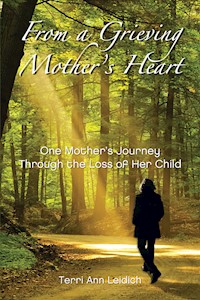
From a Grieving Mother’s Heart
© 2010 Terri Ann Leidich. All rights reserved.
No part of this book may be reproduced in any form or by any means, electronic, mechanical, digital, photocopying or recording, except for the inclusion in a review, without permission in writing from the publisher.
Published in the United States by WriteLife
(An imprint of Boutique of Quality Books Publishing Company)
www.bqbpublishing.com
Printed in the United States of America
ISBN 978-0-9828689-1-1 (p)
ISBN 978-1-937084-01-01 (e)
Library of Congress Number: 2010910819
Cover design by Darlene Swanson • www.van-garde.com
Book design by Robin Krauss • www.lindendesign.biz
To my son Rob, for all the wonderful memories
from the twenty years we spent together.
And for the growth and wisdom
that I gained from your life . . .
and even your death.
Contents
Foreword
Chapter 1 The Agony Begins
Chapter 2 Trying to Move On
Chapter 3 The Healing Begins
Epilogue
About The Author
Foreword
The loss of a child is the most devastating experience a parent can ever have. It affects us emotionally, physically, mentally, and spiritually. It feels as though someone punched their fists into our chest, tore out our heart with their bare hands, and then abandoned us to suffer alone, unsure of whether or not we will live through the ordeal.
My son was twenty years old, in college, still living at home, and a strong, positive part of my daily life. One pleasant June evening, he was visiting friends and decided to hop on a motorcycle to make a McDonald’s run. Rob had driven motorcycles and had his license, but his dad and I wouldn’t agree to let him purchase one. We felt much better when he was in his pickup, surrounded by strong steel.
I guess the beautiful Georgia summer night was too hard to resist. Rob put on a helmet, jumped on a motorcycle and headed to McDonald’s—just a few miles away. That’s the last time anyone saw him alive. A young man pulled out of an apartment complex onto a major street without looking, and my son impacted with the side of the car, breaking most major bones in his body and causing severe brain damage. He was brain dead at the scene, but his body kept functioning until 12:13 a.m. on June 8th, at which time he was pronounced dead.
On June 7th (a date that will never again be just another summer day to me), I began a horrendous journey of grief that lasted for several years. In fact, a parent never gets over the death of a child, yet the pain does ease as we learn to live around it.
Although my son died several years ago, I am often reminded that people still don’t understand the journey of grief, whether they are going through it or are trying to be there for someone else who is. Many books that have been written about grief try to make sense of it or put it into a logical format, but there is no logic to the loss of a child—only gut-wrenching, debilitating pain.
At first, the loss of a child defines us and becomes who we are—a grieving parent. But over time, the experience of this terrible loss settles into being a part of the landscape of our life, instead of the sum total of it.
The journey of losing a child is a lonely one because until we travel its path, we are oblivious to the horrific agony and pain. But once we are in its grip, we feel as though we won’t make it through, and we need something to assure us that we will.
When I lost my son, I wanted to know that others had walked this hellish path before me, not because I wanted someone else to feel the crippling pain, but to be assured that I wouldn’t die from my grief…or to give me something to cling to so I wouldn’t want to die. I wanted to be touched where it hurt—in my heart—not in my mind. I wanted to feel feelings and hear words from another parent so I would know that I wasn’t alone in my agony…that others had survived the experience.
I also needed someone to meet me where I was. From those times when my mind was caught in the realms of death and dying, no longer aware of the possibilities of life, to the times when my thoughts circled so furiously that I felt as though I was losing my mind, I needed to know that others had thought similar things and felt similar feelings so I could be assured that I wasn’t going crazy..
Those who surround us on a daily basis try desperately to help, yet it seems that only by walking through this “fire” can we truly know and understand the searing pain of its heat. For those with friends or family who have lost children, this book will help you understand what they are going through and why expecting them to “move on” is an unrealistic expectation. Yet you will be assured that they will eventually move forward when they have gone through their own cycle of grief.
My first years of grieving can be symbolized by a roller coaster ride with its many unexpected turns, ups, and downs. The force of the ride often cast me from mountaintops of faith into valleys of depression in the time span of a few hours. I was left breathless and confused by this terrifying voyage. But thankfully…as the years went by, the roller coaster slowly changed into a winding country road whose turns brought delightful surprises and where painful thoughts mingled with the bright, sunlit colors of wonderful memories.
My prayers go out to those of you who are traveling on the treacherous journey of grief, and my heart joins with yours in a sisterhood (or brotherhood) that we would not have chosen, but one of which we are members.
This book journals my experience through grief and demonstrates the rocky, tumultuous path that a parent travels after the death of a child. Through the pages of this book, other grieving parents can find companionship, understanding, and confirmation that the debilitating pain does eventually ease.
Chapter 1
The Agony Begins
June 7th (Day 1)
I just saw you five hours ago, Rob. You were tanned and handsome. I touched you, I hugged you, we talked. And now I’m standing in a small room in the hospital, waiting for the doctor to come in to talk with me. The nurses won’t tell me where you are. They won’t tell me what is happening. But I know it’s bad. They wouldn’t have put your Dad and me into this private room if it wasn’t bad.
We were just getting ready for bed when we got the call. Dad answered it, and when he turned to look at me, his face was pale . . . he looked scared. “Rob’s been in an accident,” was all he needed to say. We both headed to the car and to whatever was waiting for us. We were quiet as we drove, I turned to him once and said, “He has to be okay, Chuck. He just has to.”
When we got to the hospital, your friends were waiting outside by the doors to the emergency room. They said you had been in an accident. They were all talking at once, their phrases were choppy and jumbled. All I heard as I rushed by them was “accident . . . motorcycle . . . really bad.”
The doctor comes in. He takes my hand and sits me down. He tells me it’s bad. He tells me that you probably aren’t going to make it. He tells me to pray. It’s about ten-thirty at night and your accident happened at twenty-two minutes after nine.
I tell him I want to see you . . . he tells me they are still trying to save your life. So all I can do is wait.
The waiting room begins to fill as our neighbors, our friends, and your friends rush to be with us. I can barely breathe…I have just enough breath to pray for a miracle.
June 8th (Day 2) – Shortly after midnight
Now this doctor is telling me you’re dead. I see him. I hear him. But I don’t understand his words. He holds my hand, and Dad puts his arm around me. There are tears in their eyes. I am numb.
Dead? What does dead mean? I can’t comprehend it through my blurred mind. I’m watching my body take the necessary steps and make the necessary calls. My lips form the words, and my voice carries across the wires to your grandparents, sister, aunts, and uncles: “Rob is dead. Rob has died.” But what does it mean?
The doctor finally lets us see you—your body. Your face is swollen. And you’re pale. When I saw you for the last time, a few hours ago, you were tan and beautiful. Where did your tan go? Does death wipe out even a tan? I place my hand on your chest. It was always so firm, but now it’s not. All your major bones are broken; you feel soft.




