


Erhalten Sie Zugang zu diesem und mehr als 300000 Büchern ab EUR 5,99 monatlich.
- Herausgeber: The History Press
- Kategorie: Geisteswissenschaft
- Sprache: Englisch
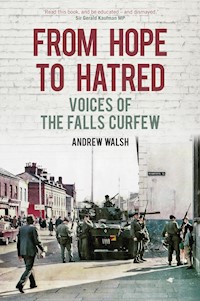
The Falls Curfew of 3-5 July 1970 is considered by many to be the turning point in Catholic-Army relations throughout Northern Ireland and Belfast in particular, and ultimately led to Catholic alienation from the state. The curfew was intended to dispel the violence, it lasted 36 hours during which 4 people were killed, at least 75 were wounded (including 15 soldiers) and 337 people were arrested. Allegations of army brutality towards Catholics and destruction of property have also popularised this belief. However, the seeds of Catholic mistrust were sown decades before. The partition of Ireland in 1922, the subsequent Unionist domination of government and the ignorance of the British government towards the province, ensured that it was only a matter of time that the initial welcome for the army in 1969 faded. This is the story of the Falls Curfew, its causes, and the subsequent polarisation of a community under siege. It is a story many wish could be forgotten, but its legacy still lives on.
Sie lesen das E-Book in den Legimi-Apps auf:
Seitenzahl: 448
Veröffentlichungsjahr: 2013
Das E-Book (TTS) können Sie hören im Abo „Legimi Premium” in Legimi-Apps auf:
Ähnliche



















To my wife, Sarah, and my children, Jordan, Jake, Caitlin, Ellé and Dylan.
Dedicated to the memory of my brother and my mother:
Garry Alan Walsh 1970–2012
Mary Jane Reynolds 1937–1987
CONTENTS
Title Page
Dedication
Foreword by Danny Morrison
Foreword by Ken Wharton
Foreword by Sir Gerald Kaufman MP
Preface
Quotes on the Curfew
Introduction
1 ‘The Irish Question’
2 The Falls Road, Republicanism, Pogroms and the British
3 British Ignorance and the Rise of the ‘Provos’
4 Curfew?
5 Aftermath
6 The ‘Stickies’ Eclipsed
7 Legal or Illegal?
Conclusion
Explanations of Groups, Organisations and Terms
Appendix A: Chronology of Major Events
Appendix B: Contemporary Sources
Notes
Bibliography
Plate Section
Copyright
FOREWORD BY DANNY MORRISON
On 27 June 1970 in Belfast the Orange Order planned to march past Hooker Street on the Crumlin Road, where Catholics’ homes had been burned down, and up Cupar Street past Bombay Street in the west, which had been similarly razed to the ground.
We know from documents and records that both the British and Unionist governments were told by their own advisers that these marches were provocative and would lead to widespread trouble. But we also know that the GOC of the British Army in the North, Sir Ian Freeland, made the following remark to the Joint Security Committee:
It is easier to push them [Orange marchers] through the Ardoyne than to control the Shankill.
As predicted, widespread rioting broke out on 27 June and ended up in gun battles and loss of life in various parts of Belfast. In Ballymacarett a Loyalist attack on St Matthew’s church was repelled by members of the Provisional IRA after the British army refused to intervene. Paddy Kennedy MP approached a British patrol for help and was told, ‘You can stew in your own fat.’ Several men died, including a Catholic defender, Henry McIlhone, and Billy McKee, a senior IRA figure, was wounded.
The Stormont government took no responsibility for what had happened and blamed Republicans. At the next meeting of the Joint Security Committee, on 1 July, it was decided that they had to ‘restore the military image’ and put down trouble ‘with maximum force’.* This explains the Falls Curfew one week later and the raid and seizure of arms which had never been used against the British army but were there solely for the protection of people who had experienced terrifying government pogroms just ten months earlier.
On that Friday night, 3 July, I was in my mid-teens, standing outside the Falls Library, with a group of mates from Beechmount. The soldiers were coming into the area in large numbers and were firing gas at whim and wildly. Overhead a helicopter was announcing what was to prove to be an illegal curfew. We were eventually driven back into Cavendish Street with soldiers making repeated baton charges.
That night we listened to the terrifying sound of gunfire coming from the lower Falls and wondered what the poor people were going through. Rumours abounded. We tried to gauge what was happening by eavesdropping on the radio traffic between the RUC and the British army.
I was later told by one young man that he joined the IRA because of what happened to his friends and neighbours that weekend. He recalled the stinging humiliation he felt when on Saturday morning he looked out from behind his bedroom curtains and saw two Unionist government ministers, John Brook and William Long, standing aloft in an open-back army lorry and driving through the area, inspecting the military operation like overlords.
The Curfew, by alienating and politicising a huge swathe of nationalist opinion, was to dramatically change the context of the political situation. When the British army first came on to the streets in 1969 they were welcomed by the majority of nationalists as their protectors. But over subsequent months this benign image rapidly changed as the Brits became a mere tool of Unionist repression, then, later, the enforcers of British direct rule.
Stormont had also been dragging its heels on introducing reforms. Many nationalists – particularly among the working class – were coming around to the Republican view that they couldn’t get their civil rights until they got their national rights and that that would involve an armed struggle against the government and the system.
It was this mood that the Republican Movement tapped into and it was after the Curfew that the IRA slowly began its military campaign which was to continue for the next three decades.
Danny Morrison, 2013
(Irish Republican writer and activist)
* According to historian Professor Geoffrey Warner there is no such record of the meeting, although this date and meeting also appears in the Sunday Times Insight Team report.
FOREWORD BY KEN WHARTON
When Andrew Walsh asked me to write a piece for his book on the famous or infamous ‘Falls Road Curfew’ – depending, of course on which side of the fence one was on – and said that the views of others with whom I would probably disagree would also be included, I was, understandably, hesitant. However, I was asked to write from the British soldier’s perspective and I am honoured to do so.
Back in the early days of the troubles, we were a naïve army made up of young boys, plus older veterans of the last war and of course the new career soldiers who had seen action in the trouble spots of the dying days of Empire such as Cyprus, Aden, Singapore et al. Many of us had little idea about Northern Ireland, let alone where it was and of the complex dynamics of sectarianism. I had been brought up as a Jehovah’s Witness – not of my own choice, incidentally – and my friends were Catholics as well as Protestants. I had experienced a fair amount of religious intolerance at school but was able to largely laugh it off. When I arrived in Belfast for the first time in the very early part of the decade – the 1970s – I was quite unprepared for the hatred and sectarianism which existed and appeared to be institutionalised. When I patrolled the areas around the Cromacs and on a later tour around the Falls and Divis areas, I saw the results of this sectarianism; incredibly substandard housing, overcrowded ghettos and an ‘army’ of unemployed men and teenagers. However, somewhere along the line, we had gone from being ‘liberators’ to ‘oppressors’ and were no longer welcomed in those areas.
Initially, the Loyalist Protestants had seen us as a ‘buffer’ between themselves and the Nationalist Catholics and when we tried to be even-handed, they, the Loyalists, turned against us. At about the same time, the Catholics saw us as an army of conquest and as siding with their sectarian enemies. The newly formed Provisional IRA was quick to exploit this and together with some over-zealous reactions from soldiers, successfully painted us as thugs and assassins and any chance of a good relationship in those areas were lost; probably for ever.
There is an old adage in Yorkshire – give a dog a bad name – and there were, regretfully, individual soldiers and individual units who were of the mindset that if the IRA were going to brand us as thugs, then why not behave like thugs? On the whole, the British Army behaved with professionalism and fairness and although there were examples of overreaction and unnecessary violence, we generally behaved well under extremely difficult and trying circumstances. As an army, we took many years and lost many lives in trying to understand the sectarian mentality and the mindset of both sections of the religious divide. As an author, I have been a major critic of the Provisional IRA and the various violent off-shoots of Republicanism – INLA, IPLO etc – but do not reserve my opprobrium for them; I condemn in equal measure the Loyalist paramilitaries of the UVF/UFF and Red Hand Commando.
In one of my books, I described the troubles of 1969–98 as merely the latest chapter of 500 years of sectarian violence in Ireland. As soldiers, we became simply a part of that on-going and senseless civil war and as such became very firmly ‘piggy in the middle.’
Since the ‘official’ end of the troubles, I have been back twice to Northern Ireland and walked the same streets on which I had patrolled all those years ago. I have to confess a certain nervousness when I returned to the Ardoyne and New Lodge in North Belfast and the Ballymurphy and Turf Lodge estates of West Belfast. I did, however, feel equally exposed when I went in certain pubs and clubs in the Loyalist heartland of the Shankill and the fear and the menace is still evident in certain areas. I visited several areas where the Loyalist paramilitaries had murdered Catholics and walked the killing grounds of the Shankill Butchers, including the site of the former Lawnbrook Social Club. I actually felt a shiver run the length of my spine as I looked at the new housing which has been built on the site of the psychopathic Lenny Murphy’s ‘romper’ rooms and I silently mourned the loss of innocent Catholic men unfortunate enough to be abducted, tortured and then murdered by his gang of ‘Butchers’. The following day, I travelled with comrades to Kingsmill, Co Armagh and stood on a lonely, rainswept road where in early 1976 the Provisional IRA murdered ten innocent Protestant workers in apparent retaliation for the earlier sectarian slaying of Catholic men at Whitecross. It was a cold day and there were few cars as we stood on the spot where terrorists poured a deadly hail of automatic fire into men as they lined up alongside their works minibus. The same shiver ran down my back and I felt sick as I stood in that sad place.
This then is what the troubles meant to me as both a soldier and also as a civilian; it is my earnest hope and prayer that the new generation of men of evil can be stopped and that Northern Ireland can one day be at peace, that people on both sides of the sectarian divide can meet without bloodshed or hatred.
Ken Wharton, 2013
(Former British soldier and writer)
FOREWORD BY SIR GERALD KAUFMAN MP
It is more than forty-two years since the notorious – even infamous – Falls Road curfew, but it still resonates in the history of both Northern Ireland and the United Kingdom. Although, following initiatives started by John Major and completed by Tony Blair, Ulster (despite occasional flurries) is no longer a running sore in the body politic, the history of the curfew, re-created by Andrew Walsh with meticulous research and vivid prose, is essential reading if we are to understand what Northern Ireland was like then, and how far it has come since. As Andrew Walsh documents, I, as a relatively newly elected Member of Parliament, was deeply concerned about this episode, both because of my deep interest in Northern Ireland and because of my deep concern about the civil liberties that were flouted and trampled upon: a ‘curfew’ that was never legally declared but enforced with blatant brutality; thousands of residents repressed, and four shot dead; a claim that the ‘curfew’ was imposed for ‘protecting lives and property’ when in fact property was invaded and the relevant Member of Parliament kept out of his own constituency. There had been different, and mutually contradictory, explanations from different ministers. I was naïve enough to believe that, by raising a debate on this matter in the House of Commons, I might get explanations and perhaps even an apology. Instead, an allegedly liberal government minister replied curtly, blusteringly, and attempting to justify the inexcusable. By refusing to acknowledge what had taken place, the Westminster government connived in it. Read this book, and be educated – and dismayed.
Sir Gerald Kaufman MP, 2012
(British Labour Party politician and government minister during the 1970s)
PREFACE
I
The conflict that plagued Northern Ireland for nearly thirty years was a complex mix of religious intolerance, social deprivation, class division and inherent mistrust. Even today, at the time of writing fifteen years since the Good Friday Agreement, society in Northern Ireland is still heavily haunted by its recent past. Walls still divide communities, snaking along interfaces that have been the scenes of inter-communal violence for generations. Memorials of the fallen in the conflict still dot the landscapes of the Falls and Shankill Roads, as do national flags and other emblems of territorial aspirations. Tourists flock to these sites, some remembering the conflict, others too young to remember but perhaps trying to understand. Belfast is a city steeped in a tragic history, a living history, which the population is still living in today.
Every now and then these old animosities boil to the surface, and create conditions that are reminiscent of the days of old. On Monday 3 December 2012 Belfast City Council voted to fly the union flag at its city hall only on designated days. Previous to this the union flag was flown 365 days a year. The decision was seen as a compromise; nationalists wanted it taken down for good. Nevertheless, many Loyalists have seen this decision as another erosion of their culture. At the time of writing (January 2013) protests are still being held, with marches and rallies right across Northern Ireland. Frequently these have degenerated into riots of the sort not seen in Northern Ireland for decades. It is only by sheer luck that so far no one has been killed and one can only hope that the situation will see a peaceful resolution.
Belfast (Beal Feirste, ‘mouth of the sandy ford’), the capital of Northern Ireland, is a vibrant, youthful-looking city on the banks of the river Lagan. It only gained city status at the end of the nineteenth century. It has a varied and very successful industrial heritage; the Titanic was built in its impressive docks, and it had a successful and profitable linen industry. The population of the city grew rapidly in the late nineteenth century, when many rural families moved into the city and its environs looking for employment. Many famous authors, musicians, footballers and politicians call Belfast home. Today Belfast is home to a wide, diverse group of nationalities; it has its own ‘Gaeltacht Quarter’, promoting Irish speech, verse and writing, and has world famous institutions such as Queens University and the Linen Hall Library, a goldmine of historical documents. However, Belfast has also had a troubled and violent past.
A soldier of the 2nd Parachute Regiment describes the Belfast of his youth in Max Arthur’s Northern Ireland Soldiers Talking:
When I was a kid, Belfast was divided up into ghettos. Belfast was actually a lot of little Belfasts. They all had their own names, like Shankill or Tiger Bay. My personal one was Sailortown, which consisted of about eight streets divided by one street, Nelson Street. All the streets running off one side were Catholic and all the streets running off the other were Protestant, and you’d have found that people would’ve gone down Nelson Street on their side to walk round the district on the other. They kept on the outskirts, they’d never walk through. I’m sure there were Protestants born on the Protestant side of Nelson Street who had never been to our town. We used to go to dances and pubs and the pictures, and we used to meet people, and they could tell where you came from. Those little communities were so tight-knit they could tell where you came from just by your accent, in the same city. It was fear that dominated, fear: keep together.1
This fear was innate; it’s what young children were taught by their parents. Keep together, don’t mix with the other side, and stay away. Mistrust and suspicion were rife in 1960s Belfast. Some of his memories of the activities of the ‘B’ Specials could however have been tainted with subsequent events and popular opinions of them.
Of course when they started the civil rights movement it brought it all home to Catholics. Actually, I was quite happy. I mean, I didn’t know I was an underdog. People were telling me I was an underdog but I didn’t realise it, ‘cos I was a merchant seaman, the same as everybody else. The employment situation wasn’t all that good but there was always jobs somewhere if you wanted them. But the civil rights thing, Catholic people were watching telly and asking ‘what are these civil rights?’ You see, before 1968 a lot of things were not reported, like the B Specials. Why they had B Specials in the towns I could never understand. B Specials used to carry Sten guns and .38 Webleys, big old fashioned pistols, and it wasn’t unknown for them just to take out their pistols and shoot at people. I remember one time when I was twelve I was at a big dance hall above Bellevue Zoo. Something had happened.
I think there’d been a fight, and for some reason the B Specials did a raid and locked everybody in. When they were letting us out they asked me: ‘What religion are you?’ If you were a Protestant you would get a smack on the lug and sent home, but if you were a Catholic you’d get a ride in a Black Maria. You know, those were the type of things that happened then.2
Not only Belfast, but Ireland as a whole has had a turbulent history, one which does not just go back to the late 1960s. The ‘Battle of the Boyne’ in 1690, almost forgotten in the mindset of Britain and to a lesser degree the Republic of Ireland, is first and foremost in the psyche of the Ulster Protestant, while the ‘Easter Rising’ of 1916, again an event that does not trigger much emotion amongst Britons, is also of paramount importance to northern Catholics. Even though the British military presence is no longer visible on the streets of Belfast, there is still an air of trepidation in the centre of the city. An ambulance siren wails; part of normal life in any other major city. However, here people stop and look, anxiety quickly showing in their faces. The people of Belfast still show fear and worry about what has passed, and what might yet come again.
The study of the present Troubles is an ongoing process and is often hampered by how recent many of the major events were. The 1970s were the worst period of the Troubles, a mere forty years ago. Many people are still alive who were involved in the early days of the conflict, and for understandable reasons many of them are unwilling to comment on events that in historical terms were only a short time ago. Lack of documentation from government sources, while another understandable aspect of the situation, considering the importance of ongoing investigations by the Historical Enquiries Team (HET), can also be a frustrating issue in researching the conflict. Many historians have written excellent accounts of the conflict in Northern Ireland within these restrictions, from its roots in a divided and sectarian society through its long-drawn-out agony to the various attempts at closure. Others, however, have incorporated the history of Northern Ireland into an all-Ireland analysis using the country’s long-standing and often fractious relationship with Britain as a guide. This has sometimes had the effect of ‘diluting’ the impact that the conflict has had on the people of Northern Ireland.
Moreover, there are many areas of the conflict which lack in-depth study, and are only ‘glossed over’ in histories of both the Troubles in particular and Irish history in general. For the people involved this can lead to a feeling of alienation from the history of the conflict. It can also play down the importance that these events had. There were many crucial events, insignificant or small at the time they occurred, that had a dramatic effect on the future course of the conflict. The Falls Curfew is one such event.
The Curfew had far-reaching consequences for the Catholic community of the lower Falls. Although there are no official statistics as to how many soldiers were involved in the operation, indeed even the army are not sure, it is argued by many historians that as many as 3,000 troops were on the ground against a handful of IRA men.
This book uses many resources in its attempt to portray the Falls Curfew as it happened, with witness statements from all sides. Archival records have been used, along with academic books, biographies and historical articles. The Central Citizens Defence Committee, organised in August 1969, took meticulous notes from people who were affected by the Curfew four weeks after the event. A small publication was released under the title of The Belfast Curfew. The author is allegedly Sean Óg Ó Fearghail, although many believe it to be Mícheál Ó Dathlaoich (Michael Dolley), a lecturer from Queens University.3 Although a very one-sided account, as would be expected, this gives important information from the period on how the people of the lower Falls reacted to the wide-scale house searches at the time and the presence of so many British troops on their streets. It is heavily used in this book for that reason, and the events mentioned have been interspersed with other accounts and witness statements to get as near to the reality what happened as possible. It is also not tainted with the passing of time, as many eyewitness accounts can be. However, as always, it is up to the historian and reader to analyse and interpret the information available.
The present book also contains in-depth chapters concerning the events before, during and after the Curfew. There is one fundamental reason for this. The story of Catholic alienation in the north of Ireland, and Ireland as a whole, goes back centuries, but it was only after partition and the inclusion of half a million Catholics in the new state that this alienation began to become a burning political and social issue. Acts of discrimination, while intended to keep Catholics from power and therefore further away from a united Ireland, only served to hasten the destruction of the Stormont government. Chapters included after the Curfew are for continuity of the story, as Catholic discrimination certainly did not end at its conclusion.
Any arguments in this book are not directed against the ordinary soldiers on the ground during the Curfew. They are not directed at any individual either. The book is the story of the Curfew and its effects on the people involved, and also the story of its dubious legality. It is a story that has not had the full attention it deserves. It was a crucial aspect of the Troubles but tends only to be mentioned in passing, save for an in-depth assessment by Geoffrey Warner and a perhaps less in-depth look by Ita Connolly and Colm Campbell. That is not to say that Connolly and Campbell’s work is not crucial, for it is the only work to date that has actively analysed the legal aspects of the decisions made by the General Officer Commanding (GOC) that weekend.
The Curfew was called by a GOC who had seen his army come under severe criticism for not getting tough. Unionists in the Northern Ireland government were partly to blame for this; the severe pressure they placed on the army command for tougher measures certainly played a part. The army hierarchy has to shoulder some of the blame as well, for it was they who placed troops in the area. Moreover, and perhaps more importantly, it resulted in the further alienation of Catholics in Northern Ireland, who had already for decades been subjected to severe discrimination in a state that they did not want to be in, and which did not want them.
II
While I was in Belfast researching this book, I was asked by Liam McAnoy, ‘Why now?’ I had no clear answer for him. Instead, I talked about how I believed that there was a story to be told, how I believed that the Curfew was a defining moment in the Troubles, and how it gave rise to the Provisional IRA and further alienated Catholics in the state of Northern Ireland. The old run-of-the-mill stuff you get from years of reading other authors’ versions of events: it was the only answer I could give him, and I felt slightly embarrassed. He had probably heard it all before. After all, it was forty years ago and he has talked to many historians over that time. However, it was only when I came away from spending the day with him that I began to think about what he had said to me in that café on the Falls Road.
Liam McAnoy was there. He was present in August 1969 when Protestant mobs, backed by the sectarian ‘B’ Specials and members of the Royal Ulster Constabulary, invaded the district that he had lived in all his life. He saw them throw petrol bombs into Catholic homes, saw them set fire to Catholic businesses and schools on the Falls Road. He remembered Patrick Rooney, a 9-year-old boy, being killed in his bed, as did everyone else who was present. He became involved, was shot in the leg in Divis Street in the worst of the fighting in that fateful month of August 1969 and was arrested in Leeson Street on the Saturday of the Curfew. He subsequently went to prison in 1972. Listening to him, I was transfixed by his matter-of-fact telling of his story. It made me think about what I was writing and, more importantly, why.
Liam introduced me to many people that day. Women who were on the ‘Bread March’ down from Ballymurphy and Andersonstown to the lower Falls, women who were present inside the area subjected to curfew by the army, and ex-prisoners whom he now helped, reminiscing with them about their shared youths in a divided and dangerous society. I spent a pleasant couple of hours in that room with some very honest and proud people. I watched a film of the lower Falls in the 1960s and was offered soup and tea; I was even asked at one point if I worked for the British!
I met members of Patrick Elliman’s family in their home. His death is one of the cases currently under review by the Historical Enquiries Team (HET). They talked about the Curfew as if it had occurred yesterday. They remembered the sounds of the army Saracens coming down the street, the fears that any child witnessing these events would have. I met Eamonn, nephew by marriage of Patrick, one of the nicest people I have ever met in my life; a man whom I would have loved to spend more time with, for he had a story to tell. Rita, whose hospitality was second to none, still carried a burden in her mind about her uncle Patrick and her dad James, who was devastated at his brother’s death.
They all remembered the noise of nail bombs going off, the screech of bullets and the smell of burning vehicles. They remembered the anguish of their parents in trying to protect their families and homes from the battles raging around them. They remembered the closeness and the bonds that linked them all together in the lower Falls, before the developers moved in to rid the area of its slum dwellings. They remember Patrick Elliman, his shooting and subsequent death. They still ask why. The past is still with them, in their houses and refurbished streets, now one way, with old entrances and exits blocked to forestall escape routes. Above all, though, I remember the hospitality and warmth that this family showed me that day in the lower Falls.
I met many people on the Falls Road, some who were involved with the paramilitaries, others who were not. They all had time to speak to me. Many were still passionate about the events that scarred their childhood. Many also believed that the Troubles were far from over, and that it would take generations before the events would be consigned to a distant memory, and have no relevance for children growing up in peace. I met Robert ‘Dinker’ McClenaghan, now a Sinn Féin representative but in his youth an active member of the Provisional IRA, because of which he served time in prison. He remembered the Curfew as a child, agog at the number of soldiers on the streets that he played in. He remembered idolising soldiers before the Curfew; he remembered hating them afterwards, as was the case with many members of the Provisionals. I remember the walk he took me on, down into the lower Falls in the rain, telling me about the streets, the families that lived there and his own personal experiences. He is a very articulate and intelligent man to whom I am indebted more than he realises.
I met two rather humorous men in the Irish Republican History Museum in Conway Mill, just off the Falls Road. When I mentioned what I was researching they pointed me to a large folder with substantial amounts of information. Before I could digest this, though, I was taken out to a back room to watch a film on the history of the Troubles – the old and the new versions, 1919 and 1969, both unashamedly Republican in the telling. It was a place full of information and full of memories of the past.
Many others helped who do not wish to be named. Even forty years after the period under study, many are still fearful; as one remarked, ‘The past has an awful habit of coming back and biting you on the arse!’ Many of them share the same memories of chaos, fires, shootings and soldiers; memories of living in the ‘no go’ areas of the early 1970s, where paramilitaries, not the security forces, were the law. They are clever and remarkable people who lived through some very rough and harrowing times.
I then interviewed ‘Dave’, a soldier of the early days of the Troubles when everyone was unsure what was going to happen next – or what to do next, for that matter. He recalled some bad memories, and some good memories. But most of all he was extremely troubled about the poverty and deprivation that he had witnessed in Belfast upon his arrival in 1969. Even though he came from a ‘slum’ area in the north of England, nothing equated to what he had seen, as far as he was concerned, on the streets of a city in the United Kingdom. He spoke to me about death, destruction and fear that he had encountered at such a young age:
What street lights there were had been either shot out, or didn’t work anyway, and our Pigs headlights were being targeted regularly. We were on duty for several days … I remember sleeping in a bus shelter somewhere, and in a burnt-out bus near to Leppar Street. I was just 20 years of age at the time. The whole of that first tour changed my life. I [subsequently] watched whole rows of terraced streets burn in The Ardoyne, picked up bits of body around The Markets, was present when Gunner Laurie and Gunner Curtis were shot. I saw rivers of human blood literally flow down Belfast streets, and saw mutilated children lying in the road. Never to be forgotten.
His memories, his life, amongst soldiers, civilians and volunteers on all sides, scarred. The formative years of the Troubles, 1968–72, destroyed many lives. I spoke to many soldiers who were there; some who were keen to tell their story, and others who were not. That is understandable. The past is the past, and some want to leave it there.
Over forty years after the event, the Falls Curfew is still as fresh in these people’s minds as it was then. They have witnessed many things within that forty-year period, cumulating in a certain kind of peace in Belfast, albeit still with the notorious peace walls, symbols of a society divided both physically and mentally. What many of them have not witnessed, however, is the truth. The Curfew was illegal in all eyes bar a few. Many facts of the events of that weekend were manipulated, denied or forgotten about as the years passed. It became another milestone, one of many in Northern Ireland. Four people were killed, but nobody knows why, and nobody in the establishment was held responsible. Soldiers shoot at targets, they are trained to react to particular incidents in certain ways, to react in conflict situations but, more importantly, all within the rule of law. Are they to be individually blamed? Catholic alienation after the Curfew was almost absolute. For many people, it seems that the Curfew was brushed under the carpet as other major, and more horrific, events began to take precedence. Many others believe that it was the first case of the army’s subsequent alleged policy of ‘Shoot to Kill’; it happened in Ballymurphy, they say, it happened in the New Lodge, it happened in Derry. Was it the first case? Did the army shoot to kill?
Something that I find amazing, and still think about a lot, is the key to their identity. They all belong to the Catholic Church. Although many do not practise their faith any more, that is where their sense of belonging lies. Catholics have had a raw deal in Ireland throughout the centuries; none more so than Northern Irish Catholics. This nurtured a sense of inferiority within the Catholic psyche that is still present today, albeit on a much reduced scale. After they were set adrift in 1922, the northern Catholics’ feelings of inferiority were only added to by successive Protestant-dominated governments, which treated them like it was the seventeenth century. It took widespread education reforms in the 1940s and 1950s to breed a new generation of articulate and vocal Catholics who began to argue against this status quo, and with that challenge came a violent offspring that set out to confront the whole make-up of the British economic, political and military structure in Ireland.
The more I researched this book, the more I came to understand that the Catholics in the north of Ireland are bonded together by their history, their religion and their identity. It is because of this that they are remarkably different from their southern counterparts, who did not have to live in a state that did not want them. That is where their collective identity is strongest. Unionism attempted to take that identity away from them for fifty years. It failed in spectacular fashion in the summer of 1969. The British army was called in. The Falls Curfew is one episode in this, and there are many more. But that is why I am writing this book now.
This book is not intended to be an academic study of the events; rather, it is an attempt to tell the story of the Curfew with the people who were involved in mind. It is them, both soldiers and citizens, who suffered in differing ways and who have their own versions of the events. In-depth archival sources, while valuable, cannot tell the whole story. The book itself is part of a wider picture of Catholic alienation from the state of Northern Ireland. While the passage of time may have influenced the memories of many of the witness statements, eyewitness accounts from as little as four weeks after the event offer the researcher a rare glimpse of the Curfew and its alleged brutalities. I have also made a conscious decision in choosing not to delve into the original inquests of the four deaths of the Curfew. Inquests were held at the time and deaths of misadventure were recorded. However these cases, and many more, are with the Historical Enquiries Team, set up to investigate murders attributable to the Troubles. At the time of writing the cases are still under consideration and any conclusions they reach are likely to be the final ones.
The overriding theme throughout the book is one of Catholic alienation, which became apparent after the Curfew. It is not being written to pass judgement on how the four deaths occurred; rather, the question is why they died.
It is also worth mentioning at this stage that the events talked about in the book are not a straightforward matter of one side against the other. There were, and still are, many Catholics who supported the link to the United Kingdom, and many Protestants who see a united Ireland as preferable to the Unionist-controlled government. Many soldiers also disagreed with some of the repressive measures taken against the Catholics. The Troubles in Northern Ireland were played out in three or more strands: Protestant v. Catholic, British army v. Catholic/IRA; and IRA/INLA and other paramilitary groups v. UVF/UFF/UDA and others. Therefore, the story is much more complex than a simple matter of ‘black and white’.
The end of this book contains various articles, quotes and comments about the discrimination that was occurring in the state up to the beginning of the Troubles. Again, they are not put there to victimise individuals. They are there to give the reader an insight into Northern Ireland before the world’s attention had been drawn to its blatant illness. They also give an insight into how Catholics felt in the state, and how alienation from the state was perhaps the best, or only, option for many.
Throughout the book, people make reference to the various groupings in Northern Ireland using a range of terms. For example, the Provisional IRA are often called ‘Provos’, Protestants are invariably called ‘Prods’ or ‘Orangies’, the British army are more often than not called ‘Brits’, Catholics are ‘Taigs’ and ‘Fenians’ and so on. Northern Ireland is also called by different names, depending on where you are situated. In the Republic it is rarely called Northern Ireland. It is generally called ‘the North’, or ‘down the North’. Others call it the ‘Six Counties’; indeed, members of Sinn Féin nearly always refer to Northern Ireland as the Six Counties, and to the south as the ‘26 Counties’. Unionists mainly refer to ‘Ulster’ in regard to Northern Ireland.
III
I initially did not want to go down the old route of sitting down and writing out an acknowledgements list of all the people who had helped me in the research of this book, as I felt that it would be a bit pretentious of me; besides, the people who have helped me know who they are, I thought. Then an event happened to me in May 2012 that blew all that out of the water. That event was the untimely death of my brother at the age of 41.
I was aware that something was wrong; he withdrew into himself for months. Every time we spoke, he would say he was fine. He clearly was not. Nevertheless it was a shock; he was my younger brother and I naively thought he would be around for me for a long time yet. I expected to go before him, as people do who are older. This had a major effect on me, and still does. Thus, his death convinced me that I should thank all those people who willingly or unwillingly had helped me in the compilation of this book. Life is too short.
I am deeply grateful to: Danny Morrison for giving me the initial contacts with people in Belfast (from little acorns do great oak trees grow!); Robert McClenaghan, a fantastic bloke who could not do enough for me even with his busy workload; Pat in the Sinn Féin shop on the Falls Road for the interview and Lorna in the Sinn Féin office; Rita, Eamonn and their family in the lower Falls for a lovely morning of interviews and Belfast Baps, cups of tea and loads of cake – an extremely warm welcome for a stranger; Liam McAnoy for being my ‘driver’ for the day in Belfast and for showing me around the lower Falls, Lenadoon and Turf Lodge and for sharing his memories of 1970; the women of the lower Falls he introduced me to that day, along with the ex-prisoners and personal friends of his; the staff at the Linen Hall Library for their help; the taxi driver, of whom I know nothing except that he was a treasure trove of information – I clearly remember him saying to me, rather disappointingly, ‘Don’t think we are all up here singing and dancing!’; the staff at the National Archives in Kew; ‘Dave’ the soldier, who was a massive help after he had checked me out, and author Ken Wharton, who introduced me to him and kindly offered to put forward the British soldier’s perspective at the beginning of this book; Professor Richard English for his constructive comments on my many questions to him; the Andersonstown News in Belfast for putting so many interviews my way; Jay Slater for having the belief; the Police Service of Northern Ireland and the army in Lisburn for giving me some details. To all the people who did not want to be identified even after so long, I am extremely grateful for your time, patience and honesty. The last words, however, have to go to my family for their support and love through many difficult periods in my life.
QUOTES ON THE CURFEW
Below is a selection of quotes from various publications and witnesses to the events. The views expressed are solely their opinions, and are used here for the purpose of context.
Anon: ‘The bubble car I owned had 2 full Jerry cans of petrol as petrol was scarce. So when the Curfew was broken and all the food was brought in by the women it was used to cater for distribution to the houses as taxis and all the cars had no petrol. It was used for that so my wee bubble car came in handy. There was a post man taking pictures I think he was Polish (SHOT DEAD BY BRITISH ARMY) hope this helps.’4
Caroline Kennedy-Pipe, author: ‘The imposition of the lower Falls Curfew had precisely the effect of allowing the Provisionals to claim that the historic British enemy was once again flexing its muscles on Irish soil.’5
Colm Campbell and Ita Connelly: ‘The curfew was therefore probably unlawful, at least beyond its first few hours. But this was not the view taken by the Army, nor by the relevant magistrate: the only point that is absolutely clear is that there is no clarity. The legal basis for military intervention was therefore lacking in precision in respect of when the military could deploy (including the question of whose consent was needed), and what it could do after deployment.’6
Corporal, Kings Own Scottish Borderers: ‘After the curfew it was mainly a lot of searches being done. I think the politics – looking back and understanding what I understand now – I think what the commanders were probably told was not to antagonise the situation, to try and keep the calm and have as much low profile as possible, to go in but not stir things up unnecessarily. Because the place was like a tinderbox.’7
Daniel M. Wilson: ‘General Freeland’s authority to declare such a curfew was dubious, and for that reason no one arrested for breaking the curfew was prosecuted. Ironically, General Freeland had argued against curfews on the 18th August 1969, saying, “What do you do if people disobey it? Shoot them?”’8
Desmond Hamill, author: ‘Permission for a curfew, he [the GOC] explained, would have taken too long, which was not an underestimation, as it would certainly have been illegal.’9
Dr Gordon Gillespie: ‘In the event the proclamation of a curfew was almost certainly illegal because it did not have the backing of the NI Minister of Home Affairs, who was the only person with the power to make such a declaration.’10
Gerald Kaufman, Labour MP for Manchester Ardwick: ‘The noble Lord said that there was no curfew, and of course he was right. There could not have been a curfew because a curfew could have been imposed only in two circumstances: either if a state of emergency had been declared – and none had – or if the Riot Act had been read by a magistrate and nobody says the Riot Act had been read. General Freeland said there was a curfew. What is more, not only did he say it and his agents go about saying it, but it was written down. I have a copy, and I sent a copy to the Secretary of State for Defence. The Minister who is to reply to the debate told me in a letter in November that the term “curfew” was used by the Army authorities to describe the restrictions, because it is one which is widely understood. But it was far from being widely understood.’11
Gerry Adams, President of Sinn Féin: ‘The Curfew was completely illegal, yet no one in the British army was ever charged with any offence in relation to it, and no attempt was ever made to bring any of the murderers of any of the people killed to trial.’12
Helena Lanigan, resident: ‘The people of the lower Falls went through a hard time and I often wonder how we did it, but we never lost our sense of humour! Or maybe that’s an Irish thing.’13
Joseph Bishop: ‘There have been a few minor instances in which the military have relied on the common law. Thus, when the General Officer Commanding in Northern Ireland, acting without specific statutory authority, imposed a 35-hour curfew in the Falls Road area of Belfast on July 3, 1970, a magistrate, in an unreported decision, upheld his action as a proper exercise of the common law power to take such steps as were necessary to preserve the peace in an emergency.’14
Lieutenant-Colonel Michael Dewar: ‘The Official IRA seized the moment to take on the army. Not surprisingly General Freeland was not prepared to let the IRA get away with it. He decided a show of force was needed and that the Falls had to be brought back under control. At 8:20pm on 3rd July the army went in. The IRA opened fire on the Black Watch and Life Guards, the latter unit having just got off the ferry from Liverpool. The army returned fire and used CS gas and, in order to avoid bloodshed, imposed a curfew at 10:00pm which was not lifted until 9:am on 5th July. While the curfew was in force the army conducted a major arms search which netted 28 rifles, two carbines, 52 pistols or revolvers, 24 shotguns, 100 incendiary devices, 28lb of gelignite and 20,750 rounds of ammunition.’15
Lieutenant-Colonel Jack Daw: ‘There was a very marked change in attitude. We were quite aggressive as we were under orders to search every house, alleyway and drain in the area and we found a lot of weapons…But it was clear that the Catholics didn’t want us there anymore. There were no more cups of tea, we were the enemy’16
Lord Balniel, Conservative MP for Hertford: ‘No formal Curfew was called.’17
Martin Dillon, Author: ‘Within GEN 42, a secret Cabinet meeting in 10 Downing Street, Prime Minister Edward Heath and his Home Secretary Reginald Maudling applauded the troops for what Republicans call “The Rape of the Falls” and for what others call “The Lower Falls Curfew”.’18
Mr. Pounder MP: ‘Is my hon. Friend aware that the prompt and courageous action of the Army in the Falls Road area last Friday night did much to defuse a potentially dangerous situation in other parts of Belfast, that there have been grave anxieties for a long time about substantial arms caches in the Falls Road area and that the Army was fully justified in its courageous action?’19
Ian Gilmour, Under Secretary for Defence: ‘The hon. Gentleman made a great deal of the death of Mr Patrick Elliman, and quite rightly, because it is very sad. However, the post mortem showed that Mr Elliman was not killed by an Army bullet.’20
Nick Van De Bijl, author ofOperation Banner: ‘Was the incident entirely the fault of the army? Special Branch still had overall responsibility for the collection of intelligence, and was unbalanced against the Catholic community, and therefore the IRA. The army, although answerable to Westminster, was in support of Stormont, and carried out this and several other operations often against its better judgement … The Army had been under significant pressure to “sort out” the Lower Falls. “Sorting out” was taken to mean imposing law and order and enabling the RUC to patrol without assistance. The Army had relatively few options open to it other than house searches. Tactically the Balkan Street Search was a limited success. However, it was a significant reverse at the operational level. It handed a significant information operations opportunity to the IRA, and this was exploited to the full. The Government and Army media response was unsophisticated and unconvincing. The search also convinced most moderate Catholics that the Army was pro-loyalist. The majority of the Catholic population became effectively nationalist, if they were not already. The IRA gained significant support. It was ironic that, with Army assistance, there had been more police patrolling of the Falls in the period before the Search than there had been for many years. It was [also] notable that Stormont ministers had called for an end to the No Go areas but did not visit to ascertain the real situation.’21
Paddy Devlin MP: ‘Hundreds of people, including journalists, were arrested and brought to court, but the charges were later dropped when it was declared in court that the curfew was indeed illegally imposed.’22
Peter Taylor, writer and journalist: ‘The divorce between the army and the section of the nationalist community was complete.’23
Press release: ‘The Director of Operations, Lt Gen Sir Ian Freeland, has declared that there to be an immediate Curfew until further notice in the area of the lower Falls … ’24
Richard English, Author: ‘The Falls Curfew … was arguably decisive in terms of worsening relations between the British Army and the Catholic working class.’25
Robert McClenaghan: ‘I was only 12 but it had a massive impact on my life. In fact it turned a whole generation of British Army loving children into the most ruthless guerrilla fighters the world has ever seen!!’26
Tony Geraghty, Journalist and Author: ‘Military PR added an additional twist to this macabre event. It presented triumphantly, riding high on the leading vehicle, two Unionist ministers from the hardline Stormont government … Local people had viewed the army’s offensive as an invasion. The presence of Long and Brooke confirmed that they were now victims of alien occupation, not friendly protection. At Springfield Road police barracks, as press cameras clicked and whirred over captured IRA arms, Captain Brooke squeezed the arm of a young RUC constable. I stood close as Brooke murmured: “It’s a grand day for us.”’27
INTRODUCTION
As with many other aspects of its initial involvement in Northern Ireland in August 1969, the British government was at a loss as to what the best approach was to halt the spiral into civil war. The ‘Irish Bog’ had come back to haunt Westminster nearly fifty years after they thought Irish politics was off the agenda. Scant attention paid to the province since 1922 meant that Westminster had to start at the beginning in understanding the issues that existed there, with the result that the government believed a peacekeeping force, put in place to enable the Unionists in power to bring through reforms, was sufficient to stabilise the situation.
As the past four decades have shown, this was not a viable option for a society that by now had deep imbedded hatreds for each other, fostered by years of misrule by the majority and complete aloofness from London. By the end of the 1960s the Westminster government had lost all credibility with the ordinary Catholics of Belfast. By the time the violence became serious enough to warrant some sort of input from the government in London it was too late. The damage was done. The British government believed that putting pressure on Stormont to speed up reforms could halt the spread of the disorder, but that was not enough. The incredible ignorance of the Westminster government to conditions and events in a province of the United Kingdom – a province to which, as Peter Taylor states, questions regarding its social and economic life were assigned on average only two hours a year in parliament – reflected the ineptitude of successive British governments towards an integral part of its territory, and was to haunt relations between the two islands for decades.




