


17,99 €
Mehr erfahren.
- Herausgeber: John Wiley & Sons
- Kategorie: Fachliteratur
- Sprache: Englisch
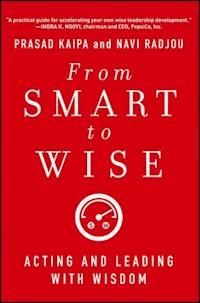
A fresh and timely approach to nurturing wise, resilient, and flexible leadership in a world of growing complexity Leaders tend to obstinately stick to the leadership style that brought them most success in the past, usually one of two extreme styles: functional leadership that focuses on operational excellence or smart leadership that focuses on growth. When a leader's focus is too functional, the organization becomes introverted and can focus too much on bottom-line profitability while missing out on top-line growth opportunities. But when leaders focus too much on smart leadership, the organization may experience quick growth but lose its effectiveness quickly. From Smart to Wise offers a new approach that balances the two styles to achieve a form of wise leadership that is both functional and smart. Drawing on inspiring real-life stories of historical and contemporary wise leaders such as Bill Gates, Warren Buffet, and even Mahatma Gandhi, the authors identify six characteristics of wise leaders and offer a practical framework to help readers develop their own style of wise leadership. * A timely and innovative approach to leadership * Written by noted speakers who conduct dozens of keynote speeches and workshops, training thousands of people annually
Sie lesen das E-Book in den Legimi-Apps auf:
Seitenzahl: 385
Veröffentlichungsjahr: 2013
Ähnliche



















Table of Contents
More Praise for From Smart to Wise
Title page
Copyright page
Dedication
Preface
CHAPTER ONE: Wise Leaders Wanted
The Pitfalls of Smart Leadership
The Functional Smart Leader and the Business Smart Leader
Evolving from Smart to Wise
What Is Wisdom?
The Six Leadership Capabilities
Becoming a Wise Leader
The Path to Wise Leadership
CHAPTER TWO: Shift Your Perspective: Connect to Your Noble Purpose
What Is “Perspective”?
The Limits of a Smart Perspective
The Wise Leader’s Perspective
Shifting Your Perspective
Noble Purpose: It’s Your Personal North Star
A Mindful Mind-set
Openness Through Reframing
Conclusion
CHAPTER THREE: Be Aware of Your Action Orientation: Act Authentically and Appropriately
Authenticity and Appropriate Action
Authentic and Appropriate Action in the Age of Complexity
The Limits of a Smart Action Orientation
How Wise Leaders Act
Bridging the Integrity Gap
Conclusion
CHAPTER FOUR: Gain Role Clarity: Lead from Any Position
The Limits of Smart Leadership Roles
How Wise Leaders Demonstrate Role Clarity
Role Clarity and Becoming a Wise Leader
Cultivating Role Clarity
Cultivating a Beginner’s Mind
Learning to Let Go
Conclusion
CHAPTER FIVE: Clarify Your Decision Logic: Decide with Discernment
The Neurobiology and Psychology of Making Decisions
Smart Versus Wise Styles of Decision Logic
Deciding with Discernment
Conclusion
CHAPTER SIX: Develop Flexible Fortitude: Know When to Hold and When to Fold
Smart Leaders Get Stuck
Wise Leaders Display Flexible Fortitude
Cultivating Flexible Fortitude
Conclusion
CHAPTER SEVEN: Discover Drivers of Your Motivation: Act with Enlightened Self-Interest
Enlightened Self-Interest: The New Business Imperative
Smart Leaders and Self-Interest
Wise Leaders Are Driven to Serve Others
Cocreating Sustainable Value with All Stakeholders
Cultivating Enlightened Self-Interest
Conclusion
CHAPTER EIGHT: Cocreate a Field of Wise Leadership: Find Your Wisdom Logic
One Journey to Wise Leadership: Steve Jobs
Wisdom Logic: Your Authentic Pathway to Wise Leadership
Cultivating Leadership Wisdom Across Social Systems
Wise Leadership in a Complex World
Conclusion
Acknowledgments
About the Authors
Index
More Praise for From Smart to Wise
“With examples from today’s best leaders, Kaipa and Radjou have created a practical guide for accelerating your own wise leadership development, a true competitive advantage in today’s rapidly changing world. We can all benefit from the self-reflection that From Smart to Wise encourages. By defining our unique ‘noble purpose,’ we can bring about meaningful change and progress in our companies, communities, and society.”
—Indra K. Nooyi, chairman and CEO, PepsiCo, Inc.
“Developing wisdom can turn a long and arduous trip into a compelling, sustainable, and inspiring leadership journey. Read this fascinating book and let it teach you the tools you’ll need to go from smart to wise!”
—Marshall Goldsmith, New York Times best-selling author, MOJO and What Got You Here Won’t Get You There
“From Smart to Wise is a practical and powerful book that reminds us of the ultimate destination of our leadership journeys: wisdom earned through experience and shared in service of others. Even better, Prasad Kaipa and Navi Radjou offer a step-by-step road map for getting there, complete with real-world examples sure to inspire and challenge us along the way.”
—John R. Ryan, president and CEO, Center for Creative Leadership
“This extraordinary book takes the intangible concept of wisdom and brings it to life, giving it context and ways for us to practice wise leadership in our daily lives. Kaipa and Radjou show us how to connect with other leaders in today’s interdependent world to cocreate a field of wise leadership. You must read From Smart to Wise. It is a journey worth taking.”
—Cynthia Cherrey, president, the International Leadership Association; vice president, Princeton University
“Getting from smart to wise is the most important leadership challenge of the twenty-first century. Prasad Kaipa and Navi Radjou offer a guidebook to this transformation, one that any leader will find of great use.”
—Daniel Goleman, author, Emotional Intelligence
“From Smart to Wise is a good example of what it talks about. It is wise, clear, and grounded in real experience. It reminds us that our humanity is the key to success in business, and also that a purpose greater than profit is needed to create a world that is fulfilling as well as productive.”
—Peter Block, author, Stewardship and Abundant Community
“From Smart to Wise is a very timely and unique book. Kaipa and Radjou offer us a pathway to evolve from behaving smartly to acting and leading wisely, extending benefits of wise leadership not only to ourselves and our companies but also to our societies.”
—Jeff Smith, CEO and cofounder, LUNAR Design
“From Smart to Wise is the book managers from all walks of life and in all institutions ought to read. Kaipa and Radjou credibly and convincingly make the point that smartness is no longer sufficient to be sustainably successful today and provide those interested in becoming wise leaders with a useful road map.”
—Dr. Klaus M. Leisinger, chairman, Novartis Foundation for Sustainable Development
“Ordinary organizations become extraordinary organizations when some wise leaders embrace the collective good and invite others to do the same. From Smart to Wise is a magnificent book about how to become a person of wisdom and influence.”
—Robert E. Quinn, professor, Ross School of Business, University of Michigan; author, Deep Change
“Kaipa and Radjou have spent most of their lives bringing the wisdom traditions to bear on the art of business. From Smart to Wise offers depth, context, and timeless tools to lift the mechanical into the noble, marrying the practical and the compassionate—a rare, effective, uplifting companion.”
—Mark Nepo, best-selling author, Seven Thousand Ways to Listen and The Book of Awakening
“From Smart to Wise is a game changer! Read it to find how to apply practical wisdom in your business. Use the framework in this book to create your own wise leadership road map—and you too can become a highly effective leader like Warren Buffett, Ratan Tata, and Alan Mulally.”
—Professor Theodore R. Malloch, Yale University; director, The Academy of Business in Society; and author, Doing Virtuous Business
Cover image: Thinkstock
Cover design: FaceoutStudio
Copyright © 2013 by Prasad Kaipa and Navi Radjou. All rights reserved.
Published by Jossey-Bass
A Wiley Imprint
One Montgomery Street, Suite 1200, San Francisco, CA 94104-4594—www.josseybass.com
No part of this publication may be reproduced, stored in a retrieval system, or transmitted in any form or by any means, electronic, mechanical, photocopying, recording, scanning, or otherwise, except as permitted under Section 107 or 108 of the 1976 United States Copyright Act, without either the prior written permission of the publisher, or authorization through payment of the appropriate per-copy fee to the Copyright Clearance Center, Inc., 222 Rosewood Drive, Danvers, MA 01923, 978-750-8400, fax 978-646-8600, or on the Web at www.copyright.com. Requests to the publisher for permission should be addressed to the Permissions Department, John Wiley & Sons, Inc., 111 River Street, Hoboken, NJ 07030, 201-748-6011, fax 201-748-6008, or online at www.wiley.com/go/permissions.
Limit of Liability/Disclaimer of Warranty: While the publisher and author have used their best efforts in preparing this book, they make no representations or warranties with respect to the accuracy or completeness of the contents of this book and specifically disclaim any implied warranties of merchantability or fitness for a particular purpose. No warranty may be created or extended by sales representatives or written sales materials. The advice and strategies contained herein may not be suitable for your situation. You should consult with a professional where appropriate. Neither the publisher nor author shall be liable for any loss of profit or any other commercial damages, including but not limited to special, incidental, consequential, or other damages. Readers should be aware that Internet Web sites offered as citations and/or sources for further information may have changed or disappeared between the time this was written and when it is read.
Jossey-Bass books and products are available through most bookstores. To contact Jossey-Bass directly call our Customer Care Department within the U.S. at 800-956-7739, outside the U.S. at 317-572-3986, or fax 317-572-4002.
Wiley publishes in a variety of print and electronic formats and by print-on-demand. Some material included with standard print versions of this book may not be included in e-books or in print-on-demand. If this book refers to media such as a CD or DVD that is not included in the version you purchased, you may download this material at http://booksupport.wiley.com. For more information about Wiley products, visit www.wiley.com.
Library of congress cataloging-in-publication data
Kaipa, Prasad, date.
From smart to wise : acting and leading with wisdom / Prasad Kaipa, Navi Radjou. – First edition.
pages cm
Includes bibliographical references and index.
ISBN 978-1-118-29620-2 (cloth); 978-1-118-33185-9 (ebk); 978-1-118-33407-2 (ebk); 978-1-118-33518-5 (ebk)
1. Leadership. 2. Wisdom. I. Radjou, Navi. II. Title.
HD57.7.K345 2013
658.4'092–dc23
2012048513
Maatru devo bhava (Respect Mother—as your personal God)
Pitru devo bhava (Respect Father—as your personal God)
Aachaarya devo bhava (Respect Teacher—as your personal God)
—Taittriya Upanishad
• • •
We dedicate this book to our parents and teachers
Preface
If its first twelve years are any indication, the twenty-first century risks going down in history as the century of scandals. A series of increasingly high-profile financial scandals—Enron, subprime mortgages, the LIBOR rate rigging—coupled with bailouts have knocked corporations off their high pedestal. Business leaders now grace the covers of leading magazines for all the wrong reasons—among them, Bob Diamond, Barclays Bank’s former CEO implicated in the LIBOR scandal, and Rajat Gupta, McKinsey & Company’s former managing director convicted of insider trading.
Diamond and Gupta are smart leaders known for their sharp intellect, and their organizations benefited greatly from their smartness. What got these leaders into trouble is not their lack of intelligence but their lapses in judgment. In a 2009 McKinsey Quarterly survey of 2,207 executives, only 28 percent responded that the quality of strategic decisions in their companies was generally good, 12 percent thought good decisions were altogether infrequent, and the rest (60 percent) thought that there were as many bad decisions as good. Smartness is like a wild horse: riding it can be exhilarating for a while until you are thrown from it. To tame and harness smartness for the long run, you need wisdom—the stuff that gives you ethical clarity and a sense of purpose. When wisdom provides the moral compass, smartness can become even more potent. Clearly, the need of the hour is for smart leaders who can act and lead with wisdom. Many business leaders who attended World Business Economic sessions in 2010 and 2011 have called for business reformation and renewal by rethinking values. Many corporate leaders intuitively appreciate the value of wisdom. Yet with a few notable exceptions, like Warren Buffett, Bill Gates, Bill George, John Mackey, Narayana Murthy, Ratan Tata, and Oprah Winfrey, they don’t know how to operationalize it in a business context. Some leaders view wisdom as a noble concept but difficult to put in practice in the business world. Others hear about wisdom in a religious context when they go to church on Sunday but are at a loss on how to apply this spiritual wisdom at work on Monday morning.
Wisdom is both timeless and timely. Yet few attempts have been made to date in the West to articulate wisdom in the language of business, let alone provide corporate leaders with practical tools to systematically apply wisdom in their day-to-day work. This book frames wisdom in a modern context that makes it accessible and practical for smart, busy leaders like you, so that you can learn to act and lead as a wise leader. By reading this book, you will gain new perspectives, learn new capabilities, and develop new practices that will help you become a wise leader no matter what role you play in your organization.
We have been studying the concept of wise leadership—the practice of wisdom in a leadership context—since 1989. Both of us share the motivation to help leaders discover the genius that lies dormant within the wider ecosystem of employees, customers, and partners and to tap into that collective intelligence to bring value to their organizations as well as the larger society.
In our multiple lines of work as management consultants, advisors, business researchers, and teachers, we have worked with over seventy companies around the world and with hundreds of top executives in different parts of the world. This book is the result of our cumulative experiences, insights, study, and observations.
The germ of this book came from our own desire to discover our full potential. We both consider ourselves smart, but we have not always been wise when it really mattered. We came to realize that our own smartness created invisible boundaries to what we could accomplish and where we could go with our lives and our profession. As part of this process, we realized that by breaking down boundaries, we could change our lives. In that sense, this book reflects our own experiences and personal journeys. By sharing our learning with you, we hope to ignite your leadership genius.
Prasad: I grew up in two worlds. One was the world of science, competition, and academic smartness and the other the world of wisdom and contemplation. Like many other Indian children from traditional families in the 1970s, I went to a Sanskrit teacher to study Hindu scriptures in the mornings while attending regular school during the rest of the day. I got my doctorate in physics at the Indian Institute of Technology in Chennai, India. For a long time, the path of smartness and the path of wisdom did not intersect in my actions or my consciousness. While working as a physicist at the University of Utah, I moved gradually into the world of technology and tool making and ended up at Apple. As a research fellow at Apple University, I had the opportunity to interview several Nobel laureates, high achievers, psychologists, and spiritual leaders while researching how people learn, lead, think, communicate, create, and collaborate. I became interested in the relationship between ordinary and extraordinary changes in thinking, between individual learning and team learning, and began thinking about how to synthesize ancient wisdom (e.g., from classical Hindu texts like the Upanishads) with contemporary ways of thinking. Through such personal explorations, interviews with extraordinary leaders, and experimentation with corporate clients as an educator and a facilitator, I gained insight into the concept of practical wisdom and its application in the field of leadership and innovation.
Since 1990, my research and consulting focus has been on cross-cultural leadership and innovation, and it has led me to understand more about smart and wise leadership. I have had the opportunity to work closely, as a coach and an advisor, with over one hundred CEOs, executive team members, and board members from the United States, Europe, and Asia over the past twenty-three years. Those experiences helped to hone my understanding of the importance of values and a noble purpose and shaped my thinking further around wise leadership. This book draws on these lessons.
Navi: I grew up in India in a bicultural (French and Indian) environment and was the first child in my family to go to college. I set high standards for myself, which led me to the United States to study for an M.B.A. Then it dawned on me that there is more to life than becoming a smart management consultant who would make organizations run smarter and help them compete and win in the marketplace at all costs. I decided to dedicate my career to helping smart corporate executives evolve into wise leaders who are open to learning from others and willing to serve a higher purpose. Over thirteen years, in various capacities—first as an industry analyst, then as an academic researcher, and now as an independent strategy advisor—I have helped hundreds of business leaders worldwide cultivate an open, collaborative, and global mind-set that they can use to act and lead wisely in today’s interconnected world. My purpose is to leverage my multicultural background, interdisciplinary educational training, and extensive consulting experience to create practical new business frameworks that integrate Western and Eastern perspectives on innovation and leadership. This book and my first one—Jugaad Innovation: Think Frugal, Be Flexible, Generate Breakthrough Growth—are aimed at helping people leverage the ingenuity and wisdom that we all possess so we can transcend our differences and forge a wise global community.
• • •
In this book, we distill practical wisdom into six capabilities that twenty-first-century business leaders can use to cultivate wise leadership. Here you will learn how to evolve from a smart leader to a wise leader by discovering your noble purpose, acting authentically and appropriately, learning when to lead and when to let others lead, deciding with discernment, knowing when to hold on and when to let go, and cultivating enlightened self-interest. Through the practice of these six capabilities, you will gain practical wisdom, using values and ethics to guide your smartness towards serving a noble purpose. Warren Buffett, CEO of Berkshire Hathaway; Ratan Tata, former chairman of Tata Group; Oprah Winfrey, CEO of OWN and Harpo Productions; and Narayana Murthy, cofounder of Infosys, are some of today’s leaders who have found ways to apply practical wisdom in their businesses and made their companies highly successful. You can too—and in the dynamic, complex, globalized business context of today, cultivating this kind of practical wisdom is both a smart move and a wise one.
Prasad KaipaCampbell, CaliforniaNovember 2012
Navi RadjouPalo Alto, California
CHAPTER ONE
Wise Leaders Wanted
We’ll start with a truism: in business, you need to be smart. In fact, smartness—whether it’s called cleverness, practical intelligence, or savvy—is the operating currency of twenty-first-century organizational culture. The leaders the world admires are tremendously smart, whether they’re in business—like Bill Gates of Microsoft, Indra Nooyi of PepsiCo, Tim Cook of Apple, and Ursula Burns of Xerox—or in politics—like U.S. presidents Obama and Clinton and former U.S. secretary of state Condoleezza Rice.
What all very smart leaders have in common is an ability to impress us with their intellectual prowess and ability to succeed at very high levels. They see patterns in seemingly random information. They take decisive action while others are still trying to understand or appreciate the situation. They seize opportunities that many regard as too risky and show an ability to make strategic choices that confer them a competitive edge. Some are big picture thinkers; some excel at executing strategies and others at innovating breakthrough products.
All this considered, it seems desirable to be a smart leader, and it is. When we exercise our smarts, we not only experience success; we also feel strong and capable, operating at the top of our game. We want more of this good thing. If we are in the position of leading an organization, we want to leverage our smartness to succeed and help others succeed.
But these are complex and uncertain times, and many leaders are discovering that smartness alone is insufficient to achieve both success and a sense of accomplishment and fulfillment. Smartness and more smartness is increasingly failing to bring meaningful growth and prosperity to organizations and their leaders. In our experience, wise leadership succeeds where smart leadership cannot.
Lesen Sie weiter in der vollständigen Ausgabe!
Lesen Sie weiter in der vollständigen Ausgabe!
Lesen Sie weiter in der vollständigen Ausgabe!
Lesen Sie weiter in der vollständigen Ausgabe!
Lesen Sie weiter in der vollständigen Ausgabe!
Lesen Sie weiter in der vollständigen Ausgabe!
Lesen Sie weiter in der vollständigen Ausgabe!
Lesen Sie weiter in der vollständigen Ausgabe!
Lesen Sie weiter in der vollständigen Ausgabe!
Lesen Sie weiter in der vollständigen Ausgabe!




