


Erhalten Sie Zugang zu diesem und mehr als 300000 Büchern ab EUR 5,99 monatlich.
- Herausgeber: Books on Demand
- Kategorie: Geisteswissenschaft
- Sprache: Englisch
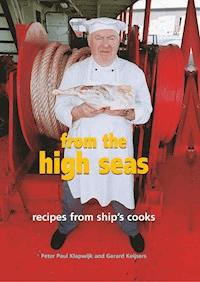
For as long as anyone can remember ports have been the focal point of many cultures. Ships from all over the world dock in their harbours. What's it like to be on board those ships though? And what does the world look like when seen from the galley? In From the High Seas one of the ship's main characters speaks: the cook. The man - sometimes woman - who keeps the crew's spirits high with his culinary skills. Forty cooks from all over the world - from China to Brasil and from South Africa to Poland - give their favourite spirit-lifting recipes in this book. The recipes are from their birthplaces and are meant for groups of ten to twenty people. Just as it would be on board. And every cook unveils the personal story behind the recipe. From the High Seas is more than a just a cookbook. Alongside each recipe, there is a 'tall story' about the sea. The cooks not only tell exciting anecdotes, they also tell about the harsh reality on board because even ship's cooks feel homesick from time to time. The interviews are by the journalist Gerard Keijsers. Photographer Peter Paul Klapwijk created colourful and unforgettable portraits of every cook on or near his ship, with an ingredient featured in their favourite recipe. Apart from the recipes and stories, From the High Seas also provides an impression of the work going on in the world's biggest port: Rotterdam. In those black and white pictures you can 'taste' the unique atmosphere of the warehouse, quay and sea. In the eighteen months since publication, 9000 copies of this book have been sold in the Netherlands. From the High Seas got excellent reviews in Dutch newspapers and magazines.
Sie lesen das E-Book in den Legimi-Apps auf:
Seitenzahl: 131
Veröffentlichungsjahr: 2018
Das E-Book (TTS) können Sie hören im Abo „Legimi Premium” in Legimi-Apps auf:
Ähnliche




















Index
TRINIDAD (Jamessmart Village)
Callaloo
ENGLAND (Plymouth)
Pastry
ICELAND (Vestmanna)
Lamb shanks
PHILIPPINES (Cavite)
Pork and chicken adobo
SYRIA (Batrah)
Knafe
RUSSIA (St. Petersburg)
Sjaslik
THE NETHERLANDS (Den Bosch)
Hutspot with rib of beef
TURKEY (Mugla)
Su boregi
JAPAN (Nagasaki)
Nagasaki noodles
SWEDEN (Stockholm)
Vegetarian balls
HUNGARY (Budapest)
Paprika’s csirke
UNITED STATES (Niceville)
Rib roast from the oven
IRAN (Abadan)
Steamed sea bass
DENMARK (Lundby)
Yellow pea soup
INDIA (Goa)
Sorpotel
CROATIA (Dubrovnik)
Cabbage with pork
TAIWAN (Kao-hsiung)
Che’s salmon
CAPE VERDE ISLANDS (San Nicolau)
Cachupa
POLAND (Szczecin)
Tartar
BRASIL (Espirito Santo)
Cearense
WALES (Denbigh)
Lamb stew
KIRIBATI (Betio)
Fishpatties with tomato sauce
GREECE (Sikiada)
Lachanodolmades
SOUTH KOREA (Mansan-si)
Sam-Gae-Tang
SURINAM (Lelydorp)
Peanut soup
INDIA (Calcutta)
Chicken tandoori
THE NETHERLANDS (Ouderkerk a/d IJssel)
Beets
PORTUGAL (Peniche)
Rabbit stew
CHINA (Shanghai)
Dumplings and braised grass carp
BELGIUM (Seraing)
Rabbit with Kriek and prunes
ITALY (Genoa)
Penne alle rose and Gnocchi al fumo di London
ENGLAND (Harwich)
Steak, kidney & ale pudding
PHILIPPINES (Pangasinan)
Grilled milkfish
LITHUANIA (Klaipeda)
Zeppelins
INDONESIA (Jakarta)
Rice rolls and chicken
MOROCCO (El Jadida)
Couscous
MYANMAR (Yangon)
Spicy fishsoup with vermicelli
NORWAY (Hidrasund)
Salted meat with potato balls
SPAIN (Sevilla)
Gazpacho
SOUTH AFRICA (Capetown)
Bobotie à la Sarah
GO TO SEA NO MORE
(Traditional)
When first I landed in Liverpool, I went upon a spree
Me money alas I spent it fast, got drunk as drunk could be
And when that me money was all gone, 'twas then I wanted more
But a man must be blind to make up his mind to go to sea once more
Once more, boys, once more, go to sea once more
But a man must be blind to make up his mind to go to sea once more
I spent the night with Angeline too drunk to roll in bed
Me watch was new and me money too, in the morning with them she fled
And as I walked the streets about, the whores they all did roar
There goes Jack Strapp, the poor sailorlad, he must go to sea once more
Once more, boys, once more, go to sea once more
There goes Jack Strapp, the poor sailorlad, he must go to sea once more
And as I walked the streets about, I met with the Rapper Brown
I asked him for to take me on and he looked at me with a frown
He said last time you was paid off with me you could no score
But I'll give you a chance and I'll take your advance and I'll send you to sea once more
Once more, boys, once more, send you to sea once more
I'll give you a chance and I'll take your advance and I'll send you to sea once more
He shipped me on board of a whaling ship bound for the arctic seas
Where the cold winds blow through the frost and snow and Jamaica rum would freeze
But worse to bear, I'd no hard weather gear for I'd spent all money on shore
'twas then that I wished that I was dead and could go to sea no more
No more, boys, no more, go to sea no more
'twas then that I wished that I was dead and could go to sea no more
So come all you bold seafaring men, who listen to me song
When you come off them long trips, I'll have you not go wrong
Take my advice, drink no strong drink, don't go sleeping with them whores
Get married instead and spend all night in bed and go to sea no more
No more, boys, no more, go to sea no more
Get married instead and spend all night in bed and go to sea no more
Preface
Many years ago, a friend of mine sailed as a mechanic on an ocean-going ship. Time and again he came home with a lot of great stories to tell. But not before he had discussed the quality of the food. Most of the times he praised the cook, but sometimes the ‘king of the kitchen’ had made a mess of things. Which ment my friend had had quite an awful journey. "There are two really important people on board", he used to say. "The captain and the cook." Good food is a good medicine against loneliness, it gives the strength to work and it creates a bond among the crew.
When Peter Paul suggested making a book about ship’s cooks who call at the port of Rotterdam, I didn’t have to think twice. Ship’s cooks deserve the honour. Moreover, I’d always wanted to go aboard real ships. Ocean-going ships, coasters, bulk-carriers, large and small; ships that come from all over the globe to Rotterdam. The first time I walked up the gangway of a containership, I felt goose pimples. I didn’t just board a ship, I entered a different country and was allowed to take a peek at the mysterious world of seadogs and free spirits.
The port of Rotterdam is in my genes. I come from a Rotterdam family with close ties to the harbour. In 1926 my great-grandfather started his business ‘H. Klapwijk’s Controlebedrijf’ on the Scheepstimmermanlaan. That made Klapwijk-Rapide the oldest independent family business in the harbour. When I was about six, my father, Hendrik Klapwijk, took me to the ‘business’ for the first time, which in those days was still on the Binnenhaven. As a small kid I could just peek over the edge of the hold of a seagoing ship. Something which I’ll never forget.
I was eighteen when I went to the harbour for the first time as a dockworker. That memory will also stick in my mind. Working in the harbour is something special. The jokes, the language, the heavy work. The sounds, the smells, the ships from faraway countries, the contact with sailors. Every ship that docks in Rotterdam is in fact a foreign country. It has its own peculiarities, which as a docker you can smell and sometimes even taste.
So owing to my genes it’s not very strange that the idea to publish a cookbook about the port of Rotterdam ocurred to me. The fact that Gerard lives in Amsterdam could have posed a problem. But then, Gerard supports Feyenoord.
On average we were on board for two hours. Altogether, we saw at least fifty-five ships from inside. Not every cook we spoke to is in this book. Either because we didn’t like their recipe well enough, or simply because we couldn’t communicate. On a Greek ship there was an Albanian cook. A chef. The man couldn’t speak a word of English, or Greek for that matter. Only Albanian. The ship’s captain told us he had been on board for two months. To everyone’s satisfaction, because he appeared to be a very good cook. But he’d never had a conversation with him. "I haven’t got a clue what it is he’s cooking for us", the captain told us. "When everybody is licking his fingers, I don’t give a damn."
Forty cooks from forty different countries have been gathered in this book. All of them have given us a recipe from their places of birth or the region they come from. Behind every dish there’s a personal story. Apart from that all cooks tell ‘tall stories’ about the sea.
Funny, weird and sometimes emotional stories. It gives the reader a realistic impression of life on board. There is a photograph of every cook with one of the ingredients from his recipe. All of them on a different part of the ship. Put together, the photographs give a complete picture of the inside and outside of the ships. Moreover, in between the recipes, stories and portraits, there is a picture-story about work in the port of Rotterdam.
Producing this book has been quite a job. Finding cooks in the port of Rotterdam isn’t very difficult. Hundreds of ships dock there every day. Tracing forty cooks from forty different nationalities is another story. Usually, crews are from low-wage countries like the Philippines, the Cape Verde Islands or India. European cooks have become quite rare. Shipowners, agencies, the Seaport police and the Port Authority (Havenbedrijf Rotterdam N.V.) have been a great help to us. They found us cooks from different countries, informed the captains and the cooks and saw to it that we could go on board. A few times we came on board without notice. Sometimes we were lucky, and traced a cook that wasn’t on our list yet.
With some exceptions, all captains and cooks were enthusiastic about our book. They loved to co-operate. And when there was time we could, no we should, join them at dinner. All those times we got the impression that the cook worked extra hard to give us a real treat. In which he succeeded with flying colours.
Another thing we had to cope with were very tight sailing-schedules. A ship is in harbour for a very short period of time. Eight hours to load and unload a containership of three hundred by forty metres is an unbelievably short time. In those hours cooks often have to stock up, cook a meal and go ashore to call home. That, despite all this, they made time for us strengthened our determination to make this into a very special book. The many positive reactions from workers in the port of Rotterdam were also stimulating. Doormen, water clerks, pilots and dockers; all of them gave us a helping hand. We want to thank everyone who has helped us to realize this book. The cooks in particular. For after all this book is especially theirs.
Gerard Keijsers Peter Paul Klapwijk
WE WANT TO THANK:
Rudolph van der Graaf, Sander Klapwijk, Klapwijk Rapide, Els Stam,
Kees Scherpenisse, Martin Postema, Sido Trovato, Eugene Ligtvoet,
Sigrid Bakker, Henk Klapwijk, Piet Krekt, Meta Gravestein,
Piet Verkaik, Louis Bömer, bemanning Smit Rhone,
bemanning Waterboot 2, Mieke Stam en Fikri Ahami,
Koninklijke Roeiers Vereniging Eendracht,
Wilkin de Boer, café De Ballentent, Dirkzwager BV,
Peter de Vette, Nathalie van Eijk, Wiegman Shipstore,
Loodswezen, Douane, Seaport police.
With the enormous amount of work of the past months it could be that the above list is incomplete. We would like to thank anyone we forgot to mention.
SHIPPING COMPANIES & AGENCIES:
Aliança
Arned Agencies
Belgische Marine
Burger & Zoon
Conga
Cross-Ocean (Cosco)
Dirkzwager Kon. Scheepsagentuur
Eimskip
Feederlines
Forest Lines Agencies
Greenpeace
Hamburg Sud
Haniel
Heerema Marine Contractors
Holland America Line
Hyundai Merchant Marine Co. Ltd.
K-Line
Ka Shipping Agencies
Kahn Scheepvaart, Jumbo
Kersten Hunik Scheepvaart Mij.
Lehnkering Logistics
Maersk Line
Marco Shipping
De Schuttergroep
Safmarine Netherlands, Saecs
Familie Stam
Smit Internationale
Stena Line
Starclippers
United Arab Shipping Company
Van Uden
Voigt & Co
Vertom
Vopak Chemical Tankers
Vopak Agencies
Wm. H. Müller & Co.
Carlton Sylvester (1949) Jamessmart Village, Trinidad
SHIP:
Smit Hunter
PARTICULARS
: tug
FLAG:
Bahama’s
CREW:
11
LENGTH:
52,52 m
Callaloo
"This is originally an African soup. Now it’s the national dish of Trinidad. We used to eat it every Sunday. Tradition, I think. I know people who don’t want to eat anything but this soup on a Sunday.”
Serves 20
1.5 kg dasheen leaves
24 okras
400 g chopped onions
1 celery
chives
9 – 12 cloves garlic
600 g squash, diced
4 hot green peppers
2 l fresh coconut milk
1 tablespoon fresh lime juice
1.6 kg crab (or shrimps)
1 teaspoon Ve Tsin
1 l water
pepper and salt to taste
You can buy dasheen leaves in Surinam shops. This vegetable is also called taro leaves, callaloo or eddo. Spinach is a good alternative.
Wash the vegetables. Remove thick veins from dasheen leaves and cut in small pieces, slice okras. Put dasheen, okras, celery, onion, garlic, crab and chives in pan with water (1 liter). Cover and bring to a boil. Stir regularly to prevent burning. Add water if necessary. Cook till dasheen and okras are tender. Then add coconut milk, whole green peppers, squash and lime juice. Add salt, pepper and Ve Tsin to taste. Cook the soup for another 10 minutes on low heat. The green peppers shouldn't dissolve and add water or coconut milk if soup thickens too much. Remove crab and peppers and stir soup rigorously using a whisk. Optional: add 200 g margarine. Bring to a boil and add crab. The soup is ready to be served.
"The captain didn’t have a clue where we were"
"I never really chose to be a cook. One day our cook became so ill that someone had to take over from him. That someone was me. I went straight from the deck into the kitchen. When the cook had recovered the crew wanted me to stay on. There was enough manpower on deck, they said. You stay in the kitchen. A natural talent? Oh well.
I’ve been sailing since 1969. I started on tugs from Trinidad. The work on deck was exciting. A lot of things happen there. I’ve witnessed some spectacular salvage operations. Once we had to come to the rescue of two Greek tankers who had collided off the coast of Trinidad. One of the tankers was on fire. We had to help putting the fire out. First with foam, later with water. When we changed from foam to water, we took some distance from the tanker. About sixty meters. All of a sudden we heard a strange noise coming from the tanker. Kee, kee, kee. We looked at each other, dived to safety and boom. A gigantic explosion. Pieces of metal as large as our dining table flew onto our deck. All fire hoses on our ship were cut through and through. There were fist-thick pieces of metal lying everywhere.
We secured the tanker with cables of almost two hundred meters and started to tug. Away from the coast. After hours of tugging, in the middle of the night, another tank on the ship exploded. The horizon was completely lit by the fire. It looked like daylight. You could see the ship sinking slowly. We cut the cables and waited at a safe distance. The tanker sank quite quickly.




