


6,99 €
Mehr erfahren.
- Herausgeber: Open Book Publishers
- Kategorie: Geisteswissenschaft
- Sprache: Englisch
Frontier Encounters presents a wide range of views on how the borders between these unique countries are enacted, produced, and crossed. It sheds light on global uncertainties: China’s search for energy resources and the employment of its huge population, Russia’s fear of Chinese migration, and the precarious economic independence of Mongolia as its neighbours negotiate to extract its plentiful resources.
Bringing together anthropologists, sociologists and economists, this timely collection of essays offers new perspectives on an area that is currently of enormous economic, strategic and geo-political relevance.
Das E-Book können Sie in Legimi-Apps oder einer beliebigen App lesen, die das folgende Format unterstützen:
Veröffentlichungsjahr: 2012
Ähnliche




















FRONTIER ENCOUNTERS
The Russia-China-Mongolia border
FRONTIER ENCOUNTERS
Knowledge and Practice at the Russian,Chinese and Mongolian Border
Edited byFranck Billé, Grégory Delaplace andCaroline Humphrey
http://www.openbookpublishers.com
© 2012 Franck Billé, Grégory Delaplace and Caroline Humphrey (contributors retain copyright of their work).
Version 1.1. Minor edits made, July 2013.
This book is licensed under a Creative Commons Attribution 3.0 Unported Licence. This license allows you to share, copy, distribute and transmit the work; to adapt the work and to make commercial use of the work providing attribution is made to the authors (but not in any way that suggests that they endorse you or your use of the work). Attribution should include the following information:
Billé, Franck, Delaplace, Grégory and Humphrey, Caroline (eds.) Frontier Encounters: Knowledge and Practice at the Russian, Chinese and Mongolian Border. Cambridge, UK: Open Book Publishers, 2012. DOI: 10.11647/OBP.0026
Further details about CC BY licenses are available at:
http://creativecommons.org/licenses/by/3.0/
Digital material and resources associated with this volume are available from our website at:
http://www.openbookpublishers.com/isbn/9781906924874
ISBN Hardback: 978-1-906924-88-1
ISBN Paperback: 978-1-906924-87-4
ISBN Digital (PDF): 978-1-906924-89-8
ISBN Digital ebook (epub version): 978-1-906924-90-4
ISBN Digital ebook (mobi version): 978-1-906924-91-1
DOI: 10.11647/OBP.0026
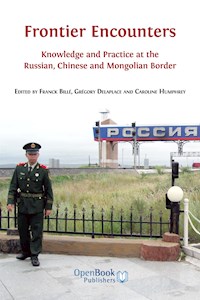
Cover image: Chinese frontier guard at the Manzhouli-Zabaikalsk border by John S.Y. Lee http://www.flickr.com/photos/38760691@N03/
All paper used by Open Book Publishers is SFI (Sustainable Forestry Initiative), and PEFC (Programme for the Endorsement of Forest Certification Schemes) Certified.
Printed in the United Kingdom and United States byLightning Source for Open Book Publishers
Contents
Contributors
1.A Slightly Complicated Door: The Ethnography and Conceptualisation of North Asian BordersGrégory Delaplace
2.On Ideas of the Border in the Russian and 19 Chinese Social ImaginariesFranck Billé
3.Rethinking Borders in Empire and Nation at the Foot of the Willow PalisadeUradyn E. Bulag
4.Concepts of “Russia” and their Relation to the Border with ChinaCaroline Humphrey
5.Chinese Migrants and Anti-Chinese Sentiments in Russian SocietyViktor Dyatlov
6.The Case of the Amur as a Cross-Border Zone of IllegalityNatalia Ryzhova
7.Prostitution and the Transformation of the Chinese Trading Town of EreenGaëlle Lacaze
8.Ritual, Memory and the Buriad Diaspora Notion of HomeSayana Namsaraeva
9.Politicisation of Quasi-Indigenousness on the Russo-Chinese FrontierIvan Peshkov
10.People of the Border: The Destiny of the Shenehen BuryatsMarina Baldano
11.The Persistence of the Nation-State at the Chinese-Kazakh BorderRoss Anthony
12.Neighbours and their Ruins: Remembering Foreign Presences in MongoliaGrégory Delaplace
Appendix 1: Border-Crossing Infrastructure: The Case of the Russian-Mongolian BorderValentin Batomunkuev
Appendix 2: Maps
Bibliography of Works Cited
Index
Contributors
Franck Billé is a post-doctoral researcher at the Department of Social Anthropology, and member of the Mongolia and Inner Asia Studies Unit, University of Cambridge. He is the coordinator of an ESRC-funded project (2012-2015) entitled ‘Where Rising Powers Meet: Russia and China at their northeast Asian border’. He previously carried out research in Mongolia where he investigated the prevalence of anti-Chinese sentiments. His manuscript Spectral Presences: Anxiety, Excess and Anti-Chinese Speech in Postsocialist Mongolia is currently under review, and his second book project, Phantom Pains: National Loss, Maps and Bodily Integrity, is in progress. Franck Billé can be contacted at [email protected].
Grégory Delaplace is a social anthropologist, working as a lecturer at the Université Paris Ouest Nanterre. His most recent research concerned the political dimension of the invisible in Mongolia today (or the invisible dimension of politics), whereby ghosts, or spirits, are led to play a role in the postsocialist nation building process. His publications include L’invention des morts. Sépultures, fantômes et photographie en Mongolie contemporaine (2009), and Parasitic Chinese, Vengeful Russians: Strangers, Ghosts and Reciprocity in Mongolia (2012). Grégory Delaplace can be contacted at [email protected].
Caroline Humphrey is an anthropologist based at the University of Cambridge who has worked in Russia, Mongolia, China, India, Nepal and Ukraine. She has researched a wide range of themes including Soviet and post-Soviet provincial economy and society; Buryat and Daur shamanism; Jain religion and ritual; trade and barter in Nepal; environment and the pastoral economy in Mongolia and the history and contemporary situation of Buddhism, especially in Inner Mongolia. Her recent research has concerned urban transformations in post-Socialist cities. Caroline Humphrey can be contacted at [email protected].
Ross Anthony is in the final stages of a PhD in social anthropology at the University of Cambridge and is a member of the Mongolia and Inner Asia Studies Unit, Cambridge. His recent work focuses on issues of urbanisation and ethno-politics in the Xinjiang Uyghur Autonomous Region. He currently holds a research fellow position at the Centre for Chinese Studies at the University of Stellenbosch in South Africa.
Marina N. Baldano is the head of the Department of History, Ethnology and Sociology, Institute of Mongolian, Buddhist and Tibetan Studies at the Siberian Branch of the Russian Academy of Sciences (Ulan-Ude, Russia). Her research analyses the changes brought by modernisation in Inner Asia, nation-building, panmongolism and cross-border migrations. She is the coordinator of a number of research projects including “Civilizational Dynamics and Modernization Processes in the Baikal Asia” and “Border, Transborder and Migrants in Central Asia: Strategy and Practices of Mutual Adaptation”. She can be contacted at [email protected].
Valentin Sergeevich Batomunkuev is a researcher at Baikal Institute of Nature Management SB RAS, Laboratory of Nature Management Economics. His current scientific work investigates the use of mineral resources, desertification and trans-boundary issues between Buryatia and Mongolia. Previously he carried out research on the management of subsurface resources and the development of transport crossing in the border territory between the two countries. He can be contacted at [email protected].
Uradyn E. Bulag is a reader in social anthropology at the University of Cambridge. His interests span East Asia and Inner Asia, especially China and Mongolia, nationalism and ethnic conflict, cosmopolitics, diplomacy, and statecraft. His works include Nationalism and Hybridity in Mongolia (1998), The Mongols at China’s Edge: History and the Politics of National Unity (2002), The Mongolia-Tibet Interface: Opening New Research Terrains in Inner Asia (co-editor, 2007), and Collaborative Nationalism: The Politics of Friendship on China’s Mongolian Frontier (2010), which has won the International Convention of Asian Scholars 2011 book prize. He can be contacted at [email protected].
Victor I. Dyatlov is a professor at the Faculty of World History and International Relations of Irkutsk State University, Russia, and Director of the Research Center on Inner Asia (Irkutsk). He published widely on cross-border migrations in modern and late imperial Russia, on the role of ethnic migrations in the formation of settlers communities in the East of Russia and on the comparative study of diasporas. He can be contacted at [email protected].
Gaëlle Lacaze is an assistant professor at the Department of Ethnology of the University of Strasbourg. Her research focuses on the anthropology of the body relating to Mongolian people and Turkic populations, including Kazakhs. Her current research investigates patterns of international migrations of Mongolian citizens. She is the author of Le corps mongol: techniques et conceptions nomades du corps (2012), the editor of “Migrations in Central Asia and Caucasus” (Revue europeenne des migrations internationales, 2010–13) and a number of articles in the field. She can be contacted at [email protected].
Sayana Namsaraeva is a Research Associate in the Division of Social Anthropology, and member of the Mongolia and Inner Asia Studies Unit, University of Cambridge. During her recent post-doctoral research at the Max Planck Institute for Social Anthropology she conducted extensive fieldwork on border regions of the Russian, Chinese and Mongolian territories. Her current project focuses on local society that straddles the Sino-Russian border in the twin cities of Zabaikal’sk and Manzhouli. She has published a number of articles in Russian, English and Chinese languages and is currently working on her book on the Qing frontier administration in Inner Asia. She can be contacted at [email protected].
Ivan Peshkov is an assistant professor at the Institute of Eastern Studies at the Adam Mickiewicz University in Poznan, Poland. His current research focuses on the political dimension of quasi-indigenousness on the Russian-Chinese frontier. He has carried out research in the Chinese, Russian, and Mongolian border triangle and investigated the main economic and historical processes that characterize this area. He can be contacted at [email protected].
Natalia Ryzhova is the director of the Amur Laboratory for Economic and Social Studies at the Economic Research Institute of the Far Eastern Branch of the Russian Academy of Science. She specialises in regional economics and economic sociology with particular focus on informal economics. In recent years she has focused on the interactions between Russian-Chinese frontier people, firms and authorities and on the issue of “border openness” in China. She is a member of the Cambridge Mongolia and Inner Asia Studies Unit’s Network for the study of the border zones between China, Russia and eastern Mongolia. Her publications include Trans-border Exchange between Russia and China: The Case of Blagoveshchensk and Heihe (with G. Ioffe, 2009); The Case of the Twin City of Blagoveshensk-Heihe (2008) and The Political Economy of Trade Openness Reform: Consequences of Reform for Russian Border Regions (in Russian, 2011). She can be contacted at [email protected].
1. A Slightly Complicated Door: The Ethnography and Conceptualisation of North Asian Borders
Grégory Delaplace
© Grégory Delaplace, CC BYDOI: 10.11647/OBP.0026.01This book presents a collection of ethnographic essays on the border region, in North Asia, where the territories of China, Russia and Mongolia meet across the contrasted landscapes of the Siberian taiga, in the northwest, and the Manchurian plains, in the south and the east.1 The aim of the present volume is two-fold. On the one hand, it seeks to provide fresh material to a field of research still heavily dominated by studies of the United States and Mexico border. On the other, it intends to challenge a tendency in anthropological research to frame analysis in terms of “culture” and “identity” when dealing with issues relating to social life in the borderland areas. Drawing on the material provided throughout the eleven chapters of this volume, this introduction proposes an alternative, and underlines the benefits of a technological approach to the study of borders.
International borders have attracted an increasing amount of interest in the social sciences over the past three decades, resulting in the creation of research centres (e.g. the Centre for International Borders in Belfast or the Nijmegen Centre for Border Research in the Netherlands), academic networks (e.g. the Association for Border Studies, which edits the Journal of Borderlands Studies), and in countless publications in the fields of Geography, Political Sciences, Economy, and History, to name only a few (for a useful yet now outdated overview, see Donnan and Wilson 1999, chapter 3). While it has not been a trailblazer in this domain, Social and Cultural Anthropology has not lagged behind either. Although the anthropology of borders has not yet been recognised as one of the discipline’s “big topics” (it is rarely mentioned in specialised encyclopedias, e.g. Barnard and Spencer 2010), anthropologists have contributed to this field of research in numerous and important ways. Highlighting the processes by which borders are “socially” or “culturally” constructed, some have insisted on the growing number of challenges posed by globalisation to the notion (e.g. Migdal 2004), while others have emphasised the enduring significance of borders at a local level in a context of global political and economic transformations (e.g. Donnan and Wilson 1998; Martinez 1994).
Overall, and at least since Renato Rosaldo’s early and seminal contribution to the field (1988), the idea has been that the specific expertise anthropologists could provide in relation to borders concerned “culture”, “identity” or “ethnicity” in borderland areas. Is there an “identity” specific to the “borderlands milieu” (Martinez 1994: 10), stemming from the simultaneous distance from political centres and the daily immersion in transnational flows that characterises these areas? How is “ethnicity” used as a border marker between neighbouring peoples, in borderlands (Vila 2005) or elsewhere (Bretell 2007)? What kind of “culture” does the presence of an international border produce, and what kind of cultural practices, in turn, constitute borders between territories and people? These, roughly, have been the questions on which the anthropology of borders has thrived.
One could hardly fail to notice, however, that a particular subfield of anthropology has remained remarkably absent from this debate: material culture, or technology, that is the study of techniques spearheaded by Mauss’ seminal essay (1979 [1934]), “the particular domain of human activity immediately aimed at action on matter” (Lemmonier 2010: 684–85). Of course, recent technological developments in border control processes, in particular the introduction of biometric identification devices, have not escaped the researchers’ attention: philosophers of sciences, jurists, and criminologists have provided valuable expertise on the implications of this technology in terms of conceptions of the body, conditions of international migrations and notions of citizenship (van der Ploeg 1999; Pickering and Weber 2006; Dijstelbloem and Meijer 2011).
Nevertheless, when scholars have considered the question of technology in relation to the border, they have limited themselves to the study of how it was involved in the process of crossing a particular border (often the one delimitating Schengen space). The concern of these authors lies in the way technology is becoming constitutive of European borders, indeed in ways that cannot but call to mind Agamben’s famous warning on exceptions becoming the rule.2 While these developments are certainly cause for concern, and one can only encourage research into the political implications of borders’ technological turn, it seems possible to conceive of a more comprehensive understanding of technology in relation to the border.
Lesen Sie weiter in der vollständigen Ausgabe!
Lesen Sie weiter in der vollständigen Ausgabe!
Lesen Sie weiter in der vollständigen Ausgabe!
Lesen Sie weiter in der vollständigen Ausgabe!
Lesen Sie weiter in der vollständigen Ausgabe!
Lesen Sie weiter in der vollständigen Ausgabe!
Lesen Sie weiter in der vollständigen Ausgabe!
Lesen Sie weiter in der vollständigen Ausgabe!
Lesen Sie weiter in der vollständigen Ausgabe!
Lesen Sie weiter in der vollständigen Ausgabe!
Lesen Sie weiter in der vollständigen Ausgabe!
Lesen Sie weiter in der vollständigen Ausgabe!
Lesen Sie weiter in der vollständigen Ausgabe!
Lesen Sie weiter in der vollständigen Ausgabe!
Lesen Sie weiter in der vollständigen Ausgabe!
Lesen Sie weiter in der vollständigen Ausgabe!
Lesen Sie weiter in der vollständigen Ausgabe!




